



Laurence Yap
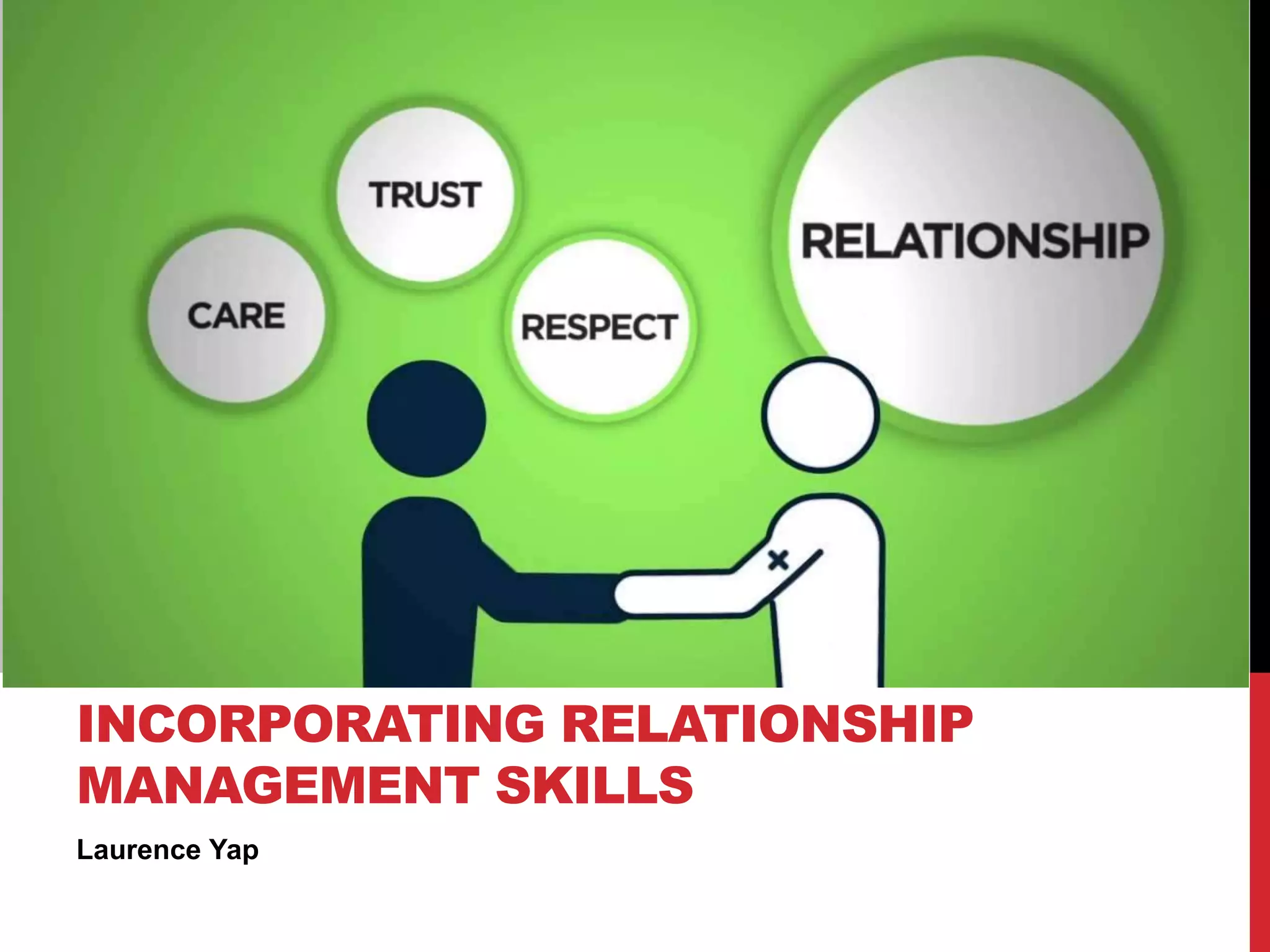
INCORPORATING RELATIONSHIP
MANAGEMENT SKILLS
CONTENTS
1. Background, Research Findings & Scope
2. Asian Mindset: Harmony and Respect Elders
3. Engagement Model
5. Method of Leadership Development
6. Results
7. Take Away
BACKGROUND
RELATIONSHIP
MANAGEMENT SKILLS
How many skills do you have.
Who are your Role model?
How was your relationship with your pass bosses?
1. BACKGROUND
Definition
Employee Relationship Management
(ERM) is a process that companies use
to effectively manage all interactions
with employees, ultimately to achieve
the goals of the organization.
BACKGROUND
The human resources department can
play a critical role in this process, both in
terms of training and coaching
managers and executives on how to
effectively establish and nurture
relationships with employees
MANAGERS’ ROLES
Enable managers to
communicate with their teams,
align employees with the overall goals
share information
build a common understanding
motivate employees to work extra
miles
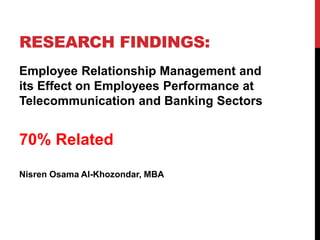
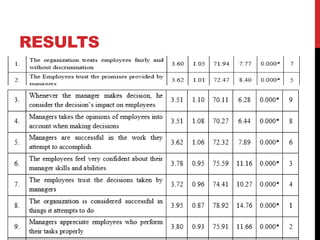
RESEARCH FINDINGS:
Employee Relationship Management and
its Effect on Employees Performance at
Telecommunication and Banking Sectors
70% Related
Nisren Osama Al-Khozondar, MBA
RESULTS
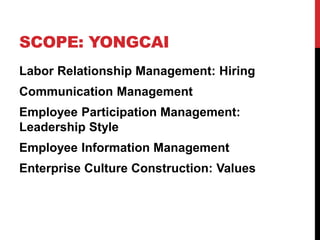
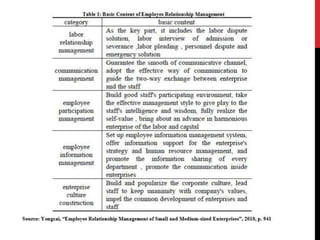
SCOPE: YONGCAI
Labor Relationship Management: Hiring
Communication Management
Employee Participation Management:
Leadership Style
Employee Information Management
Enterprise Culture Construction: Values
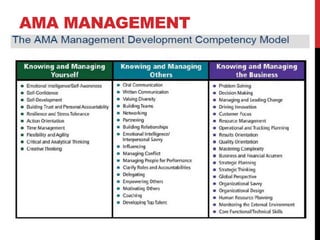
AMA MANAGEMENT
COMPETENCIES
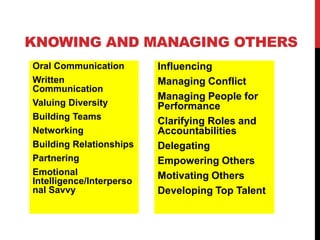
KNOWING AND MANAGING OTHERS
Oral Communication
Written
Communication
Valuing Diversity
Building Teams
Networking
Building Relationships
Partnering
Emotional
Intelligence/Interperso
nal Savvy
Influencing
Managing Conflict
Managing People for
Performance
Clarifying Roles and
Accountabilities
Delegating
Empowering Others
Motivating Others
Developing Top Talent
ASIAN MINDSET
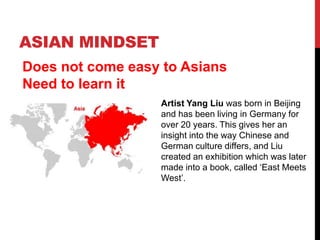
ASIAN MINDSET
Does not come easy to Asians
Need to learn it
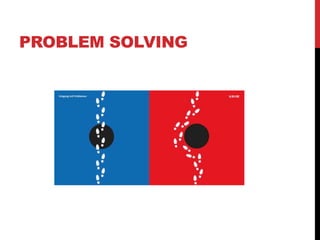
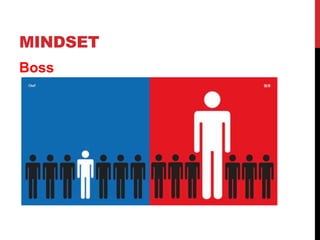
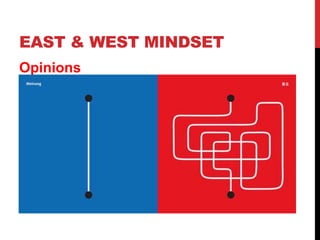
Artist Yang Liu was born in Beijing
and has been living in Germany for
over 20 years. This gives her an
insight into the way Chinese and
German culture differs, and Liu
created an exhibition which was later
made into a book, called ‘East Meets
West’.
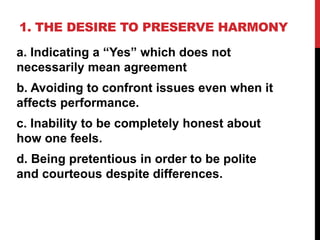
1. THE DESIRE TO PRESERVE HARMONY
a. Indicating a “Yes” which does not
necessarily mean agreement
b. Avoiding to confront issues even when it
affects performance.
c. Inability to be completely honest about
how one feels.
d. Being pretentious in order to be polite
and courteous despite differences.
TRUTH
PROBLEM SOLVING
MINDSET
Boss
2. RESPECTING THE ELDERS TO
PRESERVE ORDER AND HIERARCHY
a. Holding back personal opinions when
ideas differ.
b. Avoiding challenging the elders even
when they disagree.
c. Giving the benefit of doubt to the elders.
EAST & WEST MINDSET
Opinions
SENIORITY
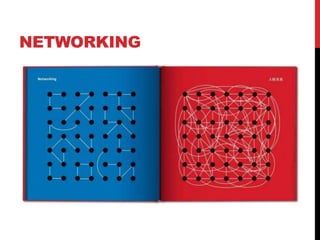
NETWORKING
ENGAGEMENT MODEL TO BUILD
RELATIONSHIPS
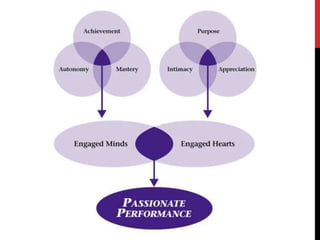
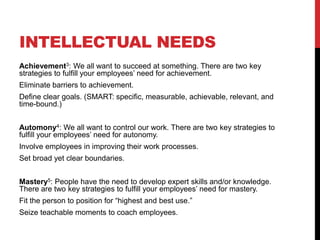
INTELLECTUAL NEEDS
Achievement3: We all want to succeed at something. There are two key
strategies to fulfill your employees’ need for achievement.
Eliminate barriers to achievement.
Define clear goals. (SMART: specific, measurable, achievable, relevant, and
time-bound.)
Automony4: We all want to control our work. There are two key strategies to
fulfill your employees’ need for autonomy.
Involve employees in improving their work processes.
Set broad yet clear boundaries.
Mastery5: People have the need to develop expert skills and/or knowledge.
There are two key strategies to fulfill your employees’ need for mastery.
Fit the person to position for “highest and best use.”
Seize teachable moments to coach employees.
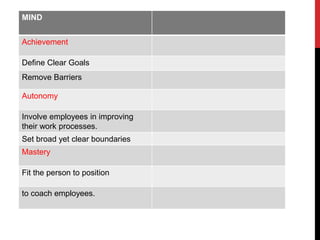
MIND
Achievement
Define Clear Goals
Remove Barriers
Autonomy
Involve employees in improving
their work processes.
Set broad yet clear boundaries
Mastery
Fit the person to position
to coach employees.
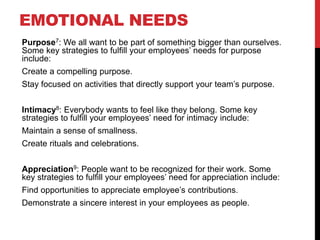
EMOTIONAL NEEDS
Purpose7: We all want to be part of something bigger than ourselves.
Some key strategies to fulfill your employees’ needs for purpose
include:
Create a compelling purpose.
Stay focused on activities that directly support your team’s purpose.
Intimacy8: Everybody wants to feel like they belong. Some key
strategies to fulfill your employees’ need for intimacy include:
Maintain a sense of smallness.
Create rituals and celebrations.
Appreciation9: People want to be recognized for their work. Some
key strategies to fulfill your employees’ need for appreciation include:
Find opportunities to appreciate employee’s contributions.
Demonstrate a sincere interest in your employees as people.
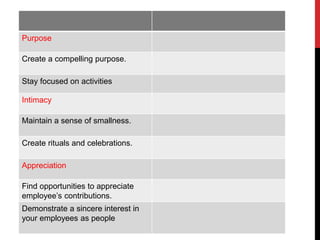
Purpose
Create a compelling purpose.
Stay focused on activities
Intimacy
Maintain a sense of smallness.
Create rituals and celebrations.
Appreciation
Find opportunities to appreciate
employee’s contributions.
Demonstrate a sincere interest in
your employees as people
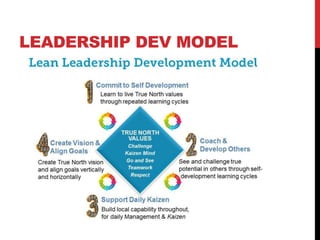
LEADERSHIP DEVELOPMENT MODEL TO
BUILD RELATIONSHIPS
LEADERSHIP DEV MODEL
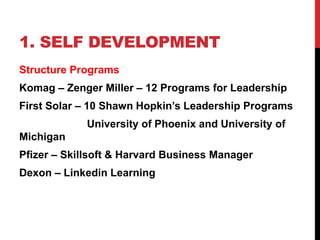
1. SELF DEVELOPMENT
Structure Programs
Komag – Zenger Miller – 12 Programs for Leadership
First Solar – 10 Shawn Hopkin’s Leadership Programs
University of Phoenix and University of
Michigan
Pfizer – Skillsoft & Harvard Business Manager
Dexon – Linkedin Learning
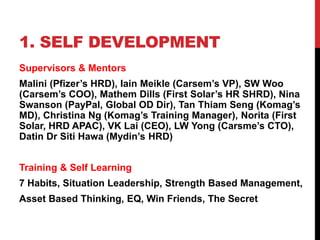
1. SELF DEVELOPMENT
Supervisors & Mentors
Malini (Pfizer’s HRD), Iain Meikle (Carsem’s VP), SW Woo
(Carsem’s COO), Mathem Dills (First Solar’s HR SHRD), Nina
Swanson (PayPal, Global OD Dir), Tan Thiam Seng (Komag’s
MD), Christina Ng (Komag’s Training Manager), Norita (First
Solar, HRD APAC), VK Lai (CEO), LW Yong (Carsme’s CTO),
Datin Dr Siti Hawa (Mydin’s HRD)
Training & Self Learning
7 Habits, Situation Leadership, Strength Based Management,
Asset Based Thinking, EQ, Win Friends, The Secret
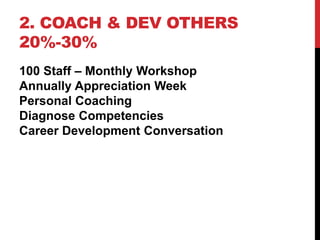
2. COACH & DEV OTHERS
20%-30%
100 Staff – Monthly Workshop
Annually Appreciation Week
Personal Coaching
Diagnose Competencies
Career Development Conversation
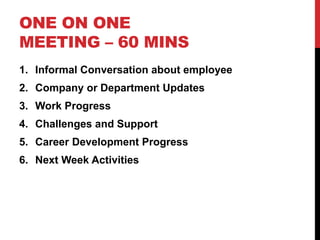
ONE ON ONE
MEETING – 60 MINS
1. Informal Conversation about employee
2. Company or Department Updates
3. Work Progress
4. Challenges and Support
5. Career Development Progress
6. Next Week Activities
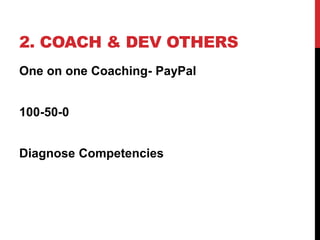
2. COACH & DEV OTHERS
One on one Coaching- PayPal
100-50-0
Diagnose Competencies
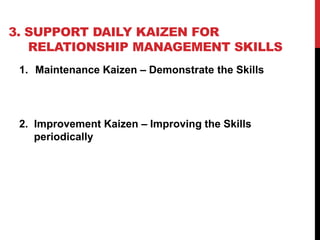
3. SUPPORT DAILY KAIZEN FOR
RELATIONSHIP MANAGEMENT SKILLS
1. Maintenance Kaizen – Demonstrate the Skills
2. Improvement Kaizen – Improving the Skills
periodically
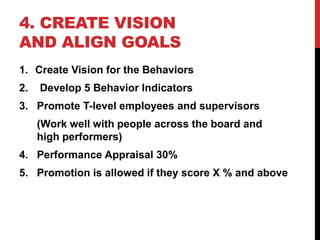
4. CREATE VISION
AND ALIGN GOALS
1. Create Vision for the Behaviors
2. Develop 5 Behavior Indicators
3. Promote T-level employees and supervisors
(Work well with people across the board and
high performers)
4. Performance Appraisal 30%
5. Promotion is allowed if they score X % and above
START
Where do you start? There are five steps you will need to
take to ignite Passionate Performance.12
Engaging leaders start with themselves
Assess your leadership skills and identify areas of opportunity
Select one opportunity to work on
Turn the opportunity into a habit by continually focusing on it
Identify a new opportunity and build another habit.
QUESTIONS

Incorporting relationship management skills

  • 1.
  • 2.
    CONTENTS 1. Background, ResearchFindings & Scope 2. Asian Mindset: Harmony and Respect Elders 3. Engagement Model 5. Method of Leadership Development 6. Results 7. Take Away
  • 3.
  • 4.
    RELATIONSHIP MANAGEMENT SKILLS How manyskills do you have. Who are your Role model? How was your relationship with your pass bosses?
  • 5.
    1. BACKGROUND Definition Employee RelationshipManagement (ERM) is a process that companies use to effectively manage all interactions with employees, ultimately to achieve the goals of the organization.
  • 6.
    BACKGROUND The human resourcesdepartment can play a critical role in this process, both in terms of training and coaching managers and executives on how to effectively establish and nurture relationships with employees
  • 7.
    MANAGERS’ ROLES Enable managersto communicate with their teams, align employees with the overall goals share information build a common understanding motivate employees to work extra miles
  • 8.
    RESEARCH FINDINGS: Employee RelationshipManagement and its Effect on Employees Performance at Telecommunication and Banking Sectors 70% Related Nisren Osama Al-Khozondar, MBA
  • 9.
  • 10.
    SCOPE: YONGCAI Labor RelationshipManagement: Hiring Communication Management Employee Participation Management: Leadership Style Employee Information Management Enterprise Culture Construction: Values
  • 12.
  • 13.
    KNOWING AND MANAGINGOTHERS Oral Communication Written Communication Valuing Diversity Building Teams Networking Building Relationships Partnering Emotional Intelligence/Interperso nal Savvy Influencing Managing Conflict Managing People for Performance Clarifying Roles and Accountabilities Delegating Empowering Others Motivating Others Developing Top Talent
  • 14.
  • 15.
    ASIAN MINDSET Does notcome easy to Asians Need to learn it Artist Yang Liu was born in Beijing and has been living in Germany for over 20 years. This gives her an insight into the way Chinese and German culture differs, and Liu created an exhibition which was later made into a book, called ‘East Meets West’.
  • 16.
    1. THE DESIRETO PRESERVE HARMONY a. Indicating a “Yes” which does not necessarily mean agreement b. Avoiding to confront issues even when it affects performance. c. Inability to be completely honest about how one feels. d. Being pretentious in order to be polite and courteous despite differences.
  • 17.
  • 18.
  • 19.
  • 20.
    2. RESPECTING THEELDERS TO PRESERVE ORDER AND HIERARCHY a. Holding back personal opinions when ideas differ. b. Avoiding challenging the elders even when they disagree. c. Giving the benefit of doubt to the elders.
  • 21.
    EAST & WESTMINDSET Opinions
  • 22.
  • 23.
  • 24.
    ENGAGEMENT MODEL TOBUILD RELATIONSHIPS
  • 26.
    INTELLECTUAL NEEDS Achievement3: Weall want to succeed at something. There are two key strategies to fulfill your employees’ need for achievement. Eliminate barriers to achievement. Define clear goals. (SMART: specific, measurable, achievable, relevant, and time-bound.) Automony4: We all want to control our work. There are two key strategies to fulfill your employees’ need for autonomy. Involve employees in improving their work processes. Set broad yet clear boundaries. Mastery5: People have the need to develop expert skills and/or knowledge. There are two key strategies to fulfill your employees’ need for mastery. Fit the person to position for “highest and best use.” Seize teachable moments to coach employees.
  • 27.
    MIND Achievement Define Clear Goals RemoveBarriers Autonomy Involve employees in improving their work processes. Set broad yet clear boundaries Mastery Fit the person to position to coach employees.
  • 28.
    EMOTIONAL NEEDS Purpose7: Weall want to be part of something bigger than ourselves. Some key strategies to fulfill your employees’ needs for purpose include: Create a compelling purpose. Stay focused on activities that directly support your team’s purpose. Intimacy8: Everybody wants to feel like they belong. Some key strategies to fulfill your employees’ need for intimacy include: Maintain a sense of smallness. Create rituals and celebrations. Appreciation9: People want to be recognized for their work. Some key strategies to fulfill your employees’ need for appreciation include: Find opportunities to appreciate employee’s contributions. Demonstrate a sincere interest in your employees as people.
  • 29.
    Purpose Create a compellingpurpose. Stay focused on activities Intimacy Maintain a sense of smallness. Create rituals and celebrations. Appreciation Find opportunities to appreciate employee’s contributions. Demonstrate a sincere interest in your employees as people
  • 30.
    LEADERSHIP DEVELOPMENT MODELTO BUILD RELATIONSHIPS
  • 31.
  • 32.
    1. SELF DEVELOPMENT StructurePrograms Komag – Zenger Miller – 12 Programs for Leadership First Solar – 10 Shawn Hopkin’s Leadership Programs University of Phoenix and University of Michigan Pfizer – Skillsoft & Harvard Business Manager Dexon – Linkedin Learning
  • 33.
    1. SELF DEVELOPMENT Supervisors& Mentors Malini (Pfizer’s HRD), Iain Meikle (Carsem’s VP), SW Woo (Carsem’s COO), Mathem Dills (First Solar’s HR SHRD), Nina Swanson (PayPal, Global OD Dir), Tan Thiam Seng (Komag’s MD), Christina Ng (Komag’s Training Manager), Norita (First Solar, HRD APAC), VK Lai (CEO), LW Yong (Carsme’s CTO), Datin Dr Siti Hawa (Mydin’s HRD) Training & Self Learning 7 Habits, Situation Leadership, Strength Based Management, Asset Based Thinking, EQ, Win Friends, The Secret
  • 34.
    2. COACH &DEV OTHERS 20%-30% 100 Staff – Monthly Workshop Annually Appreciation Week Personal Coaching Diagnose Competencies Career Development Conversation
  • 35.
    ONE ON ONE MEETING– 60 MINS 1. Informal Conversation about employee 2. Company or Department Updates 3. Work Progress 4. Challenges and Support 5. Career Development Progress 6. Next Week Activities
  • 36.
    2. COACH &DEV OTHERS One on one Coaching- PayPal 100-50-0 Diagnose Competencies
  • 37.
    3. SUPPORT DAILYKAIZEN FOR RELATIONSHIP MANAGEMENT SKILLS 1. Maintenance Kaizen – Demonstrate the Skills 2. Improvement Kaizen – Improving the Skills periodically
  • 38.
    4. CREATE VISION ANDALIGN GOALS 1. Create Vision for the Behaviors 2. Develop 5 Behavior Indicators 3. Promote T-level employees and supervisors (Work well with people across the board and high performers) 4. Performance Appraisal 30% 5. Promotion is allowed if they score X % and above
  • 39.
    START Where do youstart? There are five steps you will need to take to ignite Passionate Performance.12 Engaging leaders start with themselves Assess your leadership skills and identify areas of opportunity Select one opportunity to work on Turn the opportunity into a habit by continually focusing on it Identify a new opportunity and build another habit.
  • 40.