Improving your
leadership
communication
“A CLASSIC IS SOMETHING EVERYONE WANTS TO HAVE READ, BUT NO ONE WANTS TO READ.”
~ MARK TWAIN
BOHN’S COROLLARY: COMMUNICATION IS SOMETHING EVERY ORGANIZATION WANTS, BUT FEW
WANT TO DO.
~ DR. JIM BOHN
How effective is
your leadership
communication
right now?
Why do Leaders perceive
communication is happening?
Your opportunity to fill in the blank …
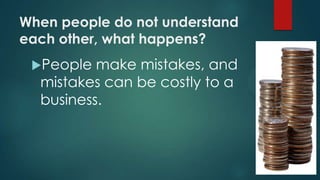
When people do not understand
each other, what happens?
People make mistakes, and
mistakes can be costly to a
business.
When people do not understand
each other, what happens?
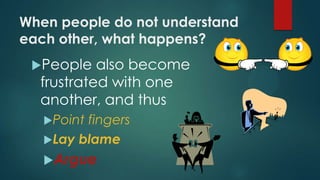
People also become
frustrated with one
another, and thus
Point fingers
Lay blame
Argue
When people do not understand
each other, what happens?
Ineffective communication causes
rumors and gossip.
Ineffective communications ultimately
lead to fear through uncertainty.
Ineffective communication stifles energy
and leads to low productivity - more time
spent on people struggles than output.
Costly rework!
When people do not understand
each other, what happens?
Ineffective communication causes
rumors and gossip.
Ineffective communications ultimately
lead to fear through uncertainty.
Ineffective communication stifles energy
and leads to low productivity - more time
spent on people struggles than output.
Costly rework!
When people do not understand
each other, what happens?
Ineffective communication causes
rumors and gossip.
Ineffective communications ultimately
lead to fear through uncertainty.
Ineffective communication stifles energy
and leads to low productivity - more time
spent on people struggles than output.
Costly rework!
When people do not understand
each other, what happens?
Ineffective communication causes
rumors and gossip.
Ineffective communications ultimately
lead to fear through uncertainty.
Ineffective communication stifles energy
and leads to low productivity - more time
spent on people struggles than output.
Costly rework!
When people do not understand
each other, what happens?
Ineffective communication causes
rumors and gossip.
Ineffective communications ultimately
lead to fear through uncertainty.
Ineffective communication stifles energy
and leads to low productivity - more time
spent on people struggles than output.
Costly rework!
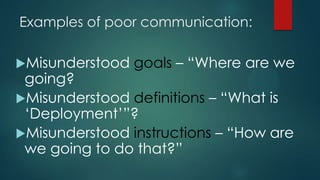
Examples of poor communication:
Misunderstood goals – “Where are we
going?
Misunderstood definitions – “What is
„Deployment‟”?
Misunderstood instructions – “How are
we going to do that?”
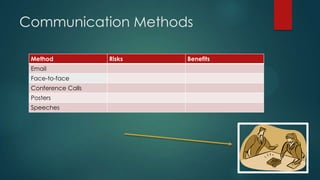
Communication Methods
Method Risks Benefits
Email
Face-to-face
Conference Calls
Posters
Speeches
Dangerous assumption …
Executives are especially
vulnerable to the belief that their
words and concepts will be
carried out, largely because of
positional power in their
organizations.
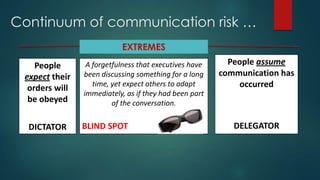
People
expect their
orders will
be obeyed
DICTATOR
People assume
communication has
occurred
DELEGATOR
A forgetfulness that executives have
been discussing something for a long
time, yet expect others to adapt
immediately, as if they had been part
of the conversation.
BLIND SPOT
Continuum of communication risk …
EXTREMES
Barriers to good communication
and why?
 Speed of
processing
 Sound bytes
 Lack of patience
 Clarity of sender
 Checking for
reception
CHARACTERISTICS
OF THE
COMMUNICATOR
Barriers to good communication
and why?
Timing of
communication
Physical space of
communication
LOGISITICS OF
COMMUNICATION
Barriers to good communication
and why?
Highest needs for
communication
often occur at
the lowest point
in the project.
THE
CRITICAL
MOMENT
Dropping the ball in communication
People get reassigned – without
a successor!
People get
bored, tired, disinterested –
especially on conference calls.
You can always slow me
down, but it's tough to speed me
up.
What‟s goin‟ on?
"Need to know basis" is so
passé.
What‟s goin‟ on?
All communications provides a
context for decision making, allow
people to sort things out among
competing priorities.
“What do I need to do to support the
organization?”
What‟s goin‟ on?
All communication provides a context for
prioritization.
“What do I need to do to support the
organization?”
Danger if this isn’t done.
Reasons it isn't done.
As a leader, you need to develop effective
ways for getting it done.
What‟s goin‟ on?
People will fill
__ the blanks.
SPECIFIC COMMUNICATION
ACTIONS
Coordination of activities - getting
people together takes
effort, clear focus, and clear
agendas.
1
SPECIFIC COMMUNICATION
ACTIONS
Knowledge of the future –
“People expect leaders in this
business to know where
they‟re going.”
2
SPECIFIC COMMUNICATION
ACTIONS
Knowledge of roles
(who‟s on first?)
3
SPECIFIC COMMUNICATION
ACTIONS
Knowledge of what has
happened? So people can feel
a sense of efficacy, movement
and momentum.
4
SPECIFIC COMMUNICATION
ACTIONS
Knowledge of victories - To allow
the emotional sense of
achievement and build efficacy
for the next project.
5
SPECIFIC COMMUNICATION
ACTIONS
 Coordination of activities - getting people together takes
effort, clear focus, clear agendas.
 Knowledge of the future – “People here expect leaders in
this business to know where they‟re going.”
 Knowledge of roles (who‟s on first?)
 Knowledge of what has happened? So people can feel a
sense of efficacy, movement and momentum.
 Knowledge of victories - To allow the emotional sense of
achievement and build efficacy for the next project.
How effective is
your leadership
communication
right now?
Pro/Axios
 We offer plainspoken guidance for
those who do the work.
 Check out the Rapid Diagnostic @ www.ProAxios.com
 info@proaxios.com
 651-302-1574
 Minneapolis, MN, USA
9/17/2013
Organizational Insight Leading to
Organizational Transformation

Improving Your Leadership Communication

  • 1.
    Improving your leadership communication “A CLASSICIS SOMETHING EVERYONE WANTS TO HAVE READ, BUT NO ONE WANTS TO READ.” ~ MARK TWAIN BOHN’S COROLLARY: COMMUNICATION IS SOMETHING EVERY ORGANIZATION WANTS, BUT FEW WANT TO DO. ~ DR. JIM BOHN
  • 2.
    How effective is yourleadership communication right now?
  • 3.
    Why do Leadersperceive communication is happening? Your opportunity to fill in the blank …
  • 4.
    When people donot understand each other, what happens? People make mistakes, and mistakes can be costly to a business.
  • 5.
    When people donot understand each other, what happens? People also become frustrated with one another, and thus Point fingers Lay blame Argue
  • 6.
    When people donot understand each other, what happens? Ineffective communication causes rumors and gossip. Ineffective communications ultimately lead to fear through uncertainty. Ineffective communication stifles energy and leads to low productivity - more time spent on people struggles than output. Costly rework!
  • 7.
    When people donot understand each other, what happens? Ineffective communication causes rumors and gossip. Ineffective communications ultimately lead to fear through uncertainty. Ineffective communication stifles energy and leads to low productivity - more time spent on people struggles than output. Costly rework!
  • 8.
    When people donot understand each other, what happens? Ineffective communication causes rumors and gossip. Ineffective communications ultimately lead to fear through uncertainty. Ineffective communication stifles energy and leads to low productivity - more time spent on people struggles than output. Costly rework!
  • 9.
    When people donot understand each other, what happens? Ineffective communication causes rumors and gossip. Ineffective communications ultimately lead to fear through uncertainty. Ineffective communication stifles energy and leads to low productivity - more time spent on people struggles than output. Costly rework!
  • 10.
    When people donot understand each other, what happens? Ineffective communication causes rumors and gossip. Ineffective communications ultimately lead to fear through uncertainty. Ineffective communication stifles energy and leads to low productivity - more time spent on people struggles than output. Costly rework!
  • 11.
    Examples of poorcommunication: Misunderstood goals – “Where are we going? Misunderstood definitions – “What is „Deployment‟”? Misunderstood instructions – “How are we going to do that?”
  • 12.
    Communication Methods Method RisksBenefits Email Face-to-face Conference Calls Posters Speeches
  • 13.
    Dangerous assumption … Executivesare especially vulnerable to the belief that their words and concepts will be carried out, largely because of positional power in their organizations.
  • 14.
    People expect their orders will beobeyed DICTATOR People assume communication has occurred DELEGATOR A forgetfulness that executives have been discussing something for a long time, yet expect others to adapt immediately, as if they had been part of the conversation. BLIND SPOT Continuum of communication risk … EXTREMES
  • 15.
    Barriers to goodcommunication and why?  Speed of processing  Sound bytes  Lack of patience  Clarity of sender  Checking for reception CHARACTERISTICS OF THE COMMUNICATOR
  • 16.
    Barriers to goodcommunication and why? Timing of communication Physical space of communication LOGISITICS OF COMMUNICATION
  • 17.
    Barriers to goodcommunication and why? Highest needs for communication often occur at the lowest point in the project. THE CRITICAL MOMENT
  • 18.
    Dropping the ballin communication People get reassigned – without a successor! People get bored, tired, disinterested – especially on conference calls. You can always slow me down, but it's tough to speed me up.
  • 19.
    What‟s goin‟ on? "Needto know basis" is so passé.
  • 20.
    What‟s goin‟ on? Allcommunications provides a context for decision making, allow people to sort things out among competing priorities. “What do I need to do to support the organization?”
  • 21.
    What‟s goin‟ on? Allcommunication provides a context for prioritization. “What do I need to do to support the organization?” Danger if this isn’t done. Reasons it isn't done. As a leader, you need to develop effective ways for getting it done.
  • 22.
    What‟s goin‟ on? Peoplewill fill __ the blanks.
  • 23.
    SPECIFIC COMMUNICATION ACTIONS Coordination ofactivities - getting people together takes effort, clear focus, and clear agendas. 1
  • 24.
    SPECIFIC COMMUNICATION ACTIONS Knowledge ofthe future – “People expect leaders in this business to know where they‟re going.” 2
  • 25.
  • 26.
    SPECIFIC COMMUNICATION ACTIONS Knowledge ofwhat has happened? So people can feel a sense of efficacy, movement and momentum. 4
  • 27.
    SPECIFIC COMMUNICATION ACTIONS Knowledge ofvictories - To allow the emotional sense of achievement and build efficacy for the next project. 5
  • 28.
    SPECIFIC COMMUNICATION ACTIONS  Coordinationof activities - getting people together takes effort, clear focus, clear agendas.  Knowledge of the future – “People here expect leaders in this business to know where they‟re going.”  Knowledge of roles (who‟s on first?)  Knowledge of what has happened? So people can feel a sense of efficacy, movement and momentum.  Knowledge of victories - To allow the emotional sense of achievement and build efficacy for the next project.
  • 29.
    How effective is yourleadership communication right now?
  • 30.
    Pro/Axios  We offerplainspoken guidance for those who do the work.  Check out the Rapid Diagnostic @ www.ProAxios.com  info@proaxios.com  651-302-1574  Minneapolis, MN, USA 9/17/2013 Organizational Insight Leading to Organizational Transformation