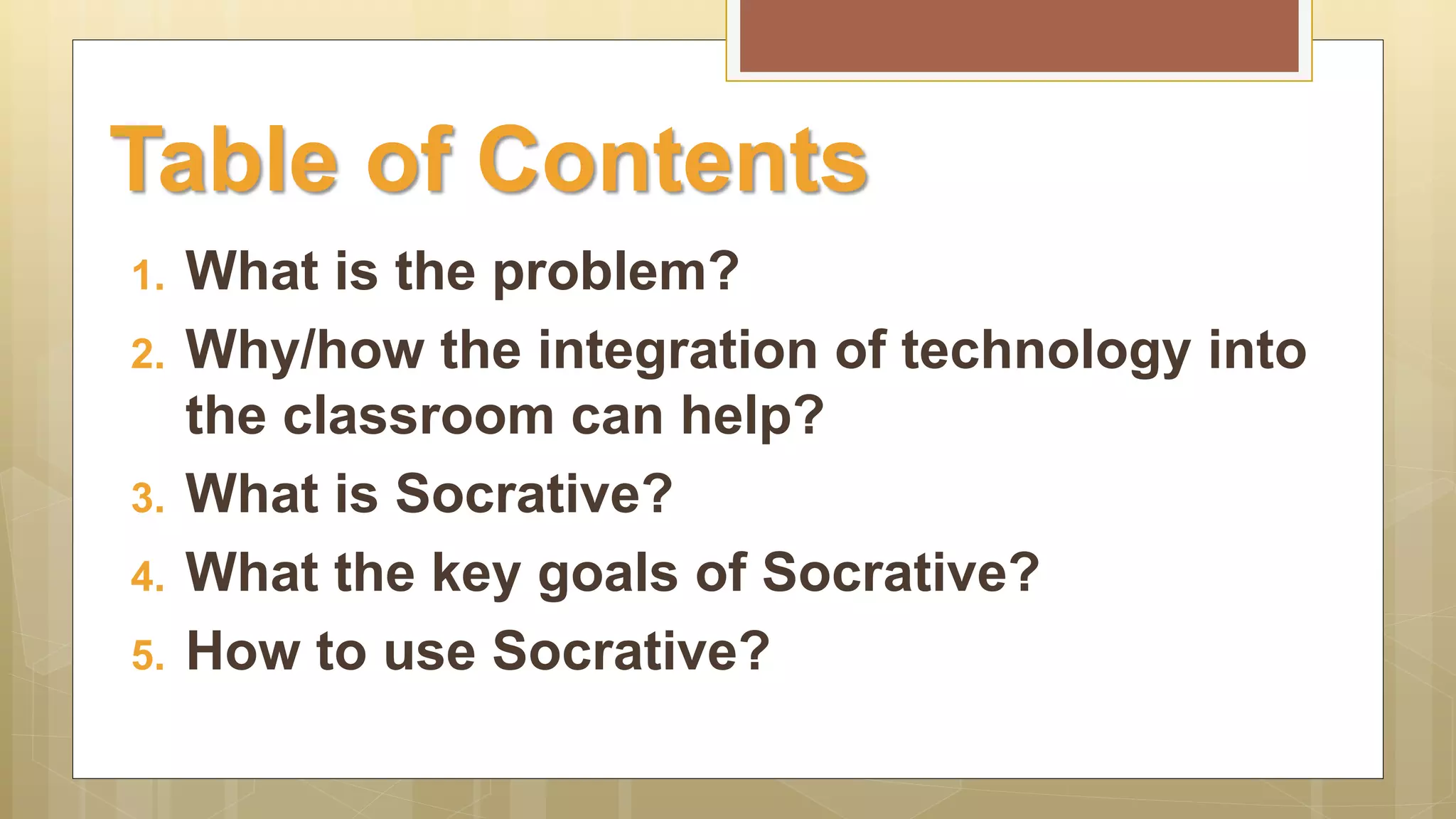

Socrative
in the
Classroom
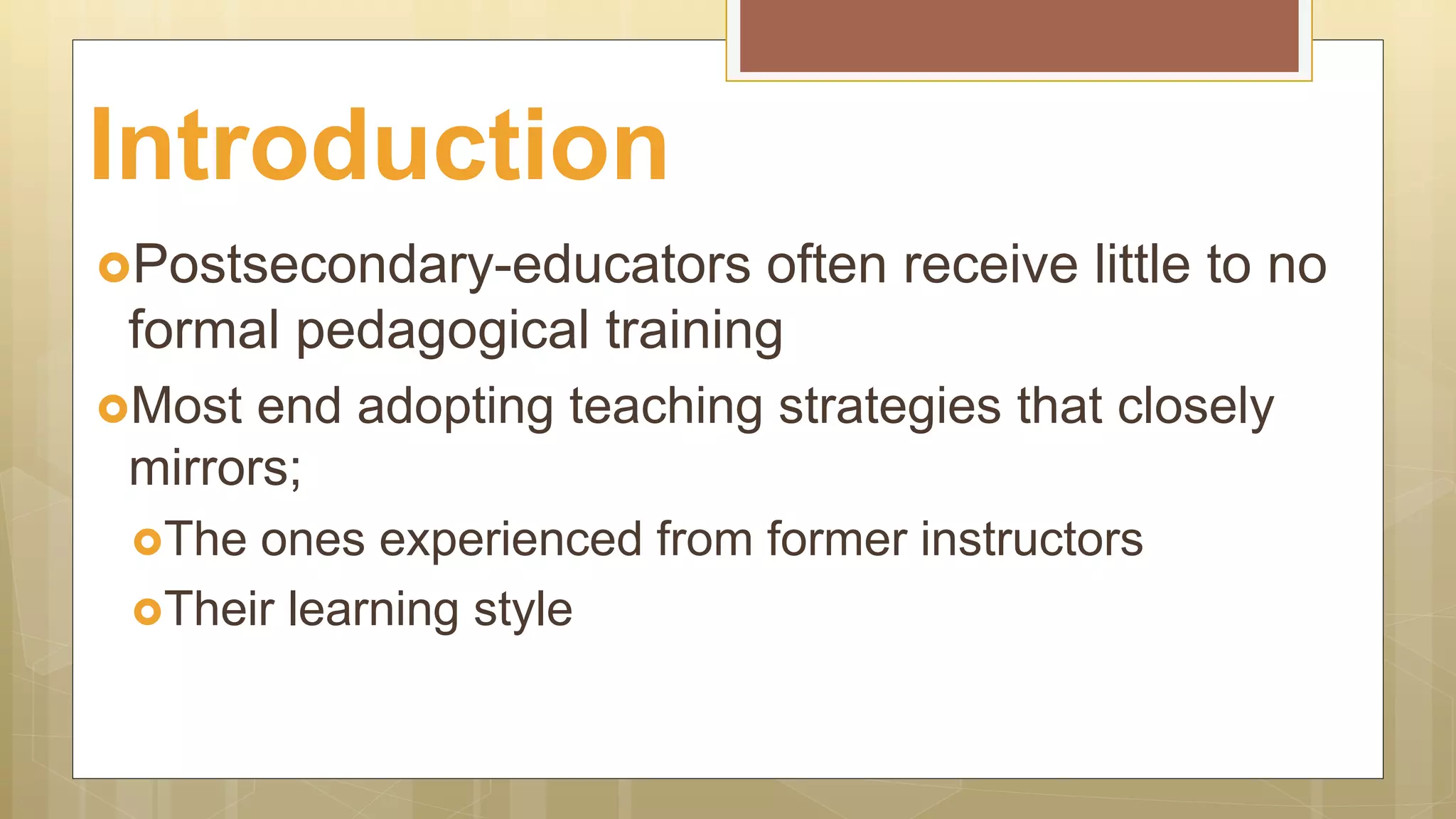
Aitza Marie Haddad Núñez
Howard University
Short Bio
 Aitza Marie Haddad Núñez
 Education, Job & Affiliation
 Ph.D. Communication, Culture & Media Studies; LL.M.
Comparative Law; J.D.; B.A. Political Science
 Adjunct Professor
 Howard University, School of Communication
 Strategic Legal & Management Communication (SLMC)
 Annenberg Honors Program
 Research Interest
 Communication, Teaching, Technology
 Human Rights, Civil Rights, Public Interest
1. What is the problem?
2. Why/how the integration of technology into
the classroom can help?
3. What is Socrative?
4. What the key goals of Socrative?
5. How to use Socrative?
Table of Contents
Postsecondary-educators often receive little to no
formal pedagogical training
Most end adopting teaching strategies that closely
mirrors;
The ones experienced from former instructors
Their learning style
Introduction
Production of a faculty that is:
 Unfamiliar with educational theories
 Unaware of the importance of accommodating learning styles with
instructional strategies, and/or
 Reluctant or uncomfortable with incorporating innovative teaching
strategies in their course delivery
Emergence of a divide between teaching styles of
instructors and learning styles of students (Hawk & Shah,
2007)
Why is this a problem?
This divide is exacerbated by millennial learners’
dependence on the daily use of technology
2014 data from100,000 students of 195 participating institutions
revealed that;
86% own a laptop,
62% own a smartphone,
33% own a desktop computer,
15% own a tablet, and
12% own an e-reader (Wash, 2014)
Why is this a problem?
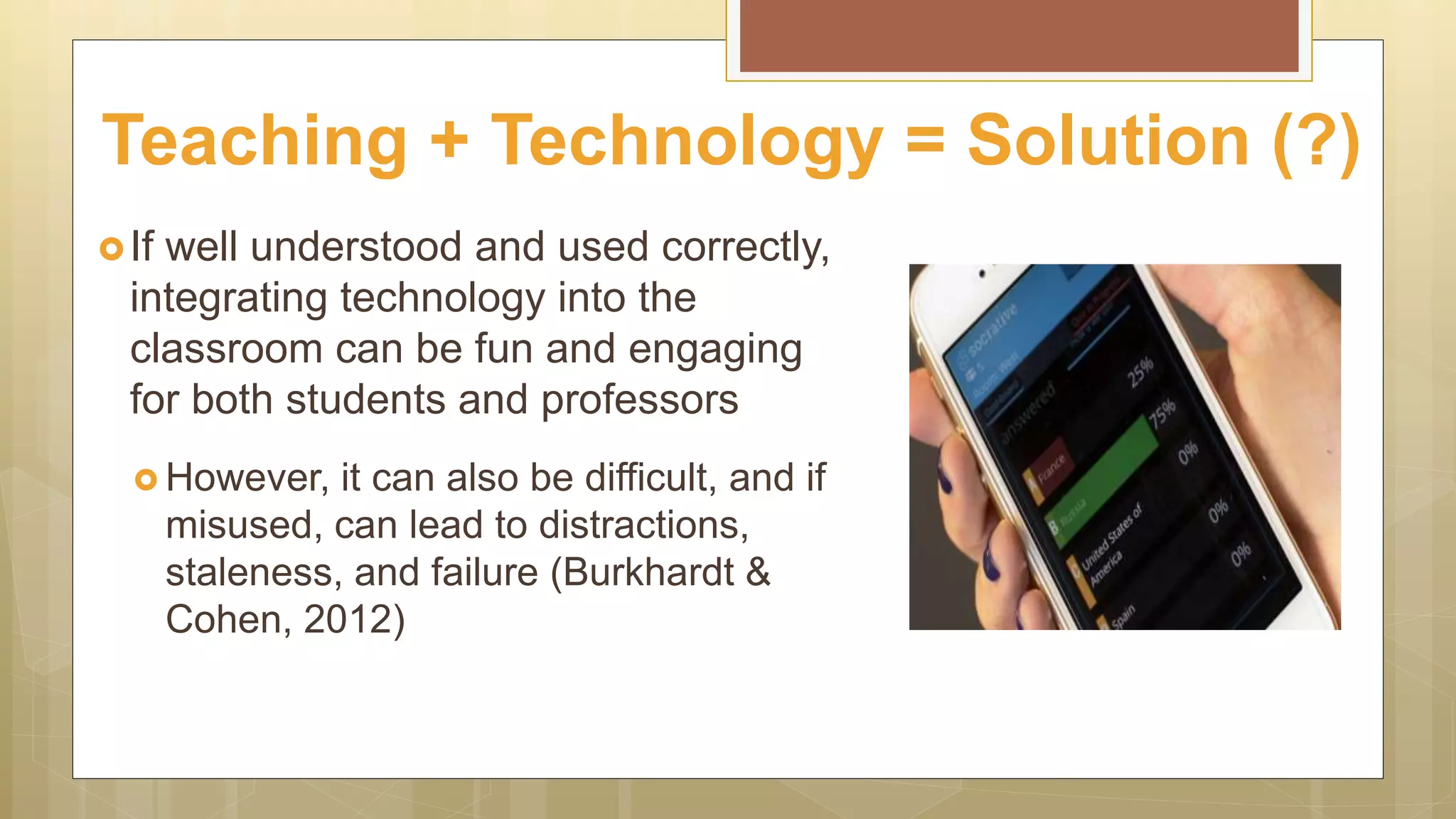
If well understood and used correctly,
integrating technology into the
classroom can be fun and engaging
for both students and professors
 However, it can also be difficult, and if
misused, can lead to distractions,
staleness, and failure (Burkhardt &
Cohen, 2012)
Teaching + Technology = Solution (?)
An early study on concluded that
Millennial students enjoy using many of the course
management tool, due to the fact that they
Embrace technology, and
Expect technology use to contribute to learning
However, “they do not see the tools as highly effective at
enhancing the learning experience” (McCabe & Meuter
2011)
How much do we know?
More recent studies have shown that;
Most colleges and universities are implementing the use of
various course management systems (CMS)
Students embrace interactive learning technologies (ILT)
Which forces instructors to integrate certain academic technology
into their teaching
The use of ILT contributes to better teaching and learning
outcomes (Wash, 2014)
What else we know?
Analysis of data collected in a STEM and a non-STEM
course with an without technology
Technology selected – Socrative
The study suggests that the effective use of technology
in the classroom can help to:
Overcome divide between teaching and learning styles
Implement Chickering and Gramson’s Seven Principles of
Undergraduate Teaching and Learning
Proposed Study
1. Encouragement of contact between students and
faculty;
2. Development of reciprocity and cooperation among
students;
3. Encouragement of active learning;
4. To provide prompt feedback;
5. To emphasize the importance of time on task;
6. To communicate high expectations; and to
7. Respects diverse talents and ways of learning.
Chickering & Gramson’s Seven Principles of
Undergraduate Teaching and Learning
Free student response system (SRS) or software
developed in 2010
Allows for the creation of virtual classrooms with the use of self-
created class IDs or codes
Can be used to take attendance and ask questions in different
formats
Questions can be created prior to class, or can be created
simultaneously with the class discussion
Allows for “the lecturer to see how many students had made a
mistake,” and thus, “for instant corrective action or advice” (Fabian,
2013, p.6)
What is Socrative?
Méndez (2013) – when both students and professors efficiently
use the mobile application Socrative, 3 different goals are
achieved:
1. Real-time assessment of the students’ learning;
2. Motivation of the students; and
3. Increased opportunities for active learning
Dervan (2014) – described his own experience using Socrative,
and that of his students, as positive and effective (p.1806)
Using Socrative…
Awedh, et al., (2014) – Socrative supports collaborative
learning, as well as the communication, and thus, learning
process by;
 Improving “students level of interactivity” (p.23)
 Increasing students’ motivation, as well as “the level of
communication with their classmates and teachers”
 Developing “communication skills and a collaborative spirit among
students”
 Making students “feel that their answers and opinions are given value
by the teacher and their classmates”
 Helping “them improve their learning performance” (p.22)
More use of Socrative…
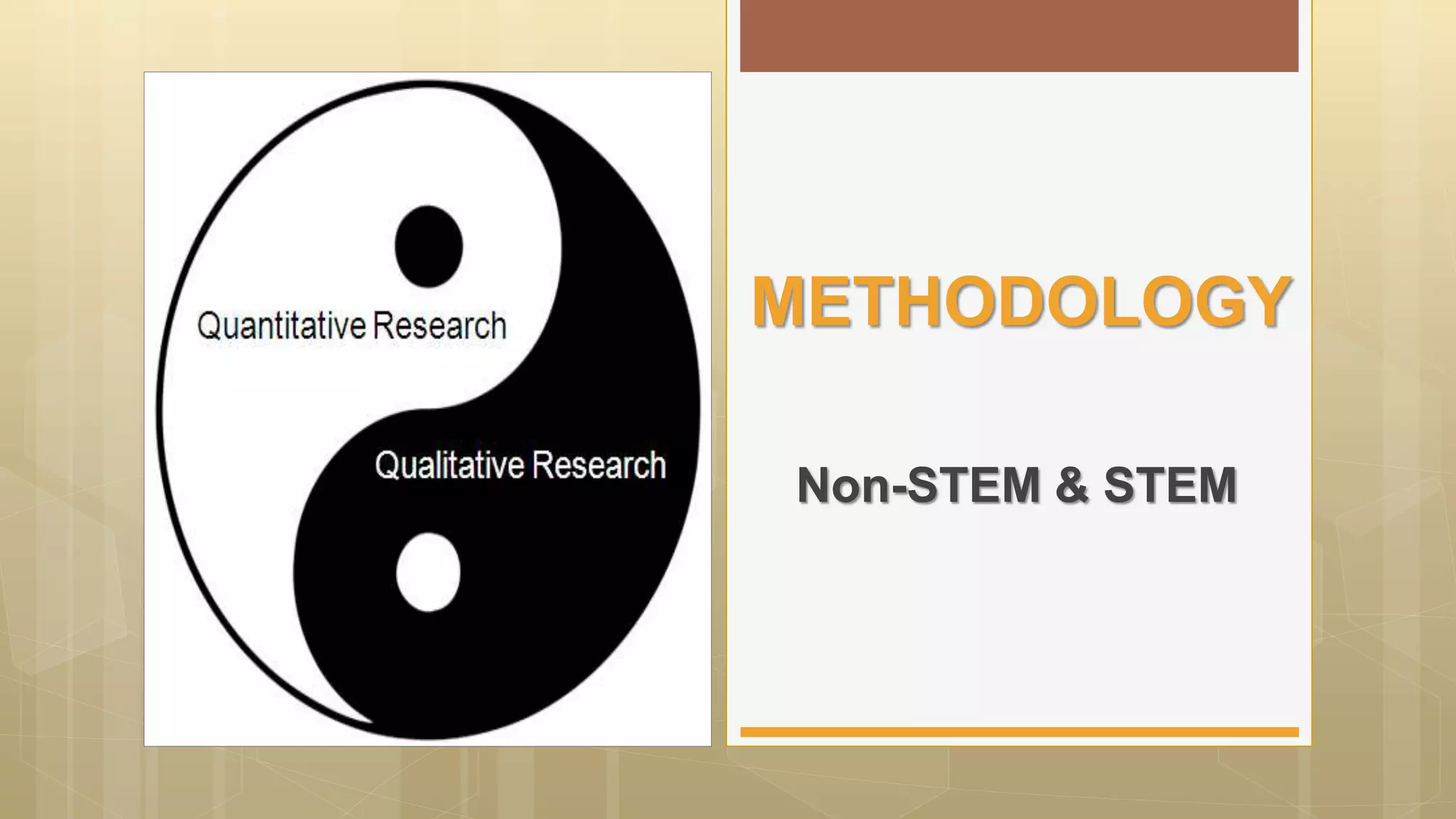
Non-STEM & STEM
METHODOLOGY
Methodology Non-STEM
Use of technology to analyze attendance and
use of technology
Communications introductory, but mandatory, course
Academic Year 2015-2016
150-170 Students per semester
Fall 2015 – attendance without Socrative Exit Ticket
Spring 2016 – attendance supplemented with Socrative Exit
Ticket
Methodology STEM
Use of technology to analyze attendance, use of
technology, and grades
Biology Introductory Laboratory
Fall 2015 and Fall 2016
22 and 17 Students Registered
Attendance taken with Socrative Exit Ticket on Fall 2016
Quantitative – Percentage of attendance per meeting
Qualitative – Answers given by individual participants
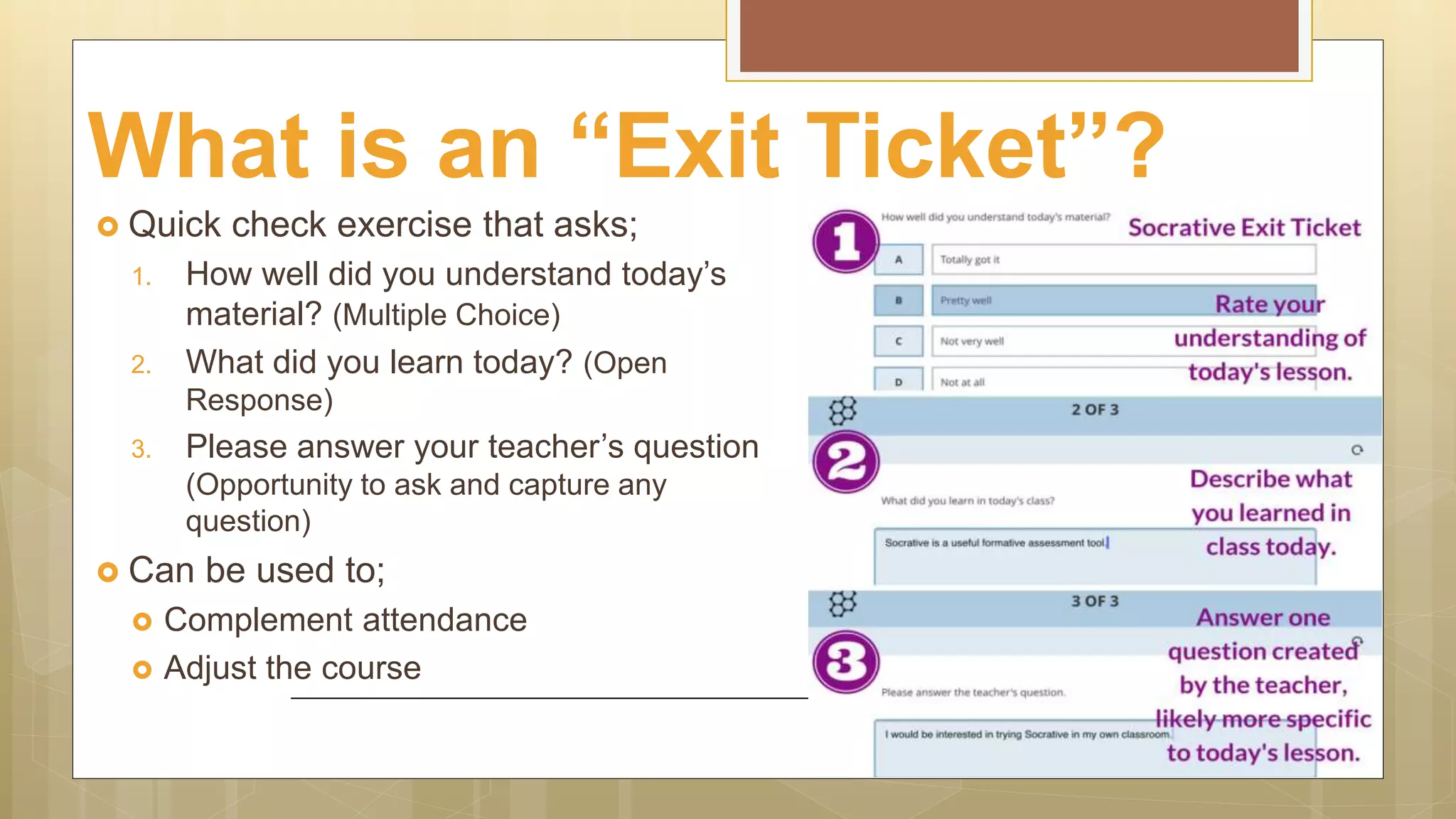
What is an “Exit Ticket”?
 Quick check exercise that asks;
1. How well did you understand today’s
material? (Multiple Choice)
2. What did you learn today? (Open
Response)
3. Please answer your teacher’s question
(Opportunity to ask and capture any
question)
 Can be used to;
 Complement attendance
 Adjust the course
Examine the efficacy of Socrative in:
Enhancing attendance taking routines
Improving engagement
Improving learning outcomes
Enhancing process of course preparation
Underscore the importance of the 7 Principles of
Undergraduate Teaching and Learning
Study Goals
Non-STEM & STEM
DATA
RESULTS
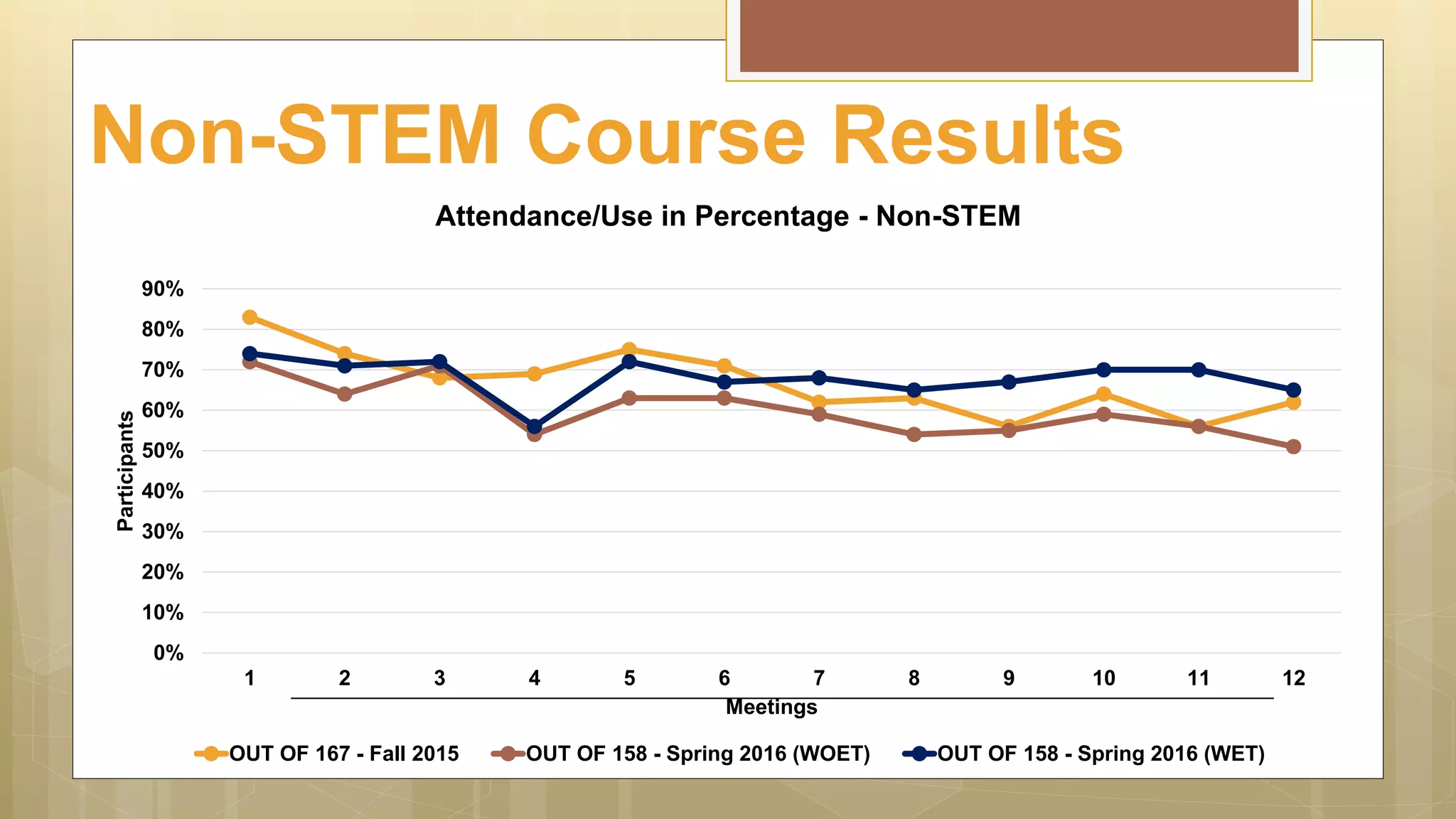
Non-STEM Course Results
0%
10%
20%
30%
40%
50%
60%
70%
80%
90%
1 2 3 4 5 6 7 8 9 10 11 12
Participants
Meetings
Attendance/Use in Percentage - Non-STEM
OUT OF 167 - Fall 2015 OUT OF 158 - Spring 2016 (WOET) OUT OF 158 - Spring 2016 (WET)
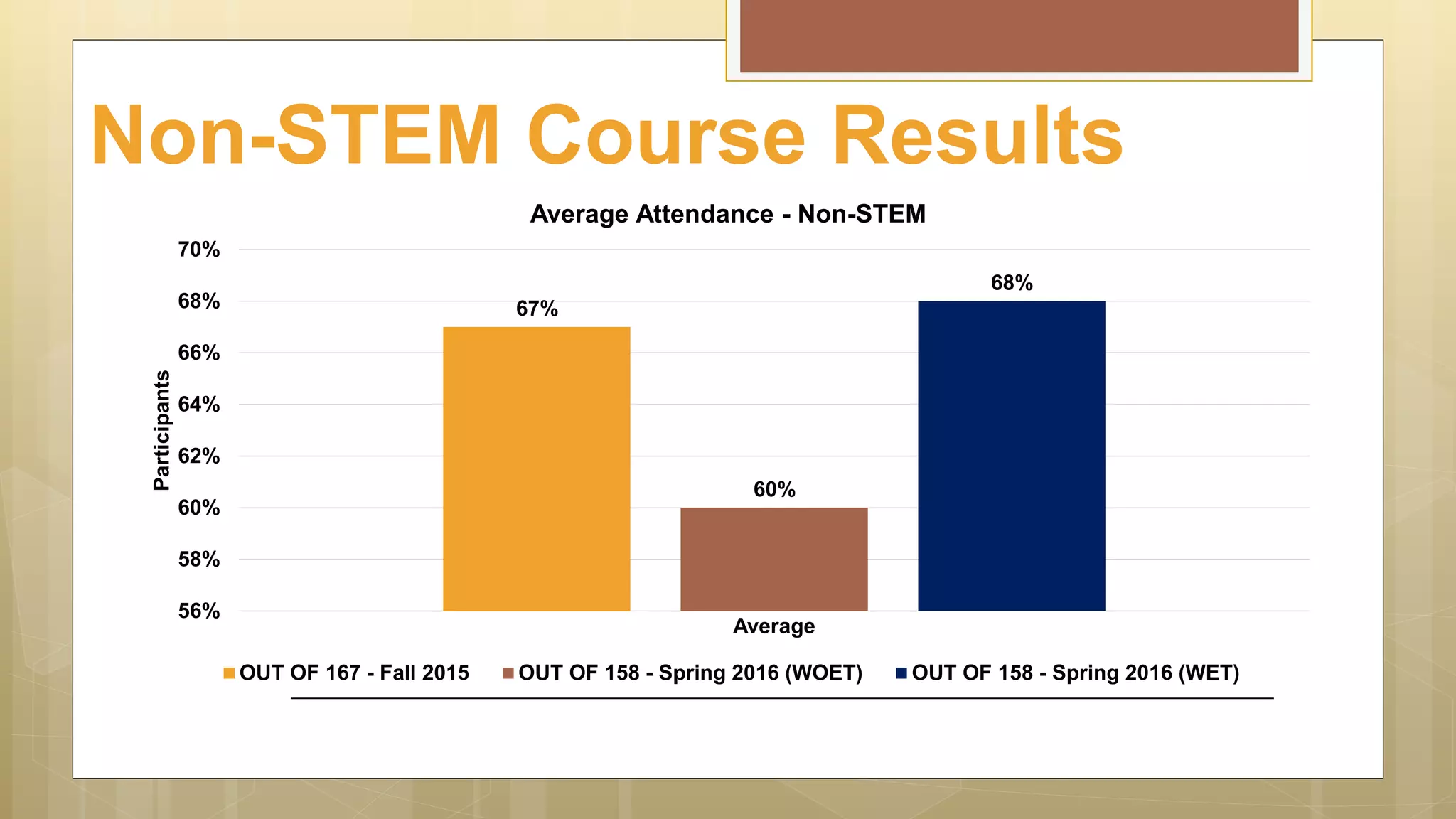
Non-STEM Course Results
67%
60%
68%
56%
58%
60%
62%
64%
66%
68%
70%
Participants
Average
Average Attendance - Non-STEM
OUT OF 167 - Fall 2015 OUT OF 158 - Spring 2016 (WOET) OUT OF 158 - Spring 2016 (WET)
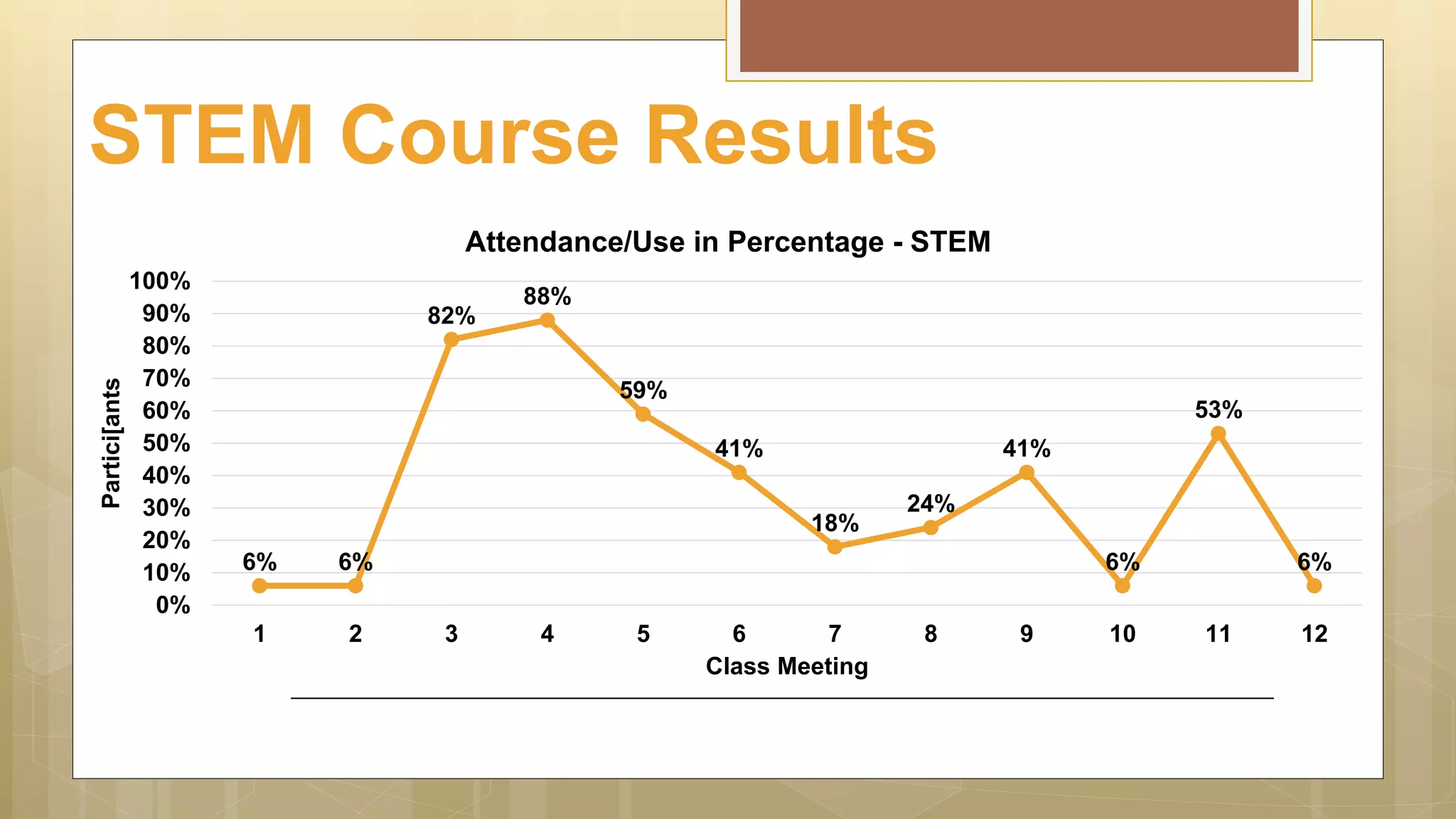
STEM Course Results
6% 6%
82%
88%
59%
41%
18%
24%
41%
6%
53%
6%
0%
10%
20%
30%
40%
50%
60%
70%
80%
90%
100%
1 2 3 4 5 6 7 8 9 10 11 12
Partici[ants
Class Meeting
Attendance/Use in Percentage - STEM
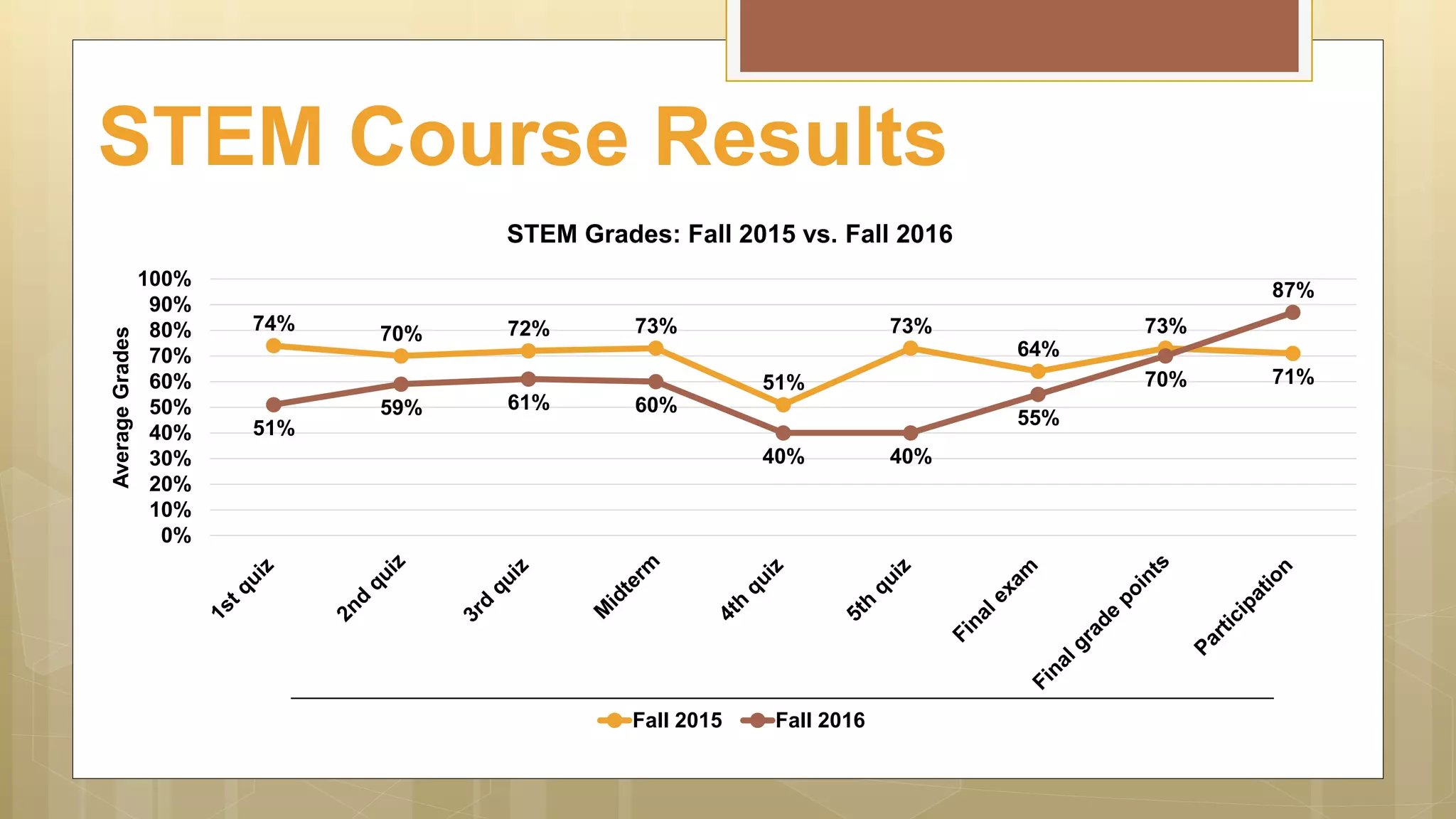
STEM Course Results
74% 70% 72% 73%
51%
73%
64%
73%
71%
51%
59% 61% 60%
40% 40%
55%
70%
87%
0%
10%
20%
30%
40%
50%
60%
70%
80%
90%
100%
AverageGrades
STEM Grades: Fall 2015 vs. Fall 2016
Fall 2015 Fall 2016
Non-STEM vs. STEM Results
74% 71% 72%
56%
72% 67% 68% 65% 67% 70% 70% 65%
6% 6%
82%
88%
59%
41%
18% 24%
41%
6%
53%
6%
0%
20%
40%
60%
80%
100%
120%
140%
160%
180%
1 2 3 4 5 6 7 8 9 10 11 12
Participants
Class Meetings
Attendance/Use in Percentages – Non-STEM vs. STEM
Non-STEM STEM
An analysis of the quantitative data revealed that:
A gradual increased in attendance/use
Non-STEM – Increased attendance through the semester
STEM – Increased used per meetings and participation
An analysis of the qualitative data allowed for:
Easier attendance taking
Better assessments of class’ level of understanding and
engagement
Better tailoring of class meetings, and course in general
Analysis
Although fundamental and technical differences exist
between non-STEM and STEM courses, the use of
Socrative proved to be positive and effective in both
courses by increasing and/or improving:
Attendance
Communication
Engagement and participation
Transparency and accountability
Conclusion
 Socrative is a good application to encourage students to participate
since it can be used from virtually anywhere.
 Students whom feel embarrassed participating or asking questions
in front of their colleagues, had a better chance to participate and
communicate their ideas and questions to their professor.
 Socrative can also be good in large classes because it gives each
student a chance to show their ideas and understandings when
there is limited time.
 The study results encourage professors whom are concerned about
their students’ participations to use Socrative as a study aid to make
sure that most, if not each, student participates and paysattention to
the lecture.
Discussion
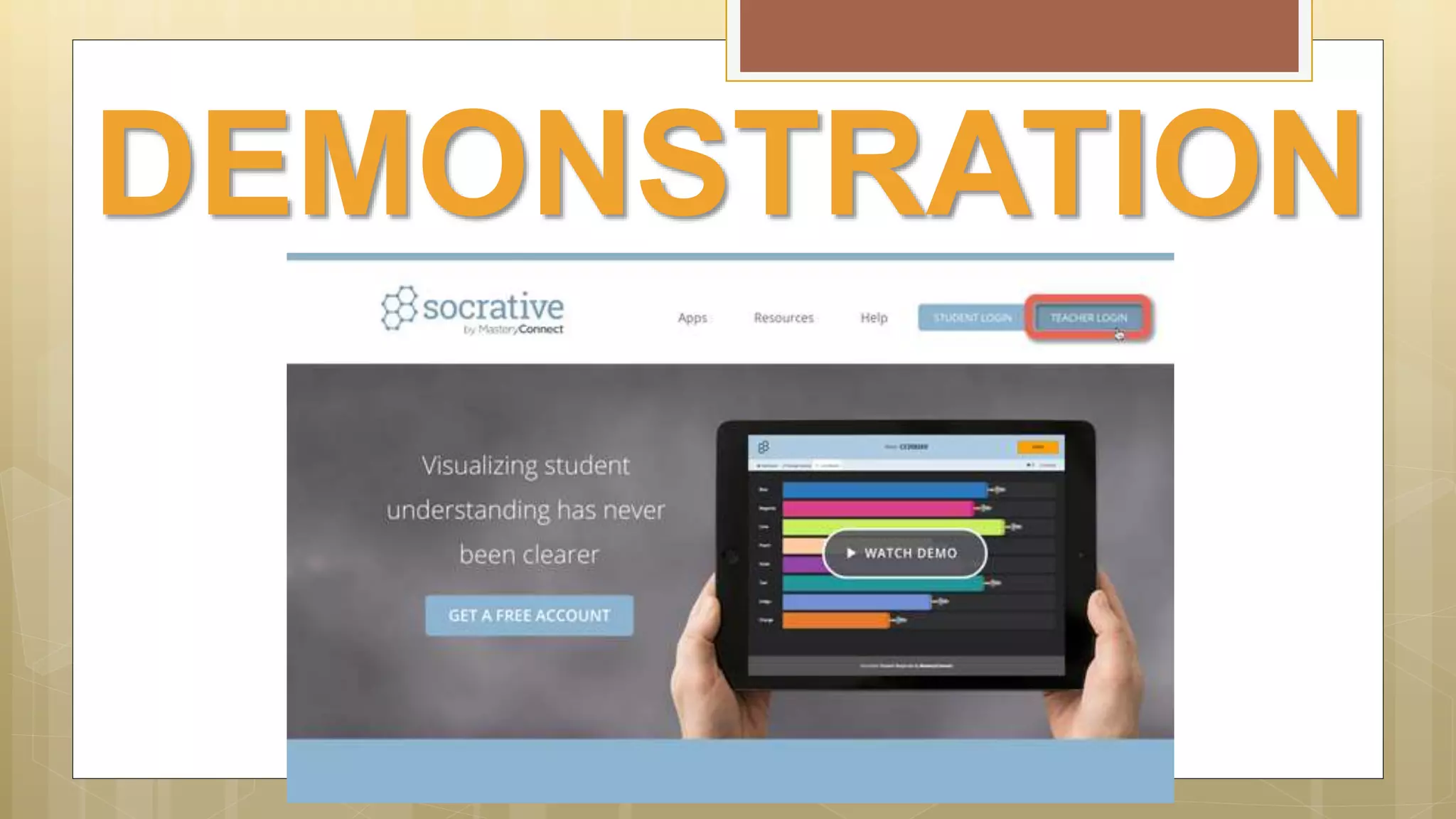
DEMONSTRATION
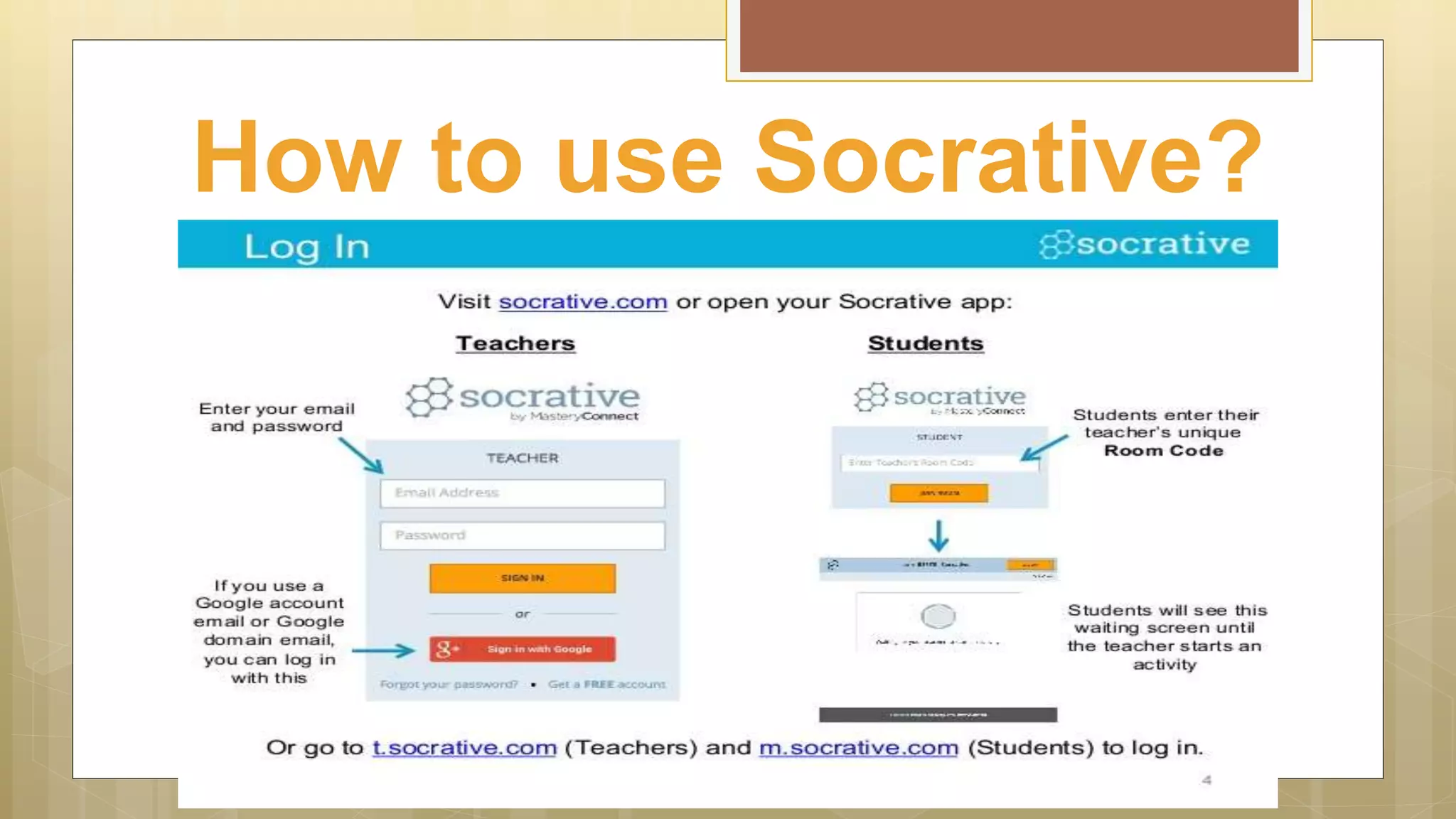
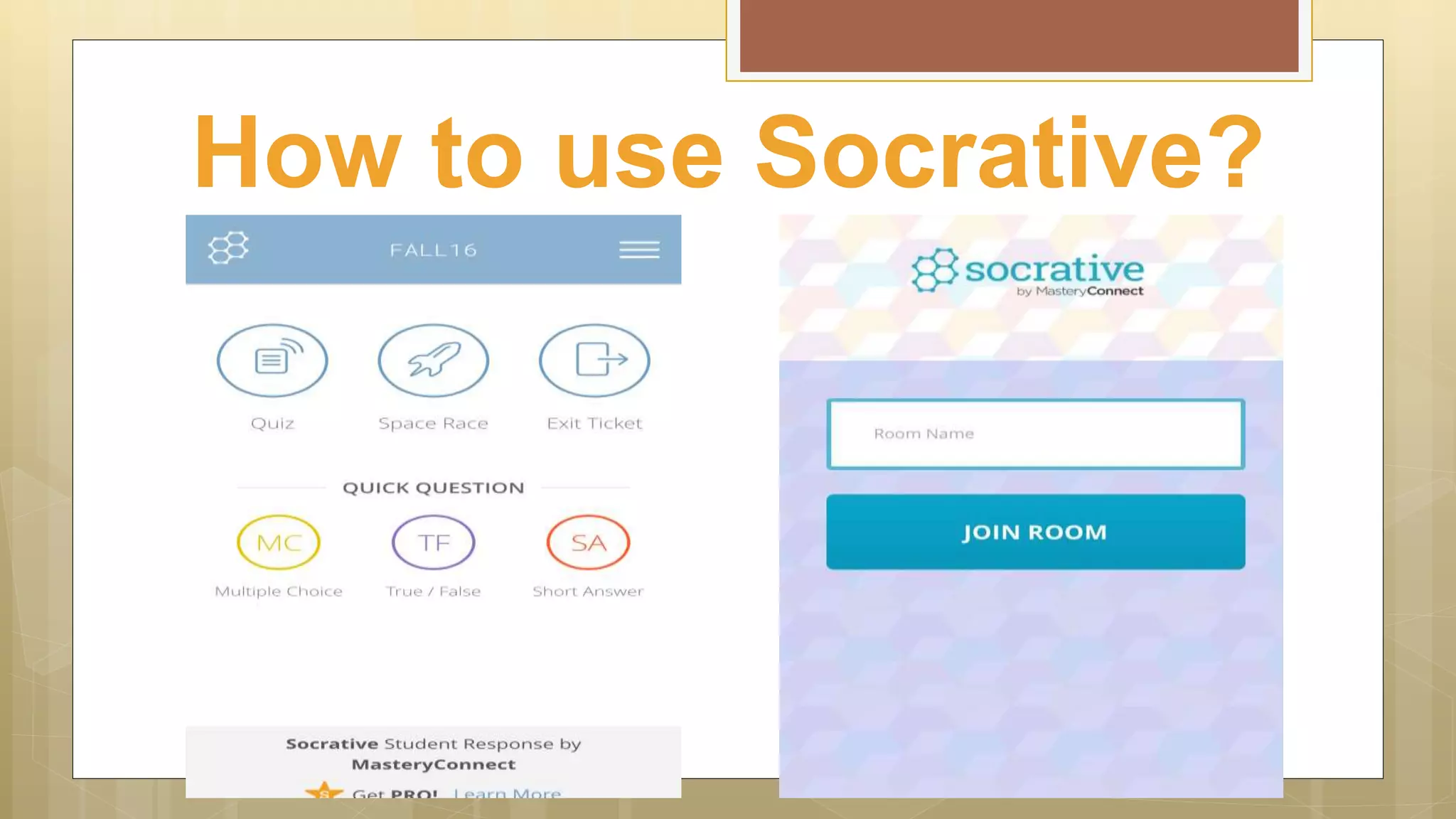
How to use Socrative?
Create Your Account
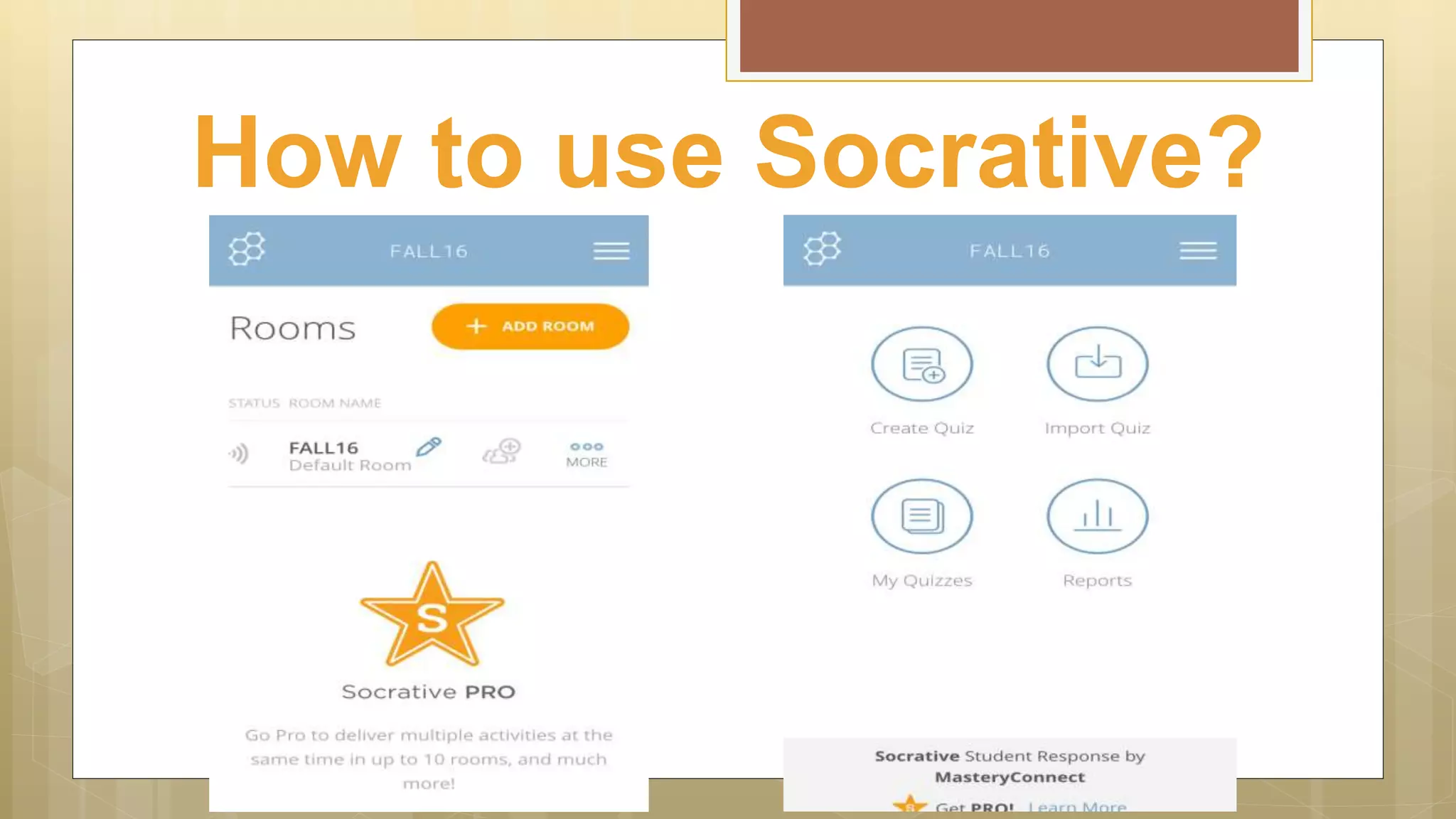
How to use Socrative?
Creating/Starting/Editing a Quiz
Import your Quizzes
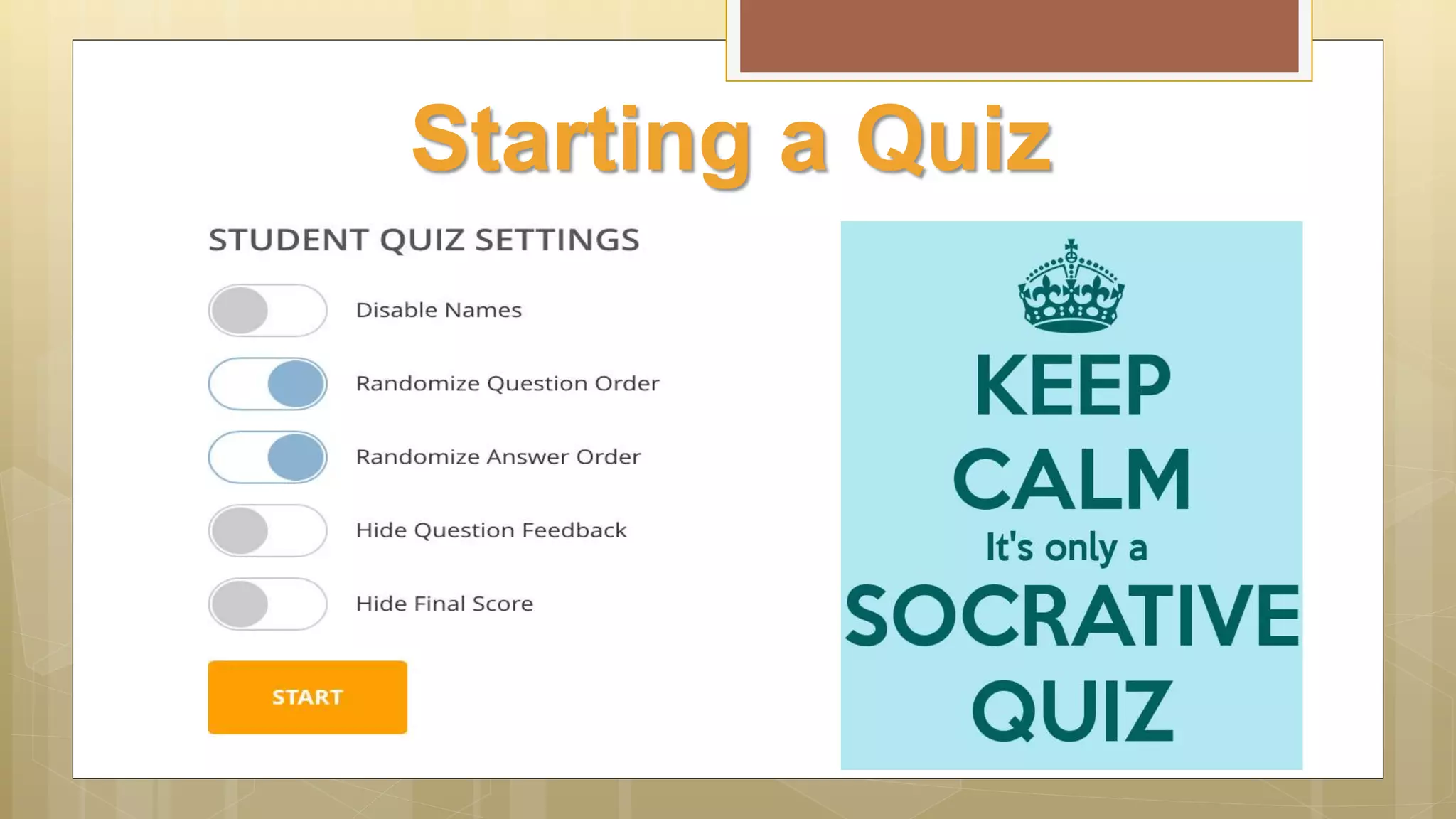
Starting a Quiz
Starting a Quiz
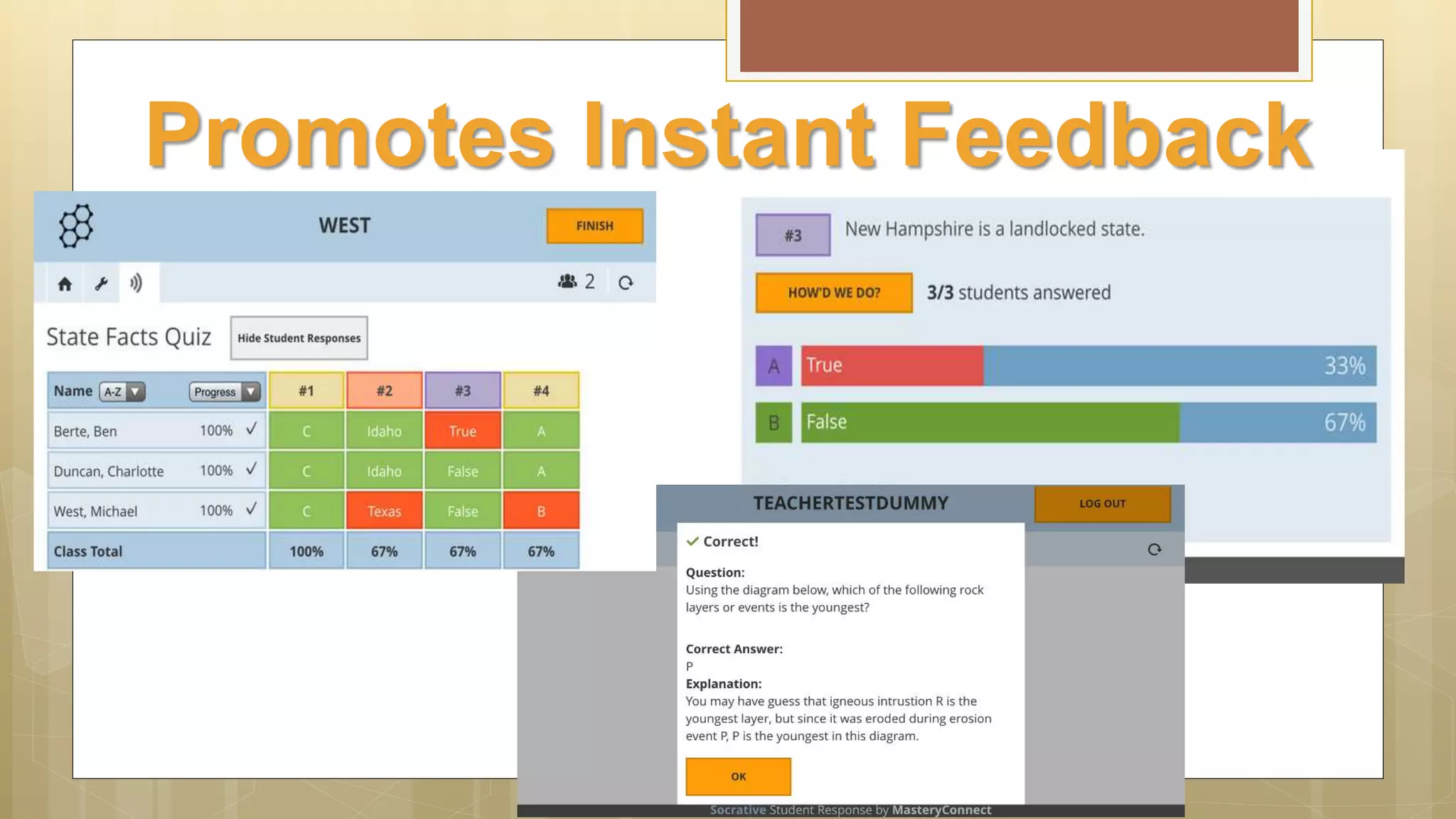
Promotes Instant Feedback
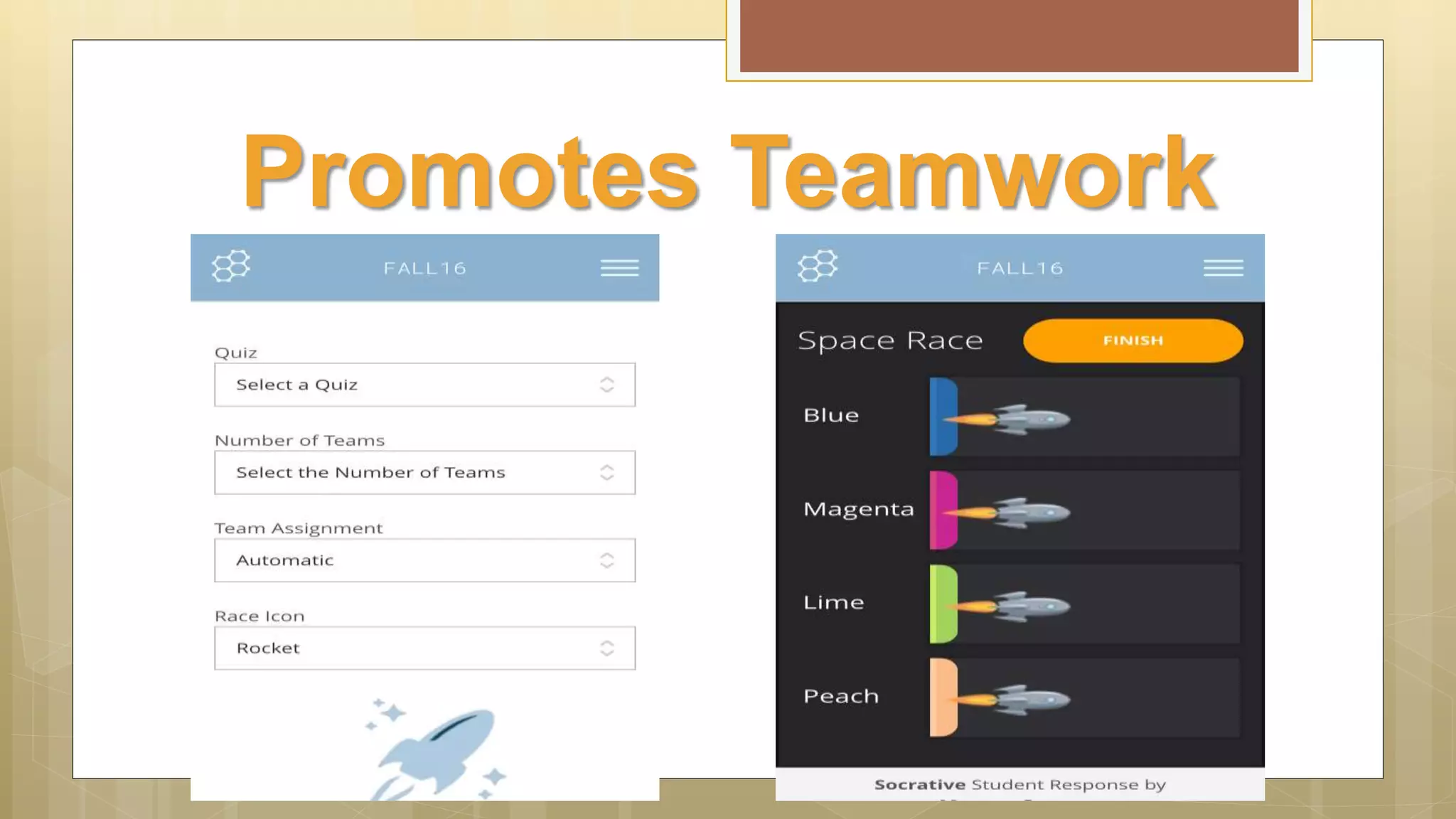
Promotes Teamwork
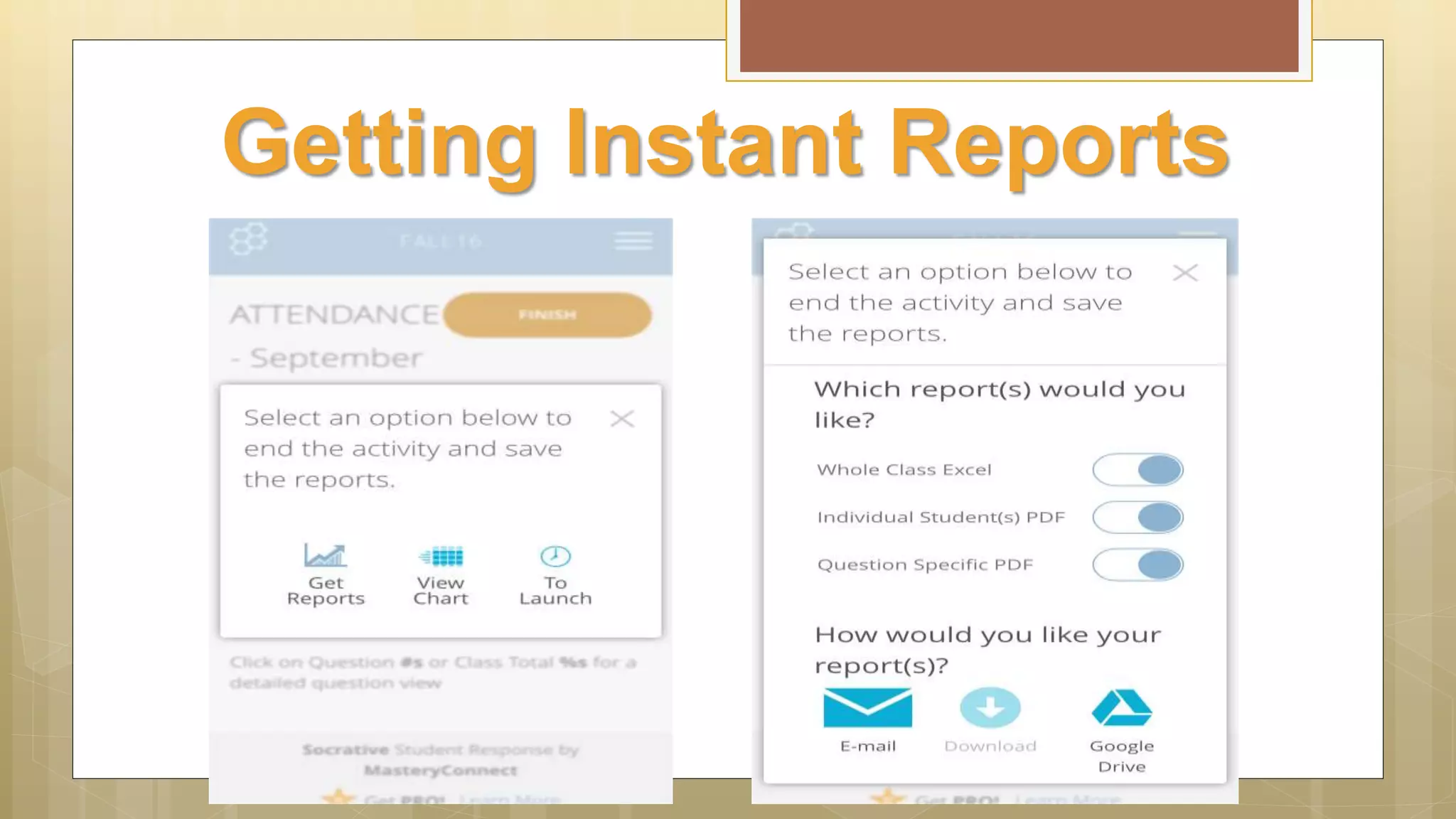
Getting Instant Reports
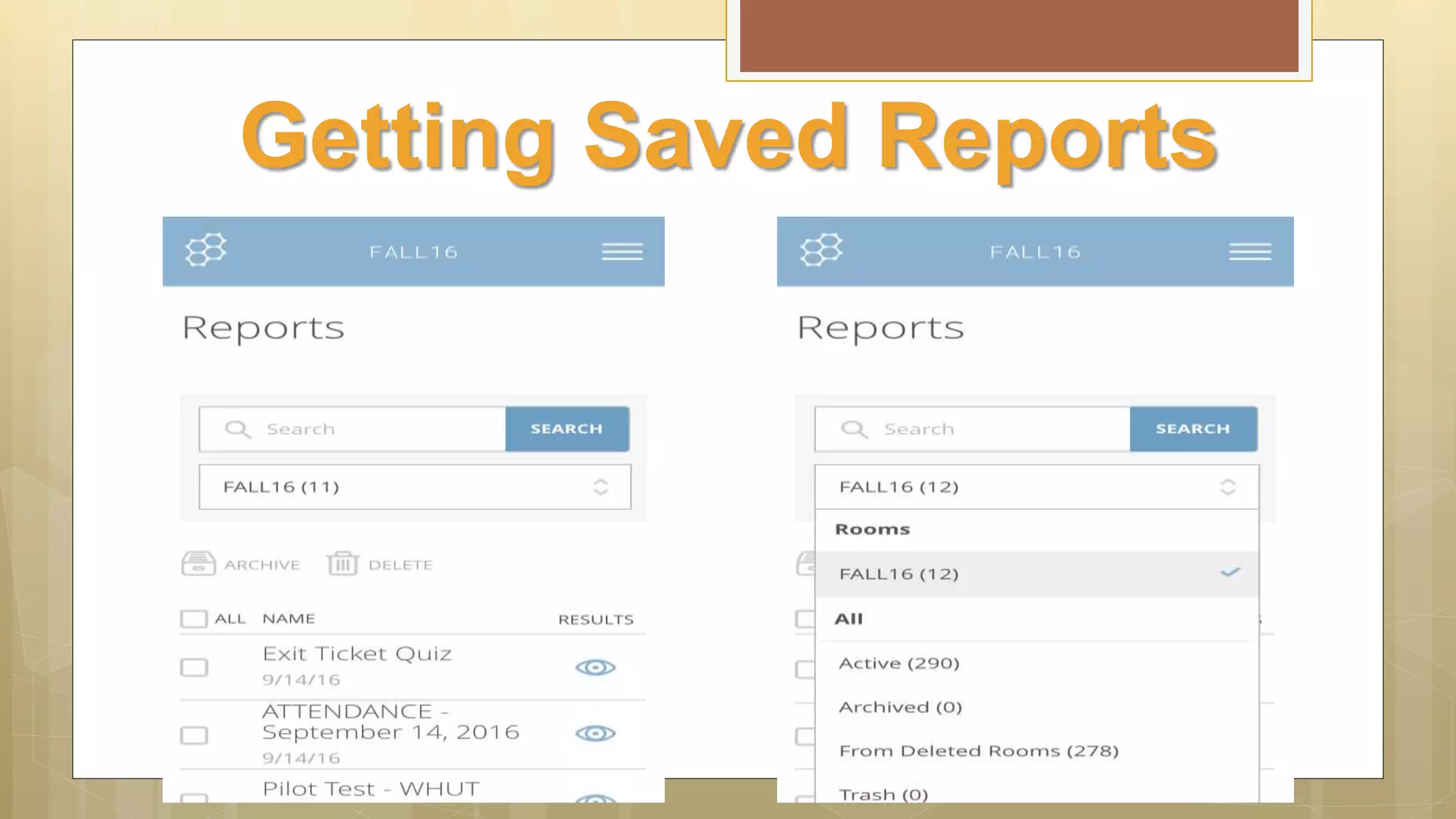
Getting Saved Reports
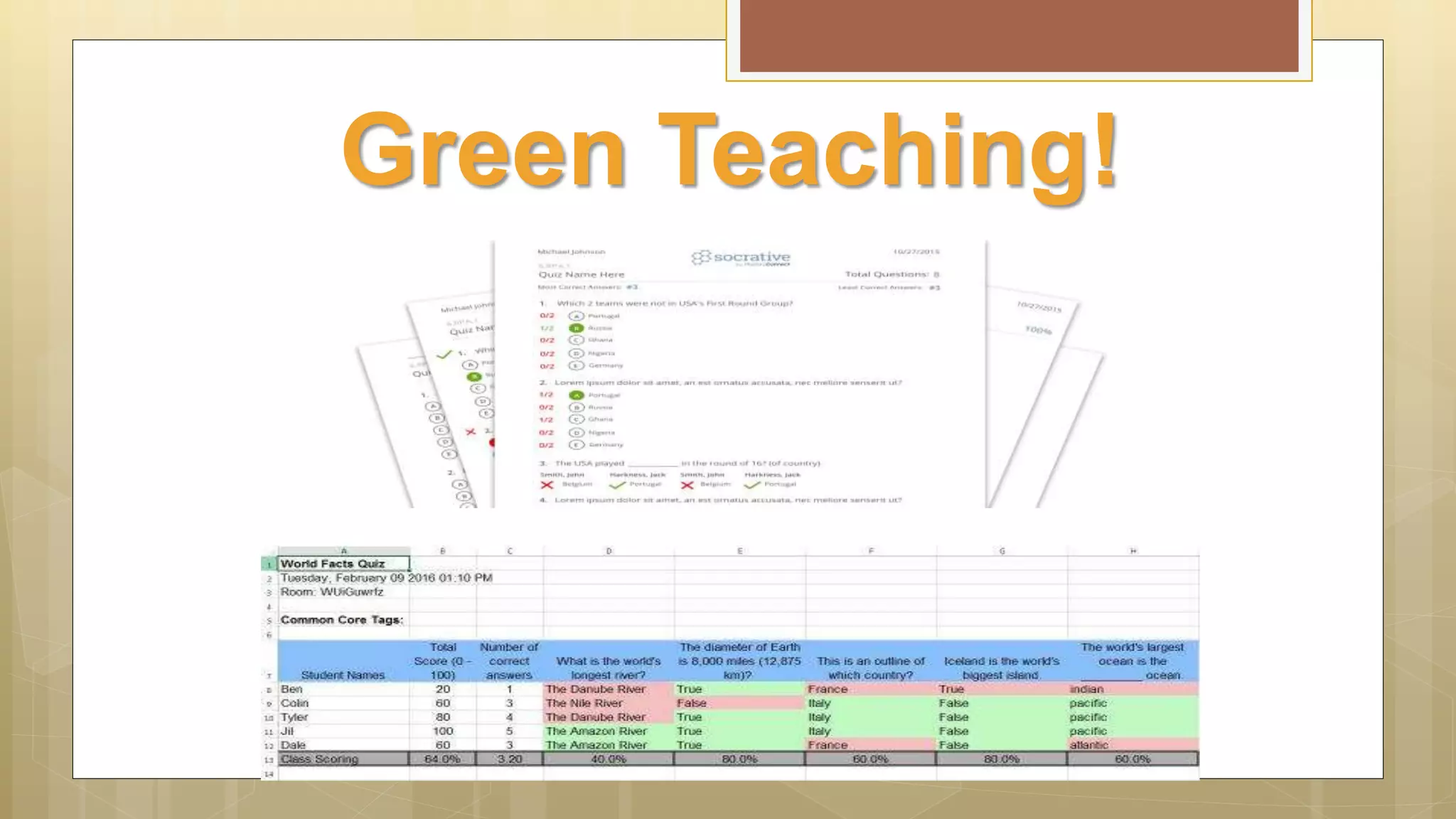
Green Teaching!
amhaddadlaw@gmail.com

Socrative in the Classroom

  • 1.
    Socrative in the Classroom Aitza MarieHaddad Núñez Howard University
  • 2.
    Short Bio  AitzaMarie Haddad Núñez  Education, Job & Affiliation  Ph.D. Communication, Culture & Media Studies; LL.M. Comparative Law; J.D.; B.A. Political Science  Adjunct Professor  Howard University, School of Communication  Strategic Legal & Management Communication (SLMC)  Annenberg Honors Program  Research Interest  Communication, Teaching, Technology  Human Rights, Civil Rights, Public Interest
  • 3.
    1. What isthe problem? 2. Why/how the integration of technology into the classroom can help? 3. What is Socrative? 4. What the key goals of Socrative? 5. How to use Socrative? Table of Contents
  • 4.
    Postsecondary-educators often receivelittle to no formal pedagogical training Most end adopting teaching strategies that closely mirrors; The ones experienced from former instructors Their learning style Introduction
  • 5.
    Production of afaculty that is:  Unfamiliar with educational theories  Unaware of the importance of accommodating learning styles with instructional strategies, and/or  Reluctant or uncomfortable with incorporating innovative teaching strategies in their course delivery Emergence of a divide between teaching styles of instructors and learning styles of students (Hawk & Shah, 2007) Why is this a problem?
  • 6.
    This divide isexacerbated by millennial learners’ dependence on the daily use of technology 2014 data from100,000 students of 195 participating institutions revealed that; 86% own a laptop, 62% own a smartphone, 33% own a desktop computer, 15% own a tablet, and 12% own an e-reader (Wash, 2014) Why is this a problem?
  • 7.
    If well understoodand used correctly, integrating technology into the classroom can be fun and engaging for both students and professors  However, it can also be difficult, and if misused, can lead to distractions, staleness, and failure (Burkhardt & Cohen, 2012) Teaching + Technology = Solution (?)
  • 8.
    An early studyon concluded that Millennial students enjoy using many of the course management tool, due to the fact that they Embrace technology, and Expect technology use to contribute to learning However, “they do not see the tools as highly effective at enhancing the learning experience” (McCabe & Meuter 2011) How much do we know?
  • 9.
    More recent studieshave shown that; Most colleges and universities are implementing the use of various course management systems (CMS) Students embrace interactive learning technologies (ILT) Which forces instructors to integrate certain academic technology into their teaching The use of ILT contributes to better teaching and learning outcomes (Wash, 2014) What else we know?
  • 10.
    Analysis of datacollected in a STEM and a non-STEM course with an without technology Technology selected – Socrative The study suggests that the effective use of technology in the classroom can help to: Overcome divide between teaching and learning styles Implement Chickering and Gramson’s Seven Principles of Undergraduate Teaching and Learning Proposed Study
  • 11.
    1. Encouragement ofcontact between students and faculty; 2. Development of reciprocity and cooperation among students; 3. Encouragement of active learning; 4. To provide prompt feedback; 5. To emphasize the importance of time on task; 6. To communicate high expectations; and to 7. Respects diverse talents and ways of learning. Chickering & Gramson’s Seven Principles of Undergraduate Teaching and Learning
  • 12.
    Free student responsesystem (SRS) or software developed in 2010 Allows for the creation of virtual classrooms with the use of self- created class IDs or codes Can be used to take attendance and ask questions in different formats Questions can be created prior to class, or can be created simultaneously with the class discussion Allows for “the lecturer to see how many students had made a mistake,” and thus, “for instant corrective action or advice” (Fabian, 2013, p.6) What is Socrative?
  • 13.
    Méndez (2013) –when both students and professors efficiently use the mobile application Socrative, 3 different goals are achieved: 1. Real-time assessment of the students’ learning; 2. Motivation of the students; and 3. Increased opportunities for active learning Dervan (2014) – described his own experience using Socrative, and that of his students, as positive and effective (p.1806) Using Socrative…
  • 14.
    Awedh, et al.,(2014) – Socrative supports collaborative learning, as well as the communication, and thus, learning process by;  Improving “students level of interactivity” (p.23)  Increasing students’ motivation, as well as “the level of communication with their classmates and teachers”  Developing “communication skills and a collaborative spirit among students”  Making students “feel that their answers and opinions are given value by the teacher and their classmates”  Helping “them improve their learning performance” (p.22) More use of Socrative…
  • 15.
  • 16.
    Methodology Non-STEM Use oftechnology to analyze attendance and use of technology Communications introductory, but mandatory, course Academic Year 2015-2016 150-170 Students per semester Fall 2015 – attendance without Socrative Exit Ticket Spring 2016 – attendance supplemented with Socrative Exit Ticket
  • 17.
    Methodology STEM Use oftechnology to analyze attendance, use of technology, and grades Biology Introductory Laboratory Fall 2015 and Fall 2016 22 and 17 Students Registered Attendance taken with Socrative Exit Ticket on Fall 2016 Quantitative – Percentage of attendance per meeting Qualitative – Answers given by individual participants
  • 18.
    What is an“Exit Ticket”?  Quick check exercise that asks; 1. How well did you understand today’s material? (Multiple Choice) 2. What did you learn today? (Open Response) 3. Please answer your teacher’s question (Opportunity to ask and capture any question)  Can be used to;  Complement attendance  Adjust the course
  • 19.
    Examine the efficacyof Socrative in: Enhancing attendance taking routines Improving engagement Improving learning outcomes Enhancing process of course preparation Underscore the importance of the 7 Principles of Undergraduate Teaching and Learning Study Goals
  • 20.
  • 21.
    Non-STEM Course Results 0% 10% 20% 30% 40% 50% 60% 70% 80% 90% 12 3 4 5 6 7 8 9 10 11 12 Participants Meetings Attendance/Use in Percentage - Non-STEM OUT OF 167 - Fall 2015 OUT OF 158 - Spring 2016 (WOET) OUT OF 158 - Spring 2016 (WET)
  • 22.
    Non-STEM Course Results 67% 60% 68% 56% 58% 60% 62% 64% 66% 68% 70% Participants Average AverageAttendance - Non-STEM OUT OF 167 - Fall 2015 OUT OF 158 - Spring 2016 (WOET) OUT OF 158 - Spring 2016 (WET)
  • 23.
    STEM Course Results 6%6% 82% 88% 59% 41% 18% 24% 41% 6% 53% 6% 0% 10% 20% 30% 40% 50% 60% 70% 80% 90% 100% 1 2 3 4 5 6 7 8 9 10 11 12 Partici[ants Class Meeting Attendance/Use in Percentage - STEM
  • 24.
    STEM Course Results 74%70% 72% 73% 51% 73% 64% 73% 71% 51% 59% 61% 60% 40% 40% 55% 70% 87% 0% 10% 20% 30% 40% 50% 60% 70% 80% 90% 100% AverageGrades STEM Grades: Fall 2015 vs. Fall 2016 Fall 2015 Fall 2016
  • 25.
    Non-STEM vs. STEMResults 74% 71% 72% 56% 72% 67% 68% 65% 67% 70% 70% 65% 6% 6% 82% 88% 59% 41% 18% 24% 41% 6% 53% 6% 0% 20% 40% 60% 80% 100% 120% 140% 160% 180% 1 2 3 4 5 6 7 8 9 10 11 12 Participants Class Meetings Attendance/Use in Percentages – Non-STEM vs. STEM Non-STEM STEM
  • 26.
    An analysis ofthe quantitative data revealed that: A gradual increased in attendance/use Non-STEM – Increased attendance through the semester STEM – Increased used per meetings and participation An analysis of the qualitative data allowed for: Easier attendance taking Better assessments of class’ level of understanding and engagement Better tailoring of class meetings, and course in general Analysis
  • 27.
    Although fundamental andtechnical differences exist between non-STEM and STEM courses, the use of Socrative proved to be positive and effective in both courses by increasing and/or improving: Attendance Communication Engagement and participation Transparency and accountability Conclusion
  • 28.
     Socrative isa good application to encourage students to participate since it can be used from virtually anywhere.  Students whom feel embarrassed participating or asking questions in front of their colleagues, had a better chance to participate and communicate their ideas and questions to their professor.  Socrative can also be good in large classes because it gives each student a chance to show their ideas and understandings when there is limited time.  The study results encourage professors whom are concerned about their students’ participations to use Socrative as a study aid to make sure that most, if not each, student participates and paysattention to the lecture. Discussion
  • 29.
  • 30.
    How to useSocrative?
  • 31.
  • 32.
    How to useSocrative?
  • 33.
    How to useSocrative?
  • 34.
  • 35.
  • 36.
  • 37.
  • 38.
  • 39.
  • 40.
  • 41.
  • 42.
  • 43.

Editor's Notes

  • #40 Up to 20 teams… Automatic or Student Selection