



Krishantha Jayasundara
(BA, PQHRM, NDTHRD)
• Leadership has been described as a
process of social influence in which a
person can enlist the aid and support of
the others in the accomplishment of a
common task.
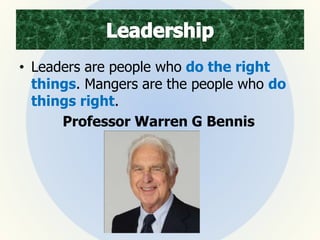
• Leaders are people who do the right
things. Mangers are the people who do
things right.
Professor Warren G Bennis
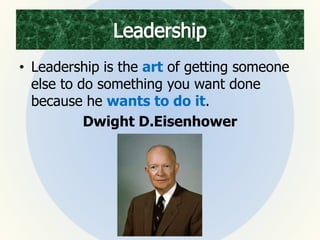
• Leadership is the art of getting someone
else to do something you want done
because he wants to do it.
Dwight D.Eisenhower
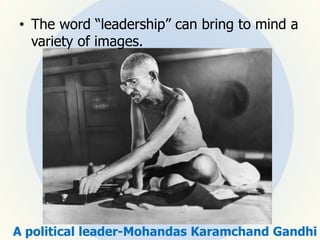
• The word “leadership” can bring to mind a
variety of images.
A political leader-Mohandas Karamchand Gandhi
• An explorer cutting path through the
jungle for the rest of his group to follow.
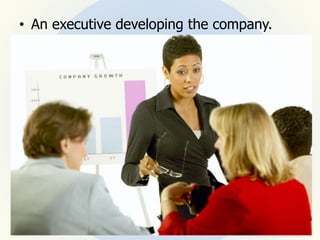
• An executive developing the company.
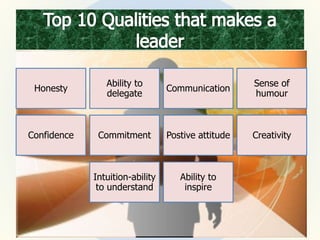
Honesty
Ability to
delegate
Communication
Sense of
humour
Confidence Commitment Postive attitude Creativity
Intuition-ability
to understand
Ability to
inspire
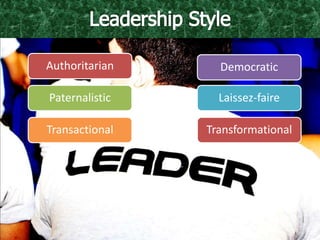
Authoritarian
Paternalistic
Democratic
Laissez-faire
Transactional Transformational
Manager
• Push the employee towards the goal
Leader
• Pulls towards goals
Manager
• Punishes the employees for mistakes
Leader
• Encourage the employees to learn from
mistakes
Manager
• Less flexible, adheres to procedure
Leader
• Flexible policies and procedures are
disregarded based
Manager
• Less flexible, adheres to procedure
Leader
• Flexible policies and procedures are
disregarded based
Manager
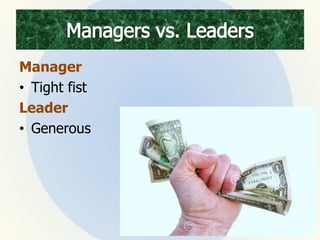
• Tight fist
Leader
• Generous
Manager
• Prefers long hours in the office
Leader
• Doesn’t prefer long hours in the office
Manager
• Hated/disliked by employees
Leader
• Welcomed by employees
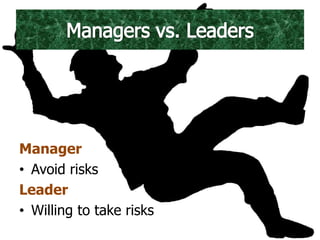
Manager
• Avoid risks
Leader
• Willing to take risks
Manager
• Only few employees are with him
Leader
• All the employees are with him
Manager
• No followers, after his resignation more
people will speak bad about him
Leader
• People will speak “good” about him even
after his departure
Manager
• Responsibility is not sufficiently delegated.
Leader
• Responsibility is delegated among
members.
Manager
• Highly concerned about cost.
Leader
• Low concerned about cost.
Manager
• Lack of creative problem solving skills.
Leader
• Skillful problem solving skills and
creativity.
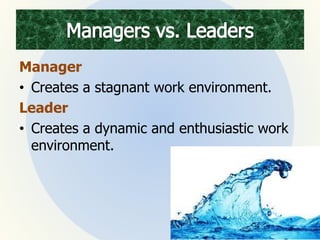
Manager
• Creates a stagnant work environment.
Leader
• Creates a dynamic and enthusiastic work
environment.
• Leadership is a personal quality rather
than character or behaviour.
• Some one will not be a leader if he doesn’t
have followers.
• Leadership can influence someone’s
thoughts and create a behaviour.
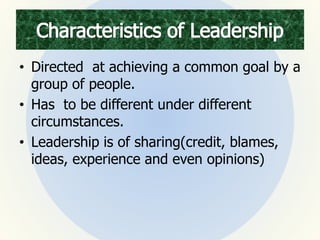
• Directed at achieving a common goal by a
group of people.
• Has to be different under different
circumstances.
• Leadership is of sharing(credit, blames,
ideas, experience and even opinions)
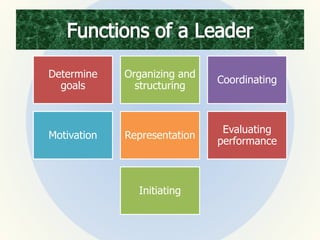
Determine
goals
Organizing and
structuring
Coordinating
Motivation Representation
Evaluating
performance
Initiating
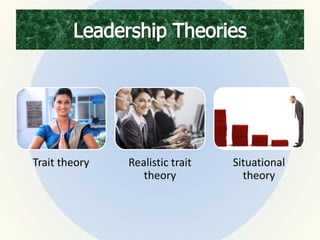
Trait theory Realistic trait
theory
Situational
theory
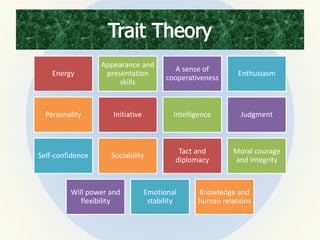
Energy
Appearance and
presentation
skills
A sense of
cooperativeness
Enthusiasm
Personality Initiative Intelligence Judgment
Self-confidence Sociability
Tact and
diplomacy
Moral courage
and integrity
Will power and
flexibility
Emotional
stability
Knowledge and
human relations
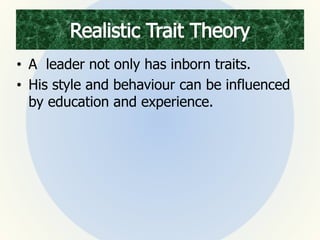
• A leader not only has inborn traits.
• His style and behaviour can be influenced
by education and experience.
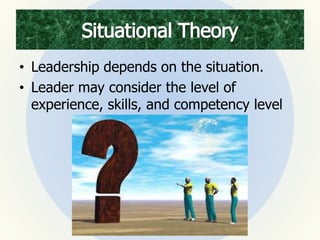
• Leadership depends on the situation.
• Leader may consider the level of
experience, skills, and competency level
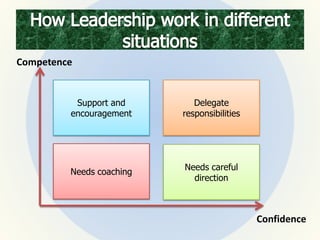
Confidence
Competence
Needs careful
direction
Needs coaching
Support and
encouragement
Delegate
responsibilities
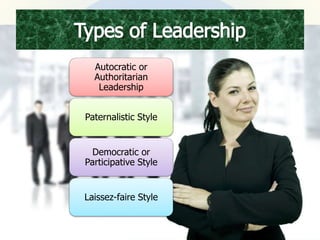
Autocratic or
Authoritarian
Leadership
Paternalistic Style
Democratic or
Participative Style
Laissez-faire Style
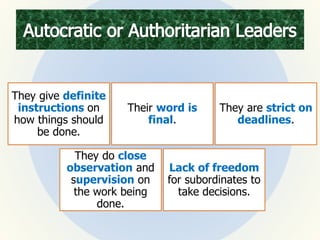
They give definite
instructions on
how things should
be done.
Their word is
final.
They are strict on
deadlines.
They do close
observation and
supervision on
the work being
done.
Lack of freedom
for subordinates to
take decisions.
• Paternalistic leader looks after the
subordinates in the way a father looks
after a family.
• They are also concerned about work.
• But, they also pay attention on the
subordinates.
• The democratic leader works according to
the will of the majority.
• Welcomes the suggestions of
subordinates.
• Gets others participated in making policies
and procedures.
• So, other may adore this leader.
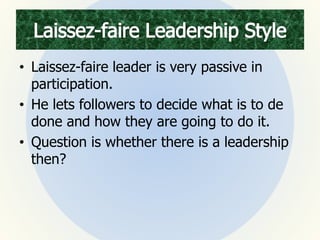
• Laissez-faire leader is very passive in
participation.
• He lets followers to decide what is to de
done and how they are going to do it.
• Question is whether there is a leadership
then?
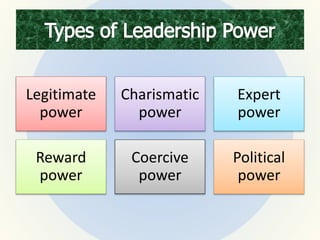
Legitimate
power
Charismatic
power
Expert
power
Reward
power
Coercive
power
Political
power
• It is also called position power or official
power.
• It comes from the designation.
• This depends on leader’s personality.
• This power is generated by the attraction.
• The devotion followers has towards them.
• The charismatic leader has personal
magnetism.
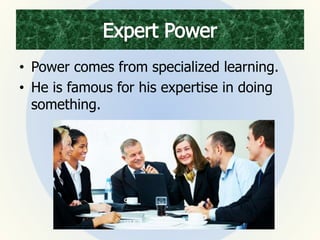
• Power comes from specialized learning.
• He is famous for his expertise in doing
something.
• This arises from the ability to reward good
behaviour.
• Reward power is to do with promotions
and increments
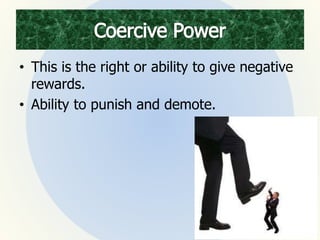
• This is the right or ability to give negative
rewards.
• Ability to punish and demote.
• This power comes from the support from
a group.
• It arises from the leader’s ability to gain
acceptance.
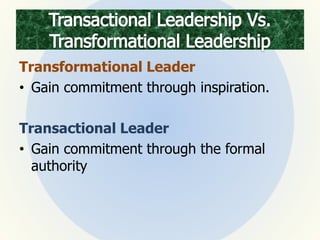
Transformational Leader
• Gain commitment through inspiration.
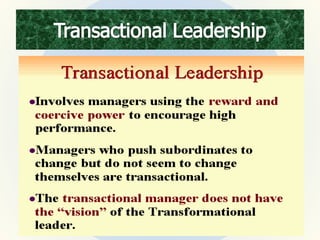
Transactional Leader
• Gain commitment through the formal
authority
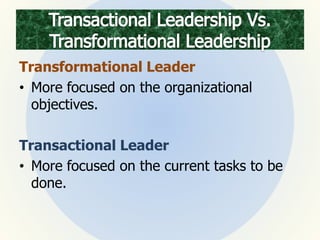
Transformational Leader
• More focused on the organizational
objectives.
Transactional Leader
• More focused on the current tasks to be
done.
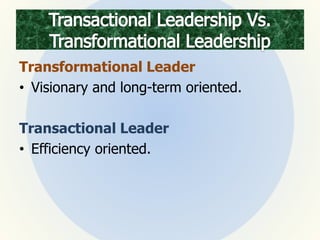
Transformational Leader
• Visionary and long-term oriented.
Transactional Leader
• Efficiency oriented.
Transformational Leader
• Visionary and long-term oriented.
Transactional Leader
• Efficiency oriented.
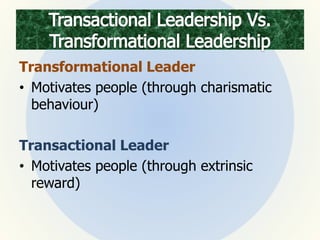
Transformational Leader
• Motivates people (through charismatic
behaviour)
Transactional Leader
• Motivates people (through extrinsic
reward)
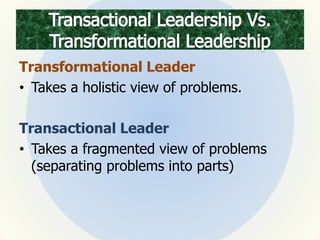
Transformational Leader
• Takes a holistic view of problems.
Transactional Leader
• Takes a fragmented view of problems
(separating problems into parts)
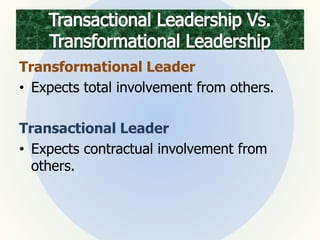
Transformational Leader
• Expects total involvement from others.
Transactional Leader
• Expects contractual involvement from
others.
Transformational Leader
• Expects total involvement from others
Transactional Leader
• Expects contractual involvement from
others
Transformational Leader
• Challenge existing mental models.
Transactional Leader
• Prefers conformity with accepted structure
and system.
Transformational Leader
• Challenge existing mental models.
Transactional Leader
• Prefers conformity with accepted structure
and system.
Transformational Leader
• Empowers people
Transactional Leader
• Delegates authority
Leadership
Leadership
Leadership
Leadership

Leadership