

Prepared by
Savitha shetty
Psychiatric nursing
department
LEADERSHIP
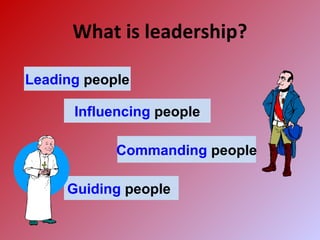
What is leadership?
Leading people
Influencing people
Commanding people
Guiding people
DEFINITION
According to Seckler and Hudson,
“Leadership is influencing and
energising of people to work together
in a common effort to achieve the
purposes of the enterprise”.
PRINCIPLES OF LEADERSHIP
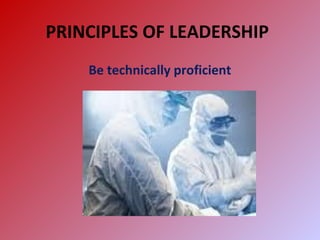
Be technically proficient
Seek responsibility and take
responsibility for your actions
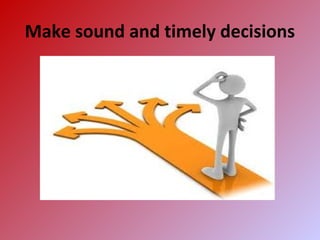
Make sound and timely decisions
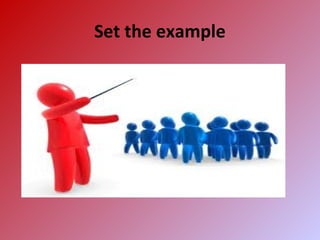
Set the example
Know your people and look out for
their well-being
Keep your workers informed
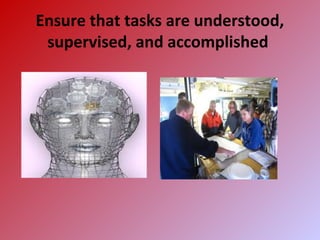
Ensure that tasks are understood,
supervised, and accomplished
Train as a team
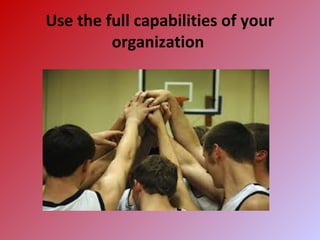
Use the full capabilities of your
organization
CHARACTERISTICS OF LEADRESHIP
• Leadership is a process of influence
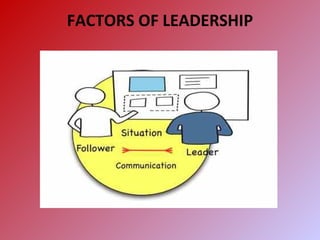
• Leadership is related to a situation
• Leadership is the function of stimulation
• Leadership gives an experience of helping to attain
the common objectives
• Employees must be satisfied with the type of
leadership provided
• Communication
• Credibility
• Delegation
• Critical thinking
• Initiating action
• Risk taking
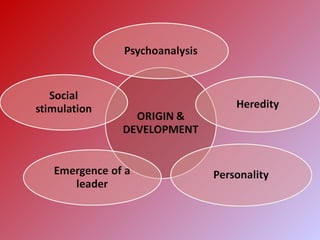
FACTORS OF LEADERSHIP
THEORIES OF LEADERSHIP
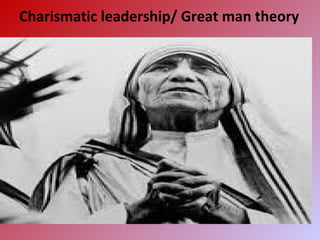
Charismatic leadership/ Great man theory
 Developed by Max Webber
 he believes that a leader is born and is not
made
 Authentic hero in the eyes of his followers
 Leadership calls for certain qualities like
commanding personality, charm, courage,
intelligence, persuasiveness and
aggressiveness. These qualities are of such
a nature that they can’t be taught or learnt in
a formal sense.
 Limitation
 Such qualities could be learnt also
through learning and experience
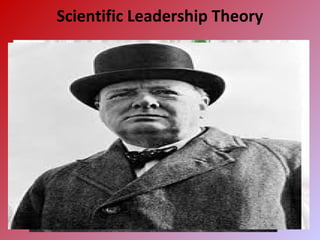
Scientific Leadership Theory
•Developed by Frederick
Winslow Taylor
•Technology as the basis of
increasing productivity
•Careful selection and training
of workers
• Leader wil be the most
competent individual in
planning and organising the
work of subordinates in
scientific way.
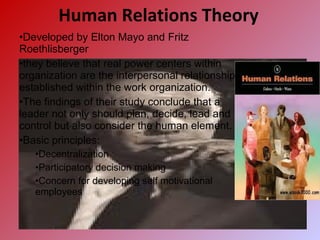
Human Relations Theory
•Developed by Elton Mayo and Fritz
Roethlisberger
•they believe that real power centers within
organization are the interpersonal relationship
established within the work organization.
•The findings of their study conclude that a
leader not only should plan, decide, lead and
control but also consider the human element.
•Basic principles:
•Decentralization
•Participatory decision making
•Concern for developing self motivational
employees
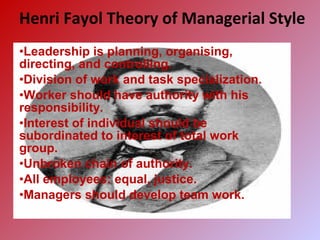
Henri Fayol Theory of Managerial Style
•Leadership is planning, organising,
directing, and controlling.
•Division of work and task specialization.
•Worker should have authority with his
responsibility.
•Interest of individual should be
subordinated to interest of total work
group.
•Unbroken chain of authority.
•All employees: equal, justice.
•Managers should develop team work.
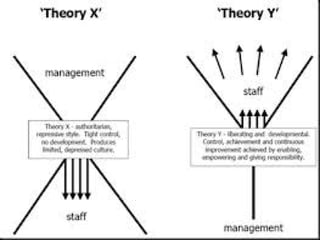
McGregor Theory
Douglas McGregor [1960] categorised leadership style
in to two brand categories
Theory X: leader assumes that people are more
interested in financial incentives than personal
achievements. So Managers exercise strong control and
direction.
Theory Y: Assumes employees enjoy physical and
mental work if they are happy in the organization. Also
believes that people will work harder and assume
responsibilities if they can satisfy their personal needs
as well as goals of their organization.
Theory Z
• Developed by Abraham H Maslow
• Japanese have adapted the principle of
human relation theory, is commonly known as
“theory Z”.
• The theory believes that employee inherently
dislike job.
• So Emphasize on group decision making,
lifetime job security and strong commitment
to goals of organization.
• Results are greater sense of job commitment
and higher productivity.
Trait Theory of Leadership
• Developed by William Paley in 1974
• According to this theory, leader is gifted
with or develops certain physical,
intellectual or personality characteristics.
• Leadership traits are not completely
inborn. These traits are not responsible
solely to identify whether a person will be
a successful leader or not, but they are
essentially seen as preconditions that
endow people with leadership potential.
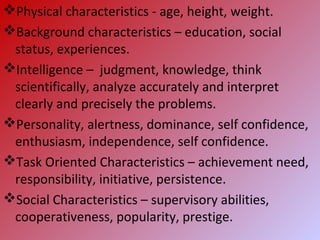
Physical characteristics - age, height, weight.
Background characteristics – education, social
status, experiences.
Intelligence – judgment, knowledge, think
scientifically, analyze accurately and interpret
clearly and precisely the problems.
Personality, alertness, dominance, self confidence,
enthusiasm, independence, self confidence.
Task Oriented Characteristics – achievement need,
responsibility, initiative, persistence.
Social Characteristics – supervisory abilities,
cooperativeness, popularity, prestige.
• Limitations
– There is bound to be some subjective judgment
in determining who is regarded as a ‘good’ or
‘successful’ leader
– There is also a disagreement over which traits
are the most important for an effective leader
– The model attempts to relate physical traits such
as, height and weight, to effective leadership.
Most of these factors relate to situational factors.
For example, a minimum weight and height
might be necessary to perform the tasks
efficiently in a military leadership position. In
business organizations, these are not the
requirements to be an effective leader.
Leader Member Exchange Theory
(LMX)
• Leadership is a process that is centered on the
interactions between leaders and followers.
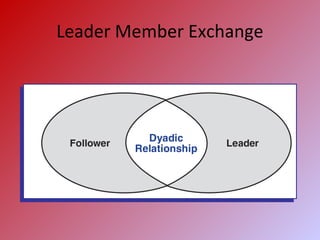
• LMX makes the dyadic relationship between
leaders and followers the focal point of the
leadership process.
• Focus is also placed on the differences that
might exist between the leader and each of his
or her followers – the leader can not treat all
the followers the same.
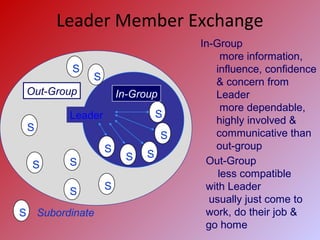
Leader Member Exchange
S Subordinate
In-GroupOut-Group
Leader
S
S
S
S S
S
S
S S
S
S
S
In-Group
more information,
influence, confidence
& concern from
Leader
more dependable,
highly involved &
communicative than
out-group
Out-Group
less compatible
with Leader
usually just come to
work, do their job &
go home
Weakness
• On the surface this theory doesn’t seem “fair”
because it does not treat everyone equally.
Also can support the development of privileged
groups in the work place.
• The basic ideas of the theory are not fully
developed. Fails to explain how high quality
exchanges are created.
• No part of the research uses dyadic measures
to analyze the LMX process
Situational Theory
• In this approach, a leader is the product of a
given situation and the behavior may in fact
vary from one situation to another.
Natural leader – Mahatma Gandhi
Rational leader - Plato
Consensus Leader – president of nation
Leader by Force - Nepolian
Behavioural theory
• Leadership is shown by a person’s acts more
than by his traits
• leader behaves according to the role
expectations of the group
• This theorist believes that leadership style like
other behaviours can be learned, regulated
and developed.
• Leadership behaviour views in 2 ways
– Functional behaviour
– Dysfunctional behaviour
Transformational theories
• It arose late in the last millennium.
• Leaders who effectively transformed
structures, human resources and profitably
balanced with quality.
• It refers to process whereby the leader
attends to the needs and motives of morality.
• The leader is a role model who inspires
followers through displayed optimism,
provides intellectual stimulation and
encourages follower creativity.
Criticism
• Transformational leadership makes use of
impression management and therefore lends
itself to self promotion by leaders
• The theory is very difficult to be trained or
taught because it is a combination of many
leadership theories.
• Followers might be manipulated by leaders
and there are chances that they lose more
than they gain.
Transactional theory
• The transactional style of leadership was first
described by Max Weber in 1947 and then by
Bernard Bass in 1981.
• Here, the exchange between leader and
follower takes place to achieve routine
performance goals
– Rewards
– Active management by exception
– Passive management by exception
– Laissez-faire
LEADERSHIP STYLE
• Refers to leader’s behaviours
• The style varies with the personality of the
leader.
• Most often, leader exhibits some
characteristics of each style of leadership
though one style will typically be more
dominant.
Autocratic/ authoritarian leader
• “you do what I say, I know that is best for you”.
• There are three categories of autocratic
leadership;
– Strict autocrat
– Benevolent autocrat
– Manipulative autocrat
• Behavior of leader
– Strong control is maintained over groups.
– Communication flows downwards.
– Decision making does not involve others
– Criticism is punitive
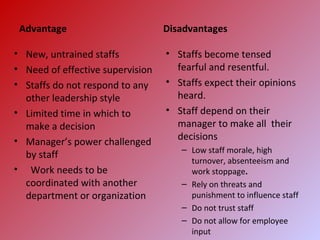
Advantage
• New, untrained staffs
• Need of effective supervision
• Staffs do not respond to any
other leadership style
• Limited time in which to
make a decision
• Manager’s power challenged
by staff
• Work needs to be
coordinated with another
department or organization
Disadvantages
• Staffs become tensed
fearful and resentful.
• Staffs expect their opinions
heard.
• Staff depend on their
manager to make all their
decisions
– Low staff morale, high
turnover, absenteeism and
work stoppage.
– Rely on threats and
punishment to influence staff
– Do not trust staff
– Do not allow for employee
input
Democratic/ participative/
creative leader
• gives instructions only after consulting the group
• the leader values the individual values, the
individual characteristics and abilities of each
subordinate.
• people centred approach
• It is a creative leadership; here leader delegates
authority to subordinates
• Participative style of leadership is a compromise
between autocratic and democratic styles
Behaviors
• Less control is maintained.
• Economic and ego awards are used to
motivate
• Others are directive through suggestions and
guidance
• Communication flows up to down
• Emphasis in ‘’we’’ rather than I and you
• Criticism is constructive.
Advantages
• improves the attitudes of
employees
• increases the cooperation
• deduction in the number of
complaints and grievance
• Increases the morale of the
employees
• help staff evaluate their own
performance
• Allows staff to establish goals
• Recognizes and encourages
Achievement
Disadvantages
• Time consuming
• Manager feels threatened
by this type of leadership
• Staff safety is a critical
concern
Laissez faire/ free rein/ abdicratic
leaders
• does not lead, but leaves the group entirely to itself
• also referred to as the freedom style or permissive
leadership
• This type of leader denies responsibilities and
abdicates authority to group
• Here leader chooses not to adopt a leadership role
• The leader may think that subordinates will perform
better if a great deal of freedom is given.
• This style will be effective where the subordinates
are highly motivated and experienced.
Behavior of leader
• He or she is permissive with little or no control
• Motivates by support when requested by the
group or individual
• Little or no direction is provided
• Communication is between members of group
and upward and downward
• Decision making is dispersed throughout the
group
• Emphasis on the group
• Criticism not given.
Bureaucratic /Transaction– “ by
book”
Effective
• performing routine tasks
• Staffs needs to understand
standards or procedures
• Safety or security training
need to conducted
• Staff performing tasks that
require handling cash
Ineffective
• Bookish knowledge is no
longer useful
• Work habits form that are
hard to break
• Loss of interest
• Staff do only what is
expected of them
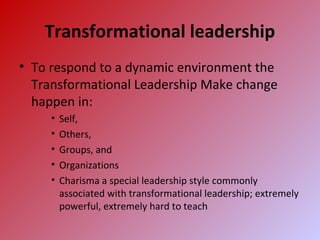
Transformational leadership
• To respond to a dynamic environment the
Transformational Leadership Make change
happen in:
• Self,
• Others,
• Groups, and
• Organizations
• Charisma a special leadership style commonly
associated with transformational leadership; extremely
powerful, extremely hard to teach
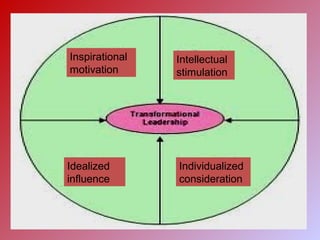
Inspirational
motivation
Intellectual
stimulation
Individualized
consideration
Idealized
influence
• Corrective Leadership
• Change Leadership
• Intelligence Leadership
• Multicultural Leadership
• Pedagogical Leadership
• Servant Leadership
• Bridging leadership
• Quite Leadership
THE NURSE AS A LEADER
• LEADERSHIP WITHIN THE WORKPLACE
– The staff nurse as a leader
– Nurses as community volunteers
• LEADERSHIP THROUGH APPOINTED AND
ELECTED OFFICE
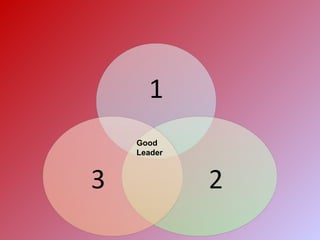
Which Type of leader you want to
be?
Good
Leader
Queries??????
???
“Not everything old was bad and
not everything new is good.”
THANK YOU

Leadership (2)

  • 1.
  • 2.
  • 3.
    What is leadership? Leadingpeople Influencing people Commanding people Guiding people
  • 4.
    DEFINITION According to Secklerand Hudson, “Leadership is influencing and energising of people to work together in a common effort to achieve the purposes of the enterprise”.
  • 6.
    PRINCIPLES OF LEADERSHIP Betechnically proficient
  • 7.
    Seek responsibility andtake responsibility for your actions
  • 8.
    Make sound andtimely decisions
  • 9.
  • 10.
    Know your peopleand look out for their well-being
  • 11.
  • 12.
    Ensure that tasksare understood, supervised, and accomplished
  • 13.
  • 14.
    Use the fullcapabilities of your organization
  • 15.
    CHARACTERISTICS OF LEADRESHIP •Leadership is a process of influence • Leadership is related to a situation • Leadership is the function of stimulation • Leadership gives an experience of helping to attain the common objectives • Employees must be satisfied with the type of leadership provided • Communication • Credibility • Delegation • Critical thinking • Initiating action • Risk taking
  • 16.
  • 17.
  • 18.
    Charismatic leadership/ Greatman theory  Developed by Max Webber  he believes that a leader is born and is not made  Authentic hero in the eyes of his followers  Leadership calls for certain qualities like commanding personality, charm, courage, intelligence, persuasiveness and aggressiveness. These qualities are of such a nature that they can’t be taught or learnt in a formal sense.  Limitation  Such qualities could be learnt also through learning and experience
  • 19.
    Scientific Leadership Theory •Developedby Frederick Winslow Taylor •Technology as the basis of increasing productivity •Careful selection and training of workers • Leader wil be the most competent individual in planning and organising the work of subordinates in scientific way.
  • 20.
    Human Relations Theory •Developedby Elton Mayo and Fritz Roethlisberger •they believe that real power centers within organization are the interpersonal relationship established within the work organization. •The findings of their study conclude that a leader not only should plan, decide, lead and control but also consider the human element. •Basic principles: •Decentralization •Participatory decision making •Concern for developing self motivational employees
  • 21.
    Henri Fayol Theoryof Managerial Style •Leadership is planning, organising, directing, and controlling. •Division of work and task specialization. •Worker should have authority with his responsibility. •Interest of individual should be subordinated to interest of total work group. •Unbroken chain of authority. •All employees: equal, justice. •Managers should develop team work.
  • 22.
    McGregor Theory Douglas McGregor[1960] categorised leadership style in to two brand categories Theory X: leader assumes that people are more interested in financial incentives than personal achievements. So Managers exercise strong control and direction. Theory Y: Assumes employees enjoy physical and mental work if they are happy in the organization. Also believes that people will work harder and assume responsibilities if they can satisfy their personal needs as well as goals of their organization.
  • 24.
    Theory Z • Developedby Abraham H Maslow • Japanese have adapted the principle of human relation theory, is commonly known as “theory Z”. • The theory believes that employee inherently dislike job. • So Emphasize on group decision making, lifetime job security and strong commitment to goals of organization. • Results are greater sense of job commitment and higher productivity.
  • 25.
    Trait Theory ofLeadership • Developed by William Paley in 1974 • According to this theory, leader is gifted with or develops certain physical, intellectual or personality characteristics. • Leadership traits are not completely inborn. These traits are not responsible solely to identify whether a person will be a successful leader or not, but they are essentially seen as preconditions that endow people with leadership potential.
  • 26.
    Physical characteristics -age, height, weight. Background characteristics – education, social status, experiences. Intelligence – judgment, knowledge, think scientifically, analyze accurately and interpret clearly and precisely the problems. Personality, alertness, dominance, self confidence, enthusiasm, independence, self confidence. Task Oriented Characteristics – achievement need, responsibility, initiative, persistence. Social Characteristics – supervisory abilities, cooperativeness, popularity, prestige.
  • 27.
    • Limitations – Thereis bound to be some subjective judgment in determining who is regarded as a ‘good’ or ‘successful’ leader – There is also a disagreement over which traits are the most important for an effective leader – The model attempts to relate physical traits such as, height and weight, to effective leadership. Most of these factors relate to situational factors. For example, a minimum weight and height might be necessary to perform the tasks efficiently in a military leadership position. In business organizations, these are not the requirements to be an effective leader.
  • 28.
    Leader Member ExchangeTheory (LMX) • Leadership is a process that is centered on the interactions between leaders and followers. • LMX makes the dyadic relationship between leaders and followers the focal point of the leadership process. • Focus is also placed on the differences that might exist between the leader and each of his or her followers – the leader can not treat all the followers the same.
  • 29.
  • 30.
    Leader Member Exchange SSubordinate In-GroupOut-Group Leader S S S S S S S S S S S S In-Group more information, influence, confidence & concern from Leader more dependable, highly involved & communicative than out-group Out-Group less compatible with Leader usually just come to work, do their job & go home
  • 31.
    Weakness • On thesurface this theory doesn’t seem “fair” because it does not treat everyone equally. Also can support the development of privileged groups in the work place. • The basic ideas of the theory are not fully developed. Fails to explain how high quality exchanges are created. • No part of the research uses dyadic measures to analyze the LMX process
  • 32.
    Situational Theory • Inthis approach, a leader is the product of a given situation and the behavior may in fact vary from one situation to another. Natural leader – Mahatma Gandhi Rational leader - Plato Consensus Leader – president of nation Leader by Force - Nepolian
  • 33.
    Behavioural theory • Leadershipis shown by a person’s acts more than by his traits • leader behaves according to the role expectations of the group • This theorist believes that leadership style like other behaviours can be learned, regulated and developed.
  • 34.
    • Leadership behaviourviews in 2 ways – Functional behaviour – Dysfunctional behaviour
  • 35.
    Transformational theories • Itarose late in the last millennium. • Leaders who effectively transformed structures, human resources and profitably balanced with quality. • It refers to process whereby the leader attends to the needs and motives of morality. • The leader is a role model who inspires followers through displayed optimism, provides intellectual stimulation and encourages follower creativity.
  • 36.
    Criticism • Transformational leadershipmakes use of impression management and therefore lends itself to self promotion by leaders • The theory is very difficult to be trained or taught because it is a combination of many leadership theories. • Followers might be manipulated by leaders and there are chances that they lose more than they gain.
  • 37.
    Transactional theory • Thetransactional style of leadership was first described by Max Weber in 1947 and then by Bernard Bass in 1981. • Here, the exchange between leader and follower takes place to achieve routine performance goals – Rewards – Active management by exception – Passive management by exception – Laissez-faire
  • 38.
    LEADERSHIP STYLE • Refersto leader’s behaviours • The style varies with the personality of the leader. • Most often, leader exhibits some characteristics of each style of leadership though one style will typically be more dominant.
  • 39.
    Autocratic/ authoritarian leader •“you do what I say, I know that is best for you”. • There are three categories of autocratic leadership; – Strict autocrat – Benevolent autocrat – Manipulative autocrat • Behavior of leader – Strong control is maintained over groups. – Communication flows downwards. – Decision making does not involve others – Criticism is punitive
  • 40.
    Advantage • New, untrainedstaffs • Need of effective supervision • Staffs do not respond to any other leadership style • Limited time in which to make a decision • Manager’s power challenged by staff • Work needs to be coordinated with another department or organization Disadvantages • Staffs become tensed fearful and resentful. • Staffs expect their opinions heard. • Staff depend on their manager to make all their decisions – Low staff morale, high turnover, absenteeism and work stoppage. – Rely on threats and punishment to influence staff – Do not trust staff – Do not allow for employee input
  • 41.
    Democratic/ participative/ creative leader •gives instructions only after consulting the group • the leader values the individual values, the individual characteristics and abilities of each subordinate. • people centred approach • It is a creative leadership; here leader delegates authority to subordinates • Participative style of leadership is a compromise between autocratic and democratic styles
  • 42.
    Behaviors • Less controlis maintained. • Economic and ego awards are used to motivate • Others are directive through suggestions and guidance • Communication flows up to down • Emphasis in ‘’we’’ rather than I and you • Criticism is constructive.
  • 43.
    Advantages • improves theattitudes of employees • increases the cooperation • deduction in the number of complaints and grievance • Increases the morale of the employees • help staff evaluate their own performance • Allows staff to establish goals • Recognizes and encourages Achievement Disadvantages • Time consuming • Manager feels threatened by this type of leadership • Staff safety is a critical concern
  • 44.
    Laissez faire/ freerein/ abdicratic leaders • does not lead, but leaves the group entirely to itself • also referred to as the freedom style or permissive leadership • This type of leader denies responsibilities and abdicates authority to group • Here leader chooses not to adopt a leadership role • The leader may think that subordinates will perform better if a great deal of freedom is given. • This style will be effective where the subordinates are highly motivated and experienced.
  • 45.
    Behavior of leader •He or she is permissive with little or no control • Motivates by support when requested by the group or individual • Little or no direction is provided • Communication is between members of group and upward and downward • Decision making is dispersed throughout the group • Emphasis on the group • Criticism not given.
  • 47.
    Bureaucratic /Transaction– “by book” Effective • performing routine tasks • Staffs needs to understand standards or procedures • Safety or security training need to conducted • Staff performing tasks that require handling cash Ineffective • Bookish knowledge is no longer useful • Work habits form that are hard to break • Loss of interest • Staff do only what is expected of them
  • 48.
    Transformational leadership • Torespond to a dynamic environment the Transformational Leadership Make change happen in: • Self, • Others, • Groups, and • Organizations • Charisma a special leadership style commonly associated with transformational leadership; extremely powerful, extremely hard to teach
  • 49.
  • 50.
    • Corrective Leadership •Change Leadership • Intelligence Leadership • Multicultural Leadership • Pedagogical Leadership • Servant Leadership • Bridging leadership • Quite Leadership
  • 52.
    THE NURSE ASA LEADER • LEADERSHIP WITHIN THE WORKPLACE – The staff nurse as a leader – Nurses as community volunteers • LEADERSHIP THROUGH APPOINTED AND ELECTED OFFICE
  • 53.
    Which Type ofleader you want to be?
  • 54.
  • 55.
  • 56.
    “Not everything oldwas bad and not everything new is good.” THANK YOU