

Training & Development
Krishantha Jayasundara
BA (English, Psychology,Sociology) University of Peradeniya, PQHRM(IPM), NDTHRD(IPM)
Change
2
3
Change
4
Introduction
Change is inevitable 5
Introduction
Change is inevitable 6
Introduction
Change is inevitable 7
Introduction
Change is inevitable 8
Introduction
• Change is inevitable
9
Introduction
• Change is inevitable
10
11
Introduction
• The training & development play a major
role in modern organizations due to the
rapid change in technology & the working
environment
12
Introduction
• Globalization of markets & the increasing
competitions are reasons for it.
13
Introduction
• Multi-skilled workforce, efficiency, and
adoptability are important.
14
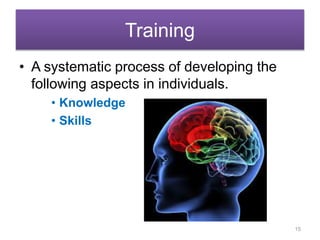
Training
• A systematic process of developing the
following aspects in individuals.
• Knowledge
• Skills
15
Training
16
Training
• A systematic process of developing the
following aspects in individuals.
• Technology
• Needed to perform better in the present
job
17
Development
• Helping an individual to successfully meet
more challenging job tasks in the future
18
Training vs. Development
Training
Current
Job
Knowledge
Skills
Attitude
19
Training vs. Development
Development
Future Job
Tasks
Knowledge
Skills
Attitude
20
Training vs. Development
Training
focuses on
current job
Development
focuses on
future job
tasks
21
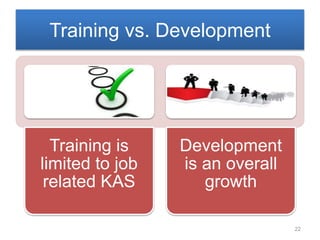
Training vs. Development
Training is
limited to job
related KAS
Development
is an overall
growth
22
Training vs. Development
Training is
temporary in
nature
Development
is permanent
in nature
23
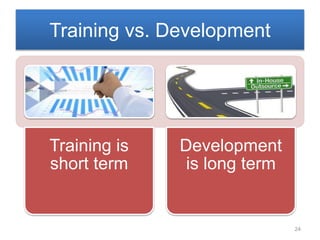
Training vs. Development
Training is
short term
Development
is long term
24
Training vs. Development
Training is for
better
performance
in current job
Development
is for better
performance
in future jobs
25
Importance of Training
• Improve Product quality
26
Importance of Training
• Improve quality of service levels- customer
satisfaction
27
Importance of Training
• Use hidden potentials of people
28
Importance of Training
• Increase moral and attitudes
29
Importance of Training
• Career progression
30
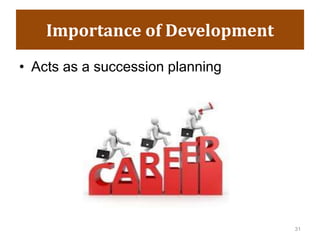
Importance of Development
• Acts as a succession planning
31
Importance of Development
32
Importance of Development
• Tracking for long term HR Goals
33
34
Steps of Training
1. Training needs
35
Steps of Training
1. Training needs
The needs of the following level should be
understood
I. Individual level
II. Occupational level
III. Organizational level
36
Steps of Training
2. Analyzing training needs
• Finding the gap between the current skill
levels and the desired skill level
37
Steps of Training
• These are the indications of training needs
 Drop in productivity
38
Steps of Training
• These are the indications of training needs
 Conflicts
39
Steps of Training
• These are the indications of training needs
 Product defects
40
Steps of Training
• These are the indications of training needs
 Staff turnover
41
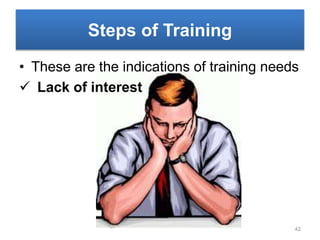
Steps of Training
• These are the indications of training needs
 Lack of interest
42
Steps of Training
• These are the indications of training needs
 Loss of market share
43
Steps of Training
3. Planning and designing training
programmes
• Objectives of the programme
44
Steps of Training
3. Planning and designing training
programmes
• Identify the target group (knowledge/Skills/
Age)
45
Steps of Training
3. Planning and designing training
programmes
• Programme content (should be suitable for
the target group)
46
Steps of Training
3. Planning and designing training
programmes
• Administration and costing (fixed cost-fee
of the lecturer/documents...est. /variable
costs)
47
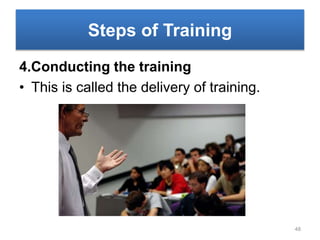
Steps of Training
4.Conducting the training
• This is called the delivery of training.
48
Steps of Training
4.Conducting the training
• Taking the attention of employees is very
important because the success of the
training programme depends on it
49
Steps of Training
4.Conducting the training
• The trainer should have skills to deliver
(presentation skills/knowledge)
50
Steps of Training
4.Conducting the training
51
Steps of Training
5. Training Evaluation
• The success of the training can be
measured by evaluating it.
52
Steps of Training
5. Training Evaluation
53
Steps of Training
5. Training Evaluation
54
Steps of Training
5. Training Evaluation
• Training evaluation helps us understand
whether we have actually met our
objectives.
55
Steps of Training
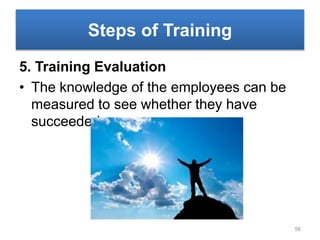
5. Training Evaluation
• The knowledge of the employees can be
measured to see whether they have
succeeded
56
Steps of Training
• Training can be evaluated at 5 levels
57
Steps of Training
• Training development level
58
Steps of Training
• Participant reaction level
59
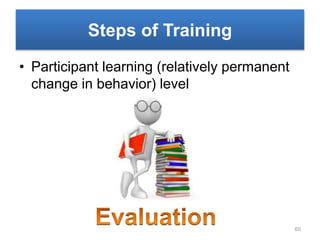
Steps of Training
• Participant learning (relatively permanent
change in behavior) level
60
Steps of Training
• Job behavioural level
61
Steps of Training
• Organizational level
62
Training Methods
• Lecture method
63
Training Methods
• On the job training (OJT)
64
Training Methods
• Off the job training
65
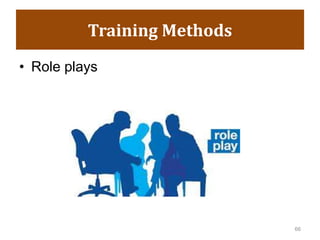
Training Methods
• Role plays
66
Training Methods
• Case study method
67
Training Methods
• Computer aided instruction
68
Learning Objectives
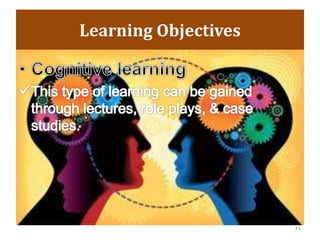
• Cognitive learning
Cognitive refers knowledge learning
(gather knowledge)
69
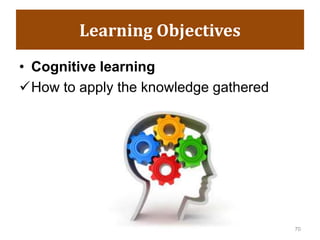
Learning Objectives
• Cognitive learning
How to apply the knowledge gathered
70
Learning Objectives
71
Learning Objectives
• Psychomotor Learning
Acquiring physical skills to successfully
complete a job task
72
Learning Objectives
• Affective Learning
It means the development of attitudes,
values & interests.
73
Learning Objectives
• Affective Learning
This is the most difficult part in training
because usually it is hard to change or
create the attitudes in people
74
Learning Objectives
• Affective Learning
The trainer should be highly professional
to handle this area of training.
75
Barriers to Learning
Trainee
Centered
Barriers
Trainer
Centered
Barriers
Environmental
Barriers
76
Barriers to Learning
• Trainee centered barriers
Language and speech barriers
77
Barriers to Learning
• Trainee centered barriers
Know it all syndrome (trainee thinks that
he knows everything)
78
Barriers to Learning
• Trainee centered barriers
Negativity
79
Barriers to Learning
• Trainee centered barriers
Shyness or aggression
80
Barriers to Learning
• Trainee centered barriers
Resistance to change
81
Barriers to Learning
• Barriers attributed to trainer
Unskilled trainer
82
Barriers to Learning
• Barriers attributed to trainer
Wrong techniques and approach
83
Barriers to Learning
• Barriers attributed to trainer
Accents
84
Barriers to Learning
• Barriers attributed to trainer
Manner of delivery
85
Barriers to Learning
• Barriers attributed to trainer
Lack of subject knowledge
86
Barriers to Learning
• Environmental barriers
Noise, cold, heat
87
Barriers to Learning
• Environmental barriers
lack of ventilation
88
Barriers to Learning
• Environmental barriers
Disturbances
89
Barriers to Learning
• Environmental barriers
Time constraints (limitations of time)
90

Training and development