Krishantha Jayasundara
BA(Peradeniya),PQHRM(IPM),NDTHRD(IPM).Following
2
Learning Outcomes
To identify Human resources and its importance to an
organization.
To define HRM
To identify Industrial revolution and birth of HRM.
To compare and contrast Personnel management with HRM
To list down Advantages of good HRM
To identify poor practices of HRM
To identify Key Result Ares of HRM
3
Human Resource Management
• What is Human?
• What is Resource?
• What is management?
• What is the purpose?
4
Definitions of HRM
The philosophy, policies,
procedures and practices
related to the management of
people within the organization.
5
Definitions of HRM
A method of maximizing
economic returns from labour
resources by integrating HRM
into business strategy.
6
Definitions of HRM
Human resource management is the
functions performed in organizations that
facilitates the most effective use of
people to achieve organizational and
individual goals.
7
Pre-Industrial Era
• There were not machines and tools to
help people perform tasks.
• Production was limited.
• Primarily an agricultural economy.
• Limited division of labour.
8
Industrial Revolution & the factory
System
• Industrial revolution began,
• in United Kingdom in late 18th century
• United States of America in 19th century
• India in the second half of the 20th century
9
Industrial Revolution & the factory
System
• Changes in the way people earned their
living (replacement of human effort by
machines)
• Development of a factory system.
• Factory system displaced the self-
employment of household and handicraft.
10
Scientific Management
• Frederick Taylor-father of scientific
management.
• Time and motion study
• Study of elements of jobs to identify time
wasters
• Identify unnecessary movements.
• “One best way” of doing things.
11
Principles of Scientific Management
Replacing rule of thumb (based on practice rather than theory)
with science (Organized Knowledge)
Harmony in group actions
Dealing with management inefficiencies through rationalization
of work
Developing Standards methods for jobs
Selecting workers with appropriate abilities for each job
Training workers with standard methods
12
Contribution of Scientific
Management to HRM
Taylor’s proposal for functional management created a need for
a separate HR functions
Taylor spoke about job analysis as a basis for selection, training
and job evolutions.
Taylor demonstrated that work and jobs can be studied,
analyzed and redesigned.
He stressed the importance of proper selection procedures and
training methods
He generated the idea of differential pay on the basis of
productivity.
He mentioned of the need of workers to be won over and led
by the management
13
Weaknesses of Scientific
Management
Social context of work and
higher need of employees
were not identified.
Individual differences were
not identified
Perceived all works as
uniformed and ignored
their ideas and suggestions
14
Why is it difficult to effectively
manage people?
Uniqueness of
People
Complexity
Unpredictable
Difficulty to
motivate
Unending Needs
15
Personnel Management VS Human
Resource Management
16
Personnel
Management
Human Resource
Management
Manages people
Consider people as a
resource that can be
developed
A manager needs only basis
skills
Specialist or a professionally
qualified manager
Admin oriented/more rules
and strict control
Development
oriented/motivation
Less concerned of future
potential
Training and development
A job A career
17
Advantages of HRM
Adding value to
organization
Improve processDecrease cost
Increase
efficiency
High
performance
18
Advantages of HRM
Development of
employees
Develop
Attitudes
Develop
Knowledge
Develop skills
19
Advantages of HRM
Improvement of
performance
FacilitationMotivationTraining
20
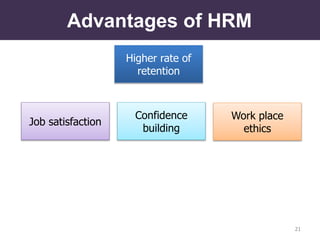
Advantages of HRM
Higher rate of
retention
Work place
ethics
Confidence
building
Job satisfaction
21
Group Activity
Form 04 groups
List down 10 advantages of
Human Resource Management.
Present them to the class
22
Consequences of Poor HRM
• Employees will confront the organization.
23
Consequences of Poor HRM
• Develop interest to stay away from the
job.
24
Consequences of Poor HRM
• People allow skills to deteriorate.
25
Consequences of Poor HRM
• Poor motivation.
26
Consequences of Poor HRM
• Hire wrong person for the job
27
Consequences of Poor HRM
• High turnover.
28
Consequences of Poor HRM
• Skills underutilized.
29
Consequences of Poor HRM
• Time wasters
30
Consequences of Poor HRM
• Have the company taken to court due to
disciplinary actions
31
Consequences of Poor HRM
• Have the company cited by labour
department for unsafe practices.
32
Consequences of Poor HRM
• Make some employees think that their
salaries are unfair.
33
Consequences of Poor HRM
• Unfair labour practices
34
Consequences of Poor HRM
• Lack of training results in inefficiency.
35
Key Result Ares of HRM
KPI-Key
Performance
Indicators
These are the areas on which the performance
and the expected results of any organization
depend on
36
Key Result Areas
Human Resource
Planning
Administration of
Compensation
Human Resource
Development
Employee Welfare
Employee
Relations
Formulation of
procedures and
practices.
Health and Safety
Performance
Management
Recruitment
& Selection
37
Human Resource Management
Activities
Strategic Human
Resource Activities
Advisory HR Activities
Operational HR
Activities
38
Strategic Human Resource Activities
Policy Making
Designing human
resource strategies
Contributing to the
cooperate plan
Integrating HR
activities
39
Advisory HR Activities
HR planning Industrial Relations
Industrial law
Training and
Development
Management
Development
Organizational
Development
40
Operational HR Activities
Recruitment and
Selection
Job Analysis
Job Evaluation
Salary
Administration
Incentive
Administration of
Grievances
Disciplinary
procedures
Communication
41
Wendell French’s Scope of HRM
Human Resource
Planning
Job and work
design
Staffing
Training and
Development
Performance
Appraisal and
Review
Compensation and
Rewards
Management
Employee
Protection and
representation
Managerial and
Organizational
development
42
43

Introduction to Human Resource Management

  • 1.
  • 2.
  • 3.
    Learning Outcomes To identifyHuman resources and its importance to an organization. To define HRM To identify Industrial revolution and birth of HRM. To compare and contrast Personnel management with HRM To list down Advantages of good HRM To identify poor practices of HRM To identify Key Result Ares of HRM 3
  • 4.
    Human Resource Management •What is Human? • What is Resource? • What is management? • What is the purpose? 4
  • 5.
    Definitions of HRM Thephilosophy, policies, procedures and practices related to the management of people within the organization. 5
  • 6.
    Definitions of HRM Amethod of maximizing economic returns from labour resources by integrating HRM into business strategy. 6
  • 7.
    Definitions of HRM Humanresource management is the functions performed in organizations that facilitates the most effective use of people to achieve organizational and individual goals. 7
  • 8.
    Pre-Industrial Era • Therewere not machines and tools to help people perform tasks. • Production was limited. • Primarily an agricultural economy. • Limited division of labour. 8
  • 9.
    Industrial Revolution &the factory System • Industrial revolution began, • in United Kingdom in late 18th century • United States of America in 19th century • India in the second half of the 20th century 9
  • 10.
    Industrial Revolution &the factory System • Changes in the way people earned their living (replacement of human effort by machines) • Development of a factory system. • Factory system displaced the self- employment of household and handicraft. 10
  • 11.
    Scientific Management • FrederickTaylor-father of scientific management. • Time and motion study • Study of elements of jobs to identify time wasters • Identify unnecessary movements. • “One best way” of doing things. 11
  • 12.
    Principles of ScientificManagement Replacing rule of thumb (based on practice rather than theory) with science (Organized Knowledge) Harmony in group actions Dealing with management inefficiencies through rationalization of work Developing Standards methods for jobs Selecting workers with appropriate abilities for each job Training workers with standard methods 12
  • 13.
    Contribution of Scientific Managementto HRM Taylor’s proposal for functional management created a need for a separate HR functions Taylor spoke about job analysis as a basis for selection, training and job evolutions. Taylor demonstrated that work and jobs can be studied, analyzed and redesigned. He stressed the importance of proper selection procedures and training methods He generated the idea of differential pay on the basis of productivity. He mentioned of the need of workers to be won over and led by the management 13
  • 14.
    Weaknesses of Scientific Management Socialcontext of work and higher need of employees were not identified. Individual differences were not identified Perceived all works as uniformed and ignored their ideas and suggestions 14
  • 15.
    Why is itdifficult to effectively manage people? Uniqueness of People Complexity Unpredictable Difficulty to motivate Unending Needs 15
  • 16.
    Personnel Management VSHuman Resource Management 16
  • 17.
    Personnel Management Human Resource Management Manages people Considerpeople as a resource that can be developed A manager needs only basis skills Specialist or a professionally qualified manager Admin oriented/more rules and strict control Development oriented/motivation Less concerned of future potential Training and development A job A career 17
  • 18.
    Advantages of HRM Addingvalue to organization Improve processDecrease cost Increase efficiency High performance 18
  • 19.
    Advantages of HRM Developmentof employees Develop Attitudes Develop Knowledge Develop skills 19
  • 20.
    Advantages of HRM Improvementof performance FacilitationMotivationTraining 20
  • 21.
    Advantages of HRM Higherrate of retention Work place ethics Confidence building Job satisfaction 21
  • 22.
    Group Activity Form 04groups List down 10 advantages of Human Resource Management. Present them to the class 22
  • 23.
    Consequences of PoorHRM • Employees will confront the organization. 23
  • 24.
    Consequences of PoorHRM • Develop interest to stay away from the job. 24
  • 25.
    Consequences of PoorHRM • People allow skills to deteriorate. 25
  • 26.
    Consequences of PoorHRM • Poor motivation. 26
  • 27.
    Consequences of PoorHRM • Hire wrong person for the job 27
  • 28.
    Consequences of PoorHRM • High turnover. 28
  • 29.
    Consequences of PoorHRM • Skills underutilized. 29
  • 30.
    Consequences of PoorHRM • Time wasters 30
  • 31.
    Consequences of PoorHRM • Have the company taken to court due to disciplinary actions 31
  • 32.
    Consequences of PoorHRM • Have the company cited by labour department for unsafe practices. 32
  • 33.
    Consequences of PoorHRM • Make some employees think that their salaries are unfair. 33
  • 34.
    Consequences of PoorHRM • Unfair labour practices 34
  • 35.
    Consequences of PoorHRM • Lack of training results in inefficiency. 35
  • 36.
    Key Result Aresof HRM KPI-Key Performance Indicators These are the areas on which the performance and the expected results of any organization depend on 36
  • 37.
    Key Result Areas HumanResource Planning Administration of Compensation Human Resource Development Employee Welfare Employee Relations Formulation of procedures and practices. Health and Safety Performance Management Recruitment & Selection 37
  • 38.
    Human Resource Management Activities StrategicHuman Resource Activities Advisory HR Activities Operational HR Activities 38
  • 39.
    Strategic Human ResourceActivities Policy Making Designing human resource strategies Contributing to the cooperate plan Integrating HR activities 39
  • 40.
    Advisory HR Activities HRplanning Industrial Relations Industrial law Training and Development Management Development Organizational Development 40
  • 41.
    Operational HR Activities Recruitmentand Selection Job Analysis Job Evaluation Salary Administration Incentive Administration of Grievances Disciplinary procedures Communication 41
  • 42.
    Wendell French’s Scopeof HRM Human Resource Planning Job and work design Staffing Training and Development Performance Appraisal and Review Compensation and Rewards Management Employee Protection and representation Managerial and Organizational development 42
  • 43.