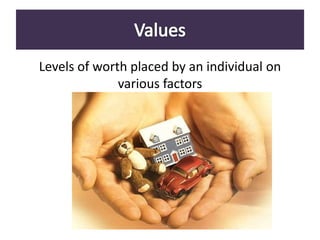


Levels of worth placed by an individual on
various factors
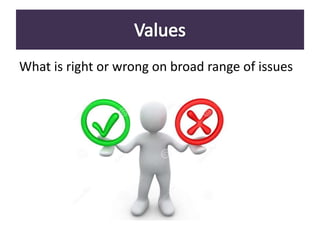
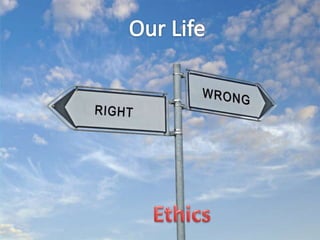
What is right or wrong on broad range of issues
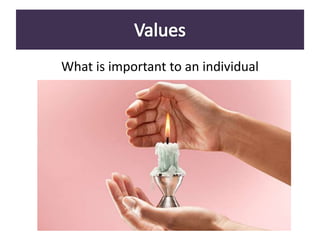
What is important to an individual
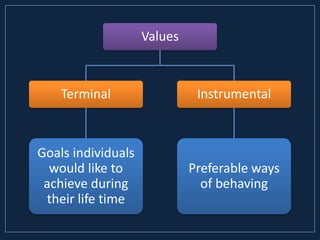
Values
Terminal
Goals individuals
would like to
achieve during
their life time
Instrumental
Preferable ways
of behaving
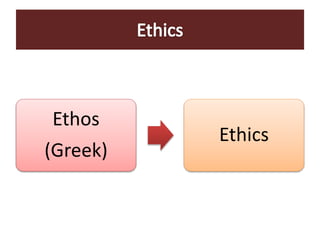
Ethos
(Greek)
Ethics
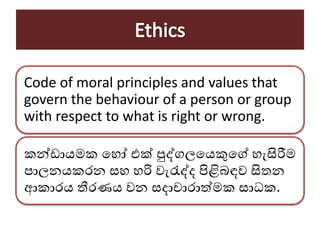
Code of moral principles and values that
govern the behaviour of a person or group
with respect to what is right or wrong.
කන්ඩායමක හ ෝ එක් පුද්ගලහයකුහේ ැසිරීම
පාලනයකරන ස රි වැරැද්ද පිළිබඳව සිරතන
ආකාරය තීරණය වන සදාචාරාත්මක සාධක.
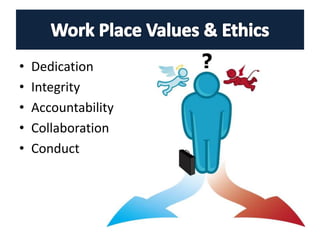
• Dedication
• Integrity
• Accountability
• Collaboration
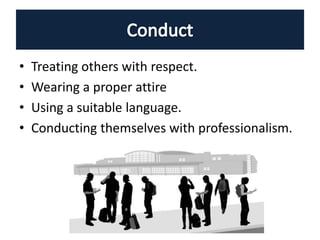
• Conduct
• How hard an employee works
• How much effort the employee put forward
Displaying honest behaviour all the time
An employee who works as a cashier is expected
to balance the drawer at the end of the every
working day.
• Showing up when they are scheduled and on
time.
• Not taking advantages of time allotted for
breaks.
• Accepting the responsibility even when things
go wrong
• When morale is high and everyone is working
together, success will follow.
• Employees need to be team players.
• Treating others with respect.
• Wearing a proper attire
• Using a suitable language.
• Conducting themselves with professionalism.
• Legal Issues
• Employee Performance
• Employee Relations
• Company Credibility
Legal Issues
Employee Performance
• Employees become money-minded.
• Careless work leads to redoing of tasks.
Employee Relations
• Lack of ethical behaviour causes tension
among people and it shakes employee
relations.
Company Credibility
• If public gets to know that company doesn’t
have good ethics, that business loses
credibility.
• Money can not restore this damage.
How to Prevent Unethical Behaviour
• Set realistic goals for employees.(If they fail to
meet unrealistic goals, they stick to unethical
behaviour to achieve them)
• Monitor employees’ performance.(they play
with tasks)
• Properly train employees (untrained
employees make excuses for everything)
• A situation in which a difficult choice has to be
made between two different things you could
do.
උභත ෝතකෝටිකය
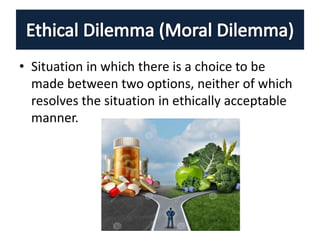
• Situation in which there is a choice to be
made between two options, neither of which
resolves the situation in ethically acceptable
manner.
Situation-01
As long as there is poverty in the world, I can
never be rich…As long as diseases are
rampant(මැඩපැවැත්වීමට හනො ැකි), I can never
be healthy…I can never be what I ought to be
until you are what you ought to be.
Situation-02
Do you believe it is ethical for companies to
capture personal information about their
website visitors without their consent?
Situations of Ethical Dilemma
Situation-03
You tried your best and came out with a creative
solution to control the turnover of your
organization. you shared it with your friend at work.
She makes use of your idea and design another
programme. It is appreciated by your manager
more than your one.
How do you feel…???
Write a similar incident which you have
heard or face
• Talent
• Interest
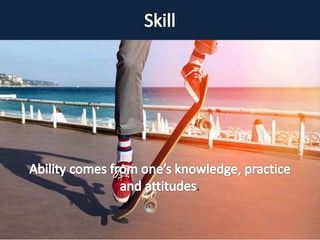
• Skills
• Personality
Comes from Latin word “Talenta”
marked innate ability
( ඳුනාගත් ස ජ ැකියාවක්)
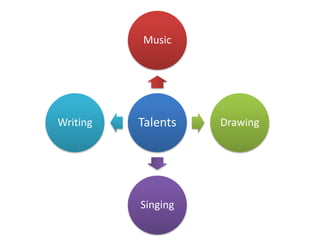
Talents
Music
Drawing
Singing
Writing
Interest
“I have an interest in sports”
“She is interested in reading novels”
“My friends have interest on gossips”
A state of curiosity/concern or attention to
something
.
• The set of characteristics that underline a
relatively stable pattern of behaviour in
response to ideas, objects, or people in the
Personality Types
1. Extroversion – බාහිර පරිසරයට/පුද්ගලයන්ට විවෘතබව
• The degree to which a person is sociable, talkative,
assertive and comfortable with interpersonal
relationships
2.Agreeableness – එකගතාවයට පැමිහණන බව
• The degree to which a person is able to get along with
others by being good-natured, cooperative, forgiving,
understanding, and trusting
3. Conscientiousness – දවතින්ම කටයුතු කරන බව
• The degree to which a person is focused on few goals,
thus behaving in the ways that are responsible,
dependable, persistent and achievement oriented.
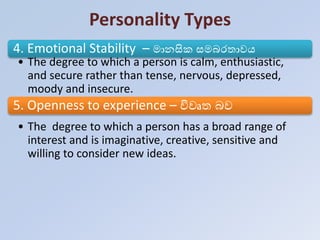
Personality Types
4. Emotional Stability – මානසිරක සමබරතාවය
• The degree to which a person is calm, enthusiastic,
and secure rather than tense, nervous, depressed,
moody and insecure.
5. Openness to experience – විවෘත බව
• The degree to which a person has a broad range of
interest and is imaginative, creative, sensitive and
willing to consider new ideas.
The Fifteen Factor Questionnaire Plus
The latest questionnaire built on 50 years of
pioneering research by the psychologist
Ray Cattell.
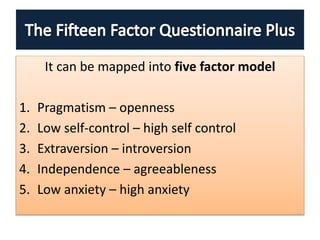
It can be mapped into five factor model
1. Pragmatism – openness
2. Low self-control – high self control
3. Extraversion – introversion
4. Independence – agreeableness
5. Low anxiety – high anxiety
An evaluation that predispose a person to act in
a certain way.
යහමකු යම් හදයක් හකහරහි යම් ආකාරයට ැසිරීමට
ඔහුව හ ෝ ඇයව හයොමු කරවන්නා වූ හදයක්.
• Cognitive components – (beliefs, opinions,
information)
• Affective components – (Person’s emotions or
feelings about the object of attitude such as
enjoying or hating a job)
• Behavioural components– (Person’s intension to
behave towards the object of the attitude in a
certain way)
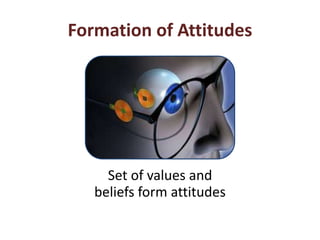
Formation of Attitudes
Set of values and
beliefs form attitudes
Changing attitudes is largely determined by a
person’s belief or the social norms that influence
a person’s intension
Change the way you think
Change the way you react
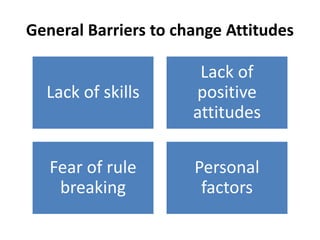
General Barriers to change Attitudes
Lack of skills
Lack of
positive
attitudes
Fear of rule
breaking
Personal
factors
Some Ways to Develop Positive
Attitudes
• Be confident
• Be positive
• Be punctual
• Be patient
• Believe in yourself
• Set goals for yourself and then work hard to
achieve them.
• Get fun out of life- don’t take life too seriously.
Questions to Check Positive Attitudes
• Are you willing to learn, no matter how difficult it
is?
• Do you do your best when studying, and try to
improve how you do your work?
• Do you demonstrate enthusiasm in whatever you
say or do?
• Do you welcome challenges, experiment and try
new ideas?
• Do you have a sense of humor by not taking
yourself too seriously

Personal value creation

  • 2.
    Levels of worthplaced by an individual on various factors
  • 3.
    What is rightor wrong on broad range of issues
  • 4.
    What is importantto an individual
  • 6.
    Values Terminal Goals individuals would liketo achieve during their life time Instrumental Preferable ways of behaving
  • 8.
  • 9.
    Code of moralprinciples and values that govern the behaviour of a person or group with respect to what is right or wrong. කන්ඩායමක හ ෝ එක් පුද්ගලහයකුහේ ැසිරීම පාලනයකරන ස රි වැරැද්ද පිළිබඳව සිරතන ආකාරය තීරණය වන සදාචාරාත්මක සාධක.
  • 11.
    • Dedication • Integrity •Accountability • Collaboration • Conduct
  • 12.
    • How hardan employee works • How much effort the employee put forward
  • 14.
    Displaying honest behaviourall the time An employee who works as a cashier is expected to balance the drawer at the end of the every working day.
  • 16.
    • Showing upwhen they are scheduled and on time. • Not taking advantages of time allotted for breaks. • Accepting the responsibility even when things go wrong
  • 17.
    • When moraleis high and everyone is working together, success will follow. • Employees need to be team players.
  • 18.
    • Treating otherswith respect. • Wearing a proper attire • Using a suitable language. • Conducting themselves with professionalism.
  • 19.
    • Legal Issues •Employee Performance • Employee Relations • Company Credibility
  • 20.
  • 21.
    Employee Performance • Employeesbecome money-minded. • Careless work leads to redoing of tasks.
  • 22.
    Employee Relations • Lackof ethical behaviour causes tension among people and it shakes employee relations.
  • 23.
    Company Credibility • Ifpublic gets to know that company doesn’t have good ethics, that business loses credibility. • Money can not restore this damage.
  • 24.
    How to PreventUnethical Behaviour • Set realistic goals for employees.(If they fail to meet unrealistic goals, they stick to unethical behaviour to achieve them) • Monitor employees’ performance.(they play with tasks) • Properly train employees (untrained employees make excuses for everything)
  • 26.
    • A situationin which a difficult choice has to be made between two different things you could do. උභත ෝතකෝටිකය
  • 27.
    • Situation inwhich there is a choice to be made between two options, neither of which resolves the situation in ethically acceptable manner.
  • 28.
    Situation-01 As long asthere is poverty in the world, I can never be rich…As long as diseases are rampant(මැඩපැවැත්වීමට හනො ැකි), I can never be healthy…I can never be what I ought to be until you are what you ought to be.
  • 29.
    Situation-02 Do you believeit is ethical for companies to capture personal information about their website visitors without their consent?
  • 30.
    Situations of EthicalDilemma Situation-03 You tried your best and came out with a creative solution to control the turnover of your organization. you shared it with your friend at work. She makes use of your idea and design another programme. It is appreciated by your manager more than your one. How do you feel…???
  • 31.
    Write a similarincident which you have heard or face
  • 32.
    • Talent • Interest •Skills • Personality
  • 33.
    Comes from Latinword “Talenta” marked innate ability ( ඳුනාගත් ස ජ ැකියාවක්)
  • 34.
  • 35.
    Interest “I have aninterest in sports” “She is interested in reading novels” “My friends have interest on gossips” A state of curiosity/concern or attention to something
  • 36.
  • 37.
    • The setof characteristics that underline a relatively stable pattern of behaviour in response to ideas, objects, or people in the
  • 38.
    Personality Types 1. Extroversion– බාහිර පරිසරයට/පුද්ගලයන්ට විවෘතබව • The degree to which a person is sociable, talkative, assertive and comfortable with interpersonal relationships 2.Agreeableness – එකගතාවයට පැමිහණන බව • The degree to which a person is able to get along with others by being good-natured, cooperative, forgiving, understanding, and trusting 3. Conscientiousness – දවතින්ම කටයුතු කරන බව • The degree to which a person is focused on few goals, thus behaving in the ways that are responsible, dependable, persistent and achievement oriented.
  • 39.
    Personality Types 4. EmotionalStability – මානසිරක සමබරතාවය • The degree to which a person is calm, enthusiastic, and secure rather than tense, nervous, depressed, moody and insecure. 5. Openness to experience – විවෘත බව • The degree to which a person has a broad range of interest and is imaginative, creative, sensitive and willing to consider new ideas.
  • 40.
    The Fifteen FactorQuestionnaire Plus The latest questionnaire built on 50 years of pioneering research by the psychologist Ray Cattell.
  • 41.
    It can bemapped into five factor model 1. Pragmatism – openness 2. Low self-control – high self control 3. Extraversion – introversion 4. Independence – agreeableness 5. Low anxiety – high anxiety
  • 42.
    An evaluation thatpredispose a person to act in a certain way. යහමකු යම් හදයක් හකහරහි යම් ආකාරයට ැසිරීමට ඔහුව හ ෝ ඇයව හයොමු කරවන්නා වූ හදයක්.
  • 43.
    • Cognitive components– (beliefs, opinions, information) • Affective components – (Person’s emotions or feelings about the object of attitude such as enjoying or hating a job) • Behavioural components– (Person’s intension to behave towards the object of the attitude in a certain way)
  • 44.
    Formation of Attitudes Setof values and beliefs form attitudes
  • 46.
    Changing attitudes islargely determined by a person’s belief or the social norms that influence a person’s intension
  • 47.
    Change the wayyou think
  • 48.
    Change the wayyou react
  • 49.
    General Barriers tochange Attitudes Lack of skills Lack of positive attitudes Fear of rule breaking Personal factors
  • 50.
    Some Ways toDevelop Positive Attitudes • Be confident • Be positive • Be punctual • Be patient • Believe in yourself • Set goals for yourself and then work hard to achieve them. • Get fun out of life- don’t take life too seriously.
  • 51.
    Questions to CheckPositive Attitudes • Are you willing to learn, no matter how difficult it is? • Do you do your best when studying, and try to improve how you do your work? • Do you demonstrate enthusiasm in whatever you say or do? • Do you welcome challenges, experiment and try new ideas? • Do you have a sense of humor by not taking yourself too seriously