Presented By : Mubashar Mehmood 1632
LCD
 Liquid crystals were first discovered in 1888 by Austrian botanist
Friedrich Reinitzer.
 RCA made the first experimental LCD in (1968)
 Melt cholesterol-like substance.
 When cooled, the liquid turned blue before finally crystallizing
 Compact and Lightweight
 Space saving
 Consume less energy and more durable
 Doest not emit Radiation
LCD (Liquid Crystal Display)
 LCD Panel is based on
– A light valve for each pixel that
turn the light on, off, or an
intermediate level.
 Grid of such light valve for the
LCD display panel.
 A back light and display
enhancement films create the
illumination.
LCD (Liquid Crystal Display)
LCD-Display
 Applying voltage to the electrodes changes the
level of illumination in each sub-pixel
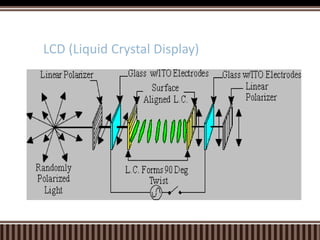
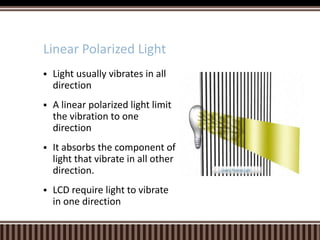
 Light usually vibrates in all
direction
 A linear polarized light limit
the vibration to one
direction
 It absorbs the component of
light that vibrate in all other
direction.
 LCD require light to vibrate
in one direction
Linear Polarized Light
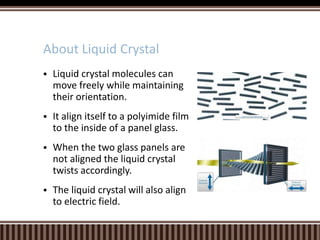
 Liquid crystal molecules can
move freely while maintaining
their orientation.
 It align itself to a polyimide film
to the inside of a panel glass.
 When the two glass panels are
not aligned the liquid crystal
twists accordingly.
 The liquid crystal will also align
to electric field.
About Liquid Crystal
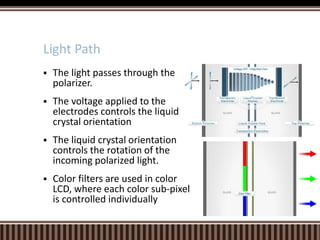
 The light passes through the
polarizer.
 The voltage applied to the
electrodes controls the liquid
crystal orientation
 The liquid crystal orientation
controls the rotation of the
incoming polarized light.
 Color filters are used in color
LCD, where each color sub-pixel
is controlled individually
Light Path
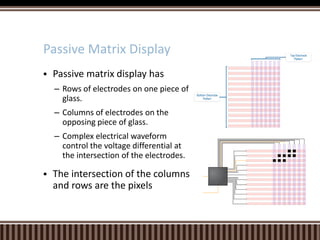
 Passive matrix display has
– Rows of electrodes on one piece of
glass.
– Columns of electrodes on the
opposing piece of glass.
– Complex electrical waveform
control the voltage differential at
the intersection of the electrodes.
 The intersection of the columns
and rows are the pixels
Passive Matrix Display
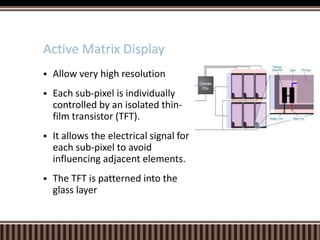
 Allow very high resolution
 Each sub-pixel is individually
controlled by an isolated thin-
film transistor (TFT).
 It allows the electrical signal for
each sub-pixel to avoid
influencing adjacent elements.
 The TFT is patterned into the
glass layer
Active Matrix Display
 This technology aims to generate stereoscopic 3D
images with the need for glasses.
 The idea is based on combining
– Active-matrix LCD with
– Lenticular lens: an array of magnifying lenses, designed to
magnify different images when viewed from slightly different
angles.
 Applications
– Industrial Visualization
– Medical imaging
– Entertainment
3-D LCD Displays

LCD

  • 1.
    Presented By :Mubashar Mehmood 1632 LCD
  • 2.
     Liquid crystalswere first discovered in 1888 by Austrian botanist Friedrich Reinitzer.  RCA made the first experimental LCD in (1968)  Melt cholesterol-like substance.  When cooled, the liquid turned blue before finally crystallizing  Compact and Lightweight  Space saving  Consume less energy and more durable  Doest not emit Radiation LCD (Liquid Crystal Display)
  • 3.
     LCD Panelis based on – A light valve for each pixel that turn the light on, off, or an intermediate level.  Grid of such light valve for the LCD display panel.  A back light and display enhancement films create the illumination. LCD (Liquid Crystal Display)
  • 4.
  • 5.
    LCD-Display  Applying voltageto the electrodes changes the level of illumination in each sub-pixel
  • 6.
     Light usuallyvibrates in all direction  A linear polarized light limit the vibration to one direction  It absorbs the component of light that vibrate in all other direction.  LCD require light to vibrate in one direction Linear Polarized Light
  • 7.
     Liquid crystalmolecules can move freely while maintaining their orientation.  It align itself to a polyimide film to the inside of a panel glass.  When the two glass panels are not aligned the liquid crystal twists accordingly.  The liquid crystal will also align to electric field. About Liquid Crystal
  • 8.
     The lightpasses through the polarizer.  The voltage applied to the electrodes controls the liquid crystal orientation  The liquid crystal orientation controls the rotation of the incoming polarized light.  Color filters are used in color LCD, where each color sub-pixel is controlled individually Light Path
  • 9.
     Passive matrixdisplay has – Rows of electrodes on one piece of glass. – Columns of electrodes on the opposing piece of glass. – Complex electrical waveform control the voltage differential at the intersection of the electrodes.  The intersection of the columns and rows are the pixels Passive Matrix Display
  • 10.
     Allow veryhigh resolution  Each sub-pixel is individually controlled by an isolated thin- film transistor (TFT).  It allows the electrical signal for each sub-pixel to avoid influencing adjacent elements.  The TFT is patterned into the glass layer Active Matrix Display
  • 11.
     This technologyaims to generate stereoscopic 3D images with the need for glasses.  The idea is based on combining – Active-matrix LCD with – Lenticular lens: an array of magnifying lenses, designed to magnify different images when viewed from slightly different angles.  Applications – Industrial Visualization – Medical imaging – Entertainment 3-D LCD Displays