FLOATING POINT ADDITION
Mr. C.KARTHIKEYAN,
ASSISTANT PROFESSOR,
ECE , RMKCET
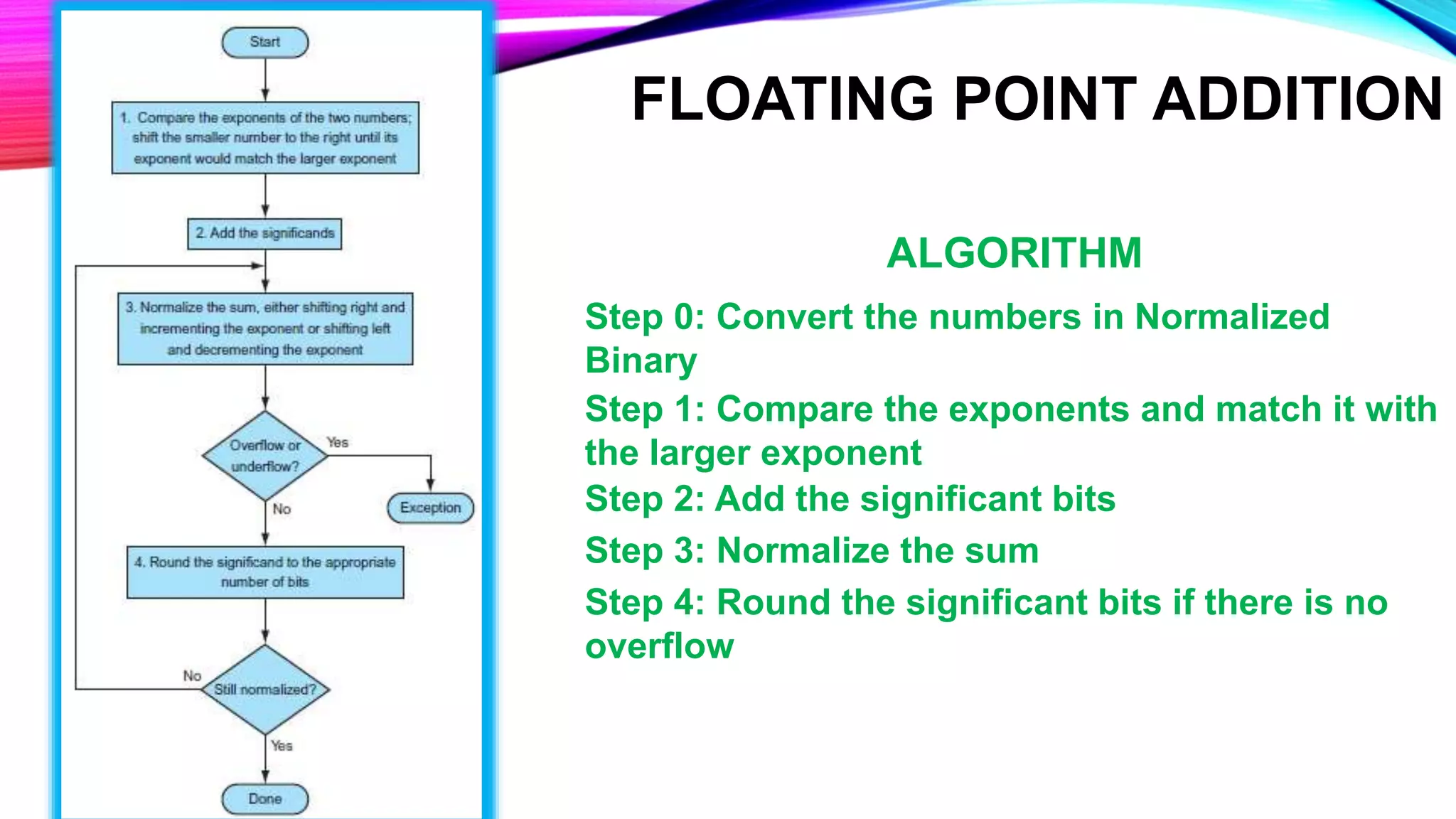
FLOATING POINT ADDITION
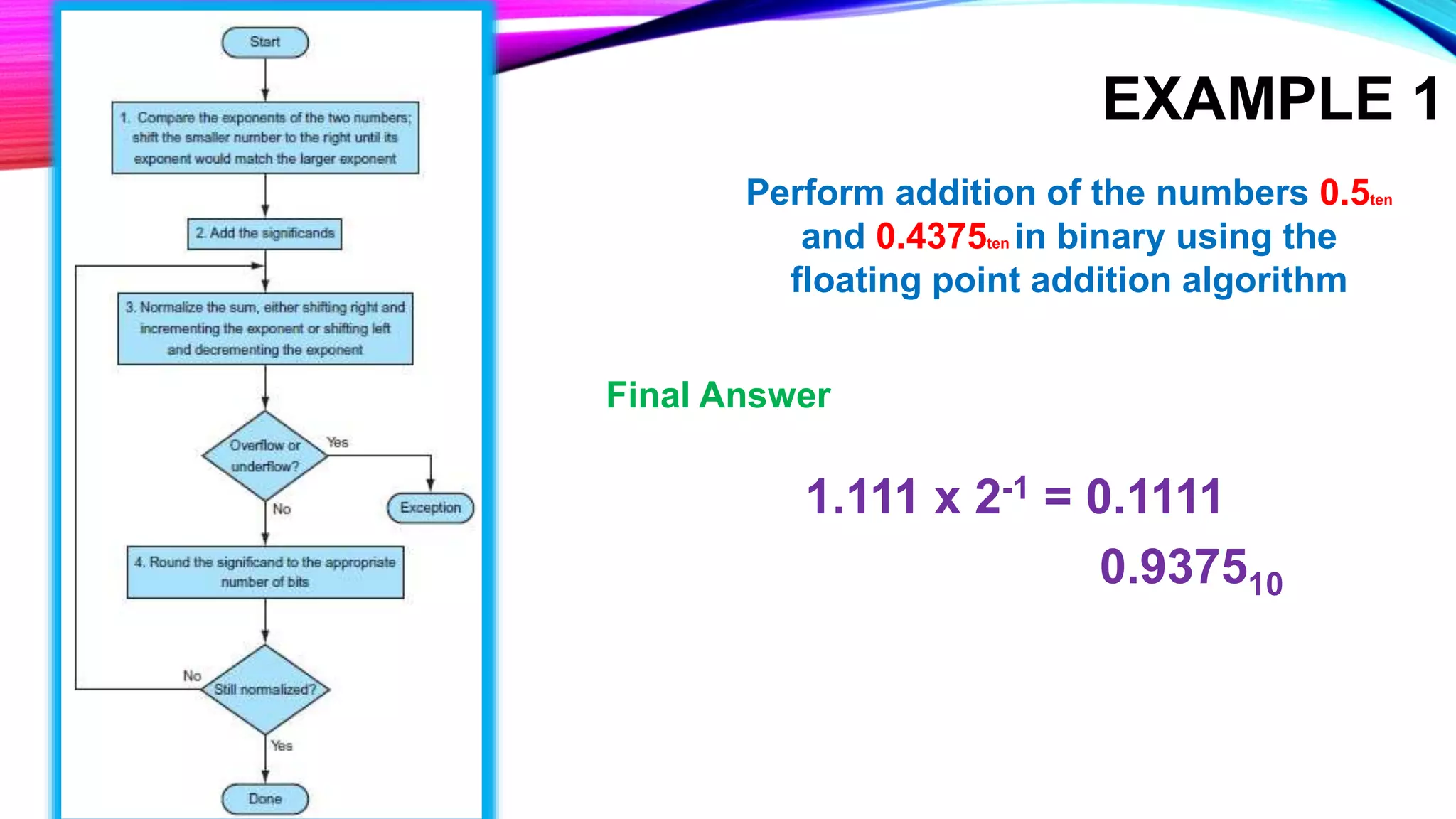
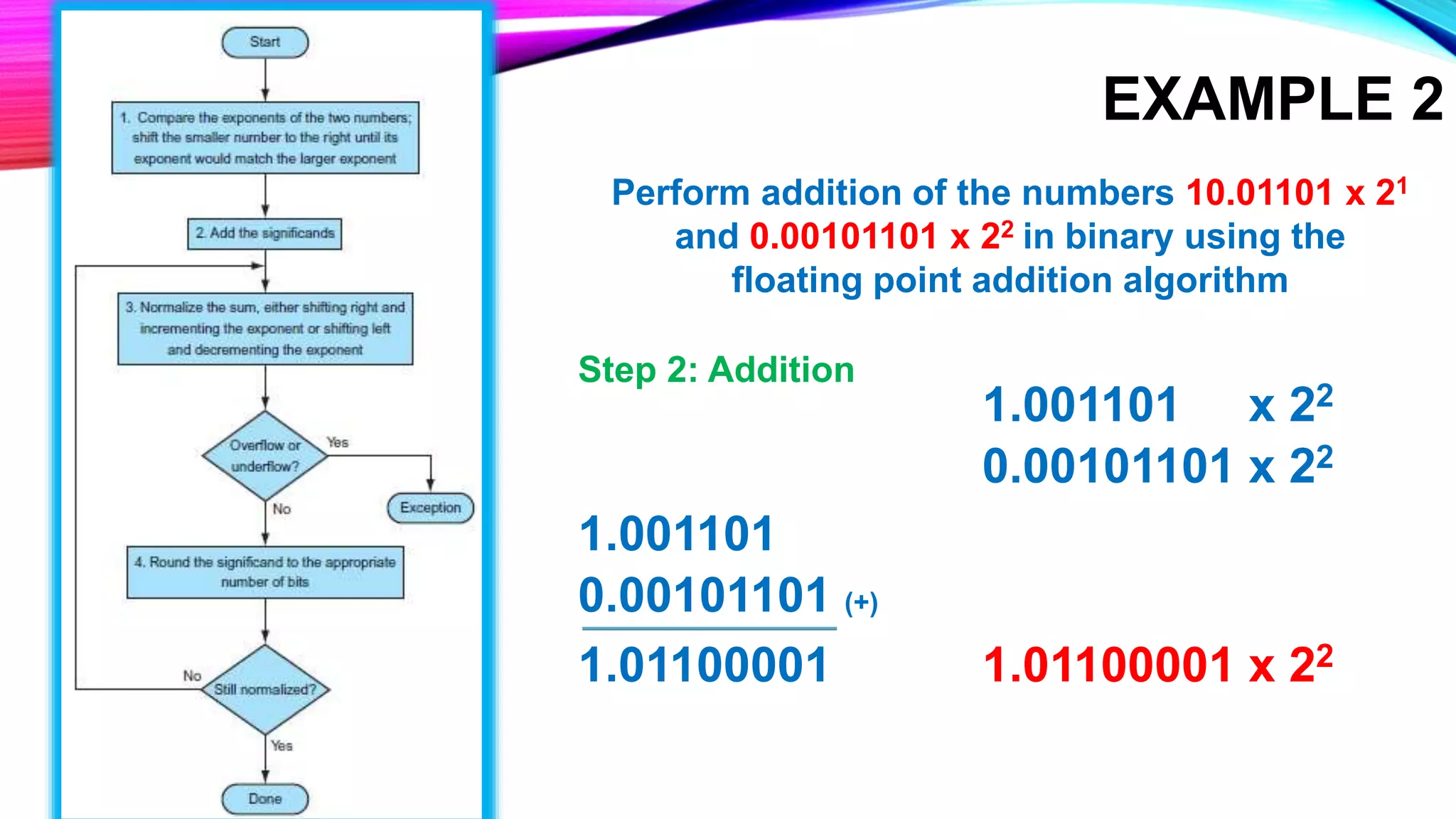
ALGORITHM
Step 0: Convert the numbers in Normalized
Binary
Step 1: Compare the exponents and match it with
the larger exponent
Step 2: Add the significant bits
Step 3: Normalize the sum
Step 4: Round the significant bits if there is no
overflow
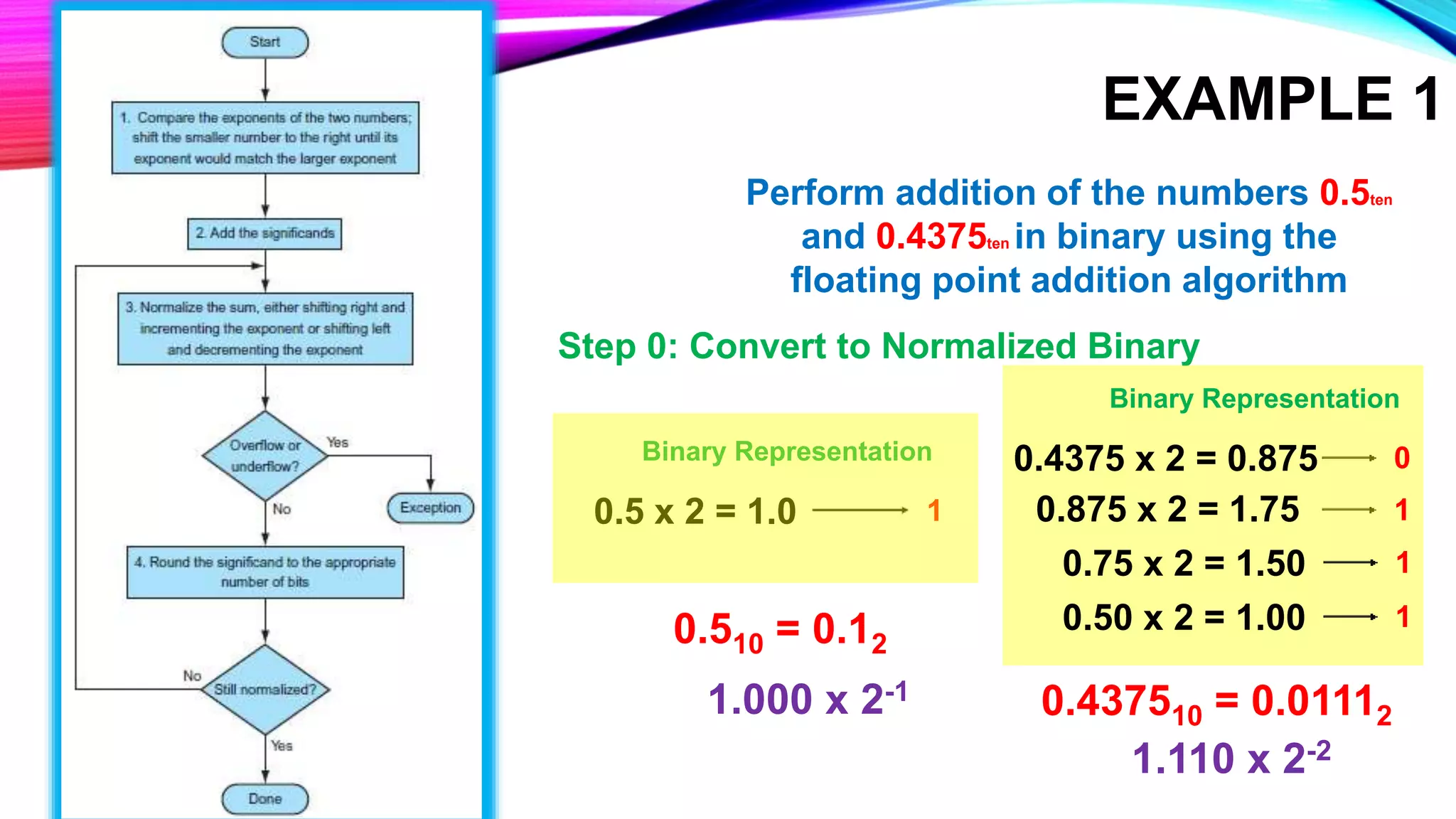
EXAMPLE 1
Perform addition of the numbers 0.5ten
and 0.4375ten in binary using the
floating point addition algorithm
Step 0: Convert to Normalized Binary
Binary Representation
0.5 x 2 = 1.0 1
0.75 x 2 = 1.50 1
0.50 x 2 = 1.00 1
0.875 x 2 = 1.75 1
0.4375 x 2 = 0.875 0
Binary Representation
0.510 = 0.12
0.437510 = 0.01112
1.000 x 2-1
1.110 x 2-2
EXAMPLE 1
Perform addition of the numbers 0.5ten
and 0.4375ten in binary using the
floating point addition algorithm
Step 1: Exponent Comparison
1.000 x 2-1
1.110 x 2-2
1.000 x 2-1
1.110 x 2-2
1.000 x 2-1
0.111 x 2-1
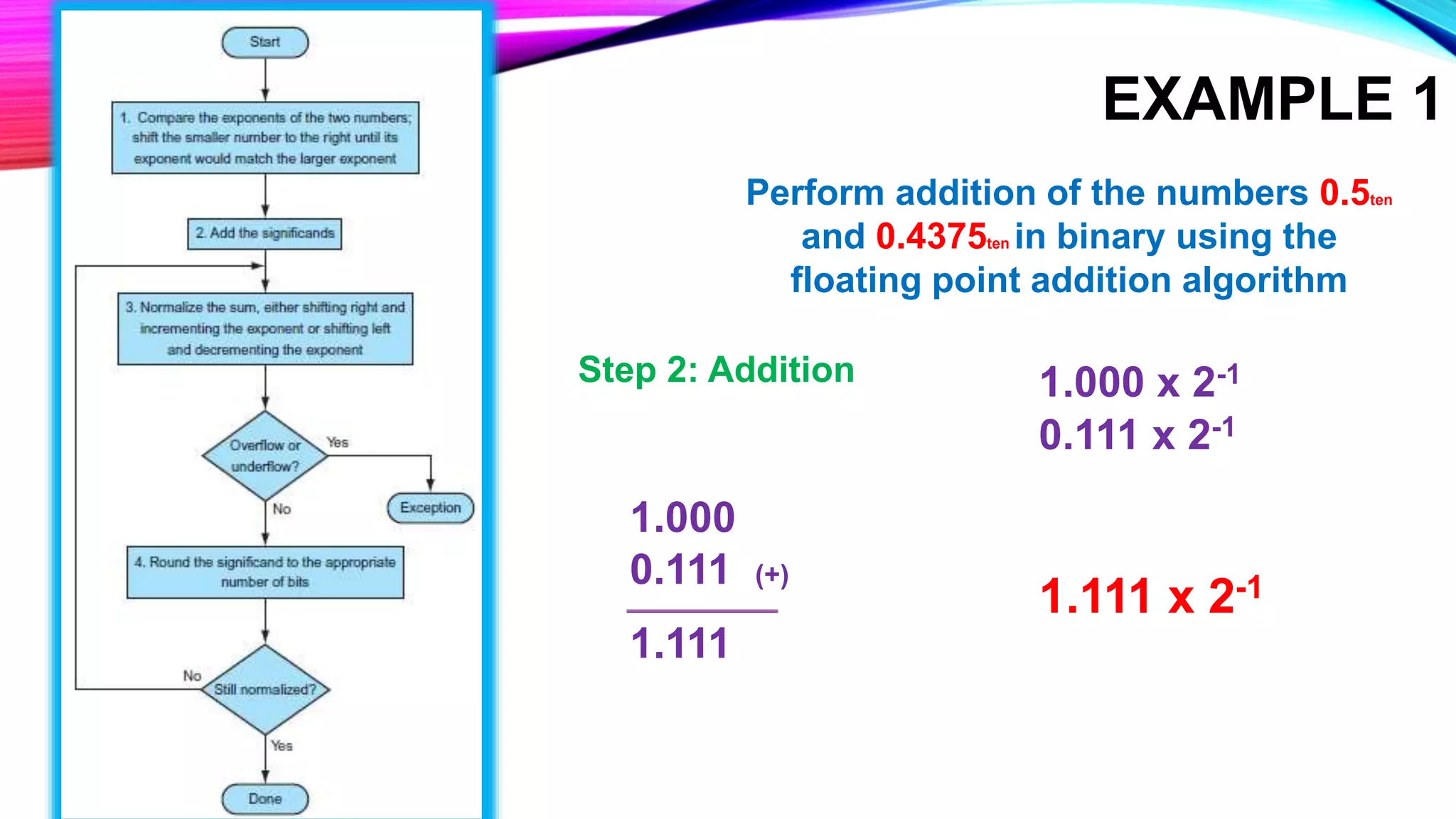
EXAMPLE 1
Perform addition of the numbers 0.5ten
and 0.4375ten in binary using the
floating point addition algorithm
Step 2: Addition 1.000 x 2-1
0.111 x 2-1
1.000
0.111 (+)
1.111
1.111 x 2-1
EXAMPLE 1
Perform addition of the numbers 0.5ten
and 0.4375ten in binary using the
floating point addition algorithm
Step 3: Normalization
1.111 x 2-1
1.111 x 2-1
(-1)S x 1.F x 2E
EXAMPLE 1
Perform addition of the numbers 0.5ten
and 0.4375ten in binary using the
floating point addition algorithm
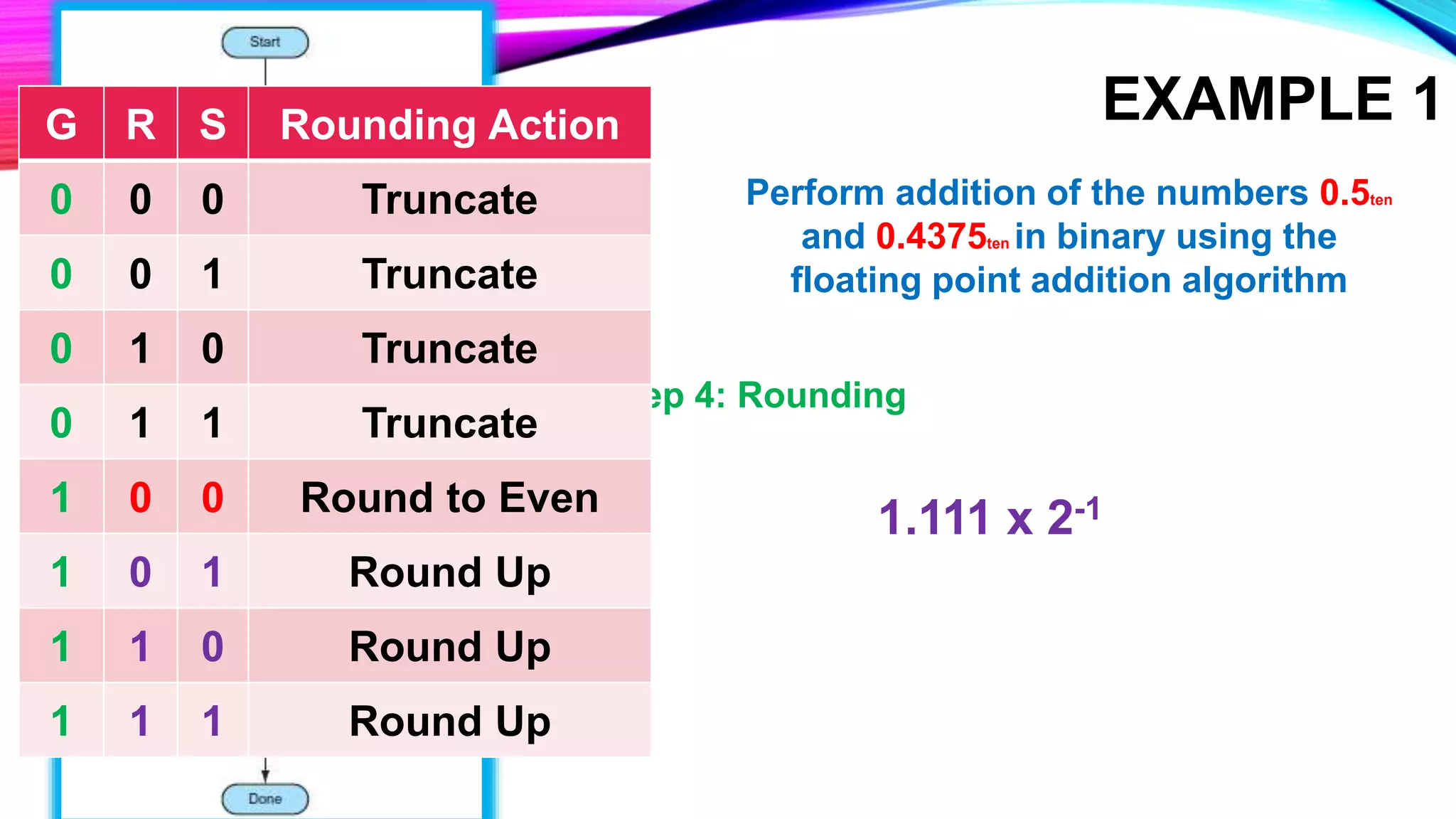
Step 4: Rounding
1.111 x 2-1
G R S Rounding Action
0 0 0 Truncate
0 0 1 Truncate
0 1 0 Truncate
0 1 1 Truncate
1 0 0 Round to Even
1 0 1 Round Up
1 1 0 Round Up
1 1 1 Round Up
EXAMPLE 1
Perform addition of the numbers 0.5ten
and 0.4375ten in binary using the
floating point addition algorithm
Final Answer
1.111 x 2-1 = 0.1111
0.937510
EXAMPLE 2
Perform addition of the numbers 10.01101 x 21
and 0.00101101 x 22 in binary using the
floating point addition algorithm
Step 0: Convert to Normalized Binary
10.01101 x 21 0.00101101 x 22
1.001101 x 22 1.01101 x 2-1
EXAMPLE 2
Perform addition of the numbers 10.01101 x 21
and 0.00101101 x 22 in binary using the
floating point addition algorithm
1.001101 x 22
1.01101 x 2-1
Step 1: Exponent Comparison
0.00101101 x 22
EXAMPLE 2
Perform addition of the numbers 10.01101 x 21
and 0.00101101 x 22 in binary using the
floating point addition algorithm
1.001101 x 22
0.00101101 x 22
Step 2: Addition
1.001101
0.00101101 (+)
1.01100001 1.01100001 x 22
EXAMPLE 2
Perform addition of the numbers 10.01101 x 21
and 0.00101101 x 22 in binary using the
floating point addition algorithm
Step 3: Normalization
1.01100001 x 22
EXAMPLE 2
Perform addition of the numbers 10.01101 x 21
and 0.00101101 x 22 in binary using the
floating point addition algorithm
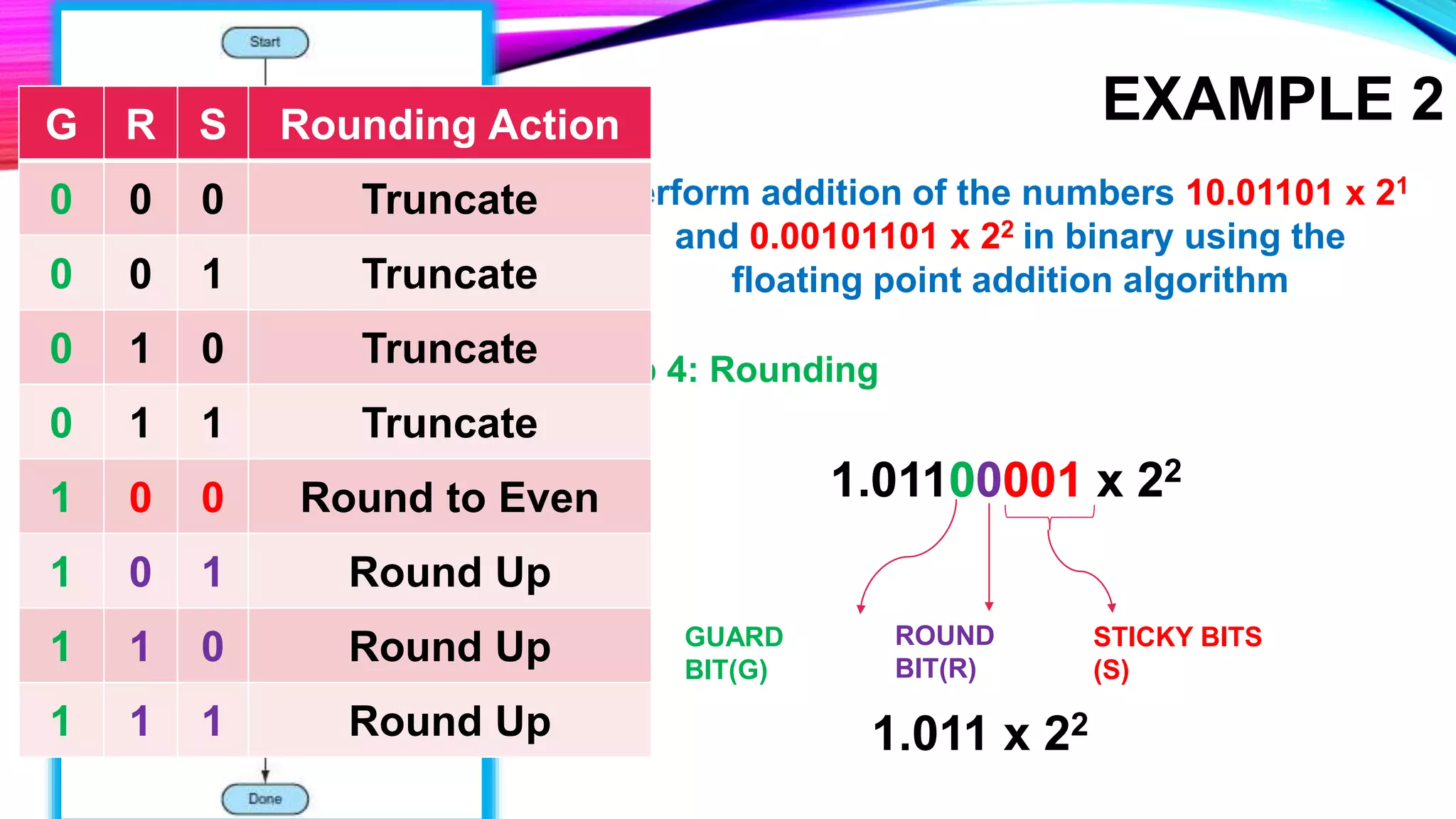
Step 4: Rounding
1.01100001 x 22
G R S Rounding Action
0 0 0 Truncate
0 0 1 Truncate
0 1 0 Truncate
0 1 1 Truncate
1 0 0 Round to Even
1 0 1 Round Up
1 1 0 Round Up
1 1 1 Round Up
1.01100001 x 22
GUARD
BIT(G)
ROUND
BIT(R)
STICKY BITS
(S)
1.011 x 22

Floating Point Addition.pptx

  • 1.
    FLOATING POINT ADDITION Mr.C.KARTHIKEYAN, ASSISTANT PROFESSOR, ECE , RMKCET
  • 2.
    FLOATING POINT ADDITION ALGORITHM Step0: Convert the numbers in Normalized Binary Step 1: Compare the exponents and match it with the larger exponent Step 2: Add the significant bits Step 3: Normalize the sum Step 4: Round the significant bits if there is no overflow
  • 3.
    EXAMPLE 1 Perform additionof the numbers 0.5ten and 0.4375ten in binary using the floating point addition algorithm Step 0: Convert to Normalized Binary Binary Representation 0.5 x 2 = 1.0 1 0.75 x 2 = 1.50 1 0.50 x 2 = 1.00 1 0.875 x 2 = 1.75 1 0.4375 x 2 = 0.875 0 Binary Representation 0.510 = 0.12 0.437510 = 0.01112 1.000 x 2-1 1.110 x 2-2
  • 4.
    EXAMPLE 1 Perform additionof the numbers 0.5ten and 0.4375ten in binary using the floating point addition algorithm Step 1: Exponent Comparison 1.000 x 2-1 1.110 x 2-2 1.000 x 2-1 1.110 x 2-2 1.000 x 2-1 0.111 x 2-1
  • 5.
    EXAMPLE 1 Perform additionof the numbers 0.5ten and 0.4375ten in binary using the floating point addition algorithm Step 2: Addition 1.000 x 2-1 0.111 x 2-1 1.000 0.111 (+) 1.111 1.111 x 2-1
  • 6.
    EXAMPLE 1 Perform additionof the numbers 0.5ten and 0.4375ten in binary using the floating point addition algorithm Step 3: Normalization 1.111 x 2-1 1.111 x 2-1 (-1)S x 1.F x 2E
  • 7.
    EXAMPLE 1 Perform additionof the numbers 0.5ten and 0.4375ten in binary using the floating point addition algorithm Step 4: Rounding 1.111 x 2-1 G R S Rounding Action 0 0 0 Truncate 0 0 1 Truncate 0 1 0 Truncate 0 1 1 Truncate 1 0 0 Round to Even 1 0 1 Round Up 1 1 0 Round Up 1 1 1 Round Up
  • 8.
    EXAMPLE 1 Perform additionof the numbers 0.5ten and 0.4375ten in binary using the floating point addition algorithm Final Answer 1.111 x 2-1 = 0.1111 0.937510
  • 9.
    EXAMPLE 2 Perform additionof the numbers 10.01101 x 21 and 0.00101101 x 22 in binary using the floating point addition algorithm Step 0: Convert to Normalized Binary 10.01101 x 21 0.00101101 x 22 1.001101 x 22 1.01101 x 2-1
  • 10.
    EXAMPLE 2 Perform additionof the numbers 10.01101 x 21 and 0.00101101 x 22 in binary using the floating point addition algorithm 1.001101 x 22 1.01101 x 2-1 Step 1: Exponent Comparison 0.00101101 x 22
  • 11.
    EXAMPLE 2 Perform additionof the numbers 10.01101 x 21 and 0.00101101 x 22 in binary using the floating point addition algorithm 1.001101 x 22 0.00101101 x 22 Step 2: Addition 1.001101 0.00101101 (+) 1.01100001 1.01100001 x 22
  • 12.
    EXAMPLE 2 Perform additionof the numbers 10.01101 x 21 and 0.00101101 x 22 in binary using the floating point addition algorithm Step 3: Normalization 1.01100001 x 22
  • 13.
    EXAMPLE 2 Perform additionof the numbers 10.01101 x 21 and 0.00101101 x 22 in binary using the floating point addition algorithm Step 4: Rounding 1.01100001 x 22 G R S Rounding Action 0 0 0 Truncate 0 0 1 Truncate 0 1 0 Truncate 0 1 1 Truncate 1 0 0 Round to Even 1 0 1 Round Up 1 1 0 Round Up 1 1 1 Round Up 1.01100001 x 22 GUARD BIT(G) ROUND BIT(R) STICKY BITS (S) 1.011 x 22