Presented by:
Mubashar Mehmood
Implementation of
Trees
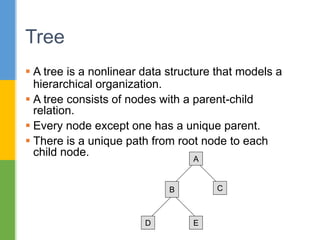
 A tree is a nonlinear data structure that models a
hierarchical organization.
 A tree consists of nodes with a parent-child
relation.
 Every node except one has a unique parent.
 There is a unique path from root node to each
child node.
Tree
A
B
D E
C
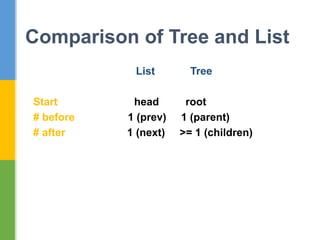
List Tree
Start head root
# before 1 (prev) 1 (parent)
# after 1 (next) >= 1 (children)
Comparison of Tree and List
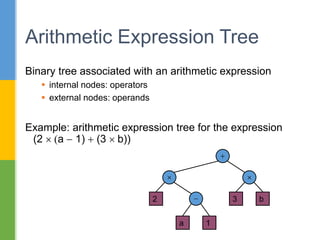
Binary tree associated with an arithmetic expression
 internal nodes: operators
 external nodes: operands
Example: arithmetic expression tree for the expression
(2  (a - 1) + (3  b))
Arithmetic Expression Tree
+

-2
a 1
3 b
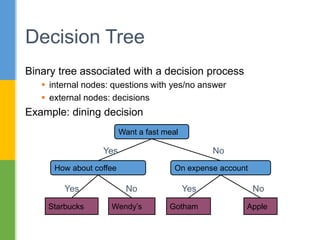
Binary tree associated with a decision process
 internal nodes: questions with yes/no answer
 external nodes: decisions
Example: dining decision
Decision Tree
Want a fast meal
How about coffee On expense account
Starbucks Wendy’s Gotham Apple
Yes No
Yes No Yes No
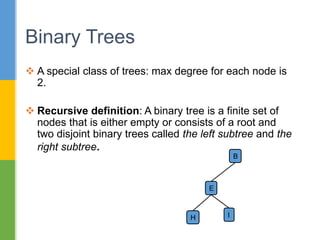
 A special class of trees: max degree for each node is
2.
 Recursive definition: A binary tree is a finite set of
nodes that is either empty or consists of a root and
two disjoint binary trees called the left subtree and the
right subtree.
Binary Trees
B
E
H I
Sequential Representation
Binary Tree Representations
A
B
E
C
D
A
B
--
C
--
--
--
D
--
.
E
[1]
[2]
[3]
[4]
[5]
[6]
[7]
[8]
[9]
.
[16]
(1) waste space
(2) insertion/deletion
problem
A
B
C
D
E
F
G
H
I
[1]
[2]
[3]
[4]
[5]
[6]
[7]
[8]
[9]
A
B C
GE
I
D
H
F
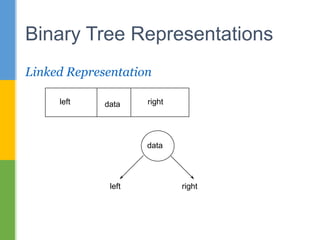
Linked Representation
Binary Tree Representations
dataleft right
left right
data
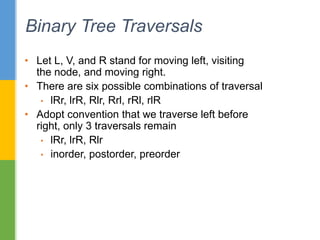
• Let L, V, and R stand for moving left, visiting
the node, and moving right.
• There are six possible combinations of traversal
• lRr, lrR, Rlr, Rrl, rRl, rlR
• Adopt convention that we traverse left before
right, only 3 traversals remain
• lRr, lrR, Rlr
• inorder, postorder, preorder
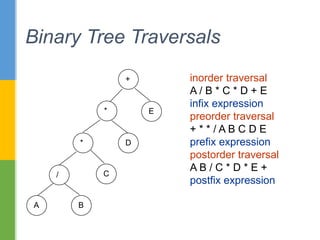
Binary Tree Traversals
+
*
A
*
/
E
D
C
B
inorder traversal
A / B * C * D + E
infix expression
preorder traversal
+ * * / A B C D E
prefix expression
postorder traversal
A B / C * D * E +
postfix expression
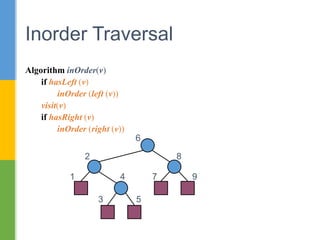
Inorder Traversal
3
1
2
5
7 9
8
4
6
Algorithm inOrder(v)
if hasLeft (v)
inOrder (left (v))
visit(v)
if hasRight (v)
inOrder (right (v))

Implementation of trees

  • 1.
  • 2.
     A treeis a nonlinear data structure that models a hierarchical organization.  A tree consists of nodes with a parent-child relation.  Every node except one has a unique parent.  There is a unique path from root node to each child node. Tree A B D E C
  • 3.
    List Tree Start headroot # before 1 (prev) 1 (parent) # after 1 (next) >= 1 (children) Comparison of Tree and List
  • 4.
    Binary tree associatedwith an arithmetic expression  internal nodes: operators  external nodes: operands Example: arithmetic expression tree for the expression (2  (a - 1) + (3  b)) Arithmetic Expression Tree +  -2 a 1 3 b
  • 5.
    Binary tree associatedwith a decision process  internal nodes: questions with yes/no answer  external nodes: decisions Example: dining decision Decision Tree Want a fast meal How about coffee On expense account Starbucks Wendy’s Gotham Apple Yes No Yes No Yes No
  • 6.
     A specialclass of trees: max degree for each node is 2.  Recursive definition: A binary tree is a finite set of nodes that is either empty or consists of a root and two disjoint binary trees called the left subtree and the right subtree. Binary Trees B E H I
  • 7.
    Sequential Representation Binary TreeRepresentations A B E C D A B -- C -- -- -- D -- . E [1] [2] [3] [4] [5] [6] [7] [8] [9] . [16] (1) waste space (2) insertion/deletion problem A B C D E F G H I [1] [2] [3] [4] [5] [6] [7] [8] [9] A B C GE I D H F
  • 8.
    Linked Representation Binary TreeRepresentations dataleft right left right data
  • 9.
    • Let L,V, and R stand for moving left, visiting the node, and moving right. • There are six possible combinations of traversal • lRr, lrR, Rlr, Rrl, rRl, rlR • Adopt convention that we traverse left before right, only 3 traversals remain • lRr, lrR, Rlr • inorder, postorder, preorder Binary Tree Traversals
  • 10.
    Binary Tree Traversals + * A * / E D C B inordertraversal A / B * C * D + E infix expression preorder traversal + * * / A B C D E prefix expression postorder traversal A B / C * D * E + postfix expression
  • 11.
    Inorder Traversal 3 1 2 5 7 9 8 4 6 AlgorithminOrder(v) if hasLeft (v) inOrder (left (v)) visit(v) if hasRight (v) inOrder (right (v))