Course: LCD
Liquid Crystal Display
Course Coordinator: Arpan Deyasi
1/27/2021 1
Arpan Deyasi, RCCIIT, India
1/27/2021 Arpan Deyasi, RCCIIT, India 2
LCD
thin, flat panel display device
displays electronic information (text, audio, video)
uses polarization property of light to display objects
electronically modulated optical device made up of any
number of pixels filled with liquid crystals
1/27/2021 Arpan Deyasi, RCCIIT, India 3
Why LCD is preferred?
smaller size: offers 60% less space than CRT
lower power consumption: consumes 50% less power and
emits less heat than CRT
less weight: 70% less weight to CRT of compatible size
less EM radiation: negligible emission of EM fields, nor
susceptible to it
longer life: longer useful life than CRT
screen shape: completely flat screen
1/27/2021 Arpan Deyasi, RCCIIT, India 4
Material aspect
flows like liquid
molecules oriented like a solid crystal
can precisely be aligned subjected to electric fields
when properly aligned, allows light to pass through
application of electric field causes it to polarize,
and becomes opaque. after removal of field, it
again becomes transparent
1/27/2021
Arpan Deyasi, RCCIIT, India
5
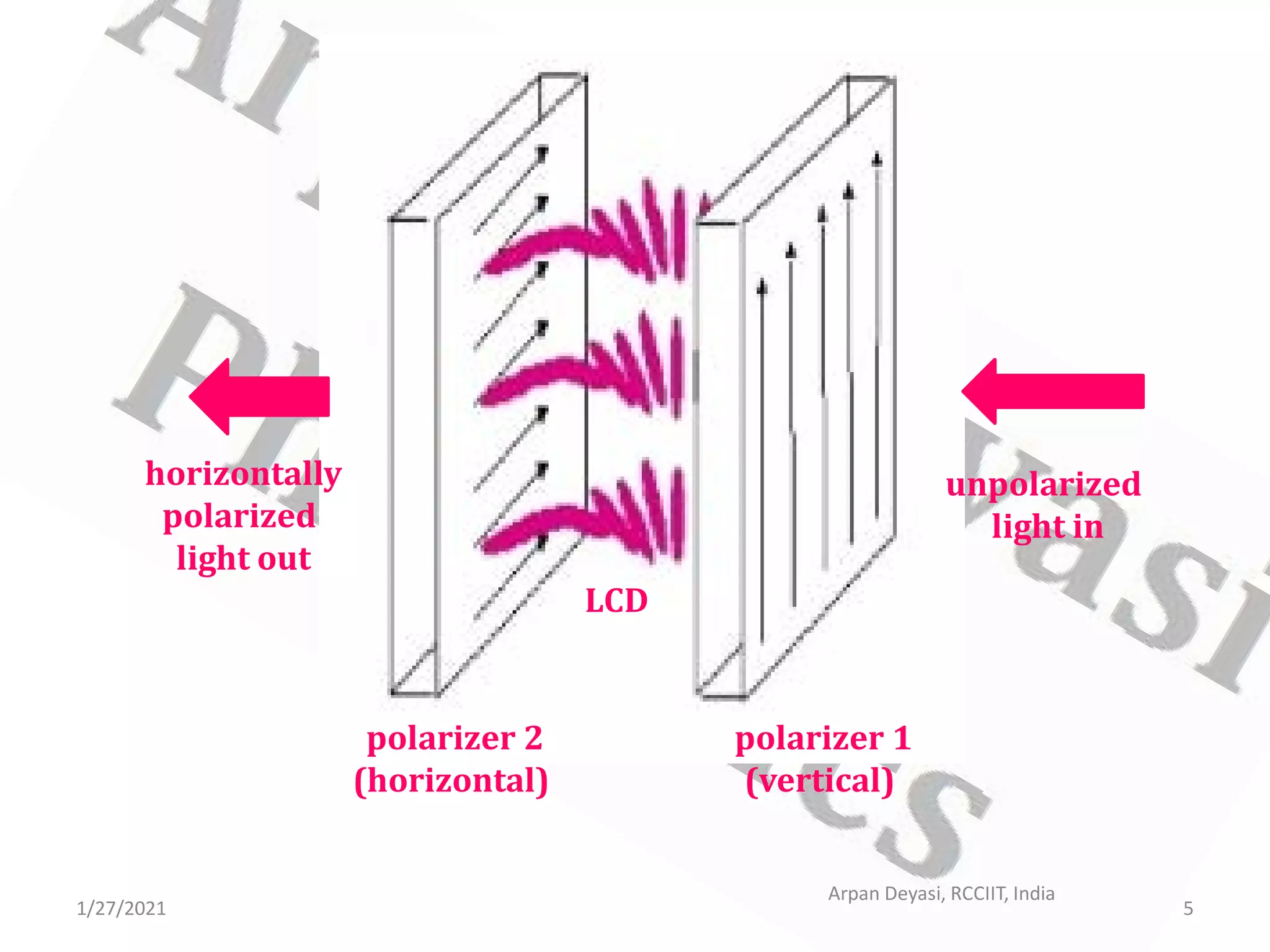
unpolarized
light in
polarizer 1
(vertical)
polarizer 2
(horizontal)
LCD
horizontally
polarized
light out
1/27/2021 Arpan Deyasi, RCCIIT, India 6
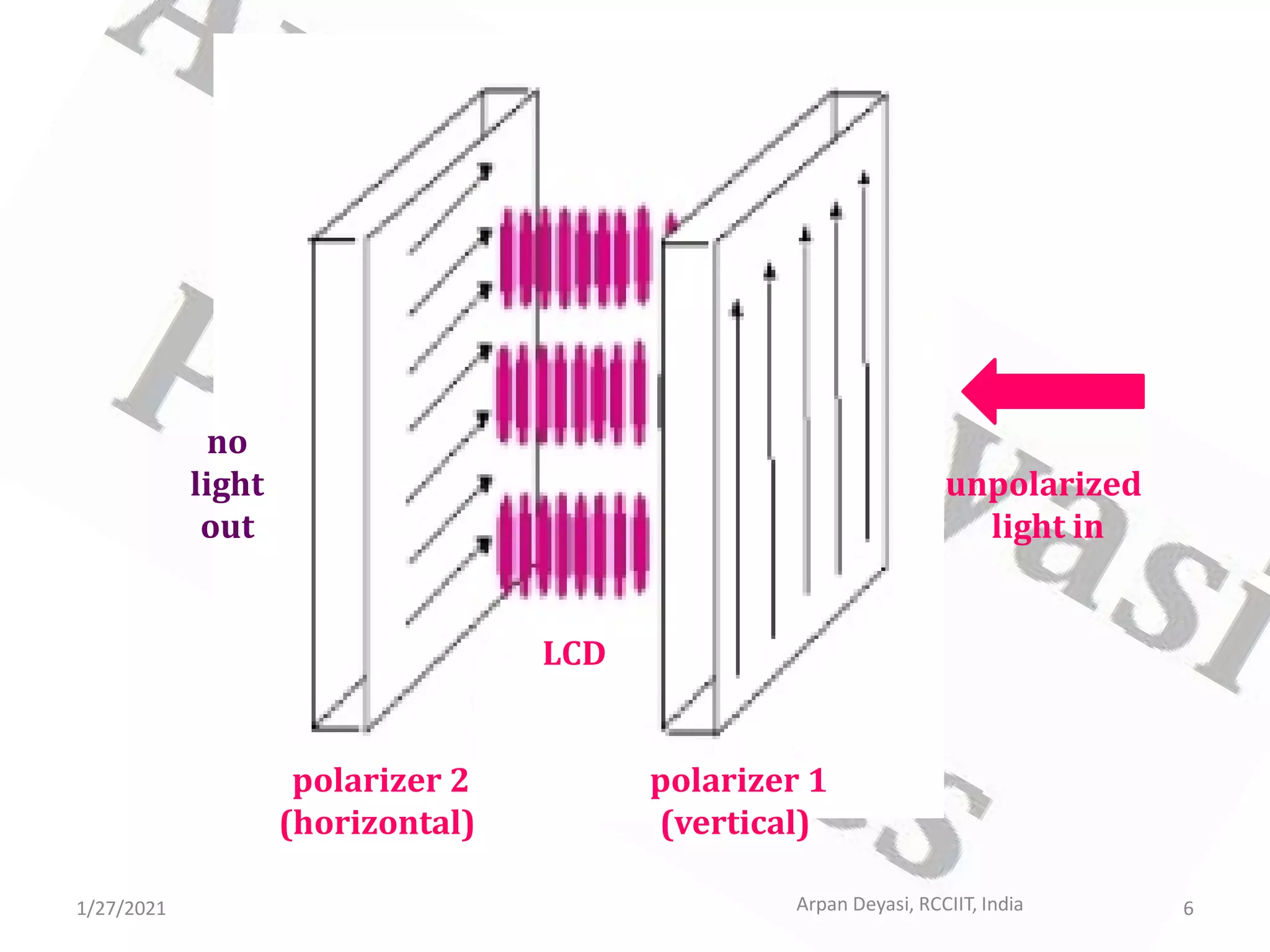
unpolarized
light in
polarizer 2
(horizontal)
LCD
polarizer 1
(vertical)
no
light
out
1/27/2021 Arpan Deyasi, RCCIIT, India 7
1/27/2021 Arpan Deyasi, RCCIIT, India 8
What is the role of polarization property?
It is used in LCD screen to switch
its colored pixel ON or OFF
1/27/2021
Arpan Deyasi, RCCIIT, India
9
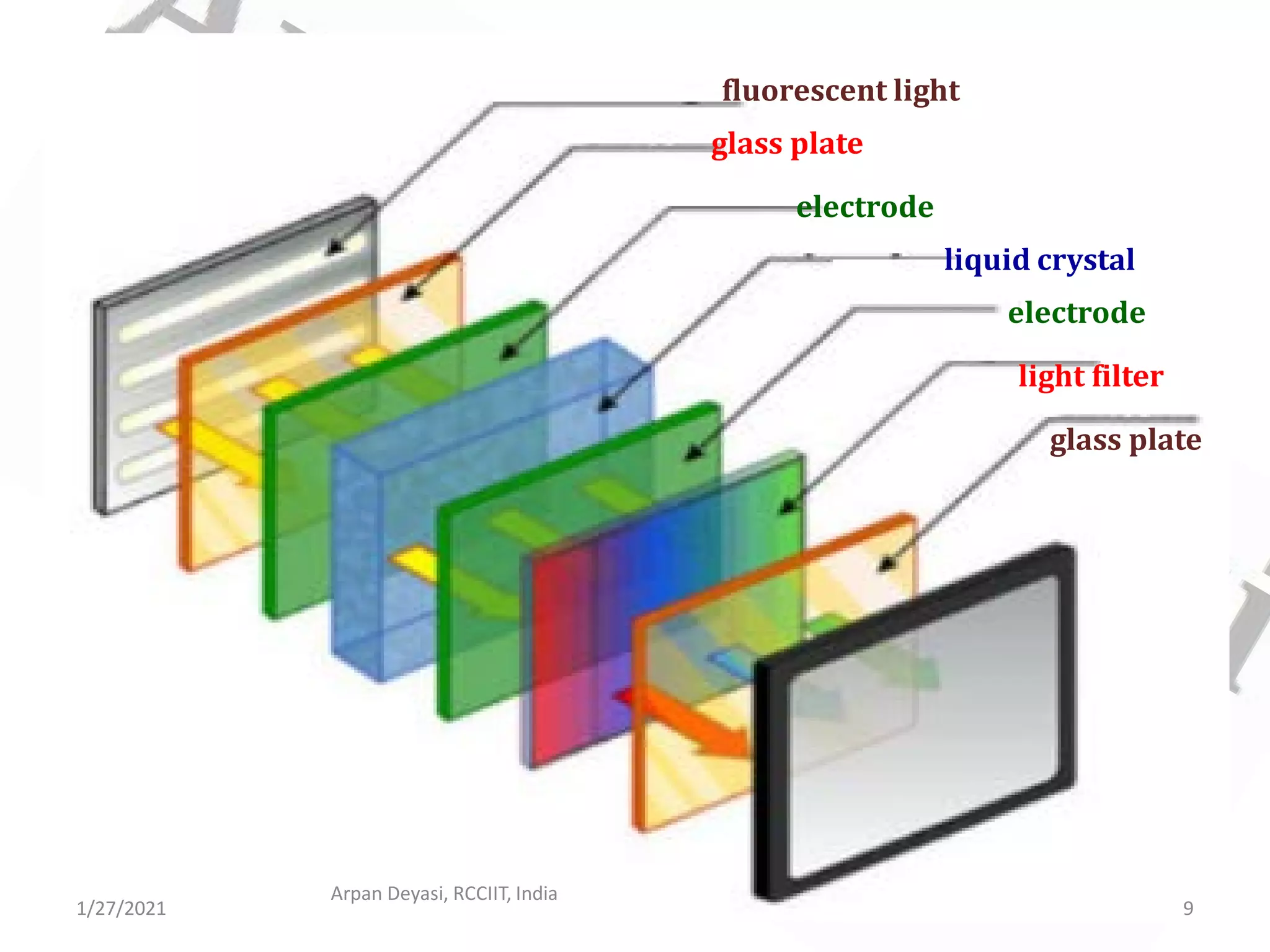
fluorescent light
glass plate
electrode
liquid crystal
electrode
light filter
glass plate
1/27/2021 Arpan Deyasi, RCCIIT, India 10
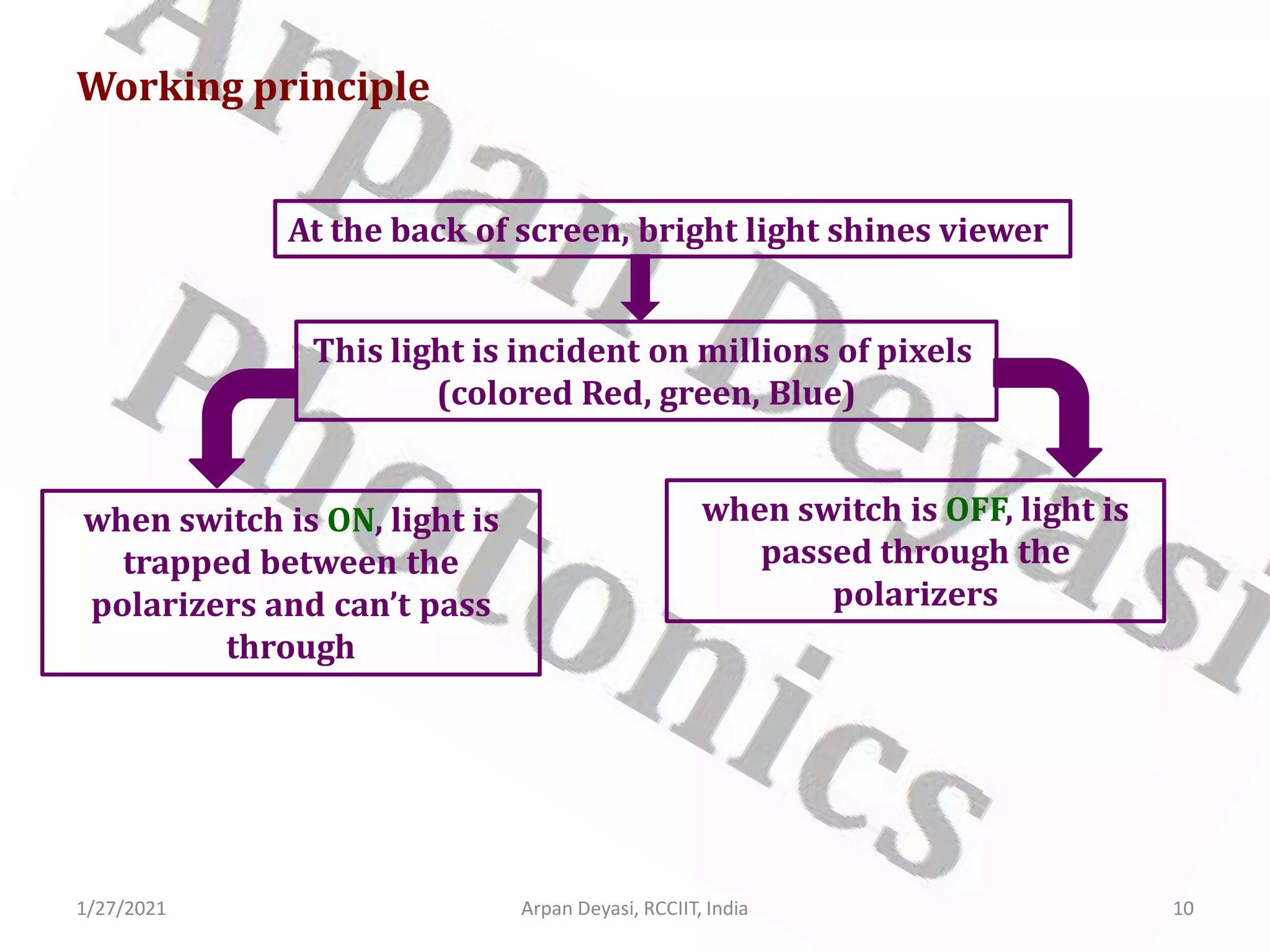
Working principle
This light is incident on millions of pixels
(colored Red, green, Blue)
At the back of screen, bright light shines viewer
when switch is ON, light is
trapped between the
polarizers and can’t pass
through
when switch is OFF, light is
passed through the
polarizers
1/27/2021 Arpan Deyasi, RCCIIT, India 11
Phases of liquid crystal
1/27/2021 Arpan Deyasi, RCCIIT, India 12
o transparent or translucent liquid that causes the
polarization of light waves to change as the waves pass
through the liquid
o characterized by molecules that have no positional order
but tend to point in the same direction (along the director)
o used in twisted nematic displays, the most common form
of liquid crystal display
o all the molecules are subsequently arranged in one
dimension structure
Nematic phase
1/27/2021 Arpan Deyasi, RCCIIT, India 13
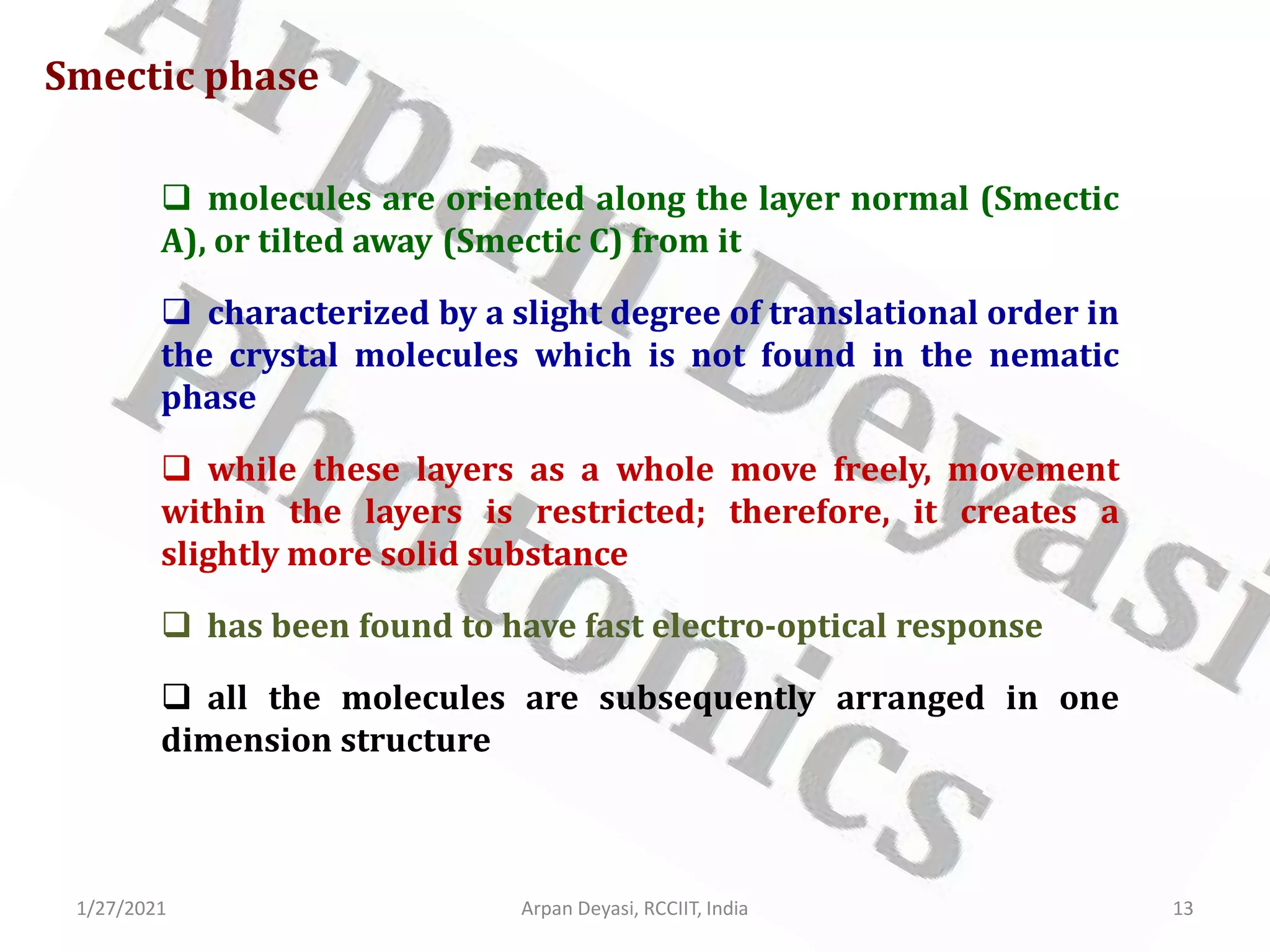
Smectic phase
 molecules are oriented along the layer normal (Smectic
A), or tilted away (Smectic C) from it
 characterized by a slight degree of translational order in
the crystal molecules which is not found in the nematic
phase
 while these layers as a whole move freely, movement
within the layers is restricted; therefore, it creates a
slightly more solid substance
 has been found to have fast electro-optical response
 all the molecules are subsequently arranged in one
dimension structure
1/27/2021 Arpan Deyasi, RCCIIT, India 14
Cholesteric phase
o all the molecules are arranged same as nematic
crystals
o all the molecules are subsequently layered at angles to
each other
o They organize in layers with no positional ordering
within layers, but a director axis which varies with
layers
1/27/2021 Arpan Deyasi, RCCIIT, India 15
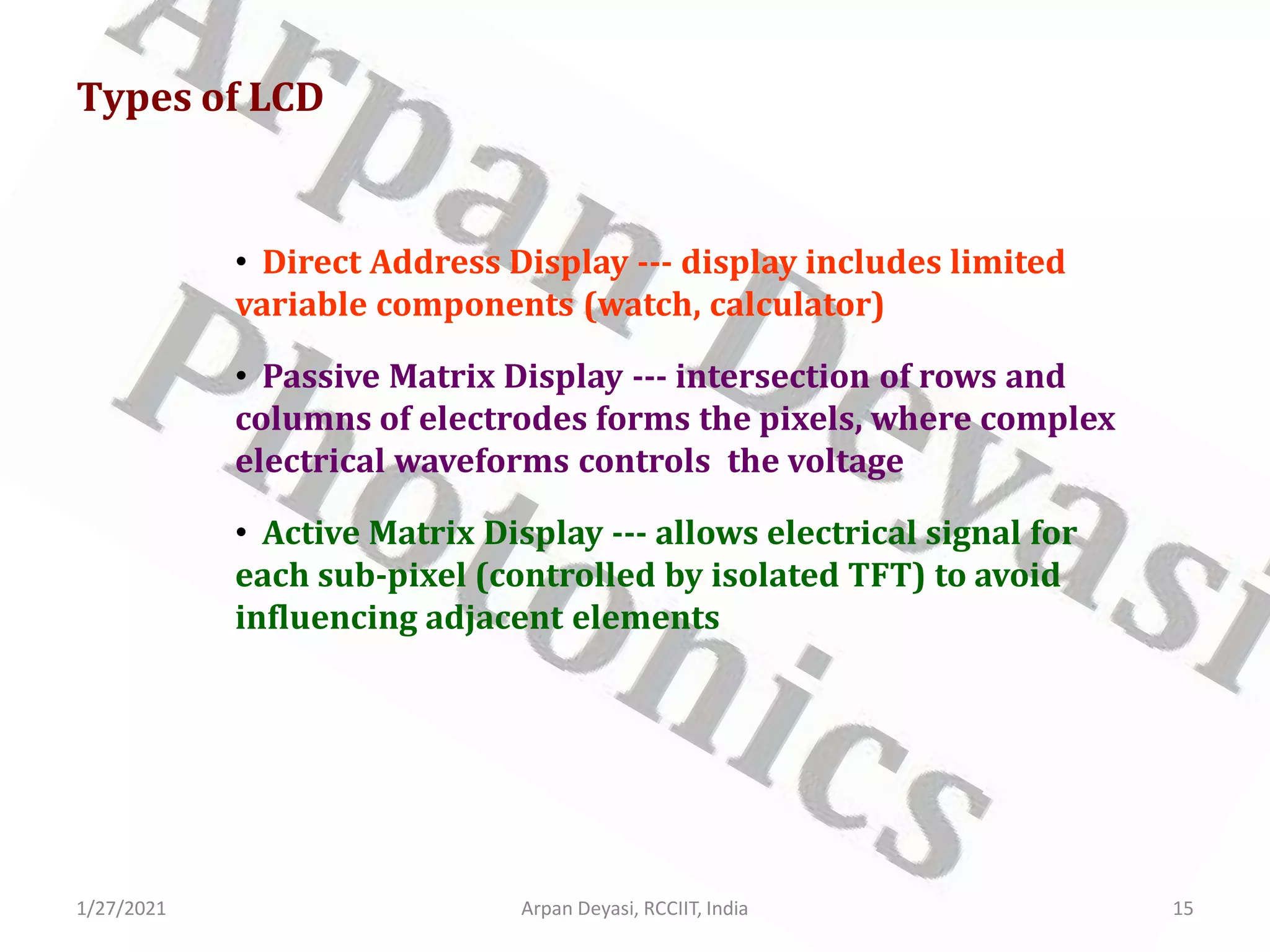
Types of LCD
• Direct Address Display --- display includes limited
variable components (watch, calculator)
• Passive Matrix Display --- intersection of rows and
columns of electrodes forms the pixels, where complex
electrical waveforms controls the voltage
• Active Matrix Display --- allows electrical signal for
each sub-pixel (controlled by isolated TFT) to avoid
influencing adjacent elements
1/27/2021 Arpan Deyasi, RCCIIT, India 16
Disadvantages
cost: more expensive than CRT
response time: slow response time
viewing angle: restricted viewing angle
contrast: lower contrast than CRT due to poor black-level

Liquid crystal display

  • 1.
    Course: LCD Liquid CrystalDisplay Course Coordinator: Arpan Deyasi 1/27/2021 1 Arpan Deyasi, RCCIIT, India
  • 2.
    1/27/2021 Arpan Deyasi,RCCIIT, India 2 LCD thin, flat panel display device displays electronic information (text, audio, video) uses polarization property of light to display objects electronically modulated optical device made up of any number of pixels filled with liquid crystals
  • 3.
    1/27/2021 Arpan Deyasi,RCCIIT, India 3 Why LCD is preferred? smaller size: offers 60% less space than CRT lower power consumption: consumes 50% less power and emits less heat than CRT less weight: 70% less weight to CRT of compatible size less EM radiation: negligible emission of EM fields, nor susceptible to it longer life: longer useful life than CRT screen shape: completely flat screen
  • 4.
    1/27/2021 Arpan Deyasi,RCCIIT, India 4 Material aspect flows like liquid molecules oriented like a solid crystal can precisely be aligned subjected to electric fields when properly aligned, allows light to pass through application of electric field causes it to polarize, and becomes opaque. after removal of field, it again becomes transparent
  • 5.
    1/27/2021 Arpan Deyasi, RCCIIT,India 5 unpolarized light in polarizer 1 (vertical) polarizer 2 (horizontal) LCD horizontally polarized light out
  • 6.
    1/27/2021 Arpan Deyasi,RCCIIT, India 6 unpolarized light in polarizer 2 (horizontal) LCD polarizer 1 (vertical) no light out
  • 7.
    1/27/2021 Arpan Deyasi,RCCIIT, India 7
  • 8.
    1/27/2021 Arpan Deyasi,RCCIIT, India 8 What is the role of polarization property? It is used in LCD screen to switch its colored pixel ON or OFF
  • 9.
    1/27/2021 Arpan Deyasi, RCCIIT,India 9 fluorescent light glass plate electrode liquid crystal electrode light filter glass plate
  • 10.
    1/27/2021 Arpan Deyasi,RCCIIT, India 10 Working principle This light is incident on millions of pixels (colored Red, green, Blue) At the back of screen, bright light shines viewer when switch is ON, light is trapped between the polarizers and can’t pass through when switch is OFF, light is passed through the polarizers
  • 11.
    1/27/2021 Arpan Deyasi,RCCIIT, India 11 Phases of liquid crystal
  • 12.
    1/27/2021 Arpan Deyasi,RCCIIT, India 12 o transparent or translucent liquid that causes the polarization of light waves to change as the waves pass through the liquid o characterized by molecules that have no positional order but tend to point in the same direction (along the director) o used in twisted nematic displays, the most common form of liquid crystal display o all the molecules are subsequently arranged in one dimension structure Nematic phase
  • 13.
    1/27/2021 Arpan Deyasi,RCCIIT, India 13 Smectic phase  molecules are oriented along the layer normal (Smectic A), or tilted away (Smectic C) from it  characterized by a slight degree of translational order in the crystal molecules which is not found in the nematic phase  while these layers as a whole move freely, movement within the layers is restricted; therefore, it creates a slightly more solid substance  has been found to have fast electro-optical response  all the molecules are subsequently arranged in one dimension structure
  • 14.
    1/27/2021 Arpan Deyasi,RCCIIT, India 14 Cholesteric phase o all the molecules are arranged same as nematic crystals o all the molecules are subsequently layered at angles to each other o They organize in layers with no positional ordering within layers, but a director axis which varies with layers
  • 15.
    1/27/2021 Arpan Deyasi,RCCIIT, India 15 Types of LCD • Direct Address Display --- display includes limited variable components (watch, calculator) • Passive Matrix Display --- intersection of rows and columns of electrodes forms the pixels, where complex electrical waveforms controls the voltage • Active Matrix Display --- allows electrical signal for each sub-pixel (controlled by isolated TFT) to avoid influencing adjacent elements
  • 16.
    1/27/2021 Arpan Deyasi,RCCIIT, India 16 Disadvantages cost: more expensive than CRT response time: slow response time viewing angle: restricted viewing angle contrast: lower contrast than CRT due to poor black-level