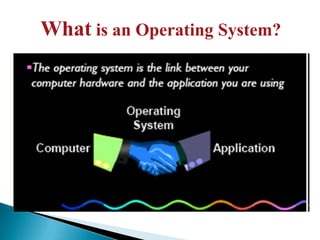
What is an Operating System?
A more formal definition!
Operating system is a piece of
software which controls all the
computer’s
resources
and
provides the base upon which the
application programs can be
written
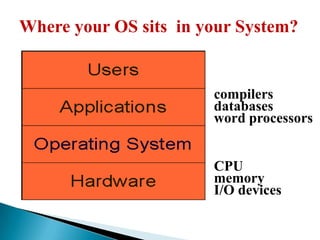
Where your OS sits in your System?

compilers
databases
word processors
CPU
memory
I/O devices
TYPES OF OPERATING SYSTEMS
Stand-Alone Operating system
Network Operating systems
Embedded Operating systems
Stand-Alone Operating system
It is a complete operating system that
works on a desktop or notebook computer.
Examples of stand-alone operating
systems are:
DOS
Windows 2000 professional
Mac OS X
Network Operating systems
It is an operating system that provides
extensive support for computer networks. A
network operating system typically resides on
a server.
Examples of a network Operating system
are:
Windows 2000 server
Unix
Linux
Solaris
Embedded Operating system
You can find this operating system on
handheld computers and small devices.
It resides on a ROM chip.
Examples of embedded operating
systems are :
oWindows CE
oPocket PC 2002
oPalm OS
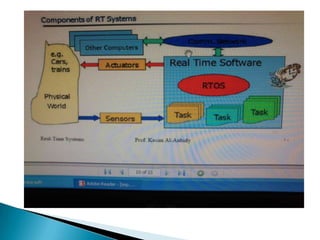
What is RTOS?
A real-time operating system (RTOS) that supports
real-time applications and embedded systems.
Real-time applications have the requirement to meet
task deadlines in addition to the logical correctness
of the results.

Multiple events handled by a single processor
Events may occur simultaneously

Processor must handle multiple, often competing events
Difference between a General purpose
operating system(GPOS) and an RTOS
A GPOS is used for systems/applications that
are not time critical.
In the case of a GPOS – task scheduling is not
based on “priority”,it is programmed to achieve
high throughput
A GPOS is made for high end, general purpose
systems whereas RTOS is usually designed for a
low end, stand alone device
All the process and threads in RTOS has got
bounded latencies – which means –a process/thread
will get executed within a specified time limit
.
Classification real time systems(RTS)
Hard Real Time System
Firm Real Time System
Soft Real Time System
Hard Real time:
Here missing an individual deadline results
in catastrophic failure of the system which
also causes a great financial loss .
The examples for Hard real time systems
are:
 Air traffic control
 Nuclear power plant control
Firm Real time:
In this, missing a deadline results in
unacceptable quality reduction. Technically
there is no difference with hard Real time,
but economically the disaster risk is limited.
Examples for Firm real time are :
Failure of Ignition of a automobile
Failure of opening of a safe
Soft real time:
Here the dead line may not be fulfilled
and can be recovered from. The
reduction in system quality and
performance is at an acceptable level.
Examples of Soft real time systems :
Multimedia transmission and reception
Networking, telecom (Mobile) networks
websites and services
Computer games
Features of an RTOS:
•Context switching latency should be short. This
means that the time taken while saving the
context of current task and then switching over to
another task should be short.
•The time taken between executing the last
instruction of an interrupted task and executing
the first instruction of interrupt handler should be
predictable and short. This is also known as
interrupt latency.
•Similarly the time taken between executing the
last instruction of the interrupt handler and
executing the next task should also be short and
predictable. This is also known as interrupt
dispatch latency.
dispatch latency.
•Reliable and time bound inter process
mechanisms should be in place for processes to
mechanisms should be in place for processes to.
communicate with each other in a timely manner.
•An RTOS should have support for multitasking
and task preemption. Preemption means to
switch from a currently executing task to a high
priority task ready and waiting to be executed.
•RTOS should be fault tolerant
Some of the most widely used RTOS
are:•LynxOS
•OSE
•QNX
•RTLinux
•VxWorks
•Windows CE
Programming languages Used
C is most widely used in RTOS programming
C++ and Ada are the next more popular for large
projects.
Java may also be a choice for some applications
Rtos by shibu

Rtos by shibu

  • 2.
    What is anOperating System?
  • 3.
    A more formaldefinition! Operating system is a piece of software which controls all the computer’s resources and provides the base upon which the application programs can be written
  • 4.
    Where your OSsits in your System? compilers databases word processors CPU memory I/O devices
  • 5.
    TYPES OF OPERATINGSYSTEMS Stand-Alone Operating system Network Operating systems Embedded Operating systems
  • 6.
    Stand-Alone Operating system Itis a complete operating system that works on a desktop or notebook computer. Examples of stand-alone operating systems are: DOS Windows 2000 professional Mac OS X
  • 7.
    Network Operating systems Itis an operating system that provides extensive support for computer networks. A network operating system typically resides on a server. Examples of a network Operating system are: Windows 2000 server Unix Linux Solaris
  • 8.
    Embedded Operating system Youcan find this operating system on handheld computers and small devices. It resides on a ROM chip. Examples of embedded operating systems are : oWindows CE oPocket PC 2002 oPalm OS
  • 9.
    What is RTOS? Areal-time operating system (RTOS) that supports real-time applications and embedded systems. Real-time applications have the requirement to meet task deadlines in addition to the logical correctness of the results. Multiple events handled by a single processor Events may occur simultaneously Processor must handle multiple, often competing events
  • 11.
    Difference between aGeneral purpose operating system(GPOS) and an RTOS A GPOS is used for systems/applications that are not time critical. In the case of a GPOS – task scheduling is not based on “priority”,it is programmed to achieve high throughput A GPOS is made for high end, general purpose systems whereas RTOS is usually designed for a low end, stand alone device All the process and threads in RTOS has got bounded latencies – which means –a process/thread will get executed within a specified time limit .
  • 12.
    Classification real timesystems(RTS) Hard Real Time System Firm Real Time System Soft Real Time System
  • 13.
    Hard Real time: Heremissing an individual deadline results in catastrophic failure of the system which also causes a great financial loss . The examples for Hard real time systems are:  Air traffic control  Nuclear power plant control
  • 14.
    Firm Real time: Inthis, missing a deadline results in unacceptable quality reduction. Technically there is no difference with hard Real time, but economically the disaster risk is limited. Examples for Firm real time are : Failure of Ignition of a automobile Failure of opening of a safe
  • 15.
    Soft real time: Herethe dead line may not be fulfilled and can be recovered from. The reduction in system quality and performance is at an acceptable level. Examples of Soft real time systems : Multimedia transmission and reception Networking, telecom (Mobile) networks websites and services Computer games
  • 16.
    Features of anRTOS: •Context switching latency should be short. This means that the time taken while saving the context of current task and then switching over to another task should be short. •The time taken between executing the last instruction of an interrupted task and executing the first instruction of interrupt handler should be predictable and short. This is also known as interrupt latency.
  • 17.
    •Similarly the timetaken between executing the •Similarly the time taken between executing the last instruction of the interrupt handler and last instruction of the interrupt handler and executing the next task should also be short and executing the next task should also be short and predictable. This is also known as interrupt predictable. This is also known as interrupt dispatch latency. dispatch latency. •Reliable and time bound inter process •Reliable and time bound inter process mechanisms should be in place for processes to mechanisms should be in place for processes to. communicate with each other in a timely manner.
  • 18.
    •An RTOS shouldhave support for multitasking and task preemption. Preemption means to switch from a currently executing task to a high priority task ready and waiting to be executed. •RTOS should be fault tolerant Some of the most widely used RTOS are:•LynxOS •OSE •QNX •RTLinux •VxWorks •Windows CE
  • 19.
    Programming languages Used Cis most widely used in RTOS programming C++ and Ada are the next more popular for large projects. Java may also be a choice for some applications