Prepared by
Bhaskar Jyoti Sarma
AmarJyoti Deka
8/7/20156:45
AM
Introductio
n
8/7/2015 6:45:54AM
ALiquid Crystal Display (LCD) is a thin , flat panel
display device used for electronically displaying
information such as text ,images and moving picture.
LCD is used in Computer monitors, Televisions ,
Instrument panels, Gaming devices etc.
Polarization of lights is used here to display objects.
Why LCD
?
8/7/2015 6:45:54AM
Smaller size —LCDs occupy approximately 60 percent less space
than CRT displays an important feature when office space is limited.
Lower power consumption—LCDs typically consume about
half the power and emit much less heat than CRT displays.
Lighter weight —LCDs weigh approximately 70 percent less than
CRT displays of comparable size.
No electromagnetic fields —LCDs do not emit electromagnetic
fields and are not susceptible to them. Thus, they are suitable for use
in areas where CRTs cannot be used.
Longer life —LCDs have a longer useful life than CRTs.
Liquid
crystals
8/7/2015 6:45:54AM
Liquid crystals are liquid chemicals in a state that has
properties between those conventional liquid and
solid crystals. That is a liquid crystal may flow like a
liquid, but its molecules may be oriented in a crystal
like way.
Liquid crystals molecules can be aligned precisely
when subjected to electric fields, as like as in the way
metal shavings line up in the field of a magnet. When
properly aligned, the liquid crystals allow light to pass
through.
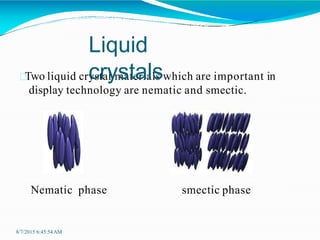
Two liquid crystal materials which are important in
display technology are nematic and smectic.
Nematic phase smectic phase
Liquid
crystals
8/7/2015 6:45:54AM
The most popular liquid crystal structure is the nematic
liquid crystal(NLC). When they are in a nematic phase,
liquid crystals are a bit like a liquid: their molecules can
move around and shuffle past one another, but they all
point in broadly the same direction.
The liquid is normally transparent, but if it is subjected to a
strong electric field, ions move through it and disrupt the
well ordered crystal structure, causing the liquid to
polarise and hence turn opaque. The removal of the
applied field allows the crystals structure to reform and the
material regains itstransparency.
8/7/2015 6:45:54AM
Liquid
crystals
How LCDs
work
8/7/2015 6:45:54AM
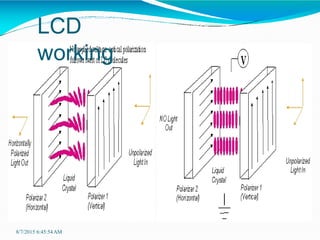
Liquid crystals can adopt a twisted up structure and
when we apply electricity to them, they straighten out
again. This is the key how LCD displays turn pixels on
and off.
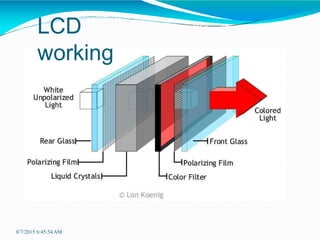
The polarization property of light is used in LCD
screen to switch its colored pixels on or off. At the
back of the screen, there is a bright light that shines
out towards the viewer. In front of this, there are the
millions of pixels, each one made up of smaller areas
called sub-pixels, that are colored Red, Green, or Blue.
LCD
working
8/7/2015 6:45:54AM
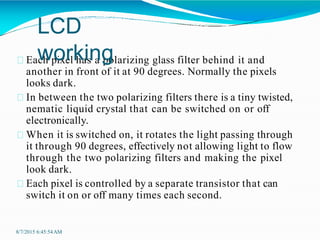
Each pixel has a polarizing glass filter behind it and
another in front of it at 90 degrees. Normally the pixels
looks dark.
In between the two polarizing filters there is a tiny twisted,
nematic liquid crystal that can be switched on or off
electronically.
When it is switched on, it rotates the light passing through
it through 90 degrees, effectively not allowing light to flow
through the two polarizing filters and making the pixel
look dark.
Each pixel is controlled by a separate transistor that can
switch it on or off many times each second.
8/7/2015 6:45:54AM
LCD
working
LCD
working
8/7/2015 6:45:54AM
LCD
working
8/7/2015 6:45:54AM
Types of
LCD
8/7/2015 6:45:54AM
Direct Address Display
Passive Matrix Display
Active Matrix Display
Direct Address
Display
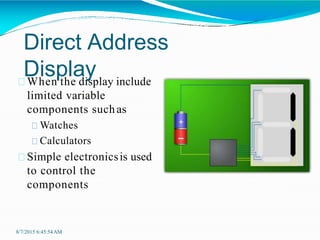
When the display include
limited variable
components suchas
Watches
Calculators
Simple electronicsis used
to control the
components
8/7/2015 6:45:54AM
Passive Matrix
Display
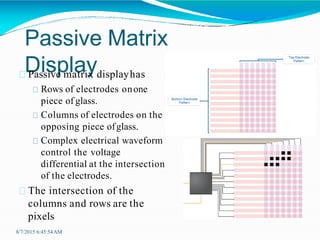
Passive matrix displayhas
Rows of electrodes onone
piece of glass.
Columns of electrodes on the
opposing piece ofglass.
Complex electrical waveform
control the voltage
differential at the intersection
of the electrodes.
The intersection of the
columns and rows are the
pixels
8/7/2015 6:45:54AM
Active Matrix
Display
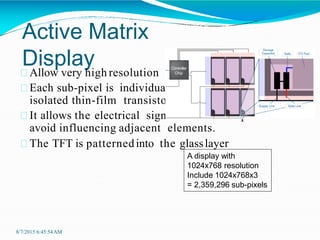
Allow very high resolution
Each sub-pixel is individually controlled by an
isolated thin-film transistor (TFT).
It allows the electrical signal for each sub-pixel to
avoid influencing adjacent elements.
The TFT is patternedinto the glasslayer
A display with
1024x768 resolution
Include 1024x768x3
= 2,359,296 sub-pixels
8/7/2015 6:45:54AM
Twisted Nematic (TN)
Display
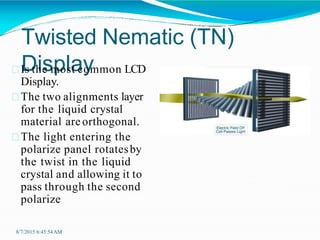
Is the most common LCD
Display.
The two alignments layer
for the liquid crystal
material are orthogonal.
The light entering the
polarize panel rotatesby
the twist in the liquid
crystal and allowing it to
pass through the second
polarize
8/7/2015 6:45:54AM
Disadvantages of Passive Matrix
Display
8/7/2015 6:45:54AM
As more rows and columns are added the range of the
allowed voltage isreduced.
At high range adjacent channels interferes
Range limit reducescontrast
Limit the types of useful liquid crystal.
It is usually limited to about 50 rows
Twisted nematic (TN) Display work best with large
voltage variation.
It can not be used in Passive Matrix Display
Advantage of Active Matrix
Displa
y
8/7/2015 6:45:54AM
Higher sizes
Higher contrast
Higher grayscale
Higher resolution
Higher viewingangle
Faster response. Eliminates“ghosting”
Better control of the color
Advantage of Twisted
Nematic Display
8/7/2015 6:45:54AM
Shortest response time.
Higher brightness.
They are cheap to manufacture, resulting in low prices
for end user.
Refferenc
es
8/7/2015 6:45:54AM
http://en.m.wikipedia.org/wiki/Liquid-crystal_display
http://www.explainstuff.com/lcdtv.html
http://www.slideshare.com
Electronic Instrumentation by H S Kalsi
Thank
you
8/7/2015 6:45:54AM

lcd presentation

  • 1.
    Prepared by Bhaskar JyotiSarma AmarJyoti Deka 8/7/20156:45 AM
  • 2.
    Introductio n 8/7/2015 6:45:54AM ALiquid CrystalDisplay (LCD) is a thin , flat panel display device used for electronically displaying information such as text ,images and moving picture. LCD is used in Computer monitors, Televisions , Instrument panels, Gaming devices etc. Polarization of lights is used here to display objects.
  • 3.
    Why LCD ? 8/7/2015 6:45:54AM Smallersize —LCDs occupy approximately 60 percent less space than CRT displays an important feature when office space is limited. Lower power consumption—LCDs typically consume about half the power and emit much less heat than CRT displays. Lighter weight —LCDs weigh approximately 70 percent less than CRT displays of comparable size. No electromagnetic fields —LCDs do not emit electromagnetic fields and are not susceptible to them. Thus, they are suitable for use in areas where CRTs cannot be used. Longer life —LCDs have a longer useful life than CRTs.
  • 4.
    Liquid crystals 8/7/2015 6:45:54AM Liquid crystalsare liquid chemicals in a state that has properties between those conventional liquid and solid crystals. That is a liquid crystal may flow like a liquid, but its molecules may be oriented in a crystal like way. Liquid crystals molecules can be aligned precisely when subjected to electric fields, as like as in the way metal shavings line up in the field of a magnet. When properly aligned, the liquid crystals allow light to pass through.
  • 5.
    Two liquid crystalmaterials which are important in display technology are nematic and smectic. Nematic phase smectic phase Liquid crystals 8/7/2015 6:45:54AM
  • 6.
    The most popularliquid crystal structure is the nematic liquid crystal(NLC). When they are in a nematic phase, liquid crystals are a bit like a liquid: their molecules can move around and shuffle past one another, but they all point in broadly the same direction. The liquid is normally transparent, but if it is subjected to a strong electric field, ions move through it and disrupt the well ordered crystal structure, causing the liquid to polarise and hence turn opaque. The removal of the applied field allows the crystals structure to reform and the material regains itstransparency. 8/7/2015 6:45:54AM Liquid crystals
  • 7.
    How LCDs work 8/7/2015 6:45:54AM Liquidcrystals can adopt a twisted up structure and when we apply electricity to them, they straighten out again. This is the key how LCD displays turn pixels on and off. The polarization property of light is used in LCD screen to switch its colored pixels on or off. At the back of the screen, there is a bright light that shines out towards the viewer. In front of this, there are the millions of pixels, each one made up of smaller areas called sub-pixels, that are colored Red, Green, or Blue.
  • 8.
  • 9.
    Each pixel hasa polarizing glass filter behind it and another in front of it at 90 degrees. Normally the pixels looks dark. In between the two polarizing filters there is a tiny twisted, nematic liquid crystal that can be switched on or off electronically. When it is switched on, it rotates the light passing through it through 90 degrees, effectively not allowing light to flow through the two polarizing filters and making the pixel look dark. Each pixel is controlled by a separate transistor that can switch it on or off many times each second. 8/7/2015 6:45:54AM LCD working
  • 10.
  • 11.
  • 12.
    Types of LCD 8/7/2015 6:45:54AM DirectAddress Display Passive Matrix Display Active Matrix Display
  • 13.
    Direct Address Display When thedisplay include limited variable components suchas Watches Calculators Simple electronicsis used to control the components 8/7/2015 6:45:54AM
  • 14.
    Passive Matrix Display Passive matrixdisplayhas Rows of electrodes onone piece of glass. Columns of electrodes on the opposing piece ofglass. Complex electrical waveform control the voltage differential at the intersection of the electrodes. The intersection of the columns and rows are the pixels 8/7/2015 6:45:54AM
  • 15.
    Active Matrix Display Allow veryhigh resolution Each sub-pixel is individually controlled by an isolated thin-film transistor (TFT). It allows the electrical signal for each sub-pixel to avoid influencing adjacent elements. The TFT is patternedinto the glasslayer A display with 1024x768 resolution Include 1024x768x3 = 2,359,296 sub-pixels 8/7/2015 6:45:54AM
  • 16.
    Twisted Nematic (TN) Display Isthe most common LCD Display. The two alignments layer for the liquid crystal material are orthogonal. The light entering the polarize panel rotatesby the twist in the liquid crystal and allowing it to pass through the second polarize 8/7/2015 6:45:54AM
  • 17.
    Disadvantages of PassiveMatrix Display 8/7/2015 6:45:54AM As more rows and columns are added the range of the allowed voltage isreduced. At high range adjacent channels interferes Range limit reducescontrast Limit the types of useful liquid crystal. It is usually limited to about 50 rows Twisted nematic (TN) Display work best with large voltage variation. It can not be used in Passive Matrix Display
  • 18.
    Advantage of ActiveMatrix Displa y 8/7/2015 6:45:54AM Higher sizes Higher contrast Higher grayscale Higher resolution Higher viewingangle Faster response. Eliminates“ghosting” Better control of the color
  • 19.
    Advantage of Twisted NematicDisplay 8/7/2015 6:45:54AM Shortest response time. Higher brightness. They are cheap to manufacture, resulting in low prices for end user.
  • 20.
  • 21.