The document discusses liquid crystal displays (LCDs). LCDs are thin, flat display devices made up of pixels arrayed in front of a light source. Each pixel consists of liquid crystal molecules aligned between two transparent electrodes. Polarizing filters allow light to pass through in varying amounts, creating different levels of gray. Modern LCDs like computer monitors use an active matrix structure with thin-film transistors to access each pixel individually. LCDs are used in devices like computer monitors, laptops, televisions, and more.
Introduction to Liquid Crystal Displays (LCD), explaining their function as electro-optical amplitude modulators.
Discussion on reflective twistive LCDs, polarizing filters, and structure involving electrodes and torque alignment.
Technical specifications of LCDs including resolution, response time, pixel pitch, refresh rate, viewing angle, brightness, contrast ratio, and aspect ratio.
Mechanics of color LCDs involving RGB subpixels, addressing schemes, and resolution improvement strategies.
Examples of LCD applications in different devices including digital cameras and computer monitors utilizing active matrix structures.
Common defects in LCDs such as dead pixels and mura effects, drawbacks including slower response times and limited viewing angles.
Comparison of LCD with CRT and other display technologies, discussing their characteristics and uses.
INTRODUCTION A liquid crystal display ( LCD ) is an electro-optical amplitude modulator realized as a thin, flat display device . It is made up of any number of color or monochrome pixels arrayed in front of a light source or reflector .
3.
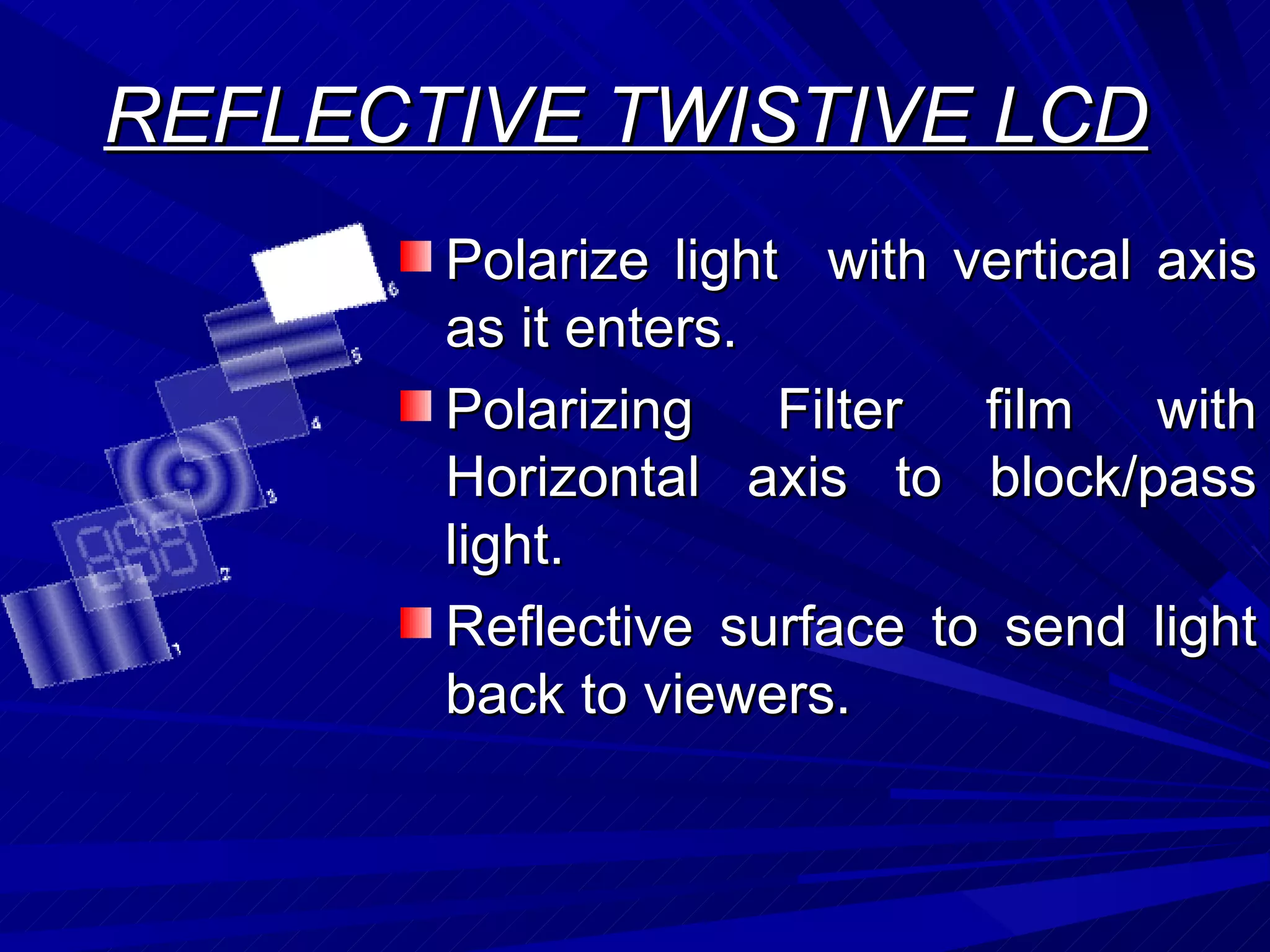
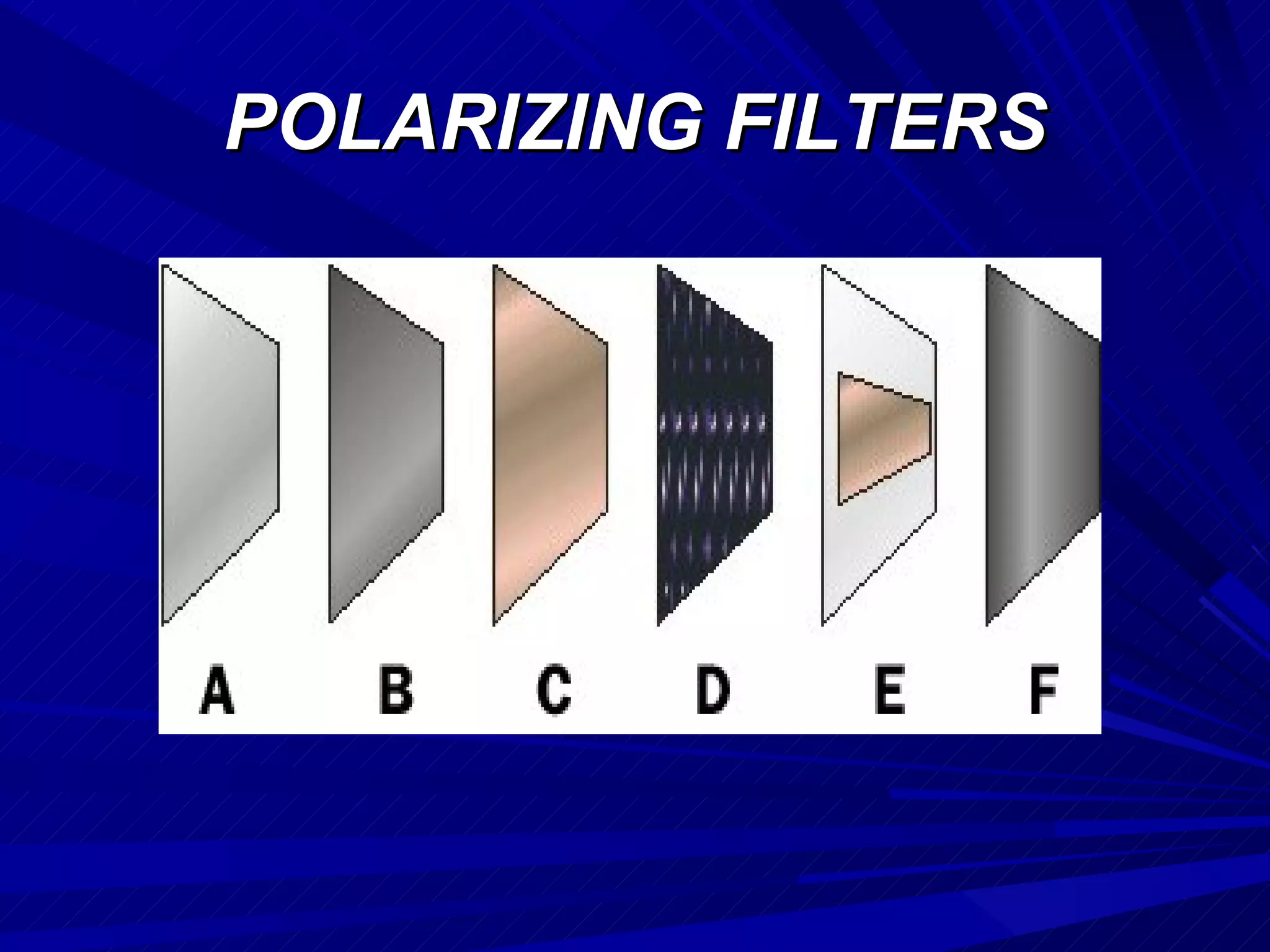
REFLECTIVE TWISTIVE LCDPolarize light with vertical axis as it enters. Polarizing Filter film with Horizontal axis to block/pass light. Reflective surface to send light back to viewers.
4.
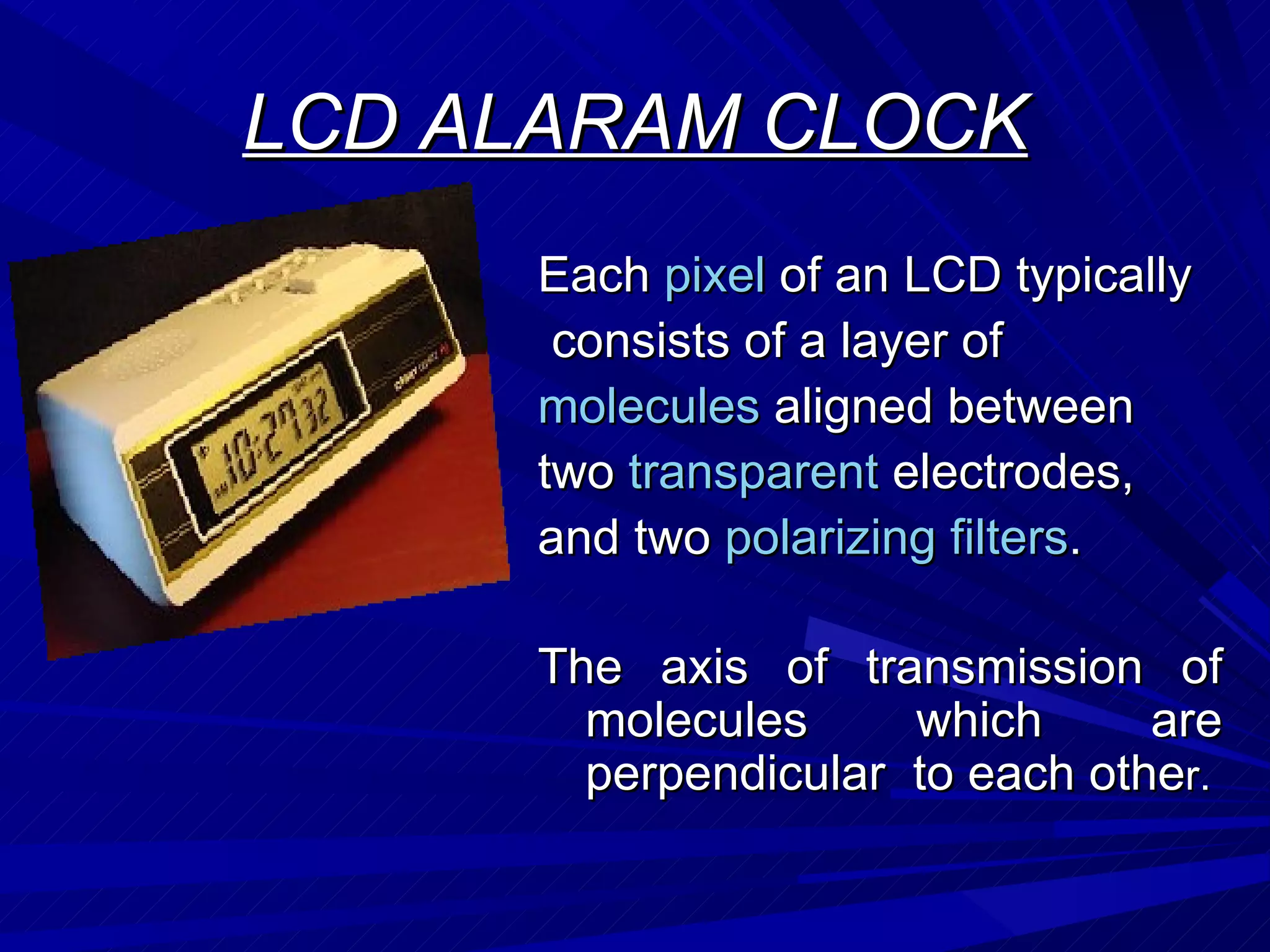
LCD ALARAM CLOCKEach pixel of an LCD typically consists of a layer of molecules aligned between two transparent electrodes, and two polarizing filters . The axis of transmission of molecules which are perpendicular to each othe r.
With no liquid crystal between the polarizing filters, light passing through the first filter would be blocked by the second (crossed) polarizer. The surface of the electrodes that are in contact with the liquid crystal material are treated so as to align the liquid crystal molecules in a particular direction
7.
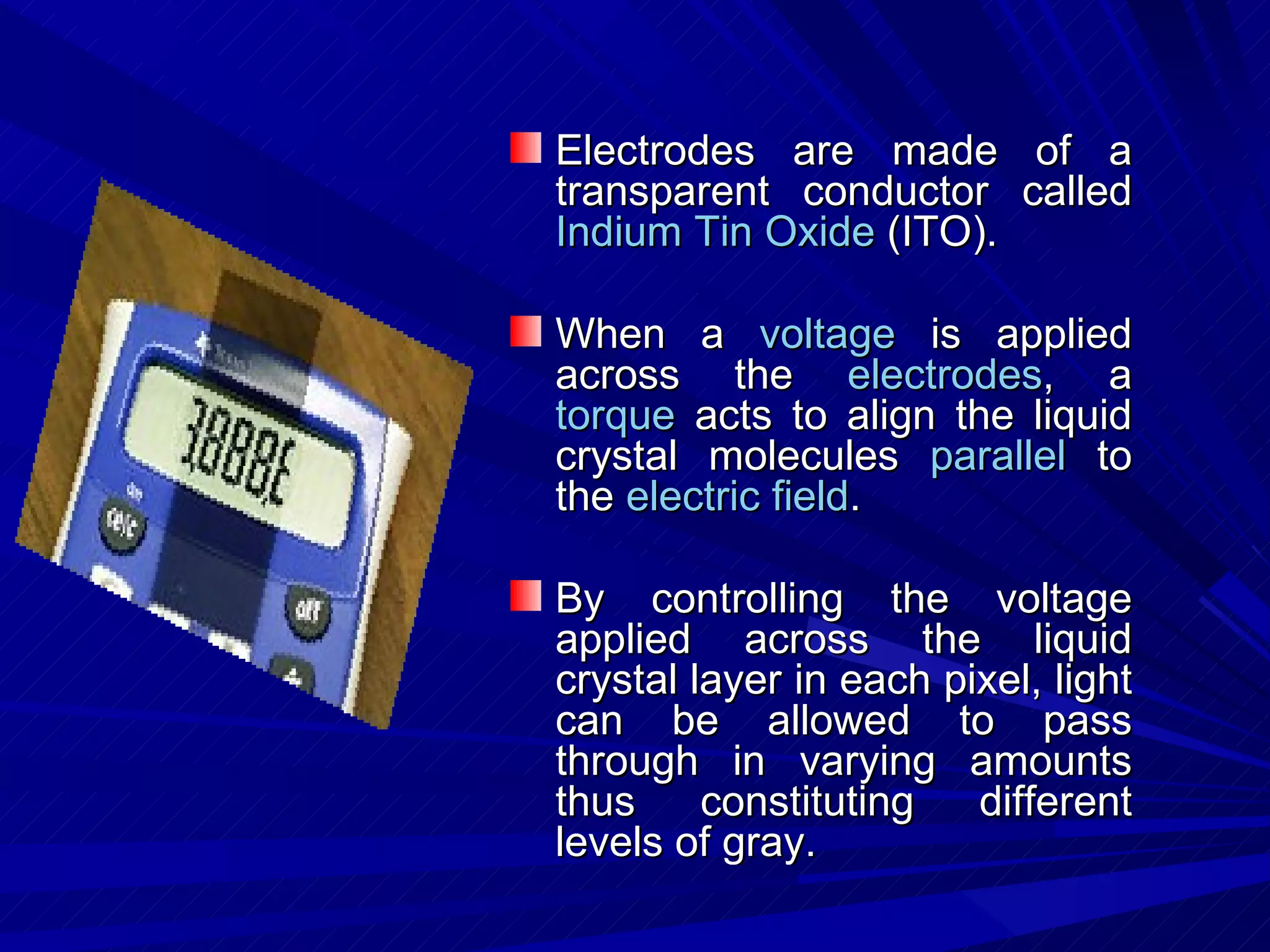
Electrodes are madeof a transparent conductor called Indium Tin Oxide (ITO). When a voltage is applied across the electrodes , a torque acts to align the liquid crystal molecules parallel to the electric field . By controlling the voltage applied across the liquid crystal layer in each pixel, light can be allowed to pass through in varying amounts thus constituting different levels of gray.
8.
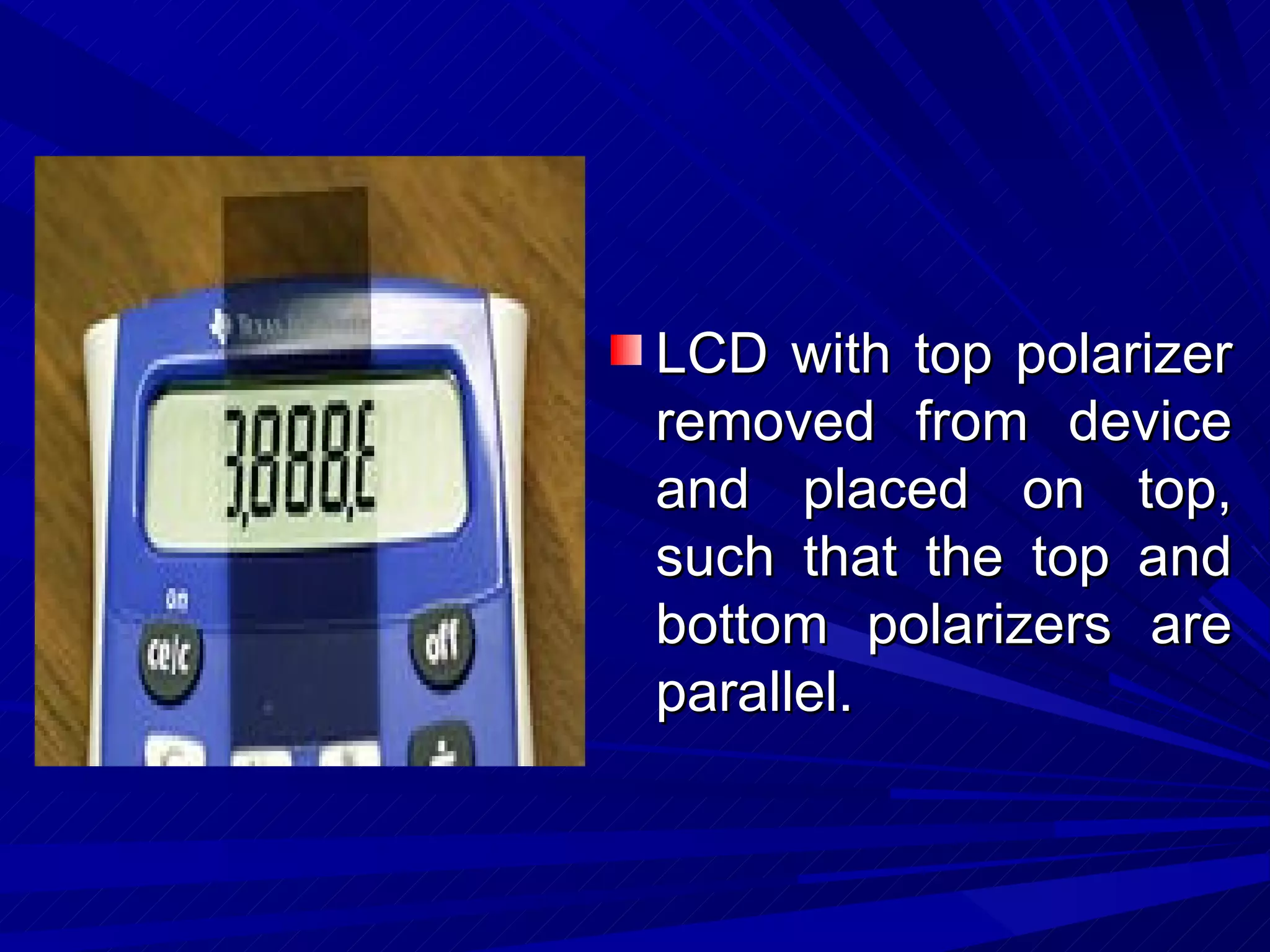
LCD with toppolarizer removed from device and placed on top, such that the top and bottom polarizers are parallel.
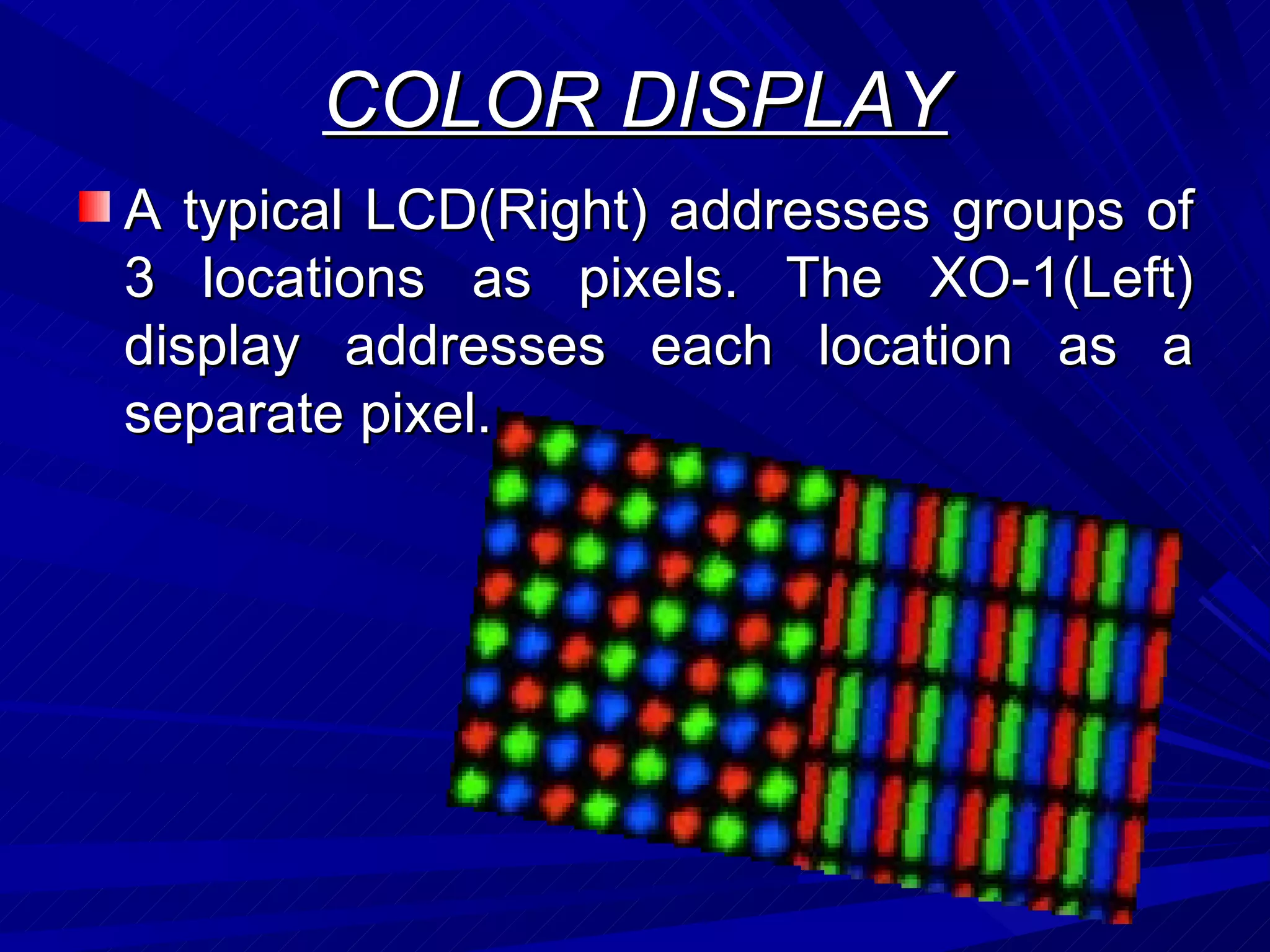
COLOR DISPLAY Atypical LCD(Right) addresses groups of 3 locations as pixels. The XO-1(Left) display addresses each location as a separate pixel.
12.
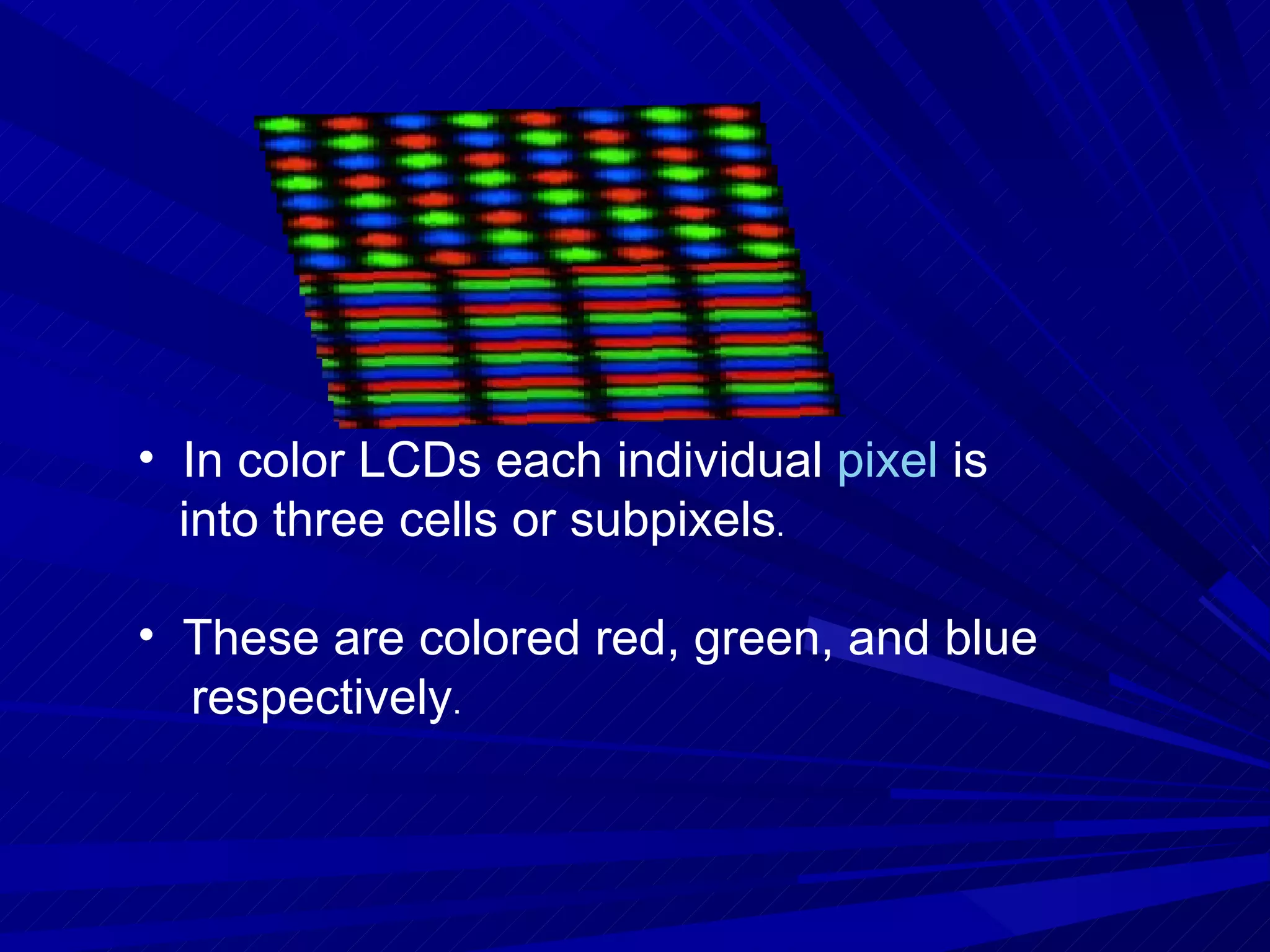
In color LCDseach individual pixel is into three cells or subpixels . These are colored red, green, and blue respectively .
13.
Color components maybe arrayed in various pixel geometries , depending on the monitor's usage. If software knows which type of geometry is being used in a given LCD, this can be used to increase the apparent resolution.
14.
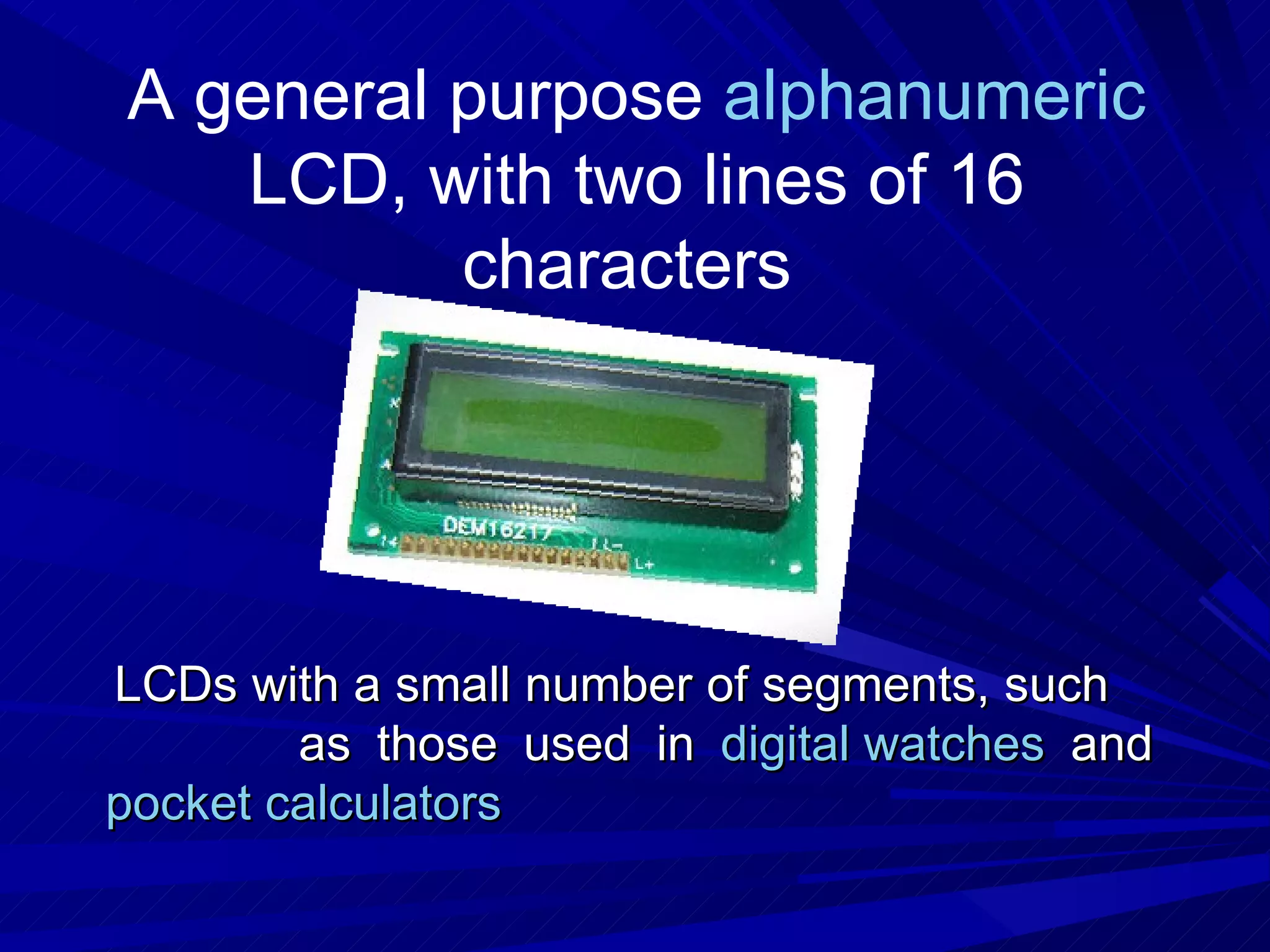
A general purpose alphanumeric LCD, with two lines of 16 characters LCDs with a small number of segments, such as those used in digital watches and pocket calculators
15.
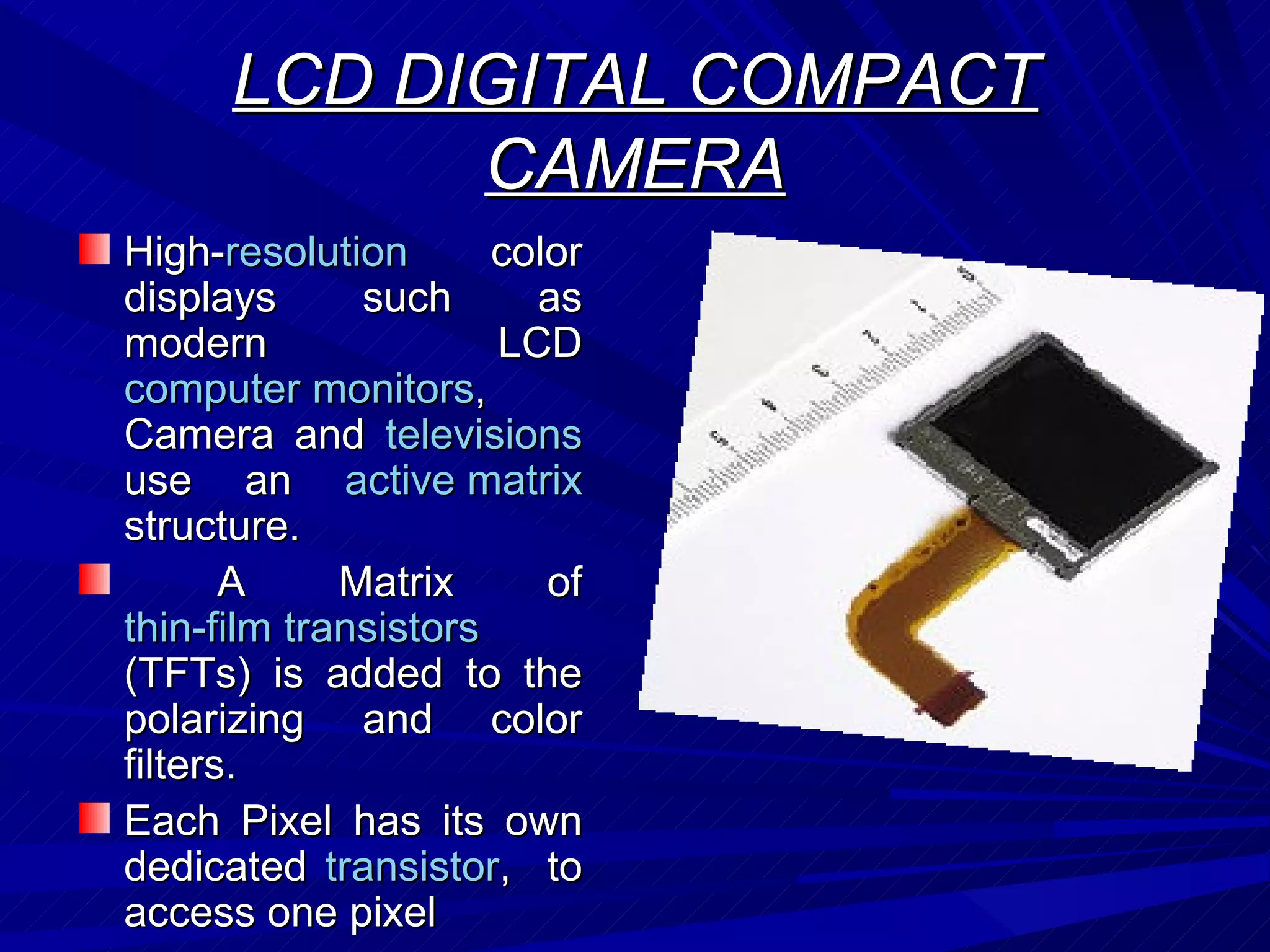
LCD DIGITAL COMPACTCAMERA High- resolution color displays such as modern LCD computer monitors , Camera and televisions use an active matrix structure. A Matrix of thin-film transistors (TFTs) is added to the polarizing and color filters. Each Pixel has its own dedicated transistor , to access one pixel
16.
DEFACTS IN LCDSome LCD panels have defective transistors causing dead pixels. It is also economically prohibitive to discard a panel with just a few defective transistor because LCD panels are much larger than ICs.
17.
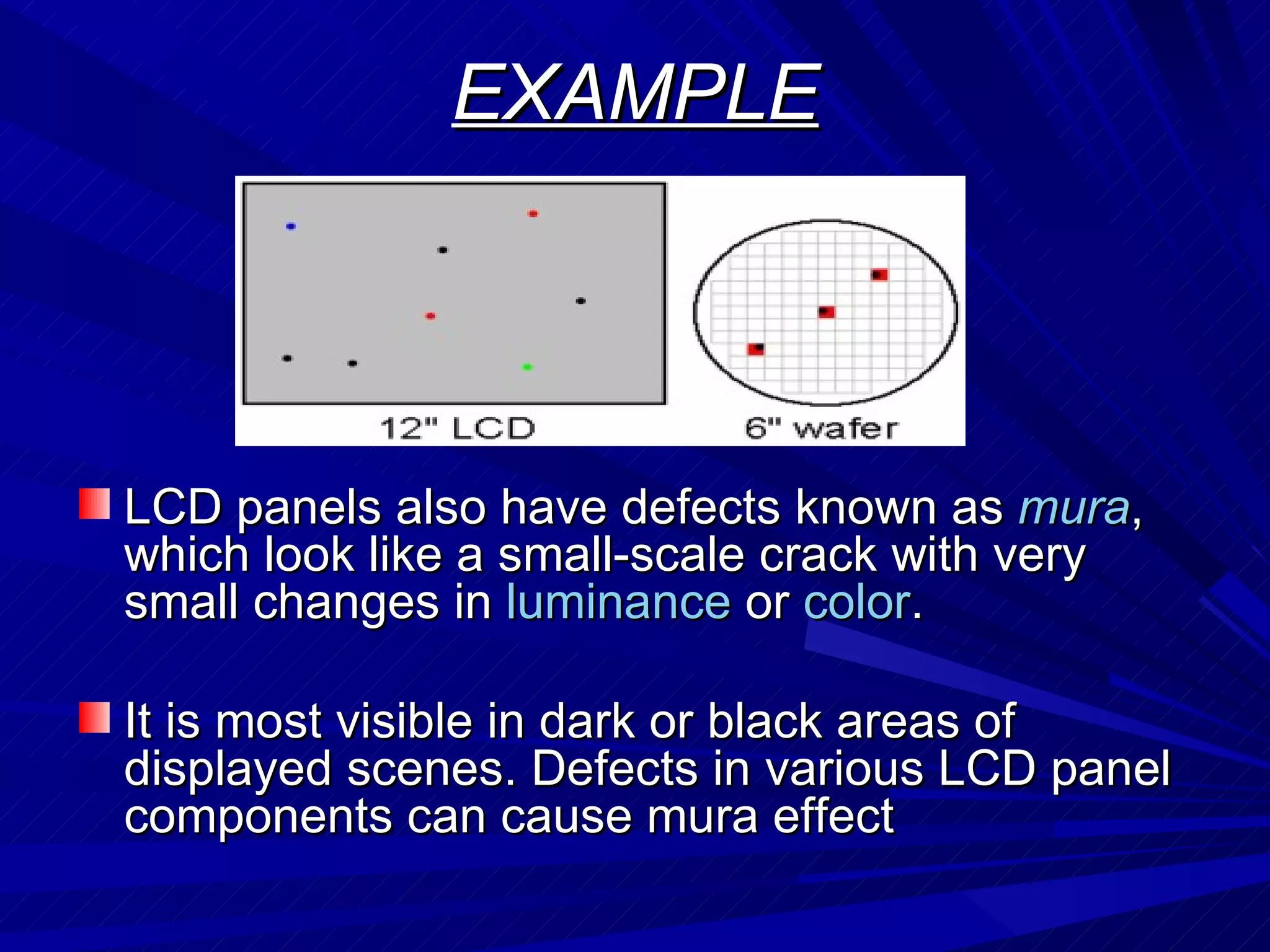
EXAMPLE LCD panelsalso have defects known as mura , which look like a small-scale crack with very small changes in luminance or color . It is most visible in dark or black areas of displayed scenes. Defects in various LCD panel components can cause mura effect
18.
APPLICATIONS PROJECTION TELEVISION DIGITAL CLOCKS and WATCHES COMPUTER MONITOR LAPTOP COMPUTERS MICROWAVE OWENS CD Players
19.
DrawBacks LCDs typicallyhave longer response times than their plasma and CRT counterparts when image rapidly changes. Some LCD TVs have slow video processing. Dead pixels can occur when the screen is damaged or pressure is put upon the screen. LCD panels using TN tend to have a limited viewing angle relative to CRT and plasma displays. This reduces the number of people able to conveniently view the same image – laptop screens are a prime example.
20.
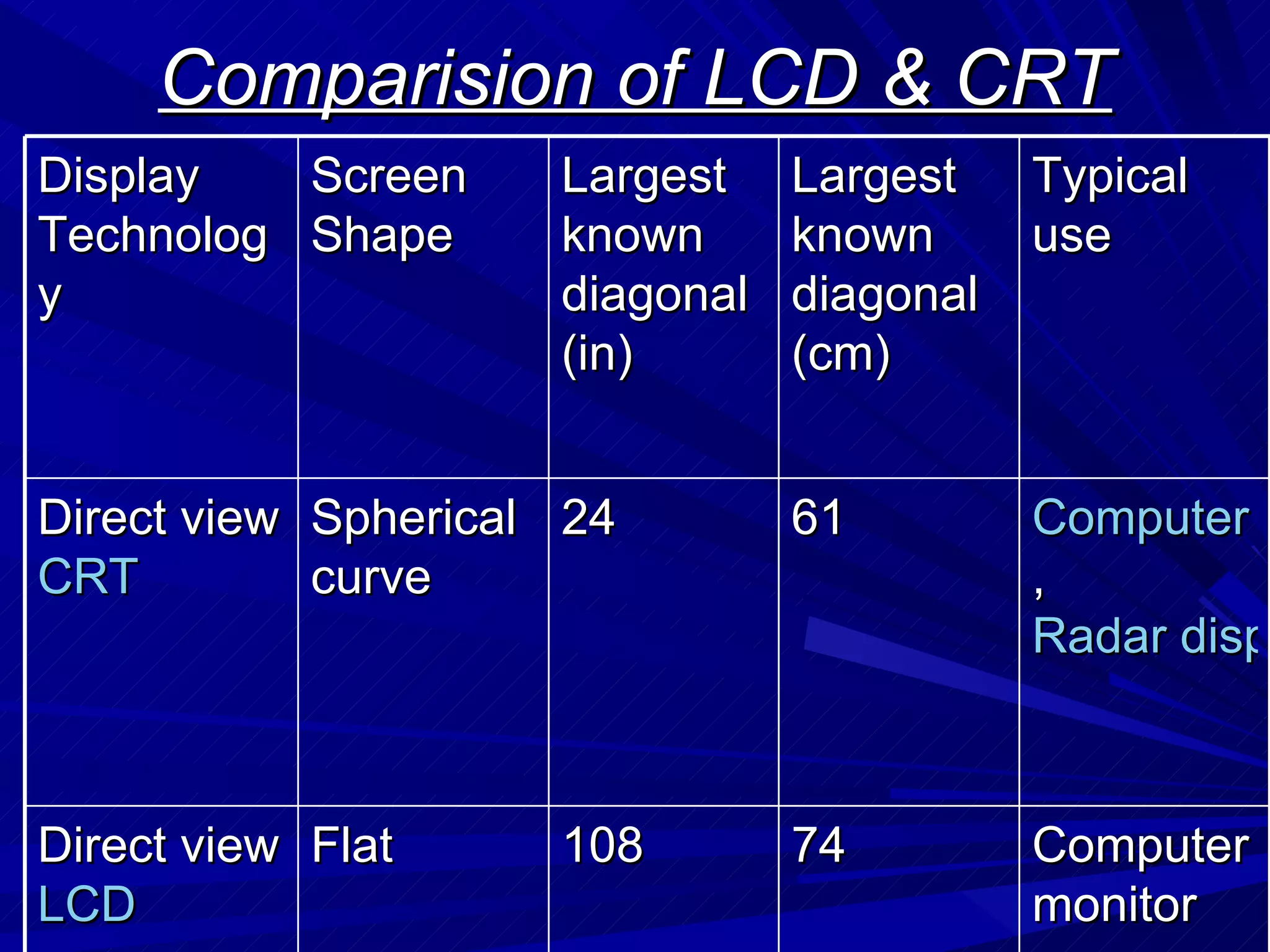
Comparision of LCD& CRT Display Technology Screen Shape Largest known diagonal (in) Largest known diagonal (cm) Typical use Direct view CRT Spherical curve 24 61 Computer monitor , Radar display Direct view LCD Flat 108 74 Computer monitor
21.
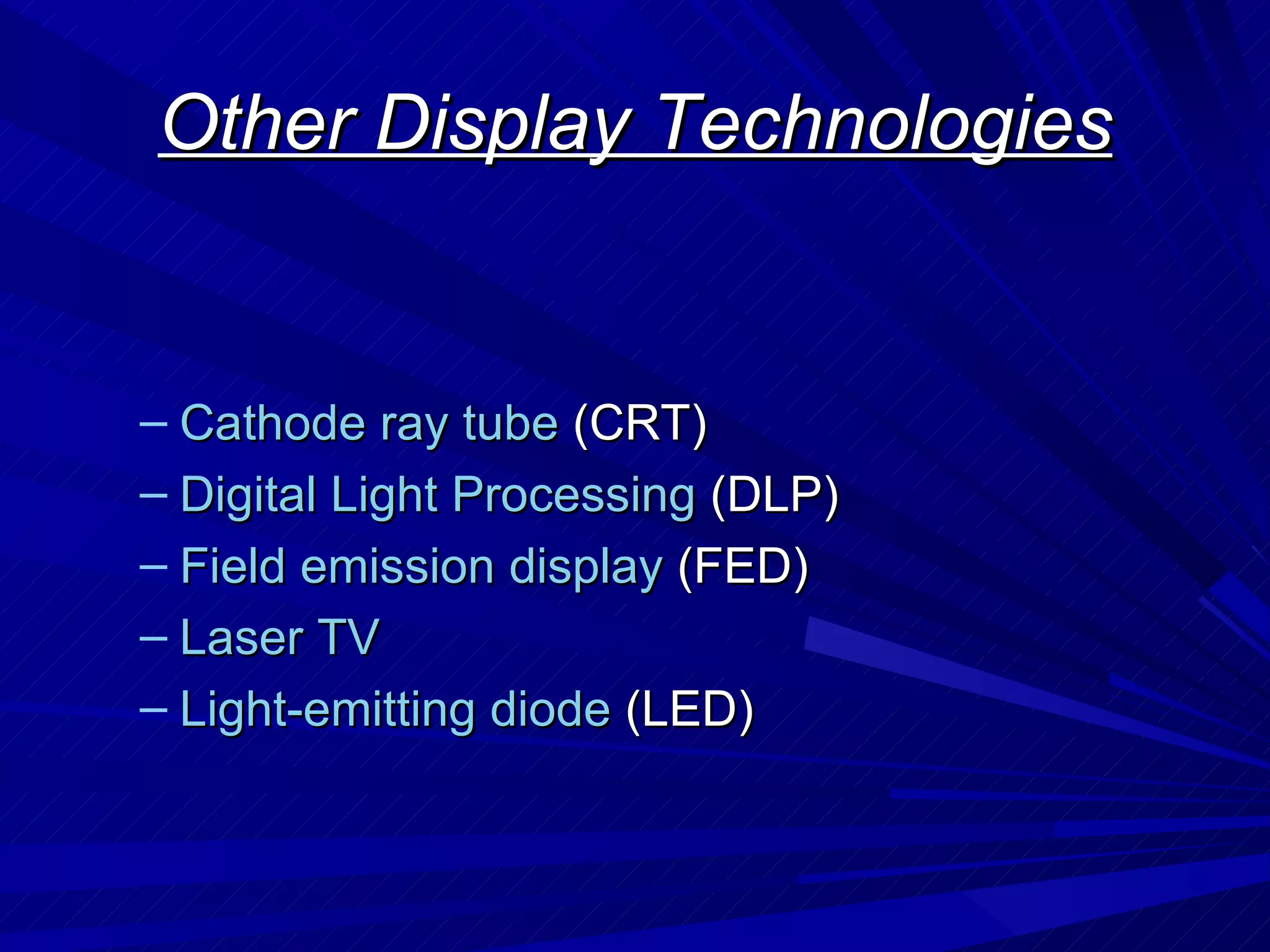
Other Display TechnologiesCathode ray tube (CRT) Digital Light Processing (DLP) Field emission display (FED) Laser TV Light-emitting diode (LED)