IJSRD - International Journal for Scientific Research & Development| Vol. 2, Issue 08, 2014 | ISSN (online): 2321-0613
All rights reserved by www.ijsrd.com 292
Land Use Land Cover Change Detection of Gulbarga City Using Remote
Sensing and GIS
Snehit S H1
Shivasharanappa2
1
M.tech 1
Associate Professor
1,2
Department of Environmental Engineering
1,2
PDA College of Engineering Gulbarga, Karnataka, India
Abstract— Land use and land cover(LULC) recently these
days became a major component to handle natural resources
and managing changes occurring in the environment.which
is due to expansion of the urban area it has lead to critical
losses of agriculture land,vegetation land and water
bodies.followed by this the urban sprawl created a
environmental issues. For example :decreased air quality
and increase in the temperature etc. Land use and land cover
change is driven by human actions and also drives changes
that limit availability of products and services for human
and animals, and it can undermine ecological wellbeing
also. Land use and land cover is an important component in
understanding various interactions of the human activities
with the environment and thus it is necessary to be able to
simulate changes. Therefore, this study was aimed at
understanding land use and land cover change in Gulbarga
city. In this work we took Gulbarga city to study the urban
expansion and LULC change that took place in 2001 and
2012 to know the changes happened in the year 2012 by
comparing with data of 2001.remote sensing methodology is
used in this study which provides major coverage mapping
& classification of land cover features such as
vegetation,soil,water,forest etc. A wide range of
environmental parameters can be measured including the
land use, vegetation types, surface temperatures , soil types,
precipitation, phytoplankton, turbidity, surface elevation and
geology.satellite images of two different years i.e 2001 and
2012 are taken in to consideration.after image processing
classification is done so as to classify images in to various
different land use categories.
Keywords: land use land cover (LULC), remote sensing,
gis,change detection, classification
I. INTRODUCTION
Land-use refers human Land use refers human exercises
ashore for gigantic uses like farming, woods advancement,
settlement improvement,etc. Land-cover refers to natural
covering of land by vegetation, water body, rocky land,
etc.change detection is a method of identifying the
enormous differences in LULC overtime. Land-use and
land-cover are linked to climate and weather in critical
ways. Key links between changes in land cover and climate
include the exchange of greenhouse gases (such as the water
vapor, the carbon dioxide, the methane, and the nitrous
oxide) between the land surface and the atmosphere, the
radiation (both solar and longwave) balance of the land
surface, the exchange of heat between the land surface and
the atmosphere, and the hardness of the land surface and its
uptake of momentum from the atmosphere. Because of these
strong links between land cover and climate,the changes in
land use and land cover can be important contributors to
climate change and variability. Land use/ Land-cover
change information has an important role to play at local
and regional as well as at macro level planning.. The land
use land-cover changes occur naturally in a progressive and
gradual way.
II. LITRATURE REVIEW
A. Innocent Ezeomedo And Joel Igbokwe,(Nigeria) :
He reported The center of this paper is to portray the fast and
commonsense methodology to Mapping and Analysis of
Landuse and Landcover examples and progressions utilizing
high determination satellite pictures. The study was done in
Onitsha urban and its environs in south-eastern Nigeria. For
this reason, multitemporal information comprising of
existing Topographical guide, SPOT-5, and IKONOS
pictures were transformed utilizing spatial examination
devices of resampling, georeferencing, grouping and post-
characterization overlay, to guide the examples and degree of
landuse and landcover in the study zone and additionally
focus the greatness of progressions between the years of
investment, 1964, 2005 and 2008 separately. The aftereffect
of the study demonstrates that the fabricated up territories
have been on a steady positive and basically uncontrolled
extension from 8.12% of the study territory in 1964 to
41.64% in 2005 and to 67.62% in 2008. Then again,
vegetation, including developed and uncultivated
horticultural grounds has been on an unfaltering decay, from
79.10% in 1964 to 51.78% in 2005 and an unimportant
18.74% in 2008. The study prescribed that the Government
and open orgs concerned ought to create approaches and
methodologies to attain an adjusted, facilitated and
reasonable improvement in the urban zone and its
environs.finally reasoned that the present study exhibits the
value of satellite information for the readiness of precise and
avant-garde area utilization/area spread maps portraying
existing area classes for breaking down their change design
by usage of computerized picture transforming
techniques.result of order obviously indicates consistent
positive increment in urbanization and adjusted decrease in
the urban vegetation.it is presumed that satellite symbolism
might be extremely successful and quick in change
identification of landuse and landcover changes. [1]
B. Hussain Ali Oumer (Ethiopia):
He reported that the Land utilize and area spread change is
determined by human activities furthermore drives changes
that point of confinement accessibility of items and
administrations for human and domesticated animals, and it
can undermine ecological wellbeing also. Thusly, this study
was gone for comprehension area utilize and area spread
change within Lenche Dima and Kuhar Michael of Amhara
district, Ethiopia. Time-arrangement satellite pictures that
included Landsat MSS, TM, Etm+ and ASTER, which
secured the timeline between 1972/3 to 2005, were utilized.
Land Use Land Cover Change Detection of Gulbarga City Using Remote Sensing and GIS
(IJSRD/Vol. 2/Issue 08/2014/067)
All rights reserved by www.ijsrd.com 293
Financial Survey and survey of reports was done to
comprehend recorded patterns, gather ground truth and other
optional data needed. Investigation of information and other
information was fulfilled through incorporated utilization of
ERDAS envision (form 9.1), ENVI (adaptation 4.3) and
Arcgis (rendition 9.2) product bundles alongside Microsoft
office systematic tools.remote sensing dissection uncovered
scene level change of developed area to have a net increment
in Kuhar Michael, while a decay is found for Lenche Dima.
Nonetheless, financial overviews demonstrated that family
level developed area has diminished from 1.2ha to 1ha and
from 2.2ha to 1.8ha in Kuhar Michael and Lenche Dima
individually, in the course of the last 30years. Real helping
variables included populace expand, event of dry spell, land
redistribution, and area debasement. Likewise, normal area
holding for every family unit has diminished from 1.6ha to
1.5ha and from 2.9ha to 2.2ha in Kuhar Michael and Lenche
Dima, respectively.his Key Objective was to comprehend
changes in area utilize and area spread happening within
Kuhar Michael and Lenche Dima catchments focused around
examination of remotely sensed data.to recognize and
analyze drivers of area utilize and area spread change as a
part of the study areas.to examine the effect on vegetation,
crop generation and creature sustain motion in the study
areas.finally Concluded that Remote sensing results
demonstrated that the region of developed land in both
studyareas has experienced a change, yet with varying
greatness and rates In Kuhar Michael, an augmentation was
found in the midst of the introductory two periods with
yearly rates of 1.7% and 0.6% , while an abatement was
uncovered in the midst of the third period at yearly rate of -
1% . Notwithstanding the occasional varieties in change of
developed area, the general rate of progress amid the entire
time of examination (1972-2005) is discovered to be 0.8%
for every annum, which brought about a net
increase.however, in Lenche Dima, developed area
demonstrated a declining pattern both at family and scene
level amid most investigation periods generally because of
area corruption .[2]
C. Prakasam.c (A research endeavor of KODAIKANAL
TALUK, Tamil nadu) :
He reported that Land utilize and area spread is an essential
segment in understanding the communications of the human
exercises with nature's domain and in this manner it is
important to have the capacity to mimic progressions.
Observational perception uncovered a change in area
utilization area spread characterization in Kodaikanal taluk,
an a piece of Western Ghats found in Tamilnadu state. In
this paper an endeavor is rolled out to study the
improvements in area utilize and area blanket within
Kodaikanal Taluk in excess of 40 years period (1969-
2008).the study has been carried out through remote sensing
methodology utilizing SOI Taluk guide of Kodaikanal
(1969), and Land Sat symbolisms of May 2003 and April
2008. The area utilization area spread characterization was
performed focused around the Survey of India Kodaikanal
Taluk guide and Satellite symbolisms. GIS programming is
utilized to set up the topical maps. Ground truth perceptions
were likewise performed to check the exactness of the
grouping. The present study has brought to light that
timberland region that involved around 70 for every penny
of the Taluk's zone in 1969 has diminished to 33 for every
penny in 2008. Agrarian area, Built up range, Harvested
land and Waste land additionally have encountered change.
Builtup grounds (Settlement) have expanded from 3 for
every penny to 21 for every penny of the aggregate region.
Kodaikanal range is recognized as one of the biodiversity
zone in India. Fitting area use arranging is vital for a
manageable improvement of Kodaikanal Taluk.the Key
Objective was to break down the nature and degree area
utilization/area spread changes in Kodaikanal Taluk in the
past 40 years and to recognize the principle constrains
behind the changes.so at last reasoned that Kodaikanal is a
celebrated slope station in south India the real wellspring of
pay is through tourism. The real land use in Kodaikanal
Taluk is woods. Anyhow the area under woodland spread
has encountered a declining pattern in the previous forty
years. Here woodland area changed over to Agricultural
land, Builtup, and Harvested land because of this
progressions we misfortune our common biological system
and biodiversity additionally. The increment in horticultural
area is an inviting pattern. Anyhow observational perception
uncovers that because of increment in expense of
development, issues because of lack of work, supply of low
quality defiled composts and value vacillation in the
business sector the agriculturists like to offer their property
to property promoters. Thus there is a danger of decrease in
the degree of area under horticulture within a brief period of
time. The increment in the zone under developed grounds
may prompt a ton of ecological and biological issues. [3]
III. STUDY AREA
Fig.1: Location Map of Gulbarga city
Gulbarga City is arranged in North piece of
Gulbarga region. It reaches out from 76° 02' to 77° 42' 0"
East Longitude and 16° 11' to 17° 46' 0" North
Latitude..area is of 64.00sq.kms & populace is of 5.43
lakhs,number of properties are 50459 & number of wards
are of 55. Two real waterways, Krishna and substantial
number of tanks which, notwithstanding the streams, water
the area. The Bhima, stream in the locale. Dark soil is
overwhelming soil sort in the region.. Bajra, toor, sugarcane,
groundnut, sunflower, sesame, castor bean, dark gram,
jowar, wheat, cotton, ragi, Bengal gram, and linseed are
developed in this district.the aggregate water supply is
50mld & for every capita water supply is 100 Lpcd.the
climate in Gulbarga comprises of 3 primary seasons. The
late spring period is from late February to mid June. It is
trailed by the south west storm which begins from the late
Land Use Land Cover Change Detection of Gulbarga City Using Remote Sensing and GIS
(IJSRD/Vol. 2/Issue 08/2014/067)
All rights reserved by www.ijsrd.com 294
June to late September substantial precipitation may go up
to 750mm.fig-1 shows location map of Gulbarga city.[4]
The temperatures amid the diverse seasons are:
 Summer : 38 to 44 °C
 Monsoon: 27 to 37 °C
 Winter : 11 to 26 °C
IV. MATERIALS AND METHODOLOGY
The materials utilized for this study will be GIS and RS
related programming models. These delicate products help us
to make maps furthermore help in the administration of
information. By utilizing these product models, altering and
investigation of the information is possible in shorter time of
time.
A. Geographic Information System (GIS):
The Geographic Information System (GIS) is a machine
supported framework for obtaining, stockpiling, investigation
and showcase of geographic information. Geographic
Information System (GIS) is an incorporated situated of
fittings and programming devices utilized for the control and
administration of spatial (geographic) and related credit
information to digitally speak to and examine the geographic
gimmicks exhibit on the world's surface and the occasions
occurring on it.
GIS takes into consideration making, keeping up
and questioning electronic databases of data ordinarily
showed on maps. These databases are spatially turned, the
crucial incorporating component being their position on the
world's surface. This framework comprises of a set of
automated devices and methodology that could be utilized to
adequately encode, store, recover, overlay, relate, control,
dissect, inquiry, and showcase area related data. They
additionally encourage the determination and exchange of
information to application particular scientific models
equipped for evaluating the effect of options on the earth.
The underlying establishment of sound GIS is a successful
advanced guide database, fixing to a precise level control
overview structure.
B. Remote Sensing (RS):
Remote sensing is the investigation of obtaining data about
earth's surface without really being in contact with it. This is
carried out by sensing & recording reflected or emitted
vitality & handling, investigating & applying that data. A
further venture of picture examination and understanding is
needed with a specific end goal to concentrate helpful data
from the picture. The human visual framework is an
illustration of a remote sensing framework in this general
sense. In a more confined sense, remote sensing generally
alludes to the engineering of obtaining data about the world's
surface (area and sea) and environment utilizing sensors
installed airborne(aircraft, inflatables) or space borne
(satellites, space shuttles) stages. In Optical Remote Sensing,
optical sensors distinguish sun based radiation reflected or
scattered from the earth, shaping pictures taking after photos
taken by a cam high up in space. The wavelength district
generally stretches out from the Visible and Near Infrared
(VNIR) to the Short-Wave Infrared (SWIR). Diverse
materials, for example, water, soil, vegetation, structures and
streets reflect unmistakable and infrared light in distinctive
ways. They have distinctive colors and shine when seen
under the sun. The translations of optical pictures require the
learning of the ghastly reflectance marks of the different
materials (regular or man-made) coating the surface of the
earth. There are additionally infrared sensors measuring the
warm infrared radiation emitted from the earth, from which
the area or ocean surface temperature might be inferred. [5]
C. Programming Model Used For The Study
(1) arcgis 10.0
(2) erdas IMAGINE 8.7
Arcgis 10.0 is a product model which incorporates a
gathering of geographic data framework (GIS). This product
model is created by ESRI.
Arcgis 10.0 is constructed around the geodatabase,
which utilizes an item social database approach for putting
away spatial information. A geodatabase is a "holder" for
holding datasets, entwining the spatial peculiarities with
properties. The geodatabase can additionally contain
topology data, and can display conduct of peculiarities, for
example, street crossing points, with guidelines on how
gimmicks identify with each other. At the point when
working with geodatabases, it is vital to see about peculiarity
classes which are a situated of gimmicks, spoke to with
focuses, lines, or polygons. With shape records, each one
record can just handle one kind of gimmick. A geodatabase
can store numerous peculiarity classes or sort of gimmicks
inside one document. Arcgis for Desktop comprises of a few
incorporated applications, including Arc Map, Arc Catalog,
Arc Toolbox, and Arc Globe. Circular segment Catalog is the
information administration application, used to scan datasets
and records on one's machine, database, or different sources.
Notwithstanding indicating what information is accessible,
Arc Catalog likewise permits clients to see the information
on a guide. Circular segment Catalog additionally gives the
capacity to view and oversee metadata for spatial datasets.
Bend Map is the application used to view, alter and inquiry
geospatial information, and make maps. The Arc Map
interface has two fundamental segments, including a list of
chapters on the left and the information frame(s) which show
the guide. Things in the list of chapters compare with layers
on the guide. Circular segment Toolbox contains geo
handling, information transformation, and dissection
instruments, alongside a great part of the usefulness in
Arcinfo. It is likewise conceivable to utilize group preparing
with Arc Toolbox, for regularly rehashed undertakings.
ERDAS IMAGINE 8.7 is basically utilized for
handling of geo-spatial raster information and permitting the
client to show the computerized pictures for mapping in GIS
programming. This product model permits the client to
perform distinctive operations on a picture. ERDAS
IMAGINE Suite which has developed to backing most
optical and radar mapping satellites, airborne mapping cams,
advanced sensors utilized for mapping. It was discharged on
a Sun Workstation utilizing Sunos giving a Graphical User
Interface to support in envisioning symbolism utilized within
mapping, vector GIS information, making map.
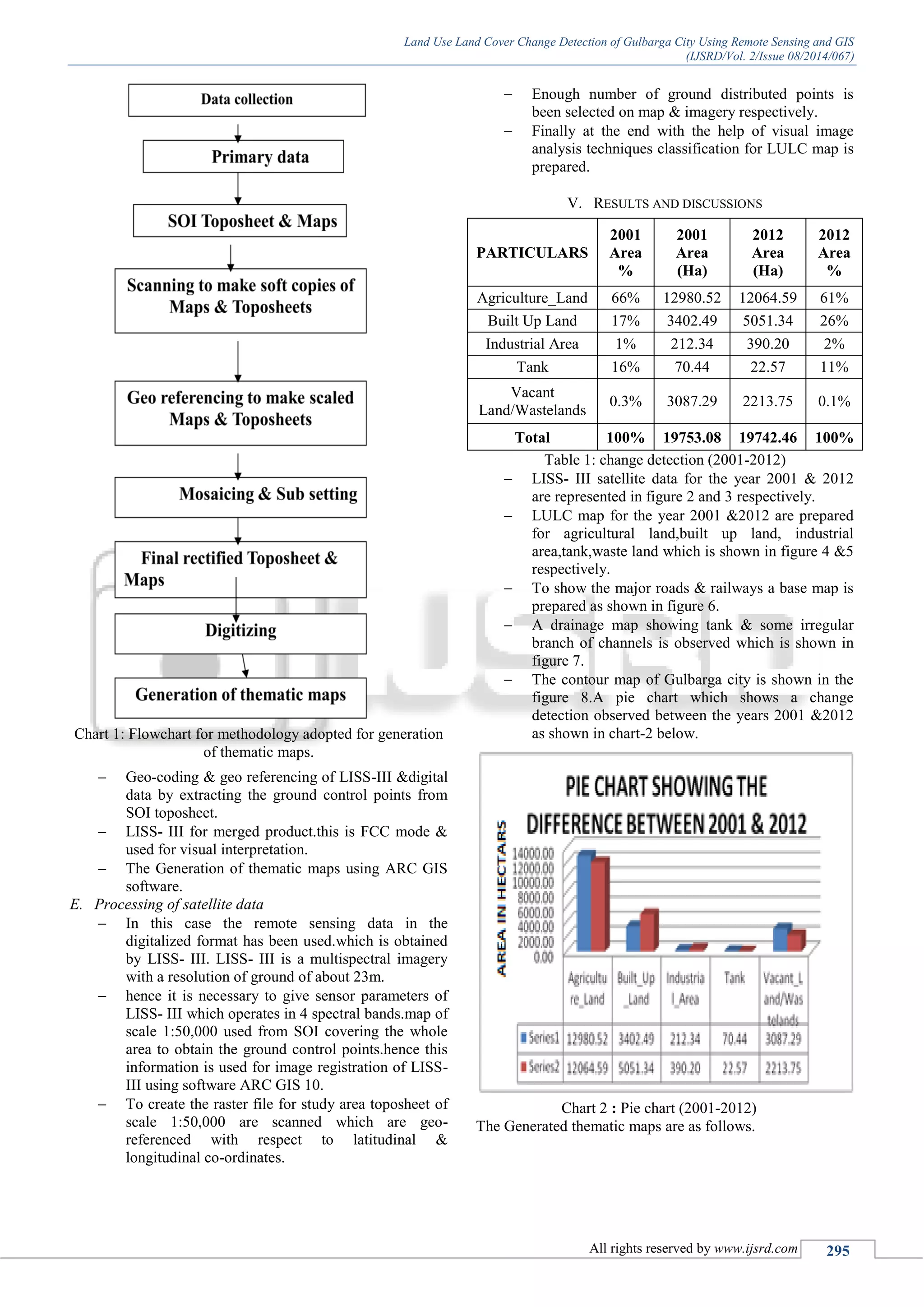
D. Generation of Thematic Maps
 Survey of India toposheets No.56C/15 on 1:50,000
scale.
 Acquisition of the LISS-III & the satellite data of
the year 2001&2012 from
NRSC,Bangalore&toposheet from survey of India
Bangalore.
 Geo-referencing of toposheet based on latitude &
longitudinal values.
Land Use Land Cover Change Detection of Gulbarga City Using Remote Sensing and GIS
(IJSRD/Vol. 2/Issue 08/2014/067)
All rights reserved by www.ijsrd.com 295
Chart 1: Flowchart for methodology adopted for generation
of thematic maps.
 Geo-coding & geo referencing of LISS-III &digital
data by extracting the ground control points from
SOI toposheet.
 LISS- III for merged product.this is FCC mode &
used for visual interpretation.
 The Generation of thematic maps using ARC GIS
software.
E. Processing of satellite data
 In this case the remote sensing data in the
digitalized format has been used.which is obtained
by LISS- III. LISS- III is a multispectral imagery
with a resolution of ground of about 23m.
 hence it is necessary to give sensor parameters of
LISS- III which operates in 4 spectral bands.map of
scale 1:50,000 used from SOI covering the whole
area to obtain the ground control points.hence this
information is used for image registration of LISS-
III using software ARC GIS 10.
 To create the raster file for study area toposheet of
scale 1:50,000 are scanned which are geo-
referenced with respect to latitudinal &
longitudinal co-ordinates.
 Enough number of ground distributed points is
been selected on map & imagery respectively.
 Finally at the end with the help of visual image
analysis techniques classification for LULC map is
prepared.
V. RESULTS AND DISCUSSIONS
PARTICULARS
2001
Area
%
2001
Area
(Ha)
2012
Area
(Ha)
2012
Area
%
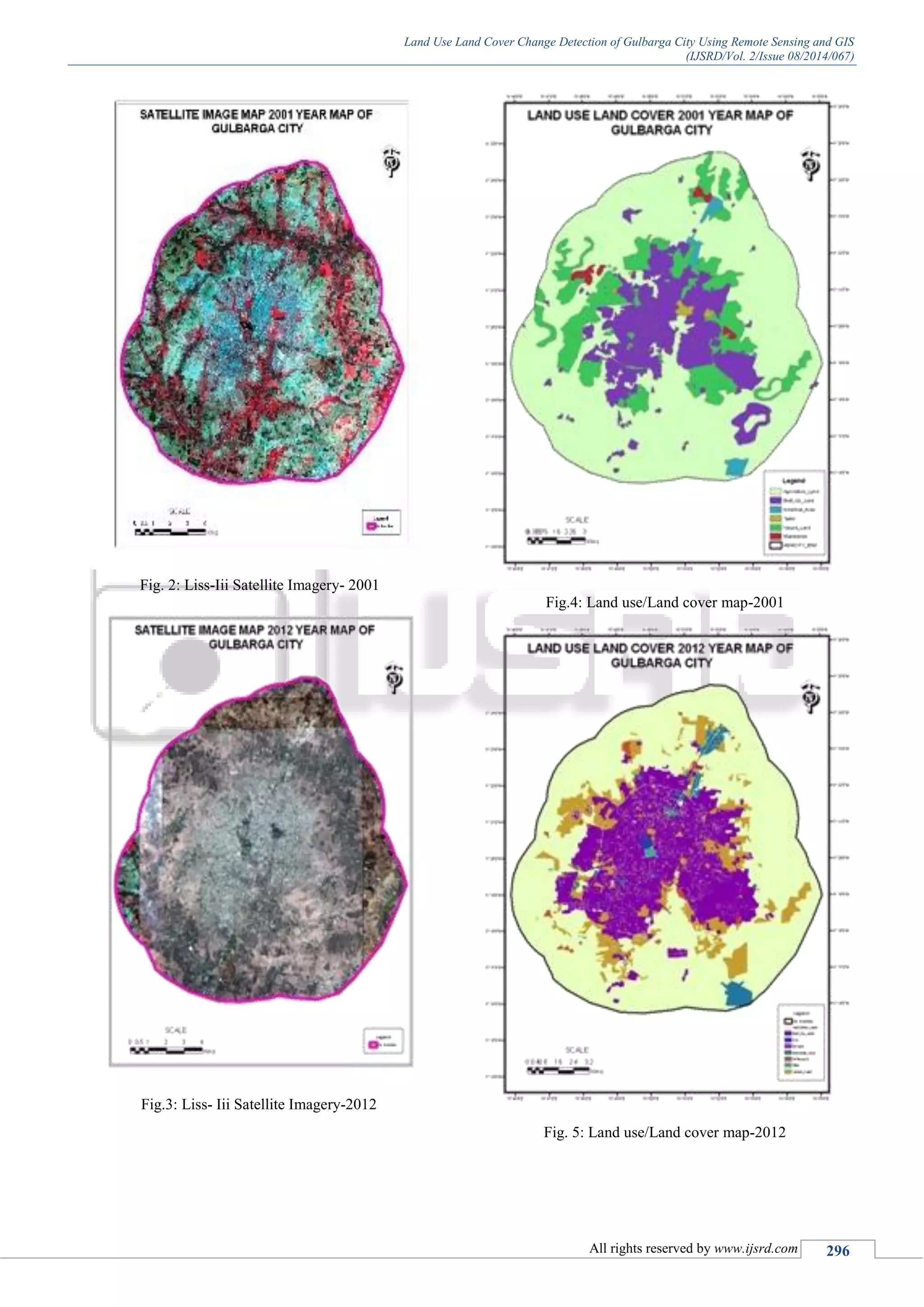
Agriculture_Land 66% 12980.52 12064.59 61%
Built Up Land 17% 3402.49 5051.34 26%
Industrial Area 1% 212.34 390.20 2%
Tank 16% 70.44 22.57 11%
Vacant
Land/Wastelands
0.3% 3087.29 2213.75 0.1%
Total 100% 19753.08 19742.46 100%
Table 1: change detection (2001-2012)
 LISS- III satellite data for the year 2001 & 2012
are represented in figure 2 and 3 respectively.
 LULC map for the year 2001 &2012 are prepared
for agricultural land,built up land, industrial
area,tank,waste land which is shown in figure 4 &5
respectively.
 To show the major roads & railways a base map is
prepared as shown in figure 6.
 A drainage map showing tank & some irregular
branch of channels is observed which is shown in
figure 7.
 The contour map of Gulbarga city is shown in the
figure 8.A pie chart which shows a change
detection observed between the years 2001 &2012
as shown in chart-2 below.
Chart 2 : Pie chart (2001-2012)
The Generated thematic maps are as follows.
Land Use Land Cover Change Detection of Gulbarga City Using Remote Sensing and GIS
(IJSRD/Vol. 2/Issue 08/2014/067)
All rights reserved by www.ijsrd.com 296
Fig. 2: Liss-Iii Satellite Imagery- 2001
Fig.3: Liss- Iii Satellite Imagery-2012
Fig.4: Land use/Land cover map-2001
Fig. 5: Land use/Land cover map-2012
Land Use Land Cover Change Detection of Gulbarga City Using Remote Sensing and GIS
(IJSRD/Vol. 2/Issue 08/2014/067)
All rights reserved by www.ijsrd.com 297
Fig.6: Base map of study area
Fig.7: Drainage map of study area
Fig.8: contour map of Gulbarga city
VI. CONCLUSION
Gulbarga City LULC process is very rapid in recent years
because of location of industrial area within the City, ,
establishment of Central University of Karnataka in 2009,
1000 bedded ESI hospital,Buddha vihar and airport along
Sedam road, new engineering and medical colleges,
establishment of High Court, widening of City roads and
highways and addition of new trains to important
destinations, and improvement in railway services. The
present study is an attempt to measure the LULC during a
decade i.e. from year 2001 to 2012 using RS and GIS
techniques. The results show that there was an increase of
about 26% built up land. The land use land cover
classification of the city was done which is a very useful for
the Urban Planning department.
The accompanying concluns might be construed
from the maps got from the study:
Change detection analyses describes and quantify
differences between images of the same scene at different
times. This analysis is very much helpful to identify various
changes occurring in different classes of land use like
increase in urban built-up area or decrease in shrub and as
the Gulbargacity,which involes Agricultural land,built up
land,industrial area,tank,vacant land/waste land so on.so
from the above study we can directly say that there is
decline in the agricultural land(61%).there is increase in the
built up land(26%) but decrease in water bodies or
tank(11%) & there is increase in the industrial area(2%)but
decline in the vacant land/waste land(0.1%).Due to increase
in the cost of cultivation there is a decline in agricultural
land this is because of labour shortage,supply of poor
quality fertilizers to farmers & variation in the rates in
market. Hence the farmers prefer to sell their land to the
land developers. Finally due to this there will be a decrease
in the agricultural land in coming future. increase in the
builtup land seriously results to lot of ecological &
environmental problems. Rapid urban LULC change causes
lot of environment problems.the urban areas grow
Land Use Land Cover Change Detection of Gulbarga City Using Remote Sensing and GIS
(IJSRD/Vol. 2/Issue 08/2014/067)
All rights reserved by www.ijsrd.com 298
normally at the cost of surrounding agriculture & other
lands. the waste generated by these urban areas(solid &
liquid) pose threat to quality of life..the industrial effluents
pollutes the surface water & ground water. Plumes from
industry causes air pollution.The Growth of city at a rate of
agricultural, forest & other land also results in the
environmental imbalance. Remote sensing data, satellite&
aerial accompanied by ground investigations are found
useful in mapping the urban land use/land cover etc..suitable
sites for 1.disposal of solid waste& 2.sewage treatment
plants can also be identified using remote sensing data.
LULC play a very important role in the climate change @
different scales such as regional, local&global.At global
scale LULC change is responsible for releasing greenhouse
gases to the atmosphere which results in the global warming
.LULC change is capable to increase the carbon dioxide
balance to the atmosphere by disturbance of terrestrial soils
and vegetation. most important is LULC change plays very
important role in emission of green house gases. Hence the
government should think seriously & take the necessary
steps to protect agricultural land which is a major parameter
& deforestation should be avoided for widening of roads .As
good as best land use planning is needed or else we
definitely loose our natural resourcesi.e water bodies,
agricultural soil. Hence finally it is concluded that satellite
imagery can be very effective and fast in change detection
of landuse and landcover changes.
REFERENCES
[1] INNOCENT EZEOMEDO and JOELIGBOKWE.
“Mapping and analysis of land use and land cover for
a sustainable development using high resolution
satellite images and gis, Nigeria” (2013).
[2] HUSSAIN ALI OUMER. Land use and land cover
change, drivers and its impact: a “comparative study
from kuhar michael and lenche dima of blue nile and
awash basins of the Ethiopia (2009)”.
[3] PRAKASAM.C. “Land use and land cover change
detection through remote sensing approach A case
study of Kodaikanal taluk, Tamilnadu,Department of
Geography, The University of Burdwan
[4] http:// www.wikimapia.org/wiki/gulbarga_dist.
[5] http://www.crisp.nus.edu.sg/~research/tutorial/intro.h
tml

Land Use Land Cover Change Detection of Gulbarga City Using Remote Sensing and GIS

  • 1.
    IJSRD - InternationalJournal for Scientific Research & Development| Vol. 2, Issue 08, 2014 | ISSN (online): 2321-0613 All rights reserved by www.ijsrd.com 292 Land Use Land Cover Change Detection of Gulbarga City Using Remote Sensing and GIS Snehit S H1 Shivasharanappa2 1 M.tech 1 Associate Professor 1,2 Department of Environmental Engineering 1,2 PDA College of Engineering Gulbarga, Karnataka, India Abstract— Land use and land cover(LULC) recently these days became a major component to handle natural resources and managing changes occurring in the environment.which is due to expansion of the urban area it has lead to critical losses of agriculture land,vegetation land and water bodies.followed by this the urban sprawl created a environmental issues. For example :decreased air quality and increase in the temperature etc. Land use and land cover change is driven by human actions and also drives changes that limit availability of products and services for human and animals, and it can undermine ecological wellbeing also. Land use and land cover is an important component in understanding various interactions of the human activities with the environment and thus it is necessary to be able to simulate changes. Therefore, this study was aimed at understanding land use and land cover change in Gulbarga city. In this work we took Gulbarga city to study the urban expansion and LULC change that took place in 2001 and 2012 to know the changes happened in the year 2012 by comparing with data of 2001.remote sensing methodology is used in this study which provides major coverage mapping & classification of land cover features such as vegetation,soil,water,forest etc. A wide range of environmental parameters can be measured including the land use, vegetation types, surface temperatures , soil types, precipitation, phytoplankton, turbidity, surface elevation and geology.satellite images of two different years i.e 2001 and 2012 are taken in to consideration.after image processing classification is done so as to classify images in to various different land use categories. Keywords: land use land cover (LULC), remote sensing, gis,change detection, classification I. INTRODUCTION Land-use refers human Land use refers human exercises ashore for gigantic uses like farming, woods advancement, settlement improvement,etc. Land-cover refers to natural covering of land by vegetation, water body, rocky land, etc.change detection is a method of identifying the enormous differences in LULC overtime. Land-use and land-cover are linked to climate and weather in critical ways. Key links between changes in land cover and climate include the exchange of greenhouse gases (such as the water vapor, the carbon dioxide, the methane, and the nitrous oxide) between the land surface and the atmosphere, the radiation (both solar and longwave) balance of the land surface, the exchange of heat between the land surface and the atmosphere, and the hardness of the land surface and its uptake of momentum from the atmosphere. Because of these strong links between land cover and climate,the changes in land use and land cover can be important contributors to climate change and variability. Land use/ Land-cover change information has an important role to play at local and regional as well as at macro level planning.. The land use land-cover changes occur naturally in a progressive and gradual way. II. LITRATURE REVIEW A. Innocent Ezeomedo And Joel Igbokwe,(Nigeria) : He reported The center of this paper is to portray the fast and commonsense methodology to Mapping and Analysis of Landuse and Landcover examples and progressions utilizing high determination satellite pictures. The study was done in Onitsha urban and its environs in south-eastern Nigeria. For this reason, multitemporal information comprising of existing Topographical guide, SPOT-5, and IKONOS pictures were transformed utilizing spatial examination devices of resampling, georeferencing, grouping and post- characterization overlay, to guide the examples and degree of landuse and landcover in the study zone and additionally focus the greatness of progressions between the years of investment, 1964, 2005 and 2008 separately. The aftereffect of the study demonstrates that the fabricated up territories have been on a steady positive and basically uncontrolled extension from 8.12% of the study territory in 1964 to 41.64% in 2005 and to 67.62% in 2008. Then again, vegetation, including developed and uncultivated horticultural grounds has been on an unfaltering decay, from 79.10% in 1964 to 51.78% in 2005 and an unimportant 18.74% in 2008. The study prescribed that the Government and open orgs concerned ought to create approaches and methodologies to attain an adjusted, facilitated and reasonable improvement in the urban zone and its environs.finally reasoned that the present study exhibits the value of satellite information for the readiness of precise and avant-garde area utilization/area spread maps portraying existing area classes for breaking down their change design by usage of computerized picture transforming techniques.result of order obviously indicates consistent positive increment in urbanization and adjusted decrease in the urban vegetation.it is presumed that satellite symbolism might be extremely successful and quick in change identification of landuse and landcover changes. [1] B. Hussain Ali Oumer (Ethiopia): He reported that the Land utilize and area spread change is determined by human activities furthermore drives changes that point of confinement accessibility of items and administrations for human and domesticated animals, and it can undermine ecological wellbeing also. Thusly, this study was gone for comprehension area utilize and area spread change within Lenche Dima and Kuhar Michael of Amhara district, Ethiopia. Time-arrangement satellite pictures that included Landsat MSS, TM, Etm+ and ASTER, which secured the timeline between 1972/3 to 2005, were utilized.
  • 2.
    Land Use LandCover Change Detection of Gulbarga City Using Remote Sensing and GIS (IJSRD/Vol. 2/Issue 08/2014/067) All rights reserved by www.ijsrd.com 293 Financial Survey and survey of reports was done to comprehend recorded patterns, gather ground truth and other optional data needed. Investigation of information and other information was fulfilled through incorporated utilization of ERDAS envision (form 9.1), ENVI (adaptation 4.3) and Arcgis (rendition 9.2) product bundles alongside Microsoft office systematic tools.remote sensing dissection uncovered scene level change of developed area to have a net increment in Kuhar Michael, while a decay is found for Lenche Dima. Nonetheless, financial overviews demonstrated that family level developed area has diminished from 1.2ha to 1ha and from 2.2ha to 1.8ha in Kuhar Michael and Lenche Dima individually, in the course of the last 30years. Real helping variables included populace expand, event of dry spell, land redistribution, and area debasement. Likewise, normal area holding for every family unit has diminished from 1.6ha to 1.5ha and from 2.9ha to 2.2ha in Kuhar Michael and Lenche Dima, respectively.his Key Objective was to comprehend changes in area utilize and area spread happening within Kuhar Michael and Lenche Dima catchments focused around examination of remotely sensed data.to recognize and analyze drivers of area utilize and area spread change as a part of the study areas.to examine the effect on vegetation, crop generation and creature sustain motion in the study areas.finally Concluded that Remote sensing results demonstrated that the region of developed land in both studyareas has experienced a change, yet with varying greatness and rates In Kuhar Michael, an augmentation was found in the midst of the introductory two periods with yearly rates of 1.7% and 0.6% , while an abatement was uncovered in the midst of the third period at yearly rate of - 1% . Notwithstanding the occasional varieties in change of developed area, the general rate of progress amid the entire time of examination (1972-2005) is discovered to be 0.8% for every annum, which brought about a net increase.however, in Lenche Dima, developed area demonstrated a declining pattern both at family and scene level amid most investigation periods generally because of area corruption .[2] C. Prakasam.c (A research endeavor of KODAIKANAL TALUK, Tamil nadu) : He reported that Land utilize and area spread is an essential segment in understanding the communications of the human exercises with nature's domain and in this manner it is important to have the capacity to mimic progressions. Observational perception uncovered a change in area utilization area spread characterization in Kodaikanal taluk, an a piece of Western Ghats found in Tamilnadu state. In this paper an endeavor is rolled out to study the improvements in area utilize and area blanket within Kodaikanal Taluk in excess of 40 years period (1969- 2008).the study has been carried out through remote sensing methodology utilizing SOI Taluk guide of Kodaikanal (1969), and Land Sat symbolisms of May 2003 and April 2008. The area utilization area spread characterization was performed focused around the Survey of India Kodaikanal Taluk guide and Satellite symbolisms. GIS programming is utilized to set up the topical maps. Ground truth perceptions were likewise performed to check the exactness of the grouping. The present study has brought to light that timberland region that involved around 70 for every penny of the Taluk's zone in 1969 has diminished to 33 for every penny in 2008. Agrarian area, Built up range, Harvested land and Waste land additionally have encountered change. Builtup grounds (Settlement) have expanded from 3 for every penny to 21 for every penny of the aggregate region. Kodaikanal range is recognized as one of the biodiversity zone in India. Fitting area use arranging is vital for a manageable improvement of Kodaikanal Taluk.the Key Objective was to break down the nature and degree area utilization/area spread changes in Kodaikanal Taluk in the past 40 years and to recognize the principle constrains behind the changes.so at last reasoned that Kodaikanal is a celebrated slope station in south India the real wellspring of pay is through tourism. The real land use in Kodaikanal Taluk is woods. Anyhow the area under woodland spread has encountered a declining pattern in the previous forty years. Here woodland area changed over to Agricultural land, Builtup, and Harvested land because of this progressions we misfortune our common biological system and biodiversity additionally. The increment in horticultural area is an inviting pattern. Anyhow observational perception uncovers that because of increment in expense of development, issues because of lack of work, supply of low quality defiled composts and value vacillation in the business sector the agriculturists like to offer their property to property promoters. Thus there is a danger of decrease in the degree of area under horticulture within a brief period of time. The increment in the zone under developed grounds may prompt a ton of ecological and biological issues. [3] III. STUDY AREA Fig.1: Location Map of Gulbarga city Gulbarga City is arranged in North piece of Gulbarga region. It reaches out from 76° 02' to 77° 42' 0" East Longitude and 16° 11' to 17° 46' 0" North Latitude..area is of 64.00sq.kms & populace is of 5.43 lakhs,number of properties are 50459 & number of wards are of 55. Two real waterways, Krishna and substantial number of tanks which, notwithstanding the streams, water the area. The Bhima, stream in the locale. Dark soil is overwhelming soil sort in the region.. Bajra, toor, sugarcane, groundnut, sunflower, sesame, castor bean, dark gram, jowar, wheat, cotton, ragi, Bengal gram, and linseed are developed in this district.the aggregate water supply is 50mld & for every capita water supply is 100 Lpcd.the climate in Gulbarga comprises of 3 primary seasons. The late spring period is from late February to mid June. It is trailed by the south west storm which begins from the late
  • 3.
    Land Use LandCover Change Detection of Gulbarga City Using Remote Sensing and GIS (IJSRD/Vol. 2/Issue 08/2014/067) All rights reserved by www.ijsrd.com 294 June to late September substantial precipitation may go up to 750mm.fig-1 shows location map of Gulbarga city.[4] The temperatures amid the diverse seasons are:  Summer : 38 to 44 °C  Monsoon: 27 to 37 °C  Winter : 11 to 26 °C IV. MATERIALS AND METHODOLOGY The materials utilized for this study will be GIS and RS related programming models. These delicate products help us to make maps furthermore help in the administration of information. By utilizing these product models, altering and investigation of the information is possible in shorter time of time. A. Geographic Information System (GIS): The Geographic Information System (GIS) is a machine supported framework for obtaining, stockpiling, investigation and showcase of geographic information. Geographic Information System (GIS) is an incorporated situated of fittings and programming devices utilized for the control and administration of spatial (geographic) and related credit information to digitally speak to and examine the geographic gimmicks exhibit on the world's surface and the occasions occurring on it. GIS takes into consideration making, keeping up and questioning electronic databases of data ordinarily showed on maps. These databases are spatially turned, the crucial incorporating component being their position on the world's surface. This framework comprises of a set of automated devices and methodology that could be utilized to adequately encode, store, recover, overlay, relate, control, dissect, inquiry, and showcase area related data. They additionally encourage the determination and exchange of information to application particular scientific models equipped for evaluating the effect of options on the earth. The underlying establishment of sound GIS is a successful advanced guide database, fixing to a precise level control overview structure. B. Remote Sensing (RS): Remote sensing is the investigation of obtaining data about earth's surface without really being in contact with it. This is carried out by sensing & recording reflected or emitted vitality & handling, investigating & applying that data. A further venture of picture examination and understanding is needed with a specific end goal to concentrate helpful data from the picture. The human visual framework is an illustration of a remote sensing framework in this general sense. In a more confined sense, remote sensing generally alludes to the engineering of obtaining data about the world's surface (area and sea) and environment utilizing sensors installed airborne(aircraft, inflatables) or space borne (satellites, space shuttles) stages. In Optical Remote Sensing, optical sensors distinguish sun based radiation reflected or scattered from the earth, shaping pictures taking after photos taken by a cam high up in space. The wavelength district generally stretches out from the Visible and Near Infrared (VNIR) to the Short-Wave Infrared (SWIR). Diverse materials, for example, water, soil, vegetation, structures and streets reflect unmistakable and infrared light in distinctive ways. They have distinctive colors and shine when seen under the sun. The translations of optical pictures require the learning of the ghastly reflectance marks of the different materials (regular or man-made) coating the surface of the earth. There are additionally infrared sensors measuring the warm infrared radiation emitted from the earth, from which the area or ocean surface temperature might be inferred. [5] C. Programming Model Used For The Study (1) arcgis 10.0 (2) erdas IMAGINE 8.7 Arcgis 10.0 is a product model which incorporates a gathering of geographic data framework (GIS). This product model is created by ESRI. Arcgis 10.0 is constructed around the geodatabase, which utilizes an item social database approach for putting away spatial information. A geodatabase is a "holder" for holding datasets, entwining the spatial peculiarities with properties. The geodatabase can additionally contain topology data, and can display conduct of peculiarities, for example, street crossing points, with guidelines on how gimmicks identify with each other. At the point when working with geodatabases, it is vital to see about peculiarity classes which are a situated of gimmicks, spoke to with focuses, lines, or polygons. With shape records, each one record can just handle one kind of gimmick. A geodatabase can store numerous peculiarity classes or sort of gimmicks inside one document. Arcgis for Desktop comprises of a few incorporated applications, including Arc Map, Arc Catalog, Arc Toolbox, and Arc Globe. Circular segment Catalog is the information administration application, used to scan datasets and records on one's machine, database, or different sources. Notwithstanding indicating what information is accessible, Arc Catalog likewise permits clients to see the information on a guide. Circular segment Catalog additionally gives the capacity to view and oversee metadata for spatial datasets. Bend Map is the application used to view, alter and inquiry geospatial information, and make maps. The Arc Map interface has two fundamental segments, including a list of chapters on the left and the information frame(s) which show the guide. Things in the list of chapters compare with layers on the guide. Circular segment Toolbox contains geo handling, information transformation, and dissection instruments, alongside a great part of the usefulness in Arcinfo. It is likewise conceivable to utilize group preparing with Arc Toolbox, for regularly rehashed undertakings. ERDAS IMAGINE 8.7 is basically utilized for handling of geo-spatial raster information and permitting the client to show the computerized pictures for mapping in GIS programming. This product model permits the client to perform distinctive operations on a picture. ERDAS IMAGINE Suite which has developed to backing most optical and radar mapping satellites, airborne mapping cams, advanced sensors utilized for mapping. It was discharged on a Sun Workstation utilizing Sunos giving a Graphical User Interface to support in envisioning symbolism utilized within mapping, vector GIS information, making map. D. Generation of Thematic Maps  Survey of India toposheets No.56C/15 on 1:50,000 scale.  Acquisition of the LISS-III & the satellite data of the year 2001&2012 from NRSC,Bangalore&toposheet from survey of India Bangalore.  Geo-referencing of toposheet based on latitude & longitudinal values.
  • 4.
    Land Use LandCover Change Detection of Gulbarga City Using Remote Sensing and GIS (IJSRD/Vol. 2/Issue 08/2014/067) All rights reserved by www.ijsrd.com 295 Chart 1: Flowchart for methodology adopted for generation of thematic maps.  Geo-coding & geo referencing of LISS-III &digital data by extracting the ground control points from SOI toposheet.  LISS- III for merged product.this is FCC mode & used for visual interpretation.  The Generation of thematic maps using ARC GIS software. E. Processing of satellite data  In this case the remote sensing data in the digitalized format has been used.which is obtained by LISS- III. LISS- III is a multispectral imagery with a resolution of ground of about 23m.  hence it is necessary to give sensor parameters of LISS- III which operates in 4 spectral bands.map of scale 1:50,000 used from SOI covering the whole area to obtain the ground control points.hence this information is used for image registration of LISS- III using software ARC GIS 10.  To create the raster file for study area toposheet of scale 1:50,000 are scanned which are geo- referenced with respect to latitudinal & longitudinal co-ordinates.  Enough number of ground distributed points is been selected on map & imagery respectively.  Finally at the end with the help of visual image analysis techniques classification for LULC map is prepared. V. RESULTS AND DISCUSSIONS PARTICULARS 2001 Area % 2001 Area (Ha) 2012 Area (Ha) 2012 Area % Agriculture_Land 66% 12980.52 12064.59 61% Built Up Land 17% 3402.49 5051.34 26% Industrial Area 1% 212.34 390.20 2% Tank 16% 70.44 22.57 11% Vacant Land/Wastelands 0.3% 3087.29 2213.75 0.1% Total 100% 19753.08 19742.46 100% Table 1: change detection (2001-2012)  LISS- III satellite data for the year 2001 & 2012 are represented in figure 2 and 3 respectively.  LULC map for the year 2001 &2012 are prepared for agricultural land,built up land, industrial area,tank,waste land which is shown in figure 4 &5 respectively.  To show the major roads & railways a base map is prepared as shown in figure 6.  A drainage map showing tank & some irregular branch of channels is observed which is shown in figure 7.  The contour map of Gulbarga city is shown in the figure 8.A pie chart which shows a change detection observed between the years 2001 &2012 as shown in chart-2 below. Chart 2 : Pie chart (2001-2012) The Generated thematic maps are as follows.
  • 5.
    Land Use LandCover Change Detection of Gulbarga City Using Remote Sensing and GIS (IJSRD/Vol. 2/Issue 08/2014/067) All rights reserved by www.ijsrd.com 296 Fig. 2: Liss-Iii Satellite Imagery- 2001 Fig.3: Liss- Iii Satellite Imagery-2012 Fig.4: Land use/Land cover map-2001 Fig. 5: Land use/Land cover map-2012
  • 6.
    Land Use LandCover Change Detection of Gulbarga City Using Remote Sensing and GIS (IJSRD/Vol. 2/Issue 08/2014/067) All rights reserved by www.ijsrd.com 297 Fig.6: Base map of study area Fig.7: Drainage map of study area Fig.8: contour map of Gulbarga city VI. CONCLUSION Gulbarga City LULC process is very rapid in recent years because of location of industrial area within the City, , establishment of Central University of Karnataka in 2009, 1000 bedded ESI hospital,Buddha vihar and airport along Sedam road, new engineering and medical colleges, establishment of High Court, widening of City roads and highways and addition of new trains to important destinations, and improvement in railway services. The present study is an attempt to measure the LULC during a decade i.e. from year 2001 to 2012 using RS and GIS techniques. The results show that there was an increase of about 26% built up land. The land use land cover classification of the city was done which is a very useful for the Urban Planning department. The accompanying concluns might be construed from the maps got from the study: Change detection analyses describes and quantify differences between images of the same scene at different times. This analysis is very much helpful to identify various changes occurring in different classes of land use like increase in urban built-up area or decrease in shrub and as the Gulbargacity,which involes Agricultural land,built up land,industrial area,tank,vacant land/waste land so on.so from the above study we can directly say that there is decline in the agricultural land(61%).there is increase in the built up land(26%) but decrease in water bodies or tank(11%) & there is increase in the industrial area(2%)but decline in the vacant land/waste land(0.1%).Due to increase in the cost of cultivation there is a decline in agricultural land this is because of labour shortage,supply of poor quality fertilizers to farmers & variation in the rates in market. Hence the farmers prefer to sell their land to the land developers. Finally due to this there will be a decrease in the agricultural land in coming future. increase in the builtup land seriously results to lot of ecological & environmental problems. Rapid urban LULC change causes lot of environment problems.the urban areas grow
  • 7.
    Land Use LandCover Change Detection of Gulbarga City Using Remote Sensing and GIS (IJSRD/Vol. 2/Issue 08/2014/067) All rights reserved by www.ijsrd.com 298 normally at the cost of surrounding agriculture & other lands. the waste generated by these urban areas(solid & liquid) pose threat to quality of life..the industrial effluents pollutes the surface water & ground water. Plumes from industry causes air pollution.The Growth of city at a rate of agricultural, forest & other land also results in the environmental imbalance. Remote sensing data, satellite& aerial accompanied by ground investigations are found useful in mapping the urban land use/land cover etc..suitable sites for 1.disposal of solid waste& 2.sewage treatment plants can also be identified using remote sensing data. LULC play a very important role in the climate change @ different scales such as regional, local&global.At global scale LULC change is responsible for releasing greenhouse gases to the atmosphere which results in the global warming .LULC change is capable to increase the carbon dioxide balance to the atmosphere by disturbance of terrestrial soils and vegetation. most important is LULC change plays very important role in emission of green house gases. Hence the government should think seriously & take the necessary steps to protect agricultural land which is a major parameter & deforestation should be avoided for widening of roads .As good as best land use planning is needed or else we definitely loose our natural resourcesi.e water bodies, agricultural soil. Hence finally it is concluded that satellite imagery can be very effective and fast in change detection of landuse and landcover changes. REFERENCES [1] INNOCENT EZEOMEDO and JOELIGBOKWE. “Mapping and analysis of land use and land cover for a sustainable development using high resolution satellite images and gis, Nigeria” (2013). [2] HUSSAIN ALI OUMER. Land use and land cover change, drivers and its impact: a “comparative study from kuhar michael and lenche dima of blue nile and awash basins of the Ethiopia (2009)”. [3] PRAKASAM.C. “Land use and land cover change detection through remote sensing approach A case study of Kodaikanal taluk, Tamilnadu,Department of Geography, The University of Burdwan [4] http:// www.wikimapia.org/wiki/gulbarga_dist. [5] http://www.crisp.nus.edu.sg/~research/tutorial/intro.h tml