Presented By
K. Kannadasan
Guest Lecturer MKU, Madurai
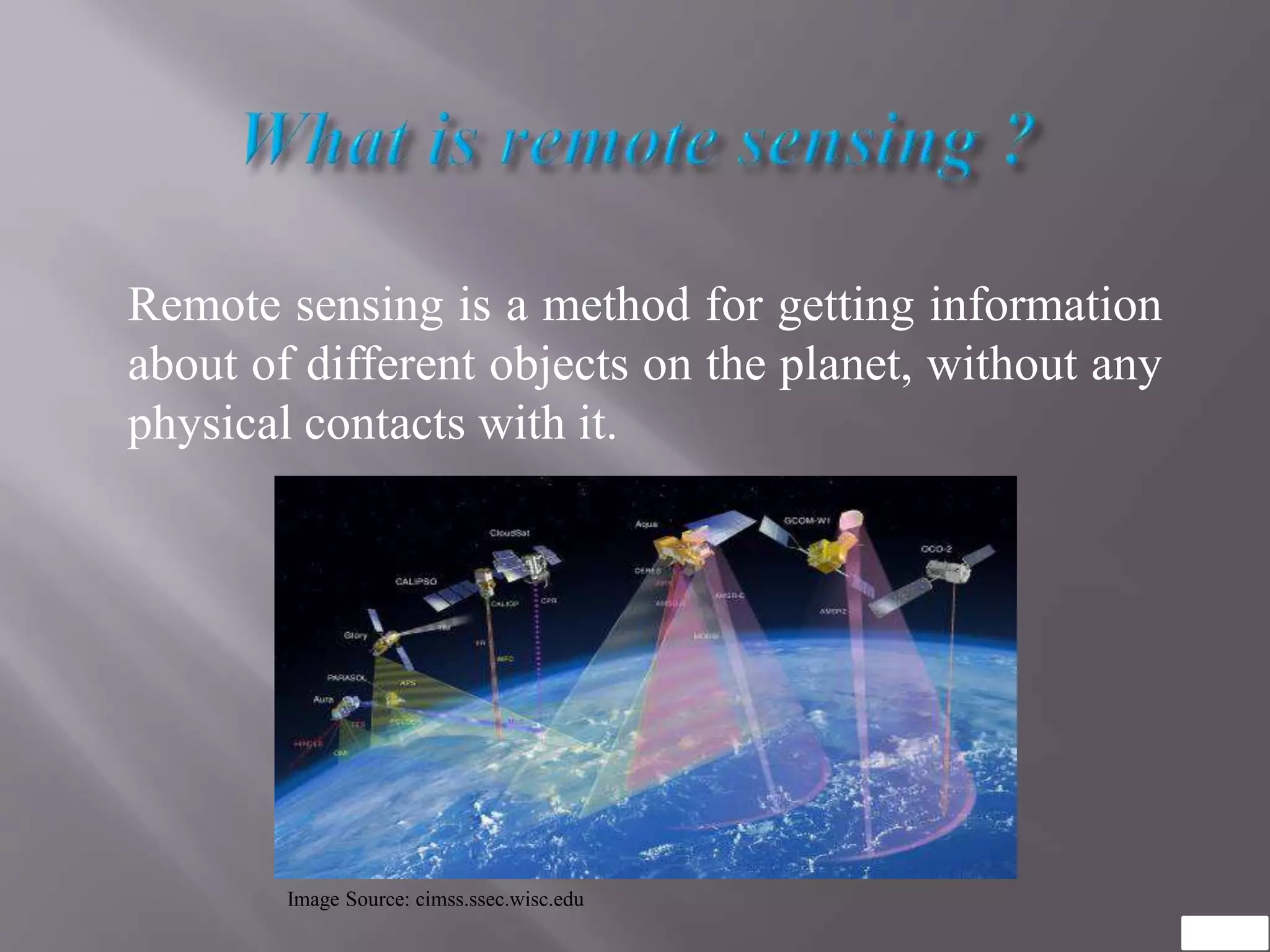
Remote sensing is a method for getting information
about of different objects on the planet, without any
physical contacts with it.
Image Source: cimss.ssec.wisc.edu
AGRICULTURE
• - Soil sensing
- Farm classification
- Farm condition assessment
- Mapping of farm and
agricultural land characteristics
- Mapping of land management
practices  Wageningen UR 2002
• Crop acreage estimation
• Crop modeling for yield & production forecast /
estimation
• Crop & Orchard monitoring
• Timely availability of crop statistics for decision making
& planning
• Crop growth monitoring
• Soil status monitoring
• Regular reports regarding total area under cultivation
FORESTRY
• Satellite image based forest resource mapping and updation
• Forest change detection
• Forest resource inventory
• GIS database development
• Availability of baseline information
• Planning for aforestation strategies
• Futuristic resource planning
• Sustainability of environment
• Wild life conservation & development for recreation purpose
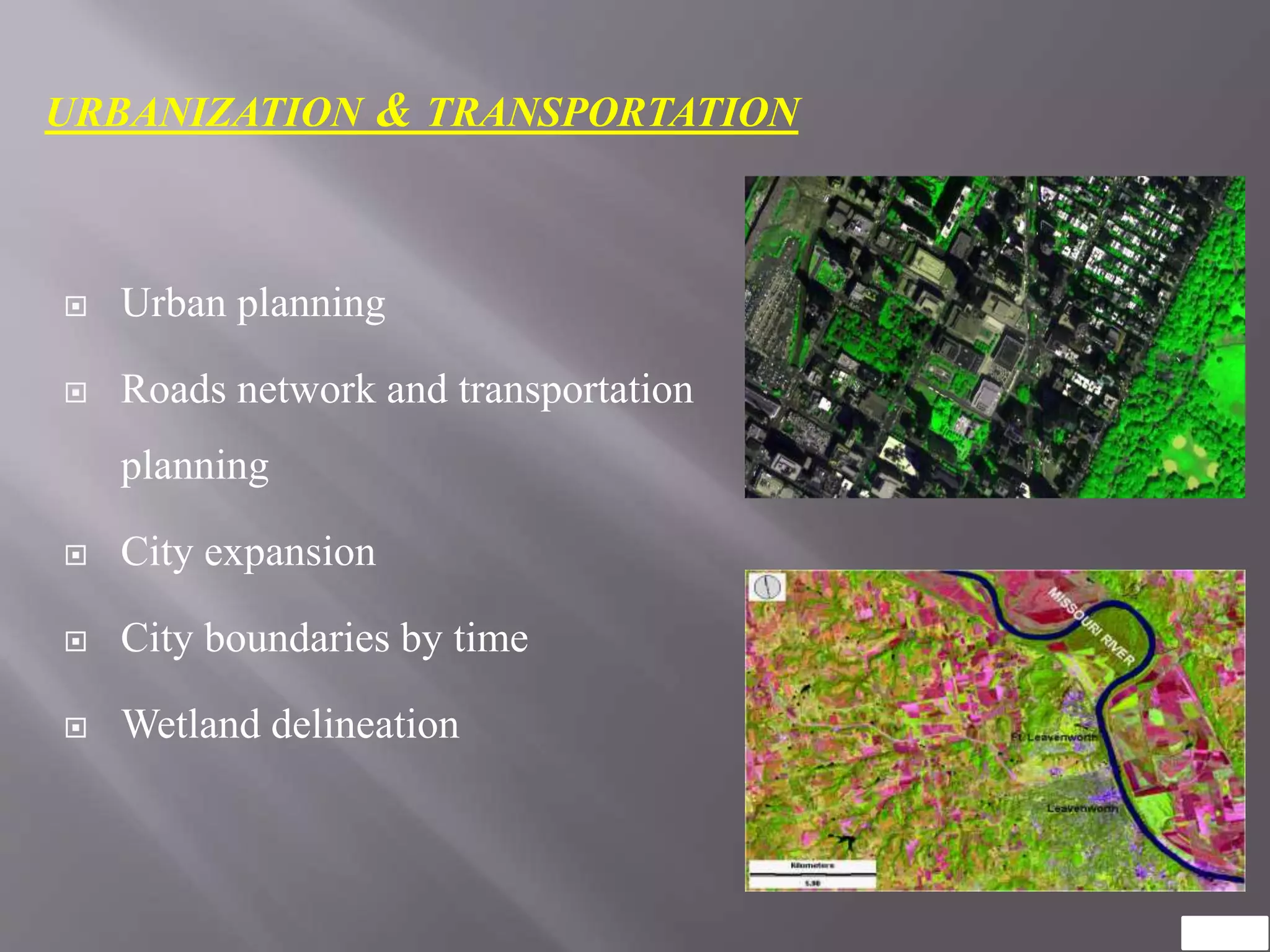
URBANIZATION & TRANSPORTATION
 Urban planning
 Roads network and transportation
planning
 City expansion
 City boundaries by time
 Wetland delineation
• Mapping & updation of city/town maps
• Urban sprawl monitoring
• Town planning
• Facility management
• GIS database development Better decision support,
planning & management
• Rapid information updation
• Infrastructure development monitoring
• Spatial information analysis
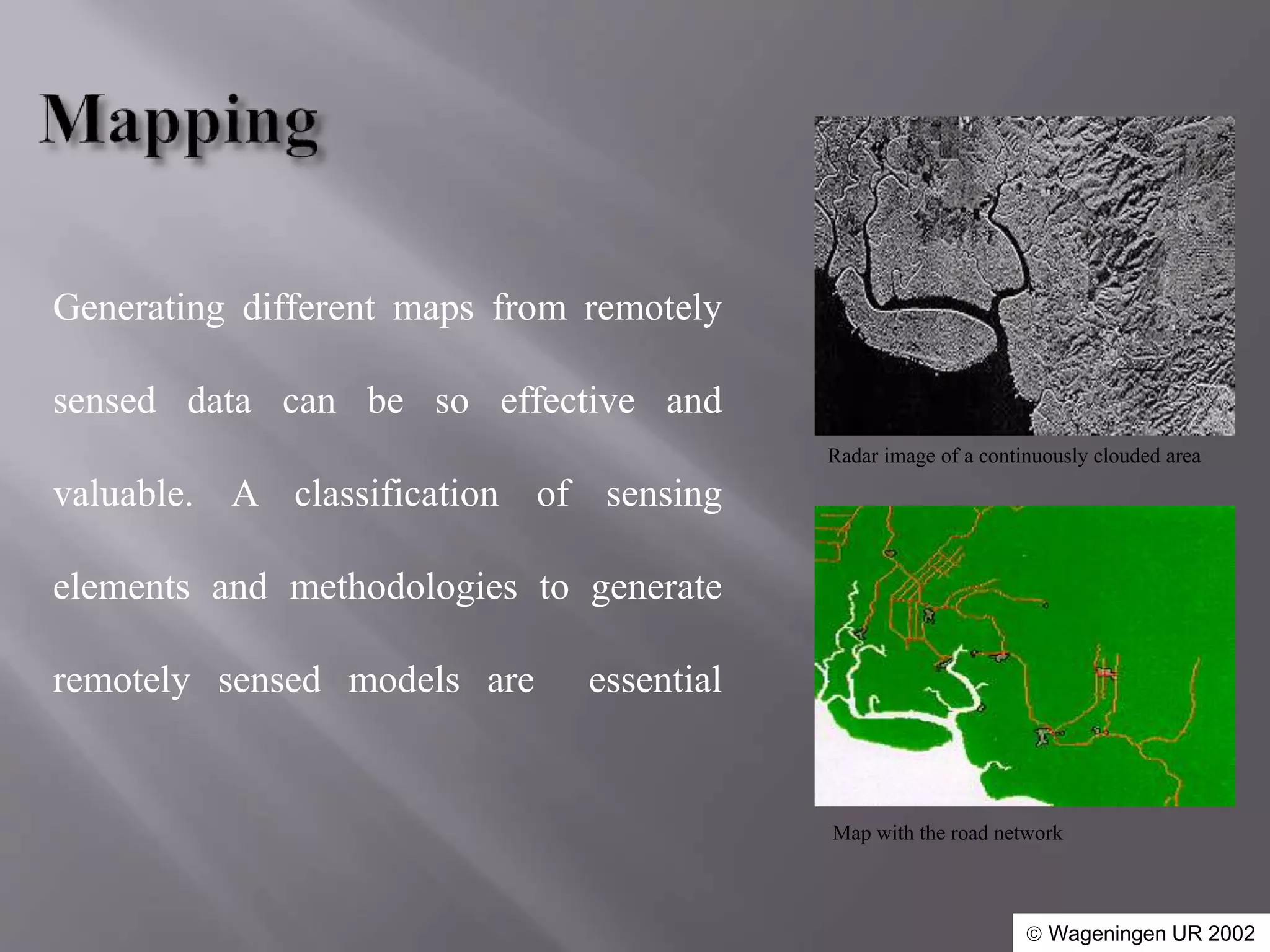
Generating different maps from remotely
sensed data can be so effective and
valuable. A classification of sensing
elements and methodologies to generate
remotely sensed models are essential
Radar image of a continuously clouded area
Map with the road network
 Wageningen UR 2002
LANDUSE / LANDCOVER MAPPING
• Urban/Rural infrastructure
• Water logging & salinity
• Assessment of spatial distribution of land resources
• Infrastructure monitoring
• Availability of usable land
• Future planning for better land management for socio-
economic development
NATURAL RESOURCE MANAGEMENT
 Water source management
 Habitat analysis
 Environmental assessment
 Pest/disease outbreaks
 Impervious surface mapping
 Hydrology
 Mineral province
 Geomorphology
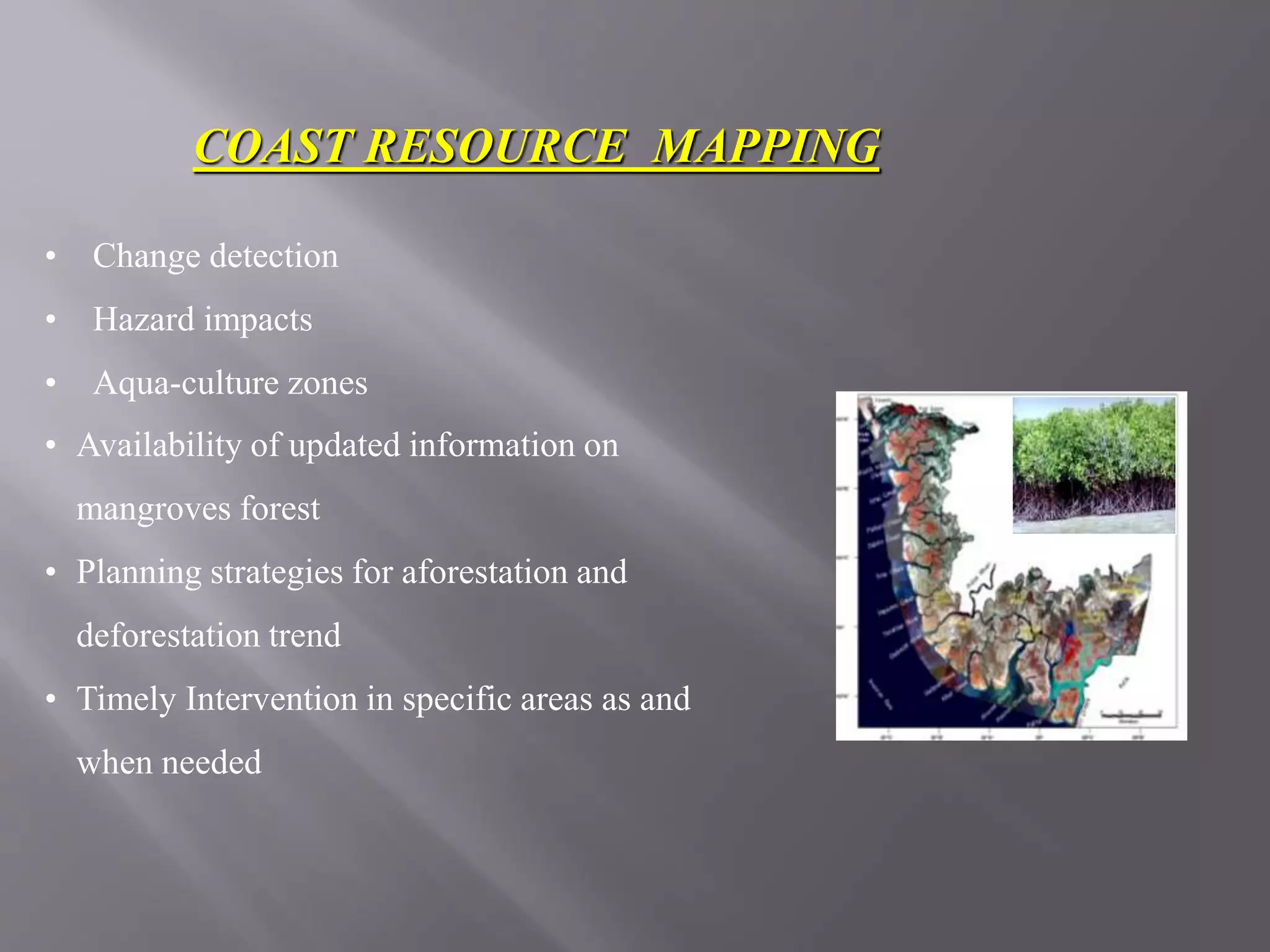
COAST RESOURCE MAPPING
• Change detection
• Hazard impacts
• Aqua-culture zones
• Availability of updated information on
mangroves forest
• Planning strategies for aforestation and
deforestation trend
• Timely Intervention in specific areas as and
when needed
Application of Remote sensing

Application of Remote sensing

  • 1.
    Presented By K. Kannadasan GuestLecturer MKU, Madurai
  • 2.
    Remote sensing isa method for getting information about of different objects on the planet, without any physical contacts with it. Image Source: cimss.ssec.wisc.edu
  • 3.
    AGRICULTURE • - Soilsensing - Farm classification - Farm condition assessment - Mapping of farm and agricultural land characteristics - Mapping of land management practices  Wageningen UR 2002
  • 4.
    • Crop acreageestimation • Crop modeling for yield & production forecast / estimation • Crop & Orchard monitoring • Timely availability of crop statistics for decision making & planning • Crop growth monitoring • Soil status monitoring • Regular reports regarding total area under cultivation
  • 5.
    FORESTRY • Satellite imagebased forest resource mapping and updation • Forest change detection • Forest resource inventory • GIS database development • Availability of baseline information • Planning for aforestation strategies • Futuristic resource planning • Sustainability of environment • Wild life conservation & development for recreation purpose
  • 6.
    URBANIZATION & TRANSPORTATION Urban planning  Roads network and transportation planning  City expansion  City boundaries by time  Wetland delineation
  • 7.
    • Mapping &updation of city/town maps • Urban sprawl monitoring • Town planning • Facility management • GIS database development Better decision support, planning & management • Rapid information updation • Infrastructure development monitoring • Spatial information analysis
  • 8.
    Generating different mapsfrom remotely sensed data can be so effective and valuable. A classification of sensing elements and methodologies to generate remotely sensed models are essential Radar image of a continuously clouded area Map with the road network  Wageningen UR 2002
  • 9.
    LANDUSE / LANDCOVERMAPPING • Urban/Rural infrastructure • Water logging & salinity • Assessment of spatial distribution of land resources • Infrastructure monitoring • Availability of usable land • Future planning for better land management for socio- economic development
  • 10.
    NATURAL RESOURCE MANAGEMENT Water source management  Habitat analysis  Environmental assessment  Pest/disease outbreaks  Impervious surface mapping  Hydrology  Mineral province  Geomorphology
  • 11.
    COAST RESOURCE MAPPING •Change detection • Hazard impacts • Aqua-culture zones • Availability of updated information on mangroves forest • Planning strategies for aforestation and deforestation trend • Timely Intervention in specific areas as and when needed