LAND USE AND LAND
COVER (RS & GIS)
PRESENTED BY – DHANENDRA BAHEKAR
M. TECH (WRD & IE)
NATIONAL INSTITUTE OF TECHNOLOGY , RAIPUR
PRESENTATION OUTLINE
■ BASIC TERMINOLOGIES
■ WHY LAND USE LAND COVER (LULC) STUDY
■ METHODOLOGY FOR LULC STUDY
■ A CASE STUDY
■ CONCLUSION AND DISCUSSION
BASIC TERMINOLOGY
■ LAND COVER – According to Food and Agricultural Organization ,
Land cover refers to observed physical and biological cover of earth’s
land. Land is covered by various types of vegetation , grass land ,
forest , water bodies , barren land etc,it all comes under land cover.
■ LAND USE - Land use is commonly defined as a series of operations
on land, carried out by humans, with the intention to obtain products
and/or benefits through using land resources it includes -
wildlife management area, agricultural land, urban, recreation area
etc.
■ LULC STUDY IS SIMPLY THE TEMPORAL ANALYSIS OF STUDY AREA’S
LAND USE.
Why do we need LULC
Maps?
■ LULC maps play a significant and prime role in planning,
management and monitoring programmes at local,
regional and national levels.
■ Provides a better understanding of land utilization aspects.
■ It plays an important role in the formation of policies and
programme required for development planning.
■ In order to achieve sustainable urban development and
to check the haphazard development of towns and cities.
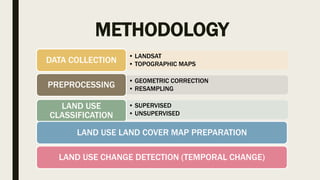
METHODOLOGY
• LANDSAT
• TOPOGRAPHIC MAPSDATA COLLECTION
• GEOMETRIC CORRECTION
• RESAMPLINGPREPROCESSING
• SUPERVISED
• UNSUPERVISED
LAND USE
CLASSIFICATION
LAND USE LAND COVER MAP PREPARATION
LAND USE CHANGE DETECTION (TEMPORAL CHANGE)
DATA COLLECTION
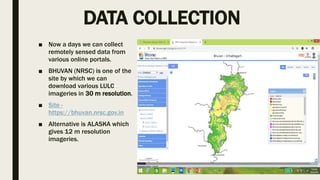
■ Now a days we can collect
remotely sensed data from
various online portals.
■ BHUVAN (NRSC) is one of the
site by which we can
download various LULC
imageries in 30 m resolution.
■ Site -
https://bhuvan.nrsc.gov.in
■ Alternative is ALASKA which
gives 12 m resolution
imageries.
PREPROCESSING
■ Preprocessing functions involve those operations that are normally required prior
to the main data analysis and extraction of information.
■ Generally grouped as radiometric or geometric corrections.
■ Radiometric corrections include correcting the data for sensor irregularities and
unwanted sensor or atmospheric noise.(When DN value of pixel is distorted)
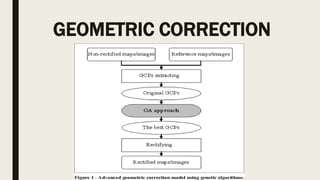
■ Geometric corrections include correcting for geometric distortions due to sensor-
Earth geometry variations, and conversion of the data to real world coordinates
(e.g. latitude and longitude) on the Earth's surface.(When location of pixel is
distorted)
GEOMETRIC CORRECTION
RADIOMETRIC CORRECTION
IMAGE CLASSIFICATION FOR
LULC MAP
■ Image Classification - assigning pixels in the image to categories
or classes of interest
■ Examples: built-up areas, waterbody, green vegetation, bare soil,
rocky areas, cloud, shadow….
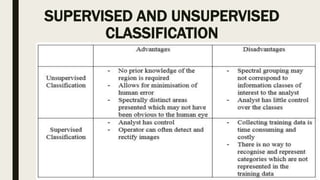
■ TYPES OF CLASSIFICATION –
■ (1) SUPERVISED CLASSIFICATION
■ (2) UNSUPERVISED CLASSIFICATION
SUPERVISED CLASSIFICATION
■ In supervised classification the user or image analyst “supervises” the
pixel classification process.
■ The user specifies the various pixels values or spectral signatures that
should be associated with each class. This is done by selecting
representative sample sites of a known cover type called Training Sites or
Areas.
■ Supervised Classification Steps:
■ (1) Select training areas
■ (2) Generate signature file
■ (3) Classify
UNSUPERVISED CLASSIFICATION
■ Unsupervised classification is a form of pixel based classification and is
essentially computer automated classification.
■ The user specifies the number of classes and the spectral classes are
created solely based on the numerical information in the data (i.e. the pixel
values for each of the bands or indices).
■ Clustering algorithms are used to determine the natural, statistical
grouping of the data. The pixels are grouped together into based on their
spectral similarity.
■ Unsupervised Classification Steps:
■ (1) Generate clusters
■ (2) Assign classes
SUPERVISED AND UNSUPERVISED
CLASSIFICATION
SUPERVISED CLASSIFICATION
ALGORITHMS
■ Minimum Distance to mean (MDM)
■ Parellelpiped
■ Maximum Likelihood (ML) [ One of the best and used
method ]
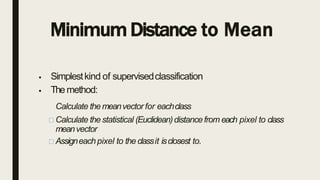
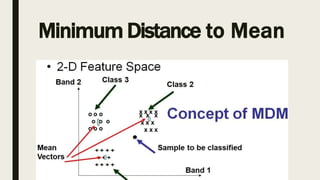
Minimum Distance to Mean
 Simplestkind of supervisedclassification
 Themethod:
Calculate themeanvector for eachclass
Calculate thestatistical (Euclidean)distancefrom each pixel to class
meanvector
Assigneachpixel to theclassit isclosest to.
Minimum Distance to Mean
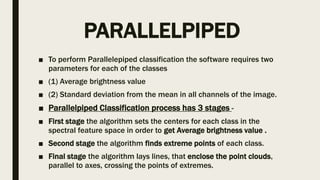
PARALLELPIPED
■ To perform Parallelepiped classification the software requires two
parameters for each of the classes
■ (1) Average brightness value
■ (2) Standard deviation from the mean in all channels of the image.
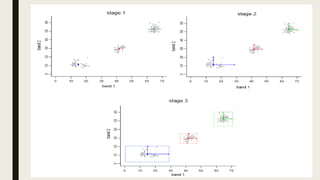
■ Parallelpiped Classification process has 3 stages -
■ First stage the algorithm sets the centers for each class in the
spectral feature space in order to get Average brightness value .
■ Second stage the algorithm finds extreme points of each class.
■ Final stage the algorithm lays lines, that enclose the point clouds,
parallel to axes, crossing the points of extremes.
MAXIMUM LIKELIHOOD
METHOD
 The maximum likelihood classifier is one of the most popular
methods of classification in remote sensing, in which a pixel with the
maximum likelihood is classified into the corresponding class.
 The likelihood Lk is defined as the posterior probability of a pixel
belonging to class k.
 Lk = P(k/X) = P(k)*P(X/k) / P(i)*P(X/i)
 where P(k) : prior probability of class k
 P(X/k) : conditional probability to observe X from class k, or
probability density function
Usually P(k) are assumed to be equal to each other and P(i)*P(X/i) is also common to all
classes.
Therefore Lk depends on P(X/k) or the probability density function.
For mathematical reasons, a multivariate normal distribution is applied as the probability
density function. In the case of normal distributions, the likelihood can be expressed as
follows.
where n: number of bands
X: image data of n bands
Lk(X) : likelihood of X belonging to class k
k : mean vector of class k
∑k : variance-covariance matrix of class k
[ One of the best and used method ]
UNSUPERVISED
CLASSIFICATION ALGORITHMS
■ Nearest Neighbor Approach
■ K Means (Extensively used and best method)
K Nearest Neighbor Approach
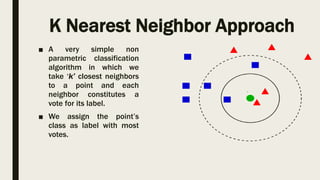
■ A very simple non
parametric classification
algorithm in which we
take ‘k’ closest neighbors
to a point and each
neighbor constitutes a
vote for its label.
■ We assign the point’s
class as label with most
votes.
K MEANS
 Iterative algorithm
 Number of clusters K is known by user
 Most popular clustering algorithm
 Initialize randomly K cluster mean vectors
 Assign each pixel to any of the K clusters based on minimum feature
distance
 After all pixels are assigned to the K clusters, each cluster mean is
recomputed.
 Iterate till cluster mean vectors stabilize
CASE STUDY
■ TITLE - Land use and land cover change detection using
geospatial techniques in the Sikkim Himalaya, India (2017)
■ AUTHERS - Prabuddh Kumar Mishra , Aman Rai , Suresh Chand Rai
■ Department of Geography, Shivaji College, University of Delhi, India
PAPER OBTAINED FROM - The Egyptian Journal of Remote Sensing
and Space Sciences (ELSEVIER)
OBJECTIVE
■ Based on remote sensing (RS) and geographic information system
(GIS) techniques, the study is an attempt to monitor the changes in
LULC patterns of Rani Khola watershed of Sikkim Himalaya for the
periods 1988–1996, 1996–2008 and 2008–2017.
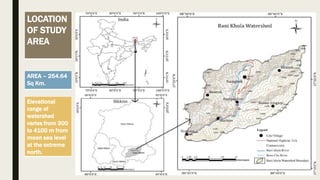
LOCATION
OF STUDY
AREA
AREA – 254.64
Sq Km.
Elevational
range of
watershed
varies from 300
to 4100 m from
mean sea level
at the extreme
north.
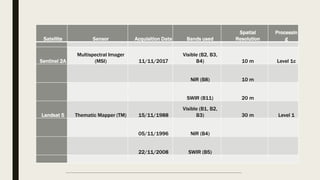
DATA AND SOFTWARES
■ In the present study Multi-temporal satellite images of Landsat-5 Thematic Mapper
(TM) imageries of 1988, 1996, 2008 and a High resolution cloud free (10 m)
Sentinel 2A Imagery of 2017 has been used to map the changing pattern of LULC
of Rani Khola watershed from 1988 to 2017.
■ ASTER DEM (WGS 1984) – To extract boundary of Rani khola watershed.
■ All the images were downloaded from USGS earth explorer website.
■ SOFTWARES –
■ (1) QGIS
■ (2) GOOGLE EARTH
Satellite Sensor Acquisition Date Bands used
Spatial
Resolution
Processin
g
Sentinel 2A
Multispectral Imager
(MSI) 11/11/2017
Visible (B2, B3,
B4) 10 m Level 1c
NIR (B8) 10 m
SWIR (B11) 20 m
Landsat 5 Thematic Mapper (TM) 15/11/1988
Visible (B1, B2,
B3) 30 m Level 1
05/11/1996 NIR (B4)
22/11/2008 SWIR (B5)
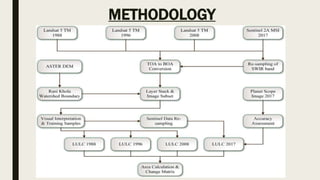
METHODOLOGY
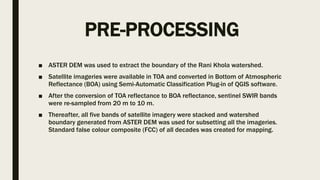
PRE-PROCESSING
■ ASTER DEM was used to extract the boundary of the Rani Khola watershed.
■ Satellite imageries were available in TOA and converted in Bottom of Atmospheric
Reflectance (BOA) using Semi-Automatic Classification Plug-in of QGIS software.
■ After the conversion of TOA reflectance to BOA reflectance, sentinel SWIR bands
were re-sampled from 20 m to 10 m.
■ Thereafter, all five bands of satellite imagery were stacked and watershed
boundary generated from ASTER DEM was used for subsetting all the imageries.
Standard false colour composite (FCC) of all decades was created for mapping.
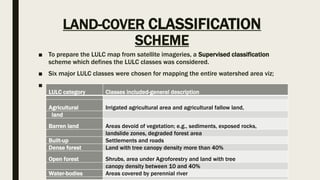
LAND-COVER CLASSIFICATION
SCHEME
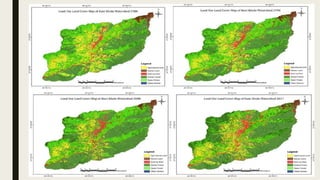
■ To prepare the LULC map from satellite imageries, a Supervised classification
scheme which defines the LULC classes was considered.
■ Six major LULC classes were chosen for mapping the entire watershed area viz;
■
LULC category Classes included-general description
Agricultural Irrigated agricultural area and agricultural fallow land,
land
Barren land Areas devoid of vegetation; e.g., sediments, exposed rocks,
landslide zones, degraded forest area
Built-up Settlements and roads
Dense forest Land with tree canopy density more than 40%
Open forest Shrubs, area under Agroforestry and land with tree
canopy density between 10 and 40%
Water-bodies Areas covered by perennial river
POST PROCESSING
■ Supervised classification - After the preparation of classification
scheme one of the most widely used image classification technique,
i.e., maximum likelihood classification was adopted for mapping all
the land use/cover classes.
■ Before the selection of training samples, empirical analysis of
satellite imagery; google earth images and toposheet of the
watershed were investigated carefully. For most of the classes, a
minimum number of training samples were 100. Selecting training
samples for water was tough because of the dense canopy of forests
along with the river channel and lack of water in the river channels
since the acquisition date of imagery was in mid-November and at
that time most of the rivers in the mountains carry less water as
compared to the monsoon season.
LULC CHANGE DETECTION
■ Post-classification change detection technique was used for analyzing the
changes. In the last few decades, many change detection methods have been
developed viz; image differencing, post classification change matrix, comparison
technique and principal component analysis.
■ Change matrix presents important information about the spatial distribution of
changes in LULC. Change matrix showing the land cover changes in each decade
was generated from classified images of 1988 to 1996, 1996 to 2008, 2008 to
2017 and a change matrix was generated from 1988 to 2017 to assess the overall
changes in LULC classes between 1988 and 2017.
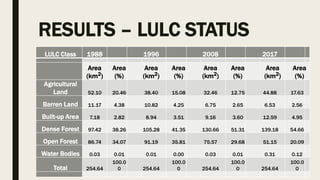
RESULTS – LULC STATUS
LULC Class 1988 1996 2008 2017
Area
(km2)
Area
(%)
Area
(km2)
Area
(%)
Area
(km2)
Area
(%)
Area
(km2)
Area
(%)
Agricultural
Land 52.10 20.46 38.40 15.08 32.46 12.75 44.88 17.63
Barren Land 11.17 4.38 10.82 4.25 6.75 2.65 6.53 2.56
Built-up Area 7.18 2.82 8.94 3.51 9.16 3.60 12.59 4.95
Dense Forest 97.42 38.26 105.28 41.35 130.66 51.31 139.18 54.66
Open Forest 86.74 34.07 91.19 35.81 75.57 29.68 51.15 20.09
Water Bodies 0.03 0.01 0.01 0.00 0.03 0.01 0.31 0.12
Total 254.64
100.0
0 254.64
100.0
0 254.64
100.0
0 254.64
100.0
0
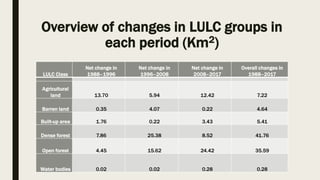
Overview of changes in LULC groups in
each period (Km2)
LULC Class
Net change in
1988–1996
Net change in
1996–2008
Net change in
2008–2017
Overall changes in
1988–2017
Agricultural
land 13.70 5.94 12.42 7.22
Barren land 0.35 4.07 0.22 4.64
Built-up area 1.76 0.22 3.43 5.41
Dense forest 7.86 25.38 8.52 41.76
Open forest 4.45 15.62 24.42 35.59
Water bodies 0.02 0.02 0.28 0.28
CONCLUSION OF CASE STUDY
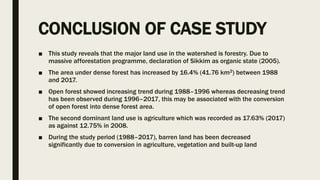
■ This study reveals that the major land use in the watershed is forestry. Due to
massive afforestation programme, declaration of Sikkim as organic state (2005).
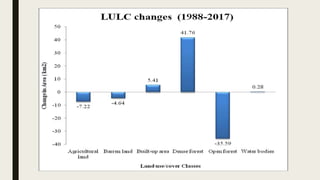
■ The area under dense forest has increased by 16.4% (41.76 km2) between 1988
and 2017.
■ Open forest showed increasing trend during 1988–1996 whereas decreasing trend
has been observed during 1996–2017, this may be associated with the conversion
of open forest into dense forest area.
■ The second dominant land use is agriculture which was recorded as 17.63% (2017)
as against 12.75% in 2008.
■ During the study period (1988–2017), barren land has been decreased
significantly due to conversion in agriculture, vegetation and built-up land
CONCLUSION AND DISCUSSION
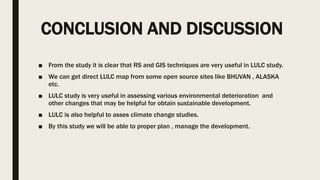
■ From the study it is clear that RS and GIS techniques are very useful in LULC study.
■ We can get direct LULC map from some open source sites like BHUVAN , ALASKA
etc.
■ LULC study is very useful in assessing various environmental deterioration and
other changes that may be helpful for obtain sustainable development.
■ LULC is also helpful to asses climate change studies.
■ By this study we will be able to proper plan , manage the development.
REFERENCES
■ Arora, K.M., Mathur, S., 2001. Multi-source classification using artificial neural
network in a rugged terrain. Geocarto Int. 16 (3), 37–44. https://doi.org/
10.1080/10106040108542202.
■ Barnsley, M.J., Møller-Jensen, L., Barr, S.L., 2001. Inferring urban land use by
spatial and structural pattern recognition. Remote Sens. Urban Anal., 115–144
■ Census of India 2011, Sikkim. 2011 Sikkim Census Report.
http://censusindia.gov.in/ 2011census/dchb/1100_PART_A_DCHB_SIKKIM.PDF
(accessed on 19th February 2019).
■ http://www.slideshare.com
THANK YOU

Land cover and Land Use

  • 1.
    LAND USE ANDLAND COVER (RS & GIS) PRESENTED BY – DHANENDRA BAHEKAR M. TECH (WRD & IE) NATIONAL INSTITUTE OF TECHNOLOGY , RAIPUR
  • 2.
    PRESENTATION OUTLINE ■ BASICTERMINOLOGIES ■ WHY LAND USE LAND COVER (LULC) STUDY ■ METHODOLOGY FOR LULC STUDY ■ A CASE STUDY ■ CONCLUSION AND DISCUSSION
  • 3.
    BASIC TERMINOLOGY ■ LANDCOVER – According to Food and Agricultural Organization , Land cover refers to observed physical and biological cover of earth’s land. Land is covered by various types of vegetation , grass land , forest , water bodies , barren land etc,it all comes under land cover. ■ LAND USE - Land use is commonly defined as a series of operations on land, carried out by humans, with the intention to obtain products and/or benefits through using land resources it includes - wildlife management area, agricultural land, urban, recreation area etc. ■ LULC STUDY IS SIMPLY THE TEMPORAL ANALYSIS OF STUDY AREA’S LAND USE.
  • 4.
    Why do weneed LULC Maps? ■ LULC maps play a significant and prime role in planning, management and monitoring programmes at local, regional and national levels. ■ Provides a better understanding of land utilization aspects. ■ It plays an important role in the formation of policies and programme required for development planning. ■ In order to achieve sustainable urban development and to check the haphazard development of towns and cities.
  • 5.
    METHODOLOGY • LANDSAT • TOPOGRAPHICMAPSDATA COLLECTION • GEOMETRIC CORRECTION • RESAMPLINGPREPROCESSING • SUPERVISED • UNSUPERVISED LAND USE CLASSIFICATION LAND USE LAND COVER MAP PREPARATION LAND USE CHANGE DETECTION (TEMPORAL CHANGE)
  • 6.
    DATA COLLECTION ■ Nowa days we can collect remotely sensed data from various online portals. ■ BHUVAN (NRSC) is one of the site by which we can download various LULC imageries in 30 m resolution. ■ Site - https://bhuvan.nrsc.gov.in ■ Alternative is ALASKA which gives 12 m resolution imageries.
  • 7.
    PREPROCESSING ■ Preprocessing functionsinvolve those operations that are normally required prior to the main data analysis and extraction of information. ■ Generally grouped as radiometric or geometric corrections. ■ Radiometric corrections include correcting the data for sensor irregularities and unwanted sensor or atmospheric noise.(When DN value of pixel is distorted) ■ Geometric corrections include correcting for geometric distortions due to sensor- Earth geometry variations, and conversion of the data to real world coordinates (e.g. latitude and longitude) on the Earth's surface.(When location of pixel is distorted)
  • 8.
  • 9.
  • 10.
    IMAGE CLASSIFICATION FOR LULCMAP ■ Image Classification - assigning pixels in the image to categories or classes of interest ■ Examples: built-up areas, waterbody, green vegetation, bare soil, rocky areas, cloud, shadow…. ■ TYPES OF CLASSIFICATION – ■ (1) SUPERVISED CLASSIFICATION ■ (2) UNSUPERVISED CLASSIFICATION
  • 11.
    SUPERVISED CLASSIFICATION ■ Insupervised classification the user or image analyst “supervises” the pixel classification process. ■ The user specifies the various pixels values or spectral signatures that should be associated with each class. This is done by selecting representative sample sites of a known cover type called Training Sites or Areas. ■ Supervised Classification Steps: ■ (1) Select training areas ■ (2) Generate signature file ■ (3) Classify
  • 12.
    UNSUPERVISED CLASSIFICATION ■ Unsupervisedclassification is a form of pixel based classification and is essentially computer automated classification. ■ The user specifies the number of classes and the spectral classes are created solely based on the numerical information in the data (i.e. the pixel values for each of the bands or indices). ■ Clustering algorithms are used to determine the natural, statistical grouping of the data. The pixels are grouped together into based on their spectral similarity. ■ Unsupervised Classification Steps: ■ (1) Generate clusters ■ (2) Assign classes
  • 13.
  • 14.
    SUPERVISED CLASSIFICATION ALGORITHMS ■ MinimumDistance to mean (MDM) ■ Parellelpiped ■ Maximum Likelihood (ML) [ One of the best and used method ]
  • 15.
    Minimum Distance toMean  Simplestkind of supervisedclassification  Themethod: Calculate themeanvector for eachclass Calculate thestatistical (Euclidean)distancefrom each pixel to class meanvector Assigneachpixel to theclassit isclosest to.
  • 16.
  • 17.
    PARALLELPIPED ■ To performParallelepiped classification the software requires two parameters for each of the classes ■ (1) Average brightness value ■ (2) Standard deviation from the mean in all channels of the image. ■ Parallelpiped Classification process has 3 stages - ■ First stage the algorithm sets the centers for each class in the spectral feature space in order to get Average brightness value . ■ Second stage the algorithm finds extreme points of each class. ■ Final stage the algorithm lays lines, that enclose the point clouds, parallel to axes, crossing the points of extremes.
  • 19.
    MAXIMUM LIKELIHOOD METHOD  Themaximum likelihood classifier is one of the most popular methods of classification in remote sensing, in which a pixel with the maximum likelihood is classified into the corresponding class.  The likelihood Lk is defined as the posterior probability of a pixel belonging to class k.  Lk = P(k/X) = P(k)*P(X/k) / P(i)*P(X/i)  where P(k) : prior probability of class k  P(X/k) : conditional probability to observe X from class k, or probability density function
  • 20.
    Usually P(k) areassumed to be equal to each other and P(i)*P(X/i) is also common to all classes. Therefore Lk depends on P(X/k) or the probability density function. For mathematical reasons, a multivariate normal distribution is applied as the probability density function. In the case of normal distributions, the likelihood can be expressed as follows. where n: number of bands X: image data of n bands Lk(X) : likelihood of X belonging to class k k : mean vector of class k ∑k : variance-covariance matrix of class k [ One of the best and used method ]
  • 22.
    UNSUPERVISED CLASSIFICATION ALGORITHMS ■ NearestNeighbor Approach ■ K Means (Extensively used and best method)
  • 23.
    K Nearest NeighborApproach ■ A very simple non parametric classification algorithm in which we take ‘k’ closest neighbors to a point and each neighbor constitutes a vote for its label. ■ We assign the point’s class as label with most votes.
  • 24.
    K MEANS  Iterativealgorithm  Number of clusters K is known by user  Most popular clustering algorithm  Initialize randomly K cluster mean vectors  Assign each pixel to any of the K clusters based on minimum feature distance  After all pixels are assigned to the K clusters, each cluster mean is recomputed.  Iterate till cluster mean vectors stabilize
  • 25.
    CASE STUDY ■ TITLE- Land use and land cover change detection using geospatial techniques in the Sikkim Himalaya, India (2017) ■ AUTHERS - Prabuddh Kumar Mishra , Aman Rai , Suresh Chand Rai ■ Department of Geography, Shivaji College, University of Delhi, India PAPER OBTAINED FROM - The Egyptian Journal of Remote Sensing and Space Sciences (ELSEVIER)
  • 26.
    OBJECTIVE ■ Based onremote sensing (RS) and geographic information system (GIS) techniques, the study is an attempt to monitor the changes in LULC patterns of Rani Khola watershed of Sikkim Himalaya for the periods 1988–1996, 1996–2008 and 2008–2017.
  • 27.
    LOCATION OF STUDY AREA AREA –254.64 Sq Km. Elevational range of watershed varies from 300 to 4100 m from mean sea level at the extreme north.
  • 28.
    DATA AND SOFTWARES ■In the present study Multi-temporal satellite images of Landsat-5 Thematic Mapper (TM) imageries of 1988, 1996, 2008 and a High resolution cloud free (10 m) Sentinel 2A Imagery of 2017 has been used to map the changing pattern of LULC of Rani Khola watershed from 1988 to 2017. ■ ASTER DEM (WGS 1984) – To extract boundary of Rani khola watershed. ■ All the images were downloaded from USGS earth explorer website. ■ SOFTWARES – ■ (1) QGIS ■ (2) GOOGLE EARTH
  • 29.
    Satellite Sensor AcquisitionDate Bands used Spatial Resolution Processin g Sentinel 2A Multispectral Imager (MSI) 11/11/2017 Visible (B2, B3, B4) 10 m Level 1c NIR (B8) 10 m SWIR (B11) 20 m Landsat 5 Thematic Mapper (TM) 15/11/1988 Visible (B1, B2, B3) 30 m Level 1 05/11/1996 NIR (B4) 22/11/2008 SWIR (B5)
  • 30.
  • 31.
    PRE-PROCESSING ■ ASTER DEMwas used to extract the boundary of the Rani Khola watershed. ■ Satellite imageries were available in TOA and converted in Bottom of Atmospheric Reflectance (BOA) using Semi-Automatic Classification Plug-in of QGIS software. ■ After the conversion of TOA reflectance to BOA reflectance, sentinel SWIR bands were re-sampled from 20 m to 10 m. ■ Thereafter, all five bands of satellite imagery were stacked and watershed boundary generated from ASTER DEM was used for subsetting all the imageries. Standard false colour composite (FCC) of all decades was created for mapping.
  • 32.
    LAND-COVER CLASSIFICATION SCHEME ■ Toprepare the LULC map from satellite imageries, a Supervised classification scheme which defines the LULC classes was considered. ■ Six major LULC classes were chosen for mapping the entire watershed area viz; ■ LULC category Classes included-general description Agricultural Irrigated agricultural area and agricultural fallow land, land Barren land Areas devoid of vegetation; e.g., sediments, exposed rocks, landslide zones, degraded forest area Built-up Settlements and roads Dense forest Land with tree canopy density more than 40% Open forest Shrubs, area under Agroforestry and land with tree canopy density between 10 and 40% Water-bodies Areas covered by perennial river
  • 33.
    POST PROCESSING ■ Supervisedclassification - After the preparation of classification scheme one of the most widely used image classification technique, i.e., maximum likelihood classification was adopted for mapping all the land use/cover classes. ■ Before the selection of training samples, empirical analysis of satellite imagery; google earth images and toposheet of the watershed were investigated carefully. For most of the classes, a minimum number of training samples were 100. Selecting training samples for water was tough because of the dense canopy of forests along with the river channel and lack of water in the river channels since the acquisition date of imagery was in mid-November and at that time most of the rivers in the mountains carry less water as compared to the monsoon season.
  • 34.
    LULC CHANGE DETECTION ■Post-classification change detection technique was used for analyzing the changes. In the last few decades, many change detection methods have been developed viz; image differencing, post classification change matrix, comparison technique and principal component analysis. ■ Change matrix presents important information about the spatial distribution of changes in LULC. Change matrix showing the land cover changes in each decade was generated from classified images of 1988 to 1996, 1996 to 2008, 2008 to 2017 and a change matrix was generated from 1988 to 2017 to assess the overall changes in LULC classes between 1988 and 2017.
  • 35.
    RESULTS – LULCSTATUS LULC Class 1988 1996 2008 2017 Area (km2) Area (%) Area (km2) Area (%) Area (km2) Area (%) Area (km2) Area (%) Agricultural Land 52.10 20.46 38.40 15.08 32.46 12.75 44.88 17.63 Barren Land 11.17 4.38 10.82 4.25 6.75 2.65 6.53 2.56 Built-up Area 7.18 2.82 8.94 3.51 9.16 3.60 12.59 4.95 Dense Forest 97.42 38.26 105.28 41.35 130.66 51.31 139.18 54.66 Open Forest 86.74 34.07 91.19 35.81 75.57 29.68 51.15 20.09 Water Bodies 0.03 0.01 0.01 0.00 0.03 0.01 0.31 0.12 Total 254.64 100.0 0 254.64 100.0 0 254.64 100.0 0 254.64 100.0 0
  • 37.
    Overview of changesin LULC groups in each period (Km2) LULC Class Net change in 1988–1996 Net change in 1996–2008 Net change in 2008–2017 Overall changes in 1988–2017 Agricultural land 13.70 5.94 12.42 7.22 Barren land 0.35 4.07 0.22 4.64 Built-up area 1.76 0.22 3.43 5.41 Dense forest 7.86 25.38 8.52 41.76 Open forest 4.45 15.62 24.42 35.59 Water bodies 0.02 0.02 0.28 0.28
  • 39.
    CONCLUSION OF CASESTUDY ■ This study reveals that the major land use in the watershed is forestry. Due to massive afforestation programme, declaration of Sikkim as organic state (2005). ■ The area under dense forest has increased by 16.4% (41.76 km2) between 1988 and 2017. ■ Open forest showed increasing trend during 1988–1996 whereas decreasing trend has been observed during 1996–2017, this may be associated with the conversion of open forest into dense forest area. ■ The second dominant land use is agriculture which was recorded as 17.63% (2017) as against 12.75% in 2008. ■ During the study period (1988–2017), barren land has been decreased significantly due to conversion in agriculture, vegetation and built-up land
  • 40.
    CONCLUSION AND DISCUSSION ■From the study it is clear that RS and GIS techniques are very useful in LULC study. ■ We can get direct LULC map from some open source sites like BHUVAN , ALASKA etc. ■ LULC study is very useful in assessing various environmental deterioration and other changes that may be helpful for obtain sustainable development. ■ LULC is also helpful to asses climate change studies. ■ By this study we will be able to proper plan , manage the development.
  • 41.
    REFERENCES ■ Arora, K.M.,Mathur, S., 2001. Multi-source classification using artificial neural network in a rugged terrain. Geocarto Int. 16 (3), 37–44. https://doi.org/ 10.1080/10106040108542202. ■ Barnsley, M.J., Møller-Jensen, L., Barr, S.L., 2001. Inferring urban land use by spatial and structural pattern recognition. Remote Sens. Urban Anal., 115–144 ■ Census of India 2011, Sikkim. 2011 Sikkim Census Report. http://censusindia.gov.in/ 2011census/dchb/1100_PART_A_DCHB_SIKKIM.PDF (accessed on 19th February 2019). ■ http://www.slideshare.com
  • 42.