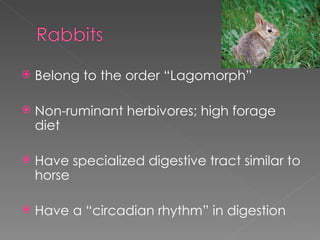
Belong to the order “Lagomorph” Non-ruminant herbivores; high forage diet Have specialized digestive tract similar to horse Have a “circadian rhythm” in digestion
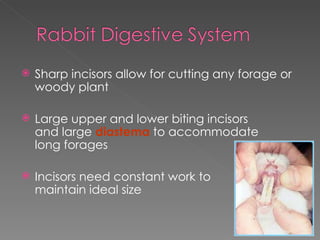
Sharp incisors allow for cutting any forage or woody plant Large upper and lower biting incisors and large  diastema  to accommodate long forages Incisors need constant work to  maintain ideal size Source:  BBC News
GI tract is very similar to horse up until the large intestine Large cecum contains bacteria to break down plant cell walls Nervous system keeps microbial activity normal during the day and rabbit makes normal fecal pellets
Circadian Rhythm changes GI motility and  cecotropes  are formed Fecal pellets with  high concentration of protein, low fiber Rabbits eat cecotropes directly from the anus and digest them in small intestine, allowing rabbit to “capture” amino acids Allows rabbit to survive during seasons when only low-protein fibrous plants are available Cecotropes are more commonly known as  Night Feces
Rabbits make both hard and soft feces Soft Feces (cecotropes):  contain higher levels of water, electrolytes and nitrogen.  Covered by a soft mucous envelop Hard Feces:  contain higher levels of fiber Rabbits never eat hard feces or soft feces that have dropped to bottom of cage Coprophagy = consumption of feces Cecotrophy = consumption of cecotropes
Gastric Stasis :  Condition where gastric motility is slowed because of too much grain and too little fiber in diet Huge quantities of hair build up in GI tract causing  Trichobezoars , which get stuck in the tract.  Can cause death What is the more commonly known term for Trichobezoars? Hairballs!
Alfalfa-based pellet with hay supplement given daily Include fresh greens or veggies daily Carrots, ripe bananas, rice cakes, dandelion leaves, dark leafy veggies, feed many colors Beware fruit pits and seeds Remove any uneaten parts – spoiled food causes GI upset
Rabbits are nocturnal:  feed hay in morning and pellets with grains in afternoon or evening. Water ad libitum Commercial feeds should be purchased and consumed within 90 days of production  Pellets high in calcium or Vit D can cause kidney or bladder stones Commercial mixes w/ seeds, dried fruit or colored cereals are junk food. Too high in sugars and CHO, can cause overgrowth of bad bacteria!
Hay is most important factor in diet – prime source of fiber Fresh Timothy, Oat and Grass Hays Buy pellets from feed store or online.  Avoid grocery & pet store chains – feed may be many months old Exercise for 3-5 hours daily outside of cage BEWARE  MOLDY HAY!
Guinea Pigs Gerbils Hamsters Rats and Mice Chinchillas Ferrets
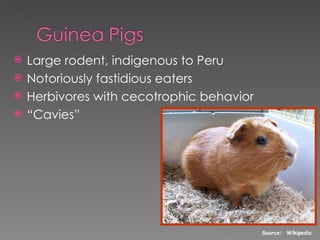
Large rodent, indigenous to Peru Notoriously fastidious eaters Herbivores with cecotrophic behavior “ Cavies” Source:  Wikipedia
Fresh guinea pig pellets (18-20% crude protein and 10-16% fiber) Unlimited supply of quality grass hay Fresh, clean water ad libitum
 
Very important – feed ad libitum Timothy hay best – less calcium and protein than alfalfa, which interfere with pellets Long fibers stimulate muscle contraction in intestines to maintain motility Chewing hay helps grind down molars which are constantly growing
Must use Guinea pig pellets  Don’t use “fiesta” mixes with seeds, nuts and dried fruit – pigs don’t like high CHO or fatty foods Adults prone to obesity, so limit pellet intake
Vit C  MUST  be included in diet or scurvy develops  Optimal amount is 1 to 2 mg per 100 grams of body weight Commercial guinea pig pellets contain extra Vit C, but only good for ~90 days Can add Vit C to water, but it’s light sensitive and loses 50% of potency in 24 hours.  Cover the bottle with sock or foil
Can supplement diet with veggies  and fruits high in Vit. C Guava, orange and lemon peel; parsley, brussel sprouts, broccoli, collard, mustard greens and kale Chewable Vit C tablets
Omnivore, desert dwelling rodent High metabolic requirements Eat ~10% of body weight every 24 hrs Diet mostly of grains, other CHO Source:  Wikipedia
Pellets made from ground seeds and grass and vitamin fortified Remove sunflower seeds from mixes; fattening At least one piece of fresh veggie per day Can give a cricket or two a few times per month Use an elevated feeding bin to prevent fecal contamination
Desert animals, therefore very efficient kidneys.  Rely primarily on plants fluids in the wild Give plenty of fresh water Make sure container is clean! Source:  Desertcreatures.com
Sunflower seeds and pieces of fruit in small amounts Front teeth are constantly growing – give chew sticks or pieces of fruit tree branches or bark to wear teeth down Avoid cherry, cedar and oleander – TOXIC! Plain dog bones make good nutritious treat!
Source:  Stumbleupon.com
Desert-dwellers Eat 10% of body weight every 24 hours Diet mostly of grains and other CHO and fresh water Restrict amount of sweet or oily food © Thepetwebsite.com
Can carry up to ½ body weight in cheek pouches In the wild, may hide up to 60lbs of grain for winter Sometimes they urine-mark.  Food can become moldy if they urine mark their stash Sometimes engage in coprophagia for more complete digestion
Require grains and lots of fresh fruits & greens (broccoli, peas in the pod, melons,etc.) Avoid iceberg lettuce and apples (too high in water and fiber) Try to avoid overfeeding;  let hamster fill pouches Rule of Thumb:  feed only enough for the day and a little for the next morning; remove leftover fruit and veggies!
Sunflower seeds in small amounts Pet store snacks are good Fresh water in sipper bottles Change water daily and run thru dishwasher weekly to kill bacteria
Source:  Wikipedia
Eat ~10% of body weight daily Indiscriminate eaters so must give them a complete diet! Careful what you feed, as they will eat anything – even things not good for them  (ex. May choke on peanut butter)
Basic diet of kibble or lab blocks, & add small amounts of leafy green veggies Commercial rat or mouse chow is available Can feed cooked meat as a small treat   (leave it on the bone – rats/mice use bone to wear down teeth) Buy only enough pellets to feed for 3 months at a time… nutritive value decreases in 3-5 months
Fresh water daily  and clean bottle Sunflower seeds & small pieces of fruit and veggies are good snacks Chew sticks for continually growing incisors.  Avoid cherry, cedar and oleander
Herbivores Require high fiber, vitamin-rich diet Most crucial part of diet is unlimited access to grass hay (Timothy, Brome, Oat and Wheat Hay).  Also need commercial chinchilla pellets
<8 months: plain alfalfa pellets available always Older chinchillas:  feed 1-2 tblsns fresh commercial pellets per day; grass hay available always Use fresh pellets (not older than 3 months) Avoid pellet mixes with nuts and grains – can cause obesity
Dried fruit (apricots, pineapple, papaya) basil, broccoli leaves, carrots and carrot tops, green peppers, kale, raspberry leaves, squash, dandelion leaves – all in small amounts Small amount of raisins help with constipation
Chewing and gnawing are daily habits.  Nocturnal, chew furniture, cords and plants Branches of maple, birch or bark from apple, peach and pear trees help Avoid cherry, oleander, cedar, plum or redwood – all are toxic Require a dust bath to keep fur clean
Strict carnivores Short digestive tract; food  passes in 3-4 hours High protein requirements:  meat protein only – plant proteins not utilized by ferrets Poor digesters of fiber Dry diets are for teeth & are more energy efficient Source:  National Geographic News
Diet must have 32-38% protein and minimum of 20% fat First ingredient on label should be meat Avoid soy or plant proteins Avoid fish and fish oil – make ferrets smelly
Feed ad libitum – ferrets don’t gorge High GI transit rate means ferret needs to eat frequently and obesity is rarely a problem High levels of corn fillers in food can cause bladder stones
Ferretone, a fatty acid supplement that makes coat shiny.  Few drops per day. Small helpings of mashed or liquefied fruits, but avoid starchy foods like cereal Limit sweets – can lead to diabetes Can give a little cooked chicken and cooked egg in small amounts
Shedding causes hairballs in spring and fall, so give Laxatone or Ferretlax After 4 years ferrets slow down & need less fat and protein.  Feed Senior Ferret food (50% less fat and protein)

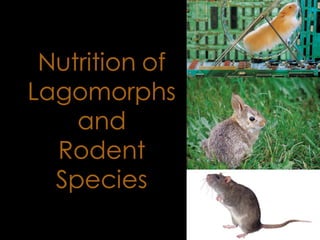
Lagomorphs & Rodents

  • 1.
  • 2.
    Belong to theorder “Lagomorph” Non-ruminant herbivores; high forage diet Have specialized digestive tract similar to horse Have a “circadian rhythm” in digestion
  • 3.
    Sharp incisors allowfor cutting any forage or woody plant Large upper and lower biting incisors and large diastema to accommodate long forages Incisors need constant work to maintain ideal size Source: BBC News
  • 4.
    GI tract isvery similar to horse up until the large intestine Large cecum contains bacteria to break down plant cell walls Nervous system keeps microbial activity normal during the day and rabbit makes normal fecal pellets
  • 5.
    Circadian Rhythm changesGI motility and cecotropes are formed Fecal pellets with high concentration of protein, low fiber Rabbits eat cecotropes directly from the anus and digest them in small intestine, allowing rabbit to “capture” amino acids Allows rabbit to survive during seasons when only low-protein fibrous plants are available Cecotropes are more commonly known as Night Feces
  • 6.
    Rabbits make bothhard and soft feces Soft Feces (cecotropes): contain higher levels of water, electrolytes and nitrogen. Covered by a soft mucous envelop Hard Feces: contain higher levels of fiber Rabbits never eat hard feces or soft feces that have dropped to bottom of cage Coprophagy = consumption of feces Cecotrophy = consumption of cecotropes
  • 7.
    Gastric Stasis : Condition where gastric motility is slowed because of too much grain and too little fiber in diet Huge quantities of hair build up in GI tract causing Trichobezoars , which get stuck in the tract. Can cause death What is the more commonly known term for Trichobezoars? Hairballs!
  • 8.
    Alfalfa-based pellet withhay supplement given daily Include fresh greens or veggies daily Carrots, ripe bananas, rice cakes, dandelion leaves, dark leafy veggies, feed many colors Beware fruit pits and seeds Remove any uneaten parts – spoiled food causes GI upset
  • 9.
    Rabbits are nocturnal: feed hay in morning and pellets with grains in afternoon or evening. Water ad libitum Commercial feeds should be purchased and consumed within 90 days of production Pellets high in calcium or Vit D can cause kidney or bladder stones Commercial mixes w/ seeds, dried fruit or colored cereals are junk food. Too high in sugars and CHO, can cause overgrowth of bad bacteria!
  • 10.
    Hay is mostimportant factor in diet – prime source of fiber Fresh Timothy, Oat and Grass Hays Buy pellets from feed store or online. Avoid grocery & pet store chains – feed may be many months old Exercise for 3-5 hours daily outside of cage BEWARE MOLDY HAY!
  • 11.
    Guinea Pigs GerbilsHamsters Rats and Mice Chinchillas Ferrets
  • 12.
    Large rodent, indigenousto Peru Notoriously fastidious eaters Herbivores with cecotrophic behavior “ Cavies” Source: Wikipedia
  • 13.
    Fresh guinea pigpellets (18-20% crude protein and 10-16% fiber) Unlimited supply of quality grass hay Fresh, clean water ad libitum
  • 14.
  • 15.
    Very important –feed ad libitum Timothy hay best – less calcium and protein than alfalfa, which interfere with pellets Long fibers stimulate muscle contraction in intestines to maintain motility Chewing hay helps grind down molars which are constantly growing
  • 16.
    Must use Guineapig pellets Don’t use “fiesta” mixes with seeds, nuts and dried fruit – pigs don’t like high CHO or fatty foods Adults prone to obesity, so limit pellet intake
  • 17.
    Vit C MUST be included in diet or scurvy develops Optimal amount is 1 to 2 mg per 100 grams of body weight Commercial guinea pig pellets contain extra Vit C, but only good for ~90 days Can add Vit C to water, but it’s light sensitive and loses 50% of potency in 24 hours. Cover the bottle with sock or foil
  • 18.
    Can supplement dietwith veggies and fruits high in Vit. C Guava, orange and lemon peel; parsley, brussel sprouts, broccoli, collard, mustard greens and kale Chewable Vit C tablets
  • 19.
    Omnivore, desert dwellingrodent High metabolic requirements Eat ~10% of body weight every 24 hrs Diet mostly of grains, other CHO Source: Wikipedia
  • 20.
    Pellets made fromground seeds and grass and vitamin fortified Remove sunflower seeds from mixes; fattening At least one piece of fresh veggie per day Can give a cricket or two a few times per month Use an elevated feeding bin to prevent fecal contamination
  • 21.
    Desert animals, thereforevery efficient kidneys. Rely primarily on plants fluids in the wild Give plenty of fresh water Make sure container is clean! Source: Desertcreatures.com
  • 22.
    Sunflower seeds andpieces of fruit in small amounts Front teeth are constantly growing – give chew sticks or pieces of fruit tree branches or bark to wear teeth down Avoid cherry, cedar and oleander – TOXIC! Plain dog bones make good nutritious treat!
  • 23.
  • 24.
    Desert-dwellers Eat 10%of body weight every 24 hours Diet mostly of grains and other CHO and fresh water Restrict amount of sweet or oily food © Thepetwebsite.com
  • 25.
    Can carry upto ½ body weight in cheek pouches In the wild, may hide up to 60lbs of grain for winter Sometimes they urine-mark. Food can become moldy if they urine mark their stash Sometimes engage in coprophagia for more complete digestion
  • 26.
    Require grains andlots of fresh fruits & greens (broccoli, peas in the pod, melons,etc.) Avoid iceberg lettuce and apples (too high in water and fiber) Try to avoid overfeeding; let hamster fill pouches Rule of Thumb: feed only enough for the day and a little for the next morning; remove leftover fruit and veggies!
  • 27.
    Sunflower seeds insmall amounts Pet store snacks are good Fresh water in sipper bottles Change water daily and run thru dishwasher weekly to kill bacteria
  • 28.
  • 29.
    Eat ~10% ofbody weight daily Indiscriminate eaters so must give them a complete diet! Careful what you feed, as they will eat anything – even things not good for them (ex. May choke on peanut butter)
  • 30.
    Basic diet ofkibble or lab blocks, & add small amounts of leafy green veggies Commercial rat or mouse chow is available Can feed cooked meat as a small treat (leave it on the bone – rats/mice use bone to wear down teeth) Buy only enough pellets to feed for 3 months at a time… nutritive value decreases in 3-5 months
  • 31.
    Fresh water daily and clean bottle Sunflower seeds & small pieces of fruit and veggies are good snacks Chew sticks for continually growing incisors. Avoid cherry, cedar and oleander
  • 32.
    Herbivores Require highfiber, vitamin-rich diet Most crucial part of diet is unlimited access to grass hay (Timothy, Brome, Oat and Wheat Hay). Also need commercial chinchilla pellets
  • 33.
    <8 months: plainalfalfa pellets available always Older chinchillas: feed 1-2 tblsns fresh commercial pellets per day; grass hay available always Use fresh pellets (not older than 3 months) Avoid pellet mixes with nuts and grains – can cause obesity
  • 34.
    Dried fruit (apricots,pineapple, papaya) basil, broccoli leaves, carrots and carrot tops, green peppers, kale, raspberry leaves, squash, dandelion leaves – all in small amounts Small amount of raisins help with constipation
  • 35.
    Chewing and gnawingare daily habits. Nocturnal, chew furniture, cords and plants Branches of maple, birch or bark from apple, peach and pear trees help Avoid cherry, oleander, cedar, plum or redwood – all are toxic Require a dust bath to keep fur clean
  • 36.
    Strict carnivores Shortdigestive tract; food passes in 3-4 hours High protein requirements: meat protein only – plant proteins not utilized by ferrets Poor digesters of fiber Dry diets are for teeth & are more energy efficient Source: National Geographic News
  • 37.
    Diet must have32-38% protein and minimum of 20% fat First ingredient on label should be meat Avoid soy or plant proteins Avoid fish and fish oil – make ferrets smelly
  • 38.
    Feed ad libitum– ferrets don’t gorge High GI transit rate means ferret needs to eat frequently and obesity is rarely a problem High levels of corn fillers in food can cause bladder stones
  • 39.
    Ferretone, a fattyacid supplement that makes coat shiny. Few drops per day. Small helpings of mashed or liquefied fruits, but avoid starchy foods like cereal Limit sweets – can lead to diabetes Can give a little cooked chicken and cooked egg in small amounts
  • 40.
    Shedding causes hairballsin spring and fall, so give Laxatone or Ferretlax After 4 years ferrets slow down & need less fat and protein. Feed Senior Ferret food (50% less fat and protein)