1Copyright © 2011, 2003, 2000, 1994 by Mosby, Inc., an affiliate of Elsevier Inc.
Introduction to Anesthesia
Anesthesia is utilized daily in most veterinary
practices to provide sedation, tranquilization,
immobility, muscle relaxation, unconsciousness,
and pain control
Chapter 1
2Copyright © 2011, 2003, 2000, 1994 by Mosby, Inc., an affiliate of Elsevier Inc.
Human Anesthesia
 Dr. William T.G. Morton
 Dr. Oliver Wendell Holmes, Sr.
 1846—diethyl ether
3Copyright © 2011, 2003, 2000, 1994 by Mosby, Inc., an affiliate of Elsevier Inc.
Veterinary Anesthesia
 1850s—ether and chloroform
 Early twentieth century—inhalation
anesthesia
 1930s—injectable barbiturates
4Copyright © 2011, 2003, 2000, 1994 by Mosby, Inc., an affiliate of Elsevier Inc.
Anesthesia
 Loss of sensation
 Central nervous system (CNS) depression or
stimulation
5Copyright © 2011, 2003, 2000, 1994 by Mosby, Inc., an affiliate of Elsevier Inc.
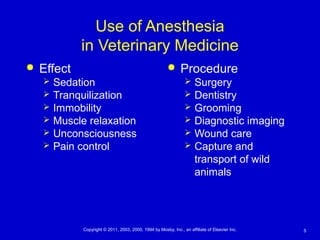
Use of Anesthesia
in Veterinary Medicine
 Effect
 Sedation
 Tranquilization
 Immobility
 Muscle relaxation
 Unconsciousness
 Pain control
 Procedure
 Surgery
 Dentistry
 Grooming
 Diagnostic imaging
 Wound care
 Capture and
transport of wild
animals
6Copyright © 2011, 2003, 2000, 1994 by Mosby, Inc., an affiliate of Elsevier Inc.
General Anesthesia
 Reversible
 Produced by administration of one or more
anesthetic drugs
 Characteristics
7Copyright © 2011, 2003, 2000, 1994 by Mosby, Inc., an affiliate of Elsevier Inc.
Surgical Anesthesia
 A stage of general anesthesia
 Analgesia and muscle relaxation
 Eliminate pain and patient movement during
the procedure
8Copyright © 2011, 2003, 2000, 1994 by Mosby, Inc., an affiliate of Elsevier Inc.
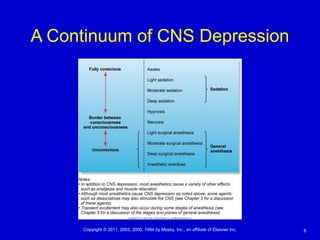
A Continuum of CNS Depression
9Copyright © 2011, 2003, 2000, 1994 by Mosby, Inc., an affiliate of Elsevier Inc.
Sedation vs. Tranquilization
 Sedation
 CNS depression
 Drowsiness
 Drug-induced
 Various levels
 Slightly aware or
unaware of
surroundings
 Aroused by noxious
stimulation
 Uses: minor procedures
 Tranquilization
 Calmness
 Patient is reluctant to
move
 Aware of
surroundings but
doesn’t care
10Copyright © 2011, 2003, 2000, 1994 by Mosby, Inc., an affiliate of Elsevier Inc.
Hypnosis vs. Narcosis
 Hypnosis
 Drug-induced
 Sleeplike state
 Impairs patient’s
ability to respond to
stimuli
 Patient can be
aroused with sufficient
stimulation
 Narcosis
 Drug-induced sleep
 Patient is not easily
aroused
 Associated with
narcotic drugs
11Copyright © 2011, 2003, 2000, 1994 by Mosby, Inc., an affiliate of Elsevier Inc.
Local Anesthesia
 Targets a small, specific area of the body
 Loss of sensation to a specific area
 Drug is infiltrated into the desired area
12Copyright © 2011, 2003, 2000, 1994 by Mosby, Inc., an affiliate of Elsevier Inc.
Topical Anesthesia
 Applied to body surfaces or a wound
 Produces a superficial loss of sensation
13Copyright © 2011, 2003, 2000, 1994 by Mosby, Inc., an affiliate of Elsevier Inc.
Regional Anesthesia
 Loss of sensation to a limited area of the
body
 Nerve blocks
 Epidural anesthesia
14Copyright © 2011, 2003, 2000, 1994 by Mosby, Inc., an affiliate of Elsevier Inc.
Balanced Anesthesia
 Using multiple drugs in smaller quantities
 Maximizes benefits
 Minimizes adverse effects
 Gives anesthetist greater control
15Copyright © 2011, 2003, 2000, 1994 by Mosby, Inc., an affiliate of Elsevier Inc.
The Veterinary Technician’s Role
as an Anesthetist
 Anesthetic machine
 Preparation
 Operation
 Maintenance
 Administer anesthetic agents
 Endotracheal intubation
 Patient monitoring
16Copyright © 2011, 2003, 2000, 1994 by Mosby, Inc., an affiliate of Elsevier Inc.
Anesthesia Challenges and Risks
 Dose calculation and rate adjustment
 Vital signs and anesthetic depth
 Assess multiple pieces of information
 Patient management
 Anesthetic accidents
17Copyright © 2011, 2003, 2000, 1994 by Mosby, Inc., an affiliate of Elsevier Inc.
Dose Calculation and Rate
Adjustment
 Narrow therapeutic index
18Copyright © 2011, 2003, 2000, 1994 by Mosby, Inc., an affiliate of Elsevier Inc.
Vital Signs and Anesthetic Depth
 Drugs may cause changes in cardiovascular
and pulmonary systems
 Changes may be lethal
 Patient must be closely monitored
19Copyright © 2011, 2003, 2000, 1994 by Mosby, Inc., an affiliate of Elsevier Inc.
Assess Multiple Pieces
of Information
 Visual, tactile, and auditory
 From patient, anesthetic machines, and
monitors
 Must be able to make rapid decisions
20Copyright © 2011, 2003, 2000, 1994 by Mosby, Inc., an affiliate of Elsevier Inc.
Patient Management
 Understand physical parameters
 Understand anesthetic equipment
 Understand monitoring devices
21Copyright © 2011, 2003, 2000, 1994 by Mosby, Inc., an affiliate of Elsevier Inc.
Anesthetic Accidents
 The outcome can be devastating or lethal
 Owners may pursue legal action
 Prevent accidents by using high standards
 Keep meticulous records

Introduction to Anesthesia

  • 1.
    1Copyright © 2011,2003, 2000, 1994 by Mosby, Inc., an affiliate of Elsevier Inc. Introduction to Anesthesia Anesthesia is utilized daily in most veterinary practices to provide sedation, tranquilization, immobility, muscle relaxation, unconsciousness, and pain control Chapter 1
  • 2.
    2Copyright © 2011,2003, 2000, 1994 by Mosby, Inc., an affiliate of Elsevier Inc. Human Anesthesia  Dr. William T.G. Morton  Dr. Oliver Wendell Holmes, Sr.  1846—diethyl ether
  • 3.
    3Copyright © 2011,2003, 2000, 1994 by Mosby, Inc., an affiliate of Elsevier Inc. Veterinary Anesthesia  1850s—ether and chloroform  Early twentieth century—inhalation anesthesia  1930s—injectable barbiturates
  • 4.
    4Copyright © 2011,2003, 2000, 1994 by Mosby, Inc., an affiliate of Elsevier Inc. Anesthesia  Loss of sensation  Central nervous system (CNS) depression or stimulation
  • 5.
    5Copyright © 2011,2003, 2000, 1994 by Mosby, Inc., an affiliate of Elsevier Inc. Use of Anesthesia in Veterinary Medicine  Effect  Sedation  Tranquilization  Immobility  Muscle relaxation  Unconsciousness  Pain control  Procedure  Surgery  Dentistry  Grooming  Diagnostic imaging  Wound care  Capture and transport of wild animals
  • 6.
    6Copyright © 2011,2003, 2000, 1994 by Mosby, Inc., an affiliate of Elsevier Inc. General Anesthesia  Reversible  Produced by administration of one or more anesthetic drugs  Characteristics
  • 7.
    7Copyright © 2011,2003, 2000, 1994 by Mosby, Inc., an affiliate of Elsevier Inc. Surgical Anesthesia  A stage of general anesthesia  Analgesia and muscle relaxation  Eliminate pain and patient movement during the procedure
  • 8.
    8Copyright © 2011,2003, 2000, 1994 by Mosby, Inc., an affiliate of Elsevier Inc. A Continuum of CNS Depression
  • 9.
    9Copyright © 2011,2003, 2000, 1994 by Mosby, Inc., an affiliate of Elsevier Inc. Sedation vs. Tranquilization  Sedation  CNS depression  Drowsiness  Drug-induced  Various levels  Slightly aware or unaware of surroundings  Aroused by noxious stimulation  Uses: minor procedures  Tranquilization  Calmness  Patient is reluctant to move  Aware of surroundings but doesn’t care
  • 10.
    10Copyright © 2011,2003, 2000, 1994 by Mosby, Inc., an affiliate of Elsevier Inc. Hypnosis vs. Narcosis  Hypnosis  Drug-induced  Sleeplike state  Impairs patient’s ability to respond to stimuli  Patient can be aroused with sufficient stimulation  Narcosis  Drug-induced sleep  Patient is not easily aroused  Associated with narcotic drugs
  • 11.
    11Copyright © 2011,2003, 2000, 1994 by Mosby, Inc., an affiliate of Elsevier Inc. Local Anesthesia  Targets a small, specific area of the body  Loss of sensation to a specific area  Drug is infiltrated into the desired area
  • 12.
    12Copyright © 2011,2003, 2000, 1994 by Mosby, Inc., an affiliate of Elsevier Inc. Topical Anesthesia  Applied to body surfaces or a wound  Produces a superficial loss of sensation
  • 13.
    13Copyright © 2011,2003, 2000, 1994 by Mosby, Inc., an affiliate of Elsevier Inc. Regional Anesthesia  Loss of sensation to a limited area of the body  Nerve blocks  Epidural anesthesia
  • 14.
    14Copyright © 2011,2003, 2000, 1994 by Mosby, Inc., an affiliate of Elsevier Inc. Balanced Anesthesia  Using multiple drugs in smaller quantities  Maximizes benefits  Minimizes adverse effects  Gives anesthetist greater control
  • 15.
    15Copyright © 2011,2003, 2000, 1994 by Mosby, Inc., an affiliate of Elsevier Inc. The Veterinary Technician’s Role as an Anesthetist  Anesthetic machine  Preparation  Operation  Maintenance  Administer anesthetic agents  Endotracheal intubation  Patient monitoring
  • 16.
    16Copyright © 2011,2003, 2000, 1994 by Mosby, Inc., an affiliate of Elsevier Inc. Anesthesia Challenges and Risks  Dose calculation and rate adjustment  Vital signs and anesthetic depth  Assess multiple pieces of information  Patient management  Anesthetic accidents
  • 17.
    17Copyright © 2011,2003, 2000, 1994 by Mosby, Inc., an affiliate of Elsevier Inc. Dose Calculation and Rate Adjustment  Narrow therapeutic index
  • 18.
    18Copyright © 2011,2003, 2000, 1994 by Mosby, Inc., an affiliate of Elsevier Inc. Vital Signs and Anesthetic Depth  Drugs may cause changes in cardiovascular and pulmonary systems  Changes may be lethal  Patient must be closely monitored
  • 19.
    19Copyright © 2011,2003, 2000, 1994 by Mosby, Inc., an affiliate of Elsevier Inc. Assess Multiple Pieces of Information  Visual, tactile, and auditory  From patient, anesthetic machines, and monitors  Must be able to make rapid decisions
  • 20.
    20Copyright © 2011,2003, 2000, 1994 by Mosby, Inc., an affiliate of Elsevier Inc. Patient Management  Understand physical parameters  Understand anesthetic equipment  Understand monitoring devices
  • 21.
    21Copyright © 2011,2003, 2000, 1994 by Mosby, Inc., an affiliate of Elsevier Inc. Anesthetic Accidents  The outcome can be devastating or lethal  Owners may pursue legal action  Prevent accidents by using high standards  Keep meticulous records

Editor's Notes

  • #2 In 1846, Dr. William T.G. Morton gave the first successful demonstration of the pain-relieving properties of diethyl ether” One month later, Dr. Oliver Wendell Holmes, Sr. suggested the name “anesthesia” to describe the state of insensibility to pain produced by this agent
  • #5 From the Greek anaisthesia meaning without feeling or insensibility. This is a very general definition.
  • #6 The effect of anesthesia does not always include loss of consciousness.
  • #7 Characteristics include unconsciousness, immobility, muscle relaxation, and loss of sensation. Used to prepare patients for acutely painful procedures, including surgery.
  • #8 Analgesia is a loss of sensitivity to pain.
  • #10 Diagnostic imaging, grooming, and wound treatment are minor procedures. These terms are often used interchangeably even though they don’t produce the same conditions.
  • #12 For example, a local anesthetic may be injected into the tissue surrounding a small cutaneous tumor to facilitate its removal without having to use general anesthesia.
  • #13 For example, topical anesthetics may be applied to the eye before an ophthalmic examination or to an open wound for pain relief.
  • #14 Nerve blocks can be used to block specific limbs or a dental arcade. Epidural anesthesia is used for pain control of the pelvis and hind quarters.
  • #15 Text gives an example of one balanced anesthetic regime.
  • #16 Knowledge, competence, commitment, and confidence are necessary in all these aspects for the safety of the patient and operating room personnel.
  • #17 The anesthetist is responsible for the well-being and indeed the life of a patient. A good anesthetist is confident, competent, caring, and dedicated.