The process for preparing job-application
    materials includes seven steps:

• Plan the job search.
• Decide how to look for a position.
• Learn as much as you can about the organizations to
  which you will apply.
• Draft the résumé and application letter.
• Revise, edit, and proofread the résumé and letter.
• Prepare for job interviews.
• Write appropriate follow-up letters.

    Chapter 15. Writing Job-Application Materials   © 2012 by Bedford/St. Martin's   1
In planning a job search,
              carry out these four tasks:

•   Do a self-inventory.
•   Learn about the employers.
•   Prepare a résumé and job-application letter.
•   Prepare a portfolio.


      Chapter 15. Writing Job-Application Materials   © 2012 by Bedford/St. Martin's   2
You can look for a job eight ways:
• through a college or university placement office
• through a professional placement bureau
• through a published job ad
• through an organization's Web site
• through a job board on the Internet
• through your connections on social media
• through personal connections
• through an unsolicited letter to an organization

    Chapter 15. Writing Job-Application Materials   © 2012 by Bedford/St. Martin's   3
Ask these four questions
      before posting to a job board:

• Who has access to your résumé?
• How will you know if an employer requests
  your résumé?
• Can your current employer see your résumé?
• Can you update your résumé at no cost?


   Chapter 15. Writing Job-Application Materials   © 2012 by Bedford/St. Martin's   4
Assume that employers will search the
Internet while screening job applicants:
• Periodically check Internet content about
  yourself.
• Use accounts on social-media sites to make a
  good first impression.
• Create a profile tailored to the type of job you
  seek.
• Project a professional persona.
• Follow through with what you say you will do.
• Help others make career connections.
    Chapter 15. Writing Job-Application Materials   © 2012 by Bedford/St. Martin's   5
There are three reasons
            to write your own résumé:

• You know yourself better than anyone else
  does.
• Employment officers know the style of the
  local agencies.
• If you write your own résumé, you will be
  more likely to adapt it to different situations.


    Chapter 15. Writing Job-Application Materials   © 2012 by Bedford/St. Martin's   6
An attractive résumé
               has four characteristics:

• generous margins
• clear type
• balanced appearance
• clear organization


    Chapter 15. Writing Job-Application Materials   © 2012 by Bedford/St. Martin's   7
The résumé must meet three standards:

• It must provide clear, specific information,
  without generalizations or self-congratulation.
• It must be free of errors.
• It must be honest.


    Chapter 15. Writing Job-Application Materials   © 2012 by Bedford/St. Martin's   8
A chronological résumé has six elements:

 • identifying information
 • objectives or summary of qualifications
 • education
 • employment history
 • interests and activities
 • references

     Chapter 15. Writing Job-Application Materials   © 2012 by Bedford/St. Martin's   9
Follow these three suggestions
when drafting a statement of objectives:

• State only the goals or duties explicitly
  mentioned, or clearly implied, in the job
  advertisement.
• Focus on the reader’s needs, not on your
  goals.
• Be specific.


    Chapter 15. Writing Job-Application Materials   © 2012 by Bedford/St. Martin's   10
Include these five elements
            in the education section:

• the degree
• the institution
• the location of the institution
• the date of graduation
• information about other schools you attended


    Chapter 15. Writing Job-Application Materials   © 2012 by Bedford/St. Martin's   11
Follow these four guidelines
 when elaborating on your education:

• List your grade-point average.
• Compile a list of courses.
• Describe a special accomplishment.
• List honors and awards you received.


    Chapter 15. Writing Job-Application Materials   © 2012 by Bedford/St. Martin's   12
Present these details
     about your employment history:

• skills
• equipment
• money
• documents
• personnel
• clients

    Chapter 15. Writing Job-Application Materials   © 2012 by Bedford/St. Martin's   13
Include information about
         your interests and activities:

• participation in community-service
  organizations
• hobbies related to your career
• sports, especially those that might be socially
  useful in your professional career
• university-sanctioned activities


    Chapter 15. Writing Job-Application Materials   © 2012 by Bedford/St. Martin's   14
Follow these three suggestions
      when providing references:

• Decide whether and how you want to present
  the references.
• Choose your references carefully.
• Give the potential reference an opportunity to
  decline gracefully.


    Chapter 15. Writing Job-Application Materials   © 2012 by Bedford/St. Martin's   15
Some résumés
         contain additional information:

•   computer skills
•   military experience
•   language ability
•   willingness to relocate


      Chapter 15. Writing Job-Application Materials   © 2012 by Bedford/St. Martin's   16
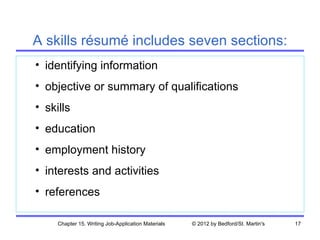
A skills résumé includes seven sections:
• identifying information
• objective or summary of qualifications
• skills
• education
• employment history
• interests and activities
• references

     Chapter 15. Writing Job-Application Materials   © 2012 by Bedford/St. Martin's   17
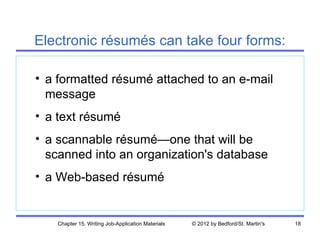
Electronic résumés can take four forms:

• a formatted résumé attached to an e-mail
  message
• a text résumé
• a scannable résumé—one that will be
  scanned into an organization's database
• a Web-based résumé


   Chapter 15. Writing Job-Application Materials   © 2012 by Bedford/St. Martin's   18
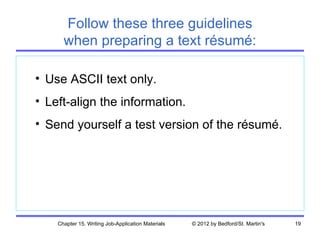
Follow these three guidelines
      when preparing a text résumé:

• Use ASCII text only.
• Left-align the information.
• Send yourself a test version of the résumé.


    Chapter 15. Writing Job-Application Materials   © 2012 by Bedford/St. Martin's   19
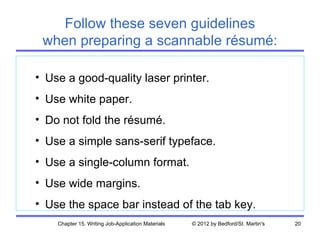
Follow these seven guidelines
 when preparing a scannable résumé:

• Use a good-quality laser printer.
• Use white paper.
• Do not fold the résumé.
• Use a simple sans-serif typeface.
• Use a single-column format.
• Use wide margins.
• Use the space bar instead of the tab key.
    Chapter 15. Writing Job-Application Materials   © 2012 by Bedford/St. Martin's   20
Follow two principles when
     drafting a job-application letter:

• Selectivity. Select two or three points of
  greatest interest to the potential employer.
• Development. Develop those points into
  paragraphs emphasizing results.


    Chapter 15. Writing Job-Application Materials   © 2012 by Bedford/St. Martin's   21
The introductory paragraph
              has four functions:

• It identifies your source of information.
• It identifies the position you are interested in.
• It states that you wish to be considered for the
  position.
• It forecasts the rest of the letter.


    Chapter 15. Writing Job-Application Materials   © 2012 by Bedford/St. Martin's   22
The concluding paragraph
             includes three elements:

• a reference to your résumé
• a polite but confident request for an interview
• your phone number and e-mail address


    Chapter 15. Writing Job-Application Materials   © 2012 by Bedford/St. Martin's   23
Follow these six guidelines
   when preparing for a job interview:
• Study job interviews.
• Study the organization to which you applied.
• Think about what you can offer the
  organization.
• Study lists of common interview questions.
• Compile a list of questions you wish to ask.
• Rehearse the interview.

    Chapter 15. Writing Job-Application Materials   © 2012 by Bedford/St. Martin's   24
Consider these seven
     questions before a job interview:

• When should you arrive for the interview?
• What should you wear?
• How do interviewers interpret your body language?
• What questions are you likely to be asked?
• How long should your answers be?
• How do you know when the interviewer wishes to end
  the interview?
• How can you get the interviewer’s contact information
  to write a follow-up letter?

     Chapter 15. Writing Job-Application Materials   © 2012 by Bedford/St. Martin's   25
Write one of these four follow-up
  letters or e-mails after the interview:

• letter of appreciation after an interview
• letter accepting a job offer
• letter rejecting a job offer
• letter acknowledging a rejection


    Chapter 15. Writing Job-Application Materials   © 2012 by Bedford/St. Martin's   26

Ch15 slides

  • 1.
    The process forpreparing job-application materials includes seven steps: • Plan the job search. • Decide how to look for a position. • Learn as much as you can about the organizations to which you will apply. • Draft the résumé and application letter. • Revise, edit, and proofread the résumé and letter. • Prepare for job interviews. • Write appropriate follow-up letters. Chapter 15. Writing Job-Application Materials © 2012 by Bedford/St. Martin's 1
  • 2.
    In planning ajob search, carry out these four tasks: • Do a self-inventory. • Learn about the employers. • Prepare a résumé and job-application letter. • Prepare a portfolio. Chapter 15. Writing Job-Application Materials © 2012 by Bedford/St. Martin's 2
  • 3.
    You can lookfor a job eight ways: • through a college or university placement office • through a professional placement bureau • through a published job ad • through an organization's Web site • through a job board on the Internet • through your connections on social media • through personal connections • through an unsolicited letter to an organization Chapter 15. Writing Job-Application Materials © 2012 by Bedford/St. Martin's 3
  • 4.
    Ask these fourquestions before posting to a job board: • Who has access to your résumé? • How will you know if an employer requests your résumé? • Can your current employer see your résumé? • Can you update your résumé at no cost? Chapter 15. Writing Job-Application Materials © 2012 by Bedford/St. Martin's 4
  • 5.
    Assume that employerswill search the Internet while screening job applicants: • Periodically check Internet content about yourself. • Use accounts on social-media sites to make a good first impression. • Create a profile tailored to the type of job you seek. • Project a professional persona. • Follow through with what you say you will do. • Help others make career connections. Chapter 15. Writing Job-Application Materials © 2012 by Bedford/St. Martin's 5
  • 6.
    There are threereasons to write your own résumé: • You know yourself better than anyone else does. • Employment officers know the style of the local agencies. • If you write your own résumé, you will be more likely to adapt it to different situations. Chapter 15. Writing Job-Application Materials © 2012 by Bedford/St. Martin's 6
  • 7.
    An attractive résumé has four characteristics: • generous margins • clear type • balanced appearance • clear organization Chapter 15. Writing Job-Application Materials © 2012 by Bedford/St. Martin's 7
  • 8.
    The résumé mustmeet three standards: • It must provide clear, specific information, without generalizations or self-congratulation. • It must be free of errors. • It must be honest. Chapter 15. Writing Job-Application Materials © 2012 by Bedford/St. Martin's 8
  • 9.
    A chronological résuméhas six elements: • identifying information • objectives or summary of qualifications • education • employment history • interests and activities • references Chapter 15. Writing Job-Application Materials © 2012 by Bedford/St. Martin's 9
  • 10.
    Follow these threesuggestions when drafting a statement of objectives: • State only the goals or duties explicitly mentioned, or clearly implied, in the job advertisement. • Focus on the reader’s needs, not on your goals. • Be specific. Chapter 15. Writing Job-Application Materials © 2012 by Bedford/St. Martin's 10
  • 11.
    Include these fiveelements in the education section: • the degree • the institution • the location of the institution • the date of graduation • information about other schools you attended Chapter 15. Writing Job-Application Materials © 2012 by Bedford/St. Martin's 11
  • 12.
    Follow these fourguidelines when elaborating on your education: • List your grade-point average. • Compile a list of courses. • Describe a special accomplishment. • List honors and awards you received. Chapter 15. Writing Job-Application Materials © 2012 by Bedford/St. Martin's 12
  • 13.
    Present these details about your employment history: • skills • equipment • money • documents • personnel • clients Chapter 15. Writing Job-Application Materials © 2012 by Bedford/St. Martin's 13
  • 14.
    Include information about your interests and activities: • participation in community-service organizations • hobbies related to your career • sports, especially those that might be socially useful in your professional career • university-sanctioned activities Chapter 15. Writing Job-Application Materials © 2012 by Bedford/St. Martin's 14
  • 15.
    Follow these threesuggestions when providing references: • Decide whether and how you want to present the references. • Choose your references carefully. • Give the potential reference an opportunity to decline gracefully. Chapter 15. Writing Job-Application Materials © 2012 by Bedford/St. Martin's 15
  • 16.
    Some résumés contain additional information: • computer skills • military experience • language ability • willingness to relocate Chapter 15. Writing Job-Application Materials © 2012 by Bedford/St. Martin's 16
  • 17.
    A skills résuméincludes seven sections: • identifying information • objective or summary of qualifications • skills • education • employment history • interests and activities • references Chapter 15. Writing Job-Application Materials © 2012 by Bedford/St. Martin's 17
  • 18.
    Electronic résumés cantake four forms: • a formatted résumé attached to an e-mail message • a text résumé • a scannable résumé—one that will be scanned into an organization's database • a Web-based résumé Chapter 15. Writing Job-Application Materials © 2012 by Bedford/St. Martin's 18
  • 19.
    Follow these threeguidelines when preparing a text résumé: • Use ASCII text only. • Left-align the information. • Send yourself a test version of the résumé. Chapter 15. Writing Job-Application Materials © 2012 by Bedford/St. Martin's 19
  • 20.
    Follow these sevenguidelines when preparing a scannable résumé: • Use a good-quality laser printer. • Use white paper. • Do not fold the résumé. • Use a simple sans-serif typeface. • Use a single-column format. • Use wide margins. • Use the space bar instead of the tab key. Chapter 15. Writing Job-Application Materials © 2012 by Bedford/St. Martin's 20
  • 21.
    Follow two principleswhen drafting a job-application letter: • Selectivity. Select two or three points of greatest interest to the potential employer. • Development. Develop those points into paragraphs emphasizing results. Chapter 15. Writing Job-Application Materials © 2012 by Bedford/St. Martin's 21
  • 22.
    The introductory paragraph has four functions: • It identifies your source of information. • It identifies the position you are interested in. • It states that you wish to be considered for the position. • It forecasts the rest of the letter. Chapter 15. Writing Job-Application Materials © 2012 by Bedford/St. Martin's 22
  • 23.
    The concluding paragraph includes three elements: • a reference to your résumé • a polite but confident request for an interview • your phone number and e-mail address Chapter 15. Writing Job-Application Materials © 2012 by Bedford/St. Martin's 23
  • 24.
    Follow these sixguidelines when preparing for a job interview: • Study job interviews. • Study the organization to which you applied. • Think about what you can offer the organization. • Study lists of common interview questions. • Compile a list of questions you wish to ask. • Rehearse the interview. Chapter 15. Writing Job-Application Materials © 2012 by Bedford/St. Martin's 24
  • 25.
    Consider these seven questions before a job interview: • When should you arrive for the interview? • What should you wear? • How do interviewers interpret your body language? • What questions are you likely to be asked? • How long should your answers be? • How do you know when the interviewer wishes to end the interview? • How can you get the interviewer’s contact information to write a follow-up letter? Chapter 15. Writing Job-Application Materials © 2012 by Bedford/St. Martin's 25
  • 26.
    Write one ofthese four follow-up letters or e-mails after the interview: • letter of appreciation after an interview • letter accepting a job offer • letter rejecting a job offer • letter acknowledging a rejection Chapter 15. Writing Job-Application Materials © 2012 by Bedford/St. Martin's 26