BLOOD
 Blood is a fluid connective
tissue composed of:
 Plasma : Proteins
Coagulation factors
Metabolic substances
 Cells : Red blood cells
White blood cells
Platelets
Presenting problems in Blood
disease
 Anaemia
 High haemoglobin
 Leucopenia (low white cell count)
 Leucocytosis (high white cell count)
 Lymphadenopathy
 Splenomegaly
 Bleeding
 Thrombocytopenia (low platelet count)
 Thrombocytosis (high platelet count)
 Pancytopenia
 Infection
Investigation of diseases of the
blood
• Full blood count
• Blood film examination
• Bone marrow examination
• Investigation of coagulation
1. History and
examination
2. Blood tests:
• Complete blood count
 Total count:WBC
 Neutrophils(N)
 Lymphocytes(L)
 Eosinophil(E)
 Basophil(B)
 Hb:
 Platelets
• Correlation of CBC with disease condition .
• What things can u identify?
 Hb Anemia. Normal Level:Male:14-18g/dl
Female: 12-16g/dl
Polycythemia
 Complete blood count Importance of
Total count :5000-10000 microlitre
High /Low: Malignancy
High: infection
Neutrophil:40-60%: Infection
Lymphocytes: 20-40%:Tuberculosis
Eosinophil:1-4%:Allergies,worm infestations
Monocytes:2-8%
Basophils:0.5-1%
 Platelets:1,50,000-4,00,000 microlitre
Red cell indices
• MCV(Mean corpuscular volume):Size of red
blood cells
• For Hemoglobin content
• MCH(Mean corpuscular hemoglobin)
• MCHC(Mean corpuscular hemoglobin
concentration)
• Packed cell volume(Hematocrit)
• Red cell Distribution width
Packed cell volume(PCV)
• Hematocrit (HCT), also called packed cell volume (PCV), is the
percentage of blood volume occupied by RBCs.
• HCT = ([RBC x MCV]/10).
• Male:41-50%
• Female:36-48%
• Low hematocrit:
Chronic bleeding
Aplastic anemia
Sickle cell anemia
High: smoking
High altitude.
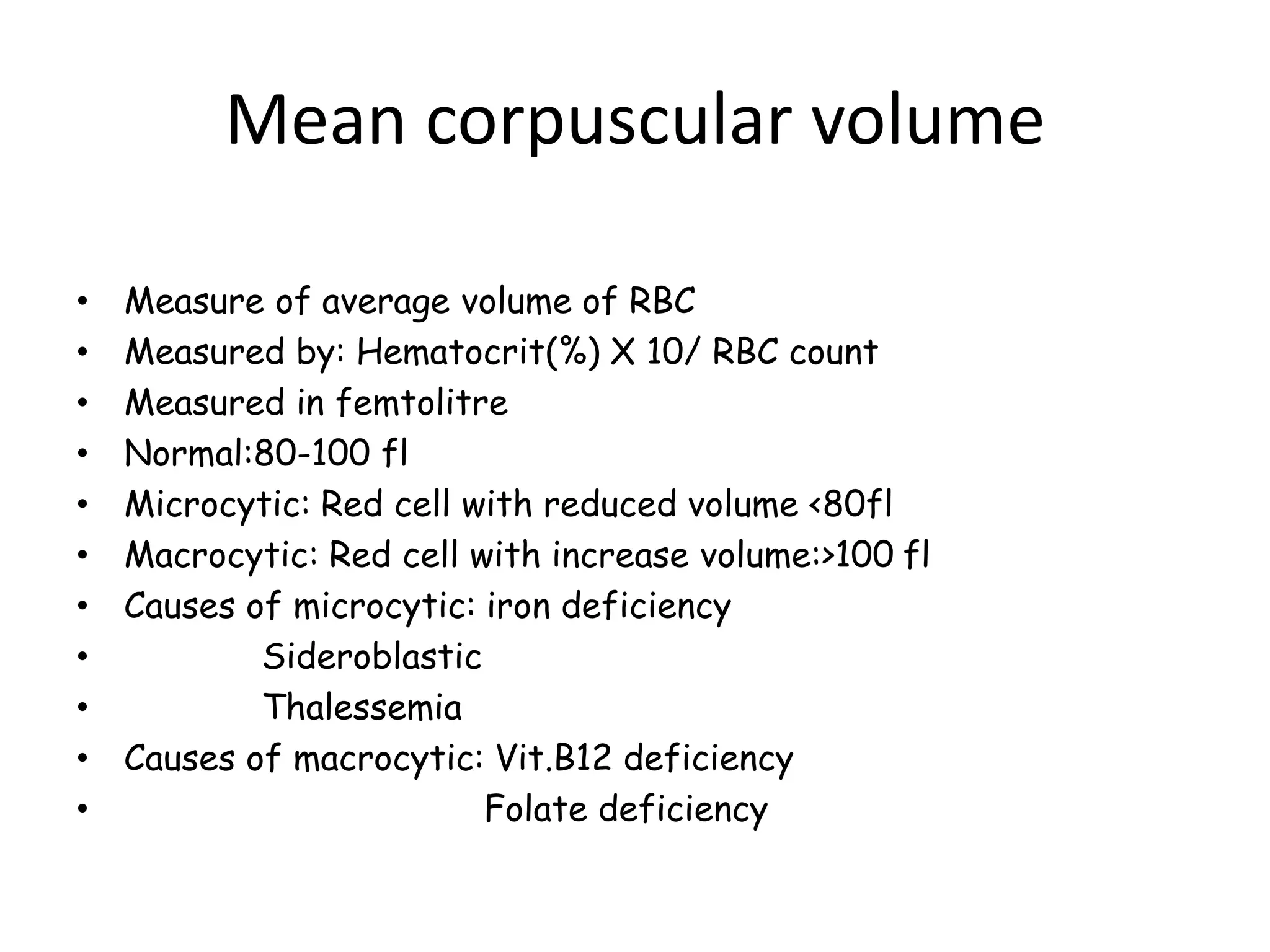
Mean corpuscular volume
• Measure of average volume of RBC
• Measured by: Hematocrit(%) X 10/ RBC count
• Measured in femtolitre
• Normal:80-100 fl
• Microcytic: Red cell with reduced volume <80fl
• Macrocytic: Red cell with increase volume:>100 fl
• Causes of microcytic: iron deficiency
• Sideroblastic
• Thalessemia
• Causes of macrocytic: Vit.B12 deficiency
• Folate deficiency
Mean corpuscular hemoglobin
concentration
• Average concentration of Hb in deciliter of erythrocytes.
Measured in g/dl.
• Ratio of Hb mass to volume
• MCHC: Hb x100/ Hematocrit
• Normochromic:32-36 g/dl
• Hypochromic:<32 g/dl
• Hyperchromic:>36 g/dl
• Causes of hypochromic: vit B6 def, Iron deficiency
• Causes of hyperchromic: Vit B12,Folate def
Mean cell Hemoglobin
• Measurement of individual
weight of Hb in individual
erythrocytes
• Measured in picogram
• MCH: Hb x10/RBC
• Normal value is 28-34 pg
Red cell distribution width
• Used along with MCV.
• Used to identify variation in
blood cell size and volume.
• RDW:11.6-14.6 in adult
• Importance: Helps to
identify heterogenous cell
size or presence of two types
of red cell population
• Other RBC indices reflects
RBC values not RBC changes.
Other tests
Reticulocyte count
Prothrombin time
• Measures time it takes plasma to clot when exposed to tissue
factor that assess extrinsic and common pathway
• PT:11-13 seconds
• INR(International normalized ratio):
• Ratio of patients prothrombin time to control prothrombin time
• Dimensionless
Uses: Unexplained bleeding
Patinet under anticoagulant
DIC
Activated partial throboplastin time
• measures the time it takes plasma to clot when exposed to
substances that activate the contact factors, which assesses
the intrinsic and common pathways of coagulation .
• Normal range:25-35 seconds
• Uses: Unexplained bleeding
Under heparin therapy
Fibrinogen and D-dimer
• Fibrinogen is the precursor to fibrin, the principle component of
a fibrin clot
• Normal value:5—100 mg/dl
• Clinical use: DIC,Liver disease
D-dimer:Fibrin D-dimer is one of the major fibrin degradation
products released upon cleavage of crosslinked fibrin by plasmin.
• Normal plasma levels of D-dimer by ELISA testing are <500
ng/mL
• Uses: Deep vein thrombosis
• Pulmonary embolism
• DIC
Peripheral blood smear
• Examination of the peripheral blood smear provides a window
into the functional status of the bone marrow.
• The peripheral smear is indispensable for evaluating the number,
size, and shape of red cells, white cells, and platelets.
• RBC:Review the color, shape, irregular borders, and presence of
nuclei, inclusions, or parasites.
• WBC:Review the presence of early (immature) cells, abnormal
lobulation or nuclear contour, abnormal or absent granulation,
presence of parasites or other inclusions
• Platelets – Review any increase or decrease in platelet number
and size, absence of granules, presence of platelet aggregation,
megakaryocyte fragments.
Other tests
• Perpiheral smear always supported by Bone marrow aspiration
and biopsy.
• AML: Myeloperoxidase on peripheral blood smear
• Flow cytometry
• Bone marrow aspiration and biopsy: Usually hypercellular
• Prsence of Auer rod on microscopy
• Cytochemistry: Myeloperoxidase,Sudan black B test.
• ALL: Anemia,neutropenia,thrombocytopenia
• Tests: Peripheral blood smear,Periodic acid shiff test,Non
esterase
• Flow cytometry/cytogenetics.
Bone marrow aspiration and cytology
THANK YOU

Lab tests in hematology.pptx

  • 1.
    BLOOD  Blood isa fluid connective tissue composed of:  Plasma : Proteins Coagulation factors Metabolic substances  Cells : Red blood cells White blood cells Platelets
  • 2.
    Presenting problems inBlood disease  Anaemia  High haemoglobin  Leucopenia (low white cell count)  Leucocytosis (high white cell count)  Lymphadenopathy  Splenomegaly  Bleeding  Thrombocytopenia (low platelet count)  Thrombocytosis (high platelet count)  Pancytopenia  Infection
  • 6.
    Investigation of diseasesof the blood • Full blood count • Blood film examination • Bone marrow examination • Investigation of coagulation
  • 7.
    1. History and examination 2.Blood tests: • Complete blood count  Total count:WBC  Neutrophils(N)  Lymphocytes(L)  Eosinophil(E)  Basophil(B)  Hb:  Platelets
  • 8.
    • Correlation ofCBC with disease condition . • What things can u identify?  Hb Anemia. Normal Level:Male:14-18g/dl Female: 12-16g/dl Polycythemia  Complete blood count Importance of Total count :5000-10000 microlitre High /Low: Malignancy High: infection Neutrophil:40-60%: Infection Lymphocytes: 20-40%:Tuberculosis Eosinophil:1-4%:Allergies,worm infestations Monocytes:2-8% Basophils:0.5-1%  Platelets:1,50,000-4,00,000 microlitre
  • 10.
    Red cell indices •MCV(Mean corpuscular volume):Size of red blood cells • For Hemoglobin content • MCH(Mean corpuscular hemoglobin) • MCHC(Mean corpuscular hemoglobin concentration) • Packed cell volume(Hematocrit) • Red cell Distribution width
  • 11.
    Packed cell volume(PCV) •Hematocrit (HCT), also called packed cell volume (PCV), is the percentage of blood volume occupied by RBCs. • HCT = ([RBC x MCV]/10). • Male:41-50% • Female:36-48% • Low hematocrit: Chronic bleeding Aplastic anemia Sickle cell anemia High: smoking High altitude.
  • 12.
    Mean corpuscular volume •Measure of average volume of RBC • Measured by: Hematocrit(%) X 10/ RBC count • Measured in femtolitre • Normal:80-100 fl • Microcytic: Red cell with reduced volume <80fl • Macrocytic: Red cell with increase volume:>100 fl • Causes of microcytic: iron deficiency • Sideroblastic • Thalessemia • Causes of macrocytic: Vit.B12 deficiency • Folate deficiency
  • 13.
    Mean corpuscular hemoglobin concentration •Average concentration of Hb in deciliter of erythrocytes. Measured in g/dl. • Ratio of Hb mass to volume • MCHC: Hb x100/ Hematocrit • Normochromic:32-36 g/dl • Hypochromic:<32 g/dl • Hyperchromic:>36 g/dl • Causes of hypochromic: vit B6 def, Iron deficiency • Causes of hyperchromic: Vit B12,Folate def
  • 14.
    Mean cell Hemoglobin •Measurement of individual weight of Hb in individual erythrocytes • Measured in picogram • MCH: Hb x10/RBC • Normal value is 28-34 pg
  • 15.
    Red cell distributionwidth • Used along with MCV. • Used to identify variation in blood cell size and volume. • RDW:11.6-14.6 in adult • Importance: Helps to identify heterogenous cell size or presence of two types of red cell population • Other RBC indices reflects RBC values not RBC changes.
  • 16.
  • 17.
  • 19.
    Prothrombin time • Measurestime it takes plasma to clot when exposed to tissue factor that assess extrinsic and common pathway • PT:11-13 seconds • INR(International normalized ratio): • Ratio of patients prothrombin time to control prothrombin time • Dimensionless Uses: Unexplained bleeding Patinet under anticoagulant DIC
  • 20.
    Activated partial throboplastintime • measures the time it takes plasma to clot when exposed to substances that activate the contact factors, which assesses the intrinsic and common pathways of coagulation . • Normal range:25-35 seconds • Uses: Unexplained bleeding Under heparin therapy
  • 21.
    Fibrinogen and D-dimer •Fibrinogen is the precursor to fibrin, the principle component of a fibrin clot • Normal value:5—100 mg/dl • Clinical use: DIC,Liver disease D-dimer:Fibrin D-dimer is one of the major fibrin degradation products released upon cleavage of crosslinked fibrin by plasmin. • Normal plasma levels of D-dimer by ELISA testing are <500 ng/mL • Uses: Deep vein thrombosis • Pulmonary embolism • DIC
  • 22.
    Peripheral blood smear •Examination of the peripheral blood smear provides a window into the functional status of the bone marrow. • The peripheral smear is indispensable for evaluating the number, size, and shape of red cells, white cells, and platelets. • RBC:Review the color, shape, irregular borders, and presence of nuclei, inclusions, or parasites. • WBC:Review the presence of early (immature) cells, abnormal lobulation or nuclear contour, abnormal or absent granulation, presence of parasites or other inclusions • Platelets – Review any increase or decrease in platelet number and size, absence of granules, presence of platelet aggregation, megakaryocyte fragments.
  • 28.
    Other tests • Perpiheralsmear always supported by Bone marrow aspiration and biopsy. • AML: Myeloperoxidase on peripheral blood smear • Flow cytometry • Bone marrow aspiration and biopsy: Usually hypercellular • Prsence of Auer rod on microscopy • Cytochemistry: Myeloperoxidase,Sudan black B test. • ALL: Anemia,neutropenia,thrombocytopenia • Tests: Peripheral blood smear,Periodic acid shiff test,Non esterase • Flow cytometry/cytogenetics.
  • 29.
  • 33.