Hemostasis
The process of blood clotting and
then the subsequent dissolution
of the clot, following repair of the
injured tissue, is termed
hemostasis.
BV Injury

Contact/
Tissue
Factor

Neural

Blood Vessel
Constriction

Haemostasis
overview:

Platelet
Aggregation

Coagulation
Cascade

Primary hemostatic plug
Reduced
Blood flow

Platelet
Activation

Stable Hemostatic Plug

Fibrin
formation
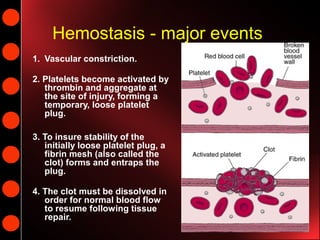
Hemostasis - major events
1. Vascular constriction.
2. Platelets become activated by
thrombin and aggregate at
the site of injury, forming a
temporary, loose platelet
plug.
3. To insure stability of the
initially loose platelet plug, a
fibrin mesh (also called the
clot) forms and entraps the
plug.
4. The clot must be dissolved in
order for normal blood flow
to resume following tissue
repair.
HK = high molecular
wt. kininogen.
PK = prekallikrein.
PL = phospholipid.
Endogeneous anticoagulants
• AT lll
– (binds to thrombin and prevents fibrinogen-fibrin)

• Heparin co-factor II
– (homologous with AT lll)

• Prot C
– (inhibits activity of factors V and Vll)

• Prot S
– (enhances the effect of protein C).

• TFPI
– (tissue factor pathway inhibitor - inhibits the
tissue factor-Vlla complex)
Vitamin K Dependent Factors
• Factors II, VII, lX, X.
• Protein C and Protein S
Role of the liver
Loss of liver parenchyma decreases:
– all coagulation factors - except F Vlll and von
Willebrand co-factor .
– physiologic inhibtors of the coagulation (AT lll,
Prot C and Prot S)
– components of the fibrinolytic system ( mainly
plasminogen, and a2 anti plasmines).

• Liver dysfunction induces:
– platelet dysfunction
– dysfibrinogenemia
– accelerated fibrinolysis (impaired clearance of
tissue plasminogen activators t-PA)
Disorders of Hemostasis
Hematologic disorders causing bleeding
• Vascular disorders
– Scurvy, easy bruising,

• Platelet disorders
– Low Number or abnormal
function

• Coagulation disorders
– Factor deficiency.

• Mixed/Consumption
– DIC
Approach to Bleeding
Disorders
HISTORY
• Is the patient bleeding?
• Surrogate markers of bleeding
– declining hemoglobin

• Age of onset
• Surgical procedures
• Medications
– Aspirin, anticoagulants, etc.

• Birth & Family
Approach to Bleeding Disorders

Platelet
Disorder

•Petechiae,
• Echymoses,
• Menorrhagia
• GI bleeding

Coagulation
Disorders

• Echymoses
• Late wounds bleeding
• Extensive hemorrhage
( joint spaces,
after immu.)

D.I.C.

•
• Bleeding from

multiple sites in an
ill patient
Approach to Bleeding Disorders

If a patient has
tolerated tonsillectomy
and / or adenoidectomy
or extraction of multiple wisdom teeth
without major hemorrhage,
a significant
bleeding disorder
is unlikely.
Clinical aspects of bleeding
Petechiae - (typical of platelet disorders)

•
•

Do not blanch with pressure
(cf. angiomas)
Not palpable
(cf. vasculitis)
Platelet

Petechiae, Purpura

Coagulation

Hematoma, Joint bl.
Clinical aspects of bleeding
Platelet factor disorders

Coagulation disorders

Site of bleeding

Skin, Mucous
membranes (epistaxis,
gum, vaginal, GIT)

Deep in soft tissues

Petechiae

Yes

No

Ecchymoses
(“bruises”)

Small, superficial

Large, deep

Hemarthrosis /
muscle bleeding

Extremely rare

Common

Bleeding after
cuts & scratches

Yes

No

Bleeding after
surgery or trauma

Immediate, usually mild

Delayed (1-2 days),
often severe

Mucus membrane
bleeds

Spontaneous

With trauma
Investigations
Platelet count

150,000 to 450,000 platelets per ml of blood.
< 20,000 per mL - spontaneous bleeding

Bleeding time

Test for platelet function in
Normal : 2 - 5 minutes

Prothrombin
Time

measures the clotting activity of factors I, II, V,
VII, and X Normal : 12-15 seconds

Activated Partial
Thromboplastin
Time

Measures clotting activity of factors I, II, V, VIII,
IX, X, XI, and XII Normal : 25 - 39 sec

Factor assays

Measure the amount of specific clotting factors

FDPs

Fibrin degradation products
Activated partial thromboplastin time (aPTT
or APTT)

• is a performance indicator measuring the
efficacy of both the "intrinsic" (now referred
to as the contact activation pathway) and the
common coagulation pathways.
• It is also used to monitor the treatment effects
with heparin, a major anticoagulant.
aPTT

- Interpretation

• Normal = 25 to 39 sec
• Prolonged APTT may indicate:
• heparin,
• direct thrombin inhibitors,
• a deficiency or inhibitor for factors in the intrinsic and
common pathway
• factors II, V, VIII, IX, X, XI, XII,

• lupus anticoagulant,
• vitamin K deficiency, or
• severe liver disease
(Inaccurate)

Whole blood clotting time
• 5 ml of blood is placed in a glass container,
kept at body temperature and observed
• A clot should occur in 5 to 15 minutes
• Prolonged = Severe deficiency of any of the
coagulation proteins

• The clot should retract in 30 to 60 minutes
• Weak friable clot = hypofibrinogenaemia
• Early dissolution = enhanced fibrinolysis
Prothrombin time
• The time taken for plasma to clot after addition of
tissue factor (obtained from animals) and calcium
to citrated blood.
• This measures the quality of the extrinsic pathway
(as well as the common pathway) of coagulation.
Prothrombin time
• The reference range for prothrombin time is
usually around 12-15 seconds;
• Prolonged
• Deficiencies of factors II, V, VII, X or
fibrinogen;
• Liver disease;
• Vitamin K deficiency and
• Oral anticoagulants (warfarin)
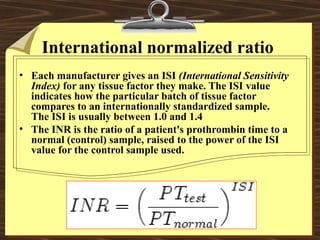
International normalized ratio
• Each manufacturer gives an ISI (International Sensitivity
Index) for any tissue factor they make. The ISI value
indicates how the particular batch of tissue factor
compares to an internationally standardized sample.
The ISI is usually between 1.0 and 1.4
• The INR is the ratio of a patient's prothrombin time to a
normal (control) sample, raised to the power of the ISI
value for the control sample used.
Thrombin time
• Time to clot formation after the addition of
thrombin to citrated blood
• Prolonged by
•
•
•
•
•

Heparin,
Direct thrombin inhibitors,
Fibrin degradation products (FDPs),
Paraproteins, and
Fibrinogen deficiency (both qualitative and
quantitative)
Bleeding time - Ivy method
• A blood pressure cuff is placed on the upper arm and
inflated to 40 mm Hg. A lancet is used to make a stab
wound on the underside of the forearm.
• The time from when the stab wound is made until all
bleeding has stopped is measured and is called the
bleeding time.
• Every 30 seconds, filter paper or a paper towel is
used to draw off the blood.
• Normal values fall between 2 - 5 minutes depending
on the method used
FDPs
• Fragments resulting from the action of
plasmin on fibrin or fibrinogen
• Reflect high fibrinolysis states (such as
DIC) when they are elevated
Platelet Count
• In an adult, a normal count is about
150,000 to 450,000 platelets / µL of blood.
• Platelet levels fall below 20,000/µL,
spontaneous bleeding may occur and is
considered a life-threatening risk.
• Increased platelet counts (thrombocytosis)
• Myeloproliferative disorder
Others Tests
• Von Willebrand factor antigen (vWF:Ag):
immunoassay for circulating vWF.
• Von Willebrand factor activity (vWF:RCo):
measures the functional ability of a patient's
vWF to agglutinate platelets in the presence of
Ristocetin.
• Factor VIII C activity: is functional assay for
factor VIII. It is measured by mixing normal
plasma with factor VIII-deficient plasma
• Platelet function studies
• Bone marrow examination – plt
Laboratory Evaluation of the Coagulation
Pathways
Partial thromboplastin time
(PTT)

Prothrombin time
(PT)

Surface activating agent
(Ellagic acid, kaolin)
Phospholipid
Calcium

Thromboplastin
Tissue factor
Phospholipid
Calcium

Intrinsic pathway

Extrinsic pathway

Thrombin time

Common pathway

Thrombin

Fibrin clot
Extrinsic Pathway

Intrinsic Pathway
II X

VI
I
*

IX

*

I
X

Prolonged
PTT

*

V
III
X

Prolonged
PT

Abnormal
PTT, PT &
TT

V
II

- - - - - - - - - - I - - - - - XIII
Both
Urea
PTT & PT
Stability
Abnormal or DIC
Test
Correction Tests
Only PTT abnormal :

XI, IX & VIII

(XII never presents clinically)
Abnormal PTT
corrected by

Plasma

Adsorbed Serum

VIII

Yes

No

IX

No

Yes
Some Rules of Thumb
Both aPTT and PT Elevated
Only PT prolonged
Only aPTT prolonged
von Willebrand Disease
An inherited bleeding disorder described by Finnish Physician

Erik Adolf von Willebrand
Low levels of a protein called von Willebrand

factor that helps the blood to clot
Von Willebrand factor that doesn’t work properly
Platelet Activation and
von Willebrand Factor (vWF)
In order for hemostasis to occur, platelets must

adhere to exposed collagen, release the contents
of their granules, and aggregate.
The adhesion of platelets to the collagen

exposed on endothelial cell surfaces is mediated
by von Willebrand factor (vWF).
Platelet Activation and
von Willebrand Factor (vWF)
The function of vWF is to act as a bridge between

a specific glycoprotein on the surface of platelets
(GPIb/IX) and collagen fibrils.
vWF binds to and stabilizes coagulation factor

VIII.
Binding of factor VIII by vWF is required for

normal survival of factor VIII in the circulation.
von Willebrand Disease
Type 1
Low level of von Willebrand factor. The level of factor VIII may also

be lower than normal
Mildest and most common form of the disease.
About 3 out of 4 people diagnosed with vWD have type 1 disease.

Type 2
Defect in von Willebrand factor causes it to not work properly. Type

2 is divided into 2A, 2B, 2M, and 2N. Each is treated differently, so
knowing the exact type is important.

Type 3
No von Willebrand factor and very low factor VIII.
Type 3 is severe and very rare.
von Willebrand Disease

Incidence
roughly about 1 in 100 individuals.
Because most forms are rather mild, they are detected
more often in women, whose bleeding tendency
shows during menstruation.
It may be more severe or apparent in people with
blood type O.
von Willebrand Disease

Genetics
vWF gene is located on chromosome twelve
(12p13.2).
o Types 1 and 2 are inherited as autosomal dominant

traits and
o type 3 is inherited as autosomal recessive.
o Occasionally type 2 also inherits recessively.
von Willebrand Disease
Weibel-Palade bodies
 Organelles in the endothelial cells
 There are two major constituents
1. von Willebrand factor (vWF), a
multimeric protein involved in blood
coagulation
2. The second is P-selectin - binds to
passing immune cells (leukocytes).
von Willebrand Disease
Manifestations:
Bruising that's unusual in location or frequency
Abnormal menstrual bleeding
Bleeding in the mucous membranes
Excessive or prolonged bleeding after a tooth
extraction or tonsillectomy
Investigations
 Bleeding time
 Factor VIII level test (factor VIII coagulant)
 von Willebrand factor antigen test (factor VIII antigen) - which

measures the amount of von Willebrand factor. ( mild if a person
has 20% to 40% of the normal, severe if the amount is less than 10% of
normal. )
 Ristocetin co-factor activity test
 measures how well the von Willebrand factor is working

 von Willebrand factor multimers test - to classify the type of

vWD
 Platelet function tests
 which determine how well the platelets work and help identify the type of vWD

or the presence of another disorder

Tests may need to be done more than once because these levels may rise
and fall over time in an individual.
von Willebrand Disease
Treatment:
No regular treatment
 Prophylactic treatment is sometimes given for
patients are scheduled for surgery.
 They can be treated with human derived medium
purity factor VIII concentrates complexed to vWF
 Mild cases - treated with desmopressin
(1-desamino

8-D-arginine vasopressin, DDAVP)
 Rises patient's own plasma levels of vWF by inducing
release of vWF stored in the Weibel-Palade bodies in the
endothelial cells
Than Q

Hemostasis Disorders

  • 2.
    Hemostasis The process ofblood clotting and then the subsequent dissolution of the clot, following repair of the injured tissue, is termed hemostasis.
  • 3.
    BV Injury Contact/ Tissue Factor Neural Blood Vessel Constriction Haemostasis overview: Platelet Aggregation Coagulation Cascade Primaryhemostatic plug Reduced Blood flow Platelet Activation Stable Hemostatic Plug Fibrin formation
  • 4.
    Hemostasis - majorevents 1. Vascular constriction. 2. Platelets become activated by thrombin and aggregate at the site of injury, forming a temporary, loose platelet plug. 3. To insure stability of the initially loose platelet plug, a fibrin mesh (also called the clot) forms and entraps the plug. 4. The clot must be dissolved in order for normal blood flow to resume following tissue repair.
  • 5.
    HK = highmolecular wt. kininogen. PK = prekallikrein. PL = phospholipid.
  • 7.
    Endogeneous anticoagulants • ATlll – (binds to thrombin and prevents fibrinogen-fibrin) • Heparin co-factor II – (homologous with AT lll) • Prot C – (inhibits activity of factors V and Vll) • Prot S – (enhances the effect of protein C). • TFPI – (tissue factor pathway inhibitor - inhibits the tissue factor-Vlla complex)
  • 8.
    Vitamin K DependentFactors • Factors II, VII, lX, X. • Protein C and Protein S
  • 9.
    Role of theliver Loss of liver parenchyma decreases: – all coagulation factors - except F Vlll and von Willebrand co-factor . – physiologic inhibtors of the coagulation (AT lll, Prot C and Prot S) – components of the fibrinolytic system ( mainly plasminogen, and a2 anti plasmines). • Liver dysfunction induces: – platelet dysfunction – dysfibrinogenemia – accelerated fibrinolysis (impaired clearance of tissue plasminogen activators t-PA)
  • 10.
  • 11.
    Hematologic disorders causingbleeding • Vascular disorders – Scurvy, easy bruising, • Platelet disorders – Low Number or abnormal function • Coagulation disorders – Factor deficiency. • Mixed/Consumption – DIC
  • 12.
    Approach to Bleeding Disorders HISTORY •Is the patient bleeding? • Surrogate markers of bleeding – declining hemoglobin • Age of onset • Surgical procedures • Medications – Aspirin, anticoagulants, etc. • Birth & Family
  • 13.
    Approach to BleedingDisorders Platelet Disorder •Petechiae, • Echymoses, • Menorrhagia • GI bleeding Coagulation Disorders • Echymoses • Late wounds bleeding • Extensive hemorrhage ( joint spaces, after immu.) D.I.C. • • Bleeding from multiple sites in an ill patient
  • 14.
    Approach to BleedingDisorders If a patient has tolerated tonsillectomy and / or adenoidectomy or extraction of multiple wisdom teeth without major hemorrhage, a significant bleeding disorder is unlikely.
  • 15.
    Clinical aspects ofbleeding Petechiae - (typical of platelet disorders) • • Do not blanch with pressure (cf. angiomas) Not palpable (cf. vasculitis)
  • 16.
  • 17.
    Clinical aspects ofbleeding Platelet factor disorders Coagulation disorders Site of bleeding Skin, Mucous membranes (epistaxis, gum, vaginal, GIT) Deep in soft tissues Petechiae Yes No Ecchymoses (“bruises”) Small, superficial Large, deep Hemarthrosis / muscle bleeding Extremely rare Common Bleeding after cuts & scratches Yes No Bleeding after surgery or trauma Immediate, usually mild Delayed (1-2 days), often severe Mucus membrane bleeds Spontaneous With trauma
  • 19.
    Investigations Platelet count 150,000 to450,000 platelets per ml of blood. < 20,000 per mL - spontaneous bleeding Bleeding time Test for platelet function in Normal : 2 - 5 minutes Prothrombin Time measures the clotting activity of factors I, II, V, VII, and X Normal : 12-15 seconds Activated Partial Thromboplastin Time Measures clotting activity of factors I, II, V, VIII, IX, X, XI, and XII Normal : 25 - 39 sec Factor assays Measure the amount of specific clotting factors FDPs Fibrin degradation products
  • 20.
    Activated partial thromboplastintime (aPTT or APTT) • is a performance indicator measuring the efficacy of both the "intrinsic" (now referred to as the contact activation pathway) and the common coagulation pathways. • It is also used to monitor the treatment effects with heparin, a major anticoagulant.
  • 21.
    aPTT - Interpretation • Normal= 25 to 39 sec • Prolonged APTT may indicate: • heparin, • direct thrombin inhibitors, • a deficiency or inhibitor for factors in the intrinsic and common pathway • factors II, V, VIII, IX, X, XI, XII, • lupus anticoagulant, • vitamin K deficiency, or • severe liver disease
  • 22.
    (Inaccurate) Whole blood clottingtime • 5 ml of blood is placed in a glass container, kept at body temperature and observed • A clot should occur in 5 to 15 minutes • Prolonged = Severe deficiency of any of the coagulation proteins • The clot should retract in 30 to 60 minutes • Weak friable clot = hypofibrinogenaemia • Early dissolution = enhanced fibrinolysis
  • 23.
    Prothrombin time • Thetime taken for plasma to clot after addition of tissue factor (obtained from animals) and calcium to citrated blood. • This measures the quality of the extrinsic pathway (as well as the common pathway) of coagulation.
  • 24.
    Prothrombin time • Thereference range for prothrombin time is usually around 12-15 seconds; • Prolonged • Deficiencies of factors II, V, VII, X or fibrinogen; • Liver disease; • Vitamin K deficiency and • Oral anticoagulants (warfarin)
  • 25.
    International normalized ratio •Each manufacturer gives an ISI (International Sensitivity Index) for any tissue factor they make. The ISI value indicates how the particular batch of tissue factor compares to an internationally standardized sample. The ISI is usually between 1.0 and 1.4 • The INR is the ratio of a patient's prothrombin time to a normal (control) sample, raised to the power of the ISI value for the control sample used.
  • 26.
    Thrombin time • Timeto clot formation after the addition of thrombin to citrated blood • Prolonged by • • • • • Heparin, Direct thrombin inhibitors, Fibrin degradation products (FDPs), Paraproteins, and Fibrinogen deficiency (both qualitative and quantitative)
  • 27.
    Bleeding time -Ivy method • A blood pressure cuff is placed on the upper arm and inflated to 40 mm Hg. A lancet is used to make a stab wound on the underside of the forearm. • The time from when the stab wound is made until all bleeding has stopped is measured and is called the bleeding time. • Every 30 seconds, filter paper or a paper towel is used to draw off the blood. • Normal values fall between 2 - 5 minutes depending on the method used
  • 29.
    FDPs • Fragments resultingfrom the action of plasmin on fibrin or fibrinogen • Reflect high fibrinolysis states (such as DIC) when they are elevated
  • 30.
    Platelet Count • Inan adult, a normal count is about 150,000 to 450,000 platelets / µL of blood. • Platelet levels fall below 20,000/µL, spontaneous bleeding may occur and is considered a life-threatening risk. • Increased platelet counts (thrombocytosis) • Myeloproliferative disorder
  • 31.
    Others Tests • VonWillebrand factor antigen (vWF:Ag): immunoassay for circulating vWF. • Von Willebrand factor activity (vWF:RCo): measures the functional ability of a patient's vWF to agglutinate platelets in the presence of Ristocetin. • Factor VIII C activity: is functional assay for factor VIII. It is measured by mixing normal plasma with factor VIII-deficient plasma • Platelet function studies • Bone marrow examination – plt
  • 32.
    Laboratory Evaluation ofthe Coagulation Pathways Partial thromboplastin time (PTT) Prothrombin time (PT) Surface activating agent (Ellagic acid, kaolin) Phospholipid Calcium Thromboplastin Tissue factor Phospholipid Calcium Intrinsic pathway Extrinsic pathway Thrombin time Common pathway Thrombin Fibrin clot
  • 33.
    Extrinsic Pathway Intrinsic Pathway IIX VI I * IX * I X Prolonged PTT * V III X Prolonged PT Abnormal PTT, PT & TT V II - - - - - - - - - - I - - - - - XIII Both Urea PTT & PT Stability Abnormal or DIC Test
  • 34.
    Correction Tests Only PTTabnormal : XI, IX & VIII (XII never presents clinically) Abnormal PTT corrected by Plasma Adsorbed Serum VIII Yes No IX No Yes
  • 35.
  • 36.
    Both aPTT andPT Elevated
  • 37.
  • 38.
  • 39.
    von Willebrand Disease Aninherited bleeding disorder described by Finnish Physician Erik Adolf von Willebrand Low levels of a protein called von Willebrand factor that helps the blood to clot Von Willebrand factor that doesn’t work properly
  • 40.
    Platelet Activation and vonWillebrand Factor (vWF) In order for hemostasis to occur, platelets must adhere to exposed collagen, release the contents of their granules, and aggregate. The adhesion of platelets to the collagen exposed on endothelial cell surfaces is mediated by von Willebrand factor (vWF).
  • 41.
    Platelet Activation and vonWillebrand Factor (vWF) The function of vWF is to act as a bridge between a specific glycoprotein on the surface of platelets (GPIb/IX) and collagen fibrils. vWF binds to and stabilizes coagulation factor VIII. Binding of factor VIII by vWF is required for normal survival of factor VIII in the circulation.
  • 42.
    von Willebrand Disease Type1 Low level of von Willebrand factor. The level of factor VIII may also be lower than normal Mildest and most common form of the disease. About 3 out of 4 people diagnosed with vWD have type 1 disease. Type 2 Defect in von Willebrand factor causes it to not work properly. Type 2 is divided into 2A, 2B, 2M, and 2N. Each is treated differently, so knowing the exact type is important. Type 3 No von Willebrand factor and very low factor VIII. Type 3 is severe and very rare.
  • 43.
    von Willebrand Disease Incidence roughlyabout 1 in 100 individuals. Because most forms are rather mild, they are detected more often in women, whose bleeding tendency shows during menstruation. It may be more severe or apparent in people with blood type O.
  • 44.
    von Willebrand Disease Genetics vWFgene is located on chromosome twelve (12p13.2). o Types 1 and 2 are inherited as autosomal dominant traits and o type 3 is inherited as autosomal recessive. o Occasionally type 2 also inherits recessively.
  • 45.
  • 46.
    Weibel-Palade bodies  Organellesin the endothelial cells  There are two major constituents 1. von Willebrand factor (vWF), a multimeric protein involved in blood coagulation 2. The second is P-selectin - binds to passing immune cells (leukocytes).
  • 47.
    von Willebrand Disease Manifestations: Bruisingthat's unusual in location or frequency Abnormal menstrual bleeding Bleeding in the mucous membranes Excessive or prolonged bleeding after a tooth extraction or tonsillectomy
  • 48.
    Investigations  Bleeding time Factor VIII level test (factor VIII coagulant)  von Willebrand factor antigen test (factor VIII antigen) - which measures the amount of von Willebrand factor. ( mild if a person has 20% to 40% of the normal, severe if the amount is less than 10% of normal. )  Ristocetin co-factor activity test  measures how well the von Willebrand factor is working  von Willebrand factor multimers test - to classify the type of vWD  Platelet function tests  which determine how well the platelets work and help identify the type of vWD or the presence of another disorder Tests may need to be done more than once because these levels may rise and fall over time in an individual.
  • 49.
    von Willebrand Disease Treatment: Noregular treatment  Prophylactic treatment is sometimes given for patients are scheduled for surgery.  They can be treated with human derived medium purity factor VIII concentrates complexed to vWF  Mild cases - treated with desmopressin (1-desamino 8-D-arginine vasopressin, DDAVP)  Rises patient's own plasma levels of vWF by inducing release of vWF stored in the Weibel-Palade bodies in the endothelial cells
  • 50.