
HEMATOLOGICAL
EXAMINATIONP R E S E N T E D B Y: T E A N Z A H E E R
HEMATOLOGY-BASICS:
• Blood:
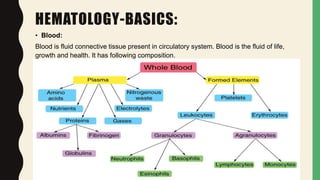
Blood is fluid connective tissue present in circulatory system. Blood is the fluid of life,
growth and health. It has following composition.
HEMATOLOGICAL EXAMINATION:
• Significance:
• Hematology testing represents an important role of the veterinarian
to provide accurate and reliable clinical laboratory test results.
• A complete hematology profile is indicated for diagnostic evaluation
of
 disease state,
 animal screening
 Blood transfusions’ success
 Measuring tool for efficacy of therapeutics used
 a screening tool before surgery or further diagnostic procedures.
• It includes the peripheral blood smear and Complete Blood Count
(CBC), which is further split into:
 Erythrocyte and leucocyte (Whole and differential) counts
 Hemoglobin concentrations
 Packed cell volume (PCV) and TS
 Differential Leucocyte Count (white blood film examination)
 Calculation of absolute values/erythrocyte indices
1. ERYTHROCYTE, LEUCOCYTE
EVALUATION:
• Indications:
• Tachycardia
• Fatigue
• Shortness of breath
• Un explained jaundice
• Pallor conjunctiva or mucous membranes
• Glossitis, gingivitis, stomatitis, hematemesis, hematochezia,
and many more
• Protocol of Manual RBC, WBC Count:
• Neubauer’s chamber is used for both types of counts.
Diluting fluid however is mostly isotonic saline solution or
Hayem’s solution for RBC counting and Turk’s fluid for WBC
counting.
• RBC Counting Area
The large center square is used for RBC counts. As already
stated, this area is subdivided into 25 medium squares,
which in turn are each divided into 16 squares. Of the 25
medium sqaures, only the four corner squares and the
center square within the large center square are used to
perform RBC counts.
• WBC Counting Area
The four large squares placed at the corners are used for white
blood cell count. Since their concentration is lower than red
blood cells a larger area is required to perform the cell count.
• Platelet Counting Area
The large center square is used to count platelets. Platelets in
all 25 squares within the large center square are counted.
• Calculations.
Inferences:
• RBC Disorders:
1. Polycythemia
2. Anemia
3. Erythrocytoses
4. Abnormal RBCs
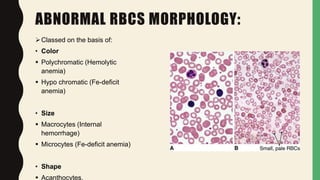
ABNORMAL RBCS MORPHOLOGY:
Classed on the basis of:
• Color
 Polychromatic (Hemolytic
anemia)
 Hypo chromatic (Fe-deficit
anemia)
• Size
 Macrocytes (Internal
hemorrhage)
 Microcytes (Fe-deficit anemia)
• Shape
 Acanthocytes,
CONTI.
• Structures on/in RBCs
 Basophilic stippling, nucleated RBCs
 Infectious agents
• Arrangement of cells on blood films
 Rouleaux formation
 Agglutination
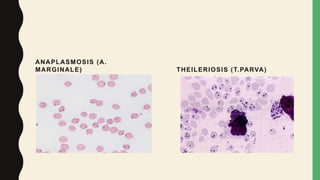
• Infectious agents in RBCs
• Babesia,Theileria, Anaplasma, Distemper
inclusions, Haemobartonella species,
Bartonella species, etc.
HCT/PCV AND TS (TOTAL SOLIDS):
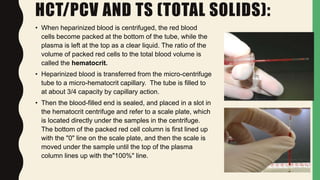
• When heparinized blood is centrifuged, the red blood
cells become packed at the bottom of the tube, while the
plasma is left at the top as a clear liquid. The ratio of the
volume of packed red cells to the total blood volume is
called the hematocrit.
• Heparinized blood is transferred from the micro-centrifuge
tube to a micro-hematocrit capillary. The tube is filled to
at about 3/4 capacity by capillary action.
• Then the blood-filled end is sealed, and placed in a slot in
the hematocrit centrifuge and refer to a scale plate, which
is located directly under the samples in the centrifuge.
The bottom of the packed red cell column is first lined up
with the "0" line on the scale plate, and then the scale is
moved under the sample until the top of the plasma
column lines up with the"100%" line.
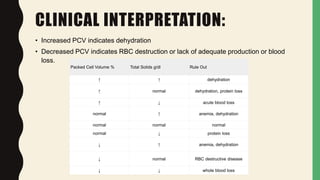
CLINICAL INTERPRETATION:
• Increased PCV indicates dehydration
• Decreased PCV indicates RBC destruction or lack of adequate production or blood
loss.
Packed Cell Volume % Total Solids g/dl Rule Out
↑ ↑ dehydration
↑ normal dehydration, protein loss
↑ ↓ acute blood loss
normal ↑ anemia, dehydration
normal normal normal
normal ↓ protein loss
↓ ↑ anemia, dehydration
↓ normal RBC destructive disease
↓ ↓ whole blood loss
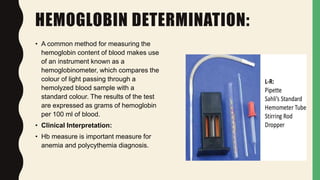
HEMOGLOBIN DETERMINATION:
• A common method for measuring the
hemoglobin content of blood makes use
of an instrument known as a
hemoglobinometer, which compares the
colour of light passing through a
hemolyzed blood sample with a
standard colour. The results of the test
are expressed as grams of hemoglobin
per 100 ml of blood.
• Clinical Interpretation:
• Hb measure is important measure for
anemia and polycythemia diagnosis.
BLOOD CELL INDICES (MCV, MCH,MCHC)
• Diagnosis of the type of anemia may be assisted by relating the measurements of red
blood cell count, hematocrit and hemoglobin to derive the mean corpuscular volume
(MCV= Average volume of RBCs), the Hemoglobin amount per red blood cell
(MCH) and the amount of hemoglobin relative to the size of the cell, per red blood cell-
the mean corpuscular hemoglobin concentration (MCHC).
• Erythrocytes that have a normal size or volume (normal MCV) are called normocytic,
• When the MCV is high, they are called macrocytic.
• When the MCV is low, they are termed microcytic.
• Erythrocytes containing the normal amount of hemoglobin (normal MCHC) are called
normochromic.
• When the MCHC is abnormally low they are called hypochromic, and when the MCHC
is abnormally high, hyperchromic. Hyperchromic cases are very rare.
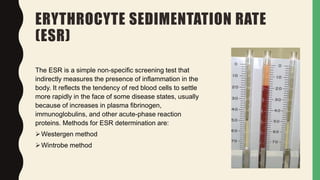
ERYTHROCYTE SEDIMENTATION RATE
(ESR)
The ESR is a simple non-specific screening test that
indirectly measures the presence of inflammation in the
body. It reflects the tendency of red blood cells to settle
more rapidly in the face of some disease states, usually
because of increases in plasma fibrinogen,
immunoglobulins, and other acute-phase reaction
proteins. Methods for ESR determination are:
Westergen method
Wintrobe method
CONTI.
• Some interferences which increase ESR:
• increased level of fibrinogen, gamma globulins.
• technical factors: tilted ESR tube, high room temperature.
• Some interferences which decrease ESR:
• abnormally shaped RBC (sickle cells, spherocytosis).
• technical factors: short ESR tubes, low room temperature, delay in test performance
(>2 hours), clotted blood sample, excess anticoagulant, bubbles in tube.
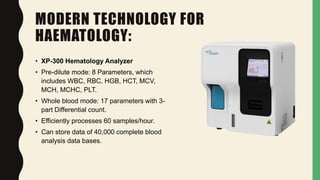
MODERN TECHNOLOGY FOR
HAEMATOLOGY:
• XP-300 Hematology Analyzer
• Pre-dilute mode: 8 Parameters, which
includes WBC, RBC, HGB, HCT, MCV,
MCH, MCHC, PLT.
• Whole blood mode: 17 parameters with 3-
part Differential count.
• Efficiently processes 60 samples/hour.
• Can store data of 40,000 complete blood
analysis data bases.
WBC COUNT (TOTAL AND DIFFERENTIAL):
• The procedure for total white cell count
proceeds in exactly the same manner as
that described for red cell count except for
a different dilution factor (1:20 dilution) and
composition of the dilution fluid. The
diluent contains an agent (glacial acetic
acid) which lyses the red cells, allowing a
proper count of white cells.
• Neutrophils (60%), eosinophils and
basophils are described collectively as
granulocytes. They are distinguished by
the nature of the granules in their
cytoplasm, and generally have small,
multi-lobed nuclei. The 2 other types of
white cells are lymphocytes (30%) and
monocytes and are described collectively
as agranulocytes. Deviations of different
white cell counts from the normal values
often indicate a diseased state.
CLINICAL INTERPRETATION:
• Leucocytosis has following types:
• Neutrophilia (high neutrophil count) often signals localized infections e.g.
• inflammation, bacterial infection, acute stress, steroid effects, etc.
• Eosinophilia (high eosinophil count) may indicate allergic and hypersensitivity
conditions or invasion by parasites.
• Lymphocytosis (high lymphocyte count) may be seen in some viral infections.
• Monocytosis seen in some bacterial infections (pyogranulomatous lesions),
hemolysis, hemorrhage.
• Basophilia usually accompanied by eosinophilia. Seen in allergic reactions, drug
incompatibility reactions, neoplasms and post operative complication of
spleenactamy.
CLINICAL INTERPRETATION:
• Leucopenia includes:
• Neutropenia (low neutrophil count) occurs in typhoid fever, or infectious hepatitis,
Eosinopenia (low eosinophil count) may be produced by an elevated secretion of
corticosteroids (in states of stress).
• Basopenia and Monocytopenia have rare clinical manifestations as well as
diagnosis.
• Leukemia is a disease characterized by the progressive overproduction of WBCs
which usually appear in the circulating blood in an immature form.
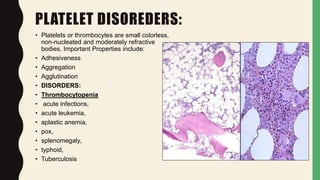
PLATELET DISOREDERS:
• Platelets or thrombocytes are small colorless,
non-nucleated and moderately refractive
bodies. Important Properties include:
• Adhesiveness
• Aggregation
• Agglutination
• DISORDERS:
• Thrombocytopenia
• acute infections,
• acute leukemia,
• aplastic anemia,
• pox,
• splenomegaly,
• typhoid,
• Tuberculosis
• Thrombocytosis-
• allergic conditions,
• hemorrhage,
• bone fracture,
• surgical operations,
• trauma.
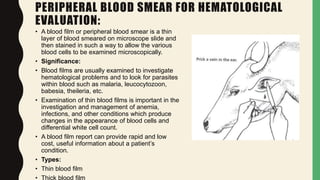
PERIPHERAL BLOOD SMEAR FOR HEMATOLOGICAL
EVALUATION:
• A blood film or peripheral blood smear is a thin
layer of blood smeared on microscope slide and
then stained in such a way to allow the various
blood cells to be examined microscopically.
• Significance:
• Blood films are usually examined to investigate
hematological problems and to look for parasites
within blood such as malaria, leucocytozoon,
babesia, theileria, etc.
• Examination of thin blood films is important in the
investigation and management of anemia,
infections, and other conditions which produce
changes in the appearance of blood cells and
differential white cell count.
• A blood film report can provide rapid and low
cost, useful information about a patient’s
condition.
• Types:
• Thin blood film
• Thick blood film
TPBF (CONTINUED)
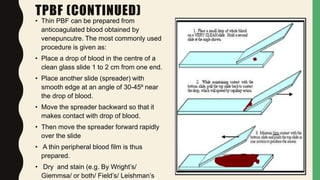
• Thin PBF can be prepared from
anticoagulated blood obtained by
venepuncutre. The most commonly used
procedure is given as:
• Place a drop of blood in the centre of a
clean glass slide 1 to 2 cm from one end.
• Place another slide (spreader) with
smooth edge at an angle of 30-45⁰ near
the drop of blood.
• Move the spreader backward so that it
makes contact with drop of blood.
• Then move the spreader forward rapidly
over the slide
• A thin peripheral blood film is thus
prepared.
• Dry and stain (e.g. By Wright’s/
Giemmsa/ or both/ Field’s/ Leishman’s
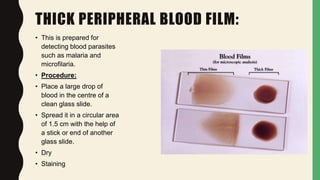
THICK PERIPHERAL BLOOD FILM:
• This is prepared for
detecting blood parasites
such as malaria and
microfilaria.
• Procedure:
• Place a large drop of
blood in the centre of a
clean glass slide.
• Spread it in a circular area
of 1.5 cm with the help of
a stick or end of another
glass slide.
• Dry
• Staining
FIELD APPLICATIONS OF BLOOD
SMEARS-HAEMOPARASITES:
TRYPANOSOMIASIS (T.
EQUIPERDUM) BABESIOSIS (B. CANIS) OF
DOGS
ANAPLASMOSIS (A.
MARGINALE) THEILERIOSIS (T.PARVA)
HAEMOPROTEUS IN BIRDS LEUCOCYTOZOON IN AVES
OTHER EXAMPLES OF USE OF BLOOD
SMEAR:
HYPOCHROMIC MICROCYTIC
ANEMIA LEUKEMIA
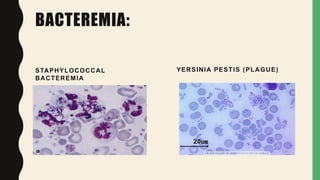
BACTEREMIA:
STAPHYLOCOCCAL
BACTEREMIA
YERSINIA PESTIS (PLAGUE)
REFERENCES:
• Guyton and Hall, textbook of veterinary physiology, 11th edition.
• K. sembulingam, Essentials of medical physiology, 3rd edition.
• Letimerr’s textbook of clinical pathology
• Veterinary Clinical Pathology by Ahrar Khan
• www. medicine.ca/physio/vlab/bloodlab/diff_count.html
• bloodjournal.org

Hematological. exam

  • 1.
    HEMATOLOGICAL EXAMINATIONP R ES E N T E D B Y: T E A N Z A H E E R
  • 2.
    HEMATOLOGY-BASICS: • Blood: Blood isfluid connective tissue present in circulatory system. Blood is the fluid of life, growth and health. It has following composition.
  • 3.
    HEMATOLOGICAL EXAMINATION: • Significance: •Hematology testing represents an important role of the veterinarian to provide accurate and reliable clinical laboratory test results. • A complete hematology profile is indicated for diagnostic evaluation of  disease state,  animal screening  Blood transfusions’ success  Measuring tool for efficacy of therapeutics used  a screening tool before surgery or further diagnostic procedures. • It includes the peripheral blood smear and Complete Blood Count (CBC), which is further split into:  Erythrocyte and leucocyte (Whole and differential) counts  Hemoglobin concentrations  Packed cell volume (PCV) and TS  Differential Leucocyte Count (white blood film examination)  Calculation of absolute values/erythrocyte indices
  • 4.
    1. ERYTHROCYTE, LEUCOCYTE EVALUATION: •Indications: • Tachycardia • Fatigue • Shortness of breath • Un explained jaundice • Pallor conjunctiva or mucous membranes • Glossitis, gingivitis, stomatitis, hematemesis, hematochezia, and many more • Protocol of Manual RBC, WBC Count: • Neubauer’s chamber is used for both types of counts. Diluting fluid however is mostly isotonic saline solution or Hayem’s solution for RBC counting and Turk’s fluid for WBC counting. • RBC Counting Area The large center square is used for RBC counts. As already stated, this area is subdivided into 25 medium squares, which in turn are each divided into 16 squares. Of the 25 medium sqaures, only the four corner squares and the center square within the large center square are used to perform RBC counts.
  • 5.
    • WBC CountingArea The four large squares placed at the corners are used for white blood cell count. Since their concentration is lower than red blood cells a larger area is required to perform the cell count. • Platelet Counting Area The large center square is used to count platelets. Platelets in all 25 squares within the large center square are counted. • Calculations. Inferences: • RBC Disorders: 1. Polycythemia 2. Anemia 3. Erythrocytoses 4. Abnormal RBCs
  • 6.
    ABNORMAL RBCS MORPHOLOGY: Classedon the basis of: • Color  Polychromatic (Hemolytic anemia)  Hypo chromatic (Fe-deficit anemia) • Size  Macrocytes (Internal hemorrhage)  Microcytes (Fe-deficit anemia) • Shape  Acanthocytes,
  • 7.
    CONTI. • Structures on/inRBCs  Basophilic stippling, nucleated RBCs  Infectious agents • Arrangement of cells on blood films  Rouleaux formation  Agglutination • Infectious agents in RBCs • Babesia,Theileria, Anaplasma, Distemper inclusions, Haemobartonella species, Bartonella species, etc.
  • 8.
    HCT/PCV AND TS(TOTAL SOLIDS): • When heparinized blood is centrifuged, the red blood cells become packed at the bottom of the tube, while the plasma is left at the top as a clear liquid. The ratio of the volume of packed red cells to the total blood volume is called the hematocrit. • Heparinized blood is transferred from the micro-centrifuge tube to a micro-hematocrit capillary. The tube is filled to at about 3/4 capacity by capillary action. • Then the blood-filled end is sealed, and placed in a slot in the hematocrit centrifuge and refer to a scale plate, which is located directly under the samples in the centrifuge. The bottom of the packed red cell column is first lined up with the "0" line on the scale plate, and then the scale is moved under the sample until the top of the plasma column lines up with the"100%" line.
  • 9.
    CLINICAL INTERPRETATION: • IncreasedPCV indicates dehydration • Decreased PCV indicates RBC destruction or lack of adequate production or blood loss. Packed Cell Volume % Total Solids g/dl Rule Out ↑ ↑ dehydration ↑ normal dehydration, protein loss ↑ ↓ acute blood loss normal ↑ anemia, dehydration normal normal normal normal ↓ protein loss ↓ ↑ anemia, dehydration ↓ normal RBC destructive disease ↓ ↓ whole blood loss
  • 10.
    HEMOGLOBIN DETERMINATION: • Acommon method for measuring the hemoglobin content of blood makes use of an instrument known as a hemoglobinometer, which compares the colour of light passing through a hemolyzed blood sample with a standard colour. The results of the test are expressed as grams of hemoglobin per 100 ml of blood. • Clinical Interpretation: • Hb measure is important measure for anemia and polycythemia diagnosis.
  • 11.
    BLOOD CELL INDICES(MCV, MCH,MCHC) • Diagnosis of the type of anemia may be assisted by relating the measurements of red blood cell count, hematocrit and hemoglobin to derive the mean corpuscular volume (MCV= Average volume of RBCs), the Hemoglobin amount per red blood cell (MCH) and the amount of hemoglobin relative to the size of the cell, per red blood cell- the mean corpuscular hemoglobin concentration (MCHC). • Erythrocytes that have a normal size or volume (normal MCV) are called normocytic, • When the MCV is high, they are called macrocytic. • When the MCV is low, they are termed microcytic. • Erythrocytes containing the normal amount of hemoglobin (normal MCHC) are called normochromic. • When the MCHC is abnormally low they are called hypochromic, and when the MCHC is abnormally high, hyperchromic. Hyperchromic cases are very rare.
  • 12.
    ERYTHROCYTE SEDIMENTATION RATE (ESR) TheESR is a simple non-specific screening test that indirectly measures the presence of inflammation in the body. It reflects the tendency of red blood cells to settle more rapidly in the face of some disease states, usually because of increases in plasma fibrinogen, immunoglobulins, and other acute-phase reaction proteins. Methods for ESR determination are: Westergen method Wintrobe method
  • 13.
    CONTI. • Some interferenceswhich increase ESR: • increased level of fibrinogen, gamma globulins. • technical factors: tilted ESR tube, high room temperature. • Some interferences which decrease ESR: • abnormally shaped RBC (sickle cells, spherocytosis). • technical factors: short ESR tubes, low room temperature, delay in test performance (>2 hours), clotted blood sample, excess anticoagulant, bubbles in tube.
  • 14.
    MODERN TECHNOLOGY FOR HAEMATOLOGY: •XP-300 Hematology Analyzer • Pre-dilute mode: 8 Parameters, which includes WBC, RBC, HGB, HCT, MCV, MCH, MCHC, PLT. • Whole blood mode: 17 parameters with 3- part Differential count. • Efficiently processes 60 samples/hour. • Can store data of 40,000 complete blood analysis data bases.
  • 15.
    WBC COUNT (TOTALAND DIFFERENTIAL): • The procedure for total white cell count proceeds in exactly the same manner as that described for red cell count except for a different dilution factor (1:20 dilution) and composition of the dilution fluid. The diluent contains an agent (glacial acetic acid) which lyses the red cells, allowing a proper count of white cells. • Neutrophils (60%), eosinophils and basophils are described collectively as granulocytes. They are distinguished by the nature of the granules in their cytoplasm, and generally have small, multi-lobed nuclei. The 2 other types of white cells are lymphocytes (30%) and monocytes and are described collectively as agranulocytes. Deviations of different white cell counts from the normal values often indicate a diseased state.
  • 16.
    CLINICAL INTERPRETATION: • Leucocytosishas following types: • Neutrophilia (high neutrophil count) often signals localized infections e.g. • inflammation, bacterial infection, acute stress, steroid effects, etc. • Eosinophilia (high eosinophil count) may indicate allergic and hypersensitivity conditions or invasion by parasites. • Lymphocytosis (high lymphocyte count) may be seen in some viral infections. • Monocytosis seen in some bacterial infections (pyogranulomatous lesions), hemolysis, hemorrhage. • Basophilia usually accompanied by eosinophilia. Seen in allergic reactions, drug incompatibility reactions, neoplasms and post operative complication of spleenactamy.
  • 17.
    CLINICAL INTERPRETATION: • Leucopeniaincludes: • Neutropenia (low neutrophil count) occurs in typhoid fever, or infectious hepatitis, Eosinopenia (low eosinophil count) may be produced by an elevated secretion of corticosteroids (in states of stress). • Basopenia and Monocytopenia have rare clinical manifestations as well as diagnosis. • Leukemia is a disease characterized by the progressive overproduction of WBCs which usually appear in the circulating blood in an immature form.
  • 18.
    PLATELET DISOREDERS: • Plateletsor thrombocytes are small colorless, non-nucleated and moderately refractive bodies. Important Properties include: • Adhesiveness • Aggregation • Agglutination • DISORDERS: • Thrombocytopenia • acute infections, • acute leukemia, • aplastic anemia, • pox, • splenomegaly, • typhoid, • Tuberculosis
  • 19.
    • Thrombocytosis- • allergicconditions, • hemorrhage, • bone fracture, • surgical operations, • trauma.
  • 20.
    PERIPHERAL BLOOD SMEARFOR HEMATOLOGICAL EVALUATION: • A blood film or peripheral blood smear is a thin layer of blood smeared on microscope slide and then stained in such a way to allow the various blood cells to be examined microscopically. • Significance: • Blood films are usually examined to investigate hematological problems and to look for parasites within blood such as malaria, leucocytozoon, babesia, theileria, etc. • Examination of thin blood films is important in the investigation and management of anemia, infections, and other conditions which produce changes in the appearance of blood cells and differential white cell count. • A blood film report can provide rapid and low cost, useful information about a patient’s condition. • Types: • Thin blood film • Thick blood film
  • 21.
    TPBF (CONTINUED) • ThinPBF can be prepared from anticoagulated blood obtained by venepuncutre. The most commonly used procedure is given as: • Place a drop of blood in the centre of a clean glass slide 1 to 2 cm from one end. • Place another slide (spreader) with smooth edge at an angle of 30-45⁰ near the drop of blood. • Move the spreader backward so that it makes contact with drop of blood. • Then move the spreader forward rapidly over the slide • A thin peripheral blood film is thus prepared. • Dry and stain (e.g. By Wright’s/ Giemmsa/ or both/ Field’s/ Leishman’s
  • 22.
    THICK PERIPHERAL BLOODFILM: • This is prepared for detecting blood parasites such as malaria and microfilaria. • Procedure: • Place a large drop of blood in the centre of a clean glass slide. • Spread it in a circular area of 1.5 cm with the help of a stick or end of another glass slide. • Dry • Staining
  • 23.
    FIELD APPLICATIONS OFBLOOD SMEARS-HAEMOPARASITES: TRYPANOSOMIASIS (T. EQUIPERDUM) BABESIOSIS (B. CANIS) OF DOGS
  • 24.
  • 25.
    HAEMOPROTEUS IN BIRDSLEUCOCYTOZOON IN AVES
  • 26.
    OTHER EXAMPLES OFUSE OF BLOOD SMEAR: HYPOCHROMIC MICROCYTIC ANEMIA LEUKEMIA
  • 27.
  • 28.
    REFERENCES: • Guyton andHall, textbook of veterinary physiology, 11th edition. • K. sembulingam, Essentials of medical physiology, 3rd edition. • Letimerr’s textbook of clinical pathology • Veterinary Clinical Pathology by Ahrar Khan • www. medicine.ca/physio/vlab/bloodlab/diff_count.html • bloodjournal.org