EE-646
Lecture-9
Fuzzy Implications
Introduction
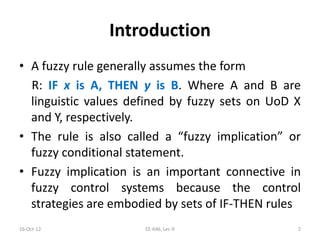
• A fuzzy rule generally assumes the form
R: IF x is A, THEN y is B. Where A and B are
linguistic values defined by fuzzy sets on UoD X
and Y, respectively.
• The rule is also called a “fuzzy implication” or
fuzzy conditional statement.
• Fuzzy implication is an important connective in
fuzzy control systems because the control
strategies are embodied by sets of IF-THEN rules
16-Oct-12 EE-646, Lec-9 2
Contd...
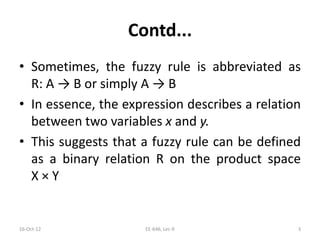
• Sometimes, the fuzzy rule is abbreviated as
R: A → B or simply A → B
• In essence, the expression describes a relation
between two variables x and y.
• This suggests that a fuzzy rule can be defined
as a binary relation R on the product space
X × Y
16-Oct-12 EE-646, Lec-9 3
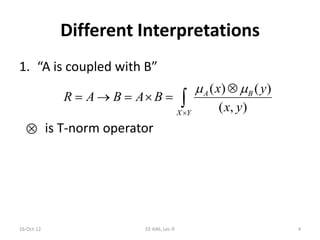
Different Interpretations
1. “A is coupled with B”
is T-norm operator
16-Oct-12 EE-646, Lec-9 4
( ) ( )
( , )
A B
X Y
x y
R A B A B
x y
 


     

Interpretations
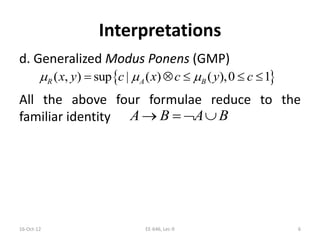
2. “A entails B”→ Four different formulae
a. Material Implication
b. Propositional calculus
c. Extended Propositional calculus
16-Oct-12 EE-646, Lec-9 5
R A B A B    
 R A B A A B     
 R A B A B B     
Interpretations
16-Oct-12 EE-646, Lec-9 6
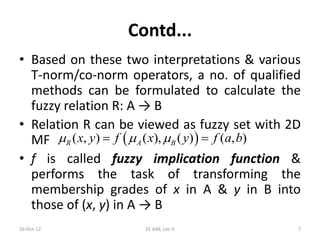
d. Generalized Modus Ponens (GMP)
All the above four formulae reduce to the
familiar identity
 ( , ) sup | ( ) ( ),0 1R A Bx y c x c y c      
A B A B   
Contd...
• Based on these two interpretations & various
T-norm/co-norm operators, a no. of qualified
methods can be formulated to calculate the
fuzzy relation R: A → B
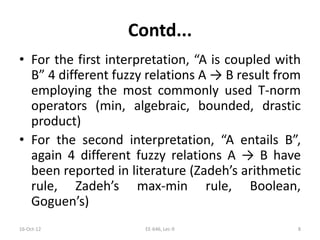
• Relation R can be viewed as fuzzy set with 2D
MF
• f is called fuzzy implication function &
performs the task of transforming the
membership grades of x in A & y in B into
those of (x, y) in A → B
16-Oct-12 EE-646, Lec-9 7
 ( , ) ( ), ( ) ( , )R A Bx y f x y f a b   
Contd...
• For the first interpretation, “A is coupled with
B” 4 different fuzzy relations A → B result from
employing the most commonly used T-norm
operators (min, algebraic, bounded, drastic
product)
• For the second interpretation, “A entails B”,
again 4 different fuzzy relations A → B have
been reported in literature (Zadeh’s arithmetic
rule, Zadeh’s max-min rule, Boolean,
Goguen’s)
16-Oct-12 EE-646, Lec-9 8
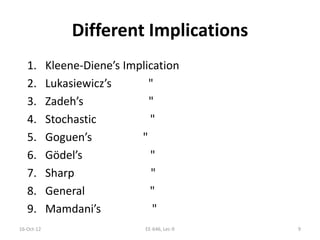
Different Implications
1. Kleene-Diene’s Implication
2. Lukasiewicz’s "
3. Zadeh’s "
4. Stochastic "
5. Goguen’s "
6. Gödel’s "
7. Sharp "
8. General "
9. Mamdani’s "
16-Oct-12 9EE-646, Lec-9
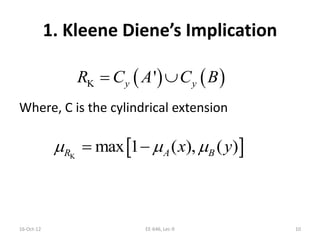
1. Kleene Diene’s Implication
Where, C is the cylindrical extension
16-Oct-12 EE-646, Lec-9 10
   K 'y yR C A C B 
 K
max 1 ( ), ( )R A Bx y   
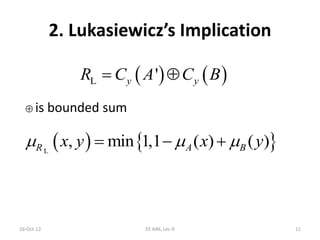
2. Lukasiewicz’s Implication
is bounded sum
16-Oct-12 EE-646, Lec-9 11
   L 'y yR C A C B 

   L
, min 1,1 ( ) ( )R A Bx y x y    
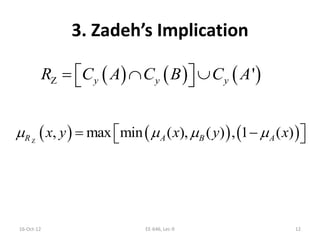
3. Zadeh’s Implication
16-Oct-12 EE-646, Lec-9 12
     Z 'y y yR C A C B C A    
     Z
, max min ( ), ( ) , 1 ( )R A B Ax y x y x      
4. Stochastic Implication
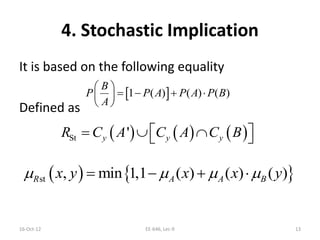
It is based on the following equality
Defined as
16-Oct-12 EE-646, Lec-9 13
 1 ( ) ( ) ( )
B
P P A P A P B
A
 
    
 
     St 'y y yR C A C A C B    
   st , min 1,1 ( ) ( ) ( )R A A Bx y x x y      
5. Goguen’s Implication
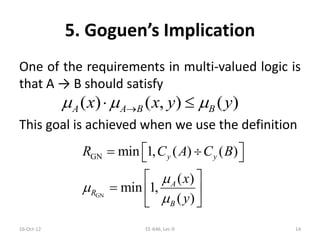
One of the requirements in multi-valued logic is
that A → B should satisfy
This goal is achieved when we use the definition
16-Oct-12 EE-646, Lec-9 14
( ) ( , ) ( )A A B Bx x y y   
GN
GN min 1, ( ) ( )
( )
min 1,
( )
y y
A
R
B
R C A C B
x
y



   
 
  
 
6. Gödel’s Implication
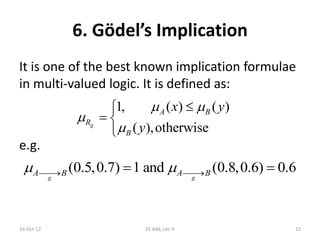
It is one of the best known implication formulae
in multi-valued logic. It is defined as:
e.g.
16-Oct-12 EE-646, Lec-9 15
1, ( ) ( )
( ),otherwiseg
A B
R
B
x y
y
 



 

(0.5,0.7) 1 and (0.8,0.6) 0.6
g g
A B A B   
6. Gödel’s Implication...contd
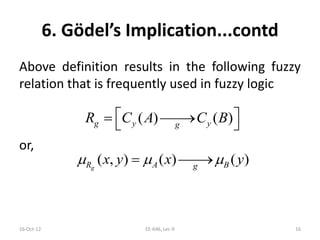
Above definition results in the following fuzzy
relation that is frequently used in fuzzy logic
or,
16-Oct-12 EE-646, Lec-9 16
( ) ( )g y yg
R C A C B   
( , ) ( ) ( )gR A Bg
x y x y   
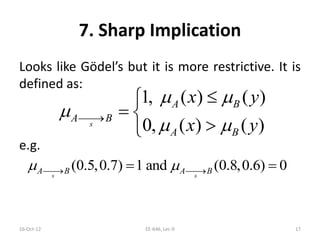
7. Sharp Implication
Looks like Gödel’s but it is more restrictive. It is
defined as:
e.g.
16-Oct-12 EE-646, Lec-9 17
1, ( ) ( )
0, ( ) ( )s
A B
A B
A B
x y
x y
 

 

 

(0.5,0.7) 1 and (0.8,0.6) 0
s s
A B A B   
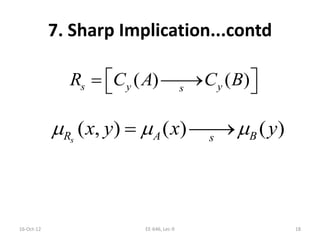
7. Sharp Implication...contd
16-Oct-12 EE-646, Lec-9 18
( ) ( )s y ys
R C A C B   
( , ) ( ) ( )sR A Bs
x y x y   
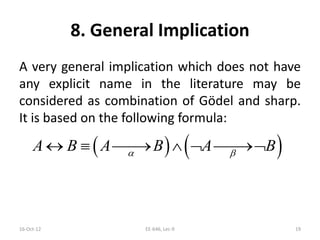
8. General Implication
A very general implication which does not have
any explicit name in the literature may be
considered as combination of Gödel and sharp.
It is based on the following formula:
16-Oct-12 EE-646, Lec-9 19
   A B A B A B 
     
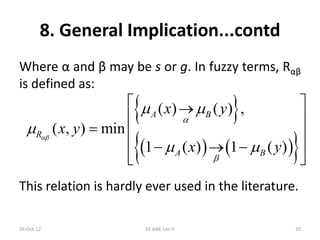
8. General Implication...contd
Where α and β may be s or g. In fuzzy terms, Rαβ
is defined as:
This relation is hardly ever used in the literature.
16-Oct-12 EE-646, Lec-9 20
 
    
( ) ( ) ,
( , ) min
1 ( ) 1 ( )
A B
R
A B
x y
x y
x y



 

 
 
 
  
   
 
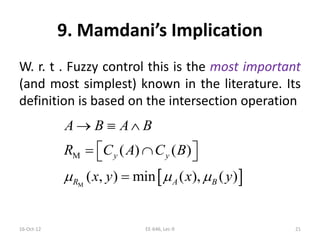
9. Mamdani’s Implication
W. r. t . Fuzzy control this is the most important
(and most simplest) known in the literature. Its
definition is based on the intersection operation
16-Oct-12 EE-646, Lec-9 21
 M
M ( ) ( )
( , ) min ( ), ( )
y y
R A B
A B A B
R C A C B
x y x y  
  
   

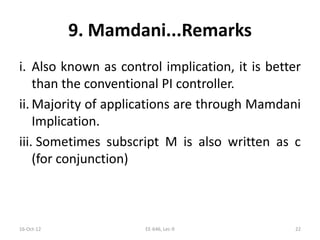
9. Mamdani...Remarks
i. Also known as control implication, it is better
than the conventional PI controller.
ii. Majority of applications are through Mamdani
Implication.
iii. Sometimes subscript M is also written as c
(for conjunction)
16-Oct-12 EE-646, Lec-9 22
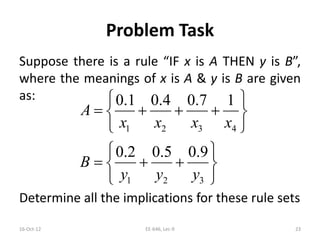
Problem Task
Suppose there is a rule “IF x is A THEN y is B”,
where the meanings of x is A & y is B are given
as:
Determine all the implications for these rule sets
16-Oct-12 EE-646, Lec-9 23
1 2 3 4
1 2 3
0.1 0.4 0.7 1
0.2 0.5 0.9
A
x x x x
B
y y y
 
    
 
 
   
 
Further Reading
1. Jang et. al., “Neuro-Fuzzy & Soft Computing”,
PHI, 1997.
2. Driankov, D. et. al., “An Introduction to Fuzzy
Control”, Narosa, 2001.
3. Mamdani, E. H., “Application of Fuzzy
Algorithm for Control of Simple Dynamic
System”, Proc. IEEE, 121(12), 1974.
16-Oct-12 EE-646, Lec-9 24

L9 fuzzy implications

  • 1.
  • 2.
    Introduction • A fuzzyrule generally assumes the form R: IF x is A, THEN y is B. Where A and B are linguistic values defined by fuzzy sets on UoD X and Y, respectively. • The rule is also called a “fuzzy implication” or fuzzy conditional statement. • Fuzzy implication is an important connective in fuzzy control systems because the control strategies are embodied by sets of IF-THEN rules 16-Oct-12 EE-646, Lec-9 2
  • 3.
    Contd... • Sometimes, thefuzzy rule is abbreviated as R: A → B or simply A → B • In essence, the expression describes a relation between two variables x and y. • This suggests that a fuzzy rule can be defined as a binary relation R on the product space X × Y 16-Oct-12 EE-646, Lec-9 3
  • 4.
    Different Interpretations 1. “Ais coupled with B” is T-norm operator 16-Oct-12 EE-646, Lec-9 4 ( ) ( ) ( , ) A B X Y x y R A B A B x y           
  • 5.
    Interpretations 2. “A entailsB”→ Four different formulae a. Material Implication b. Propositional calculus c. Extended Propositional calculus 16-Oct-12 EE-646, Lec-9 5 R A B A B      R A B A A B       R A B A B B     
  • 6.
    Interpretations 16-Oct-12 EE-646, Lec-96 d. Generalized Modus Ponens (GMP) All the above four formulae reduce to the familiar identity  ( , ) sup | ( ) ( ),0 1R A Bx y c x c y c       A B A B   
  • 7.
    Contd... • Based onthese two interpretations & various T-norm/co-norm operators, a no. of qualified methods can be formulated to calculate the fuzzy relation R: A → B • Relation R can be viewed as fuzzy set with 2D MF • f is called fuzzy implication function & performs the task of transforming the membership grades of x in A & y in B into those of (x, y) in A → B 16-Oct-12 EE-646, Lec-9 7  ( , ) ( ), ( ) ( , )R A Bx y f x y f a b   
  • 8.
    Contd... • For thefirst interpretation, “A is coupled with B” 4 different fuzzy relations A → B result from employing the most commonly used T-norm operators (min, algebraic, bounded, drastic product) • For the second interpretation, “A entails B”, again 4 different fuzzy relations A → B have been reported in literature (Zadeh’s arithmetic rule, Zadeh’s max-min rule, Boolean, Goguen’s) 16-Oct-12 EE-646, Lec-9 8
  • 9.
    Different Implications 1. Kleene-Diene’sImplication 2. Lukasiewicz’s " 3. Zadeh’s " 4. Stochastic " 5. Goguen’s " 6. Gödel’s " 7. Sharp " 8. General " 9. Mamdani’s " 16-Oct-12 9EE-646, Lec-9
  • 10.
    1. Kleene Diene’sImplication Where, C is the cylindrical extension 16-Oct-12 EE-646, Lec-9 10    K 'y yR C A C B   K max 1 ( ), ( )R A Bx y   
  • 11.
    2. Lukasiewicz’s Implication isbounded sum 16-Oct-12 EE-646, Lec-9 11    L 'y yR C A C B      L , min 1,1 ( ) ( )R A Bx y x y    
  • 12.
    3. Zadeh’s Implication 16-Oct-12EE-646, Lec-9 12      Z 'y y yR C A C B C A          Z , max min ( ), ( ) , 1 ( )R A B Ax y x y x      
  • 13.
    4. Stochastic Implication Itis based on the following equality Defined as 16-Oct-12 EE-646, Lec-9 13  1 ( ) ( ) ( ) B P P A P A P B A               St 'y y yR C A C A C B        st , min 1,1 ( ) ( ) ( )R A A Bx y x x y      
  • 14.
    5. Goguen’s Implication Oneof the requirements in multi-valued logic is that A → B should satisfy This goal is achieved when we use the definition 16-Oct-12 EE-646, Lec-9 14 ( ) ( , ) ( )A A B Bx x y y    GN GN min 1, ( ) ( ) ( ) min 1, ( ) y y A R B R C A C B x y              
  • 15.
    6. Gödel’s Implication Itis one of the best known implication formulae in multi-valued logic. It is defined as: e.g. 16-Oct-12 EE-646, Lec-9 15 1, ( ) ( ) ( ),otherwiseg A B R B x y y         (0.5,0.7) 1 and (0.8,0.6) 0.6 g g A B A B   
  • 16.
    6. Gödel’s Implication...contd Abovedefinition results in the following fuzzy relation that is frequently used in fuzzy logic or, 16-Oct-12 EE-646, Lec-9 16 ( ) ( )g y yg R C A C B    ( , ) ( ) ( )gR A Bg x y x y   
  • 17.
    7. Sharp Implication Lookslike Gödel’s but it is more restrictive. It is defined as: e.g. 16-Oct-12 EE-646, Lec-9 17 1, ( ) ( ) 0, ( ) ( )s A B A B A B x y x y          (0.5,0.7) 1 and (0.8,0.6) 0 s s A B A B   
  • 18.
    7. Sharp Implication...contd 16-Oct-12EE-646, Lec-9 18 ( ) ( )s y ys R C A C B    ( , ) ( ) ( )sR A Bs x y x y   
  • 19.
    8. General Implication Avery general implication which does not have any explicit name in the literature may be considered as combination of Gödel and sharp. It is based on the following formula: 16-Oct-12 EE-646, Lec-9 19    A B A B A B       
  • 20.
    8. General Implication...contd Whereα and β may be s or g. In fuzzy terms, Rαβ is defined as: This relation is hardly ever used in the literature. 16-Oct-12 EE-646, Lec-9 20        ( ) ( ) , ( , ) min 1 ( ) 1 ( ) A B R A B x y x y x y                     
  • 21.
    9. Mamdani’s Implication W.r. t . Fuzzy control this is the most important (and most simplest) known in the literature. Its definition is based on the intersection operation 16-Oct-12 EE-646, Lec-9 21  M M ( ) ( ) ( , ) min ( ), ( ) y y R A B A B A B R C A C B x y x y          
  • 22.
    9. Mamdani...Remarks i. Alsoknown as control implication, it is better than the conventional PI controller. ii. Majority of applications are through Mamdani Implication. iii. Sometimes subscript M is also written as c (for conjunction) 16-Oct-12 EE-646, Lec-9 22
  • 23.
    Problem Task Suppose thereis a rule “IF x is A THEN y is B”, where the meanings of x is A & y is B are given as: Determine all the implications for these rule sets 16-Oct-12 EE-646, Lec-9 23 1 2 3 4 1 2 3 0.1 0.4 0.7 1 0.2 0.5 0.9 A x x x x B y y y                 
  • 24.
    Further Reading 1. Janget. al., “Neuro-Fuzzy & Soft Computing”, PHI, 1997. 2. Driankov, D. et. al., “An Introduction to Fuzzy Control”, Narosa, 2001. 3. Mamdani, E. H., “Application of Fuzzy Algorithm for Control of Simple Dynamic System”, Proc. IEEE, 121(12), 1974. 16-Oct-12 EE-646, Lec-9 24