Fuzzy Logic
Dr. Umang Soni
Classical Logic
2
 Invented by ancient Greeks,
 used by mathematicians
In this logic
 Every statement is either TRUE or FALSE
 Statements can be combined with the logical connections:
AND and OR
 A statement can be modified with NOT
 Truth tables are used to evaluate the truth value of a complicated
statement (i.e., TRUEness or FALSEness)
 Logical IF–THEN statements are used to express “THEOREMS”
BRIEF HISTORY
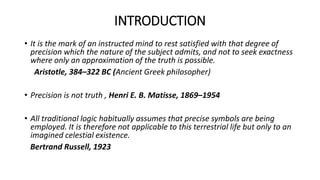
Aristotle
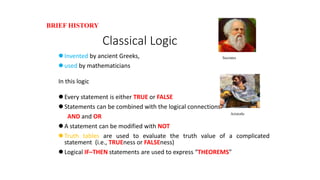
Socrates
INTRODUCTION
• It is the mark of an instructed mind to rest satisfied with that degree of
precision which the nature of the subject admits, and not to seek exactness
where only an approximation of the truth is possible.
Aristotle, 384–322 BC (Ancient Greek philosopher)
• Precision is not truth , Henri E. B. Matisse, 1869–1954
• All traditional logic habitually assumes that precise symbols are being
employed. It is therefore not applicable to this terrestrial life but only to an
imagined celestial existence.
Bertrand Russell, 1923
• Most engineering texts do not address the uncertainty in the information, models,
and solutions that are conveyed within the problems addressed therein.
• The more complex a system is, the more imprecise or inexact is the information that
we have to characterize that system. It seems, then, that precision, information and
complexity are inextricably related in the problems we pose for eventual solution.
• However, for most of the problems that we face, we can do a better job in accepting
some level of imprecision.
• It seems intuitive that we should balance the degree of precision in a problem with
the associated uncertainty in that problem
Boolean Logic
5
• Based on Classical Logic
• In Boolean logic, we use only two possible values, called by various names,
such as
"true" and "false",
"yes" and "no",
"on" and "off“,
"1" and "0".
 Formulas evaluate truth values
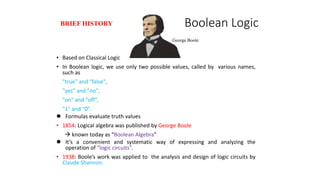
• 1854: Logical algebra was published by George Boole
 known today as “Boolean Algebra”
 It’s a convenient and systematic way of expressing and analyzing the
operation of “logic circuits”.
• 1938: Boole’s work was applied to the analysis and design of logic circuits by
Claude Shannon.
BRIEF HISTORY
George Boole
6
Boolean Logic
In Boolean logic, each element either belongs to or
does not belong to a set.
If an element is a member of a given set, the Boolean
logic will return :
1 (representing complete membership)
0 (representing non-membership)
1
Boolean Logic
If A represents an ordinary crisp set/ Boolean set
Then A ={x | P(x)} indicates that the set A consists of those items
x for which the property P is true.
For example:
“THE BULB GLOWS AT A SUPPLY VOLTAGE OF 220V”
According to this statement the bulb will glow at 220V and not otherwise.
216 218 220 222 224 226
GLOW, 1
NOT GLOW, 0
BOOLEAN REPRESENTATION
8
1
Fuzzy logic
The Statement “Today is sunny” can be
• 100% true if there are no clouds
• 80% true if there are a few clouds
• 50% true if it's hazy and
• 0% true if it rains all day
9
1
Basics of Fuzzy Logic…
The condition “around 220V” cannot be represented by either 1 or 0, although the
human mind can very well comprehend that it refers to voltages little below or
higher than 220V. Thus “ around 220V” is not a binary /crisp condition. i.e. two
distinct states 1 and 0 are not enough to characterize it. So one might be inclined to
say that we require more states or multiple states. But how many states?
214 216 218 220 222 224 226
FUZZY REPRESENTATION
1
0
Now consider the statement “The bulb glows when supply voltage is "around
220V”
According to this statement , the bulb will glow even for voltages lower as well as
higher than 220V.
THE ANSWER LIES WITH FUZZY LOGIC
10
Basics of Fuzzy Logic…
The terms like AROUND, APPROXIMATELY, MORE-OR-LESS,
SLIGHTLY, VERY represent an intuitive feel of expert human and
can be expressed as FUZZY SETS.
FUZZY SET
Fuzzy set is a mathematical measure of ambiguous phenomenon
and a technique for mathematically expressing linguistics
ambiguity.
The phrase” around 220V” can be represented by a set of points.
Each point is a measure of the degree to which the phrase”
around 220V” is true.
11
Basics of Fuzzy Logic…
• The collection of points which determine the curve “AROUND
220V” can be written in the form
• The ∫ and  do not represent the conventional integration or
differentiation signs, but they only denote the collection of
points which form the set F. F is called a fuzzy Set.
• F= AROUND 220V = [0/208, 0.1/210, 0.2/212, 0.4/214,
0.6/216, 0.8/217, 1/220, 0.8/224, 0.6/226, 0.2/230, 0/234]
(x)/x
μ
OR F
(x)/x
μ
F
u
F
u
F 
 

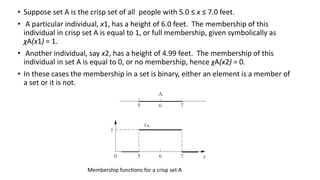
• Suppose set A is the crisp set of all people with 5.0 ≤ x ≤ 7.0 feet.
• A particular individual, x1, has a height of 6.0 feet. The membership of this
individual in crisp set A is equal to 1, or full membership, given symbolically as
χA(x1) = 1.
• Another individual, say x2, has a height of 4.99 feet. The membership of this
individual in set A is equal to 0, or no membership, hence χA(x2) = 0.
• In these cases the membership in a set is binary, either an element is a member of
a set or it is not.
Membership functions for a crisp set A
• The sets on the universe X that can accommodate “degrees of membership”
were termed by Zadeh as fuzzy sets.
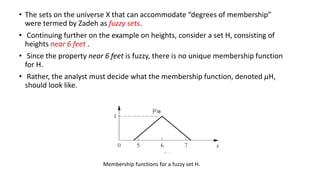
• Continuing further on the example on heights, consider a set H, consisting of
heights near 6 feet .
• Since the property near 6 feet is fuzzy, there is no unique membership function
for H.
• Rather, the analyst must decide what the membership function, denoted μH,
should look like.
Membership functions for a fuzzy set H.
• A key difference between crisp and fuzzy sets is their membership
function; a crisp set has a unique membership function, whereas a
fuzzy set can have an infinite number of membership functions to
represent it.
• For fuzzy sets, the uniqueness is sacrificed, but flexibility is gained
because the membership function can be adjusted to maximize the
utility for a particular application.
Fuzzy Set Operations
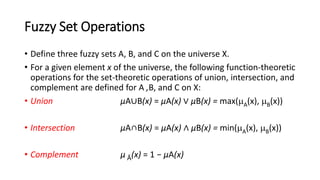
• Define three fuzzy sets A, B, and C on the universe X.
• For a given element x of the universe, the following function-theoretic
operations for the set-theoretic operations of union, intersection, and
complement are defined for A ,B, and C on X:
• Union μA∪B(x) = μA(x) ∨ μB(x) = max(A(x), B(x))
• Intersection μA∩B(x) = μA(x) ∧ μB(x) = min(A(x), B(x))
• Complement μ Ā(x) = 1 − μA(x)
Membership functions
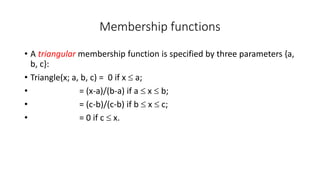
• A triangular membership function is specified by three parameters {a,
b, c}:
• Triangle(x; a, b, c) = 0 if x  a;
• = (x-a)/(b-a) if a  x  b;
• = (c-b)/(c-b) if b  x  c;
• = 0 if c  x.
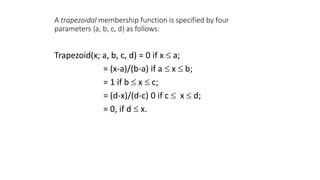
A trapezoidal membership function is specified by four
parameters {a, b, c, d} as follows:
Trapezoid(x; a, b, c, d) = 0 if x  a;
= (x-a)/(b-a) if a  x  b;
= 1 if b  x  c;
= (d-x)/(d-c) 0 if c  x  d;
= 0, if d  x.
A sigmoidal membership function is specified by two
parameters {a, c}:
• Sigmoid(x; a, c) = 1/(1 + exp[-a(x-c)]) where a controls slope at the
crossover point x = c.
• These membership functions are some of the commonly used
membership functions in the fuzzy inference systems.
Fuzzy Rules
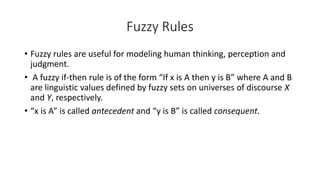
• Fuzzy rules are useful for modeling human thinking, perception and
judgment.
• A fuzzy if-then rule is of the form “If x is A then y is B” where A and B
are linguistic values defined by fuzzy sets on universes of discourse X
and Y, respectively.
• “x is A” is called antecedent and “y is B” is called consequent.
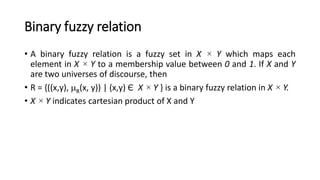
Binary fuzzy relation
• A binary fuzzy relation is a fuzzy set in X × Y which maps each
element in X × Y to a membership value between 0 and 1. If X and Y
are two universes of discourse, then
• R = {((x,y), R(x, y)) | (x,y) Є X × Y } is a binary fuzzy relation in X × Y.
• X × Y indicates cartesian product of X and Y
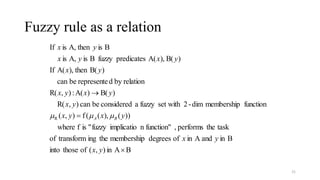
Fuzzy rule as a relation
21
B
A
in
)
,
(
of
those
into
B
in
and
A
in
of
degrees
membership
the
ing
transform
of
task
the
performs
,
function"
n
implicatio
fuzzy
"
is
f
where
)
)
(
),
(
(
f
)
,
(
function
membership
dim
-
2
set with
fuzzy
a
considered
be
can
)
,
R(
)
B(
)
A(
:
)
,
R(
relation
by
d
represente
be
can
)
B(
then
),
A(
If
)
B(
),
A(
predicates
fuzzy
B
is
A,
is
B
is
then
A,
is
If
R



y
x
y
x
y
x
y
x
y
x
y
x
y
x
y
x
y
x
y
x
y
x
B
A 


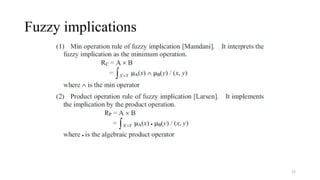
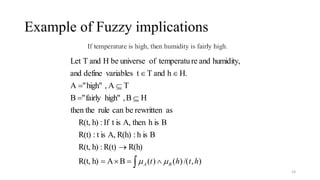
Fuzzy implications
22
Example of Fuzzy implications
23
 










)
,
/(
)
(
)
(
B
A
h)
R(t,
R(h)
R(t)
:
h)
R(t,
B
is
h
:
R(h)
A,
is
t
:
R(t)
B
is
h
then
A,
is
t
If
:
h)
R(t,
as
rewritten
be
can
rule
then the
H
B
,
high"
fairly
"
B
T
A
,
high"
"
A
H.
h
and
T
t
variables
define
and
humidity,
and
re
temperatu
of
universe
be
H
and
T
Let
h
t
h
t B
A 

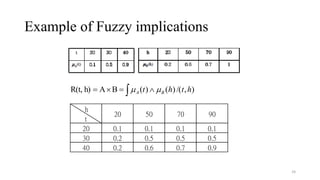
Example of Fuzzy implications
24
 


 )
,
/(
)
(
)
(
B
A
h)
R(t, h
t
h
t B
A 

h
t
20 50 70 90
20 0.1 0.1 0.1 0.1
30 0.2 0.5 0.5 0.5
40 0.2 0.6 0.7 0.9
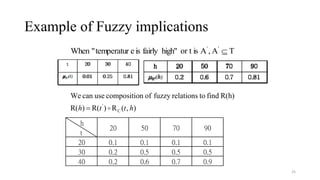
Example of Fuzzy implications
25
T
A
,
A
is
or t
high"
fairly
is
e
temperatur
"
When '
'

)
,
(
R
)
R(
)
R(
R(h)
find
to
relations
fuzzy
of
n
compositio
use
can
We
C
'
h
t
t
h 

h
t
20 50 70 90
20 0.1 0.1 0.1 0.1
30 0.2 0.5 0.5 0.5
40 0.2 0.6 0.7 0.9
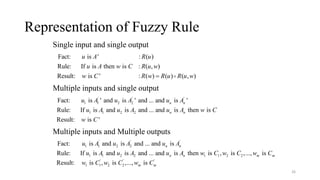
Representation of Fuzzy Rule
26
Fact: is ' : ( )
Rule: If is then is : ( , )
Result: is ' : ( ) ( ) ( , )
u A R u
u A w C R u w
w C R w R u R u w

Single input and single output
' ' '
1 1 2 2
1 1 2 2
Fact: is ' and is ' and ... and is '
Rule: If is and is and ... and is then is
Result: is '
n n
n n
u A u A u A
u A u A u A w C
w C
Multiple inputs and single output
' ' '
1 1 2 2
1 1 2 2 1 1 2 2
Fact: is and is and ... and is
Rule: If is and is and ... and is then is , is ,..., is
Res
n n
n n m m
u A u A u A
u A u A u A w C w C w C
' ' '
1 1 2 2
ult: is , is ,..., is
m m
w C w C w C
Multiple inputs and Multiple outputs
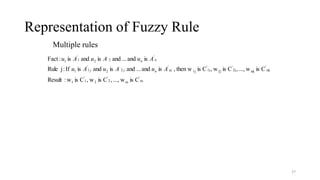
Representation of Fuzzy Rule
27
Multiple rules
m
'
m
2
'
2
1
'
1
mj
'
mj
2j
'
2j
1j
'
1j
2
2
1
1
2
2
1
1
C
is
w
...,
,
C
is
w
,
C
is
w
:
Result
C
is
w
...,
,
C
is
w
,
C
is
then w
,
is
and
...
and
is
and
is
If
:
j
Rule
is
and
...
and
is
and
is
:
Fact
nj
'
n
j
j
'
n
'
n
'
A
u
A
u
A
u
A
u
A
u
A
u
'
'
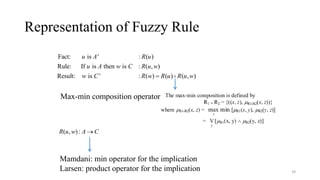
Compositional rule of inference
28
The inference procedure is called as the “compositional rule of inference”. The
inference is determined by two factors : “implication operator” and
“composition operator”.
For the implication, the two operators are often used:
For the composition, the two operators are often used:
Representation of Fuzzy Rule
29
Max-min composition operator
Fact: is ' : ( )
Rule: If is then is : ( , )
Result: is ' : ( ) ( ) ( , )
u A R u
u A w C R u w
w C R w R u R u w

( , ):
R u w A C

Mamdani: min operator for the implication
Larsen: product operator for the implication

Fuzzy.pptx

  • 1.
  • 2.
    Classical Logic 2  Inventedby ancient Greeks,  used by mathematicians In this logic  Every statement is either TRUE or FALSE  Statements can be combined with the logical connections: AND and OR  A statement can be modified with NOT  Truth tables are used to evaluate the truth value of a complicated statement (i.e., TRUEness or FALSEness)  Logical IF–THEN statements are used to express “THEOREMS” BRIEF HISTORY Aristotle Socrates
  • 3.
    INTRODUCTION • It isthe mark of an instructed mind to rest satisfied with that degree of precision which the nature of the subject admits, and not to seek exactness where only an approximation of the truth is possible. Aristotle, 384–322 BC (Ancient Greek philosopher) • Precision is not truth , Henri E. B. Matisse, 1869–1954 • All traditional logic habitually assumes that precise symbols are being employed. It is therefore not applicable to this terrestrial life but only to an imagined celestial existence. Bertrand Russell, 1923
  • 4.
    • Most engineeringtexts do not address the uncertainty in the information, models, and solutions that are conveyed within the problems addressed therein. • The more complex a system is, the more imprecise or inexact is the information that we have to characterize that system. It seems, then, that precision, information and complexity are inextricably related in the problems we pose for eventual solution. • However, for most of the problems that we face, we can do a better job in accepting some level of imprecision. • It seems intuitive that we should balance the degree of precision in a problem with the associated uncertainty in that problem
  • 5.
    Boolean Logic 5 • Basedon Classical Logic • In Boolean logic, we use only two possible values, called by various names, such as "true" and "false", "yes" and "no", "on" and "off“, "1" and "0".  Formulas evaluate truth values • 1854: Logical algebra was published by George Boole  known today as “Boolean Algebra”  It’s a convenient and systematic way of expressing and analyzing the operation of “logic circuits”. • 1938: Boole’s work was applied to the analysis and design of logic circuits by Claude Shannon. BRIEF HISTORY George Boole
  • 6.
    6 Boolean Logic In Booleanlogic, each element either belongs to or does not belong to a set. If an element is a member of a given set, the Boolean logic will return : 1 (representing complete membership) 0 (representing non-membership)
  • 7.
    1 Boolean Logic If Arepresents an ordinary crisp set/ Boolean set Then A ={x | P(x)} indicates that the set A consists of those items x for which the property P is true. For example: “THE BULB GLOWS AT A SUPPLY VOLTAGE OF 220V” According to this statement the bulb will glow at 220V and not otherwise. 216 218 220 222 224 226 GLOW, 1 NOT GLOW, 0 BOOLEAN REPRESENTATION
  • 8.
    8 1 Fuzzy logic The Statement“Today is sunny” can be • 100% true if there are no clouds • 80% true if there are a few clouds • 50% true if it's hazy and • 0% true if it rains all day
  • 9.
    9 1 Basics of FuzzyLogic… The condition “around 220V” cannot be represented by either 1 or 0, although the human mind can very well comprehend that it refers to voltages little below or higher than 220V. Thus “ around 220V” is not a binary /crisp condition. i.e. two distinct states 1 and 0 are not enough to characterize it. So one might be inclined to say that we require more states or multiple states. But how many states? 214 216 218 220 222 224 226 FUZZY REPRESENTATION 1 0 Now consider the statement “The bulb glows when supply voltage is "around 220V” According to this statement , the bulb will glow even for voltages lower as well as higher than 220V. THE ANSWER LIES WITH FUZZY LOGIC
  • 10.
    10 Basics of FuzzyLogic… The terms like AROUND, APPROXIMATELY, MORE-OR-LESS, SLIGHTLY, VERY represent an intuitive feel of expert human and can be expressed as FUZZY SETS. FUZZY SET Fuzzy set is a mathematical measure of ambiguous phenomenon and a technique for mathematically expressing linguistics ambiguity. The phrase” around 220V” can be represented by a set of points. Each point is a measure of the degree to which the phrase” around 220V” is true.
  • 11.
    11 Basics of FuzzyLogic… • The collection of points which determine the curve “AROUND 220V” can be written in the form • The ∫ and  do not represent the conventional integration or differentiation signs, but they only denote the collection of points which form the set F. F is called a fuzzy Set. • F= AROUND 220V = [0/208, 0.1/210, 0.2/212, 0.4/214, 0.6/216, 0.8/217, 1/220, 0.8/224, 0.6/226, 0.2/230, 0/234] (x)/x μ OR F (x)/x μ F u F u F    
  • 12.
    • Suppose setA is the crisp set of all people with 5.0 ≤ x ≤ 7.0 feet. • A particular individual, x1, has a height of 6.0 feet. The membership of this individual in crisp set A is equal to 1, or full membership, given symbolically as χA(x1) = 1. • Another individual, say x2, has a height of 4.99 feet. The membership of this individual in set A is equal to 0, or no membership, hence χA(x2) = 0. • In these cases the membership in a set is binary, either an element is a member of a set or it is not. Membership functions for a crisp set A
  • 13.
    • The setson the universe X that can accommodate “degrees of membership” were termed by Zadeh as fuzzy sets. • Continuing further on the example on heights, consider a set H, consisting of heights near 6 feet . • Since the property near 6 feet is fuzzy, there is no unique membership function for H. • Rather, the analyst must decide what the membership function, denoted μH, should look like. Membership functions for a fuzzy set H.
  • 14.
    • A keydifference between crisp and fuzzy sets is their membership function; a crisp set has a unique membership function, whereas a fuzzy set can have an infinite number of membership functions to represent it. • For fuzzy sets, the uniqueness is sacrificed, but flexibility is gained because the membership function can be adjusted to maximize the utility for a particular application.
  • 15.
    Fuzzy Set Operations •Define three fuzzy sets A, B, and C on the universe X. • For a given element x of the universe, the following function-theoretic operations for the set-theoretic operations of union, intersection, and complement are defined for A ,B, and C on X: • Union μA∪B(x) = μA(x) ∨ μB(x) = max(A(x), B(x)) • Intersection μA∩B(x) = μA(x) ∧ μB(x) = min(A(x), B(x)) • Complement μ Ā(x) = 1 − μA(x)
  • 16.
    Membership functions • Atriangular membership function is specified by three parameters {a, b, c}: • Triangle(x; a, b, c) = 0 if x  a; • = (x-a)/(b-a) if a  x  b; • = (c-b)/(c-b) if b  x  c; • = 0 if c  x.
  • 17.
    A trapezoidal membershipfunction is specified by four parameters {a, b, c, d} as follows: Trapezoid(x; a, b, c, d) = 0 if x  a; = (x-a)/(b-a) if a  x  b; = 1 if b  x  c; = (d-x)/(d-c) 0 if c  x  d; = 0, if d  x.
  • 18.
    A sigmoidal membershipfunction is specified by two parameters {a, c}: • Sigmoid(x; a, c) = 1/(1 + exp[-a(x-c)]) where a controls slope at the crossover point x = c. • These membership functions are some of the commonly used membership functions in the fuzzy inference systems.
  • 19.
    Fuzzy Rules • Fuzzyrules are useful for modeling human thinking, perception and judgment. • A fuzzy if-then rule is of the form “If x is A then y is B” where A and B are linguistic values defined by fuzzy sets on universes of discourse X and Y, respectively. • “x is A” is called antecedent and “y is B” is called consequent.
  • 20.
    Binary fuzzy relation •A binary fuzzy relation is a fuzzy set in X × Y which maps each element in X × Y to a membership value between 0 and 1. If X and Y are two universes of discourse, then • R = {((x,y), R(x, y)) | (x,y) Є X × Y } is a binary fuzzy relation in X × Y. • X × Y indicates cartesian product of X and Y
  • 21.
    Fuzzy rule asa relation 21 B A in ) , ( of those into B in and A in of degrees membership the ing transform of task the performs , function" n implicatio fuzzy " is f where ) ) ( ), ( ( f ) , ( function membership dim - 2 set with fuzzy a considered be can ) , R( ) B( ) A( : ) , R( relation by d represente be can ) B( then ), A( If ) B( ), A( predicates fuzzy B is A, is B is then A, is If R    y x y x y x y x y x y x y x y x y x y x y x B A   
  • 22.
  • 23.
    Example of Fuzzyimplications 23             ) , /( ) ( ) ( B A h) R(t, R(h) R(t) : h) R(t, B is h : R(h) A, is t : R(t) B is h then A, is t If : h) R(t, as rewritten be can rule then the H B , high" fairly " B T A , high" " A H. h and T t variables define and humidity, and re temperatu of universe be H and T Let h t h t B A  
  • 24.
    Example of Fuzzyimplications 24      ) , /( ) ( ) ( B A h) R(t, h t h t B A   h t 20 50 70 90 20 0.1 0.1 0.1 0.1 30 0.2 0.5 0.5 0.5 40 0.2 0.6 0.7 0.9
  • 25.
    Example of Fuzzyimplications 25 T A , A is or t high" fairly is e temperatur " When ' '  ) , ( R ) R( ) R( R(h) find to relations fuzzy of n compositio use can We C ' h t t h   h t 20 50 70 90 20 0.1 0.1 0.1 0.1 30 0.2 0.5 0.5 0.5 40 0.2 0.6 0.7 0.9
  • 26.
    Representation of FuzzyRule 26 Fact: is ' : ( ) Rule: If is then is : ( , ) Result: is ' : ( ) ( ) ( , ) u A R u u A w C R u w w C R w R u R u w  Single input and single output ' ' ' 1 1 2 2 1 1 2 2 Fact: is ' and is ' and ... and is ' Rule: If is and is and ... and is then is Result: is ' n n n n u A u A u A u A u A u A w C w C Multiple inputs and single output ' ' ' 1 1 2 2 1 1 2 2 1 1 2 2 Fact: is and is and ... and is Rule: If is and is and ... and is then is , is ,..., is Res n n n n m m u A u A u A u A u A u A w C w C w C ' ' ' 1 1 2 2 ult: is , is ,..., is m m w C w C w C Multiple inputs and Multiple outputs
  • 27.
    Representation of FuzzyRule 27 Multiple rules m ' m 2 ' 2 1 ' 1 mj ' mj 2j ' 2j 1j ' 1j 2 2 1 1 2 2 1 1 C is w ..., , C is w , C is w : Result C is w ..., , C is w , C is then w , is and ... and is and is If : j Rule is and ... and is and is : Fact nj ' n j j ' n ' n ' A u A u A u A u A u A u ' '
  • 28.
    Compositional rule ofinference 28 The inference procedure is called as the “compositional rule of inference”. The inference is determined by two factors : “implication operator” and “composition operator”. For the implication, the two operators are often used: For the composition, the two operators are often used:
  • 29.
    Representation of FuzzyRule 29 Max-min composition operator Fact: is ' : ( ) Rule: If is then is : ( , ) Result: is ' : ( ) ( ) ( , ) u A R u u A w C R u w w C R w R u R u w  ( , ): R u w A C  Mamdani: min operator for the implication Larsen: product operator for the implication

Editor's Notes

  • #3 Classical logic identifies a class of formal logis that have been most intensively studied and most widely used. The class is sometimes called standard logic as well
  • #6 We are all familiar with binary valued logic and set theory. An element belongs to a set of all possible elements and given any specific subset, it can be said accurately, whether that element is or is not a member of it. For example, a person belongs to the set of all human beings, and given a specific subset, such as all males, one can say whether or not each particular person (element) belongs to this set. This is appealing since it seems to describe the way human reason. Collecting many elements into sets allows to describe many occurrences with few rules. For example, the simple statement IF person is male AND a parent THEN person is a father applies to many people across the world with complete precision. The rules are formed using operators. Here, the intersection operator AND is used, which manipulates the sets.