PEE-102A
Fundamentals of Electrical Engineering
Lecture-9
Instructor:
Mohd. Umar Rehman
EES, University Polytechnic, AMU
PEE-102A U-III, L-9 1 / 15
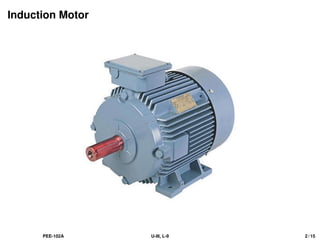
Induction Motor
PEE-102A U-III, L-9 2 / 15
Induction Motor
Introduction
The Three Phase Induction Motor (3-Ph IM or 3-φ IM) is the most popular type
of AC motor.
Invented by Nikola Tesla
Commonly used for many industrial applications.
Cheap, robust (less wear and tear), efficient and reliable.
It has high starting torque, speed control is easy and has reasonable overload
capacity.
It is singly excited machine as compared to DC motor. Only the stationary part
(stator) is supplied with AC, while current is induced in the rotating part (rotor)
by EM Induction. Hence, the name Induction motor.
PEE-102A U-III, L-9 3 / 15
Construction
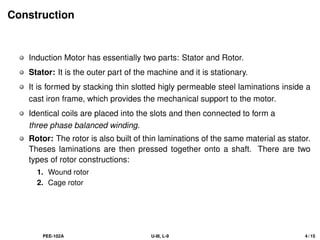
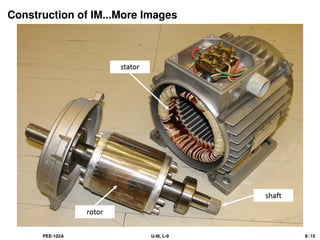
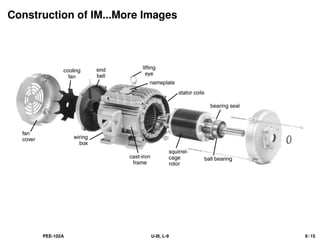
Induction Motor has essentially two parts: Stator and Rotor.
Stator: It is the outer part of the machine and it is stationary.
It is formed by stacking thin slotted higly permeable steel laminations inside a
cast iron frame, which provides the mechanical support to the motor.
Identical coils are placed into the slots and then connected to form a
three phase balanced winding.
Rotor: The rotor is also built of thin laminations of the same material as stator.
Theses laminations are then pressed together onto a shaft. There are two
types of rotor constructions:
1. Wound rotor
2. Cage rotor
PEE-102A U-III, L-9 4 / 15
Construction...contd
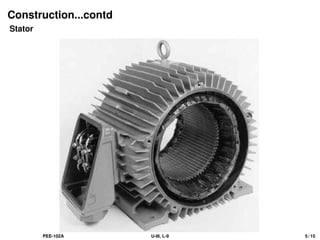
Stator
PEE-102A U-III, L-9 5 / 15
Construction...contd
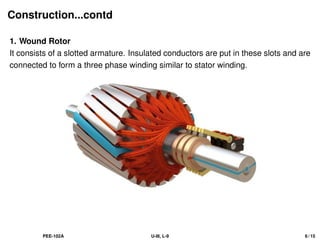
1. Wound Rotor
It consists of a slotted armature. Insulated conductors are put in these slots and are
connected to form a three phase winding similar to stator winding.
PEE-102A U-III, L-9 6 / 15
Construction...contd
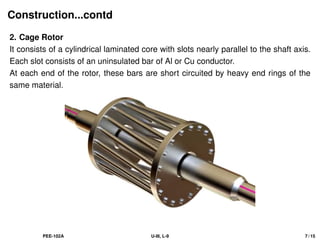
2. Cage Rotor
It consists of a cylindrical laminated core with slots nearly parallel to the shaft axis.
Each slot consists of an uninsulated bar of Al or Cu conductor.
At each end of the rotor, these bars are short circuited by heavy end rings of the
same material.
PEE-102A U-III, L-9 7 / 15
Construction of IM...More Images
PEE-102A U-III, L-9 8 / 15
Construction of IM...More Images
PEE-102A U-III, L-9 9 / 15
Principle of Operation of IM
Single Line Answer: Rotating Magnetic Field
When three phase balanced currents are supplied to three phase balanced
winding, a rotating magnetic field is produced.
When the stator winding of a 3-φ IM is supplied with 3-φ balanced currents,
then a magnetic field is produced that is:
Constant in magnitude.
Revolves around the stator edge.
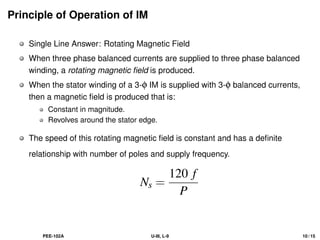
The speed of this rotating magnetic field is constant and has a definite
relationship with number of poles and supply frequency.
Ns =
120 f
P
PEE-102A U-III, L-9 10 / 15
Principle...Contd
The rotating magnetic field induces an EMF in the rotor winding, which in turn
induces a current in the rotor winding.
Now due to motor action1
, the conductor experiences a force (torque) and the
rotor starts rotating in the direction of the rotating magnetic field.
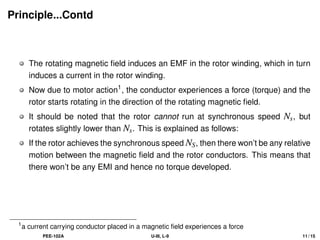
It should be noted that the rotor cannot run at synchronous speed Ns, but
rotates slightly lower than Ns. This is explained as follows:
If the rotor achieves the synchronous speed NS, then there won’t be any relative
motion between the magnetic field and the rotor conductors. This means that
there won’t be any EMI and hence no torque developed.
1
a current carrying conductor placed in a magnetic field experiences a force
PEE-102A U-III, L-9 11 / 15
Motor Speed and Slip
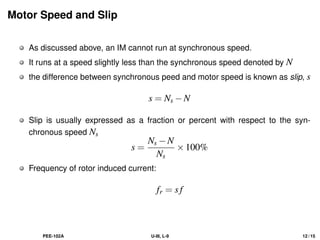
As discussed above, an IM cannot run at synchronous speed.
It runs at a speed slightly less than the synchronous speed denoted by N
the difference between synchronous peed and motor speed is known as slip, s
s = Ns −N
Slip is usually expressed as a fraction or percent with respect to the syn-
chronous speed Ns
s =
Ns −N
Ns
×100%
Frequency of rotor induced current:
fr = sf
PEE-102A U-III, L-9 12 / 15
Numerical Example 1
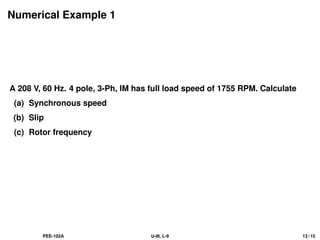
A 208 V, 60 Hz. 4 pole, 3-Ph, IM has full load speed of 1755 RPM. Calculate
(a) Synchronous speed
(b) Slip
(c) Rotor frequency
PEE-102A U-III, L-9 13 / 15
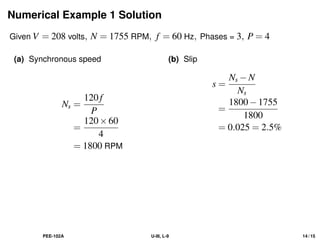
Numerical Example 1 Solution
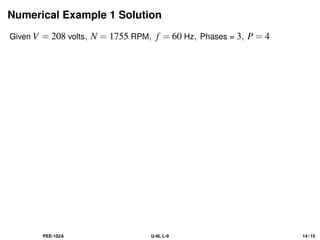
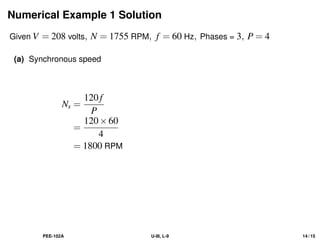
Given V = 208 volts, N = 1755 RPM, f = 60 Hz, Phases = 3, P = 4
PEE-102A U-III, L-9 14 / 15
Numerical Example 1 Solution
Given V = 208 volts, N = 1755 RPM, f = 60 Hz, Phases = 3, P = 4
(a) Synchronous speed
Ns =
120f
P
=
120×60
4
= 1800 RPM
PEE-102A U-III, L-9 14 / 15
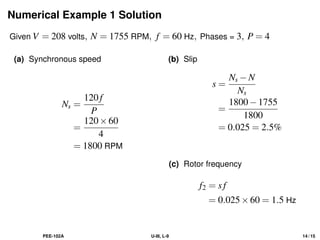
Numerical Example 1 Solution
Given V = 208 volts, N = 1755 RPM, f = 60 Hz, Phases = 3, P = 4
(a) Synchronous speed
Ns =
120f
P
=
120×60
4
= 1800 RPM
(b) Slip
s =
Ns −N
Ns
=
1800−1755
1800
= 0.025 = 2.5%
PEE-102A U-III, L-9 14 / 15
Numerical Example 1 Solution
Given V = 208 volts, N = 1755 RPM, f = 60 Hz, Phases = 3, P = 4
(a) Synchronous speed
Ns =
120f
P
=
120×60
4
= 1800 RPM
(b) Slip
s =
Ns −N
Ns
=
1800−1755
1800
= 0.025 = 2.5%
(c) Rotor frequency
f2 = sf
= 0.025×60 = 1.5 Hz
PEE-102A U-III, L-9 14 / 15
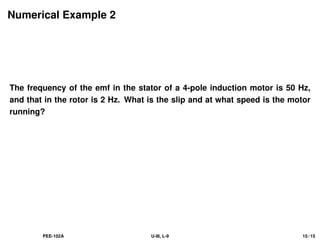
Numerical Example 2
The frequency of the emf in the stator of a 4-pole induction motor is 50 Hz,
and that in the rotor is 2 Hz. What is the slip and at what speed is the motor
running?
PEE-102A U-III, L-9 15 / 15
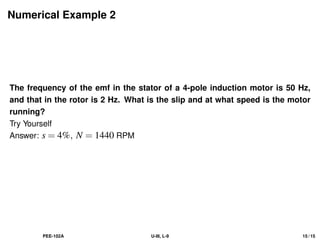
Numerical Example 2
The frequency of the emf in the stator of a 4-pole induction motor is 50 Hz,
and that in the rotor is 2 Hz. What is the slip and at what speed is the motor
running?
Try Yourself
Answer: s = 4%, N = 1440 RPM
PEE-102A U-III, L-9 15 / 15

PEE-102A_L-9

  • 1.
    PEE-102A Fundamentals of ElectricalEngineering Lecture-9 Instructor: Mohd. Umar Rehman EES, University Polytechnic, AMU PEE-102A U-III, L-9 1 / 15
  • 2.
  • 3.
    Induction Motor Introduction The ThreePhase Induction Motor (3-Ph IM or 3-φ IM) is the most popular type of AC motor. Invented by Nikola Tesla Commonly used for many industrial applications. Cheap, robust (less wear and tear), efficient and reliable. It has high starting torque, speed control is easy and has reasonable overload capacity. It is singly excited machine as compared to DC motor. Only the stationary part (stator) is supplied with AC, while current is induced in the rotating part (rotor) by EM Induction. Hence, the name Induction motor. PEE-102A U-III, L-9 3 / 15
  • 4.
    Construction Induction Motor hasessentially two parts: Stator and Rotor. Stator: It is the outer part of the machine and it is stationary. It is formed by stacking thin slotted higly permeable steel laminations inside a cast iron frame, which provides the mechanical support to the motor. Identical coils are placed into the slots and then connected to form a three phase balanced winding. Rotor: The rotor is also built of thin laminations of the same material as stator. Theses laminations are then pressed together onto a shaft. There are two types of rotor constructions: 1. Wound rotor 2. Cage rotor PEE-102A U-III, L-9 4 / 15
  • 5.
  • 6.
    Construction...contd 1. Wound Rotor Itconsists of a slotted armature. Insulated conductors are put in these slots and are connected to form a three phase winding similar to stator winding. PEE-102A U-III, L-9 6 / 15
  • 7.
    Construction...contd 2. Cage Rotor Itconsists of a cylindrical laminated core with slots nearly parallel to the shaft axis. Each slot consists of an uninsulated bar of Al or Cu conductor. At each end of the rotor, these bars are short circuited by heavy end rings of the same material. PEE-102A U-III, L-9 7 / 15
  • 8.
    Construction of IM...MoreImages PEE-102A U-III, L-9 8 / 15
  • 9.
    Construction of IM...MoreImages PEE-102A U-III, L-9 9 / 15
  • 10.
    Principle of Operationof IM Single Line Answer: Rotating Magnetic Field When three phase balanced currents are supplied to three phase balanced winding, a rotating magnetic field is produced. When the stator winding of a 3-φ IM is supplied with 3-φ balanced currents, then a magnetic field is produced that is: Constant in magnitude. Revolves around the stator edge. The speed of this rotating magnetic field is constant and has a definite relationship with number of poles and supply frequency. Ns = 120 f P PEE-102A U-III, L-9 10 / 15
  • 11.
    Principle...Contd The rotating magneticfield induces an EMF in the rotor winding, which in turn induces a current in the rotor winding. Now due to motor action1 , the conductor experiences a force (torque) and the rotor starts rotating in the direction of the rotating magnetic field. It should be noted that the rotor cannot run at synchronous speed Ns, but rotates slightly lower than Ns. This is explained as follows: If the rotor achieves the synchronous speed NS, then there won’t be any relative motion between the magnetic field and the rotor conductors. This means that there won’t be any EMI and hence no torque developed. 1 a current carrying conductor placed in a magnetic field experiences a force PEE-102A U-III, L-9 11 / 15
  • 12.
    Motor Speed andSlip As discussed above, an IM cannot run at synchronous speed. It runs at a speed slightly less than the synchronous speed denoted by N the difference between synchronous peed and motor speed is known as slip, s s = Ns −N Slip is usually expressed as a fraction or percent with respect to the syn- chronous speed Ns s = Ns −N Ns ×100% Frequency of rotor induced current: fr = sf PEE-102A U-III, L-9 12 / 15
  • 13.
    Numerical Example 1 A208 V, 60 Hz. 4 pole, 3-Ph, IM has full load speed of 1755 RPM. Calculate (a) Synchronous speed (b) Slip (c) Rotor frequency PEE-102A U-III, L-9 13 / 15
  • 14.
    Numerical Example 1Solution Given V = 208 volts, N = 1755 RPM, f = 60 Hz, Phases = 3, P = 4 PEE-102A U-III, L-9 14 / 15
  • 15.
    Numerical Example 1Solution Given V = 208 volts, N = 1755 RPM, f = 60 Hz, Phases = 3, P = 4 (a) Synchronous speed Ns = 120f P = 120×60 4 = 1800 RPM PEE-102A U-III, L-9 14 / 15
  • 16.
    Numerical Example 1Solution Given V = 208 volts, N = 1755 RPM, f = 60 Hz, Phases = 3, P = 4 (a) Synchronous speed Ns = 120f P = 120×60 4 = 1800 RPM (b) Slip s = Ns −N Ns = 1800−1755 1800 = 0.025 = 2.5% PEE-102A U-III, L-9 14 / 15
  • 17.
    Numerical Example 1Solution Given V = 208 volts, N = 1755 RPM, f = 60 Hz, Phases = 3, P = 4 (a) Synchronous speed Ns = 120f P = 120×60 4 = 1800 RPM (b) Slip s = Ns −N Ns = 1800−1755 1800 = 0.025 = 2.5% (c) Rotor frequency f2 = sf = 0.025×60 = 1.5 Hz PEE-102A U-III, L-9 14 / 15
  • 18.
    Numerical Example 2 Thefrequency of the emf in the stator of a 4-pole induction motor is 50 Hz, and that in the rotor is 2 Hz. What is the slip and at what speed is the motor running? PEE-102A U-III, L-9 15 / 15
  • 19.
    Numerical Example 2 Thefrequency of the emf in the stator of a 4-pole induction motor is 50 Hz, and that in the rotor is 2 Hz. What is the slip and at what speed is the motor running? Try Yourself Answer: s = 4%, N = 1440 RPM PEE-102A U-III, L-9 15 / 15