1
Planning
2
Planning problem
• Find a sequence of actions that achieves a given goal when
executed from a given initial world state. That is, given
– a set of operator descriptions (defining the possible primitive actions
by the agent),
– an initial state description, and
– a goal state description or predicate,
compute a plan, which is
– a sequence of operator instances, such that executing them in the
initial state will change the world to a state satisfying the goal-state
description.
• Goals are usually specified as a conjunction of goals to be
achieved
3
Planning vs. problem solving
• Planning and problem solving methods can often solve the
same sorts of problems
• Planning is more powerful because of the representations
and methods used
• States, goals, and actions are decomposed into sets of
sentences (usually in first-order logic)
• Search often proceeds through plan space rather than state
space (though there are also state-space planners)
• Subgoals can be planned independently, reducing the
complexity of the planning problem
4
Typical assumptions
• Atomic time: Each action is indivisible
• No concurrent actions are allowed (though actions do not
need to be ordered with respect to each other in the plan)
• Deterministic actions: The result of actions are completely
determined—there is no uncertainty in their effects
• Agent is the sole cause of change in the world
• Agent is omniscient: Has complete knowledge of the state
of the world
• Closed World Assumption: everything known to be true in
the world is included in the state description. Anything not
listed is false.
5
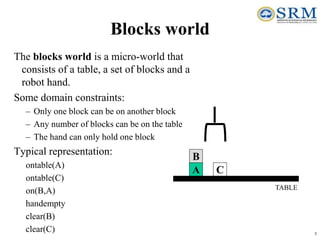
Blocks world
The blocks world is a micro-world that
consists of a table, a set of blocks and a
robot hand.
Some domain constraints:
– Only one block can be on another block
– Any number of blocks can be on the table
– The hand can only hold one block
Typical representation:
ontable(A)
ontable(C)
on(B,A)
handempty
clear(B)
clear(C)
A
B
C
TABLE
6
General Problem Solver
• The General Problem Solver (GPS) system was an early
planner (Newell, Shaw, and Simon)
• GPS generated actions that reduced the difference between
some state and a goal state
• GPS used Means-Ends Analysis
– Compare what is given or known with what is desired and select a
reasonable thing to do next
– Use a table of differences to identify procedures to reduce types of
differences
• GPS was a state space planner: it operated in the domain of
state space problems specified by an initial state, some goal
states, and a set of operations
7
Situation calculus planning
• Intuition: Represent the planning problem using
first-order logic
–Situation calculus lets us reason about changes in
the world
–Use theorem proving to “prove” that a particular
sequence of actions, when applied to the
situation characterizing the world state, will lead
to a desired result
8
Situation calculus
• Initial state: a logical sentence about (situation) S0
At(Home, S0) ^ ~Have(Milk, S0) ^ ~ Have(Bananas, S0) ^ ~Have(Drill, S0)
• Goal state:
(s) At(Home,s) ^ Have(Milk,s) ^ Have(Bananas,s) ^ Have(Drill,s)
• Operators are descriptions of how the world changes as a result
of the agent’s actions:
(a,s) Have(Milk,Result(a,s)) <=> ((a=Buy(Milk) ^ At(Grocery,s)) 
(Have(Milk, s) ^ a~=Drop(Milk)))
• Result(a,s) names the situation resulting from executing action a
in situation s.
• Action sequences are also useful: Result'(l,s) is the result of
executing the list of actions (l) starting in s:
(s) Result'([],s) = s
(a,p,s) Result'([a|p]s) = Result'(p,Result(a,s))
9
Situation calculus II
• A solution is a plan that when applied to the initial state
yields a situation satisfying the goal query:
At(Home,Result'(p,S0))
^ Have(Milk,Result'(p,S0))
^ Have(Bananas,Result'(p,S0))
^ Have(Drill,Result'(p,S0))
• Thus we would expect a plan (i.e., variable assignment
through unification) such as:
p = [Go(Grocery), Buy(Milk), Buy(Bananas), Go(HardwareStore),
Buy(Drill), Go(Home)]
10
Situation calculus: Blocks world
• Here’s an example of a situation calculus rule for the blocks
world:
– Clear (X, Result(A,S)) 
[Clear (X, S) 
((A=Stack(Y,X)  A=Pickup(X))
 (A=Stack(Y,X)  (holding(Y,S))
 (A=Pickup(X)  (handempty(S)  ontable(X,S)  clear(X,S))))]
 [A=Stack(X,Y)  holding(X,S)  clear(Y,S)]
 [A=Unstack(Y,X)  on(Y,X,S)  clear(Y,S)  handempty(S)]
 [A=Putdown(X)  holding(X,S)]
• English translation: A block is clear if (a) in the previous state it
was clear and we didn’t pick it up or stack something on it
successfully, or (b) we stacked it on something else successfully,
or (c) something was on it that we unstacked successfully, or (d)
we were holding it and we put it down.
• Whew!!! There’s gotta be a better way!
11
Situation calculus planning: Analysis
• This is fine in theory, but remember that problem solving
(search) is exponential in the worst case
• Also, resolution theorem proving only finds a proof (plan),
not necessarily a good plan
• So we restrict the language and use a special-purpose
algorithm (a planner) rather than general theorem prover
12
Basic representations for planning
• Classic approach first used in the STRIPS planner circa 1970
• States represented as a conjunction of ground literals
– at(Home) ^ ~have(Milk) ^ ~have(bananas) ...
• Goals are conjunctions of literals, but may have variables
which are assumed to be existentially quantified
– at(x) ^ have(Milk) ^ have(bananas) ...
• Do not need to fully specify state
– Non-specified either don’t-care or assumed false
– Represent many cases in small storage
– Often only represent changes in state rather than entire situation
• Unlike theorem prover, not seeking whether the goal is true,
but is there a sequence of actions to attain it
13
Operator/action representation
• Operators contain three components:
– Action description
– Precondition - conjunction of positive literals
– Effect - conjunction of positive or negative literals
which describe how situation changes when operator
is applied
• Example:
Op[Action: Go(there),
Precond: At(here) ^ Path(here,there),
Effect: At(there) ^ ~At(here)]
• All variables are universally quantified
• Situation variables are implicit
– preconditions must be true in the state immediately
before operator is applied; effects are true
immediately after
Go(there)
At(here) ,Path(here,there)
At(there) , ~At(here)
14
Blocks world operators
• Here are the classic basic operations for the blocks world:
– stack(X,Y): put block X on block Y
– unstack(X,Y): remove block X from block Y
– pickup(X): pickup block X
– putdown(X): put block X on the table
• Each will be represented by
– a list of preconditions
– a list of new facts to be added (add-effects)
– a list of facts to be removed (delete-effects)
– optionally, a set of (simple) variable constraints
• For example:
preconditions(stack(X,Y), [holding(X),clear(Y)])
deletes(stack(X,Y), [holding(X),clear(Y)]).
adds(stack(X,Y), [handempty,on(X,Y),clear(X)])
constraints(stack(X,Y), [X==Y,Y==table,X==table])
15
Blocks world operators II
operator(stack(X,Y),
Precond [holding(X),clear(Y)],
Add [handempty,on(X,Y),clear(X)],
Delete [holding(X),clear(Y)],
Constr [X==Y,Y==table,X==table]).
operator(pickup(X),
[ontable(X), clear(X), handempty],
[holding(X)],
[ontable(X),clear(X),handempty],
[X==table]).
operator(unstack(X,Y),
Pre [on(X,Y), clear(X), handempty],
ADD[holding(X),clear(Y)],
Del [handempty,clear(X),on(X,Y)],
[X==Y,Y==table,X==table]).
operator(putdown(X),
[holding(X)],
[ontable(X),handempty,clear(X)],
[holding(X)],
[X==table]).
16
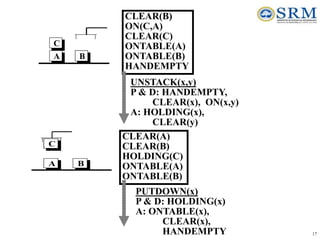
STRIPS planning
• STRIPS maintains two additional data structures:
– State List - all currently true predicates.
– Goal Stack - a push down stack of goals to be solved, with current
goal on top of stack.
• If current goal is not satisfied by present state, examine add
lists of operators, and push operator and preconditions list
on stack. (Subgoals)
• When a current goal is satisfied, POP it from stack.
• When an operator is on top stack, record the application of
that operator on the plan sequence and use the operator’s
add and delete lists to update the current state.
17
CLEAR(B)
ON(C,A)
CLEAR(C)
ONTABLE(A)
ONTABLE(B)
HANDEMPTY
CLEAR(A)
CLEAR(B)
HOLDING(C)
ONTABLE(A)
ONTABLE(B)
A
C
B
UNSTACK(x,y)
P & D: HANDEMPTY,
CLEAR(x), ON(x,y)
A: HOLDING(x),
CLEAR(y)
PUTDOWN(x)
P & D: HOLDING(x)
A: ONTABLE(x),
CLEAR(x),
HANDEMPTY
A
C
B
18
CLEAR(A)
CLEAR(B)
ONTABLE(A)
ONTABLE(B)
ONTABLE(C)
CLEAR(C)
HANDEMPTY
A
C B
PICKUP(x)
P & D: ONTABLE(x),
CLEAR(x), HANDEMPTY
A: HOLDING(x)
CLEAR(A)
ONTABLE(A)
ONTABLE(C)
CLEAR(C)
HOLDING(B)
etc.
A
C
B
STACK(x,y)
P & D: HOLDING(x),
CLEAR(y)
A: HANDEMPTY, ON(x,y), CLEAR(x)
19
The original STRIPS system used
a goal stack to control its search.
The system has a database and a goal
stack, and it focuses attention on
solving the top goal (which may
involve solving sub-goals, which are
then pushed onto the stack, etc.)
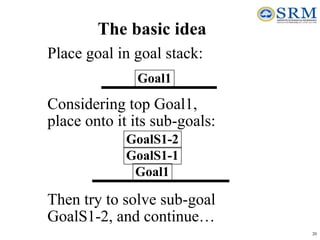
20
Place goal in goal stack:
Goal1
Considering top Goal1,
place onto it its sub-goals:
Goal1
GoalS1-2
GoalS1-1
Then try to solve sub-goal
GoalS1-2, and continue…
The basic idea
21
Stack Manipulation Rules I
If on top of goal stack
• Compound or single goal
matching the current state
description
• Compound goal not matching
the current state description
Than do:
• Remove it
1. Keep original compound goal
on stack;
2. List the unsatisfied
component goals on the stack
in some new order
22
Stack Manipulation Rules II
If on top of goal stack
• Single-literal goal not
matching the current state
description.
• Rule
Than do:
• Find new rule whose instantiated
add-list includes the goal, and
1. Replace the goal with the
instantiated rule;
2. Place the rule’s instantiated
precondition formula on top of
stack
1. Remove rule from stack;
2. Update database using rule;
3. Keep track of rule (for solution)
• Nothing • Stop
23
1. Place on stack original
goal:
Stack:
On(A,C) & On(C,B)
CLEAR(B)
ON(C,A)
CLEAR(C)
ONTABLE(A)
ONTABLE(B)
HANDEMPTY
Database:
Example
A B
C
Initial state
Goal state
A
B
C
24
2. Since top goal is unsatisfied
compound goal, list its unsatisfied
subgoals on top of it:
Stack:
On(A,C) & On(C,B)
On(A,C)
On(C,B)
CLEAR(B)
ON(C,A)
CLEAR(C)
ONTABLE(A)
ONTABLE(B)
HANDEMPTY
Database
(unchanged):
Example
25
Stack:
On(A,C) & On(C,B)
On(A,C)
stack(C,B)
Holding(C) & Clear(B)
CLEAR(B)
ON(C,A)
CLEAR(C)
ONTABLE(A)
ONTABLE(B)
HANDEMPTY
Database
(unchanged):
3. Since top goal is unsatisfied single-literal goal, find
rule whose instantiated add-list includes the goal,
and: a. Replace the goal with the instantiated rule;
b. Place the rule’s instantiated precondition formula
on top of stack
Example
On(C,B)
26
stack(C,B)
Stack:
On(A,C) & On(C,B)
On(A,C)
Holding(C) & Clear(B)
Holding(C)
Clear(B)
4. Since top goal is unsatisfied compound goal, list its
subgoals on top of it:
Example
CLEAR(B)
ON(C,A)
CLEAR(C)
ONTABLE(A)
ONTABLE(B)
HANDEMPTY
Database
(unchanged):
27
Stack:
5. Single goal on top of stack matches data base, so
remove it:
Example
CLEAR(B)
ON(C,A)
CLEAR(C)
ONTABLE(A)
ONTABLE(B)
HANDEMPTY
Database
(unchanged):
stack(C,B)
On(A,C) & On(C,B)
On(A,C)
Holding(C) & Clear(B)
Holding(C)
Clear(B)
28
On(C,A) &Clear(C) & Handempty
Stack:
On(A,C) &On(C,B)
On(A,C)
stack(C,B)
Holding(C) & Clear(B)
unstack(C,A)
Database: (unchanged)
6. Since top goal is unsatisfied single-literal goal, find
rule whose instantiated add-list includes the goal,
and: a. Replace the goal with the instantiated rule;
b. Place the rule’s instantiated precondition formula
on top of stack
Example
Holding(C)
29
Stack:
7. Compound goal on top of stack matches data base,
so remove it:
Example
CLEAR(B)
ON(C,A)
CLEAR(C)
ONTABLE(A)
ONTABLE(B)
HANDEMPTY
Database
(unchanged):
On(C,A) &Clear(C) & Handempty
On(A,C) &On(C,B)
On(A,C)
stack(C,B)
Holding(C) & Clear(B)
unstack(C,A)
30
Stack:
Solution: {unstack(C,A)}
8. Top item is rule, so:
a. Remove rule from stack;
b. Update database using rule;
c. Keep track of rule (for solution)
Example
CLEAR(B)
ONTABLE(A)
ONTABLE(B)
HOLDING(C)
CLEAR(A)
Database:
unstack(X,Y):
Add - [holding(X),clear(Y)]
Delete -[handempty,clear(X),on(X,Y)]
On(A,C) &On(C,B)
On(A,C)
stack(C,B)
Holding(C) & Clear(B)
unstack(C,A)
31
Stack:
9. Compound goal on top of stack matches data base,
so remove it:
Example
On(A,C) &On(C,B)
On(A,C)
stack(C,B)
Holding(C) & Clear(B)
Solution: {unstack(C)}
CLEAR(B)
ONTABLE(A)
ONTABLE(B)
HOLDING(C)
CLEAR(A)
Database:
(unchanged)
32
Stack:
10. Top item is rule, so:
a. Remove rule from stack;
b. Update database using rule;
c. Keep track of rule (for solution)
Example
Solution: {unstack(C), stack(C,B)}
ONTABLE(A)
ONTABLE(B)
HANDEMPTY
CLEAR(A)
CLEAR(C)
ON(C,B)
Database:
stack(X,Y):
Add - [handempty,on(X,Y),clear(X)]
Delete - [holding(X),clear(Y)]
On(A,C) &On(C,B)
On(A,C)
stack(C,B)
33
Stack:
On(A,C) &On(C,B)
stack(A,C)
Holding(A) &Clear(C)
11. Since top goal is unsatisfied single-literal goal,
find rule whose instantiated add-list includes the
goal, and: a. Replace the goal with the instantiated
rule; b. Place the rule’s instantiated precondition
formula on top of stack
Example
Solution: {unstack(C), stack(C,B)}
ONTABLE(A)
ONTABLE(B)
HANDEMPTY
CLEAR(A)
CLEAR(C)
ON(C,B)
Database:
(unchanged)
On(A,C)
34
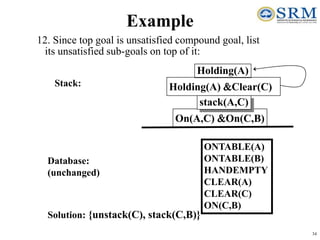
Holding(A)
12. Since top goal is unsatisfied compound goal, list
its unsatisfied sub-goals on top of it:
Example
Solution: {unstack(C), stack(C,B)}
ONTABLE(A)
ONTABLE(B)
HANDEMPTY
CLEAR(A)
CLEAR(C)
ON(C,B)
Database:
(unchanged)
On(A,C) &On(C,B)
stack(A,C)
Holding(A) &Clear(C)
Stack:
35
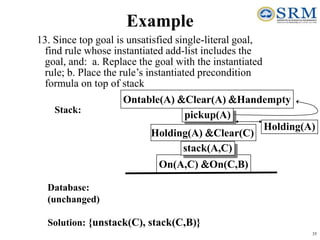
13. Since top goal is unsatisfied single-literal goal,
find rule whose instantiated add-list includes the
goal, and: a. Replace the goal with the instantiated
rule; b. Place the rule’s instantiated precondition
formula on top of stack
Example
Holding(A)
On(A,C) &On(C,B)
stack(A,C)
Holding(A) &Clear(C)
pickup(A)
Ontable(A) &Clear(A) &Handempty
Solution: {unstack(C), stack(C,B)}
Database:
(unchanged)
Stack:
36
14. Compound goal on top of stack matches data base,
so remove it:
Example
On(A,C) &On(C,B)
stack(A,C)
Holding(A) &Clear(C)
pickup(A)
Ontable(A) &Clear(A) &Handempty
Solution: {unstack(C), stack(C,B)}
Database:
(unchanged)
Stack:
ONTABLE(A)
ONTABLE(B)
HANDEMPTY
CLEAR(A)
CLEAR(C)
ON(C,B)
37
ONTABLE(B)
ON(C,B)
CLEAR(C)
HOLDING(A)
15. Top item is rule, so:
a. Remove rule from stack;
b. Update database using rule;
c. Keep track of rule (for solution)
Example
On(A,C) &On(C,B)
stack(A,C)
Holding(A) &Clear(C)
pickup(A)
Stack:
Solution: {unstack(C), stack(C,B),pickup(A)}
Database:
pickup(X):
Add - [holding(X)]
Delete - [ontable(X),clear(X),handempty]
38
16. Compound goal on top of stack matches data base,
so remove it:
Example
ONTABLE(B)
ON(C,B)
CLEAR(C)
HOLDING(A)
On(A,C) &On(C,B)
stack(A,C)
Holding(A) &Clear(C)
Stack:
Solution: {unstack(C), stack(C,B),pickup(A)}
Database:
(unchanged)
39
ONTABLE(B)
ON(C,B)
ON(A,C)
CLEAR(A)
HANDEMPTY
17. Top item is rule, so:
a. Remove rule from stack;
b. Update database using rule;
c. Keep track of rule (for solution)
Example
Solution: {unstack(C), stack(C,B),pickup(A), stack(A,C)}
On(A,C) &On(C,B)
stack(A,C)
Stack:
Database:
stack(X,Y):
Add - [handempty,on(X,Y),clear(X)]
Delete - [holding(X),clear(Y)]
40
18. Compound goal on top of stack matches data base,
so remove it:
Example
ONTABLE(B)
ON(C,B)
ON(A,C)
CLEAR(A)
HANDEMPTY
Solution: {unstack(C), stack(C,B),pickup(A), stack(A,C)}
On(A,C) &On(C,B)
Stack:
Database:
stack(X,Y):
Add - [handempty,on(X,Y),clear(X)]
Delete - [holding(X),clear(Y)]
19. Stack is empty, so stop.
Solution: {unstack(C), stack(C,B),pickup(A), stack(A,C)}
41
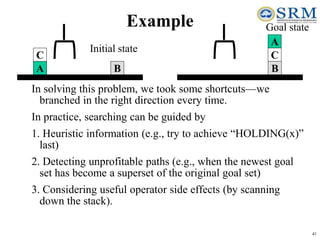
In solving this problem, we took some shortcuts—we
branched in the right direction every time.
In practice, searching can be guided by
1. Heuristic information (e.g., try to achieve “HOLDING(x)”
last)
2. Detecting unprofitable paths (e.g., when the newest goal
set has become a superset of the original goal set)
3. Considering useful operator side effects (by scanning
down the stack).
Example
A B
C
Initial state
Goal state
A
B
C
42
I: G:
ON(C,A)
ONTABLE(A)
ONTABLE(B)
ARMEMPTY
ON(A,B)
ON(B,C)
It could try ON(B,C) first, then ON(A,B)—
but it will find that the first goal has been
undone. So the first goal will be added
back onto the stack and solved.
Sussman Anomaly
A B
C
Initial state
Goal state
A
B
C
43
The final sequence is
inefficient:
PICKUP(B)
STACK(B,C)
UNSTACK(B,C)
PUTDOWN(B)
UNSTACK(C,A)
PUTDOWN(C)
PICKUP(A)
STACK(A,B)
UNSTACK(A,B)
PUTDOWN(A)
PICKUP(B)
STACK(B,C)
PICKUP(A)
STACK(A,B)
1. Trying the goals in the other order
doesn’t help much.
2. We can remove adjacent operators that
undo each other.
Sussman Anomaly
A
B
C
A B
C
Goal state
Initial state
44
1. Begin work on ON(A,B) by clearing A (i.e., putting C
on table)
2. Achieve ON(B,C) by stacking B on C
3. Achieve [finish] ON(A,B) by stacking A on B.
We couldn’t do this using a stack,
but we can if we use a set of
goals.
A B
C
Initial state
Goal state
A
B
C
What we really want is to:
45
Ex (from Nilsson, p. 305):
“We have two memory registers X and Y whose
initial contents are A and B respectively.”
I: Contents(X,A) &Contents(Y,B)
We have one operation,
Assign(u,r,t,s) P: Contents(r,s)
D: Contents(u,t) A: Contents(u,s)
Our goal state is:
G: Contents(X,B) &Contents(Y,A)
STRIPS cannot defer its solution of either subgoal
long enough not to erase the other register’s
contents.
STRIPS cannot solve all goals

Goal stack planning.ppt

  • 1.
  • 2.
    2 Planning problem • Finda sequence of actions that achieves a given goal when executed from a given initial world state. That is, given – a set of operator descriptions (defining the possible primitive actions by the agent), – an initial state description, and – a goal state description or predicate, compute a plan, which is – a sequence of operator instances, such that executing them in the initial state will change the world to a state satisfying the goal-state description. • Goals are usually specified as a conjunction of goals to be achieved
  • 3.
    3 Planning vs. problemsolving • Planning and problem solving methods can often solve the same sorts of problems • Planning is more powerful because of the representations and methods used • States, goals, and actions are decomposed into sets of sentences (usually in first-order logic) • Search often proceeds through plan space rather than state space (though there are also state-space planners) • Subgoals can be planned independently, reducing the complexity of the planning problem
  • 4.
    4 Typical assumptions • Atomictime: Each action is indivisible • No concurrent actions are allowed (though actions do not need to be ordered with respect to each other in the plan) • Deterministic actions: The result of actions are completely determined—there is no uncertainty in their effects • Agent is the sole cause of change in the world • Agent is omniscient: Has complete knowledge of the state of the world • Closed World Assumption: everything known to be true in the world is included in the state description. Anything not listed is false.
  • 5.
    5 Blocks world The blocksworld is a micro-world that consists of a table, a set of blocks and a robot hand. Some domain constraints: – Only one block can be on another block – Any number of blocks can be on the table – The hand can only hold one block Typical representation: ontable(A) ontable(C) on(B,A) handempty clear(B) clear(C) A B C TABLE
  • 6.
    6 General Problem Solver •The General Problem Solver (GPS) system was an early planner (Newell, Shaw, and Simon) • GPS generated actions that reduced the difference between some state and a goal state • GPS used Means-Ends Analysis – Compare what is given or known with what is desired and select a reasonable thing to do next – Use a table of differences to identify procedures to reduce types of differences • GPS was a state space planner: it operated in the domain of state space problems specified by an initial state, some goal states, and a set of operations
  • 7.
    7 Situation calculus planning •Intuition: Represent the planning problem using first-order logic –Situation calculus lets us reason about changes in the world –Use theorem proving to “prove” that a particular sequence of actions, when applied to the situation characterizing the world state, will lead to a desired result
  • 8.
    8 Situation calculus • Initialstate: a logical sentence about (situation) S0 At(Home, S0) ^ ~Have(Milk, S0) ^ ~ Have(Bananas, S0) ^ ~Have(Drill, S0) • Goal state: (s) At(Home,s) ^ Have(Milk,s) ^ Have(Bananas,s) ^ Have(Drill,s) • Operators are descriptions of how the world changes as a result of the agent’s actions: (a,s) Have(Milk,Result(a,s)) <=> ((a=Buy(Milk) ^ At(Grocery,s))  (Have(Milk, s) ^ a~=Drop(Milk))) • Result(a,s) names the situation resulting from executing action a in situation s. • Action sequences are also useful: Result'(l,s) is the result of executing the list of actions (l) starting in s: (s) Result'([],s) = s (a,p,s) Result'([a|p]s) = Result'(p,Result(a,s))
  • 9.
    9 Situation calculus II •A solution is a plan that when applied to the initial state yields a situation satisfying the goal query: At(Home,Result'(p,S0)) ^ Have(Milk,Result'(p,S0)) ^ Have(Bananas,Result'(p,S0)) ^ Have(Drill,Result'(p,S0)) • Thus we would expect a plan (i.e., variable assignment through unification) such as: p = [Go(Grocery), Buy(Milk), Buy(Bananas), Go(HardwareStore), Buy(Drill), Go(Home)]
  • 10.
    10 Situation calculus: Blocksworld • Here’s an example of a situation calculus rule for the blocks world: – Clear (X, Result(A,S))  [Clear (X, S)  ((A=Stack(Y,X)  A=Pickup(X))  (A=Stack(Y,X)  (holding(Y,S))  (A=Pickup(X)  (handempty(S)  ontable(X,S)  clear(X,S))))]  [A=Stack(X,Y)  holding(X,S)  clear(Y,S)]  [A=Unstack(Y,X)  on(Y,X,S)  clear(Y,S)  handempty(S)]  [A=Putdown(X)  holding(X,S)] • English translation: A block is clear if (a) in the previous state it was clear and we didn’t pick it up or stack something on it successfully, or (b) we stacked it on something else successfully, or (c) something was on it that we unstacked successfully, or (d) we were holding it and we put it down. • Whew!!! There’s gotta be a better way!
  • 11.
    11 Situation calculus planning:Analysis • This is fine in theory, but remember that problem solving (search) is exponential in the worst case • Also, resolution theorem proving only finds a proof (plan), not necessarily a good plan • So we restrict the language and use a special-purpose algorithm (a planner) rather than general theorem prover
  • 12.
    12 Basic representations forplanning • Classic approach first used in the STRIPS planner circa 1970 • States represented as a conjunction of ground literals – at(Home) ^ ~have(Milk) ^ ~have(bananas) ... • Goals are conjunctions of literals, but may have variables which are assumed to be existentially quantified – at(x) ^ have(Milk) ^ have(bananas) ... • Do not need to fully specify state – Non-specified either don’t-care or assumed false – Represent many cases in small storage – Often only represent changes in state rather than entire situation • Unlike theorem prover, not seeking whether the goal is true, but is there a sequence of actions to attain it
  • 13.
    13 Operator/action representation • Operatorscontain three components: – Action description – Precondition - conjunction of positive literals – Effect - conjunction of positive or negative literals which describe how situation changes when operator is applied • Example: Op[Action: Go(there), Precond: At(here) ^ Path(here,there), Effect: At(there) ^ ~At(here)] • All variables are universally quantified • Situation variables are implicit – preconditions must be true in the state immediately before operator is applied; effects are true immediately after Go(there) At(here) ,Path(here,there) At(there) , ~At(here)
  • 14.
    14 Blocks world operators •Here are the classic basic operations for the blocks world: – stack(X,Y): put block X on block Y – unstack(X,Y): remove block X from block Y – pickup(X): pickup block X – putdown(X): put block X on the table • Each will be represented by – a list of preconditions – a list of new facts to be added (add-effects) – a list of facts to be removed (delete-effects) – optionally, a set of (simple) variable constraints • For example: preconditions(stack(X,Y), [holding(X),clear(Y)]) deletes(stack(X,Y), [holding(X),clear(Y)]). adds(stack(X,Y), [handempty,on(X,Y),clear(X)]) constraints(stack(X,Y), [X==Y,Y==table,X==table])
  • 15.
    15 Blocks world operatorsII operator(stack(X,Y), Precond [holding(X),clear(Y)], Add [handempty,on(X,Y),clear(X)], Delete [holding(X),clear(Y)], Constr [X==Y,Y==table,X==table]). operator(pickup(X), [ontable(X), clear(X), handempty], [holding(X)], [ontable(X),clear(X),handempty], [X==table]). operator(unstack(X,Y), Pre [on(X,Y), clear(X), handempty], ADD[holding(X),clear(Y)], Del [handempty,clear(X),on(X,Y)], [X==Y,Y==table,X==table]). operator(putdown(X), [holding(X)], [ontable(X),handempty,clear(X)], [holding(X)], [X==table]).
  • 16.
    16 STRIPS planning • STRIPSmaintains two additional data structures: – State List - all currently true predicates. – Goal Stack - a push down stack of goals to be solved, with current goal on top of stack. • If current goal is not satisfied by present state, examine add lists of operators, and push operator and preconditions list on stack. (Subgoals) • When a current goal is satisfied, POP it from stack. • When an operator is on top stack, record the application of that operator on the plan sequence and use the operator’s add and delete lists to update the current state.
  • 17.
    17 CLEAR(B) ON(C,A) CLEAR(C) ONTABLE(A) ONTABLE(B) HANDEMPTY CLEAR(A) CLEAR(B) HOLDING(C) ONTABLE(A) ONTABLE(B) A C B UNSTACK(x,y) P & D:HANDEMPTY, CLEAR(x), ON(x,y) A: HOLDING(x), CLEAR(y) PUTDOWN(x) P & D: HOLDING(x) A: ONTABLE(x), CLEAR(x), HANDEMPTY A C B
  • 18.
    18 CLEAR(A) CLEAR(B) ONTABLE(A) ONTABLE(B) ONTABLE(C) CLEAR(C) HANDEMPTY A C B PICKUP(x) P &D: ONTABLE(x), CLEAR(x), HANDEMPTY A: HOLDING(x) CLEAR(A) ONTABLE(A) ONTABLE(C) CLEAR(C) HOLDING(B) etc. A C B STACK(x,y) P & D: HOLDING(x), CLEAR(y) A: HANDEMPTY, ON(x,y), CLEAR(x)
  • 19.
    19 The original STRIPSsystem used a goal stack to control its search. The system has a database and a goal stack, and it focuses attention on solving the top goal (which may involve solving sub-goals, which are then pushed onto the stack, etc.)
  • 20.
    20 Place goal ingoal stack: Goal1 Considering top Goal1, place onto it its sub-goals: Goal1 GoalS1-2 GoalS1-1 Then try to solve sub-goal GoalS1-2, and continue… The basic idea
  • 21.
    21 Stack Manipulation RulesI If on top of goal stack • Compound or single goal matching the current state description • Compound goal not matching the current state description Than do: • Remove it 1. Keep original compound goal on stack; 2. List the unsatisfied component goals on the stack in some new order
  • 22.
    22 Stack Manipulation RulesII If on top of goal stack • Single-literal goal not matching the current state description. • Rule Than do: • Find new rule whose instantiated add-list includes the goal, and 1. Replace the goal with the instantiated rule; 2. Place the rule’s instantiated precondition formula on top of stack 1. Remove rule from stack; 2. Update database using rule; 3. Keep track of rule (for solution) • Nothing • Stop
  • 23.
    23 1. Place onstack original goal: Stack: On(A,C) & On(C,B) CLEAR(B) ON(C,A) CLEAR(C) ONTABLE(A) ONTABLE(B) HANDEMPTY Database: Example A B C Initial state Goal state A B C
  • 24.
    24 2. Since topgoal is unsatisfied compound goal, list its unsatisfied subgoals on top of it: Stack: On(A,C) & On(C,B) On(A,C) On(C,B) CLEAR(B) ON(C,A) CLEAR(C) ONTABLE(A) ONTABLE(B) HANDEMPTY Database (unchanged): Example
  • 25.
    25 Stack: On(A,C) & On(C,B) On(A,C) stack(C,B) Holding(C)& Clear(B) CLEAR(B) ON(C,A) CLEAR(C) ONTABLE(A) ONTABLE(B) HANDEMPTY Database (unchanged): 3. Since top goal is unsatisfied single-literal goal, find rule whose instantiated add-list includes the goal, and: a. Replace the goal with the instantiated rule; b. Place the rule’s instantiated precondition formula on top of stack Example On(C,B)
  • 26.
    26 stack(C,B) Stack: On(A,C) & On(C,B) On(A,C) Holding(C)& Clear(B) Holding(C) Clear(B) 4. Since top goal is unsatisfied compound goal, list its subgoals on top of it: Example CLEAR(B) ON(C,A) CLEAR(C) ONTABLE(A) ONTABLE(B) HANDEMPTY Database (unchanged):
  • 27.
    27 Stack: 5. Single goalon top of stack matches data base, so remove it: Example CLEAR(B) ON(C,A) CLEAR(C) ONTABLE(A) ONTABLE(B) HANDEMPTY Database (unchanged): stack(C,B) On(A,C) & On(C,B) On(A,C) Holding(C) & Clear(B) Holding(C) Clear(B)
  • 28.
    28 On(C,A) &Clear(C) &Handempty Stack: On(A,C) &On(C,B) On(A,C) stack(C,B) Holding(C) & Clear(B) unstack(C,A) Database: (unchanged) 6. Since top goal is unsatisfied single-literal goal, find rule whose instantiated add-list includes the goal, and: a. Replace the goal with the instantiated rule; b. Place the rule’s instantiated precondition formula on top of stack Example Holding(C)
  • 29.
    29 Stack: 7. Compound goalon top of stack matches data base, so remove it: Example CLEAR(B) ON(C,A) CLEAR(C) ONTABLE(A) ONTABLE(B) HANDEMPTY Database (unchanged): On(C,A) &Clear(C) & Handempty On(A,C) &On(C,B) On(A,C) stack(C,B) Holding(C) & Clear(B) unstack(C,A)
  • 30.
    30 Stack: Solution: {unstack(C,A)} 8. Topitem is rule, so: a. Remove rule from stack; b. Update database using rule; c. Keep track of rule (for solution) Example CLEAR(B) ONTABLE(A) ONTABLE(B) HOLDING(C) CLEAR(A) Database: unstack(X,Y): Add - [holding(X),clear(Y)] Delete -[handempty,clear(X),on(X,Y)] On(A,C) &On(C,B) On(A,C) stack(C,B) Holding(C) & Clear(B) unstack(C,A)
  • 31.
    31 Stack: 9. Compound goalon top of stack matches data base, so remove it: Example On(A,C) &On(C,B) On(A,C) stack(C,B) Holding(C) & Clear(B) Solution: {unstack(C)} CLEAR(B) ONTABLE(A) ONTABLE(B) HOLDING(C) CLEAR(A) Database: (unchanged)
  • 32.
    32 Stack: 10. Top itemis rule, so: a. Remove rule from stack; b. Update database using rule; c. Keep track of rule (for solution) Example Solution: {unstack(C), stack(C,B)} ONTABLE(A) ONTABLE(B) HANDEMPTY CLEAR(A) CLEAR(C) ON(C,B) Database: stack(X,Y): Add - [handempty,on(X,Y),clear(X)] Delete - [holding(X),clear(Y)] On(A,C) &On(C,B) On(A,C) stack(C,B)
  • 33.
    33 Stack: On(A,C) &On(C,B) stack(A,C) Holding(A) &Clear(C) 11.Since top goal is unsatisfied single-literal goal, find rule whose instantiated add-list includes the goal, and: a. Replace the goal with the instantiated rule; b. Place the rule’s instantiated precondition formula on top of stack Example Solution: {unstack(C), stack(C,B)} ONTABLE(A) ONTABLE(B) HANDEMPTY CLEAR(A) CLEAR(C) ON(C,B) Database: (unchanged) On(A,C)
  • 34.
    34 Holding(A) 12. Since topgoal is unsatisfied compound goal, list its unsatisfied sub-goals on top of it: Example Solution: {unstack(C), stack(C,B)} ONTABLE(A) ONTABLE(B) HANDEMPTY CLEAR(A) CLEAR(C) ON(C,B) Database: (unchanged) On(A,C) &On(C,B) stack(A,C) Holding(A) &Clear(C) Stack:
  • 35.
    35 13. Since topgoal is unsatisfied single-literal goal, find rule whose instantiated add-list includes the goal, and: a. Replace the goal with the instantiated rule; b. Place the rule’s instantiated precondition formula on top of stack Example Holding(A) On(A,C) &On(C,B) stack(A,C) Holding(A) &Clear(C) pickup(A) Ontable(A) &Clear(A) &Handempty Solution: {unstack(C), stack(C,B)} Database: (unchanged) Stack:
  • 36.
    36 14. Compound goalon top of stack matches data base, so remove it: Example On(A,C) &On(C,B) stack(A,C) Holding(A) &Clear(C) pickup(A) Ontable(A) &Clear(A) &Handempty Solution: {unstack(C), stack(C,B)} Database: (unchanged) Stack: ONTABLE(A) ONTABLE(B) HANDEMPTY CLEAR(A) CLEAR(C) ON(C,B)
  • 37.
    37 ONTABLE(B) ON(C,B) CLEAR(C) HOLDING(A) 15. Top itemis rule, so: a. Remove rule from stack; b. Update database using rule; c. Keep track of rule (for solution) Example On(A,C) &On(C,B) stack(A,C) Holding(A) &Clear(C) pickup(A) Stack: Solution: {unstack(C), stack(C,B),pickup(A)} Database: pickup(X): Add - [holding(X)] Delete - [ontable(X),clear(X),handempty]
  • 38.
    38 16. Compound goalon top of stack matches data base, so remove it: Example ONTABLE(B) ON(C,B) CLEAR(C) HOLDING(A) On(A,C) &On(C,B) stack(A,C) Holding(A) &Clear(C) Stack: Solution: {unstack(C), stack(C,B),pickup(A)} Database: (unchanged)
  • 39.
    39 ONTABLE(B) ON(C,B) ON(A,C) CLEAR(A) HANDEMPTY 17. Top itemis rule, so: a. Remove rule from stack; b. Update database using rule; c. Keep track of rule (for solution) Example Solution: {unstack(C), stack(C,B),pickup(A), stack(A,C)} On(A,C) &On(C,B) stack(A,C) Stack: Database: stack(X,Y): Add - [handempty,on(X,Y),clear(X)] Delete - [holding(X),clear(Y)]
  • 40.
    40 18. Compound goalon top of stack matches data base, so remove it: Example ONTABLE(B) ON(C,B) ON(A,C) CLEAR(A) HANDEMPTY Solution: {unstack(C), stack(C,B),pickup(A), stack(A,C)} On(A,C) &On(C,B) Stack: Database: stack(X,Y): Add - [handempty,on(X,Y),clear(X)] Delete - [holding(X),clear(Y)] 19. Stack is empty, so stop. Solution: {unstack(C), stack(C,B),pickup(A), stack(A,C)}
  • 41.
    41 In solving thisproblem, we took some shortcuts—we branched in the right direction every time. In practice, searching can be guided by 1. Heuristic information (e.g., try to achieve “HOLDING(x)” last) 2. Detecting unprofitable paths (e.g., when the newest goal set has become a superset of the original goal set) 3. Considering useful operator side effects (by scanning down the stack). Example A B C Initial state Goal state A B C
  • 42.
    42 I: G: ON(C,A) ONTABLE(A) ONTABLE(B) ARMEMPTY ON(A,B) ON(B,C) It couldtry ON(B,C) first, then ON(A,B)— but it will find that the first goal has been undone. So the first goal will be added back onto the stack and solved. Sussman Anomaly A B C Initial state Goal state A B C
  • 43.
    43 The final sequenceis inefficient: PICKUP(B) STACK(B,C) UNSTACK(B,C) PUTDOWN(B) UNSTACK(C,A) PUTDOWN(C) PICKUP(A) STACK(A,B) UNSTACK(A,B) PUTDOWN(A) PICKUP(B) STACK(B,C) PICKUP(A) STACK(A,B) 1. Trying the goals in the other order doesn’t help much. 2. We can remove adjacent operators that undo each other. Sussman Anomaly A B C A B C Goal state Initial state
  • 44.
    44 1. Begin workon ON(A,B) by clearing A (i.e., putting C on table) 2. Achieve ON(B,C) by stacking B on C 3. Achieve [finish] ON(A,B) by stacking A on B. We couldn’t do this using a stack, but we can if we use a set of goals. A B C Initial state Goal state A B C What we really want is to:
  • 45.
    45 Ex (from Nilsson,p. 305): “We have two memory registers X and Y whose initial contents are A and B respectively.” I: Contents(X,A) &Contents(Y,B) We have one operation, Assign(u,r,t,s) P: Contents(r,s) D: Contents(u,t) A: Contents(u,s) Our goal state is: G: Contents(X,B) &Contents(Y,A) STRIPS cannot defer its solution of either subgoal long enough not to erase the other register’s contents. STRIPS cannot solve all goals