Fuzzy Relations and
Reasoning
Fuzzy Relations
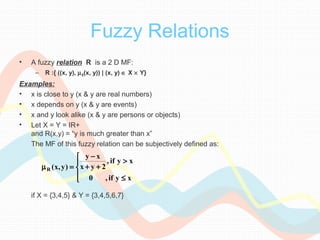
• A fuzzy relation R is a 2 D MF:
– R :{ ((x, y), µR(x, y)) | (x, y) ∈ X × Y}
Examples:
• x is close to y (x & y are real numbers)
• x depends on y (x & y are events)
• x and y look alike (x & y are persons or objects)
• Let X = Y = IR+
and R(x,y) = “y is much greater than x”
The MF of this fuzzy relation can be subjectively defined as:
if X = {3,4,5} & Y = {3,4,5,6,7}





≤
>
++
−
=µ
xyif,0
xyif,
2yx
xy
)y,x(R
Extension Principle
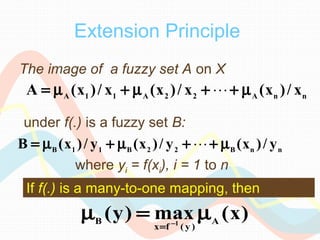
The image of a fuzzy set A on X
nnA22A11A
x/)x(x/)x(x/)x(A µ++µ+µ= 
under f(.) is a fuzzy set B:
nnB22B11B
y/)x(y/)x(y/)x(B µ++µ+µ= 
where yi = f(xi), i = 1 to n
If f(.) is a many-to-one mapping, then
)x(max)y( A
)y(fx
B 1
µ=µ −
=
Defintion: Extension Principle
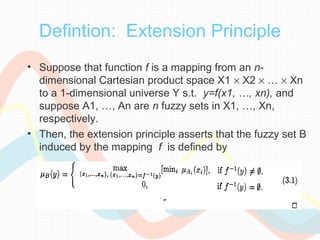
• Suppose that function f is a mapping from an n-
dimensional Cartesian product space X1 × X2 × … × Xn
to a 1-dimensional universe Y s.t. y=f(x1, …, xn), and
suppose A1, …, An are n fuzzy sets in X1, …, Xn,
respectively.
• Then, the extension principle asserts that the fuzzy set B
induced by the mapping f is defined by
Example
– Application of the extension principle to fuzzy
sets with discrete universes
Let A = 0.1 / -2+0.4 / -1+0.8 / 0+0.9 / 1+0.3 / 2
and f(x) = x2 – 3
• Applying the extension principle, we obtain:
B = 0.1 / 1+0.4 / -2+0.8 / -3+0.9 / -2+0.3 /1
= 0.8 / -3+(0.4V0.9) / -2+(0.1V0.3) / 1
= 0.8 / -3+0.9 / -2+0.3 / 1
where “V” represents the “max” operator, Same
reasoning for continuous universes
Max-Min Composition
The max-min composition of two fuzzy relations
R1 (defined on X and Y) and R2 (defined on Y and
Z) is
Properties:
– Associativity:
– Distributivity over union:
– Week distributivity over intersection:
– Monotonicity:
µ µ µR R
y
R Rx z x y y z1 2 1 2 ( , ) [ ( , ) ( , )]= ∨ ∧
R S T R S R T    ( ) ( ) ( )=
R S T R S T   ( ) ( )=
R S T R S R T    ( ) ( ) ( )⊆
S T R S R T⊆ ⇒ ⊆( ) ( ) 
Max-Star Composition
• Max-product composition:
• In general, we have max-* composition:
where * is a T-norm operator.
µ µ µR R
y
R Rx z x y y z1 2 1 2 ( , ) [ ( , ) ( , )]= ∨
µ µ µR R
y
R Rx z x y y z1 2 1 2 ( , ) [ ( , )* ( , )]= ∨
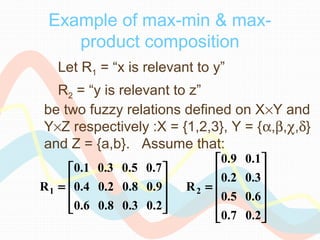
Example of max-min & max-
product composition
Let R1 = “x is relevant to y”
R2 = “y is relevant to z”
be two fuzzy relations defined on X×Y and
Y×Z respectively :X = {1,2,3}, Y = {α,β,χ,δ}
and Z = {a,b}. Assume that:












=










=
0.20.7
0.60.5
0.30.2
0.19.0
R
0.20.30.80.6
0.90.80.20.4
0.70.50.31.0
R 21
R1oR2 may be interpreted as the derived fuzzy
relation “x is relevant to z” based on R1 & R2
Let’s assume that we want to compute the
degree of relevance between 2 ∈ X & a ∈ Z
Using max-min, we obtain:
{ }
{ }
0.7
5,0.70.4,0.2,0.max
7.09.0,5.08.0,2.02.0,9.04.0max)a,2(2R1R
=
=
∧∧∧∧=µ 
{ }
{ }
0.63
0.40,0.630.36,0.04,max
7.0*9.0,5.0*8.0,2.0*2.0,9.0*4.0max)a,2(2R1R
=
=
=µ 
Using max-product composition, we obtain:
Linguistic variables
• The concept of linguistic variables introduced
by Zadeh is an alternative approach to
modeling human thinking.
• Information is expressed in terms of
fuzzy sets instead of crisp numbers
Example
• numerical values: Age = 65
*A linguistic variables takes linguistic values Age is old
*A linguistic value is a fuzzy set
*All linguistic values form a term set
T(age) = {young, not young, very young, ..., middle
aged, not middle aged, ..., old, not old, very old, more or
less old, ...,not very young and A numerical variable
takes not very old, ...}
Where each term T(age) is characterized by fuzzy
set of a universe of discourse X= = [0,100]
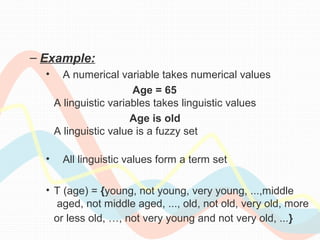
– Example:
• A numerical variable takes numerical values
Age = 65
A linguistic variables takes linguistic values
Age is old
A linguistic value is a fuzzy set
• All linguistic values form a term set
• T (age) = {young, not young, very young, ...,middle
aged, not middle aged, ..., old, not old, very old, more
or less old, …, not very young and not very old, ...}
Linguistic variables
• Where each term T(age) is
characterized by a fuzzy set of a
universe of discourse X= [0,100]
Operations on linguistic variables
– Let A be a linguistic value described by a fuzzy set
with membership function µA(.)
– is a modified version of the original linguistic value.
– A2 = CON(A) is called the concentration operation
√A = DIL(A) is called the dilation operation
– CON(A) & DIL(A) are useful in expression the hedges such as
“very” & “more or less” in the linguistic term A
– Other definitions for linguistic hedges are also possible
∫ µ=
X
k
A
k
x/)]x([A
Linguistic variables
– Composite linguistic terms
– Let’s define:
– where A, B are two linguistic values whose
semantics are respectively defined by
µA(.) & µB(.)
– Composite linguistic terms such as: “not very
young”, “not very old” & “young but not too young”
can be easily characterized
∫
∫
∫
µ∨µ=∪=
µ∧µ=∩=
µ−=¬=
X
BA
X
BA
X
A
x/)]x()x([BABorA
x/)]x()x([BABandA
,x/)]x(1[A)A(NOT
Linguistic variables
– Example: Construction of MFs for composite
linguistic terms. Let’s define
– Where x is the age of a person in the universe of
discourse [0,100]
• More or less = DIL(old) = √old =
6old
4young
30
100x
1
1
)100,3,30,x(bell)x(
20
x
1
1
)0,2,20,x(bell)x(





 −
+
==µ






+
==µ
x/
30
100x
1
1
X
6∫





 −
+
k2x
1
1
),k,,x(bell)x((...)






σ
µ−
+
=µσ=µ
Linguistic variables
• Not young and not old = ¬young ∩ ¬old =
• Young but not too young = young ∩ ¬young2 (too =
very) =
• Extremely old ≡ very very very old = CON
(CON(CON(old))) =
x/
30
100x
1
1
1
20
x
1
1
1 6
X
4

















 −
+
−∧


















+
−∫
∫


































+
−∧


















+x
2
44
x/
20
x
1
1
1
20
x
1
1
∫

















 −
+x
8
6
x/
30
100x
1
1
Linguistic variables
– Contrast intensification
– the operation of contrast intensification on a
linguistic value A is defined by
• INT increases the values of µA(x) which are greater
than 0.5 & decreases those which are less or equal
that 0.5
• Contrast intensification has effect of reducing the
fuzziness of the linguistic value A




≤µ≤¬¬
≤µ≤
=
1)x(0.5if)A(2
5.0)x(0ifA2
)A(INT
A
2
A
2
Linguistic variables
– Orthogonality
• A term set T = t1,…, tn of a linguistic variable x on the
universe X is orthogonal if:
• Where the ti’s are convex & normal fuzzy sets
defined on X.
∑
=
∈∀=µ
n
1i
it Xx,1)x(
Fuzzy if-then rules
• General format:
– If x is A then y is B
(where A & B are linguistic values defined by fuzzy sets
on universes of discourse X & Y).
• “x is A” is called the antecedent or premise
• “y is B” is called the consequence or conclusion
– Examples:
• If pressure is high, then volume is small.
• If the road is slippery, then driving is dangerous.
• If a tomato is red, then it is ripe.
• If the speed is high, then apply the brake a little.
Fuzzy If-Then Rules
A coupled with B A entails B
Two ways to interpret “If x is A then y is B”:
Fuzzy if-then rules
• Note that R can be viewed as a fuzzy set with a
two-dimensional MF
µR(x, y) = f(µA(x), µB(y)) = f(a, b)
• With a = µA(x), b = µB(y) and f called the fuzzy
implication function provides the membership
value of (x, y)
Fuzzy if-then rules
– Case of “A coupled with B” (A and B)
(minimum operator proposed by Mamdani, 1975)
(product proposed by Larsen, 1980)
(bounded product operator)
∫ ∧==
YX
BAm yxyxBAR
*
),/()()(* µµ
)y,x/()y()x(B*AR
Y*X
BAp ∫ µµ==
)y,x/()1)y()x((0
)y,x/()y()x(B*AR
BA
Y*X
Y*X
BAbp
−µ+µ∨=
µ⊗µ==
∫
∫
Fuzzy if-then rules
• Fuzzy implication function:
A coupled with B
µA(x)=bell(x;4,3,10) and µB(y)=bell(y;4,3,10)
µ µ µR A Bx y f x y f a b( , ) ( ( ), ( )) ( , )= =
Fuzzy if-then rules
– Case of “A entails B” (not A or B)
(Zadeh’s arithmetic rule by using bounded sum
operator for union)
(Zadeh’s max-min rule)
)ba1(1)b,a(f:where
)y,x/()y()x(1(1BAR
a
Y*X
BAa
+−∧=
µ+µ−∧=∪¬= ∫
)ba()a1()b,a(f:where
)y,x/())y()x(())x(1()BA(AR
m
Y*X
BAAmm
∧∨−=
µ∧µ∨µ−=∩∪¬= ∫
Fuzzy if-then rules
(Boolean fuzzy implication with max for union)
(Goguen’s fuzzy implication with algebraic product for T-norm)
b)a1()b,a(f:where
)y,x/()y())x(1(BAR
s
Y*X
BAs
∨−=
µ∨µ−=∪¬= ∫


 ≤
=<
µ<µ= ∫∆
otherwisea/b
baif1
b~a:where
)y,x/())y(~)x((R
Y*X
BA
Fuzzy if-then rules
A entails B
Fuzzy Reasoning
– Known also as approximate reasoning
– It is an inference procedure that derives
conclusions from a set of fuzzy if-then-rules &
known facts
– The compositional rule of inference plays a key
role in F.R.
– Using the compositional rule of inference, an
inference procedure upon a set of fuzzy if-
then rules are formalized.
Compositional Rule of Inference
Derivation of y = b from x = a and y = f(x):
a and b: points
y = f(x) : a curve
x
y
a
b
y = f(x)
a
b
y
x
a and b: intervals
y = f(x) : an interval-valued
function
y = f(x)
Compositional Rule of Inference
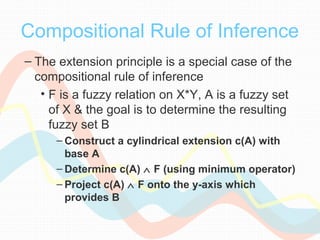
– The extension principle is a special case of the
compositional rule of inference
• F is a fuzzy relation on X*Y, A is a fuzzy set
of X & the goal is to determine the resulting
fuzzy set B
– Construct a cylindrical extension c(A) with
base A
– Determine c(A) ∧ F (using minimum operator)
– Project c(A) ∧ F onto the y-axis which
provides B
Compositional Rule of Inference
• a is a fuzzy set and y = f(x) is a fuzzy relation:
Compositional Rule of Inference
B?
(a) F: X × Y
(b) c(A)
(c) c(A)∩F
(d) Y as a
fuzzy
set B
on the
y-axis.
Compositional Rule of Inference
(a) F: X × Y µF(x,y)
(b) c(A) µc(A)(x,y) = µA(x)
(c) c(A)∩F µc(A)∩F(x,y) = min[µc(A)(x,y), µF(x,y)]
= min[µA(x), µF(x,y)]
= ∧ [µA(x), µF(x,y)]
(d) Y as a fuzzy set B on the y-axis.
µB(y) = maxx min[µA(x), µF(x,y)]
= ∨x [µA(x) ∧ µF(x,y)]
B? B = A ° F
f) Extension principle is a special case of the compositional
rule of inference:
µ µB
x f y
Ay x( ) max ( )
( )
=
= −1
Fuzzy Reasoning
• Given A, A ⇒ B, infer B
– A = “today is sunny”
– A ⇒ B: day = sunny then sky = blue
infer: “sky is blue”
• illustration
– Premise 1 (fact): x is A
– Premise 2 (rule): if x is A then y is B
– Consequence: y is B
Fuzzy Reasoning
• Approximation
A’ = “ today is more or less sunny”
B’ = “ sky is more or less blue”
• illustration
Premise 1 (fact): x is A’
Premise 2 (rule): if x is A then y is B
Consequence: y is B’
(approximate reasoning or fuzzy reasoning!)
Fuzzy Reasoning (Approximate Reasoning)
Approximate Reasoning ⇔ Fuzzy Reasoning
Definition:
Let A, A’, and B be fuzzy sets of X, X, and Y,
respectively. Assume that the fuzzy implication
A→B is expressed as a fuzzy relation R on X×Y.
Then, the fuzzy set B induced by “x is A′ ” and the
fuzzy rule “if x is A then y is B” is defined by
µB′ (y) = maxx min [µA′ (x), µR (x,y)]
= ∨x [µA′ (x) ∧ µR (x,y)]
⇔ B′ = A′ ° R = A′ ° (A→B)
Mamdani’s fuzzy implication functions and max-min
composition for simplicity and their wide applicability.
Fuzzy Reasoning (Approximate Reasoning)
Y
x is A’
Y
A
X
w
A’ B
B’
A’
X
y is B’
• Single rule with single antecedent
– Rule: if x is A then y is B
– Fact: x is A’ µB′ (y) = [∨x (µA′ (x) ∧ µA (x))] ∧ µB (y)
– Conclusion: y is B’ = w ∧ µB (y)
• Graphic Representation:
Fuzzy Reasoning
– Single rule with multiple antecedents
• Premise 1 (fact): x is A’ and y is B’
• Premise 2 (rule): if x is A and y is B then z is C
• Conclusion: z is C’
• Premise 2: A*B  C
[ ] [ ]
[ ]{ }
[ ]{ } [ ]{ }
)z()w(w
)z()y()y()x()x(
)z()y()x()y()x(
)z()y()x()y()x()z(
)CB*A()'B'*A('C
)z,y,x/()z()y()x(C*)B*A()C,B,A(R
C21
C
2w
B'By
w
A'Ax
CBA'B'Ay,x
CBA'B'Ay,x'C
2premise1premise
CB
Z*Y*X
Amamdani
1
µ∧∧=
µ∧µ∧µ∨∧µ∧µ∨=
µ∧µ∧µ∧µ∧µ∨=
µ∧µ∧µ∧µ∧µ∨=µ
→=
µ∧µ∧µ== ∫
    



Fuzzy Reasoning
A B
T-norm
X Y
w
A’ B’ C2
Z
C’
Z
X Y
A’ B’
x is A’ y is B’ z is C’
Fuzzy Reasoning
– Multiple rules with multiple antecedents
Premise 1 (fact): x is A’ and y is B’
Premise 2 (rule 1): if x is A1 and y is B1 then z is C1
Premise 3 (rule 2): If x is A2 and y is B2 then z is C2
Consequence (conclusion): z is C’
R1 = A1 * B1  C1
R2 = A2 * B2  C2
Since the max-min composition operator o is distributive over
the union operator, it follows:
C’ = (A’ * B’) o (R1 ∪ R2) = [(A’ * B’) o R1] ∪ [(A’ * B’) o R2]
= C’1 ∪ C’2
Where C’1 & C’2 are the inferred fuzzy set for rules 1 & 2
respectively
Fuzzy Reasoning
A1 B1
A2 B2
T-norm
X
X
Y
Y
w1
w2
A’
A’ B’
B’ C1
C2
Z
Z
C’
Z
X Y
A’ B’
x is A’ y is B’ z is C’

Ch02 fuzzyrelation

  • 1.
  • 2.
    Fuzzy Relations • Afuzzy relation R is a 2 D MF: – R :{ ((x, y), µR(x, y)) | (x, y) ∈ X × Y} Examples: • x is close to y (x & y are real numbers) • x depends on y (x & y are events) • x and y look alike (x & y are persons or objects) • Let X = Y = IR+ and R(x,y) = “y is much greater than x” The MF of this fuzzy relation can be subjectively defined as: if X = {3,4,5} & Y = {3,4,5,6,7}      ≤ > ++ − =µ xyif,0 xyif, 2yx xy )y,x(R
  • 3.
    Extension Principle The imageof a fuzzy set A on X nnA22A11A x/)x(x/)x(x/)x(A µ++µ+µ=  under f(.) is a fuzzy set B: nnB22B11B y/)x(y/)x(y/)x(B µ++µ+µ=  where yi = f(xi), i = 1 to n If f(.) is a many-to-one mapping, then )x(max)y( A )y(fx B 1 µ=µ − =
  • 4.
    Defintion: Extension Principle •Suppose that function f is a mapping from an n- dimensional Cartesian product space X1 × X2 × … × Xn to a 1-dimensional universe Y s.t. y=f(x1, …, xn), and suppose A1, …, An are n fuzzy sets in X1, …, Xn, respectively. • Then, the extension principle asserts that the fuzzy set B induced by the mapping f is defined by
  • 5.
    Example – Application ofthe extension principle to fuzzy sets with discrete universes Let A = 0.1 / -2+0.4 / -1+0.8 / 0+0.9 / 1+0.3 / 2 and f(x) = x2 – 3 • Applying the extension principle, we obtain: B = 0.1 / 1+0.4 / -2+0.8 / -3+0.9 / -2+0.3 /1 = 0.8 / -3+(0.4V0.9) / -2+(0.1V0.3) / 1 = 0.8 / -3+0.9 / -2+0.3 / 1 where “V” represents the “max” operator, Same reasoning for continuous universes
  • 6.
    Max-Min Composition The max-mincomposition of two fuzzy relations R1 (defined on X and Y) and R2 (defined on Y and Z) is Properties: – Associativity: – Distributivity over union: – Week distributivity over intersection: – Monotonicity: µ µ µR R y R Rx z x y y z1 2 1 2 ( , ) [ ( , ) ( , )]= ∨ ∧ R S T R S R T    ( ) ( ) ( )= R S T R S T   ( ) ( )= R S T R S R T    ( ) ( ) ( )⊆ S T R S R T⊆ ⇒ ⊆( ) ( ) 
  • 7.
    Max-Star Composition • Max-productcomposition: • In general, we have max-* composition: where * is a T-norm operator. µ µ µR R y R Rx z x y y z1 2 1 2 ( , ) [ ( , ) ( , )]= ∨ µ µ µR R y R Rx z x y y z1 2 1 2 ( , ) [ ( , )* ( , )]= ∨
  • 8.
    Example of max-min& max- product composition Let R1 = “x is relevant to y” R2 = “y is relevant to z” be two fuzzy relations defined on X×Y and Y×Z respectively :X = {1,2,3}, Y = {α,β,χ,δ} and Z = {a,b}. Assume that:             =           = 0.20.7 0.60.5 0.30.2 0.19.0 R 0.20.30.80.6 0.90.80.20.4 0.70.50.31.0 R 21
  • 9.
    R1oR2 may beinterpreted as the derived fuzzy relation “x is relevant to z” based on R1 & R2 Let’s assume that we want to compute the degree of relevance between 2 ∈ X & a ∈ Z Using max-min, we obtain: { } { } 0.7 5,0.70.4,0.2,0.max 7.09.0,5.08.0,2.02.0,9.04.0max)a,2(2R1R = = ∧∧∧∧=µ  { } { } 0.63 0.40,0.630.36,0.04,max 7.0*9.0,5.0*8.0,2.0*2.0,9.0*4.0max)a,2(2R1R = = =µ  Using max-product composition, we obtain:
  • 10.
    Linguistic variables • Theconcept of linguistic variables introduced by Zadeh is an alternative approach to modeling human thinking. • Information is expressed in terms of fuzzy sets instead of crisp numbers
  • 11.
    Example • numerical values:Age = 65 *A linguistic variables takes linguistic values Age is old *A linguistic value is a fuzzy set *All linguistic values form a term set T(age) = {young, not young, very young, ..., middle aged, not middle aged, ..., old, not old, very old, more or less old, ...,not very young and A numerical variable takes not very old, ...} Where each term T(age) is characterized by fuzzy set of a universe of discourse X= = [0,100]
  • 12.
    – Example: • Anumerical variable takes numerical values Age = 65 A linguistic variables takes linguistic values Age is old A linguistic value is a fuzzy set • All linguistic values form a term set • T (age) = {young, not young, very young, ...,middle aged, not middle aged, ..., old, not old, very old, more or less old, …, not very young and not very old, ...}
  • 13.
    Linguistic variables • Whereeach term T(age) is characterized by a fuzzy set of a universe of discourse X= [0,100]
  • 14.
    Operations on linguisticvariables – Let A be a linguistic value described by a fuzzy set with membership function µA(.) – is a modified version of the original linguistic value. – A2 = CON(A) is called the concentration operation √A = DIL(A) is called the dilation operation – CON(A) & DIL(A) are useful in expression the hedges such as “very” & “more or less” in the linguistic term A – Other definitions for linguistic hedges are also possible ∫ µ= X k A k x/)]x([A
  • 15.
    Linguistic variables – Compositelinguistic terms – Let’s define: – where A, B are two linguistic values whose semantics are respectively defined by µA(.) & µB(.) – Composite linguistic terms such as: “not very young”, “not very old” & “young but not too young” can be easily characterized ∫ ∫ ∫ µ∨µ=∪= µ∧µ=∩= µ−=¬= X BA X BA X A x/)]x()x([BABorA x/)]x()x([BABandA ,x/)]x(1[A)A(NOT
  • 16.
    Linguistic variables – Example:Construction of MFs for composite linguistic terms. Let’s define – Where x is the age of a person in the universe of discourse [0,100] • More or less = DIL(old) = √old = 6old 4young 30 100x 1 1 )100,3,30,x(bell)x( 20 x 1 1 )0,2,20,x(bell)x(       − + ==µ       + ==µ x/ 30 100x 1 1 X 6∫       − + k2x 1 1 ),k,,x(bell)x((...)       σ µ− + =µσ=µ
  • 17.
    Linguistic variables • Notyoung and not old = ¬young ∩ ¬old = • Young but not too young = young ∩ ¬young2 (too = very) = • Extremely old ≡ very very very old = CON (CON(CON(old))) = x/ 30 100x 1 1 1 20 x 1 1 1 6 X 4                   − + −∧                   + −∫ ∫                                   + −∧                   +x 2 44 x/ 20 x 1 1 1 20 x 1 1 ∫                   − +x 8 6 x/ 30 100x 1 1
  • 19.
    Linguistic variables – Contrastintensification – the operation of contrast intensification on a linguistic value A is defined by • INT increases the values of µA(x) which are greater than 0.5 & decreases those which are less or equal that 0.5 • Contrast intensification has effect of reducing the fuzziness of the linguistic value A     ≤µ≤¬¬ ≤µ≤ = 1)x(0.5if)A(2 5.0)x(0ifA2 )A(INT A 2 A 2
  • 21.
    Linguistic variables – Orthogonality •A term set T = t1,…, tn of a linguistic variable x on the universe X is orthogonal if: • Where the ti’s are convex & normal fuzzy sets defined on X. ∑ = ∈∀=µ n 1i it Xx,1)x(
  • 22.
    Fuzzy if-then rules •General format: – If x is A then y is B (where A & B are linguistic values defined by fuzzy sets on universes of discourse X & Y). • “x is A” is called the antecedent or premise • “y is B” is called the consequence or conclusion – Examples: • If pressure is high, then volume is small. • If the road is slippery, then driving is dangerous. • If a tomato is red, then it is ripe. • If the speed is high, then apply the brake a little.
  • 23.
    Fuzzy If-Then Rules Acoupled with B A entails B Two ways to interpret “If x is A then y is B”:
  • 24.
    Fuzzy if-then rules •Note that R can be viewed as a fuzzy set with a two-dimensional MF µR(x, y) = f(µA(x), µB(y)) = f(a, b) • With a = µA(x), b = µB(y) and f called the fuzzy implication function provides the membership value of (x, y)
  • 25.
    Fuzzy if-then rules –Case of “A coupled with B” (A and B) (minimum operator proposed by Mamdani, 1975) (product proposed by Larsen, 1980) (bounded product operator) ∫ ∧== YX BAm yxyxBAR * ),/()()(* µµ )y,x/()y()x(B*AR Y*X BAp ∫ µµ== )y,x/()1)y()x((0 )y,x/()y()x(B*AR BA Y*X Y*X BAbp −µ+µ∨= µ⊗µ== ∫ ∫
  • 26.
    Fuzzy if-then rules •Fuzzy implication function: A coupled with B µA(x)=bell(x;4,3,10) and µB(y)=bell(y;4,3,10) µ µ µR A Bx y f x y f a b( , ) ( ( ), ( )) ( , )= =
  • 27.
    Fuzzy if-then rules –Case of “A entails B” (not A or B) (Zadeh’s arithmetic rule by using bounded sum operator for union) (Zadeh’s max-min rule) )ba1(1)b,a(f:where )y,x/()y()x(1(1BAR a Y*X BAa +−∧= µ+µ−∧=∪¬= ∫ )ba()a1()b,a(f:where )y,x/())y()x(())x(1()BA(AR m Y*X BAAmm ∧∨−= µ∧µ∨µ−=∩∪¬= ∫
  • 28.
    Fuzzy if-then rules (Booleanfuzzy implication with max for union) (Goguen’s fuzzy implication with algebraic product for T-norm) b)a1()b,a(f:where )y,x/()y())x(1(BAR s Y*X BAs ∨−= µ∨µ−=∪¬= ∫    ≤ =< µ<µ= ∫∆ otherwisea/b baif1 b~a:where )y,x/())y(~)x((R Y*X BA
  • 29.
  • 30.
    Fuzzy Reasoning – Knownalso as approximate reasoning – It is an inference procedure that derives conclusions from a set of fuzzy if-then-rules & known facts – The compositional rule of inference plays a key role in F.R. – Using the compositional rule of inference, an inference procedure upon a set of fuzzy if- then rules are formalized.
  • 31.
    Compositional Rule ofInference Derivation of y = b from x = a and y = f(x): a and b: points y = f(x) : a curve x y a b y = f(x) a b y x a and b: intervals y = f(x) : an interval-valued function y = f(x)
  • 32.
    Compositional Rule ofInference – The extension principle is a special case of the compositional rule of inference • F is a fuzzy relation on X*Y, A is a fuzzy set of X & the goal is to determine the resulting fuzzy set B – Construct a cylindrical extension c(A) with base A – Determine c(A) ∧ F (using minimum operator) – Project c(A) ∧ F onto the y-axis which provides B
  • 33.
    Compositional Rule ofInference • a is a fuzzy set and y = f(x) is a fuzzy relation: Compositional Rule of Inference B? (a) F: X × Y (b) c(A) (c) c(A)∩F (d) Y as a fuzzy set B on the y-axis.
  • 34.
    Compositional Rule ofInference (a) F: X × Y µF(x,y) (b) c(A) µc(A)(x,y) = µA(x) (c) c(A)∩F µc(A)∩F(x,y) = min[µc(A)(x,y), µF(x,y)] = min[µA(x), µF(x,y)] = ∧ [µA(x), µF(x,y)] (d) Y as a fuzzy set B on the y-axis. µB(y) = maxx min[µA(x), µF(x,y)] = ∨x [µA(x) ∧ µF(x,y)] B? B = A ° F f) Extension principle is a special case of the compositional rule of inference: µ µB x f y Ay x( ) max ( ) ( ) = = −1
  • 35.
    Fuzzy Reasoning • GivenA, A ⇒ B, infer B – A = “today is sunny” – A ⇒ B: day = sunny then sky = blue infer: “sky is blue” • illustration – Premise 1 (fact): x is A – Premise 2 (rule): if x is A then y is B – Consequence: y is B
  • 36.
    Fuzzy Reasoning • Approximation A’= “ today is more or less sunny” B’ = “ sky is more or less blue” • illustration Premise 1 (fact): x is A’ Premise 2 (rule): if x is A then y is B Consequence: y is B’ (approximate reasoning or fuzzy reasoning!)
  • 37.
    Fuzzy Reasoning (ApproximateReasoning) Approximate Reasoning ⇔ Fuzzy Reasoning Definition: Let A, A’, and B be fuzzy sets of X, X, and Y, respectively. Assume that the fuzzy implication A→B is expressed as a fuzzy relation R on X×Y. Then, the fuzzy set B induced by “x is A′ ” and the fuzzy rule “if x is A then y is B” is defined by µB′ (y) = maxx min [µA′ (x), µR (x,y)] = ∨x [µA′ (x) ∧ µR (x,y)] ⇔ B′ = A′ ° R = A′ ° (A→B) Mamdani’s fuzzy implication functions and max-min composition for simplicity and their wide applicability.
  • 38.
    Fuzzy Reasoning (ApproximateReasoning) Y x is A’ Y A X w A’ B B’ A’ X y is B’ • Single rule with single antecedent – Rule: if x is A then y is B – Fact: x is A’ µB′ (y) = [∨x (µA′ (x) ∧ µA (x))] ∧ µB (y) – Conclusion: y is B’ = w ∧ µB (y) • Graphic Representation:
  • 39.
    Fuzzy Reasoning – Singlerule with multiple antecedents • Premise 1 (fact): x is A’ and y is B’ • Premise 2 (rule): if x is A and y is B then z is C • Conclusion: z is C’ • Premise 2: A*B  C [ ] [ ] [ ]{ } [ ]{ } [ ]{ } )z()w(w )z()y()y()x()x( )z()y()x()y()x( )z()y()x()y()x()z( )CB*A()'B'*A('C )z,y,x/()z()y()x(C*)B*A()C,B,A(R C21 C 2w B'By w A'Ax CBA'B'Ay,x CBA'B'Ay,x'C 2premise1premise CB Z*Y*X Amamdani 1 µ∧∧= µ∧µ∧µ∨∧µ∧µ∨= µ∧µ∧µ∧µ∧µ∨= µ∧µ∧µ∧µ∧µ∨=µ →= µ∧µ∧µ== ∫        
  • 40.
    Fuzzy Reasoning A B T-norm XY w A’ B’ C2 Z C’ Z X Y A’ B’ x is A’ y is B’ z is C’
  • 41.
    Fuzzy Reasoning – Multiplerules with multiple antecedents Premise 1 (fact): x is A’ and y is B’ Premise 2 (rule 1): if x is A1 and y is B1 then z is C1 Premise 3 (rule 2): If x is A2 and y is B2 then z is C2 Consequence (conclusion): z is C’ R1 = A1 * B1  C1 R2 = A2 * B2  C2 Since the max-min composition operator o is distributive over the union operator, it follows: C’ = (A’ * B’) o (R1 ∪ R2) = [(A’ * B’) o R1] ∪ [(A’ * B’) o R2] = C’1 ∪ C’2 Where C’1 & C’2 are the inferred fuzzy set for rules 1 & 2 respectively
  • 42.
    Fuzzy Reasoning A1 B1 A2B2 T-norm X X Y Y w1 w2 A’ A’ B’ B’ C1 C2 Z Z C’ Z X Y A’ B’ x is A’ y is B’ z is C’