PEE-102A
Fundamentals of Electrical Engineering
Lecture-2
Instructor:
Mohd. Umar Rehman
EES, University Polytechnic, AMU
PEE-102A U-I, L-2 1 / 17
Kirchhoff’s Laws
Circuit Terminology
Please see the following link before Lecture-2:
Khan Academy
PEE-102A U-I, L-2 3 / 17
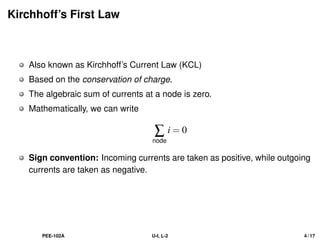
Kirchhoff’s First Law
Also known as Kirchhoff’s Current Law (KCL)
Based on the conservation of charge.
The algebraic sum of currents at a node is zero.
Mathematically, we can write
∑
node
i = 0
Sign convention: Incoming currents are taken as positive, while outgoing
currents are taken as negative.
PEE-102A U-I, L-2 4 / 17
Kirchhoff’s First Law...Contd
PEE-102A U-I, L-2 5 / 17
Kirchhoff’s First Law...Contd
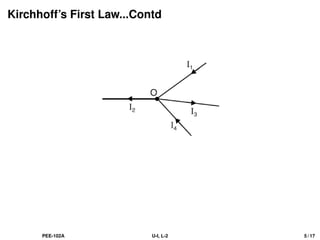
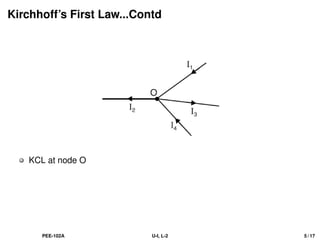
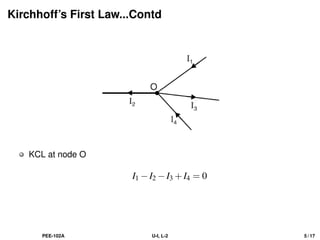
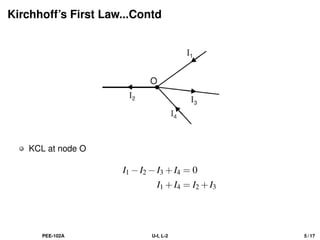
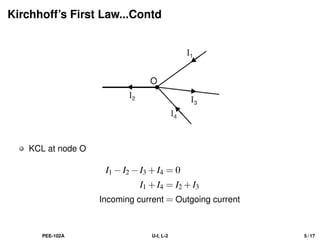
KCL at node O
PEE-102A U-I, L-2 5 / 17
Kirchhoff’s First Law...Contd
KCL at node O
I1 −I2 −I3 +I4 = 0
PEE-102A U-I, L-2 5 / 17
Kirchhoff’s First Law...Contd
KCL at node O
I1 −I2 −I3 +I4 = 0
I1 +I4 = I2 +I3
PEE-102A U-I, L-2 5 / 17
Kirchhoff’s First Law...Contd
KCL at node O
I1 −I2 −I3 +I4 = 0
I1 +I4 = I2 +I3
Incoming current = Outgoing current
PEE-102A U-I, L-2 5 / 17
Kirchhoff’s First Law...Contd
PEE-102A U-I, L-2 6 / 17
Kirchhoff’s First Law...Contd
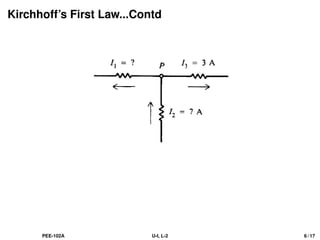
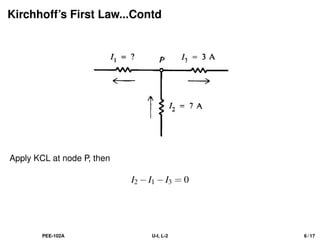
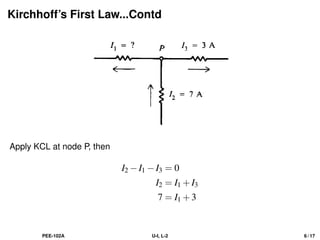
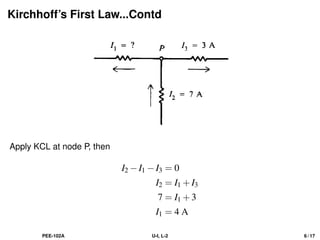
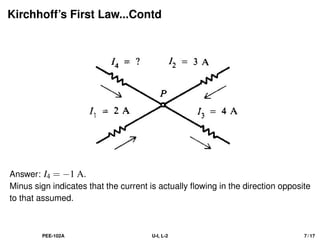
Apply KCL at node P, then
I2 −I1 −I3 = 0
PEE-102A U-I, L-2 6 / 17
Kirchhoff’s First Law...Contd
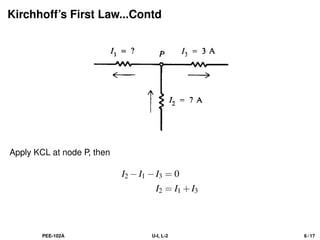
Apply KCL at node P, then
I2 −I1 −I3 = 0
I2 = I1 +I3
PEE-102A U-I, L-2 6 / 17
Kirchhoff’s First Law...Contd
Apply KCL at node P, then
I2 −I1 −I3 = 0
I2 = I1 +I3
7 = I1 +3
PEE-102A U-I, L-2 6 / 17
Kirchhoff’s First Law...Contd
Apply KCL at node P, then
I2 −I1 −I3 = 0
I2 = I1 +I3
7 = I1 +3
I1 = 4 A
PEE-102A U-I, L-2 6 / 17
Kirchhoff’s First Law...Contd
PEE-102A U-I, L-2 7 / 17
Kirchhoff’s First Law...Contd
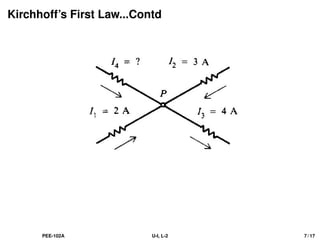
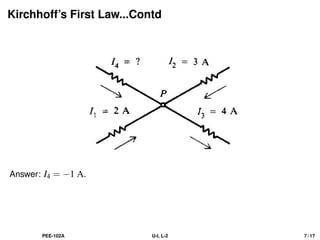
Answer: I4 = −1 A.
PEE-102A U-I, L-2 7 / 17
Kirchhoff’s First Law...Contd
Answer: I4 = −1 A.
Minus sign indicates that the current is actually flowing in the direction opposite
to that assumed.
PEE-102A U-I, L-2 7 / 17
Kirchhoff’s Second Law
Also known as Kirchhoff’s Voltage Law (KVL)
Based on the conservation of energy.
The algebraic sum of voltages in a closed loop is zero.
Mathematically, we can write
∑
loop
v = 0
Sign convention: Voltage rise is taken as positive, while voltage drop is
taken as negative.
Another form is: Voltage Rise = Voltage drop
PEE-102A U-I, L-2 8 / 17
Kirchhoff’s Second Law...Contd
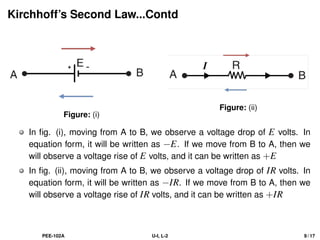
Figure: (i)
Figure: (ii)
In fig. (i), moving from A to B, we observe a voltage drop of E volts. In
equation form, it will be written as −E. If we move from B to A, then we
will observe a voltage rise of E volts, and it can be written as +E
In fig. (ii), moving from A to B, we observe a voltage drop of IR volts. In
equation form, it will be written as −IR. If we move from B to A, then we
will observe a voltage rise of IR volts, and it can be written as +IR
PEE-102A U-I, L-2 9 / 17
Illustration 1
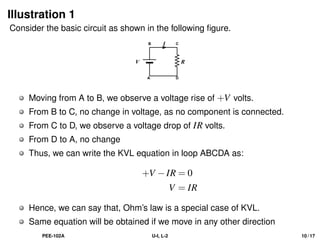
Consider the basic circuit as shown in the following figure.
V R
I
A
B C
D
Moving from A to B, we observe a voltage rise of +V volts.
From B to C, no change in voltage, as no component is connected.
From C to D, we observe a voltage drop of IR volts.
From D to A, no change
Thus, we can write the KVL equation in loop ABCDA as:
+V −IR = 0
V = IR
Hence, we can say that, Ohm’s law is a special case of KVL.
Same equation will be obtained if we move in any other direction
PEE-102A U-I, L-2 10 / 17
Illustration 2
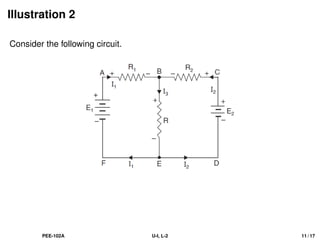
Consider the following circuit.
PEE-102A U-I, L-2 11 / 17
Illustration 2
Consider the following circuit.
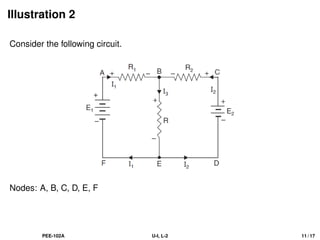
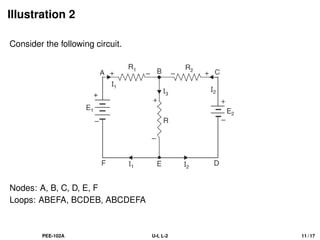
Nodes: A, B, C, D, E, F
PEE-102A U-I, L-2 11 / 17
Illustration 2
Consider the following circuit.
Nodes: A, B, C, D, E, F
Loops: ABEFA, BCDEB, ABCDEFA
PEE-102A U-I, L-2 11 / 17
Illustration 2...Contd
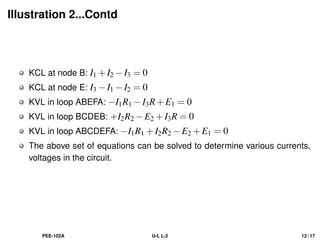
KCL at node B: I1 +I2 −I3 = 0
PEE-102A U-I, L-2 12 / 17
Illustration 2...Contd
KCL at node B: I1 +I2 −I3 = 0
KCL at node E: I3 −I1 −I2 = 0
PEE-102A U-I, L-2 12 / 17
Illustration 2...Contd
KCL at node B: I1 +I2 −I3 = 0
KCL at node E: I3 −I1 −I2 = 0
KVL in loop ABEFA: −I1R1 −I3R+E1 = 0
PEE-102A U-I, L-2 12 / 17
Illustration 2...Contd
KCL at node B: I1 +I2 −I3 = 0
KCL at node E: I3 −I1 −I2 = 0
KVL in loop ABEFA: −I1R1 −I3R+E1 = 0
KVL in loop BCDEB: +I2R2 −E2 +I3R = 0
PEE-102A U-I, L-2 12 / 17
Illustration 2...Contd
KCL at node B: I1 +I2 −I3 = 0
KCL at node E: I3 −I1 −I2 = 0
KVL in loop ABEFA: −I1R1 −I3R+E1 = 0
KVL in loop BCDEB: +I2R2 −E2 +I3R = 0
KVL in loop ABCDEFA: −I1R1 +I2R2 −E2 +E1 = 0
PEE-102A U-I, L-2 12 / 17
Illustration 2...Contd
KCL at node B: I1 +I2 −I3 = 0
KCL at node E: I3 −I1 −I2 = 0
KVL in loop ABEFA: −I1R1 −I3R+E1 = 0
KVL in loop BCDEB: +I2R2 −E2 +I3R = 0
KVL in loop ABCDEFA: −I1R1 +I2R2 −E2 +E1 = 0
The above set of equations can be solved to determine various currents,
voltages in the circuit.
PEE-102A U-I, L-2 12 / 17
Illustration 3
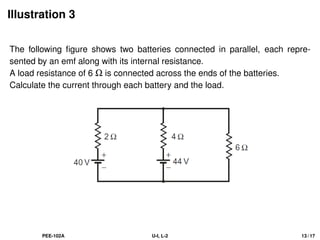
The following figure shows two batteries connected in parallel, each repre-
sented by an emf along with its internal resistance.
A load resistance of 6 Ω is connected across the ends of the batteries.
Calculate the current through each battery and the load.
PEE-102A U-I, L-2 13 / 17
Solution
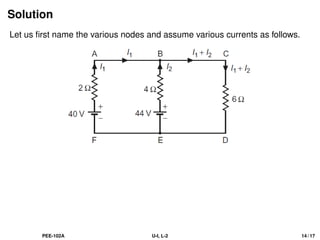
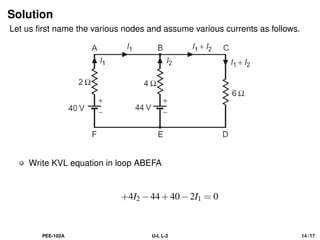
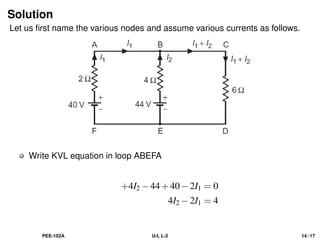
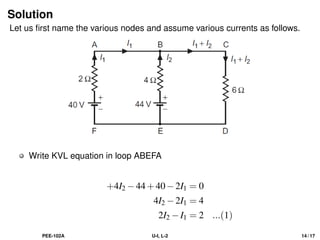
Let us first name the various nodes and assume various currents as follows.
PEE-102A U-I, L-2 14 / 17
Solution
Let us first name the various nodes and assume various currents as follows.
PEE-102A U-I, L-2 14 / 17
Solution
Let us first name the various nodes and assume various currents as follows.
Write KVL equation in loop ABEFA
+4I2 −44+40−2I1 = 0
PEE-102A U-I, L-2 14 / 17
Solution
Let us first name the various nodes and assume various currents as follows.
Write KVL equation in loop ABEFA
+4I2 −44+40−2I1 = 0
4I2 −2I1 = 4
PEE-102A U-I, L-2 14 / 17
Solution
Let us first name the various nodes and assume various currents as follows.
Write KVL equation in loop ABEFA
+4I2 −44+40−2I1 = 0
4I2 −2I1 = 4
2I2 −I1 = 2 ...(1)
PEE-102A U-I, L-2 14 / 17
Solution...Contd
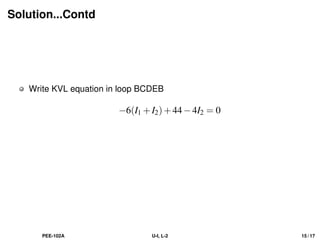
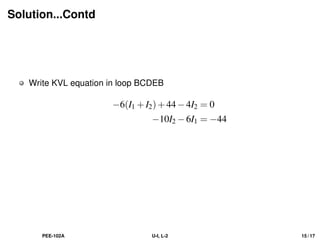
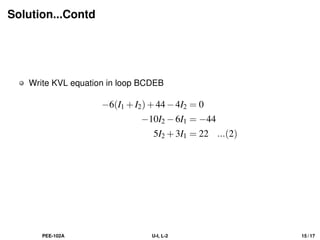
Write KVL equation in loop BCDEB
−6(I1 +I2)+44−4I2 = 0
PEE-102A U-I, L-2 15 / 17
Solution...Contd
Write KVL equation in loop BCDEB
−6(I1 +I2)+44−4I2 = 0
−10I2 −6I1 = −44
PEE-102A U-I, L-2 15 / 17
Solution...Contd
Write KVL equation in loop BCDEB
−6(I1 +I2)+44−4I2 = 0
−10I2 −6I1 = −44
5I2 +3I1 = 22 ...(2)
PEE-102A U-I, L-2 15 / 17
Solution...Contd
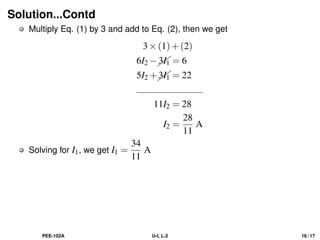
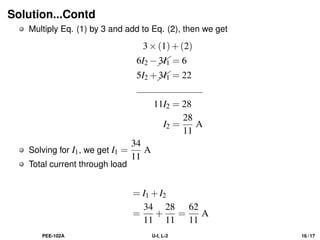
Multiply Eq. (1) by 3 and add to Eq. (2), then we get
3×(1)+(2)
6I2 −

3I1 = 6
5I2 +

3I1 = 22
11I2 = 28
I2 =
28
11
A
Solving for I1, we get I1 =
34
11
A
PEE-102A U-I, L-2 16 / 17
Solution...Contd
Multiply Eq. (1) by 3 and add to Eq. (2), then we get
3×(1)+(2)
6I2 −

3I1 = 6
5I2 +

3I1 = 22
11I2 = 28
I2 =
28
11
A
Solving for I1, we get I1 =
34
11
A
Total current through load
= I1 +I2
=
34
11
+
28
11
=
62
11
A
PEE-102A U-I, L-2 16 / 17
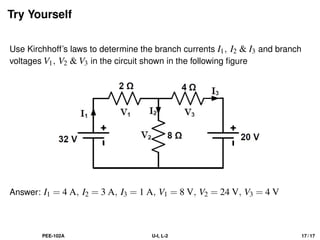
Try Yourself
Use Kirchhoff’s laws to determine the branch currents I1, I2  I3 and branch
voltages V1, V2  V3 in the circuit shown in the following figure
Answer: I1 = 4 A, I2 = 3 A, I3 = 1 A, V1 = 8 V, V2 = 24 V, V3 = 4 V
PEE-102A U-I, L-2 17 / 17

PEE-102A_L-2

  • 1.
    PEE-102A Fundamentals of ElectricalEngineering Lecture-2 Instructor: Mohd. Umar Rehman EES, University Polytechnic, AMU PEE-102A U-I, L-2 1 / 17
  • 2.
  • 3.
    Circuit Terminology Please seethe following link before Lecture-2: Khan Academy PEE-102A U-I, L-2 3 / 17
  • 4.
    Kirchhoff’s First Law Alsoknown as Kirchhoff’s Current Law (KCL) Based on the conservation of charge. The algebraic sum of currents at a node is zero. Mathematically, we can write ∑ node i = 0 Sign convention: Incoming currents are taken as positive, while outgoing currents are taken as negative. PEE-102A U-I, L-2 4 / 17
  • 5.
  • 6.
    Kirchhoff’s First Law...Contd KCLat node O PEE-102A U-I, L-2 5 / 17
  • 7.
    Kirchhoff’s First Law...Contd KCLat node O I1 −I2 −I3 +I4 = 0 PEE-102A U-I, L-2 5 / 17
  • 8.
    Kirchhoff’s First Law...Contd KCLat node O I1 −I2 −I3 +I4 = 0 I1 +I4 = I2 +I3 PEE-102A U-I, L-2 5 / 17
  • 9.
    Kirchhoff’s First Law...Contd KCLat node O I1 −I2 −I3 +I4 = 0 I1 +I4 = I2 +I3 Incoming current = Outgoing current PEE-102A U-I, L-2 5 / 17
  • 10.
  • 11.
    Kirchhoff’s First Law...Contd ApplyKCL at node P, then I2 −I1 −I3 = 0 PEE-102A U-I, L-2 6 / 17
  • 12.
    Kirchhoff’s First Law...Contd ApplyKCL at node P, then I2 −I1 −I3 = 0 I2 = I1 +I3 PEE-102A U-I, L-2 6 / 17
  • 13.
    Kirchhoff’s First Law...Contd ApplyKCL at node P, then I2 −I1 −I3 = 0 I2 = I1 +I3 7 = I1 +3 PEE-102A U-I, L-2 6 / 17
  • 14.
    Kirchhoff’s First Law...Contd ApplyKCL at node P, then I2 −I1 −I3 = 0 I2 = I1 +I3 7 = I1 +3 I1 = 4 A PEE-102A U-I, L-2 6 / 17
  • 15.
  • 16.
    Kirchhoff’s First Law...Contd Answer:I4 = −1 A. PEE-102A U-I, L-2 7 / 17
  • 17.
    Kirchhoff’s First Law...Contd Answer:I4 = −1 A. Minus sign indicates that the current is actually flowing in the direction opposite to that assumed. PEE-102A U-I, L-2 7 / 17
  • 18.
    Kirchhoff’s Second Law Alsoknown as Kirchhoff’s Voltage Law (KVL) Based on the conservation of energy. The algebraic sum of voltages in a closed loop is zero. Mathematically, we can write ∑ loop v = 0 Sign convention: Voltage rise is taken as positive, while voltage drop is taken as negative. Another form is: Voltage Rise = Voltage drop PEE-102A U-I, L-2 8 / 17
  • 19.
    Kirchhoff’s Second Law...Contd Figure:(i) Figure: (ii) In fig. (i), moving from A to B, we observe a voltage drop of E volts. In equation form, it will be written as −E. If we move from B to A, then we will observe a voltage rise of E volts, and it can be written as +E In fig. (ii), moving from A to B, we observe a voltage drop of IR volts. In equation form, it will be written as −IR. If we move from B to A, then we will observe a voltage rise of IR volts, and it can be written as +IR PEE-102A U-I, L-2 9 / 17
  • 20.
    Illustration 1 Consider thebasic circuit as shown in the following figure. V R I A B C D Moving from A to B, we observe a voltage rise of +V volts. From B to C, no change in voltage, as no component is connected. From C to D, we observe a voltage drop of IR volts. From D to A, no change Thus, we can write the KVL equation in loop ABCDA as: +V −IR = 0 V = IR Hence, we can say that, Ohm’s law is a special case of KVL. Same equation will be obtained if we move in any other direction PEE-102A U-I, L-2 10 / 17
  • 21.
    Illustration 2 Consider thefollowing circuit. PEE-102A U-I, L-2 11 / 17
  • 22.
    Illustration 2 Consider thefollowing circuit. Nodes: A, B, C, D, E, F PEE-102A U-I, L-2 11 / 17
  • 23.
    Illustration 2 Consider thefollowing circuit. Nodes: A, B, C, D, E, F Loops: ABEFA, BCDEB, ABCDEFA PEE-102A U-I, L-2 11 / 17
  • 24.
    Illustration 2...Contd KCL atnode B: I1 +I2 −I3 = 0 PEE-102A U-I, L-2 12 / 17
  • 25.
    Illustration 2...Contd KCL atnode B: I1 +I2 −I3 = 0 KCL at node E: I3 −I1 −I2 = 0 PEE-102A U-I, L-2 12 / 17
  • 26.
    Illustration 2...Contd KCL atnode B: I1 +I2 −I3 = 0 KCL at node E: I3 −I1 −I2 = 0 KVL in loop ABEFA: −I1R1 −I3R+E1 = 0 PEE-102A U-I, L-2 12 / 17
  • 27.
    Illustration 2...Contd KCL atnode B: I1 +I2 −I3 = 0 KCL at node E: I3 −I1 −I2 = 0 KVL in loop ABEFA: −I1R1 −I3R+E1 = 0 KVL in loop BCDEB: +I2R2 −E2 +I3R = 0 PEE-102A U-I, L-2 12 / 17
  • 28.
    Illustration 2...Contd KCL atnode B: I1 +I2 −I3 = 0 KCL at node E: I3 −I1 −I2 = 0 KVL in loop ABEFA: −I1R1 −I3R+E1 = 0 KVL in loop BCDEB: +I2R2 −E2 +I3R = 0 KVL in loop ABCDEFA: −I1R1 +I2R2 −E2 +E1 = 0 PEE-102A U-I, L-2 12 / 17
  • 29.
    Illustration 2...Contd KCL atnode B: I1 +I2 −I3 = 0 KCL at node E: I3 −I1 −I2 = 0 KVL in loop ABEFA: −I1R1 −I3R+E1 = 0 KVL in loop BCDEB: +I2R2 −E2 +I3R = 0 KVL in loop ABCDEFA: −I1R1 +I2R2 −E2 +E1 = 0 The above set of equations can be solved to determine various currents, voltages in the circuit. PEE-102A U-I, L-2 12 / 17
  • 30.
    Illustration 3 The followingfigure shows two batteries connected in parallel, each repre- sented by an emf along with its internal resistance. A load resistance of 6 Ω is connected across the ends of the batteries. Calculate the current through each battery and the load. PEE-102A U-I, L-2 13 / 17
  • 31.
    Solution Let us firstname the various nodes and assume various currents as follows. PEE-102A U-I, L-2 14 / 17
  • 32.
    Solution Let us firstname the various nodes and assume various currents as follows. PEE-102A U-I, L-2 14 / 17
  • 33.
    Solution Let us firstname the various nodes and assume various currents as follows. Write KVL equation in loop ABEFA +4I2 −44+40−2I1 = 0 PEE-102A U-I, L-2 14 / 17
  • 34.
    Solution Let us firstname the various nodes and assume various currents as follows. Write KVL equation in loop ABEFA +4I2 −44+40−2I1 = 0 4I2 −2I1 = 4 PEE-102A U-I, L-2 14 / 17
  • 35.
    Solution Let us firstname the various nodes and assume various currents as follows. Write KVL equation in loop ABEFA +4I2 −44+40−2I1 = 0 4I2 −2I1 = 4 2I2 −I1 = 2 ...(1) PEE-102A U-I, L-2 14 / 17
  • 36.
    Solution...Contd Write KVL equationin loop BCDEB −6(I1 +I2)+44−4I2 = 0 PEE-102A U-I, L-2 15 / 17
  • 37.
    Solution...Contd Write KVL equationin loop BCDEB −6(I1 +I2)+44−4I2 = 0 −10I2 −6I1 = −44 PEE-102A U-I, L-2 15 / 17
  • 38.
    Solution...Contd Write KVL equationin loop BCDEB −6(I1 +I2)+44−4I2 = 0 −10I2 −6I1 = −44 5I2 +3I1 = 22 ...(2) PEE-102A U-I, L-2 15 / 17
  • 39.
    Solution...Contd Multiply Eq. (1)by 3 and add to Eq. (2), then we get 3×(1)+(2) 6I2 − 3I1 = 6 5I2 + 3I1 = 22 11I2 = 28 I2 = 28 11 A Solving for I1, we get I1 = 34 11 A PEE-102A U-I, L-2 16 / 17
  • 40.
    Solution...Contd Multiply Eq. (1)by 3 and add to Eq. (2), then we get 3×(1)+(2) 6I2 − 3I1 = 6 5I2 + 3I1 = 22 11I2 = 28 I2 = 28 11 A Solving for I1, we get I1 = 34 11 A Total current through load = I1 +I2 = 34 11 + 28 11 = 62 11 A PEE-102A U-I, L-2 16 / 17
  • 41.
    Try Yourself Use Kirchhoff’slaws to determine the branch currents I1, I2 I3 and branch voltages V1, V2 V3 in the circuit shown in the following figure Answer: I1 = 4 A, I2 = 3 A, I3 = 1 A, V1 = 8 V, V2 = 24 V, V3 = 4 V PEE-102A U-I, L-2 17 / 17