Research Methodology and
Evidence Based Healthcare (EBHC481)
HOW TO CONDUCT
RESEARCH INTERVIEWS?
WRITTEN AND COMPILED BY DR. EMAN ABD ALHALIM MD, PHD1
Lecture 13
Level 8
Year 4
Research Methodology and
Evidence Based Healthcare (EBHC481)
Objectives
• Explain methods of recording of interview
• Discuss the interview schedule
• Describe how to establish rapport
• Explain how to ask questions and probe for information.
WRITTEN AND COMPILED BY DR. EMAN ABD ALHALIM MD, PHD2
Research Methodology and
Evidence Based Healthcare (EBHC481)
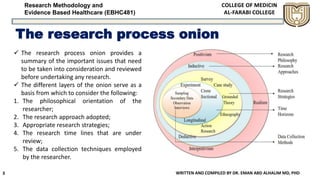
The research process onion
WRITTEN AND COMPILED BY DR. EMAN ABD ALHALIM MD, PHD3
 The research process onion provides a
summary of the important issues that need
to be taken into consideration and reviewed
before undertaking any research.
 The different layers of the onion serve as a
basis from which to consider the following:
1. The philosophical orientation of the
researcher;
2. The research approach adopted;
3. Appropriate research strategies;
4. The research time lines that are under
review;
5. The data collection techniques employed
by the researcher.
Research Methodology and
Evidence Based Healthcare (EBHC481)
How to Conduct Interviews
• There are three main types of interview which tend to be used in
social research – unstructured interviews, semi-structured
interviews and structured interviews.
• For each type you will need to think about how you are going to
record the interview, what type of questions you need to ask, how
you intend to establish rapport and how you can probe for more
information.
WRITTEN AND COMPILED BY DR. EMAN ABD ALHALIM MD, PHD4
Research Methodology and
Evidence Based Healthcare (EBHC481)
METHODS OF RECORDING
• If you’ve decided that interviewing is the most appropriate method for
your research, you need to think about what sort of recording
equipment you’re going to use.
• You should think about this early on in your research as you need to
become familiar with its use through practice.
• Even if you decide not to use tape-recording equipment, and instead
use pen and paper, you should practice taking notes in an interview
situation, making sure that you can maintain eye contact and write at
the same time.
WRITTEN AND COMPILED BY DR. EMAN ABD ALHALIM MD, PHD5
Research Methodology and
Evidence Based Healthcare (EBHC481)
Using a tape recorder
• A suitable tape recorder is one of personal stereo size which uses
normal size cassettes and has a built-in microphone.
• A battery indicator light is crucial– it enables you to check that the
recording continues throughout the interview without drawing
attention to the machine.
• A recorder which automatically turns at the end of the tape is
useful as you can have twice as long uninterrupted interviewing.
WRITTEN AND COMPILED BY DR. EMAN ABD ALHALIM MD, PHD6
Research Methodology and
Evidence Based Healthcare (EBHC481)
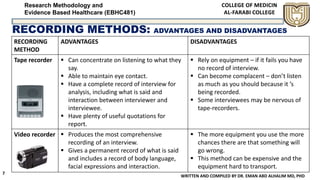
RECORDING METHODS: ADVANTAGES AND DISADVANTAGES
RECORDING
METHOD
ADVANTAGES DISADVANTAGES
Tape recorder  Can concentrate on listening to what they
say.
 Able to maintain eye contact.
 Have a complete record of interview for
analysis, including what is said and
interaction between interviewer and
interviewee.
 Have plenty of useful quotations for
report.
 Rely on equipment – if it fails you have
no record of interview.
 Can become complacent – don’t listen
as much as you should because it ’s
being recorded.
 Some interviewees may be nervous of
tape-recorders.
Video recorder  Produces the most comprehensive
recording of an interview.
 Gives a permanent record of what is said
and includes a record of body language,
facial expressions and interaction.
 The more equipment you use the more
chances there are that something will
go wrong.
 This method can be expensive and the
equipment hard to transport.
WRITTEN AND COMPILED BY DR. EMAN ABD ALHALIM MD, PHD
7
Research Methodology and
Evidence Based Healthcare (EBHC481)
RECORDING METHODS: ADVANTAGES AND DISADVANTAGES
RECORDING
METHOD
ADVANTAGES DISADVANTAGES
Note-taking  Don’t have to rely on recording
equipment which could fail.
 Is the cheapest method if on a very
limited budget.
 Interviewees may think they have
something important to say if they see
you taking notes – while you write
they may add more information.
 Cannot maintain eye contact all the time.
 Can be hard to concentrate on what they’re
saying and to probe for more information.
 Can be tiring.
 Will not have many verbatim quotations for
final report.
Box-ticking  Simple to use.
 Easy to analyze.
 Easy to compare information with that
obtained from other interviews.
 Inflexible – no scope for additional information.
 Forces interviewees to answer in a certain way.
 May leave interviewees feeling that they have
not answered in the way they would have liked
to have done.
WRITTEN AND COMPILED BY DR. EMAN ABD ALHALIM MD, PHD8
Research Methodology and
Evidence Based Healthcare (EBHC481)
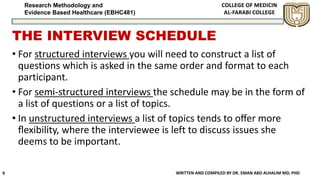
THE INTERVIEW SCHEDULE
• For structured interviews you will need to construct a list of
questions which is asked in the same order and format to each
participant.
• For semi-structured interviews the schedule may be in the form of
a list of questions or a list of topics.
• In unstructured interviews a list of topics tends to offer more
flexibility, where the interviewee is left to discuss issues she
deems to be important.
WRITTEN AND COMPILED BY DR. EMAN ABD ALHALIM MD, PHD9
Research Methodology and
Evidence Based Healthcare (EBHC481)
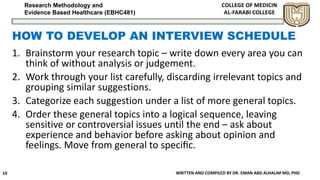
HOW TO DEVELOP AN INTERVIEW SCHEDULE
1. Brainstorm your research topic – write down every area you can
think of without analysis or judgement.
2. Work through your list carefully, discarding irrelevant topics and
grouping similar suggestions.
3. Categorize each suggestion under a list of more general topics.
4. Order these general topics into a logical sequence, leaving
sensitive or controversial issues until the end – ask about
experience and behavior before asking about opinion and
feelings. Move from general to specific.
WRITTEN AND COMPILED BY DR. EMAN ABD ALHALIM MD, PHD10
Research Methodology and
Evidence Based Healthcare (EBHC481)
HOW TO DEVELOP AN INTERVIEW SCHEDULE
5. Think of questions you will want to ask relating to each of these areas. If
you’re new to research you might find it useful to include these questions
on your schedule. However, you do not have to adhere rigidly to these
during your interview.
6. When developing questions, make sure they are open rather than closed.
Keep them neutral, short and to the point. Use language which will be
understood. Avoid jargon and double-barreled questions
7. If you need to, revise your schedule after each interview.
8. Become familiar with your schedule so that you do not have to keep
referring to it during the interview.
WRITTEN AND COMPILED BY DR. EMAN ABD ALHALIM MD, PHD11
Research Methodology and
Evidence Based Healthcare (EBHC481)
ESTABLISHING RAPPORT
• A researcher has to establish rapport before a participant will
share personal information.
There are a number of ways to do this:
I. Treat interviewees with respect. Make sure you arrive on time.
Don’t rush straight into the interview unless the interviewee
pushes to do so. Accept a cup of tea, if offered, and make polite
conversation to help put both of you at ease.
WRITTEN AND COMPILED BY DR. EMAN ABD ALHALIM MD, PHD12
Research Methodology and
Evidence Based Healthcare (EBHC481)
ESTABLISHING RAPPORT
II. Think about your appearance and the expectations of the
person you’re about to interview. If the interviewee is a smartly
turned out business person who expects to be interviewed by a
professional looking researcher, make sure you try to fulfil those
expectations with your appearance and behavior.
WRITTEN AND COMPILED BY DR. EMAN ABD ALHALIM MD, PHD13
Research Methodology and
Evidence Based Healthcare (EBHC481)
ESTABLISHING RAPPORT
III. During the interview, firm eye contact with little movement
indicates that you’re interested in what is being said.
• Also, it indicates honesty and high self-esteem.
• On the other hand, if your eyes wander all over the place and only
briefly make contact with the eyes of the interviewee, low self-
esteem, deceit or boredom can be indicated.
• Don’t rub your eyes as this could indicate you’re tired or bored.
Conversely, watch the eyes of your interviewees which will tell you
a lot about how the interview is progressing.
WRITTEN AND COMPILED BY DR. EMAN ABD ALHALIM MD, PHD14
Research Methodology and
Evidence Based Healthcare (EBHC481)
ESTABLISHING RAPPORT
IV. Think about body language.
-Try not to come across as nervous or shy.
- Maintain appropriate eye-contact and smile in a natural, unforced
manner.
- Remember that the eyes and smile account for more than 50% of
the total communication in a greeting situation.
- If you establish rapid and clear eye-contact, you’ll be more easily
trusted.
WRITTEN AND COMPILED BY DR. EMAN ABD ALHALIM MD, PHD15
Research Methodology and
Evidence Based Healthcare (EBHC481)
ESTABLISHING RAPPORT
V. Don’t invade their space. Try not to sit directly opposite them –
at an angle is better, but not by their side as you will have to
keep turning your heads which will be un-comfortable in a long
interview.
WRITTEN AND COMPILED BY DR. EMAN ABD ALHALIM MD, PHD16
Research Methodology and
Evidence Based Healthcare (EBHC481)
ASKING QUESTIONS AND PROBING FOR
INFORMATION
• As the interview progresses, ask questions, listen carefully to
responses and probe for more information.
• You should probe in a way which doesn’t influence the
interviewee.
• When you probe, you need to think about obtaining clarification,
elaboration, explanation and understanding.
WRITTEN AND COMPILED BY DR. EMAN ABD ALHALIM MD, PHD17
Research Methodology and
Evidence Based Healthcare (EBHC481)
ASKING QUESTIONS AND PROBING FOR
INFORMATION
WRITTEN AND COMPILED BY DR. EMAN ABD ALHALIM MD, PHD18
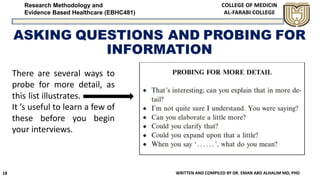
There are several ways to
probe for more detail, as
this list illustrates.
It ’s useful to learn a few of
these before you begin
your interviews.
Research Methodology and
Evidence Based Healthcare (EBHC481)
ASKING QUESTIONS AND PROBING FOR
INFORMATION
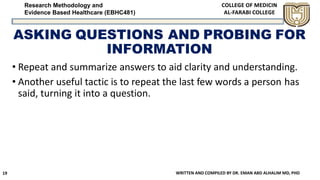
• Repeat and summarize answers to aid clarity and understanding.
• Another useful tactic is to repeat the last few words a person has
said, turning it into a question.
WRITTEN AND COMPILED BY DR. EMAN ABD ALHALIM MD, PHD19
Research Methodology and
Evidence Based Healthcare (EBHC481)
REFERANCE BOOK
WRITTEN AND COMPILED BY DR. EMAN ABD ALHALIM MD, PHD20
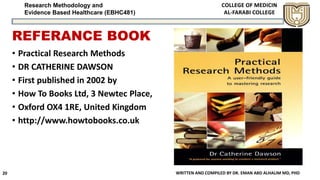
• Practical Research Methods
• DR CATHERINE DAWSON
• First published in 2002 by
• How To Books Ltd, 3 Newtec Place,
• Oxford OX4 1RE, United Kingdom
• http://www.howtobooks.co.uk

L13 rm how to conduct research interviews

  • 1.
    Research Methodology and EvidenceBased Healthcare (EBHC481) HOW TO CONDUCT RESEARCH INTERVIEWS? WRITTEN AND COMPILED BY DR. EMAN ABD ALHALIM MD, PHD1 Lecture 13 Level 8 Year 4
  • 2.
    Research Methodology and EvidenceBased Healthcare (EBHC481) Objectives • Explain methods of recording of interview • Discuss the interview schedule • Describe how to establish rapport • Explain how to ask questions and probe for information. WRITTEN AND COMPILED BY DR. EMAN ABD ALHALIM MD, PHD2
  • 3.
    Research Methodology and EvidenceBased Healthcare (EBHC481) The research process onion WRITTEN AND COMPILED BY DR. EMAN ABD ALHALIM MD, PHD3  The research process onion provides a summary of the important issues that need to be taken into consideration and reviewed before undertaking any research.  The different layers of the onion serve as a basis from which to consider the following: 1. The philosophical orientation of the researcher; 2. The research approach adopted; 3. Appropriate research strategies; 4. The research time lines that are under review; 5. The data collection techniques employed by the researcher.
  • 4.
    Research Methodology and EvidenceBased Healthcare (EBHC481) How to Conduct Interviews • There are three main types of interview which tend to be used in social research – unstructured interviews, semi-structured interviews and structured interviews. • For each type you will need to think about how you are going to record the interview, what type of questions you need to ask, how you intend to establish rapport and how you can probe for more information. WRITTEN AND COMPILED BY DR. EMAN ABD ALHALIM MD, PHD4
  • 5.
    Research Methodology and EvidenceBased Healthcare (EBHC481) METHODS OF RECORDING • If you’ve decided that interviewing is the most appropriate method for your research, you need to think about what sort of recording equipment you’re going to use. • You should think about this early on in your research as you need to become familiar with its use through practice. • Even if you decide not to use tape-recording equipment, and instead use pen and paper, you should practice taking notes in an interview situation, making sure that you can maintain eye contact and write at the same time. WRITTEN AND COMPILED BY DR. EMAN ABD ALHALIM MD, PHD5
  • 6.
    Research Methodology and EvidenceBased Healthcare (EBHC481) Using a tape recorder • A suitable tape recorder is one of personal stereo size which uses normal size cassettes and has a built-in microphone. • A battery indicator light is crucial– it enables you to check that the recording continues throughout the interview without drawing attention to the machine. • A recorder which automatically turns at the end of the tape is useful as you can have twice as long uninterrupted interviewing. WRITTEN AND COMPILED BY DR. EMAN ABD ALHALIM MD, PHD6
  • 7.
    Research Methodology and EvidenceBased Healthcare (EBHC481) RECORDING METHODS: ADVANTAGES AND DISADVANTAGES RECORDING METHOD ADVANTAGES DISADVANTAGES Tape recorder  Can concentrate on listening to what they say.  Able to maintain eye contact.  Have a complete record of interview for analysis, including what is said and interaction between interviewer and interviewee.  Have plenty of useful quotations for report.  Rely on equipment – if it fails you have no record of interview.  Can become complacent – don’t listen as much as you should because it ’s being recorded.  Some interviewees may be nervous of tape-recorders. Video recorder  Produces the most comprehensive recording of an interview.  Gives a permanent record of what is said and includes a record of body language, facial expressions and interaction.  The more equipment you use the more chances there are that something will go wrong.  This method can be expensive and the equipment hard to transport. WRITTEN AND COMPILED BY DR. EMAN ABD ALHALIM MD, PHD 7
  • 8.
    Research Methodology and EvidenceBased Healthcare (EBHC481) RECORDING METHODS: ADVANTAGES AND DISADVANTAGES RECORDING METHOD ADVANTAGES DISADVANTAGES Note-taking  Don’t have to rely on recording equipment which could fail.  Is the cheapest method if on a very limited budget.  Interviewees may think they have something important to say if they see you taking notes – while you write they may add more information.  Cannot maintain eye contact all the time.  Can be hard to concentrate on what they’re saying and to probe for more information.  Can be tiring.  Will not have many verbatim quotations for final report. Box-ticking  Simple to use.  Easy to analyze.  Easy to compare information with that obtained from other interviews.  Inflexible – no scope for additional information.  Forces interviewees to answer in a certain way.  May leave interviewees feeling that they have not answered in the way they would have liked to have done. WRITTEN AND COMPILED BY DR. EMAN ABD ALHALIM MD, PHD8
  • 9.
    Research Methodology and EvidenceBased Healthcare (EBHC481) THE INTERVIEW SCHEDULE • For structured interviews you will need to construct a list of questions which is asked in the same order and format to each participant. • For semi-structured interviews the schedule may be in the form of a list of questions or a list of topics. • In unstructured interviews a list of topics tends to offer more flexibility, where the interviewee is left to discuss issues she deems to be important. WRITTEN AND COMPILED BY DR. EMAN ABD ALHALIM MD, PHD9
  • 10.
    Research Methodology and EvidenceBased Healthcare (EBHC481) HOW TO DEVELOP AN INTERVIEW SCHEDULE 1. Brainstorm your research topic – write down every area you can think of without analysis or judgement. 2. Work through your list carefully, discarding irrelevant topics and grouping similar suggestions. 3. Categorize each suggestion under a list of more general topics. 4. Order these general topics into a logical sequence, leaving sensitive or controversial issues until the end – ask about experience and behavior before asking about opinion and feelings. Move from general to specific. WRITTEN AND COMPILED BY DR. EMAN ABD ALHALIM MD, PHD10
  • 11.
    Research Methodology and EvidenceBased Healthcare (EBHC481) HOW TO DEVELOP AN INTERVIEW SCHEDULE 5. Think of questions you will want to ask relating to each of these areas. If you’re new to research you might find it useful to include these questions on your schedule. However, you do not have to adhere rigidly to these during your interview. 6. When developing questions, make sure they are open rather than closed. Keep them neutral, short and to the point. Use language which will be understood. Avoid jargon and double-barreled questions 7. If you need to, revise your schedule after each interview. 8. Become familiar with your schedule so that you do not have to keep referring to it during the interview. WRITTEN AND COMPILED BY DR. EMAN ABD ALHALIM MD, PHD11
  • 12.
    Research Methodology and EvidenceBased Healthcare (EBHC481) ESTABLISHING RAPPORT • A researcher has to establish rapport before a participant will share personal information. There are a number of ways to do this: I. Treat interviewees with respect. Make sure you arrive on time. Don’t rush straight into the interview unless the interviewee pushes to do so. Accept a cup of tea, if offered, and make polite conversation to help put both of you at ease. WRITTEN AND COMPILED BY DR. EMAN ABD ALHALIM MD, PHD12
  • 13.
    Research Methodology and EvidenceBased Healthcare (EBHC481) ESTABLISHING RAPPORT II. Think about your appearance and the expectations of the person you’re about to interview. If the interviewee is a smartly turned out business person who expects to be interviewed by a professional looking researcher, make sure you try to fulfil those expectations with your appearance and behavior. WRITTEN AND COMPILED BY DR. EMAN ABD ALHALIM MD, PHD13
  • 14.
    Research Methodology and EvidenceBased Healthcare (EBHC481) ESTABLISHING RAPPORT III. During the interview, firm eye contact with little movement indicates that you’re interested in what is being said. • Also, it indicates honesty and high self-esteem. • On the other hand, if your eyes wander all over the place and only briefly make contact with the eyes of the interviewee, low self- esteem, deceit or boredom can be indicated. • Don’t rub your eyes as this could indicate you’re tired or bored. Conversely, watch the eyes of your interviewees which will tell you a lot about how the interview is progressing. WRITTEN AND COMPILED BY DR. EMAN ABD ALHALIM MD, PHD14
  • 15.
    Research Methodology and EvidenceBased Healthcare (EBHC481) ESTABLISHING RAPPORT IV. Think about body language. -Try not to come across as nervous or shy. - Maintain appropriate eye-contact and smile in a natural, unforced manner. - Remember that the eyes and smile account for more than 50% of the total communication in a greeting situation. - If you establish rapid and clear eye-contact, you’ll be more easily trusted. WRITTEN AND COMPILED BY DR. EMAN ABD ALHALIM MD, PHD15
  • 16.
    Research Methodology and EvidenceBased Healthcare (EBHC481) ESTABLISHING RAPPORT V. Don’t invade their space. Try not to sit directly opposite them – at an angle is better, but not by their side as you will have to keep turning your heads which will be un-comfortable in a long interview. WRITTEN AND COMPILED BY DR. EMAN ABD ALHALIM MD, PHD16
  • 17.
    Research Methodology and EvidenceBased Healthcare (EBHC481) ASKING QUESTIONS AND PROBING FOR INFORMATION • As the interview progresses, ask questions, listen carefully to responses and probe for more information. • You should probe in a way which doesn’t influence the interviewee. • When you probe, you need to think about obtaining clarification, elaboration, explanation and understanding. WRITTEN AND COMPILED BY DR. EMAN ABD ALHALIM MD, PHD17
  • 18.
    Research Methodology and EvidenceBased Healthcare (EBHC481) ASKING QUESTIONS AND PROBING FOR INFORMATION WRITTEN AND COMPILED BY DR. EMAN ABD ALHALIM MD, PHD18 There are several ways to probe for more detail, as this list illustrates. It ’s useful to learn a few of these before you begin your interviews.
  • 19.
    Research Methodology and EvidenceBased Healthcare (EBHC481) ASKING QUESTIONS AND PROBING FOR INFORMATION • Repeat and summarize answers to aid clarity and understanding. • Another useful tactic is to repeat the last few words a person has said, turning it into a question. WRITTEN AND COMPILED BY DR. EMAN ABD ALHALIM MD, PHD19
  • 20.
    Research Methodology and EvidenceBased Healthcare (EBHC481) REFERANCE BOOK WRITTEN AND COMPILED BY DR. EMAN ABD ALHALIM MD, PHD20 • Practical Research Methods • DR CATHERINE DAWSON • First published in 2002 by • How To Books Ltd, 3 Newtec Place, • Oxford OX4 1RE, United Kingdom • http://www.howtobooks.co.uk