



ETHNOGRAPHY
An invaluable Research Method
Prof.Dr.Ing. David Luigi Fuschi
Definition
 Ethnography
• Pronunciation: / θ n r fi/ - nounɛ ˈ ɒɡ ə
The scientific description of peoples and cultures with
their customs, habits, and mutual differences.
Oxford Dictionary
 However, Ethnography, is much more than this and
does not only apply to people, customs and habits, it
can be used in a wide set of contexts…
Ethnography...
 includes both qualitative and quantitative methods
 is more than simply methods, but has ontological and
epistemological properties
 is a holistic approach to the study of cultural systems
 is the study of the socio cultural contexts, processes,‐
and meanings within cultural systems
 is the study of cultural systems from both emic and etic
perspectives (Phon-emic vs Phon-etic)
Whitehead,T.L., (2004)
Ethnography...
 is greatly dependent on fieldwork
 is a process of discovery, making inferences, and
continuing inquiries in an attempt to achieve emic
validity
 is an iterative process of learning episodes
 is an open ended emergent learning process, and not a‐
rigid investigator controlled experiment
 is a highly flexible and creative process
Whitehead,T.L., (2004)
Ethnography...
 is an interpretive, reflexive, and constructivist process
 requires the daily and continuous recording of field-
notes
 may be carried out by individual or by teams of
investigators
 presents the world of its host population in human
contexts of thickly described case studies.
Whitehead,T.L., (2004)
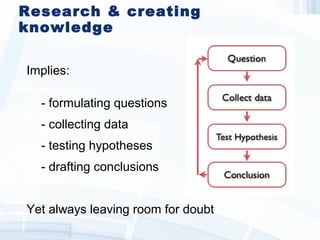
Research & creating
knowledge
Implies:
- formulating questions
- collecting data
- testing hypotheses
- drafting conclusions
Yet always leaving room for doubt
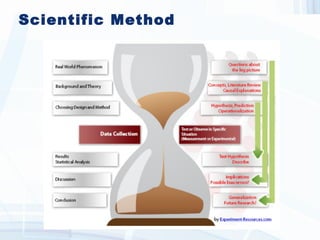
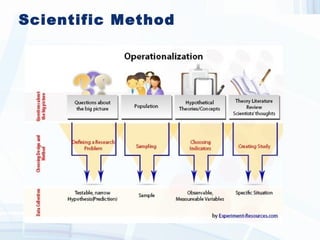
Scientific Method
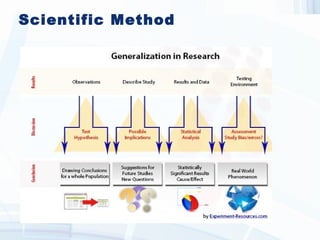
Scientific Method
Scientific Method
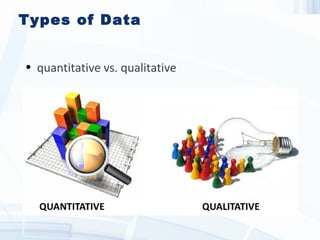
Types of Data
• quantitative vs. qualitative
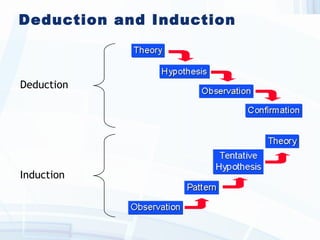
Deduction and Induction
Deduction
Induction
Ethics in Research
 The researcher is always responsible of the ethical conduct
of her/his research
 Avoid fabrication and falsification of any form at any time
 Always acknowledge work and contributions of others so as
to avoid plagiarism
 Always use informed consent whenever there are human
participants
 balance between protecting participants vs. quest for
knowledge
Questions?
Practice
Some examples
 We will now examine some examples coming from the
following sources:
• http://www.jhsph.edu/research/centers-and-institutes/center-
for-refugee-and-disaster-
response/publications_tools/publications/_pdf/pr_apx-
b_ethnographic.PDF
• http://wp.stolaf.edu/sociology/soan-373-ethnographic-research-
methods-final-papers/
• http://www.thesummitprep.org/pmisterovich/files/2011/11/Soc-
101-Ethnographic-Study-Examples-2011.pdf
Questions?
References&
Sources
References
Whitehead,T.L., (2004), "What is
 Ethnography?

Methodological,
Ontological,
and Epis
temological
Attributes
",
 EICCARS Working Paper Series
Whitehead,T.L., (2002), "Introduction to Ethnographically
Informed Community and Cultural As
s
es
s
ment
Res
earch Sys
tems
", EICCARS Working Paper Series
Whitehead,T.L., (2002), "Bas
ic Clas
s
ical Ethnographic
Res
earch Methods
 - Secondary Data Analys
is
,

Fieldwork,
 Obs
ervation/Participant Obs
ervation,
 and
Informal and Semi-s
tructured Interviewing", EICCARS
Working Ppaper Series
Sources
Oskar Blakstad,O., (2008), “Research Basics”, [On-Line]:
https://explorable.com/research-basics
Shuttleworth,M., (2009), “What is the Scientific Method?”,
[On-Line]: https://explorable.com/what-is-the-scientific-
method
Shuttleworth,M., (2008). “Operationalization”, [On-Line]:
https://explorable.com/operationalization
Shuttleworth,M., (2008). “What is Generalization?”, [On-
Line]: https://explorable.com/what-is-generalization
Thank You!
Prof.Dr.Ing. David Luigi Fuschi
d.fuschi@bridgingconsulting.com

Ethnography

  • 1.
    ETHNOGRAPHY An invaluable ResearchMethod Prof.Dr.Ing. David Luigi Fuschi
  • 2.
    Definition  Ethnography • Pronunciation:/ θ n r fi/ - nounɛ ˈ ɒɡ ə The scientific description of peoples and cultures with their customs, habits, and mutual differences. Oxford Dictionary  However, Ethnography, is much more than this and does not only apply to people, customs and habits, it can be used in a wide set of contexts…
  • 3.
    Ethnography...  includes bothqualitative and quantitative methods  is more than simply methods, but has ontological and epistemological properties  is a holistic approach to the study of cultural systems  is the study of the socio cultural contexts, processes,‐ and meanings within cultural systems  is the study of cultural systems from both emic and etic perspectives (Phon-emic vs Phon-etic) Whitehead,T.L., (2004)
  • 4.
    Ethnography...  is greatlydependent on fieldwork  is a process of discovery, making inferences, and continuing inquiries in an attempt to achieve emic validity  is an iterative process of learning episodes  is an open ended emergent learning process, and not a‐ rigid investigator controlled experiment  is a highly flexible and creative process Whitehead,T.L., (2004)
  • 5.
    Ethnography...  is aninterpretive, reflexive, and constructivist process  requires the daily and continuous recording of field- notes  may be carried out by individual or by teams of investigators  presents the world of its host population in human contexts of thickly described case studies. Whitehead,T.L., (2004)
  • 6.
    Research & creating knowledge Implies: -formulating questions - collecting data - testing hypotheses - drafting conclusions Yet always leaving room for doubt
  • 7.
  • 8.
  • 9.
  • 10.
    Types of Data •quantitative vs. qualitative
  • 11.
  • 12.
    Ethics in Research The researcher is always responsible of the ethical conduct of her/his research  Avoid fabrication and falsification of any form at any time  Always acknowledge work and contributions of others so as to avoid plagiarism  Always use informed consent whenever there are human participants  balance between protecting participants vs. quest for knowledge
  • 13.
  • 14.
  • 15.
    Some examples  Wewill now examine some examples coming from the following sources: • http://www.jhsph.edu/research/centers-and-institutes/center- for-refugee-and-disaster- response/publications_tools/publications/_pdf/pr_apx- b_ethnographic.PDF • http://wp.stolaf.edu/sociology/soan-373-ethnographic-research- methods-final-papers/ • http://www.thesummitprep.org/pmisterovich/files/2011/11/Soc- 101-Ethnographic-Study-Examples-2011.pdf
  • 16.
  • 17.
  • 18.
    References Whitehead,T.L., (2004), "Whatis
 Ethnography?
 Methodological,
Ontological,
and Epis
temological Attributes
",
 EICCARS Working Paper Series Whitehead,T.L., (2002), "Introduction to Ethnographically Informed Community and Cultural As
s
es
s
ment Res
earch Sys
tems
", EICCARS Working Paper Series Whitehead,T.L., (2002), "Bas
ic Clas
s
ical Ethnographic Res
earch Methods
 - Secondary Data Analys
is
,
 Fieldwork,
 Obs
ervation/Participant Obs
ervation,
 and Informal and Semi-s
tructured Interviewing", EICCARS Working Ppaper Series
  • 19.
    Sources Oskar Blakstad,O., (2008),“Research Basics”, [On-Line]: https://explorable.com/research-basics Shuttleworth,M., (2009), “What is the Scientific Method?”, [On-Line]: https://explorable.com/what-is-the-scientific- method Shuttleworth,M., (2008). “Operationalization”, [On-Line]: https://explorable.com/operationalization Shuttleworth,M., (2008). “What is Generalization?”, [On- Line]: https://explorable.com/what-is-generalization
  • 20.
    Thank You! Prof.Dr.Ing. DavidLuigi Fuschi d.fuschi@bridgingconsulting.com