Research Methodology and
Evidence Based Healthcare (EBHC481)
Questionnaire
- Basic measurement tool -
Research Methodology and
Evidence Based Healthcare (EBHC481)
Why is it important?
1. Statistical analysis can be repeated
2. If done incorrectly initially, there is
seldom a second chance to obtain
information by questionnaire from large
numbers of participants (Methods in
observational epidemiology)
Research Methodology and
Evidence Based Healthcare (EBHC481)
What Is A Questionnaire?
A tool for collecting information to
describe, compare, or explain an event or
situation, as well as, knowledge, attitudes,
behaviors, and/or socio-demographic
characteristics on a particular target group.
Research Methodology and
Evidence Based Healthcare (EBHC481)
Procedure for Development
• Specify what information will be sought (back to
objectives)
• Determine the type of questionnaire and
method of administration
• Determine the content of individual questions
• Determine the form of response to each
question
• Determine the wording of each question
Research Methodology and
Evidence Based Healthcare (EBHC481)
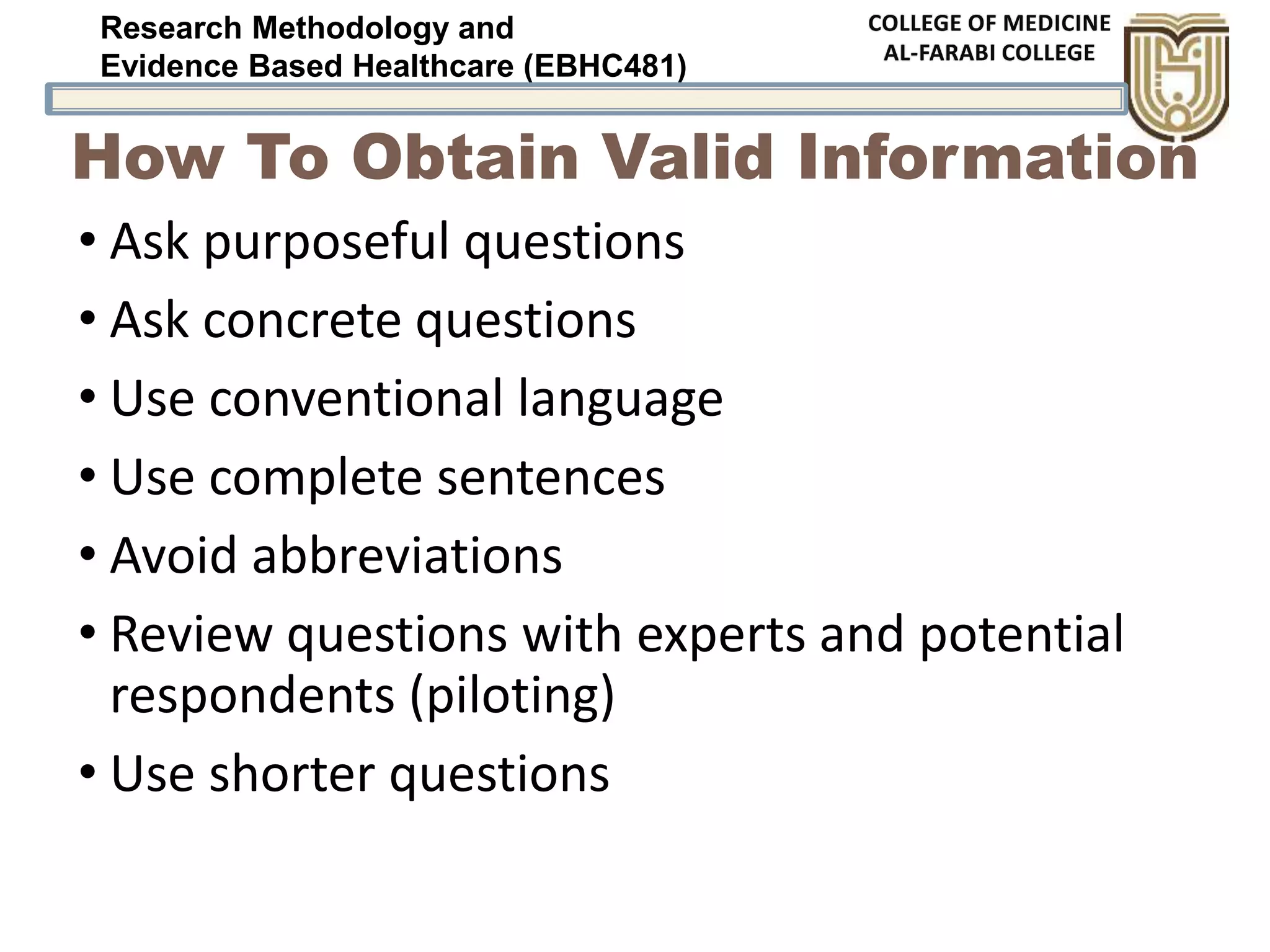
How To Obtain Valid Information
• Ask purposeful questions
• Ask concrete questions
• Use conventional language
• Use complete sentences
• Avoid abbreviations
• Review questions with experts and potential
respondents (piloting)
• Use shorter questions
Research Methodology and
Evidence Based Healthcare (EBHC481)
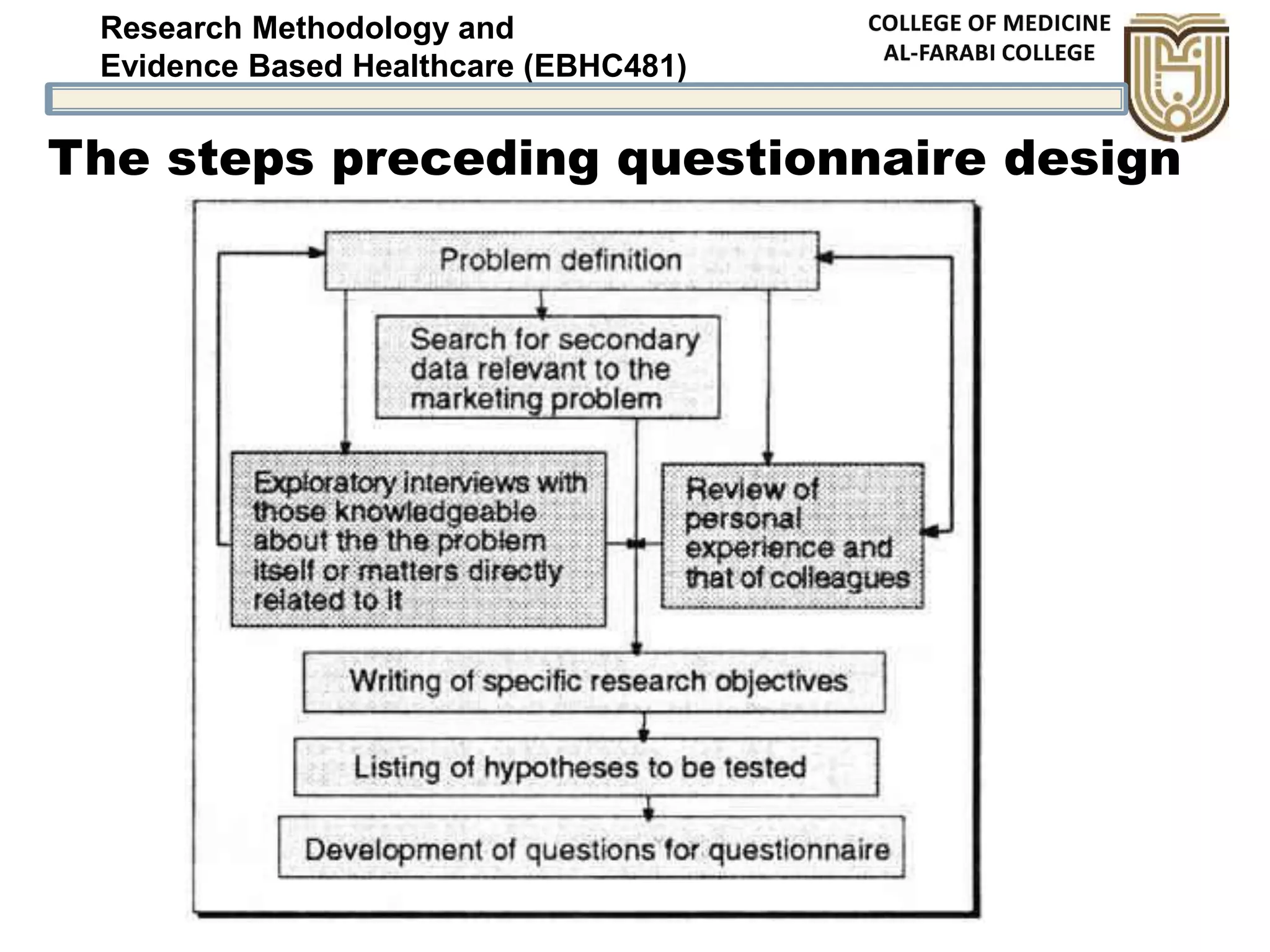
The steps preceding questionnaire design
Research Methodology and
Evidence Based Healthcare (EBHC481)
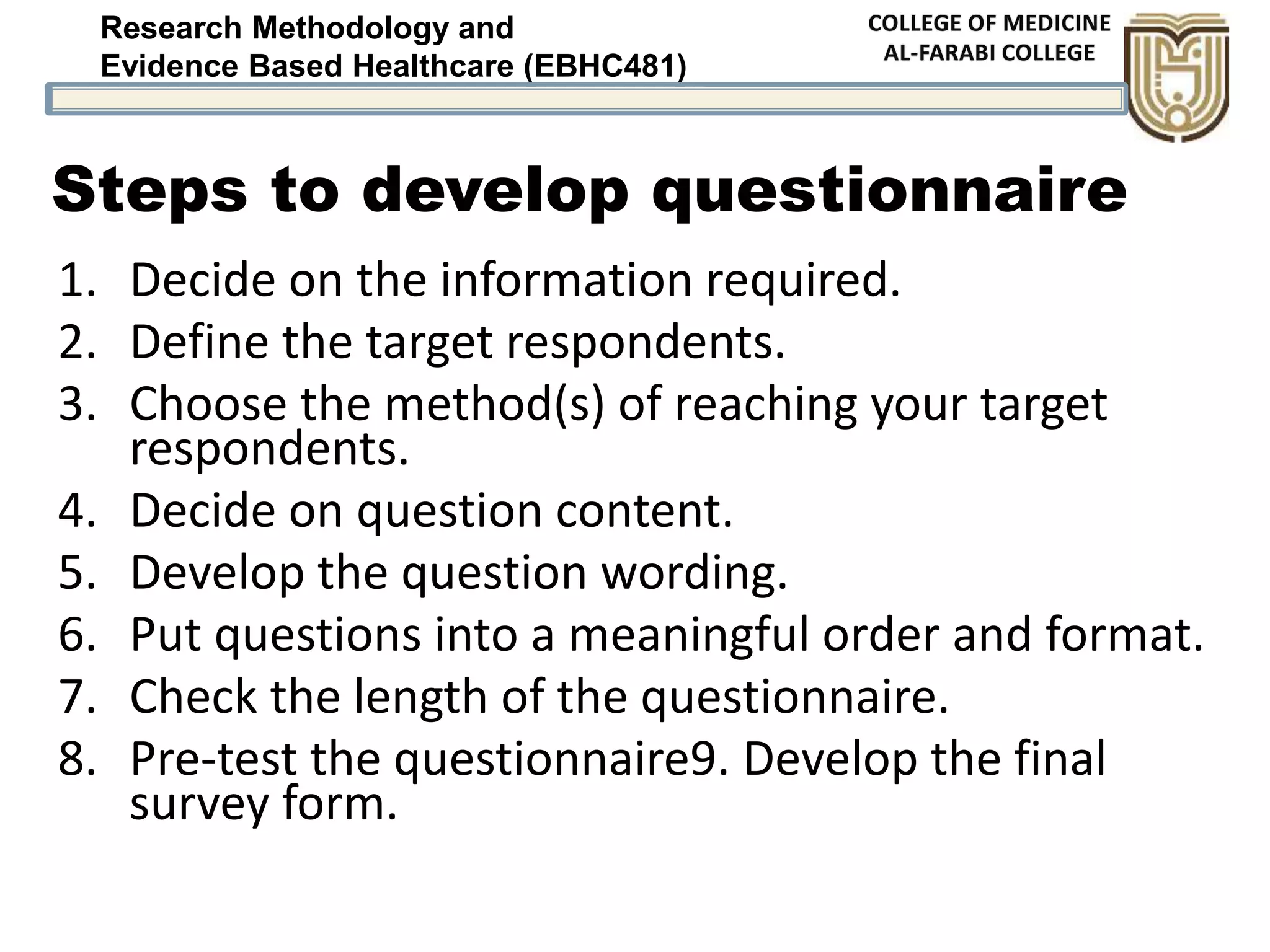
Steps to develop questionnaire
1. Decide on the information required.
2. Define the target respondents.
3. Choose the method(s) of reaching your target
respondents.
4. Decide on question content.
5. Develop the question wording.
6. Put questions into a meaningful order and format.
7. Check the length of the questionnaire.
8. Pre-test the questionnaire9. Develop the final
survey form.
Research Methodology and
Evidence Based Healthcare (EBHC481)
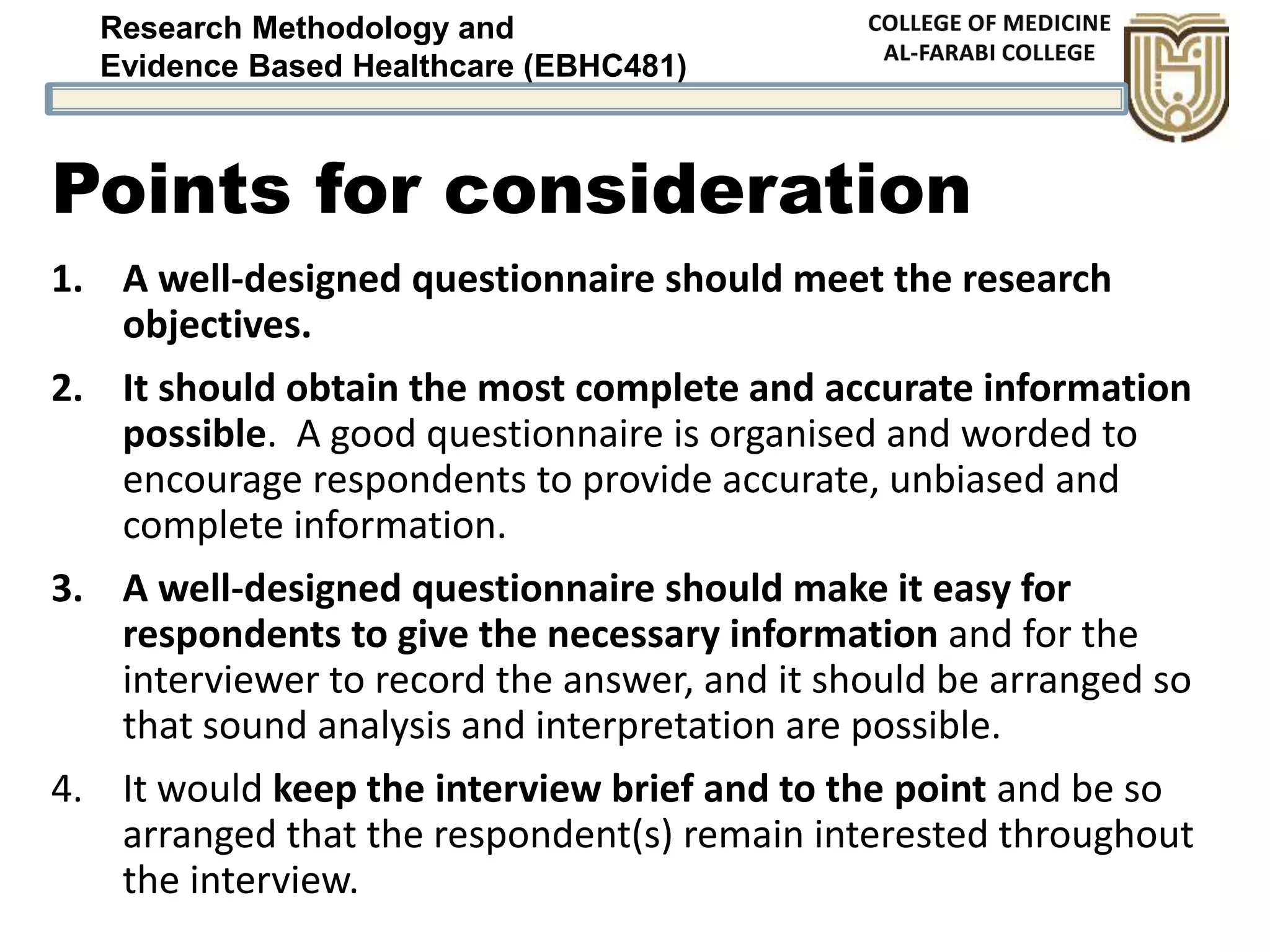
Points for consideration
1. A well-designed questionnaire should meet the research
objectives.
2. It should obtain the most complete and accurate information
possible. A good questionnaire is organised and worded to
encourage respondents to provide accurate, unbiased and
complete information.
3. A well-designed questionnaire should make it easy for
respondents to give the necessary information and for the
interviewer to record the answer, and it should be arranged so
that sound analysis and interpretation are possible.
4. It would keep the interview brief and to the point and be so
arranged that the respondent(s) remain interested throughout
the interview.
Research Methodology and
Evidence Based Healthcare (EBHC481)
Questions Context
•Standardize the interviewer
•Standardize the response format
•Ask questions in a social, cultural, and
economic context
•Keep confidentiality and voluntary
participation
•Include a letter of introduction or
presentation
Research Methodology and
Evidence Based Healthcare (EBHC481)
Questions Format
• Open questions - more information but
difficult to codify, enter, and analyze
• Closed questions - less information but easy to
codify, enter, and analyze
• Fixed-response (closed-ended):
• Yes-No
• True-False
• Multiple Choice
• Rating Scale/Continuum (e.g. a Likert-type scale)
• Agree-Disagree
• Rank ordering
Research Methodology and
Evidence Based Healthcare (EBHC481)
Questionnaire: type
• Structured: same questions in the same way
• closed-ended questions
• open-ended questions
• precoded (self-coded) questions
• Unstructured: questions may vary
Written document used to obtain information from respondents
Research Methodology and
Evidence Based Healthcare (EBHC481)
Type Examples
Open-ended question What is your current marital
status ?
Closed-ended question
(pre-coded/ not pre-
coded)
Are you currently (circle one):
married ? [1]
widowed ? [2]
divorced ? [3]
separated ? [4]
or have you never been married ?
[5]
Research Methodology and
Evidence Based Healthcare (EBHC481)
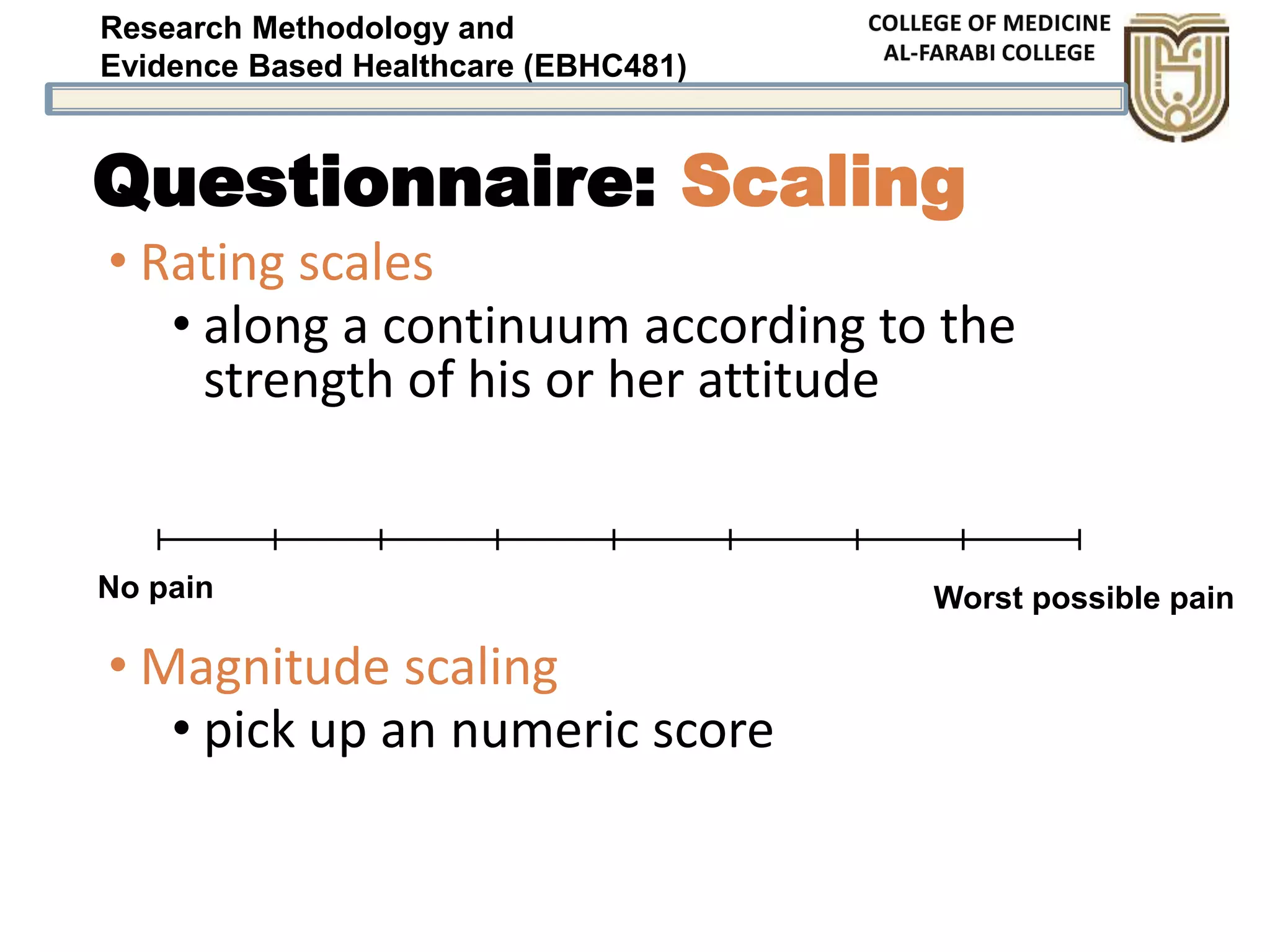
Questionnaire: Scaling
• Rating scales
• along a continuum according to the
strength of his or her attitude
• Magnitude scaling
• pick up an numeric score
No pain Worst possible pain
Research Methodology and
Evidence Based Healthcare (EBHC481)
14
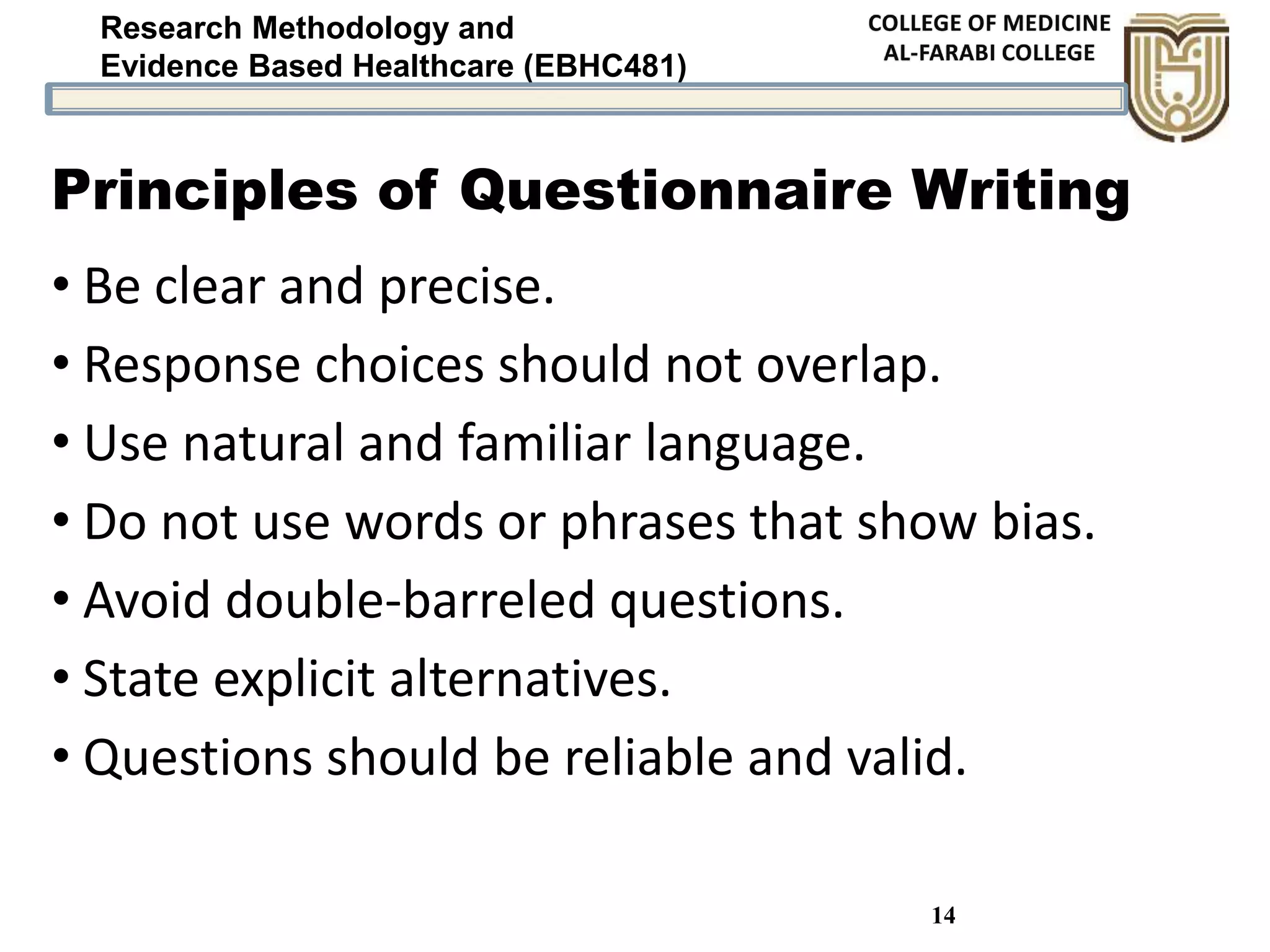
Principles of Questionnaire Writing
• Be clear and precise.
• Response choices should not overlap.
• Use natural and familiar language.
• Do not use words or phrases that show bias.
• Avoid double-barreled questions.
• State explicit alternatives.
• Questions should be reliable and valid.
Research Methodology and
Evidence Based Healthcare (EBHC481)
15
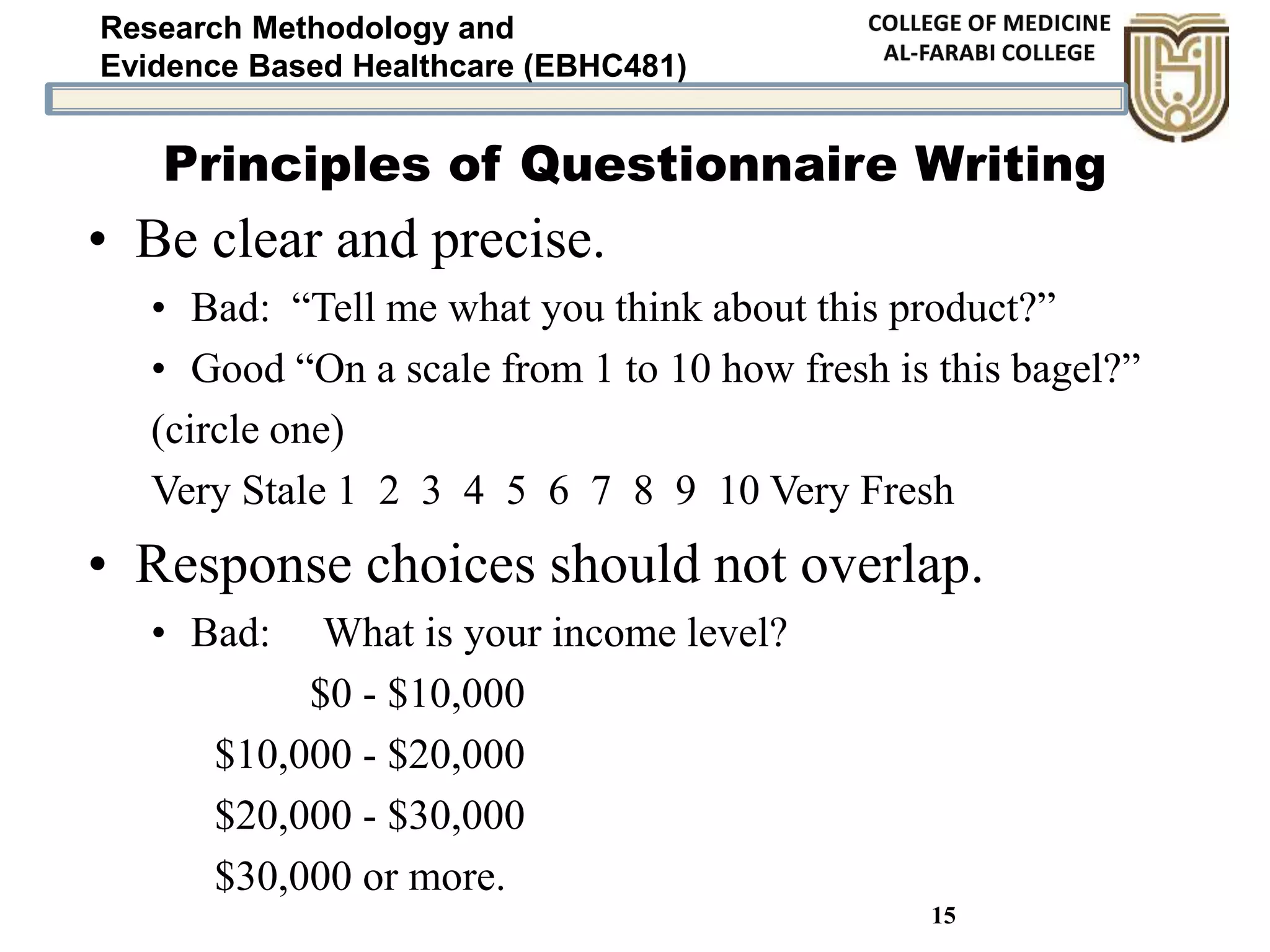
Principles of Questionnaire Writing
• Be clear and precise.
• Bad: “Tell me what you think about this product?”
• Good “On a scale from 1 to 10 how fresh is this bagel?”
(circle one)
Very Stale 1 2 3 4 5 6 7 8 9 10 Very Fresh
• Response choices should not overlap.
• Bad: What is your income level?
$0 - $10,000
$10,000 - $20,000
$20,000 - $30,000
$30,000 or more.
Research Methodology and
Evidence Based Healthcare (EBHC481)
16
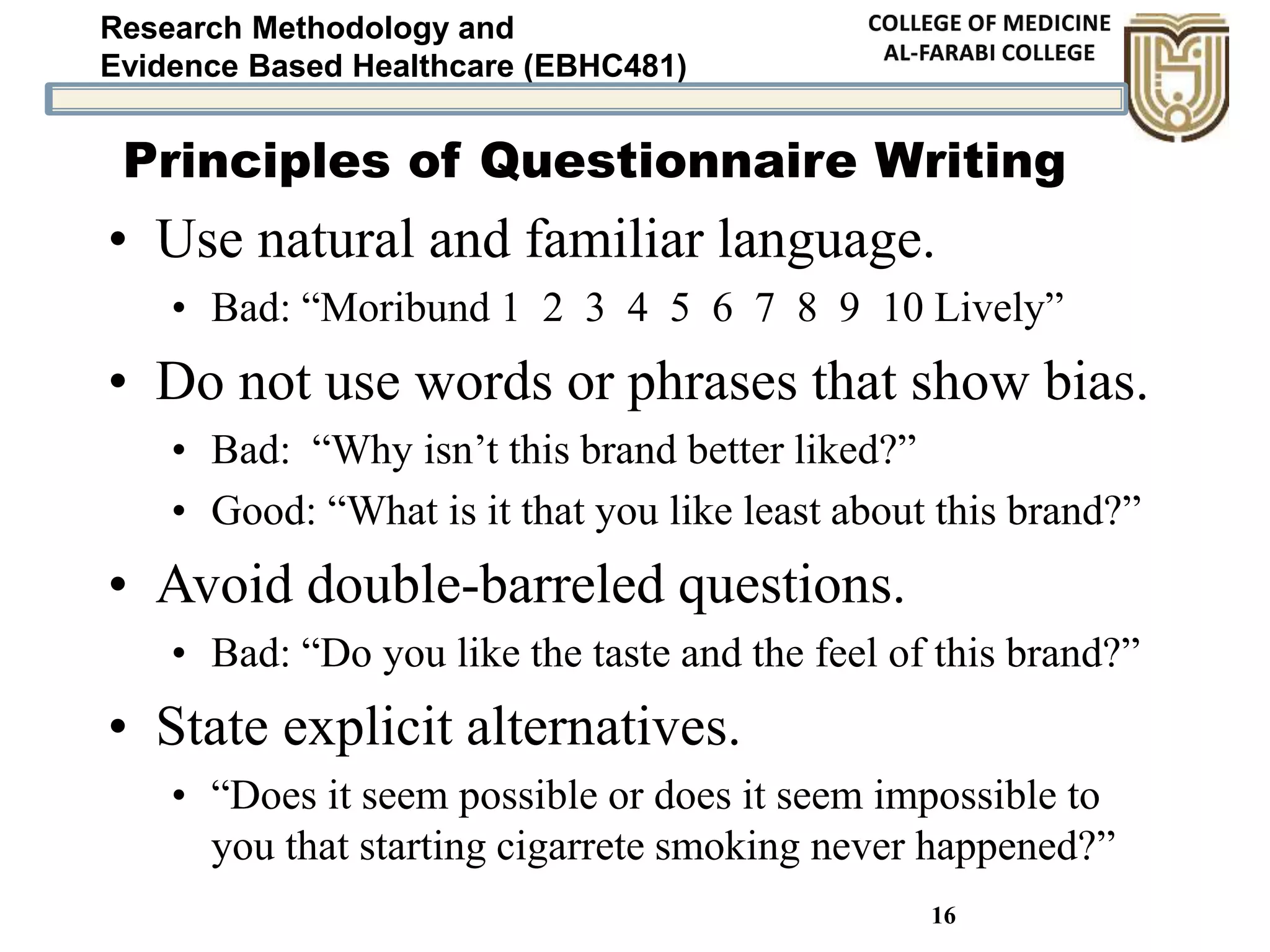
• Use natural and familiar language.
• Bad: “Moribund 1 2 3 4 5 6 7 8 9 10 Lively”
• Do not use words or phrases that show bias.
• Bad: “Why isn’t this brand better liked?”
• Good: “What is it that you like least about this brand?”
• Avoid double-barreled questions.
• Bad: “Do you like the taste and the feel of this brand?”
• State explicit alternatives.
• “Does it seem possible or does it seem impossible to
you that starting cigarrete smoking never happened?”
Principles of Questionnaire Writing
Research Methodology and
Evidence Based Healthcare (EBHC481)
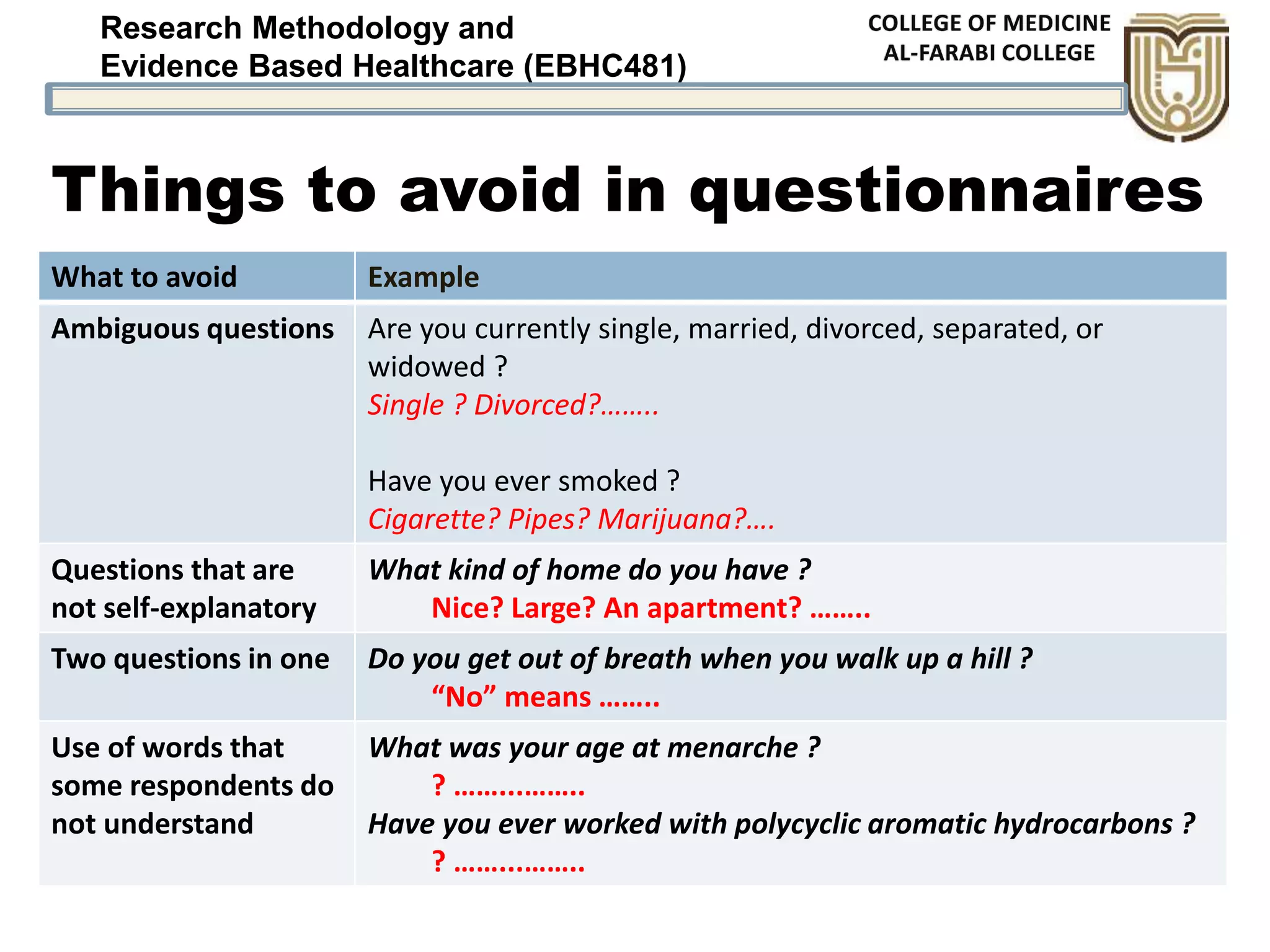
Things to avoid in questionnaires
What to avoid Example
Ambiguous questions Are you currently single, married, divorced, separated, or
widowed ?
Single ? Divorced?……..
Have you ever smoked ?
Cigarette? Pipes? Marijuana?….
Questions that are
not self-explanatory
What kind of home do you have ?
Nice? Large? An apartment? ……..
Two questions in one Do you get out of breath when you walk up a hill ?
“No” means ……..
Use of words that
some respondents do
not understand
What was your age at menarche ?
? ……...……..
Have you ever worked with polycyclic aromatic hydrocarbons ?
? ……...……..
Research Methodology and
Evidence Based Healthcare (EBHC481)
Things to avoid in questionnaires
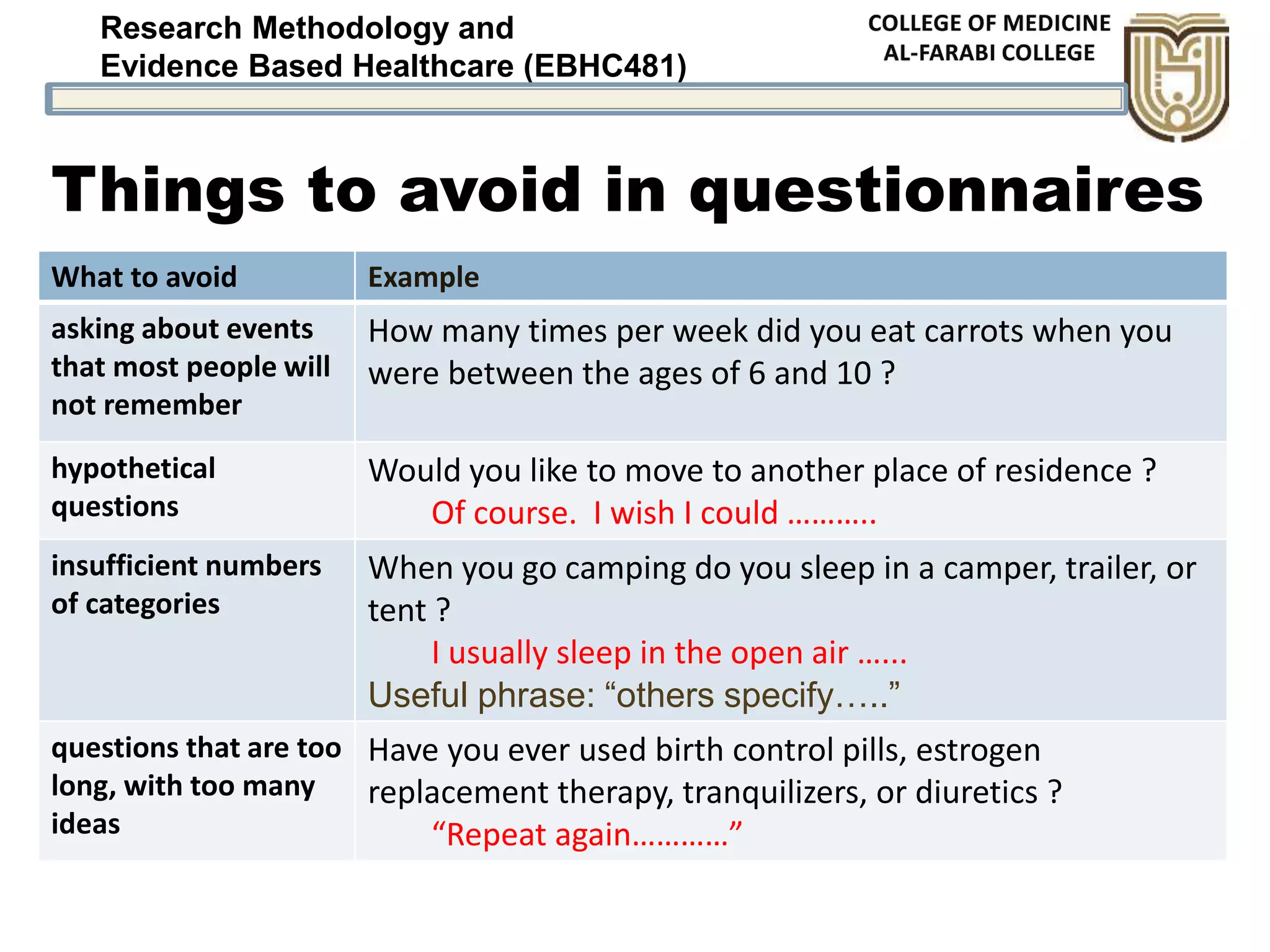
What to avoid Example
asking about events
that most people will
not remember
How many times per week did you eat carrots when you
were between the ages of 6 and 10 ?
hypothetical
questions
Would you like to move to another place of residence ?
Of course. I wish I could ………..
insufficient numbers
of categories
When you go camping do you sleep in a camper, trailer, or
tent ?
I usually sleep in the open air …...
Useful phrase: “others specify…..”
questions that are too
long, with too many
ideas
Have you ever used birth control pills, estrogen
replacement therapy, tranquilizers, or diuretics ?
“Repeat again…………”
Research Methodology and
Evidence Based Healthcare (EBHC481)
Things to avoid in questionnaires
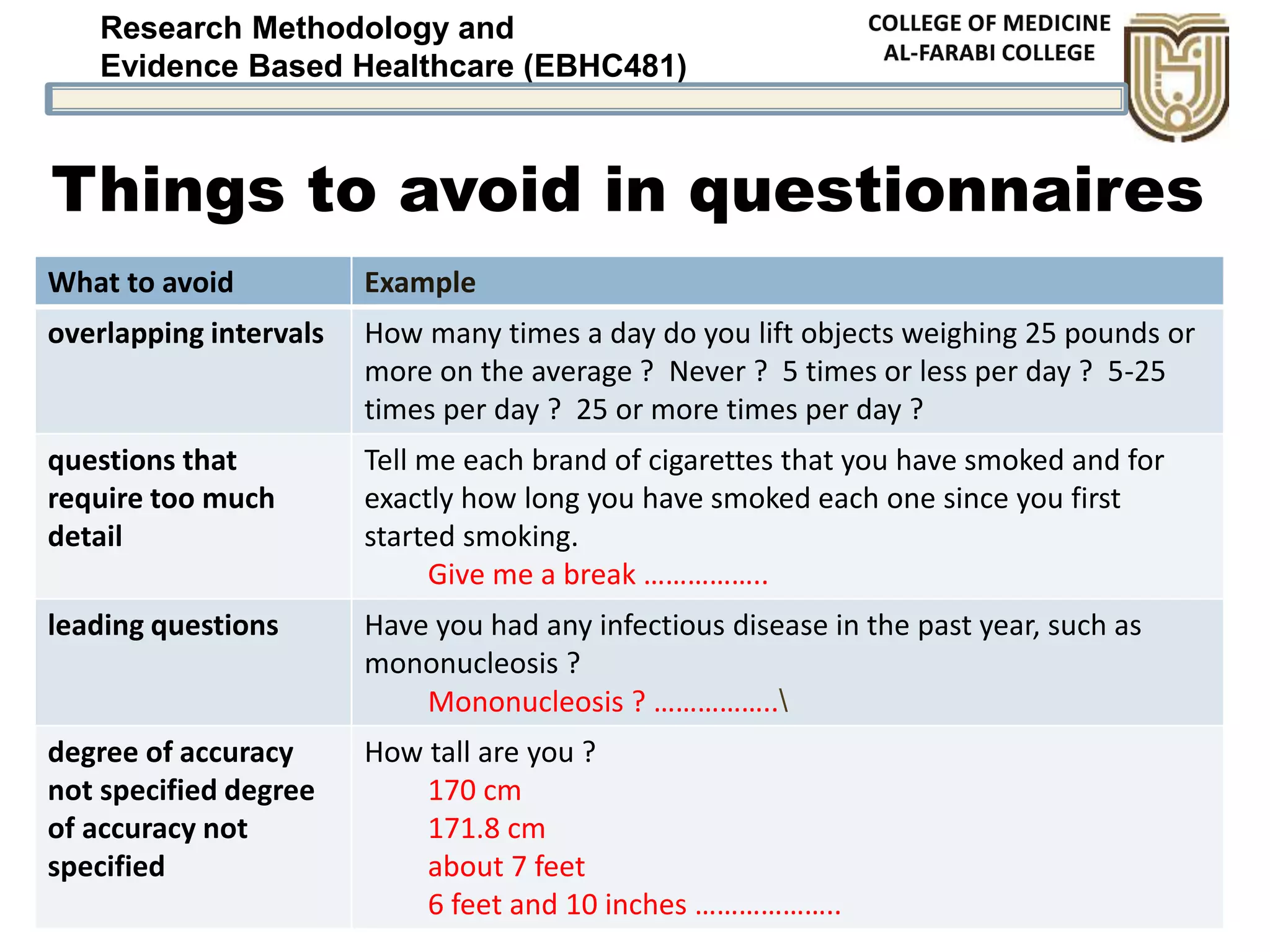
What to avoid Example
overlapping intervals How many times a day do you lift objects weighing 25 pounds or
more on the average ? Never ? 5 times or less per day ? 5-25
times per day ? 25 or more times per day ?
questions that
require too much
detail
Tell me each brand of cigarettes that you have smoked and for
exactly how long you have smoked each one since you first
started smoking.
Give me a break ……………..
leading questions Have you had any infectious disease in the past year, such as
mononucleosis ?
Mononucleosis ? ……………..
degree of accuracy
not specified degree
of accuracy not
specified
How tall are you ?
170 cm
171.8 cm
about 7 feet
6 feet and 10 inches ………………..
Research Methodology and
Evidence Based Healthcare (EBHC481)
Examples of BAD questions
• Biased/leading question
• Incorrect: Community organizing is hard. Do
leadership trainings help you feel prepared for
community organizing?
• Much more prepared [ ]
• Somewhat more prepared [ ]
• Slightly more prepared [ ]
• Not more prepared [ ]
• Correct: The leadership trainings prepare me for
community organizing.
• Strongly agree [ ] Agree [ ] Disagree [ ] Strongly disagree [ ]
Research Methodology and
Evidence Based Healthcare (EBHC481)
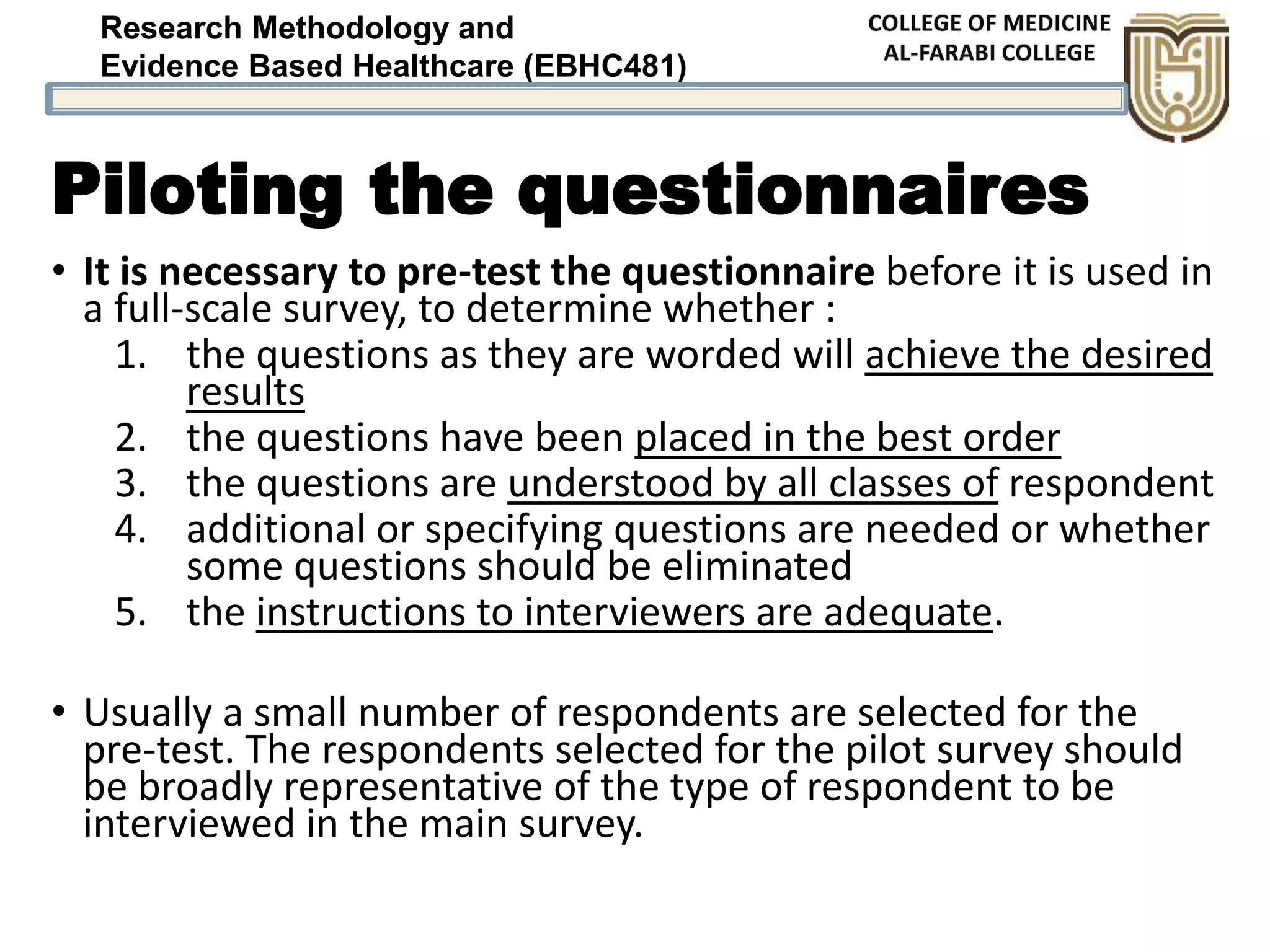
Piloting the questionnaires
• It is necessary to pre-test the questionnaire before it is used in
a full-scale survey, to determine whether :
1. the questions as they are worded will achieve the desired
results
2. the questions have been placed in the best order
3. the questions are understood by all classes of respondent
4. additional or specifying questions are needed or whether
some questions should be eliminated
5. the instructions to interviewers are adequate.
• Usually a small number of respondents are selected for the
pre-test. The respondents selected for the pilot survey should
be broadly representative of the type of respondent to be
interviewed in the main survey.
Research Methodology and
Evidence Based Healthcare (EBHC481)
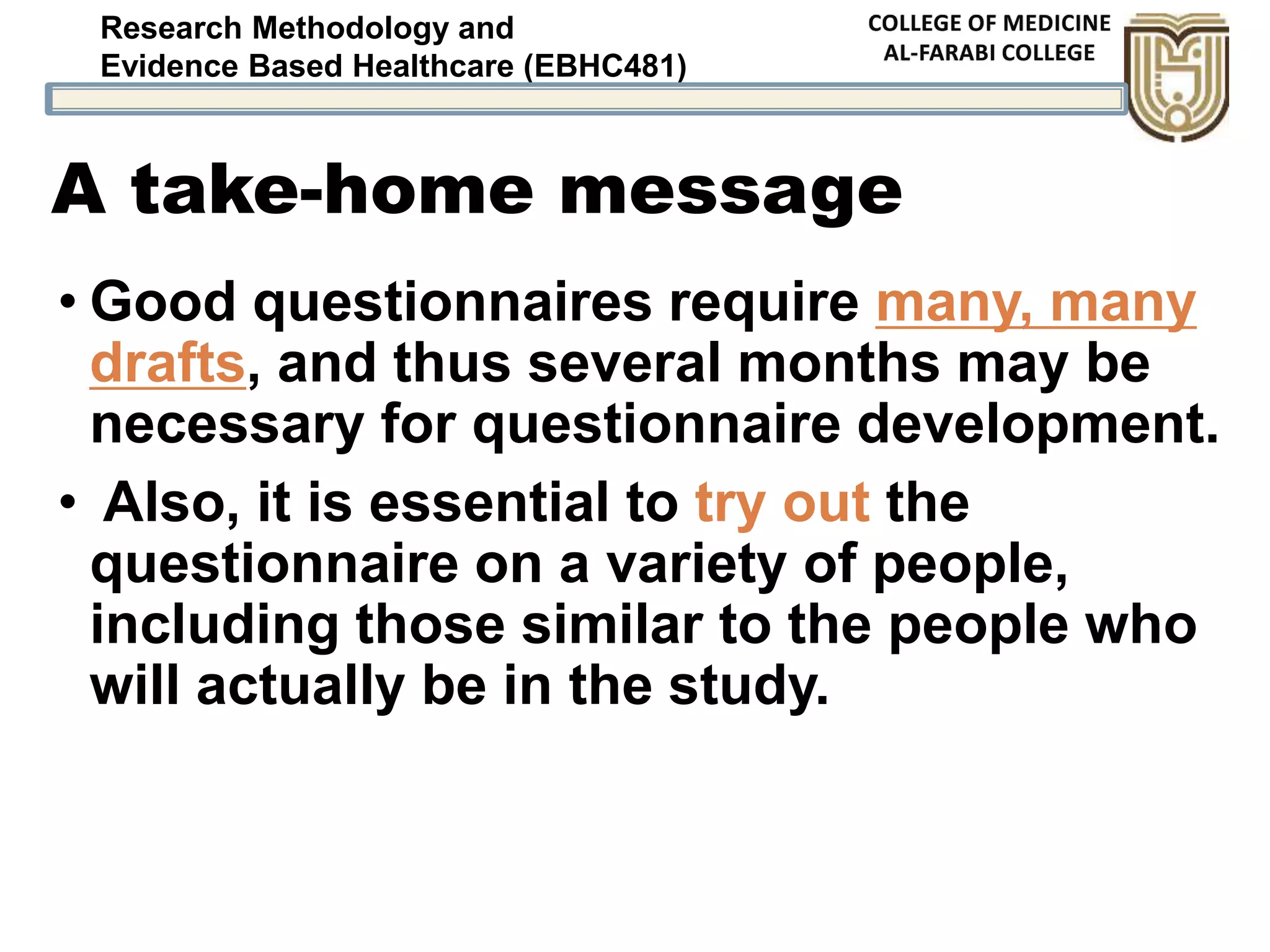
A take-home message
• Good questionnaires require many, many
drafts, and thus several months may be
necessary for questionnaire development.
• Also, it is essential to try out the
questionnaire on a variety of people,
including those similar to the people who
will actually be in the study.
Research Methodology and
Evidence Based Healthcare (EBHC481)
Practical Task
• Based on the topic and objectives you have
chosen in the previous sessions:
• Start designing your questionnaire fulfilling the
following:
• Decide on the sections/subheadings of the
questionnaire
• Add 2-3 questions under each subheading
• In pairs, start asking each other these
questions
• Give feedback

L12 questionnaires as data collection tools

  • 1.
    Research Methodology and EvidenceBased Healthcare (EBHC481) Questionnaire - Basic measurement tool -
  • 2.
    Research Methodology and EvidenceBased Healthcare (EBHC481) Why is it important? 1. Statistical analysis can be repeated 2. If done incorrectly initially, there is seldom a second chance to obtain information by questionnaire from large numbers of participants (Methods in observational epidemiology)
  • 3.
    Research Methodology and EvidenceBased Healthcare (EBHC481) What Is A Questionnaire? A tool for collecting information to describe, compare, or explain an event or situation, as well as, knowledge, attitudes, behaviors, and/or socio-demographic characteristics on a particular target group.
  • 4.
    Research Methodology and EvidenceBased Healthcare (EBHC481) Procedure for Development • Specify what information will be sought (back to objectives) • Determine the type of questionnaire and method of administration • Determine the content of individual questions • Determine the form of response to each question • Determine the wording of each question
  • 5.
    Research Methodology and EvidenceBased Healthcare (EBHC481) How To Obtain Valid Information • Ask purposeful questions • Ask concrete questions • Use conventional language • Use complete sentences • Avoid abbreviations • Review questions with experts and potential respondents (piloting) • Use shorter questions
  • 6.
    Research Methodology and EvidenceBased Healthcare (EBHC481) The steps preceding questionnaire design
  • 7.
    Research Methodology and EvidenceBased Healthcare (EBHC481) Steps to develop questionnaire 1. Decide on the information required. 2. Define the target respondents. 3. Choose the method(s) of reaching your target respondents. 4. Decide on question content. 5. Develop the question wording. 6. Put questions into a meaningful order and format. 7. Check the length of the questionnaire. 8. Pre-test the questionnaire9. Develop the final survey form.
  • 8.
    Research Methodology and EvidenceBased Healthcare (EBHC481) Points for consideration 1. A well-designed questionnaire should meet the research objectives. 2. It should obtain the most complete and accurate information possible. A good questionnaire is organised and worded to encourage respondents to provide accurate, unbiased and complete information. 3. A well-designed questionnaire should make it easy for respondents to give the necessary information and for the interviewer to record the answer, and it should be arranged so that sound analysis and interpretation are possible. 4. It would keep the interview brief and to the point and be so arranged that the respondent(s) remain interested throughout the interview.
  • 9.
    Research Methodology and EvidenceBased Healthcare (EBHC481) Questions Context •Standardize the interviewer •Standardize the response format •Ask questions in a social, cultural, and economic context •Keep confidentiality and voluntary participation •Include a letter of introduction or presentation
  • 10.
    Research Methodology and EvidenceBased Healthcare (EBHC481) Questions Format • Open questions - more information but difficult to codify, enter, and analyze • Closed questions - less information but easy to codify, enter, and analyze • Fixed-response (closed-ended): • Yes-No • True-False • Multiple Choice • Rating Scale/Continuum (e.g. a Likert-type scale) • Agree-Disagree • Rank ordering
  • 11.
    Research Methodology and EvidenceBased Healthcare (EBHC481) Questionnaire: type • Structured: same questions in the same way • closed-ended questions • open-ended questions • precoded (self-coded) questions • Unstructured: questions may vary Written document used to obtain information from respondents
  • 12.
    Research Methodology and EvidenceBased Healthcare (EBHC481) Type Examples Open-ended question What is your current marital status ? Closed-ended question (pre-coded/ not pre- coded) Are you currently (circle one): married ? [1] widowed ? [2] divorced ? [3] separated ? [4] or have you never been married ? [5]
  • 13.
    Research Methodology and EvidenceBased Healthcare (EBHC481) Questionnaire: Scaling • Rating scales • along a continuum according to the strength of his or her attitude • Magnitude scaling • pick up an numeric score No pain Worst possible pain
  • 14.
    Research Methodology and EvidenceBased Healthcare (EBHC481) 14 Principles of Questionnaire Writing • Be clear and precise. • Response choices should not overlap. • Use natural and familiar language. • Do not use words or phrases that show bias. • Avoid double-barreled questions. • State explicit alternatives. • Questions should be reliable and valid.
  • 15.
    Research Methodology and EvidenceBased Healthcare (EBHC481) 15 Principles of Questionnaire Writing • Be clear and precise. • Bad: “Tell me what you think about this product?” • Good “On a scale from 1 to 10 how fresh is this bagel?” (circle one) Very Stale 1 2 3 4 5 6 7 8 9 10 Very Fresh • Response choices should not overlap. • Bad: What is your income level? $0 - $10,000 $10,000 - $20,000 $20,000 - $30,000 $30,000 or more.
  • 16.
    Research Methodology and EvidenceBased Healthcare (EBHC481) 16 • Use natural and familiar language. • Bad: “Moribund 1 2 3 4 5 6 7 8 9 10 Lively” • Do not use words or phrases that show bias. • Bad: “Why isn’t this brand better liked?” • Good: “What is it that you like least about this brand?” • Avoid double-barreled questions. • Bad: “Do you like the taste and the feel of this brand?” • State explicit alternatives. • “Does it seem possible or does it seem impossible to you that starting cigarrete smoking never happened?” Principles of Questionnaire Writing
  • 17.
    Research Methodology and EvidenceBased Healthcare (EBHC481) Things to avoid in questionnaires What to avoid Example Ambiguous questions Are you currently single, married, divorced, separated, or widowed ? Single ? Divorced?…….. Have you ever smoked ? Cigarette? Pipes? Marijuana?…. Questions that are not self-explanatory What kind of home do you have ? Nice? Large? An apartment? …….. Two questions in one Do you get out of breath when you walk up a hill ? “No” means …….. Use of words that some respondents do not understand What was your age at menarche ? ? ……...…….. Have you ever worked with polycyclic aromatic hydrocarbons ? ? ……...……..
  • 18.
    Research Methodology and EvidenceBased Healthcare (EBHC481) Things to avoid in questionnaires What to avoid Example asking about events that most people will not remember How many times per week did you eat carrots when you were between the ages of 6 and 10 ? hypothetical questions Would you like to move to another place of residence ? Of course. I wish I could ……….. insufficient numbers of categories When you go camping do you sleep in a camper, trailer, or tent ? I usually sleep in the open air …... Useful phrase: “others specify…..” questions that are too long, with too many ideas Have you ever used birth control pills, estrogen replacement therapy, tranquilizers, or diuretics ? “Repeat again…………”
  • 19.
    Research Methodology and EvidenceBased Healthcare (EBHC481) Things to avoid in questionnaires What to avoid Example overlapping intervals How many times a day do you lift objects weighing 25 pounds or more on the average ? Never ? 5 times or less per day ? 5-25 times per day ? 25 or more times per day ? questions that require too much detail Tell me each brand of cigarettes that you have smoked and for exactly how long you have smoked each one since you first started smoking. Give me a break …………….. leading questions Have you had any infectious disease in the past year, such as mononucleosis ? Mononucleosis ? …………….. degree of accuracy not specified degree of accuracy not specified How tall are you ? 170 cm 171.8 cm about 7 feet 6 feet and 10 inches ………………..
  • 20.
    Research Methodology and EvidenceBased Healthcare (EBHC481) Examples of BAD questions • Biased/leading question • Incorrect: Community organizing is hard. Do leadership trainings help you feel prepared for community organizing? • Much more prepared [ ] • Somewhat more prepared [ ] • Slightly more prepared [ ] • Not more prepared [ ] • Correct: The leadership trainings prepare me for community organizing. • Strongly agree [ ] Agree [ ] Disagree [ ] Strongly disagree [ ]
  • 21.
    Research Methodology and EvidenceBased Healthcare (EBHC481) Piloting the questionnaires • It is necessary to pre-test the questionnaire before it is used in a full-scale survey, to determine whether : 1. the questions as they are worded will achieve the desired results 2. the questions have been placed in the best order 3. the questions are understood by all classes of respondent 4. additional or specifying questions are needed or whether some questions should be eliminated 5. the instructions to interviewers are adequate. • Usually a small number of respondents are selected for the pre-test. The respondents selected for the pilot survey should be broadly representative of the type of respondent to be interviewed in the main survey.
  • 22.
    Research Methodology and EvidenceBased Healthcare (EBHC481) A take-home message • Good questionnaires require many, many drafts, and thus several months may be necessary for questionnaire development. • Also, it is essential to try out the questionnaire on a variety of people, including those similar to the people who will actually be in the study.
  • 23.
    Research Methodology and EvidenceBased Healthcare (EBHC481) Practical Task • Based on the topic and objectives you have chosen in the previous sessions: • Start designing your questionnaire fulfilling the following: • Decide on the sections/subheadings of the questionnaire • Add 2-3 questions under each subheading • In pairs, start asking each other these questions • Give feedback