DATA COLLECTION
METHOD
(Chapter 5)
NHA INSTRUCTORS
DATA COLLECTION METHOD
• The primary methods to
collect data are:
1. Observation
2. Interview
3. Examination (Physical
Assessment)
• The nurse must use all the
methods simultaneously
when assessing the client.
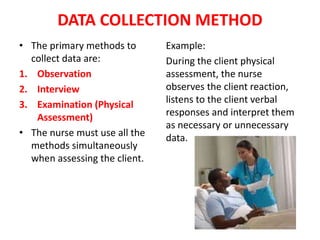
Example:
During the client physical
assessment, the nurse
observes the client reaction,
listens to the client verbal
responses and interpret them
as necessary or unnecessary
data.
OBSERVATION
A Method of Data Collection
OBSERVATION
• Observation is the gathering of
data using the senses. Although,
the sense of sight is mostly being
used, all senses must be engaged
during careful observation.
• Nurse needs to focus on specific
data to avoid being overwhelmed
by a multitude of data.
• Observation must be organized so
that nothing significant can be
missed.
Example:
A nurse walks into the client’s room
and observes, in the following order:
1. Clinical signs of client distress
(e.g. pallor or flushing, labored
breathing, and behavior
indicating pain or emotional
distress).
2. Threats to the client’s safety,
real or anticipated (e.g. lowered
side rails)
3. The presence and functioning of
associated equipment (e.g. IVF,
Oxygen)
4. The immediate environment,
including the people in it.
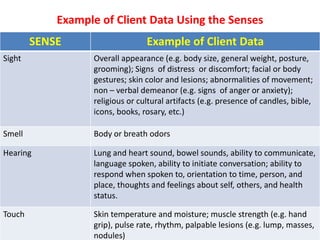
Example of Client Data Using the Senses
SENSE Example of Client Data
Sight Overall appearance (e.g. body size, general weight, posture,
grooming); Signs of distress or discomfort; facial or body
gestures; skin color and lesions; abnormalities of movement;
non – verbal demeanor (e.g. signs of anger or anxiety);
religious or cultural artifacts (e.g. presence of candles, bible,
icons, books, rosary, etc.)
Smell Body or breath odors
Hearing Lung and heart sound, bowel sounds, ability to communicate,
language spoken, ability to initiate conversation; ability to
respond when spoken to, orientation to time, person, and
place, thoughts and feelings about self, others, and health
status.
Touch Skin temperature and moisture; muscle strength (e.g. hand
grip), pulse rate, rhythm, palpable lesions (e.g. lump, masses,
nodules)
INTERVIEW
A Method of Data Collection
INTERVIEW
• Is a planned communication or a
conversation with a purpose
which targets are:
1. To get or give information
2. To identify problems of mutual
concern
3. To evaluate change
4. To teach and provide support
5. To provide counseling or therapy
• Nurses also used interview to
establish rapport with the
patient.
Approaches in Conducting Interview
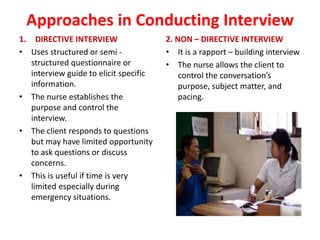
1. DIRECTIVE INTERVIEW
• Uses structured or semi -
structured questionnaire or
interview guide to elicit specific
information.
• The nurse establishes the
purpose and control the
interview.
• The client responds to questions
but may have limited opportunity
to ask questions or discuss
concerns.
• This is useful if time is very
limited especially during
emergency situations.
2. NON – DIRECTIVE INTERVIEW
• It is a rapport – building interview
• The nurse allows the client to
control the conversation’s
purpose, subject matter, and
pacing.
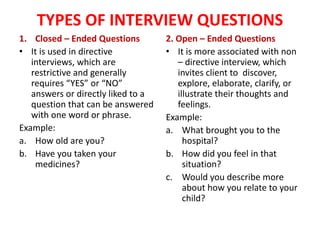
TYPES OF INTERVIEW QUESTIONS
1. Closed – Ended Questions
• It is used in directive
interviews, which are
restrictive and generally
requires “YES” or “NO”
answers or directly liked to a
question that can be answered
with one word or phrase.
Example:
a. How old are you?
b. Have you taken your
medicines?
2. Open – Ended Questions
• It is more associated with non
– directive interview, which
invites client to discover,
explore, elaborate, clarify, or
illustrate their thoughts and
feelings.
Example:
a. What brought you to the
hospital?
b. How did you feel in that
situation?
c. Would you describe more
about how you relate to your
child?
TYPES OF INTERVIEW QUESTIONS
3. Neutral Questions
• Is a question the client can
answer without direction or
pressure from the nurse.
• It is open – ended and non
– directive.
Example:
a. How do you feel about
today?
b. Why do you think you had
the operation?
4. Leading Questions
• Is closed and is a directive form of
question.
• The leading questions gives the
client less opportunity to decide
whether the answer is true or
not.
• Leading questions create
problems if the client, in an effort
to please the nurse, gives
inaccurate responses, thus,
resulting to inaccurate data.
Examples:
a. You will take your medicines,
won’t you?
b. You’re stressed about the
surgery tomorrow, aren’t you?
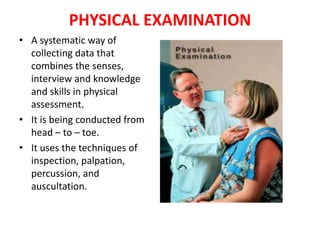
PHYSICAL EXAMINATION
• A systematic way of
collecting data that
combines the senses,
interview and knowledge
and skills in physical
assessment.
• It is being conducted from
head – to – toe.
• It uses the techniques of
inspection, palpation,
percussion, and
auscultation.
PLANNING THE
INTERVIEW SESSION
Planning the Interview
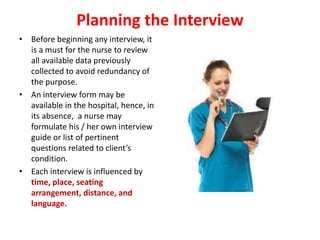
• Before beginning any interview, it
is a must for the nurse to review
all available data previously
collected to avoid redundancy of
the purpose.
• An interview form may be
available in the hospital, hence, in
its absence, a nurse may
formulate his / her own interview
guide or list of pertinent
questions related to client’s
condition.
• Each interview is influenced by
time, place, seating
arrangement, distance, and
language.
FACTORS THAT AFFECTS INTERVIEW
1. TIME
• The best time to conduct an
interview is when the
patient is physically
comfortable and is free
from pain, and is not
interrupted by the friends
or relatives inside the room.
• The client should feel
comfortable with the nurse
during the interview and
must feel the relaxing
atmosphere where the
nurse is unhurried to
complete his / her task.
2. PLACE
• A well – lighted, well –
ventilated room that is
relatively free from noise,
movements and
interruptions encourage
communication.
• Consider also that
conversations will not be
overheard by nearby
patients or visitors.
FACTORS THAT AFFECTS INTERVIEW
3. SEATING ARRANGEMENT
• It is better to create an interview
setting that is informal than being
too formal.
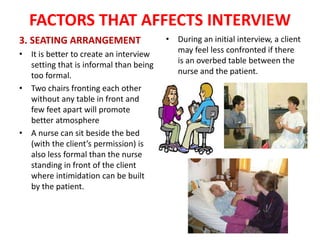
• Two chairs fronting each other
without any table in front and
few feet apart will promote
better atmosphere
• A nurse can sit beside the bed
(with the client’s permission) is
also less formal than the nurse
standing in front of the client
where intimidation can be built
by the patient.
• During an initial interview, a client
may feel less confronted if there
is an overbed table between the
nurse and the patient.
FACTORS THAT AFFECTS INTERVIEW
4. DISTANCE
• The distance between the
nurse and the patient should
be neither too small not too
great, because people may
feel uncomfortable when
talking to someone who is too
close or too far away.
• Most people feel comfortable
maintaining a distance of 2 – 3
feet during an interview. Some
people require more or less
personal space, depending on
their culture and personal
needs.
FACTORS THAT AFFECTS INTERVIEW
4. DISTANCE (Transcultural)
• Accepted distance between
individuals in conversation
varies with ethnicity.
a. 8 – 12 inches among Arabs
b. 18 inches for Americans
c. 24 inches for British
d. 36 inches for Japanese and
Asians
• Men of all cultures usually
require more space than
women
• Anxiety increases the need
for space
• Direct eye contact increases
the need for space.
• In East Asia and
Scandinavian Countries,
direct eye contact is
considered as disrespectful.
• Physical contact is used only
if it has therapeutic
purpose. Touch, even a
simple hand on the
shoulder, can be
misinterpreted – especially
between persons of
opposite gender.
FACTORS THAT AFFECTS INTERVIEW
5. LANGUAGE
• Failure to communicate in
language the client can
understand is a form of
discrimination.
• The nurse must convert medical
terms into common language (or
use interpreter) if the nurse and
the client has different languages.
However, nurses must be
cautious if the message is
properly being sent to the client
and to the nurse him / herself.
• In giving written documents to
clients, the nurse must determine
if the client can read.
ADDITIONAL INTERVIEW GUIDELINES
1. Listen attentively using all your senses, and speak clearly and
slowly.
2. Use language the client understands, and clarify points that are not
understood.
3. Plan question to follow a logical sequence.
4. Ask only one question at a time. Double questions limit the client
to one choice and may confuse both the nurse and the client.
5. Allow the client the opportunity to look at things they appear to
him or her and not the way they appear to the nurse or someone
else.
6. Do not impose your own values on the client.
7. Avoid using personal examples, such as saying “If I were you…”
8. Nonverbally convey respect, concern, interest, and acceptance.
9. Use and accept silence to help the client search for more thoughts
or to organize them.
10. Use eye contact and be calm, unhurried and sympathetic.
ROUTINE MEASUREMENTS
MADE
21
ROUTINE MEASUREMENTS MADE
1. If the physician have requested
for any form of diagnostic test, be
sure to have the report whenever
the doctor visits and performs
physical assessment
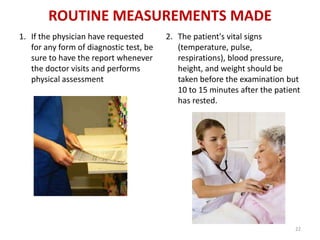
2. The patient's vital signs
(temperature, pulse,
respirations), blood pressure,
height, and weight should be
taken before the examination but
10 to 15 minutes after the patient
has rested.
22
ROUTINE MEASUREMENTS MADE
3. Routine examinations such as
complete blood count (CBC),
urinalysis, electrolytes, and chest
x-ray are usually ordered.
Complete the lab and x-ray
request slips with the patient's
name, rank, social security
number, date, and all other
required information.
4. Any abnormal values from direct
physical assessment and / or any
diagnostic result/s should be
immediately reported to the
physician.
23
END OF CHAPTER 5

5. Data Collection Method.pptx

  • 1.
  • 2.
    DATA COLLECTION METHOD •The primary methods to collect data are: 1. Observation 2. Interview 3. Examination (Physical Assessment) • The nurse must use all the methods simultaneously when assessing the client. Example: During the client physical assessment, the nurse observes the client reaction, listens to the client verbal responses and interpret them as necessary or unnecessary data.
  • 3.
    OBSERVATION A Method ofData Collection
  • 4.
    OBSERVATION • Observation isthe gathering of data using the senses. Although, the sense of sight is mostly being used, all senses must be engaged during careful observation. • Nurse needs to focus on specific data to avoid being overwhelmed by a multitude of data. • Observation must be organized so that nothing significant can be missed. Example: A nurse walks into the client’s room and observes, in the following order: 1. Clinical signs of client distress (e.g. pallor or flushing, labored breathing, and behavior indicating pain or emotional distress). 2. Threats to the client’s safety, real or anticipated (e.g. lowered side rails) 3. The presence and functioning of associated equipment (e.g. IVF, Oxygen) 4. The immediate environment, including the people in it.
  • 5.
    Example of ClientData Using the Senses SENSE Example of Client Data Sight Overall appearance (e.g. body size, general weight, posture, grooming); Signs of distress or discomfort; facial or body gestures; skin color and lesions; abnormalities of movement; non – verbal demeanor (e.g. signs of anger or anxiety); religious or cultural artifacts (e.g. presence of candles, bible, icons, books, rosary, etc.) Smell Body or breath odors Hearing Lung and heart sound, bowel sounds, ability to communicate, language spoken, ability to initiate conversation; ability to respond when spoken to, orientation to time, person, and place, thoughts and feelings about self, others, and health status. Touch Skin temperature and moisture; muscle strength (e.g. hand grip), pulse rate, rhythm, palpable lesions (e.g. lump, masses, nodules)
  • 6.
    INTERVIEW A Method ofData Collection
  • 7.
    INTERVIEW • Is aplanned communication or a conversation with a purpose which targets are: 1. To get or give information 2. To identify problems of mutual concern 3. To evaluate change 4. To teach and provide support 5. To provide counseling or therapy • Nurses also used interview to establish rapport with the patient.
  • 8.
    Approaches in ConductingInterview 1. DIRECTIVE INTERVIEW • Uses structured or semi - structured questionnaire or interview guide to elicit specific information. • The nurse establishes the purpose and control the interview. • The client responds to questions but may have limited opportunity to ask questions or discuss concerns. • This is useful if time is very limited especially during emergency situations. 2. NON – DIRECTIVE INTERVIEW • It is a rapport – building interview • The nurse allows the client to control the conversation’s purpose, subject matter, and pacing.
  • 9.
    TYPES OF INTERVIEWQUESTIONS 1. Closed – Ended Questions • It is used in directive interviews, which are restrictive and generally requires “YES” or “NO” answers or directly liked to a question that can be answered with one word or phrase. Example: a. How old are you? b. Have you taken your medicines? 2. Open – Ended Questions • It is more associated with non – directive interview, which invites client to discover, explore, elaborate, clarify, or illustrate their thoughts and feelings. Example: a. What brought you to the hospital? b. How did you feel in that situation? c. Would you describe more about how you relate to your child?
  • 10.
    TYPES OF INTERVIEWQUESTIONS 3. Neutral Questions • Is a question the client can answer without direction or pressure from the nurse. • It is open – ended and non – directive. Example: a. How do you feel about today? b. Why do you think you had the operation? 4. Leading Questions • Is closed and is a directive form of question. • The leading questions gives the client less opportunity to decide whether the answer is true or not. • Leading questions create problems if the client, in an effort to please the nurse, gives inaccurate responses, thus, resulting to inaccurate data. Examples: a. You will take your medicines, won’t you? b. You’re stressed about the surgery tomorrow, aren’t you?
  • 11.
  • 12.
    PHYSICAL EXAMINATION • Asystematic way of collecting data that combines the senses, interview and knowledge and skills in physical assessment. • It is being conducted from head – to – toe. • It uses the techniques of inspection, palpation, percussion, and auscultation.
  • 13.
  • 14.
    Planning the Interview •Before beginning any interview, it is a must for the nurse to review all available data previously collected to avoid redundancy of the purpose. • An interview form may be available in the hospital, hence, in its absence, a nurse may formulate his / her own interview guide or list of pertinent questions related to client’s condition. • Each interview is influenced by time, place, seating arrangement, distance, and language.
  • 15.
    FACTORS THAT AFFECTSINTERVIEW 1. TIME • The best time to conduct an interview is when the patient is physically comfortable and is free from pain, and is not interrupted by the friends or relatives inside the room. • The client should feel comfortable with the nurse during the interview and must feel the relaxing atmosphere where the nurse is unhurried to complete his / her task. 2. PLACE • A well – lighted, well – ventilated room that is relatively free from noise, movements and interruptions encourage communication. • Consider also that conversations will not be overheard by nearby patients or visitors.
  • 16.
    FACTORS THAT AFFECTSINTERVIEW 3. SEATING ARRANGEMENT • It is better to create an interview setting that is informal than being too formal. • Two chairs fronting each other without any table in front and few feet apart will promote better atmosphere • A nurse can sit beside the bed (with the client’s permission) is also less formal than the nurse standing in front of the client where intimidation can be built by the patient. • During an initial interview, a client may feel less confronted if there is an overbed table between the nurse and the patient.
  • 17.
    FACTORS THAT AFFECTSINTERVIEW 4. DISTANCE • The distance between the nurse and the patient should be neither too small not too great, because people may feel uncomfortable when talking to someone who is too close or too far away. • Most people feel comfortable maintaining a distance of 2 – 3 feet during an interview. Some people require more or less personal space, depending on their culture and personal needs.
  • 18.
    FACTORS THAT AFFECTSINTERVIEW 4. DISTANCE (Transcultural) • Accepted distance between individuals in conversation varies with ethnicity. a. 8 – 12 inches among Arabs b. 18 inches for Americans c. 24 inches for British d. 36 inches for Japanese and Asians • Men of all cultures usually require more space than women • Anxiety increases the need for space • Direct eye contact increases the need for space. • In East Asia and Scandinavian Countries, direct eye contact is considered as disrespectful. • Physical contact is used only if it has therapeutic purpose. Touch, even a simple hand on the shoulder, can be misinterpreted – especially between persons of opposite gender.
  • 19.
    FACTORS THAT AFFECTSINTERVIEW 5. LANGUAGE • Failure to communicate in language the client can understand is a form of discrimination. • The nurse must convert medical terms into common language (or use interpreter) if the nurse and the client has different languages. However, nurses must be cautious if the message is properly being sent to the client and to the nurse him / herself. • In giving written documents to clients, the nurse must determine if the client can read.
  • 20.
    ADDITIONAL INTERVIEW GUIDELINES 1.Listen attentively using all your senses, and speak clearly and slowly. 2. Use language the client understands, and clarify points that are not understood. 3. Plan question to follow a logical sequence. 4. Ask only one question at a time. Double questions limit the client to one choice and may confuse both the nurse and the client. 5. Allow the client the opportunity to look at things they appear to him or her and not the way they appear to the nurse or someone else. 6. Do not impose your own values on the client. 7. Avoid using personal examples, such as saying “If I were you…” 8. Nonverbally convey respect, concern, interest, and acceptance. 9. Use and accept silence to help the client search for more thoughts or to organize them. 10. Use eye contact and be calm, unhurried and sympathetic.
  • 21.
  • 22.
    ROUTINE MEASUREMENTS MADE 1.If the physician have requested for any form of diagnostic test, be sure to have the report whenever the doctor visits and performs physical assessment 2. The patient's vital signs (temperature, pulse, respirations), blood pressure, height, and weight should be taken before the examination but 10 to 15 minutes after the patient has rested. 22
  • 23.
    ROUTINE MEASUREMENTS MADE 3.Routine examinations such as complete blood count (CBC), urinalysis, electrolytes, and chest x-ray are usually ordered. Complete the lab and x-ray request slips with the patient's name, rank, social security number, date, and all other required information. 4. Any abnormal values from direct physical assessment and / or any diagnostic result/s should be immediately reported to the physician. 23
  • 24.