




LECTURE L12
DIGITAL TRANSFORMATION
Broadcasting
Media in the 20th Century
Print Radio TV CD/DVDs
1900 2000
Analog, Broadcast, One-2-many, copies to sell
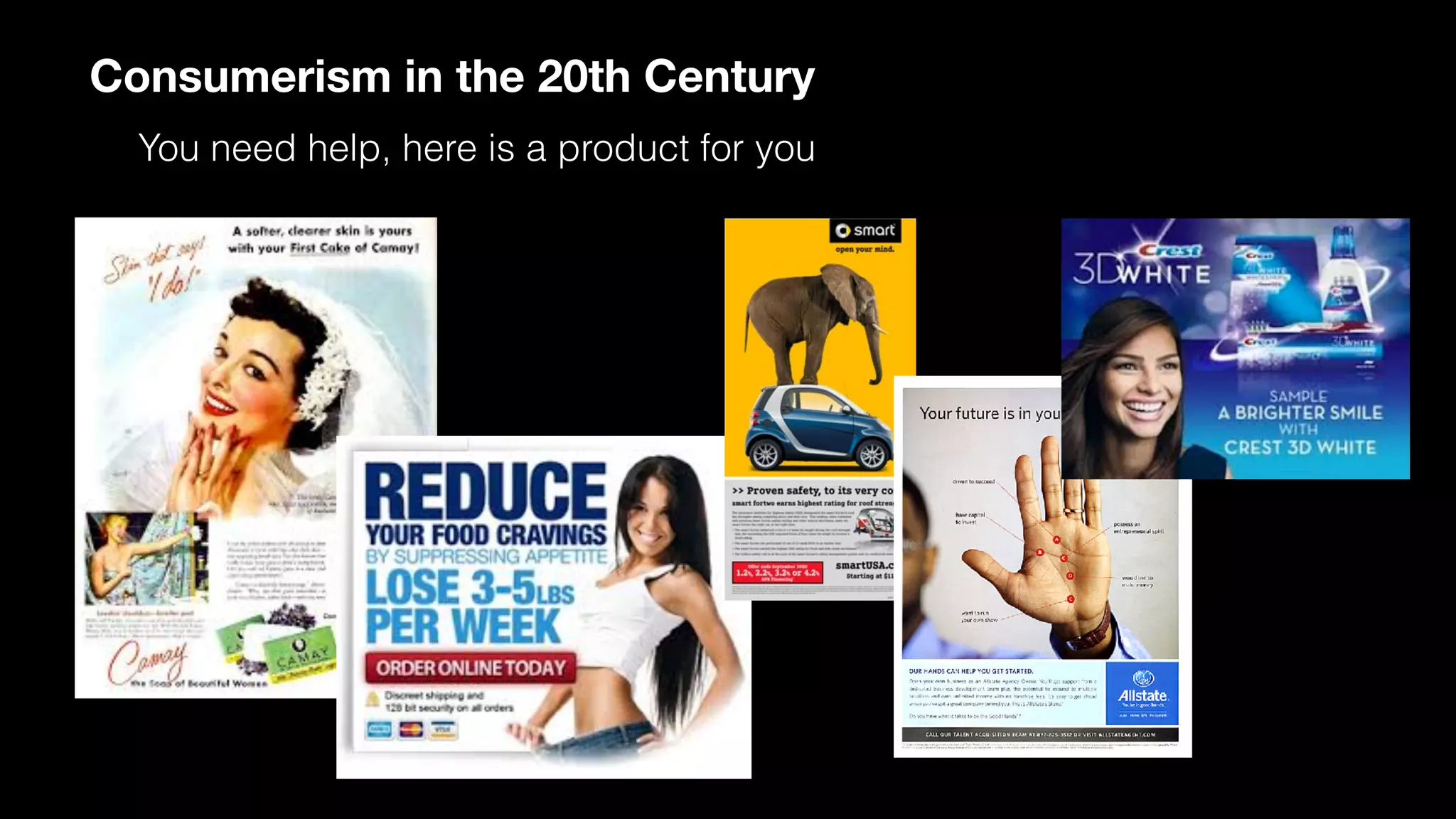
Consumerism in the 20th Century
You need help, here is a product for you
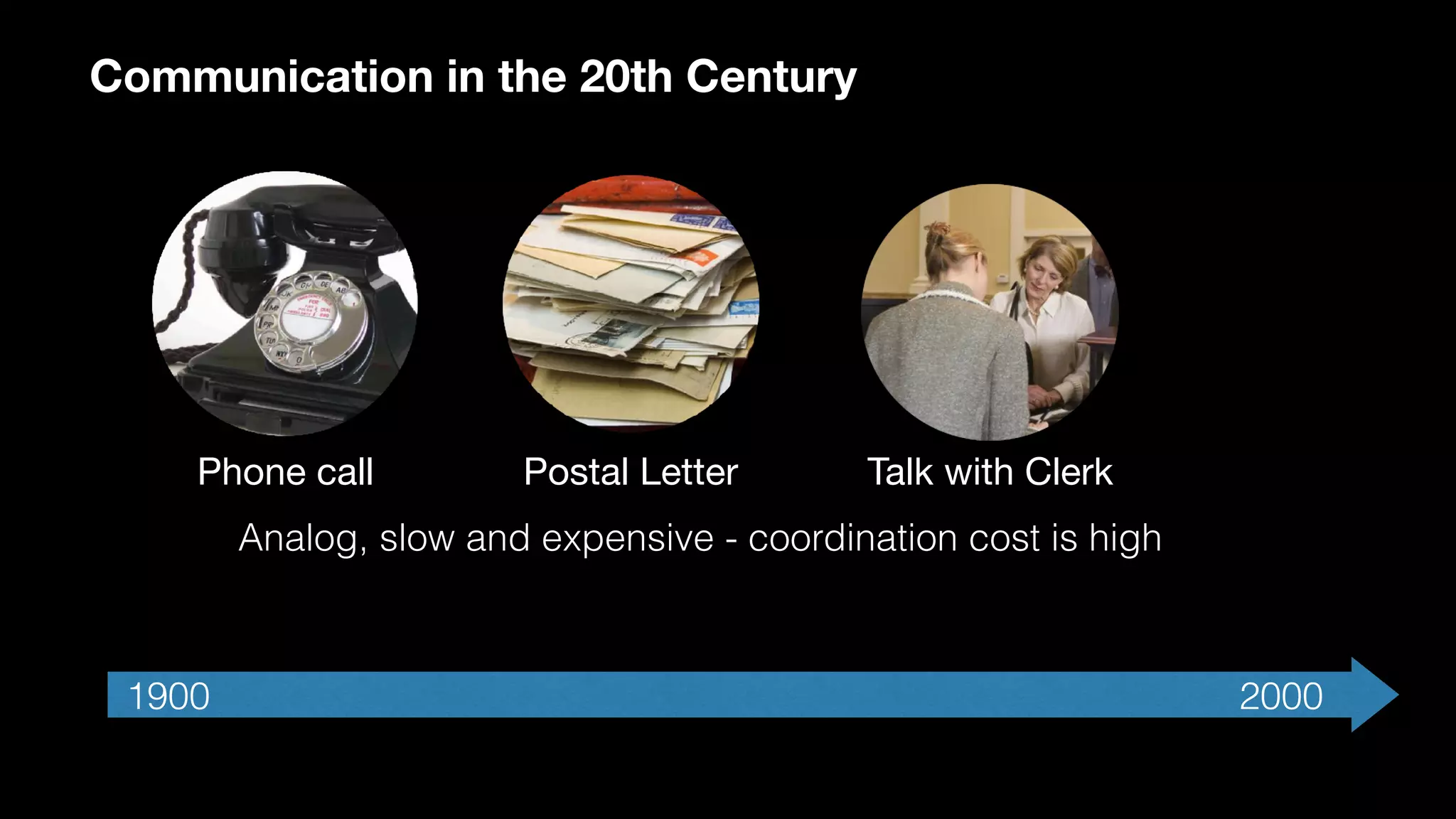
Communication in the 20th Century
Phone call Postal Letter Talk with Clerk
Analog, slow and expensive - coordination cost is high
1900 2000
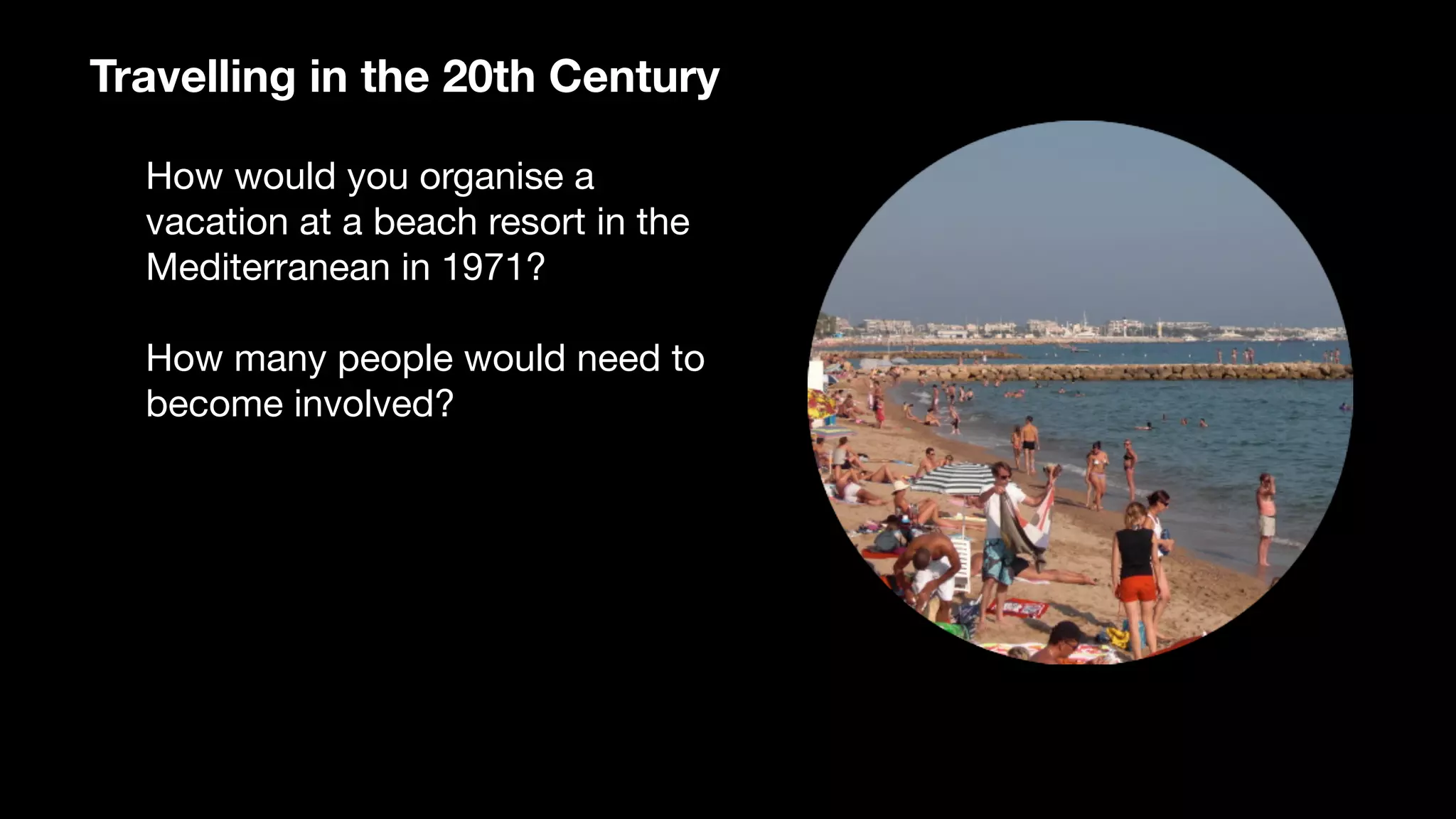
Travelling in the 20th Century
How would you organise a
vacation at a beach resort in the
Mediterranean in 1971?

How many people would need to
become involved?
Coordination
To solve coordination, hierarchical
structures must be formed

Corporate structure with layers of
middle managers

Coordination cost is high and
involves many people

Getting things done is expensive
and slow
Hierarchy
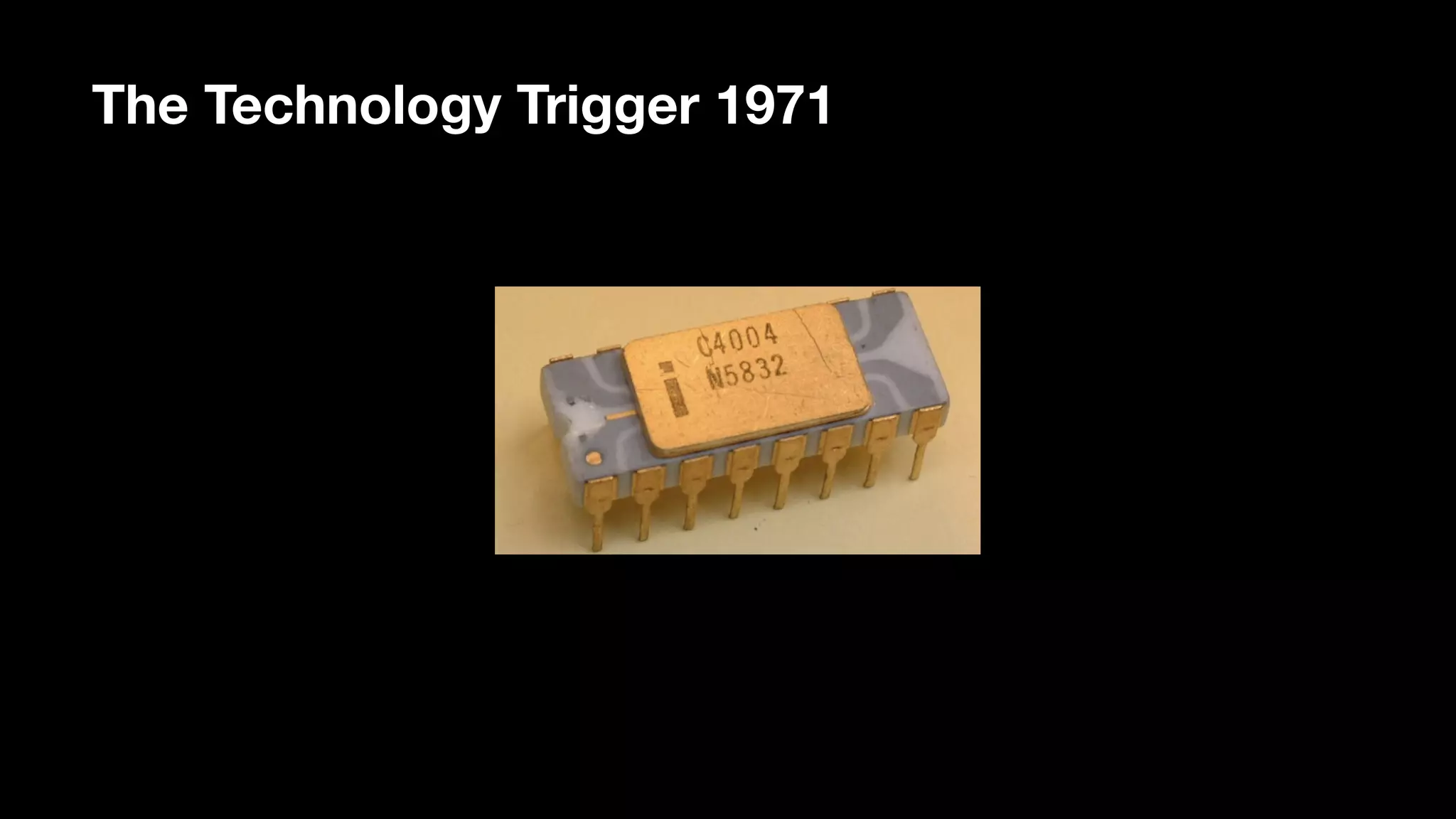
Fifth Technological Revolution
starts
Intel 1971
The Technology Trigger 1971
PDP-8
Computer from DEC in
March 1965
Cost 18.500 USD
50.000 machines sold
12 bit architecture
32K memory
0,5 MIPS
MIPS: millions instruction per second
iPhone 6
Smartphone from

September 2015
Cost $649
Sold 10 million phones

in 3 days
64 bit architecture
128GB “capacity”
25.000 MIPS
2000 2010
iMac iPhone
iMac G3	
Mac OS 9.0.4

500 MHz PowerPC G3 CPU, 128MB Memory

Screen - 786K pixels

Storage - 30GB Hard Drive
iPhone 4	iOS 4.0

1 Ghz ARM A4 CPU, 512MB Memory

Screen - 614K pixels

Storage - 32GB Flash Drive
MOORE’S LAW
MUSIC
PICTURES
COMMUNICATION
SMARTPHONES
TV	SHOWS
MOVIES
BOOKS
THE DIGITAL DECADE
2000 2010
2000 2010
SOCIAL MEDIA
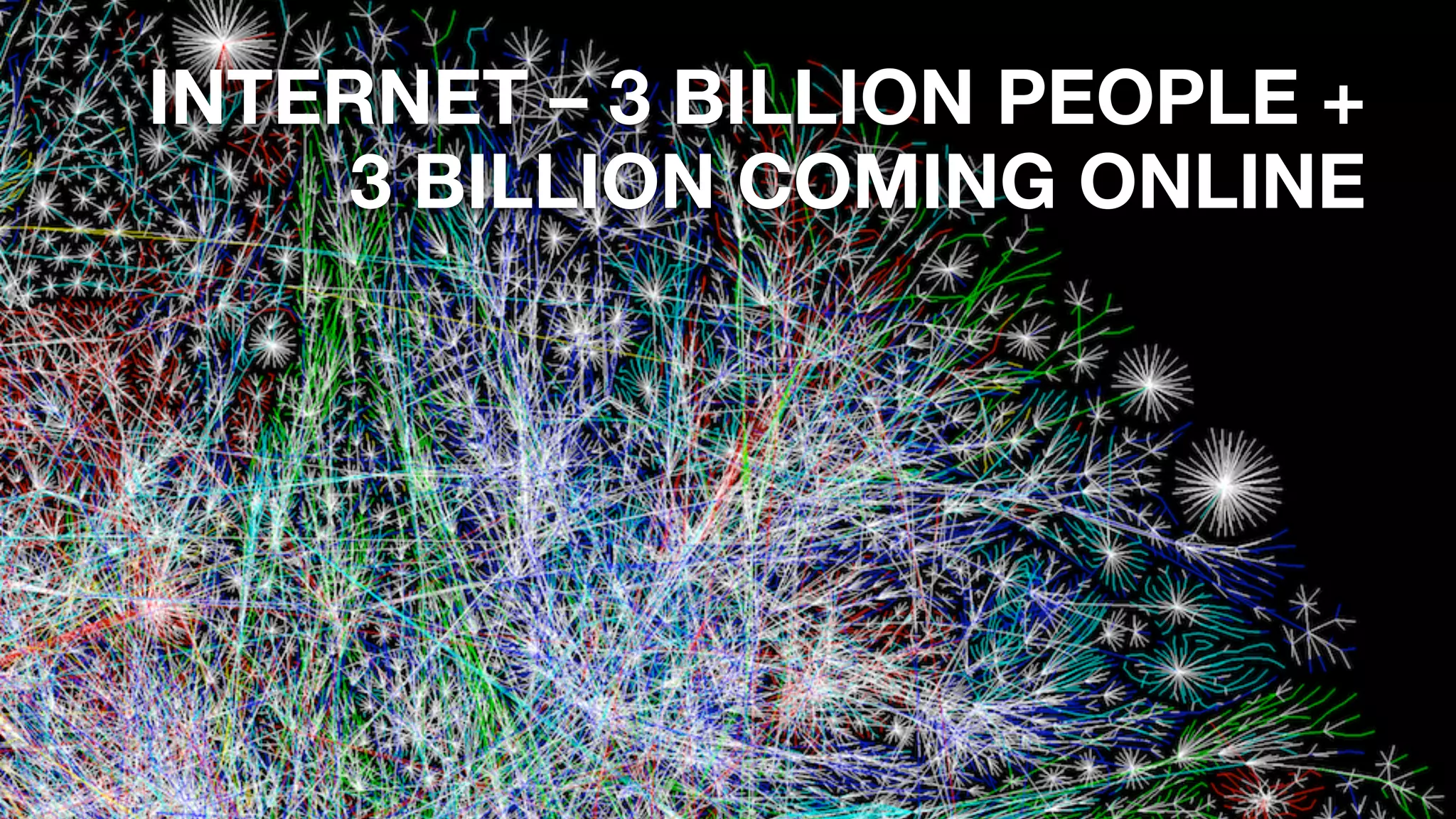
INTERNET – 3 BILLION PEOPLE + 

3 BILLION COMING ONLINE
SOFTWARE AND DATA 

ARE IN THE CLOUD
INTELLINGENT

REAL-TIME
SOFTWARE
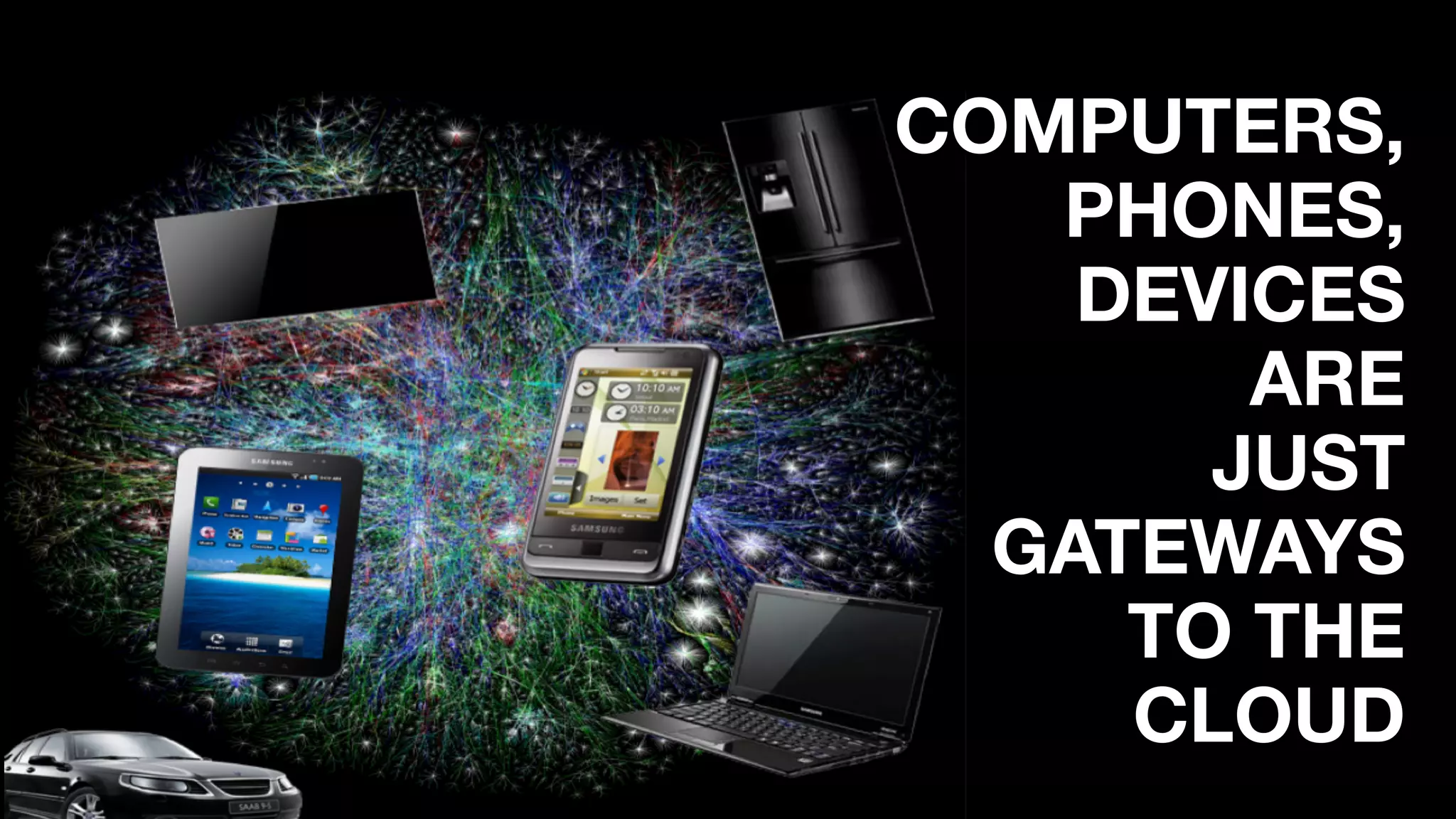
COMPUTERS,

PHONES,
DEVICES
ARE 

JUST 

GATEWAYS
TO THE

CLOUD
Mainframe
1947
Minicomputer
1965
PC
1981 1995
Internet Smartphone
2007
The Shortening Waves
Clay Shirky: Institutions vs. collaboration
TED Talk 2005
Coordination Cost
All of the financial cost and institutional difficulties arranging
group output
Form an institution - get resources together

1. Management Problem

2. Structure - economic, legal, physical etc.

3. Inherently exclusionary

4. Professional class
Solving the Coordination Cost
Cost of communication is now basically zero and universal

Put the cooperation into the infrastructure

Design a system that coordinates the output of the system as a
byproduct of operating the system with out regard to institutional
models
New Solutions
New solutions get built on the Internet infrastructure
Napster in 1999
Music Industry goes crazy
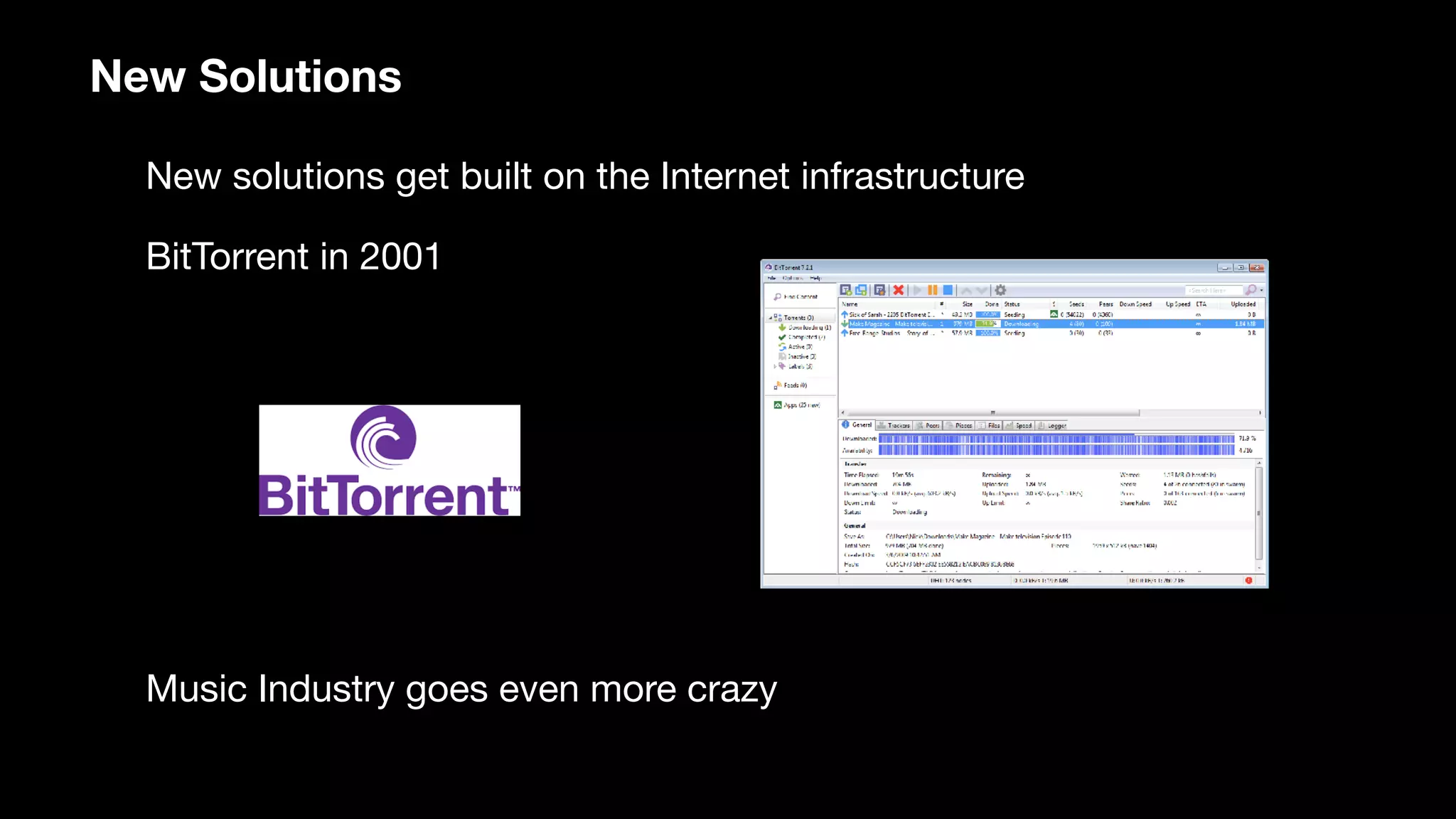
New Solutions
New solutions get built on the Internet infrastructure
BitTorrent in 2001
Music Industry goes even more crazy
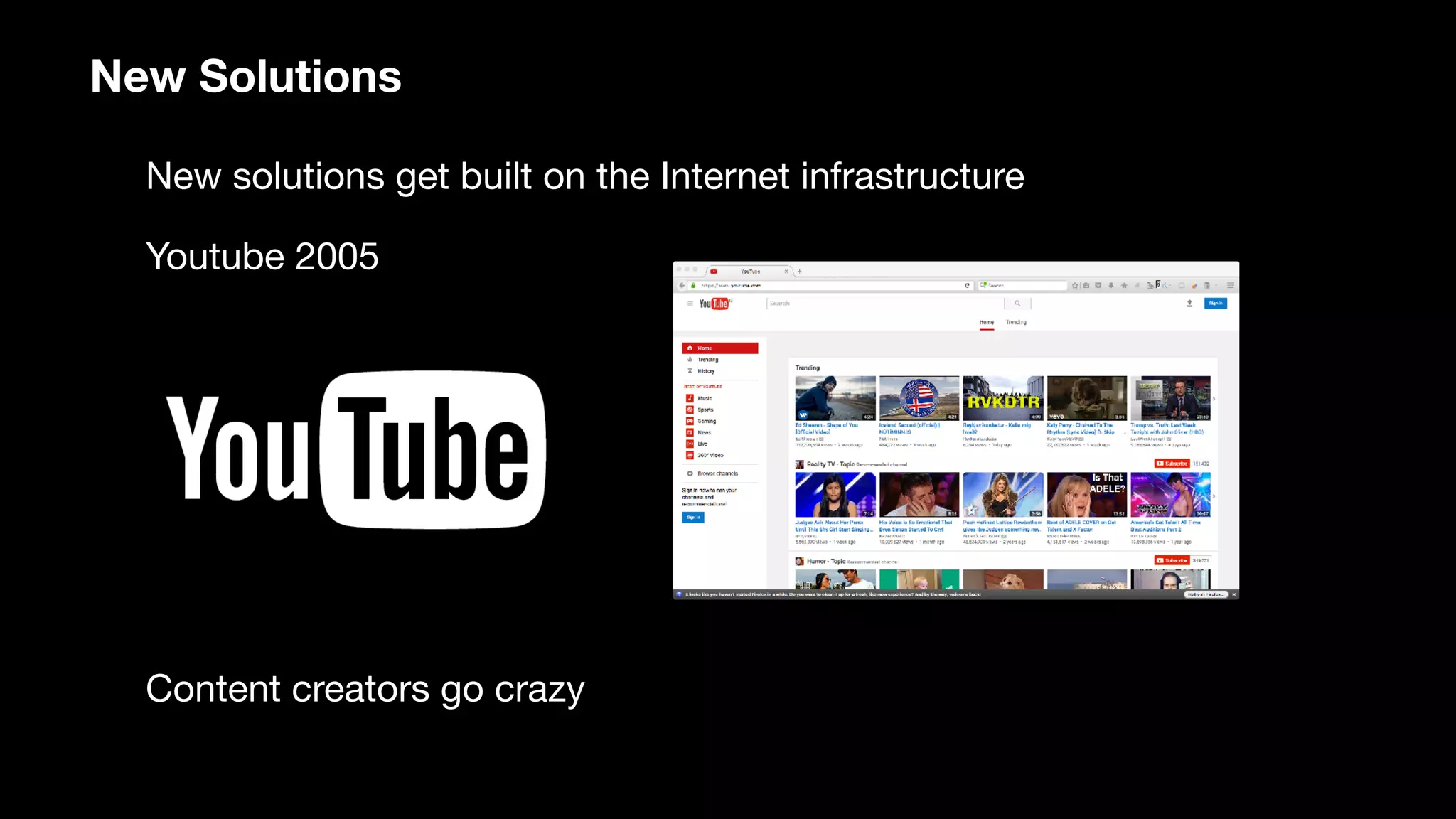
New Solutions
New solutions get built on the Internet infrastructure
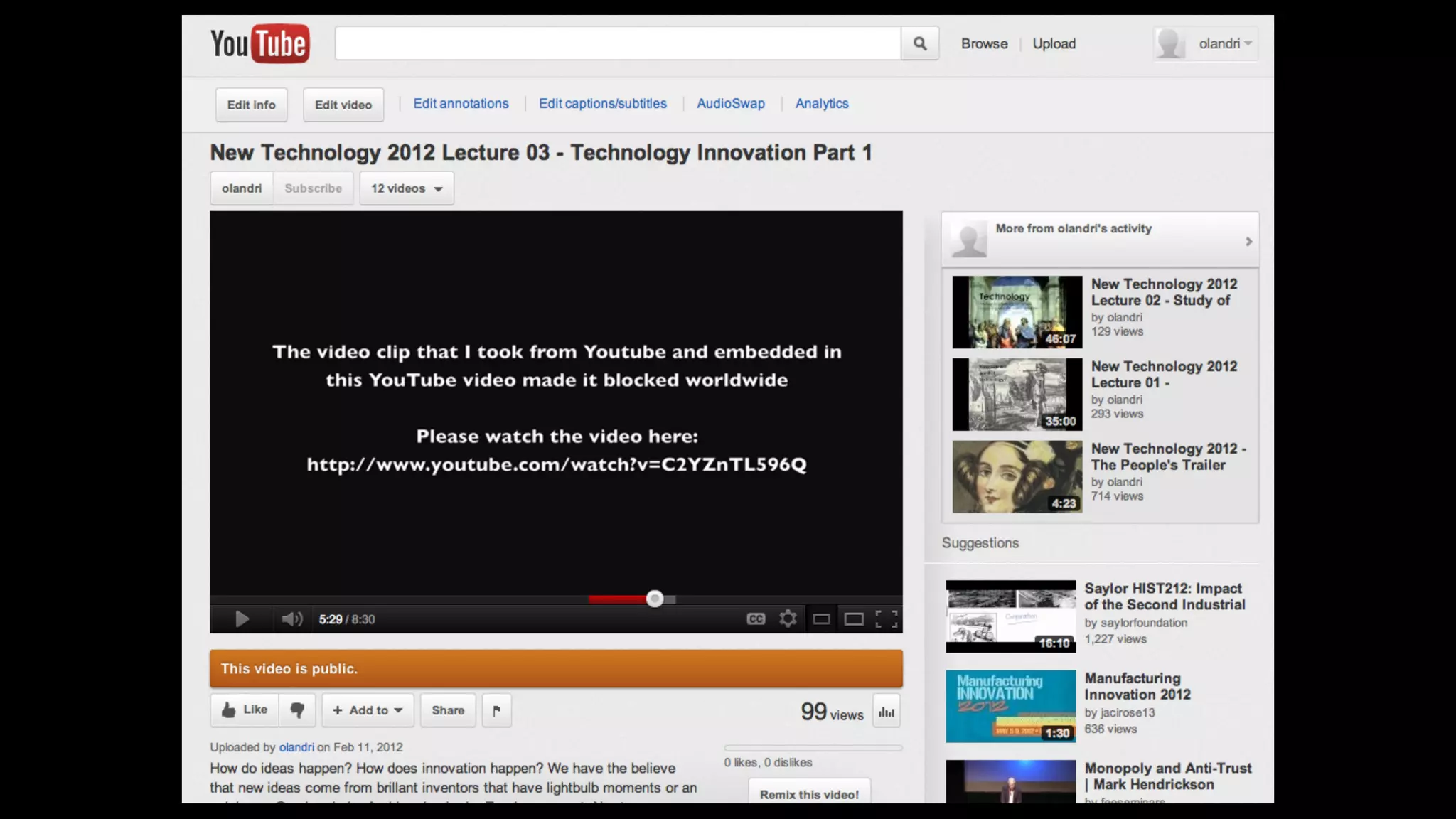
Youtube 2005
Content creators go crazy
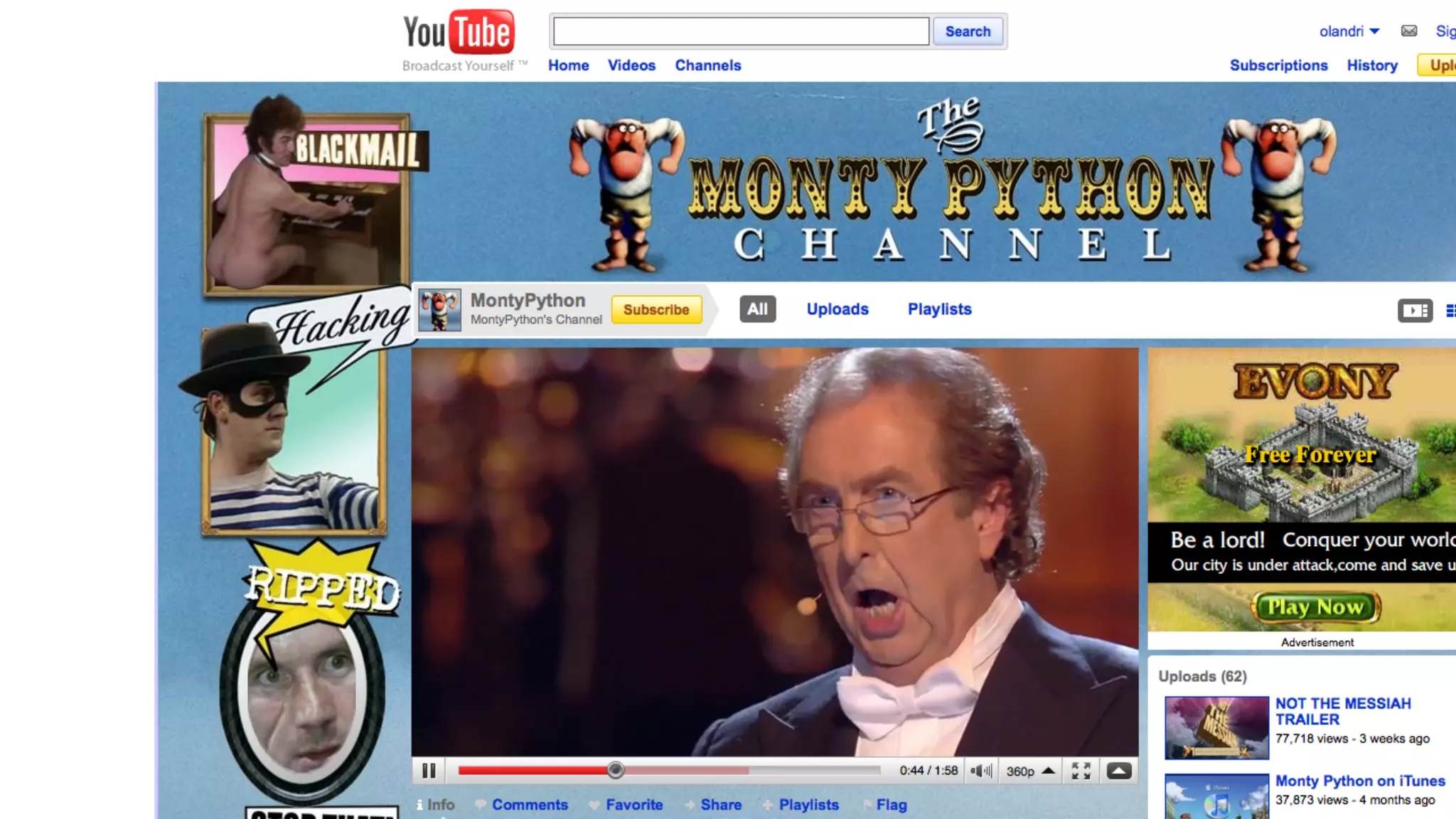
Monty Payton goes to War
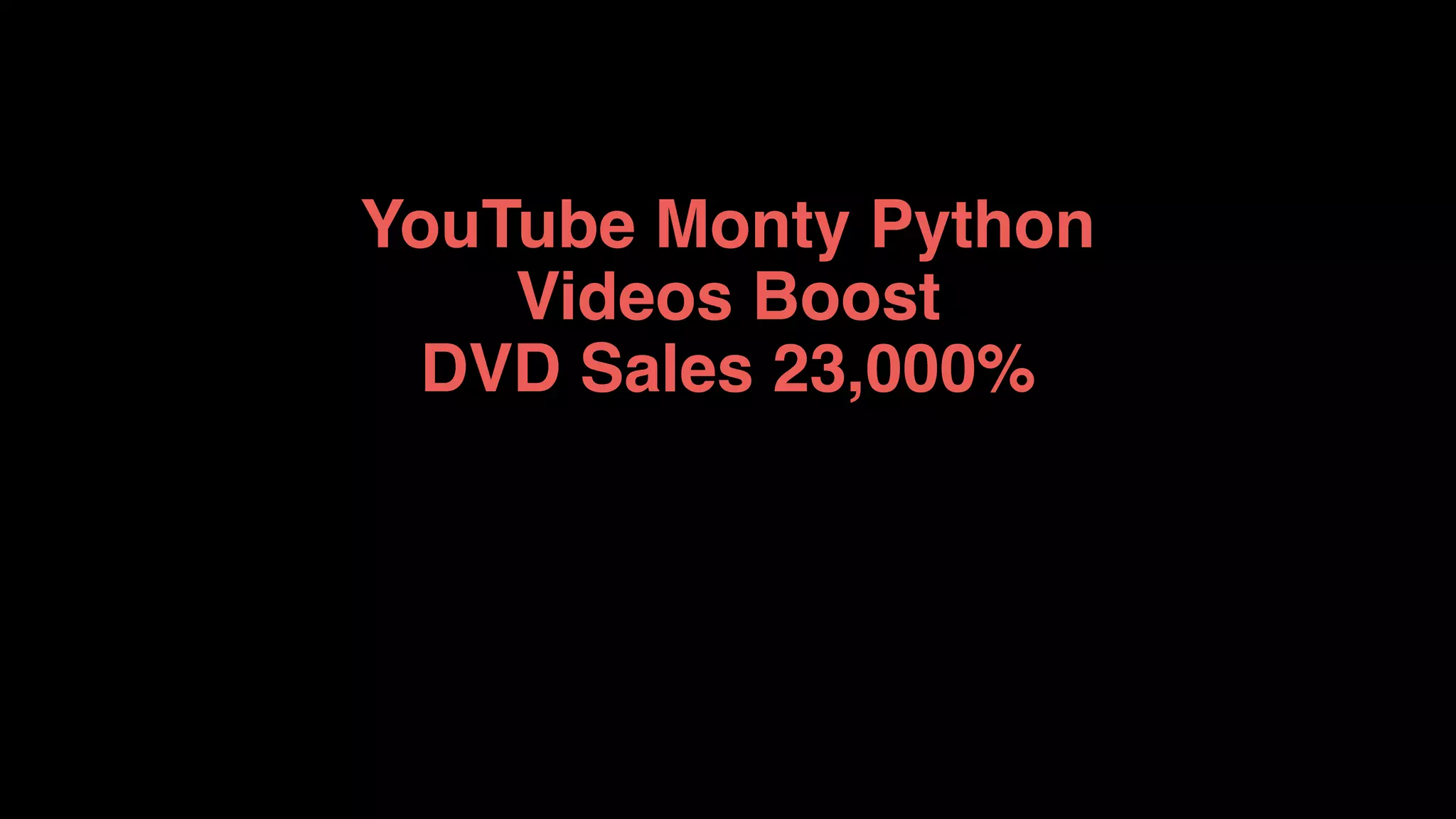
YouTube Monty Python 

Videos Boost 

DVD Sales 23,000%
Airbnb
Airbnb is bigger than Hilton

Has more than 2 millions listing

Does not own any rooms or apartments
Airbnb nightmares
Uber
Uber has 327,000 active drivers in the US

40 millions rides per month globally

Don’t own a single car
Uber Protests
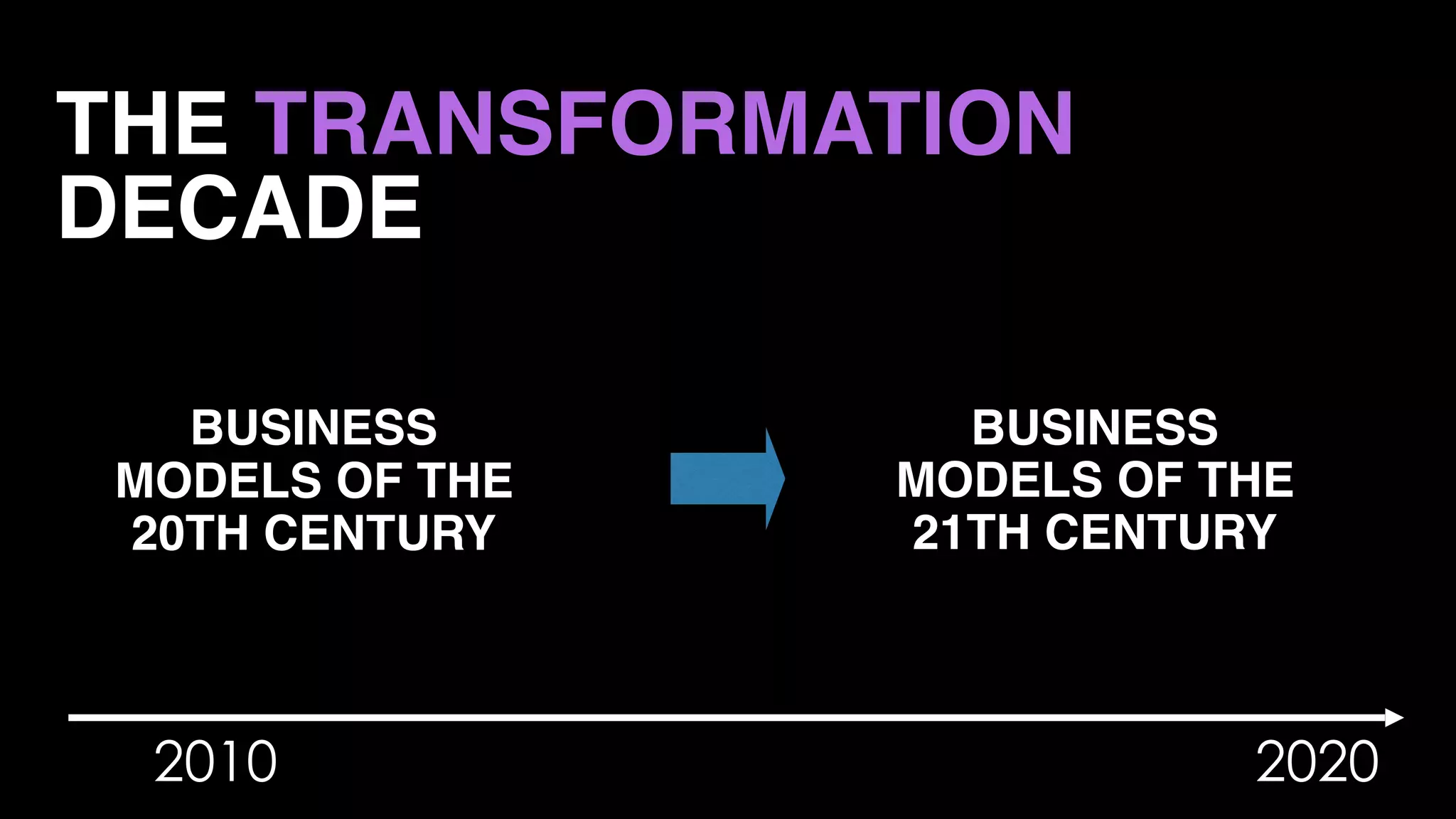
THE TRANSFORMATION 

DECADE
2010 2020
BUSINESS
MODELS OF THE
20TH CENTURY
BUSINESS
MODELS OF THE
21TH CENTURY
HIERARCHAL NETWORK
20th Century 21th Century
THE 

DIGITAL DECADE
THE CONTENT

ESCAPES

THE FORM

INTERNET 

DISRUPTION

BEGINS
1900 2000
From hierarchical structure to networks
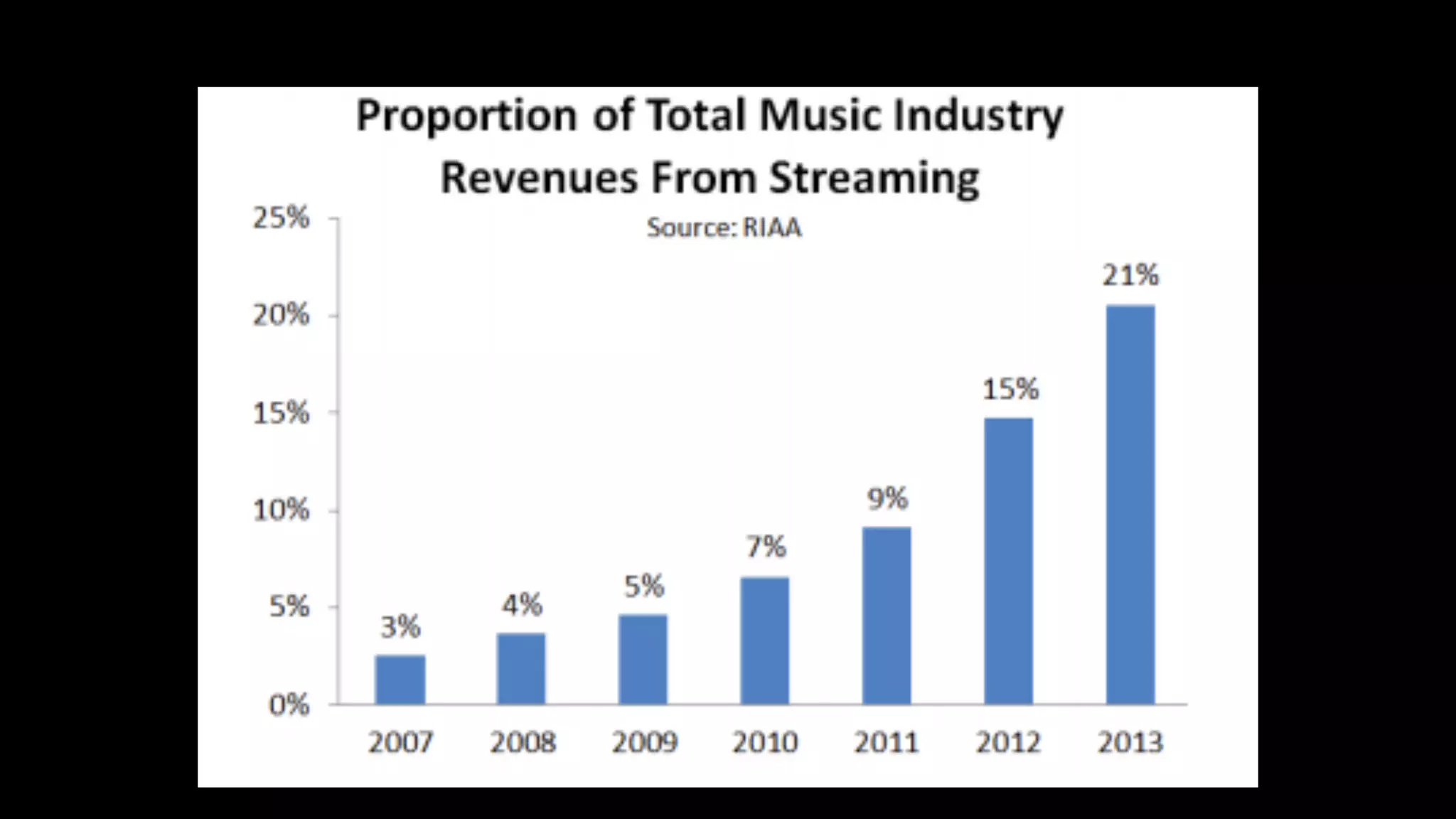
From broadcasting to streaming - long tail
From Read-only culture to read-write culture
The Move to Networks
THE 

TRANSFORMATION
DECADE
BUSINESS MODELS
CHANGE

SMARTPHONES

REAL TIME SOFTWARE

CLOUD AND AI
2010
2010 2020
Defined Industry Boundaries
Single-purpose Products
Producers and Consumers
Buying Economy
Hierarchical Structure
Platforms, ecosystems
Connected Smart Products
User as producer, co-creation
Sharing economy
Network Structure
The Transformation Decade
Broadcasting Streaming
Gatekeepers Algorithms
2010 2020
What is happening to traditional businesses is that they
are getting challenged by digital real-time software base
network companies
It the transformation of old established physical way of
doing business into new ways that are optimized around
real-time software systems
This is called Digital Transformation
Digital Transformation
Software is becoming the change agent of all business
If the internet has not disrupted a business, it will
Traditional industries like retail, shipping, banking,
insurance, law firms, health and the list goes on…
Digital Transformation
Any business that is built around a
hierarchy with high coordination
cost, will be crushed by a
networked software solution with
low coordination cost
Finance Healthcare Retail
Transportation Education
?
Any industry
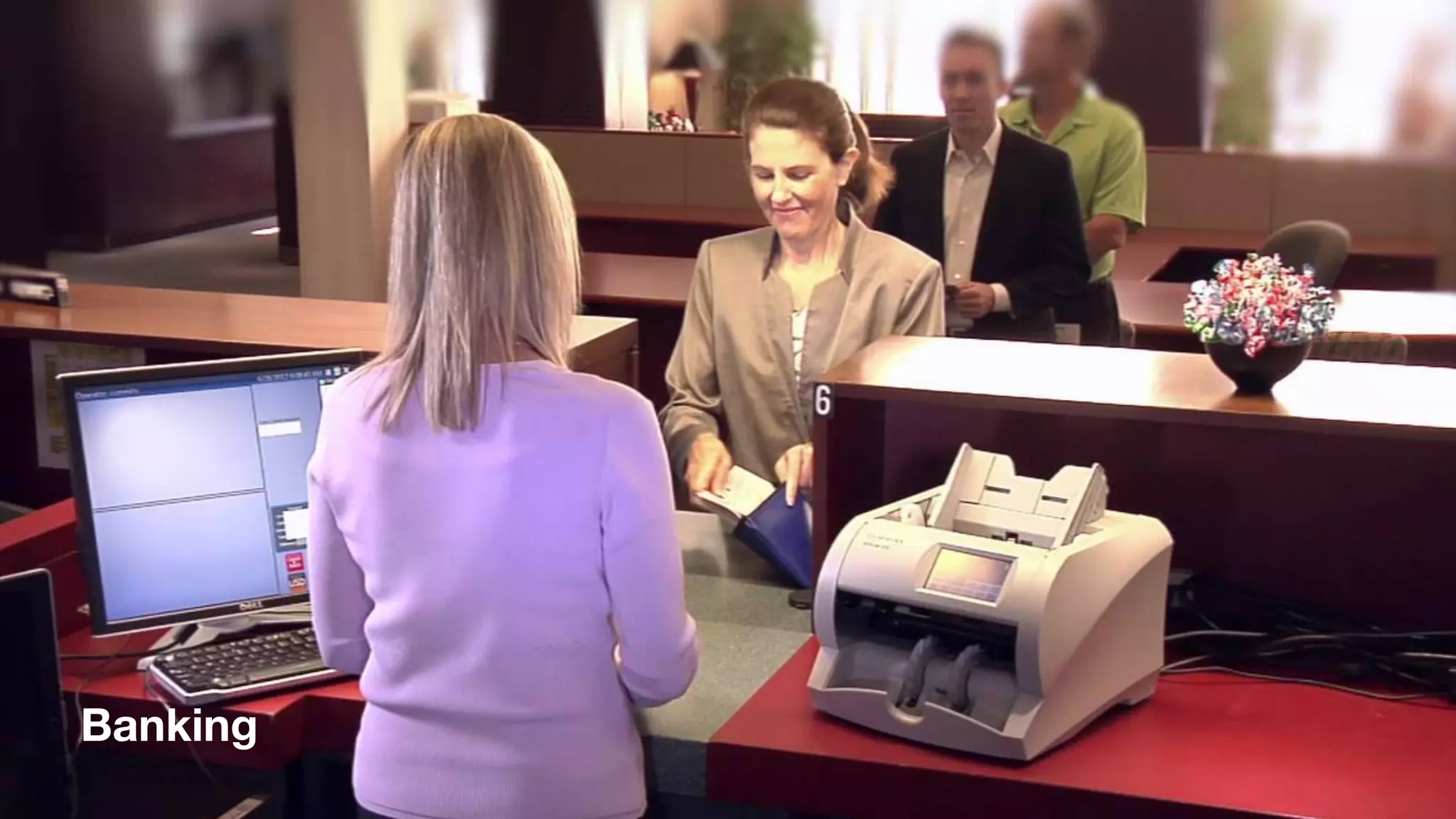
Banking
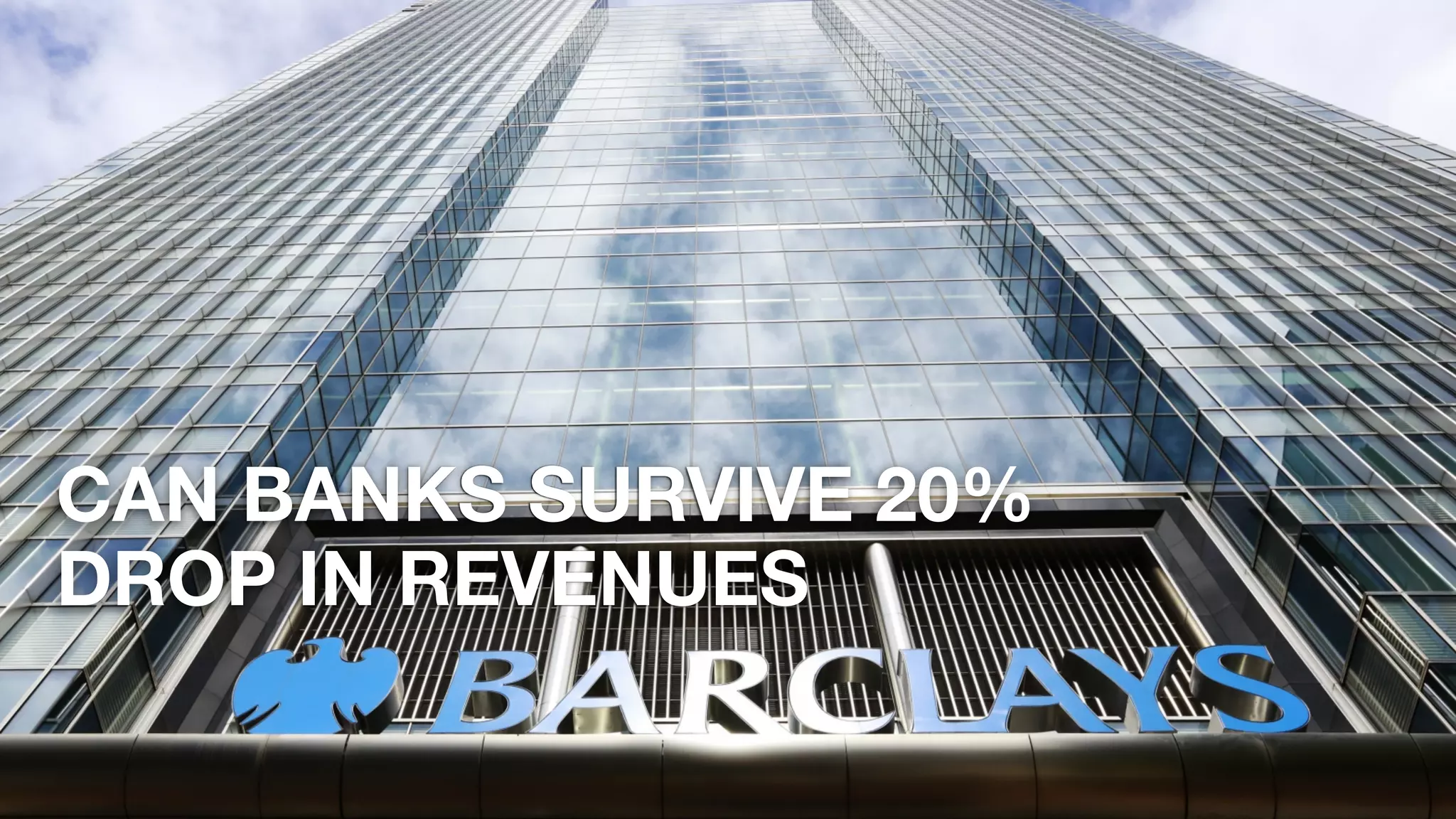
CAN BANKS SURVIVE 20% 

DROP IN REVENUES
Traditional Banking
Highly established and structured
organisations

Conservative and secretive

Slow and expensive

Not very transparent with endless
“hidden fees”
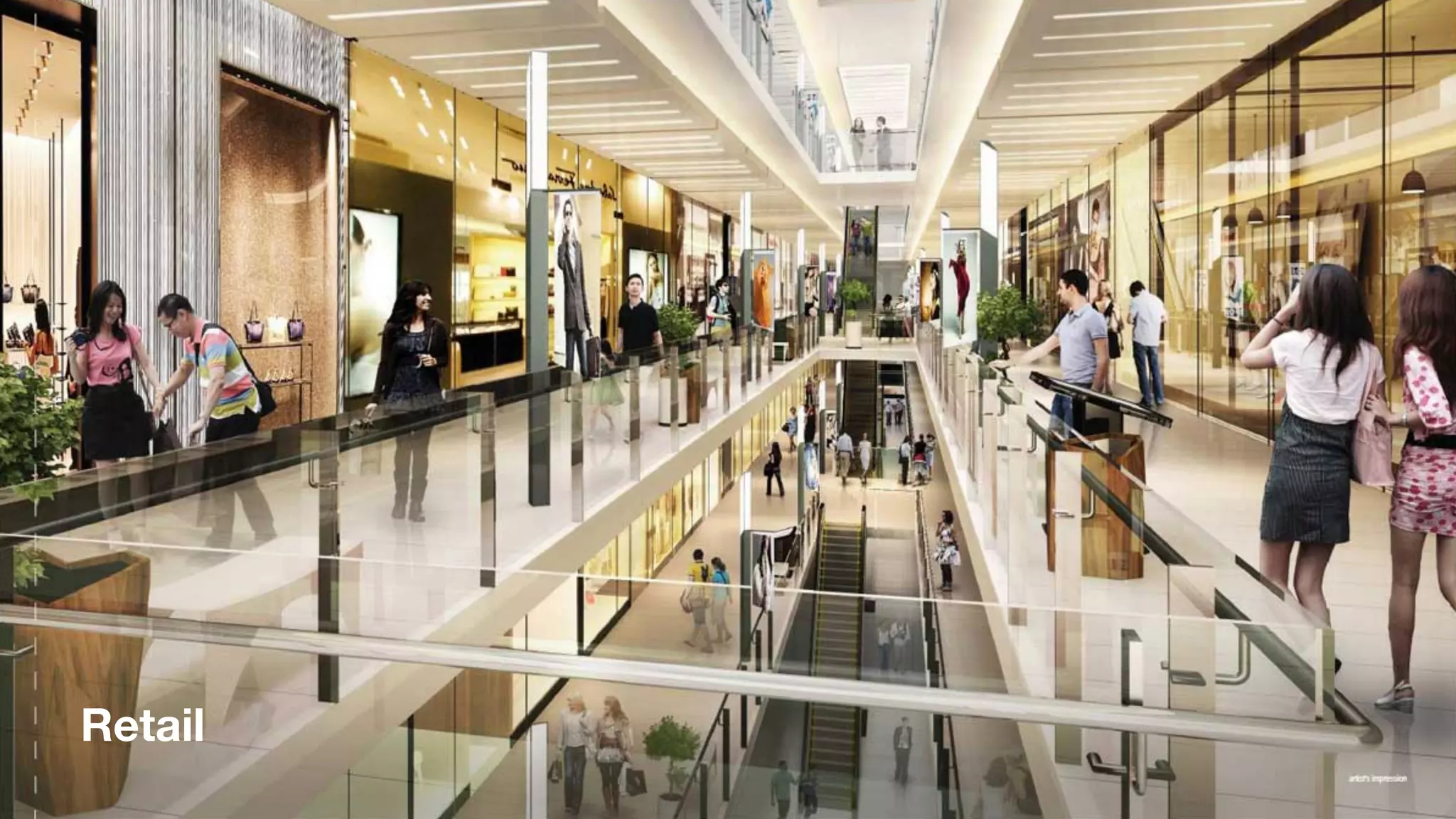
Retail
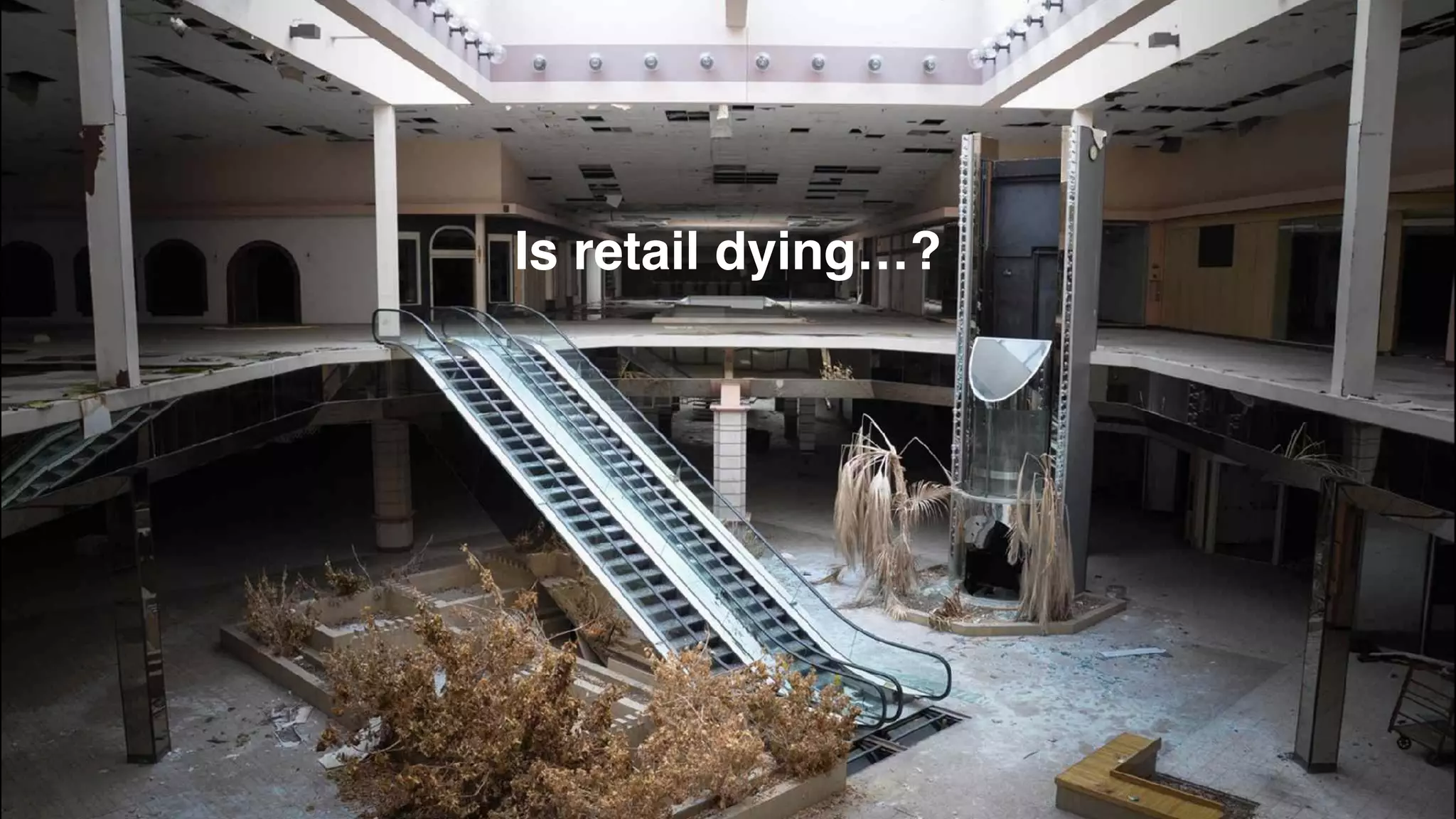
Is retail dying…?
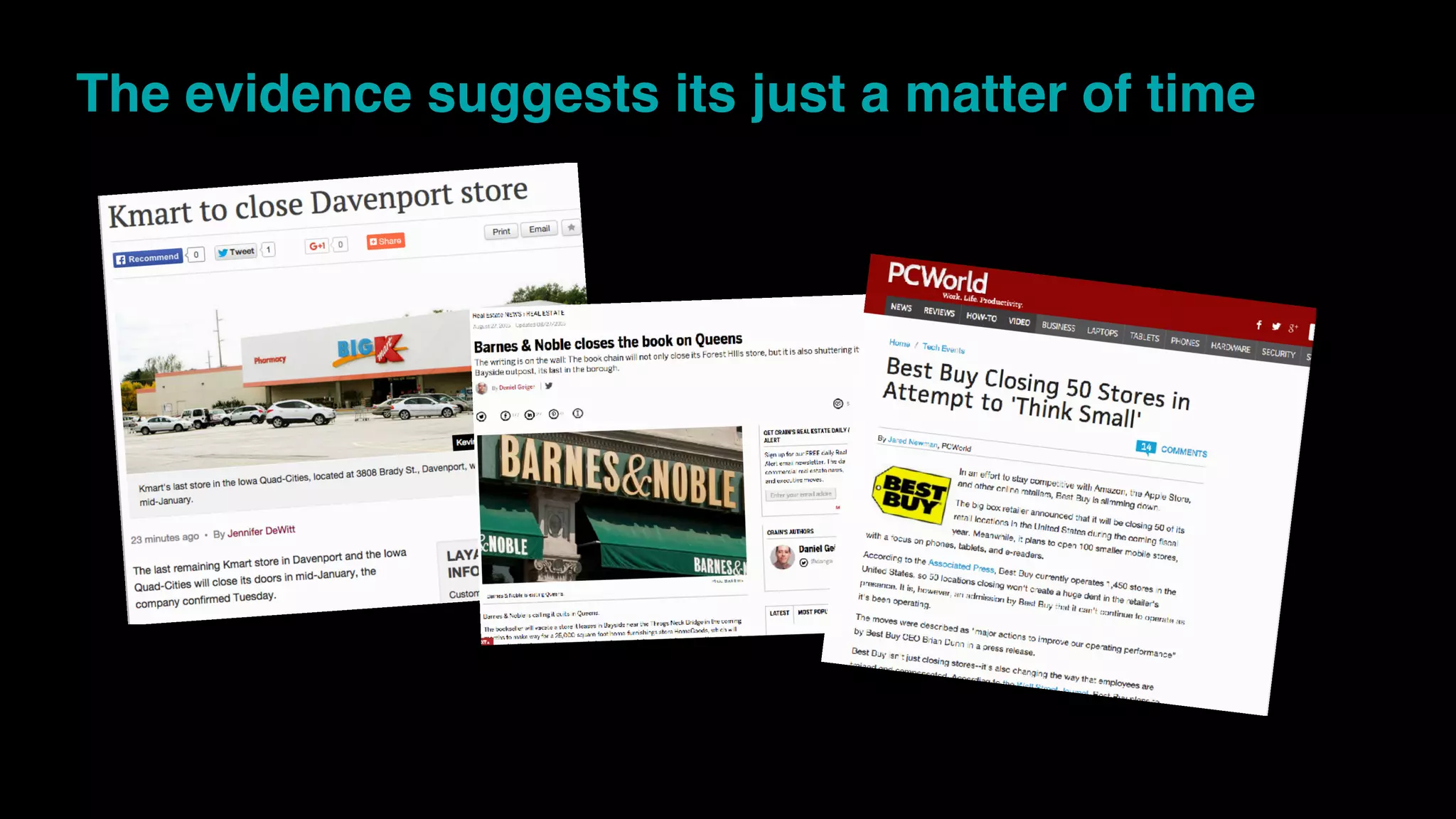
The evidence suggests its just a matter of time
Sales at US retail stores on Black Friday fell to $10.4 billion
this year, down from $11.6 billion in 2014
Source: ShopperTrak

image: Huffington Post Canada
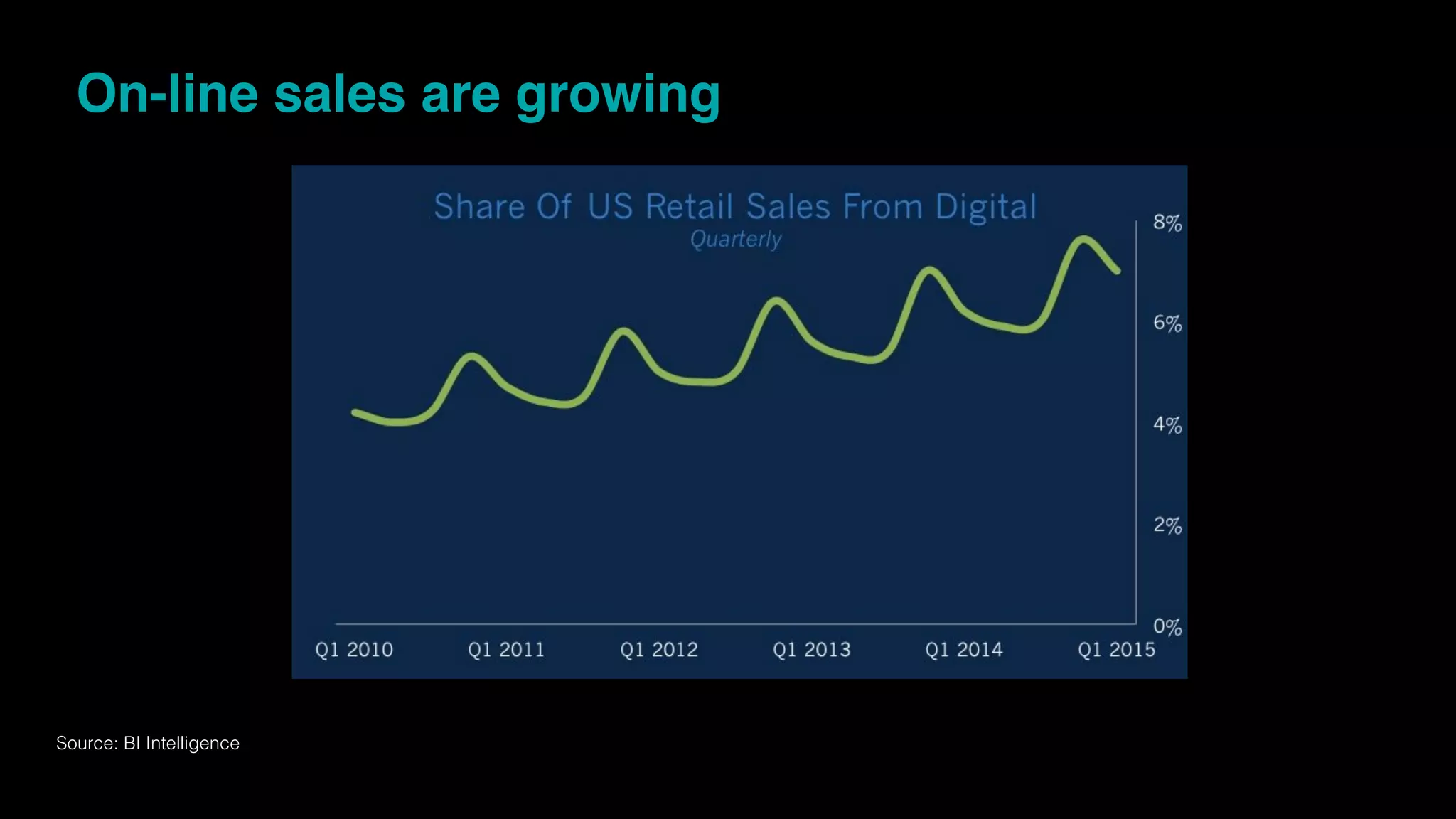
On-line sales are growing
Source: BI Intelligence
IBM said spending was up
17.8% from Cyber Monday
2014, and more customers
than ever opted to browse
deals on their mobile
devices.
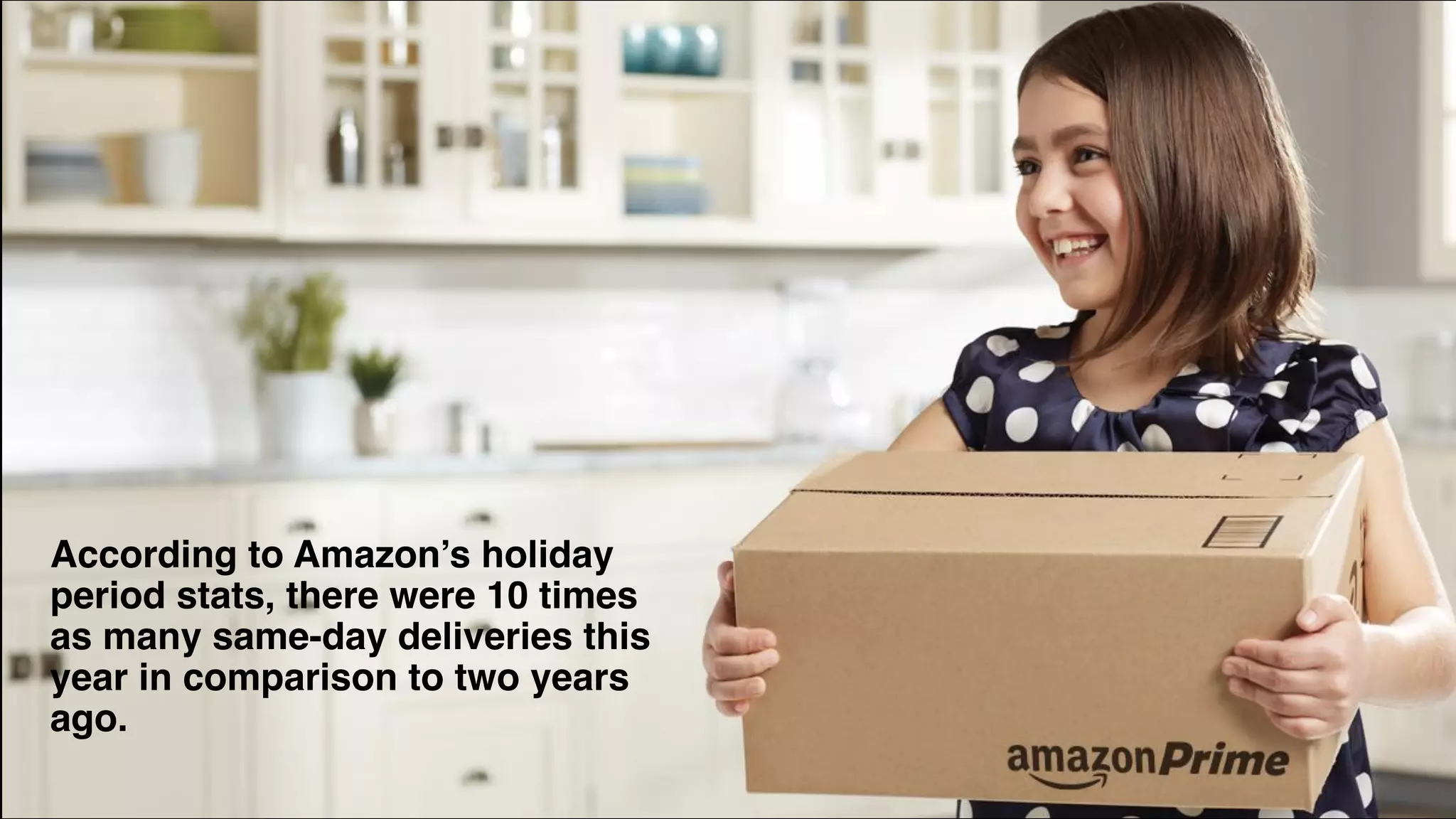
According to Amazon’s holiday
period stats, there were 10 times
as many same-day deliveries this
year in comparison to two years
ago.
And delivery services are exploding…
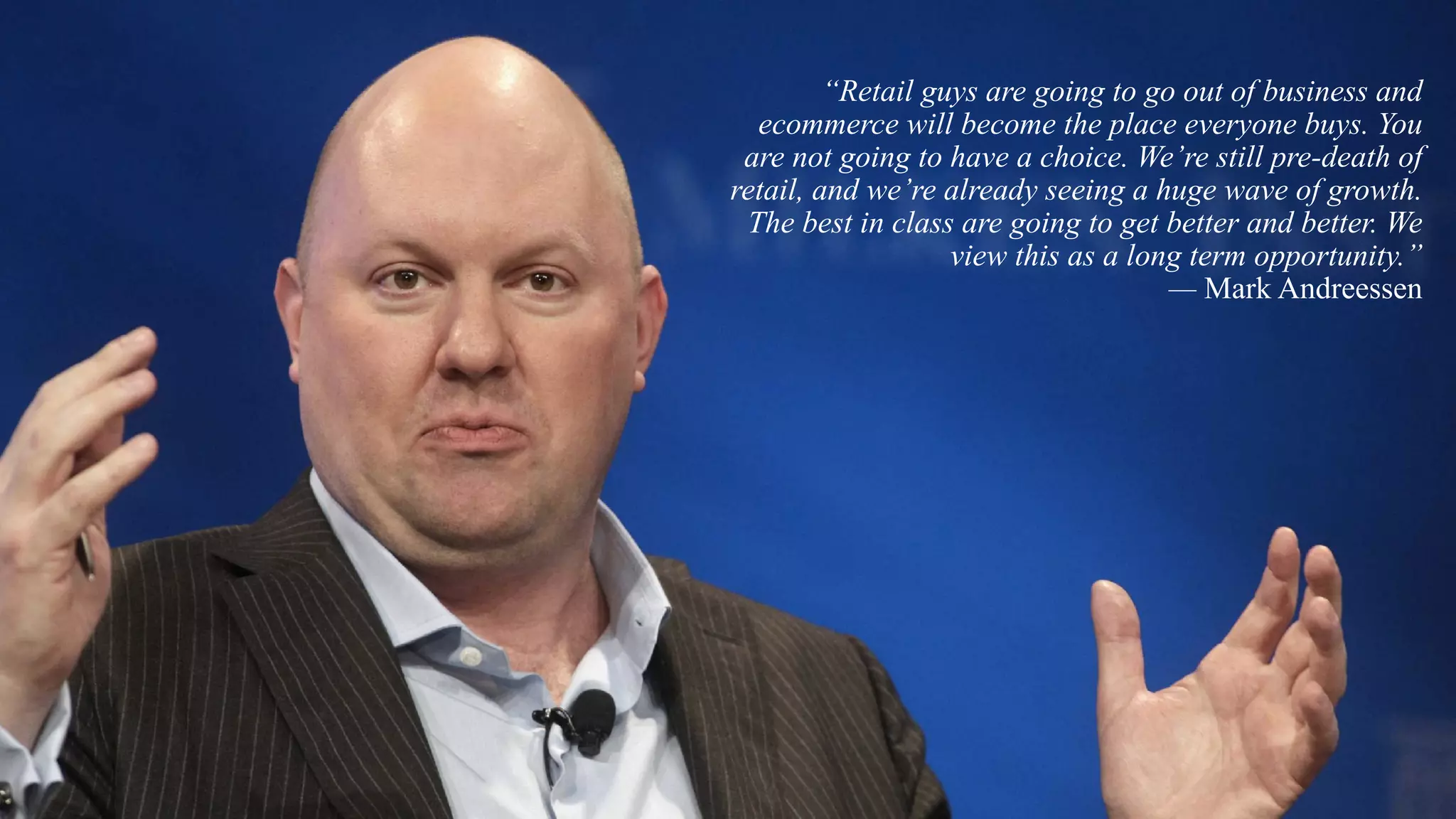
“Retail guys are going to go out of business and
ecommerce will become the place everyone buys. You
are not going to have a choice. We’re still pre-death of
retail, and we’re already seeing a huge wave of growth.
The best in class are going to get better and better. We
view this as a long term opportunity.”
— Mark Andreessen
Retail is fundamentally implausible economic structure
You combine the fixed cost of real estate with inventory
Every retailer is put in a highly leveraged position
Few can survive a decline of 20 to 30 percent in revenues
There is fundamentally a better model
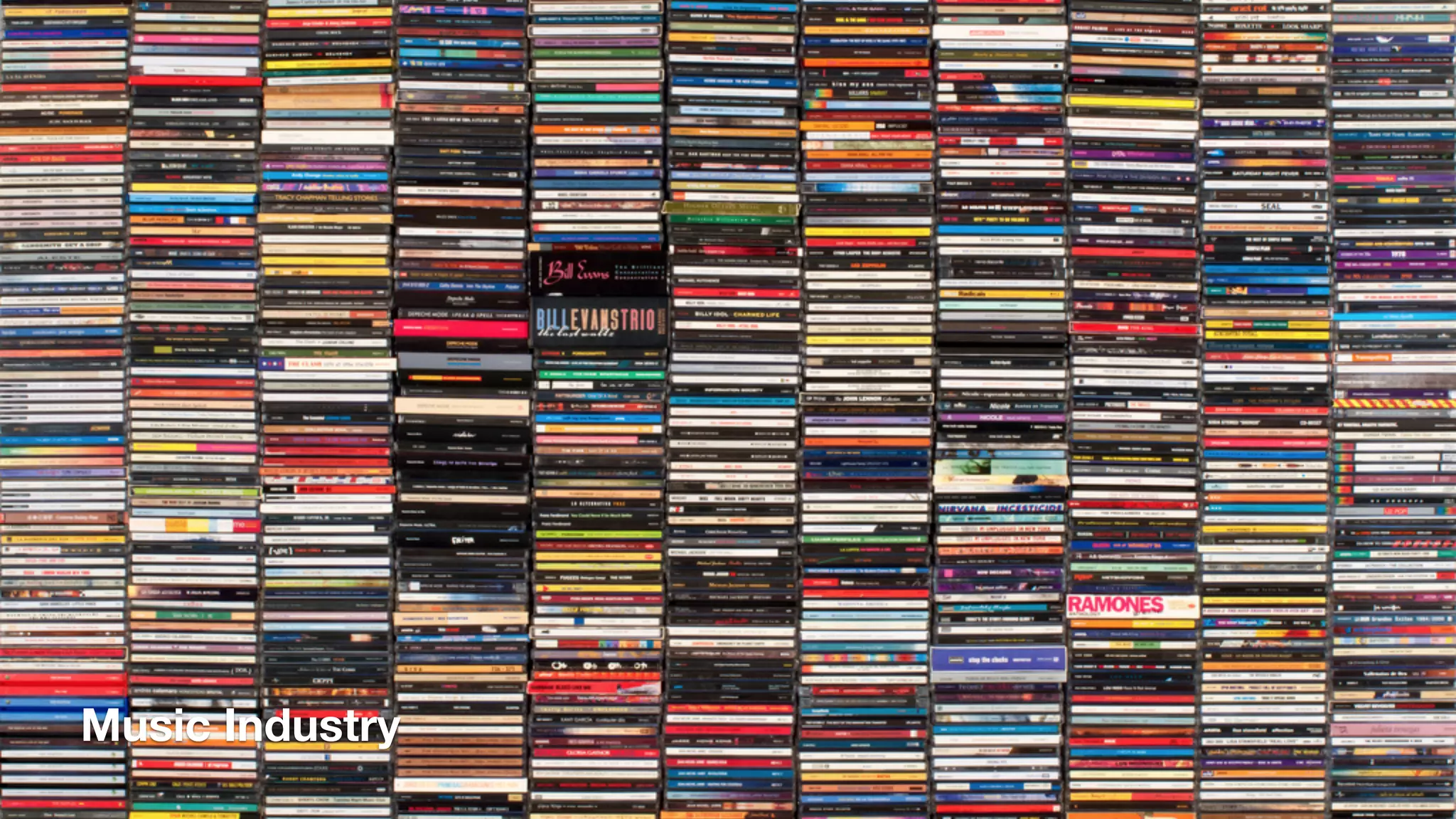
Music Industry
A) People that just steals, they will never pay
B) People that want to try before buy - if they like they pay
C) People that want something but it is not available
D) Copyright laws don’t apply anymore - its not piracy
Reasons for Piracy
Content Creation in the 20th Century
Image from Jyrki J.J. Kasvi
Content Creation in the 21st Century
Can this delivery
method compete?
Subscription to vast repository of music
Very accessible and relevant
Music Subscription
In the LP/CD era, the industry was based in scarcity model of
economics
Only few artists became popstarts - professionalised and limited
Today, consumers don’t want to pay as much as they did for music
Add to that, the fact that anybody can be a musician and be on
Soundcloud or Spotify
World of Music
“Every industry that becomes digital 

becomes free”
- Chris Anderson, Editor WIRED
Freeconomics
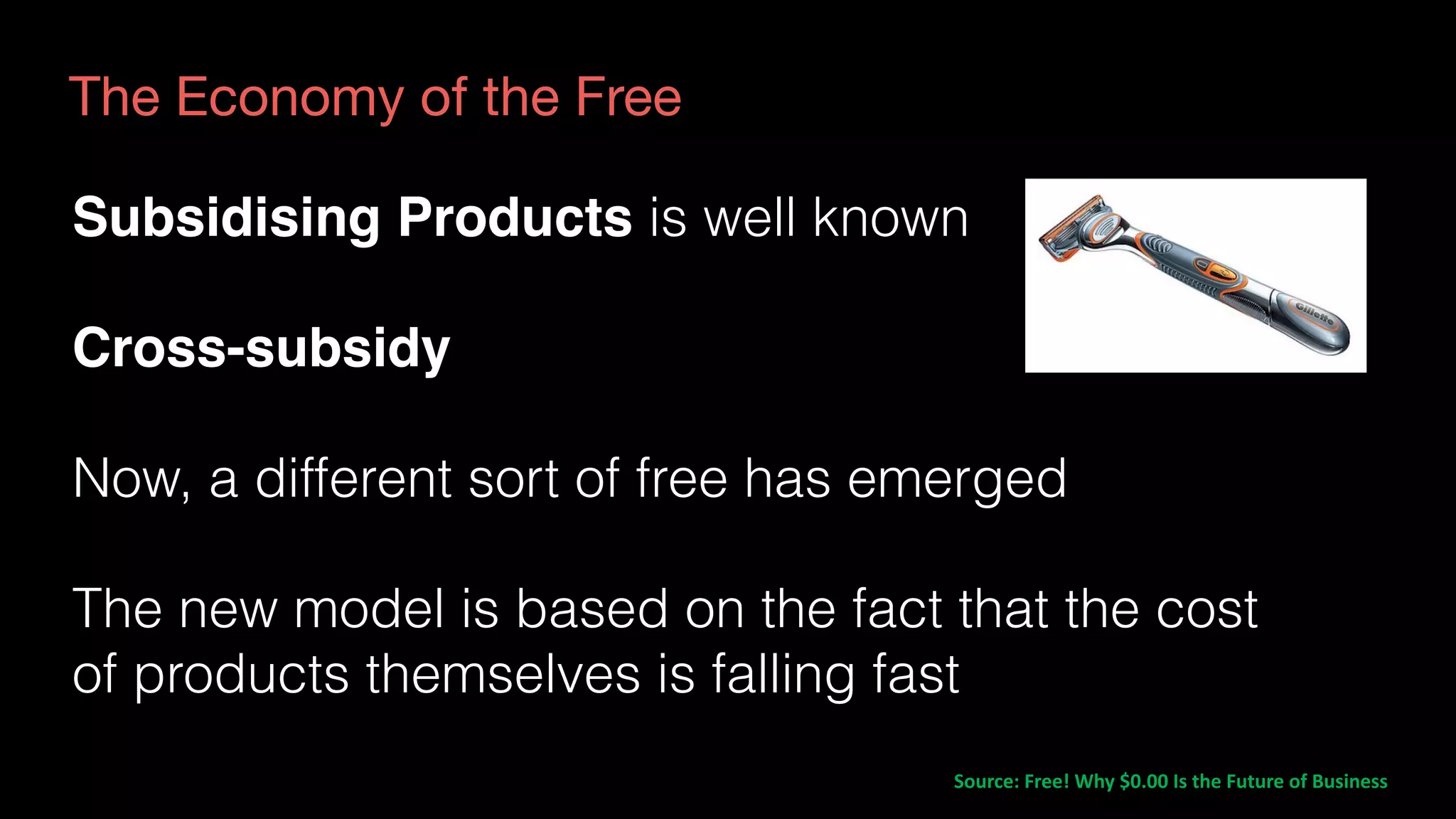
The Economy of the Free
Source:	Free!	Why	$0.00	Is	the	Future	of	Business	
Subsidising Products is well known
Cross-subsidy
Now, a different sort of free has emerged
The new model is based on the fact that the cost
of products themselves is falling fast
THE

ECONOMY
OF
THE FREE
A Taxonomy of Free
"Freemium"
What's free: Web software and services, some content
Free to whom: users of the basic version
Subscription model of media
Varying tiers of content, from free to 

expensive, or a premium "pro" version
The 1% Rule - 1% of a community does

all the work
F2P in the video games industry
A Taxonomy of Free
Advertising
What's free: content, services, software, and more
Free to whom: everyone
Examples
Yahoo's pay-per-pageview banners
Google's pay-per-click text ads,
Amazon's pay-per-transaction "affiliate ads"
Paid inclusion in search results
Paid listing in information services
Lead generation
A Taxonomy of Free
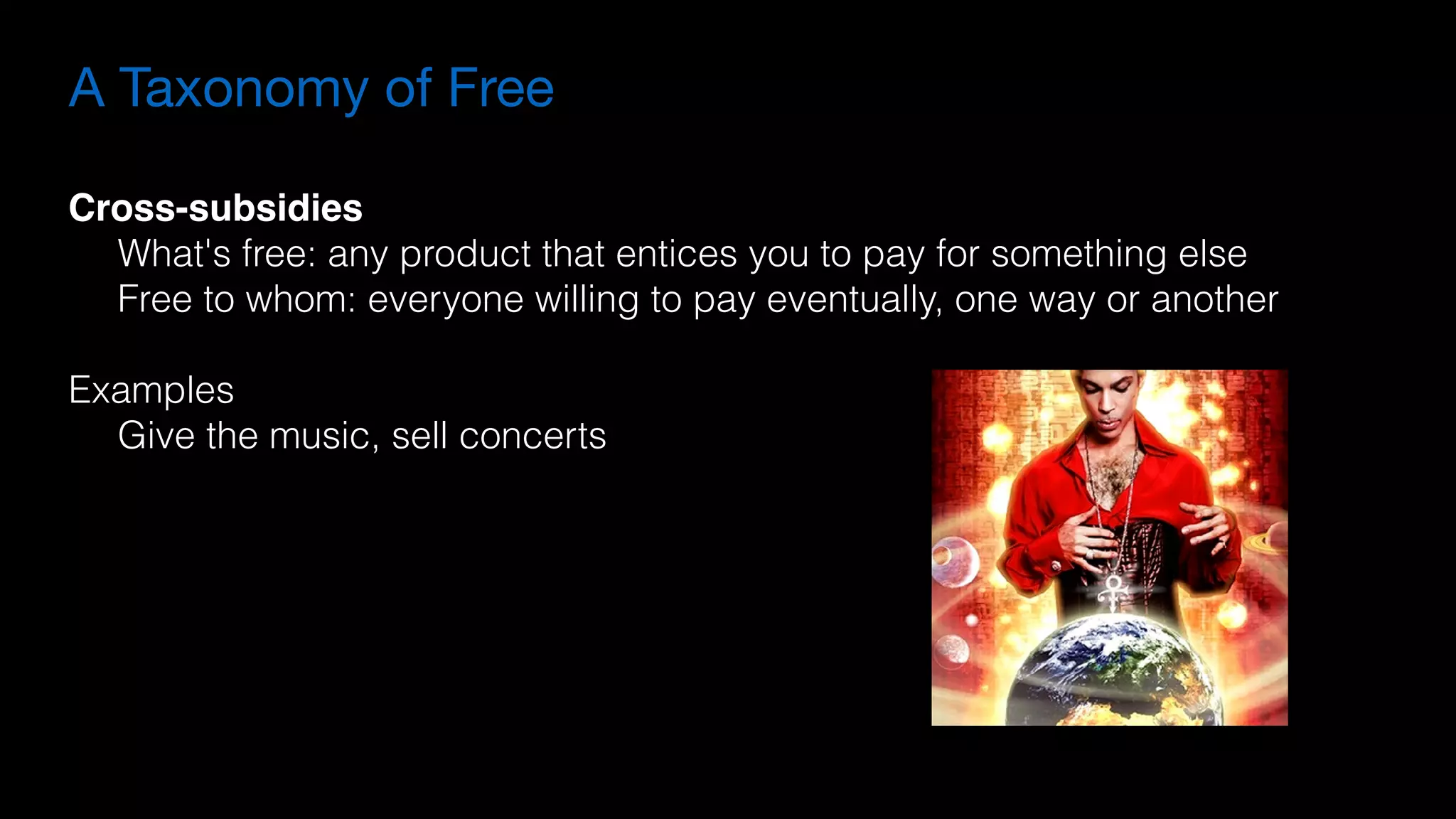
Cross-subsidies
What's free: any product that entices you to pay for something else
Free to whom: everyone willing to pay eventually, one way or another
Examples
Give the music, sell concerts
A Taxonomy of Free
Zero marginal cost
What's free: things that can be distributed
without an appreciable cost to anyone
Free to whom: everyone
Examples
On-line music
Digital reproduction and peer-to-peer
distribution, the real cost of distributing 

music has truly hit bottom
A Taxonomy of Free
Labor exchange
What's free: Web sites and services
Free to whom: all users, since the act of using these sites and 

services actually creates something of value
Examples
Free porn if you solve a few captchas
Rating stories on Digg, voting on Yahoo Answers,
or using Google's 411 service
A Taxonomy of Free
Gift economy
What's free: the whole enchilada, be it open source software
or user-generated content
Free to whom: everyone
Examples
Wikipedia
Zero-cost distribution has turned 

sharing into an industry
Economy of Abundance
Traditional products exist in the economy of scarcity
When the cost of copying and distributing becomes
close to nothing, the economy shifts
You can’t sell copies – their worthless
It’s not only about money - time and respect are also
important
So is your digital footprint
You can’t sell
copiesthey’re worthless
25
Videostores, DVD,
late fees, clutter
Everything, anywhere,
anytime (almost)
BEFORE NOW
CHANGE IN CONSUMER BEHAVIOR
Printed books, magazines
Digital, automatically
delivered, interactive
BEFORE NOW
CHANGE IN CONSUMER BEHAVIOUR
Own, store, clutter Rent, subscribe, stream
OWNERLESS LIFESTYLE
BEFOE NOW
Oliver Lukket, theAudience
What can you
sell?and make money?
Accessibility
Immediacy
Personalization
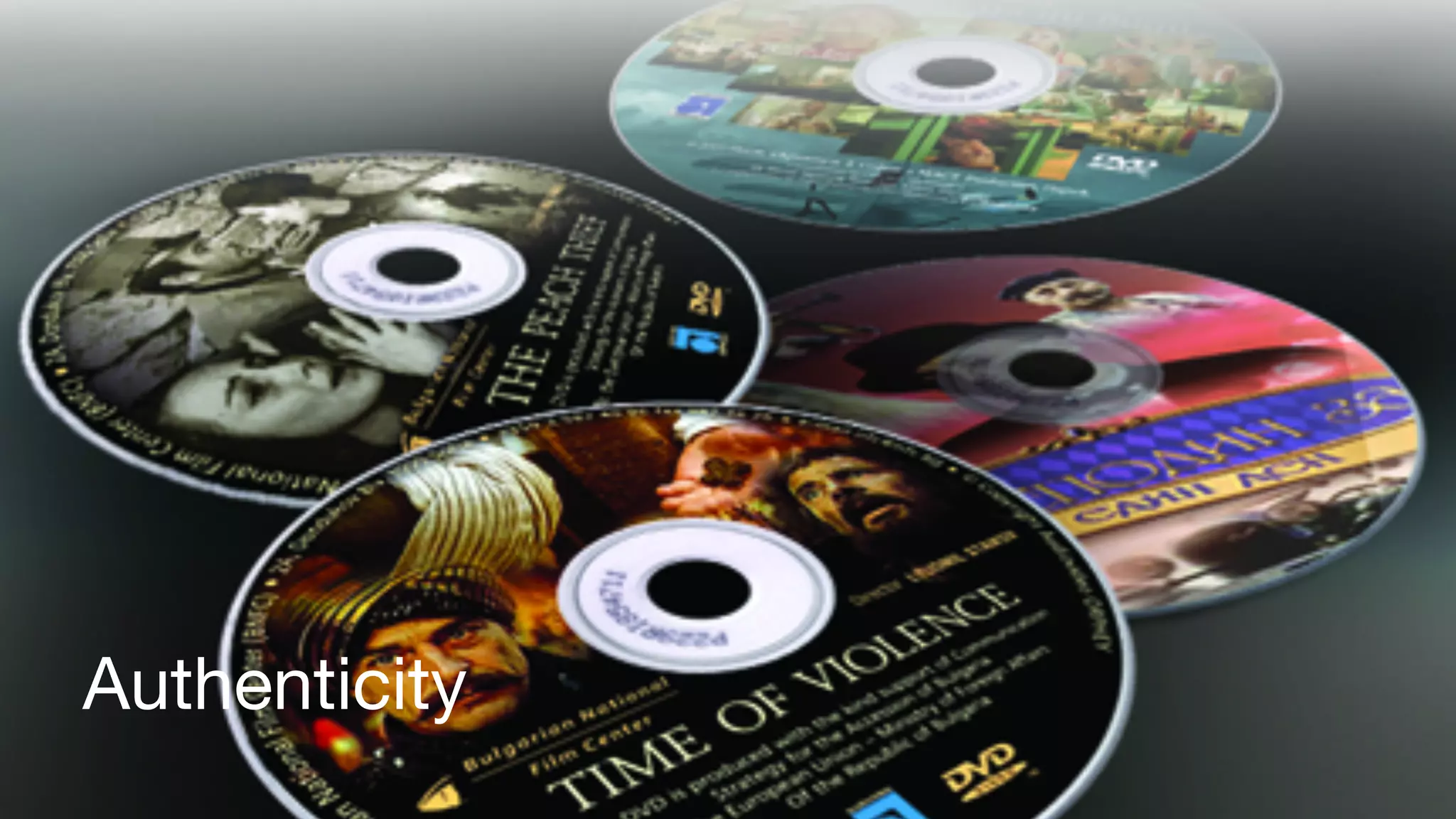
Authenticity
Patronage
Interpretation
Embodiment
Findability
How can you
marketyour Products?
TRADITIONAL MARKETING
TRADITIONAL PRODUCTION OF CONTENT
"1984"
TRADITIONAL PRODUCTION OF CONTENT
Benchmark:
Production budget: $900,000
Audience: ~ 50,000,000
USER
GENERATED
CONTENT
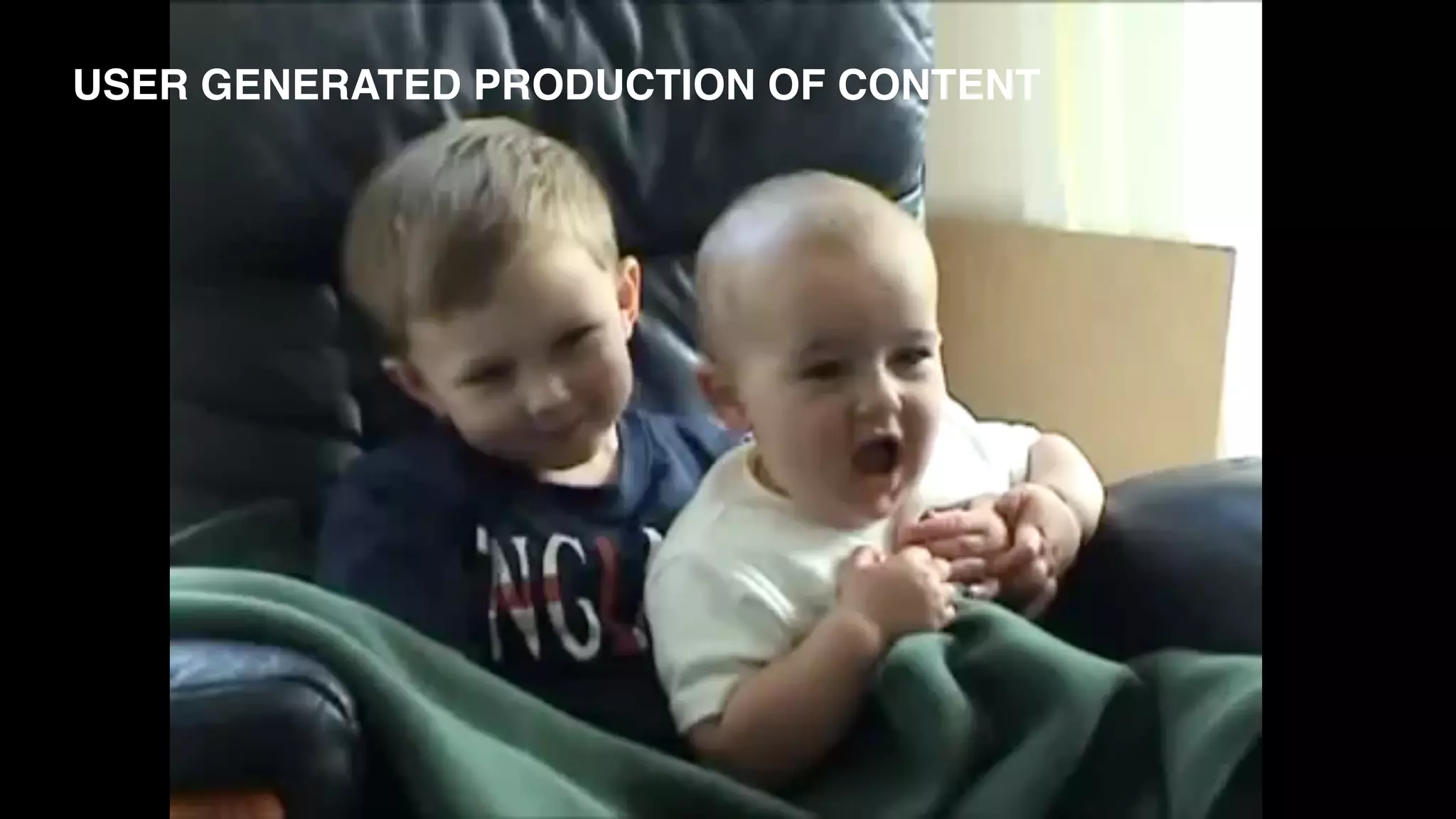
USER GENERATED PRODUCTION OF CONTENT
Benchmark:
Production budget: $0
Audience: 814,105,854
Use the medium people use
From marketing to conversation
Oliver Luckett, theAudiance
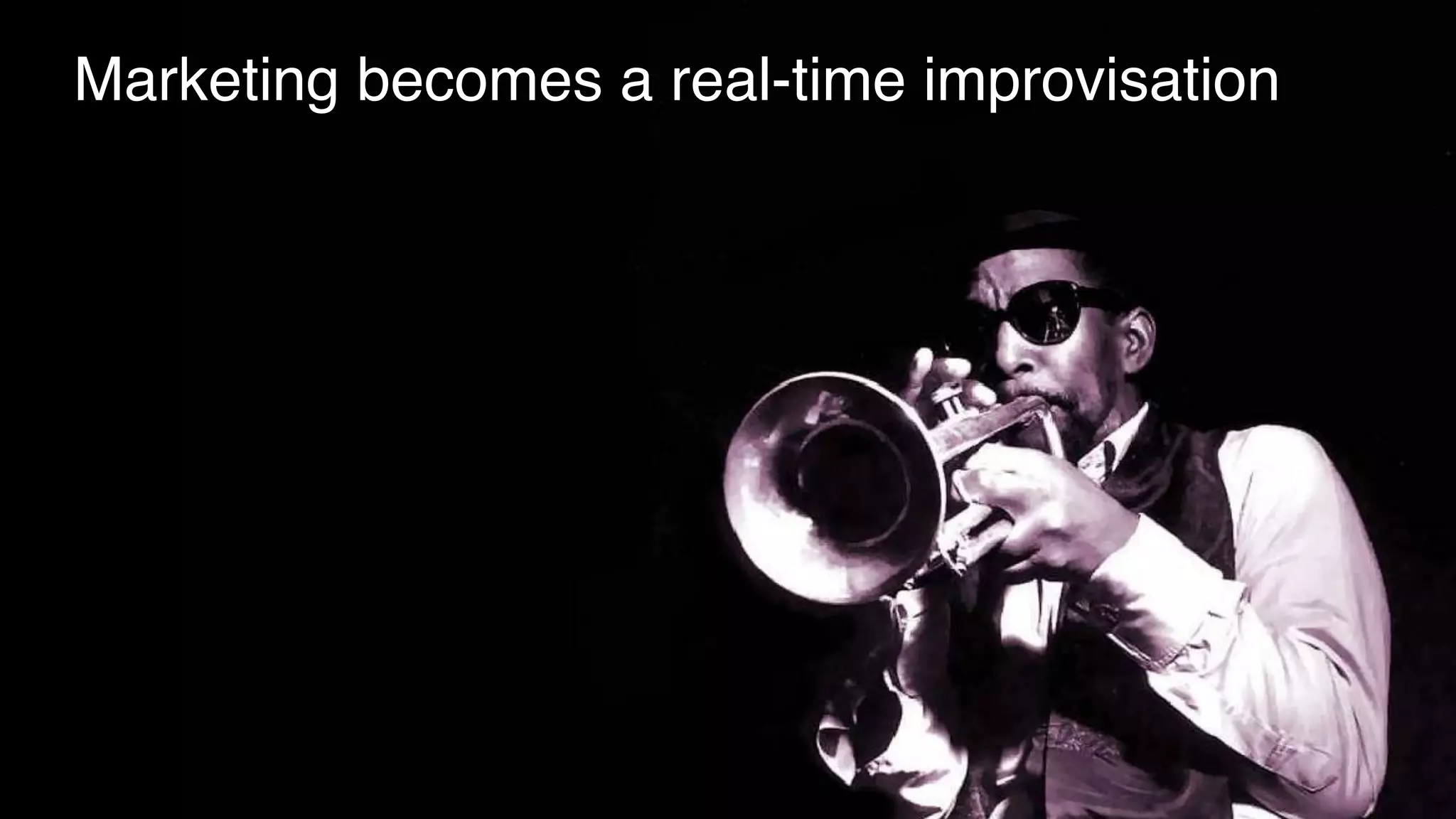
Marketing becomes a real-time improvisation
Conversation in real-time
CONVERSATION
Discoverability
Online web sites and
product reviews
Social media, Facebook,
Pinterest, Twitter etc
Youtube, Vimeo etc
Buying
Buying online
Show rooming and buying
online
Buying in-store has to be an
experience - shareable
Rating
Social media, Facebook,
Pinterest, Twitter etc
If it is not shareable, it did
not happen
Use the medium people use
$3,500 Taylor Guitar
UNITED BREAKS GUITARS
The YouTube video was posted on July 6, 2009
It amassed 150,000 views within one day, prompting United to
contact Carroll saying it hoped to right the wrong
13.3 million by September 2013
http://en.wikipedia.org/wiki/United_Breaks_Guitars
Within 4 days of the video being posted online, United
Airlines' stock price fell 10%, costing stockholders about
$180 million in value
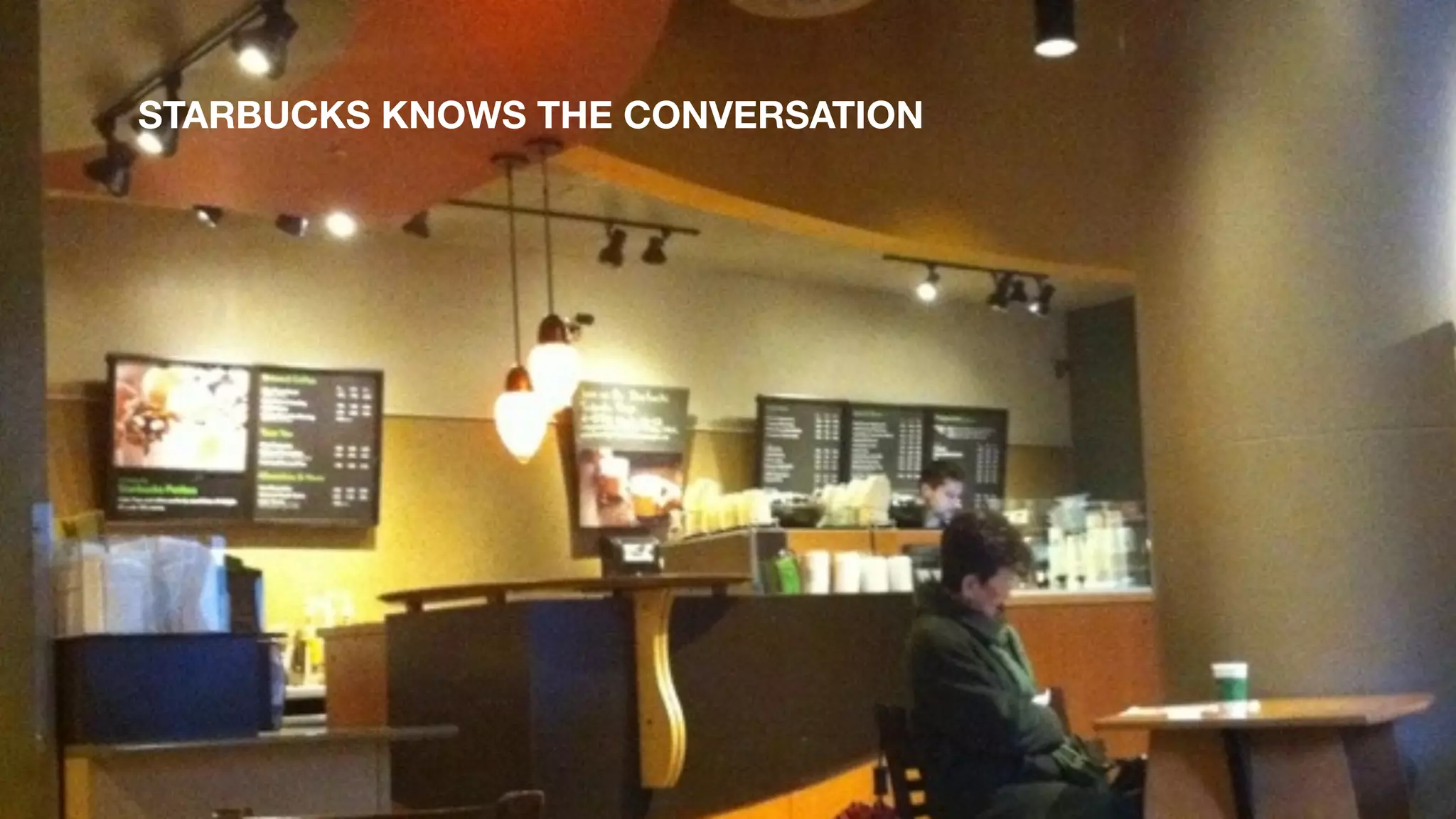
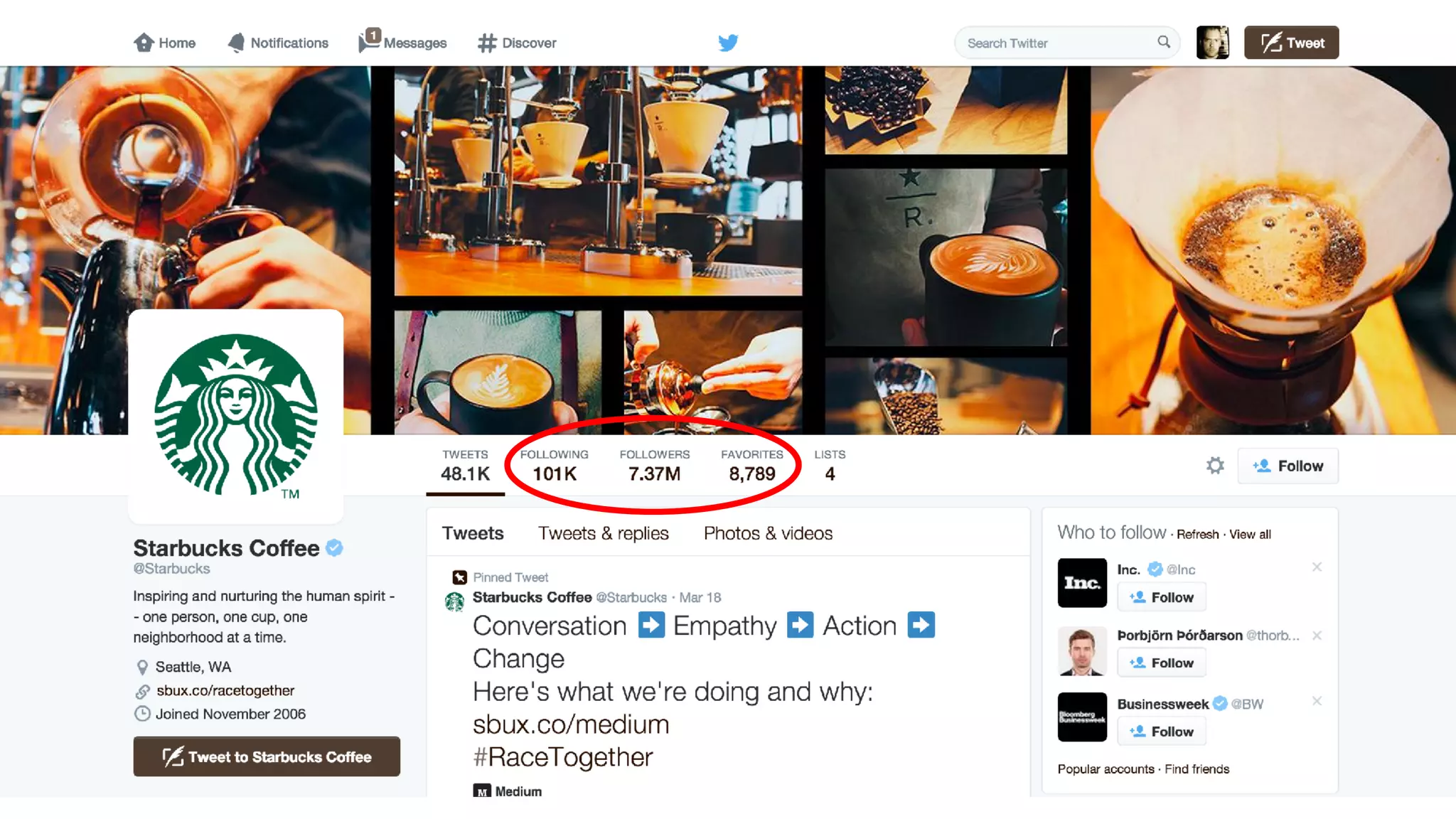
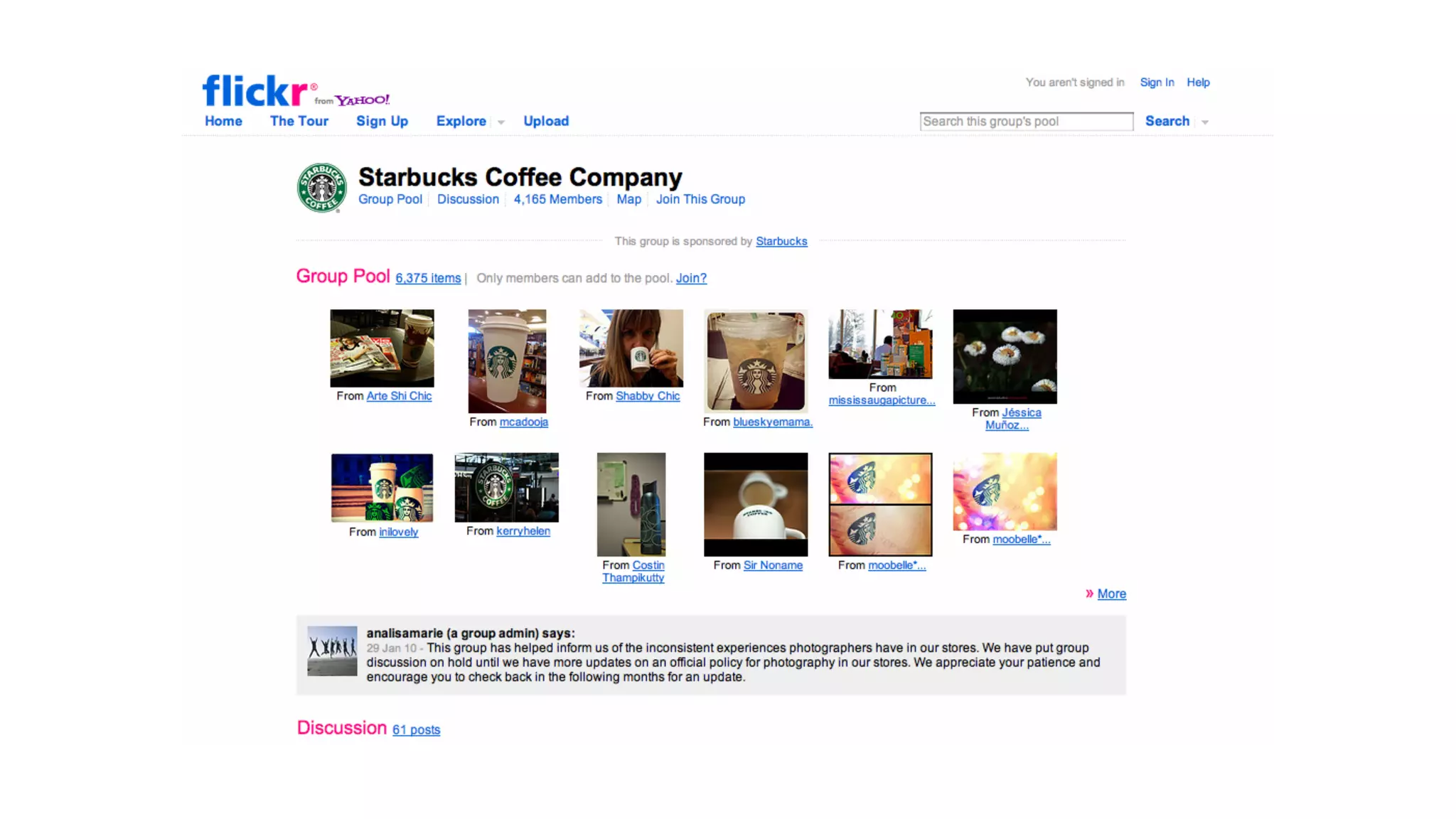
STARBUCKS KNOWS THE CONVERSATION
CONVERSATION
NEXT
Rise of the machine
Assignment 2
Draft

L12 Digital Transformation

  • 1.
  • 2.
  • 3.
    Media in the20th Century Print Radio TV CD/DVDs 1900 2000 Analog, Broadcast, One-2-many, copies to sell
  • 4.
    Consumerism in the20th Century You need help, here is a product for you
  • 5.
    Communication in the20th Century Phone call Postal Letter Talk with Clerk Analog, slow and expensive - coordination cost is high 1900 2000
  • 6.
    Travelling in the20th Century How would you organise a vacation at a beach resort in the Mediterranean in 1971? How many people would need to become involved?
  • 7.
    Coordination To solve coordination,hierarchical structures must be formed Corporate structure with layers of middle managers Coordination cost is high and involves many people Getting things done is expensive and slow Hierarchy
  • 8.
    Fifth Technological Revolution starts Intel1971 The Technology Trigger 1971
  • 9.
    PDP-8 Computer from DECin March 1965 Cost 18.500 USD 50.000 machines sold 12 bit architecture 32K memory 0,5 MIPS MIPS: millions instruction per second iPhone 6 Smartphone from
 September 2015 Cost $649 Sold 10 million phones
 in 3 days 64 bit architecture 128GB “capacity” 25.000 MIPS
  • 10.
    2000 2010 iMac iPhone iMacG3 Mac OS 9.0.4
 500 MHz PowerPC G3 CPU, 128MB Memory
 Screen - 786K pixels
 Storage - 30GB Hard Drive iPhone 4 iOS 4.0
 1 Ghz ARM A4 CPU, 512MB Memory
 Screen - 614K pixels
 Storage - 32GB Flash Drive MOORE’S LAW
  • 11.
  • 12.
  • 13.
    INTERNET – 3BILLION PEOPLE + 
 3 BILLION COMING ONLINE
  • 14.
    SOFTWARE AND DATA
 ARE IN THE CLOUD
  • 15.
  • 16.
  • 17.
  • 18.
    Clay Shirky: Institutionsvs. collaboration TED Talk 2005
  • 20.
    Coordination Cost All ofthe financial cost and institutional difficulties arranging group output Form an institution - get resources together 1. Management Problem 2. Structure - economic, legal, physical etc. 3. Inherently exclusionary 4. Professional class
  • 21.
    Solving the CoordinationCost Cost of communication is now basically zero and universal Put the cooperation into the infrastructure Design a system that coordinates the output of the system as a byproduct of operating the system with out regard to institutional models
  • 22.
    New Solutions New solutionsget built on the Internet infrastructure Napster in 1999 Music Industry goes crazy
  • 23.
    New Solutions New solutionsget built on the Internet infrastructure BitTorrent in 2001 Music Industry goes even more crazy
  • 24.
    New Solutions New solutionsget built on the Internet infrastructure Youtube 2005 Content creators go crazy
  • 29.
  • 32.
    YouTube Monty Python
 Videos Boost 
 DVD Sales 23,000%
  • 34.
    Airbnb Airbnb is biggerthan Hilton Has more than 2 millions listing Does not own any rooms or apartments
  • 35.
  • 37.
    Uber Uber has 327,000active drivers in the US 40 millions rides per month globally Don’t own a single car
  • 38.
  • 39.
    THE TRANSFORMATION 
 DECADE 20102020 BUSINESS MODELS OF THE 20TH CENTURY BUSINESS MODELS OF THE 21TH CENTURY
  • 40.
  • 41.
    THE 
 DIGITAL DECADE THECONTENT ESCAPES THE FORM INTERNET DISRUPTION BEGINS 1900 2000 From hierarchical structure to networks From broadcasting to streaming - long tail From Read-only culture to read-write culture The Move to Networks THE 
 TRANSFORMATION DECADE BUSINESS MODELS CHANGE SMARTPHONES
 REAL TIME SOFTWARE CLOUD AND AI 2010
  • 42.
    2010 2020 Defined IndustryBoundaries Single-purpose Products Producers and Consumers Buying Economy Hierarchical Structure Platforms, ecosystems Connected Smart Products User as producer, co-creation Sharing economy Network Structure The Transformation Decade Broadcasting Streaming Gatekeepers Algorithms 2010 2020
  • 43.
    What is happeningto traditional businesses is that they are getting challenged by digital real-time software base network companies It the transformation of old established physical way of doing business into new ways that are optimized around real-time software systems This is called Digital Transformation Digital Transformation
  • 44.
    Software is becomingthe change agent of all business If the internet has not disrupted a business, it will Traditional industries like retail, shipping, banking, insurance, law firms, health and the list goes on… Digital Transformation
  • 45.
    Any business thatis built around a hierarchy with high coordination cost, will be crushed by a networked software solution with low coordination cost
  • 46.
  • 47.
  • 48.
    CAN BANKS SURVIVE20% 
 DROP IN REVENUES
  • 49.
    Traditional Banking Highly establishedand structured organisations Conservative and secretive Slow and expensive Not very transparent with endless “hidden fees”
  • 51.
  • 52.
  • 53.
    The evidence suggestsits just a matter of time
  • 54.
    Sales at USretail stores on Black Friday fell to $10.4 billion this year, down from $11.6 billion in 2014 Source: ShopperTrak
 image: Huffington Post Canada
  • 55.
    On-line sales aregrowing Source: BI Intelligence
  • 56.
    IBM said spendingwas up 17.8% from Cyber Monday 2014, and more customers than ever opted to browse deals on their mobile devices.
  • 57.
    According to Amazon’sholiday period stats, there were 10 times as many same-day deliveries this year in comparison to two years ago.
  • 58.
    And delivery servicesare exploding…
  • 59.
    “Retail guys aregoing to go out of business and ecommerce will become the place everyone buys. You are not going to have a choice. We’re still pre-death of retail, and we’re already seeing a huge wave of growth. The best in class are going to get better and better. We view this as a long term opportunity.” — Mark Andreessen
  • 60.
    Retail is fundamentallyimplausible economic structure You combine the fixed cost of real estate with inventory Every retailer is put in a highly leveraged position Few can survive a decline of 20 to 30 percent in revenues There is fundamentally a better model
  • 61.
  • 63.
    A) People thatjust steals, they will never pay B) People that want to try before buy - if they like they pay C) People that want something but it is not available D) Copyright laws don’t apply anymore - its not piracy Reasons for Piracy
  • 65.
    Content Creation inthe 20th Century Image from Jyrki J.J. Kasvi
  • 66.
    Image from JyrkiJ.J. Kasvi Content Creation in the 21st Century
  • 67.
  • 68.
    Subscription to vastrepository of music Very accessible and relevant Music Subscription
  • 69.
    In the LP/CDera, the industry was based in scarcity model of economics Only few artists became popstarts - professionalised and limited Today, consumers don’t want to pay as much as they did for music Add to that, the fact that anybody can be a musician and be on Soundcloud or Spotify World of Music
  • 72.
    “Every industry thatbecomes digital 
 becomes free” - Chris Anderson, Editor WIRED Freeconomics
  • 73.
    The Economy ofthe Free Source: Free! Why $0.00 Is the Future of Business Subsidising Products is well known Cross-subsidy Now, a different sort of free has emerged The new model is based on the fact that the cost of products themselves is falling fast
  • 75.
  • 76.
    A Taxonomy ofFree "Freemium" What's free: Web software and services, some content Free to whom: users of the basic version Subscription model of media Varying tiers of content, from free to 
 expensive, or a premium "pro" version The 1% Rule - 1% of a community does
 all the work F2P in the video games industry
  • 77.
    A Taxonomy ofFree Advertising What's free: content, services, software, and more Free to whom: everyone Examples Yahoo's pay-per-pageview banners Google's pay-per-click text ads, Amazon's pay-per-transaction "affiliate ads" Paid inclusion in search results Paid listing in information services Lead generation
  • 79.
    A Taxonomy ofFree Cross-subsidies What's free: any product that entices you to pay for something else Free to whom: everyone willing to pay eventually, one way or another Examples Give the music, sell concerts
  • 80.
    A Taxonomy ofFree Zero marginal cost What's free: things that can be distributed without an appreciable cost to anyone Free to whom: everyone Examples On-line music Digital reproduction and peer-to-peer distribution, the real cost of distributing 
 music has truly hit bottom
  • 81.
    A Taxonomy ofFree Labor exchange What's free: Web sites and services Free to whom: all users, since the act of using these sites and 
 services actually creates something of value Examples Free porn if you solve a few captchas Rating stories on Digg, voting on Yahoo Answers, or using Google's 411 service
  • 82.
    A Taxonomy ofFree Gift economy What's free: the whole enchilada, be it open source software or user-generated content Free to whom: everyone Examples Wikipedia Zero-cost distribution has turned 
 sharing into an industry
  • 83.
    Economy of Abundance Traditionalproducts exist in the economy of scarcity When the cost of copying and distributing becomes close to nothing, the economy shifts You can’t sell copies – their worthless It’s not only about money - time and respect are also important So is your digital footprint
  • 84.
  • 85.
    25 Videostores, DVD, late fees,clutter Everything, anywhere, anytime (almost) BEFORE NOW CHANGE IN CONSUMER BEHAVIOR
  • 86.
    Printed books, magazines Digital,automatically delivered, interactive BEFORE NOW CHANGE IN CONSUMER BEHAVIOUR
  • 87.
    Own, store, clutterRent, subscribe, stream OWNERLESS LIFESTYLE BEFOE NOW
  • 88.
  • 90.
  • 91.
  • 92.
  • 93.
  • 94.
  • 95.
  • 96.
  • 97.
  • 98.
  • 99.
  • 100.
  • 101.
  • 102.
  • 103.
    TRADITIONAL PRODUCTION OFCONTENT Benchmark: Production budget: $900,000 Audience: ~ 50,000,000
  • 104.
  • 105.
  • 106.
    USER GENERATED PRODUCTIONOF CONTENT Benchmark: Production budget: $0 Audience: 814,105,854
  • 108.
    Use the mediumpeople use From marketing to conversation
  • 109.
  • 111.
    Marketing becomes areal-time improvisation
  • 112.
  • 113.
  • 114.
    Discoverability Online web sitesand product reviews Social media, Facebook, Pinterest, Twitter etc Youtube, Vimeo etc Buying Buying online Show rooming and buying online Buying in-store has to be an experience - shareable Rating Social media, Facebook, Pinterest, Twitter etc If it is not shareable, it did not happen Use the medium people use
  • 116.
  • 117.
  • 119.
    The YouTube videowas posted on July 6, 2009 It amassed 150,000 views within one day, prompting United to contact Carroll saying it hoped to right the wrong 13.3 million by September 2013 http://en.wikipedia.org/wiki/United_Breaks_Guitars
  • 120.
    Within 4 daysof the video being posted online, United Airlines' stock price fell 10%, costing stockholders about $180 million in value
  • 122.
    STARBUCKS KNOWS THECONVERSATION
  • 127.
  • 129.
    NEXT Rise of themachine Assignment 2 Draft