THE WEB & BUSINESS DIGITAL Waggener Edstrom Worldwide |Ged Carroll |November 17, 2008
THE WEB & BUSINESS:  A little bit of scene setting Web 1.0 New economy Transactional web Knowledge economy Web 2.0 Forces of disruption Challenges
BUSINESS The etymology of "business" relates to the state of being busy either as an individual or society as a whole, doing commercially viable and profitable work.  The term "business" has at least three usages, depending on the scope A particular company or corporation The generalised usage to refer to a particular market sector, such as "the music business" and compound forms such as agribusiness The broadest meaning to include all activity by the community of suppliers of goods and services. However, the exact definition of business, like much else in the philosophy of business, is a matter of debate
A LITTLE BIT OF SCENE SETTING: CONFLICT The internet and counterculture Homebrew computing Hippie culture Stewart Brand Libertarianism Open Source  Social web MAKE culture The internet and ‘The Man’ ARPAnet Commercialisation of the web Technology bubble Telecoms bubble IT bubble Dot.coms Google age
WEB 1.0
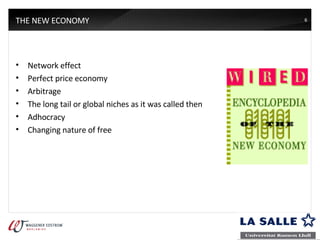
THE NEW ECONOMY Network effect Perfect price economy  Arbitrage The long tail or global niches as it was called then Adhocracy Changing nature of free
TRANSACTIONAL WEB Businesses went online because they saw a vast untapped marketplace Brochureware – replication of printed literature in pixels A canonical "dot-com" company's business model relied on harnessing network effects by operating at a sustained net loss to build market share (or mind share) What’s technically possible and hang the user experience Reduce the costs of processes Circumvent size, reputation and entrenched brands Circumvent government regulation Click through advertising Extremely measurable and trackable Traditional direct response marketing moved online Brand-building is a struggle Cheaper ongoing costs of distribution in electronic publishing Paid subscriptions Online marketplaces
HIGH CASUALTY RATE Businesses went disappeared because: There wasn’t sufficient demand for the products or services offered They burnt through cash base before making a profit People only use online services if there is a benefit (its easier to order pizzas by phone than by WAP) New build business processes didn’t work Couldn’t compete head-to-head with established brands Regulation caught up with businesses Online advertising dropped 27% post-bubble Restrictions on payment systems (merchant status and transaction costs) Technology did not match expectations
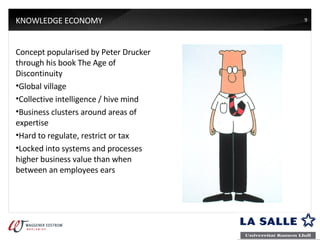
KNOWLEDGE ECONOMY Concept popularised by Peter Drucker through his book The Age of Discontinuity Global village Collective intelligence / hive mind Business clusters around areas of expertise Hard to regulate, restrict or tax Locked into systems and processes higher business value than when between an employees ears
WEB 2.0
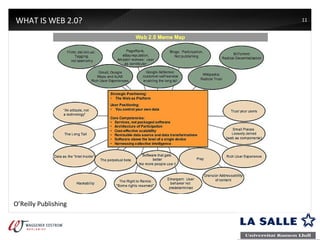
WHAT IS WEB 2.0? O’Reilly Publishing
WEB AS A PLATFORM Social networks Widgets Applications XML APIs Publishing platforms Blogger Letseat.at On Demand Computing Amazon EC3 MediaTemple SaaS Salesforce.com Google Office Click and build tools DoodleKit Dottemplate Iompi Crowdsourcing / Prosumption Get Satisfaction Wikis Amazon Mechanical Turk
 
WEB OF NO WEB
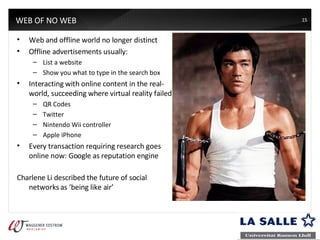
WEB OF NO WEB Web and offline world no longer distinct Offline advertisements usually: List a website Show you what to type in the search box Interacting with online content in the real-world, succeeding where virtual reality failed QR Codes Twitter Nintendo Wii controller Apple iPhone Every transaction requiring research goes online now: Google as reputation engine Charlene Li described the future of social networks as ‘being like air’
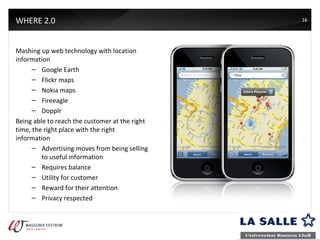
WHERE 2.0 Mashing up web technology with location information Google Earth Flickr maps Nokia maps Fireeagle Dopplr Being able to reach the customer at the right time, the right place with the right information  Advertising moves from being selling to useful information Requires balance Utility for customer Reward for their attention Privacy respected
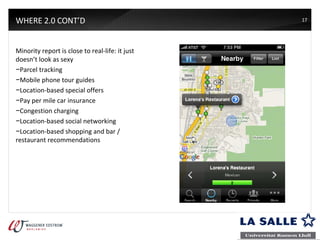
WHERE 2.0 CONT’D Minority report is close to real-life: it just doesn’t look as sexy Parcel tracking Mobile phone tour guides Location-based special offers Pay per mile car insurance Congestion charging Location-based social networking Location-based shopping and bar / restaurant recommendations
FORCES OF DISRUPTION
FORCES OF DISRUPTION Culture / politics clash Information must be free Open source and creative commons movement Technology moves faster than business models Music and film industry Crowdsourcing Amazon’s Mechanical Turk service Carnegie Mellon ESP game Rapid development Web as a platform and OSS reduces development costs and times considerably Start-up on a credit card - Trumours Margins in the long tail Most music masters won’t be remastered for online distribution Self-publishing costs falls dramatically Blogging versus specialist media Self-published pornography versus the adult entertainment industry Flickr versus stock photography Scoopt Consumer newsgathering Badvocacy
BIBLIOGRAPHY
BIBLIOGRAPHY Encyclopedia of the New Economy  –  Wired Magazine From Counterculture to Cyberculture: Stewart Brand, the Whole Earth Network, and the Rise of Digital Utopianism  by Fred Turner Marketing to the Social Web: How Digital Customer Communities Build Your Business  by Larry Weber Now or Never : How Companies Must Change Today to Win The Battle for Internet Customers  by Mary Modahl The Groundswell  by Charlene Li and Josh Bernoff  Free Culture: The nature and future of creativity  by Lawrence Lessig cultures@siliconvalley  by J. A. English-Lueck What is web 2.0?  B y Tim O’Reilly The Age of Discontinuity  by Peter Drucker
©  Waggener Edstrom Worldwide 2008

081017 - web centric business model

  • 1.
    THE WEB &BUSINESS DIGITAL Waggener Edstrom Worldwide |Ged Carroll |November 17, 2008
  • 2.
    THE WEB &BUSINESS: A little bit of scene setting Web 1.0 New economy Transactional web Knowledge economy Web 2.0 Forces of disruption Challenges
  • 3.
    BUSINESS The etymologyof "business" relates to the state of being busy either as an individual or society as a whole, doing commercially viable and profitable work. The term "business" has at least three usages, depending on the scope A particular company or corporation The generalised usage to refer to a particular market sector, such as "the music business" and compound forms such as agribusiness The broadest meaning to include all activity by the community of suppliers of goods and services. However, the exact definition of business, like much else in the philosophy of business, is a matter of debate
  • 4.
    A LITTLE BITOF SCENE SETTING: CONFLICT The internet and counterculture Homebrew computing Hippie culture Stewart Brand Libertarianism Open Source Social web MAKE culture The internet and ‘The Man’ ARPAnet Commercialisation of the web Technology bubble Telecoms bubble IT bubble Dot.coms Google age
  • 5.
  • 6.
    THE NEW ECONOMYNetwork effect Perfect price economy Arbitrage The long tail or global niches as it was called then Adhocracy Changing nature of free
  • 7.
    TRANSACTIONAL WEB Businesseswent online because they saw a vast untapped marketplace Brochureware – replication of printed literature in pixels A canonical "dot-com" company's business model relied on harnessing network effects by operating at a sustained net loss to build market share (or mind share) What’s technically possible and hang the user experience Reduce the costs of processes Circumvent size, reputation and entrenched brands Circumvent government regulation Click through advertising Extremely measurable and trackable Traditional direct response marketing moved online Brand-building is a struggle Cheaper ongoing costs of distribution in electronic publishing Paid subscriptions Online marketplaces
  • 8.
    HIGH CASUALTY RATEBusinesses went disappeared because: There wasn’t sufficient demand for the products or services offered They burnt through cash base before making a profit People only use online services if there is a benefit (its easier to order pizzas by phone than by WAP) New build business processes didn’t work Couldn’t compete head-to-head with established brands Regulation caught up with businesses Online advertising dropped 27% post-bubble Restrictions on payment systems (merchant status and transaction costs) Technology did not match expectations
  • 9.
    KNOWLEDGE ECONOMY Conceptpopularised by Peter Drucker through his book The Age of Discontinuity Global village Collective intelligence / hive mind Business clusters around areas of expertise Hard to regulate, restrict or tax Locked into systems and processes higher business value than when between an employees ears
  • 10.
  • 11.
    WHAT IS WEB2.0? O’Reilly Publishing
  • 12.
    WEB AS APLATFORM Social networks Widgets Applications XML APIs Publishing platforms Blogger Letseat.at On Demand Computing Amazon EC3 MediaTemple SaaS Salesforce.com Google Office Click and build tools DoodleKit Dottemplate Iompi Crowdsourcing / Prosumption Get Satisfaction Wikis Amazon Mechanical Turk
  • 13.
  • 14.
  • 15.
    WEB OF NOWEB Web and offline world no longer distinct Offline advertisements usually: List a website Show you what to type in the search box Interacting with online content in the real-world, succeeding where virtual reality failed QR Codes Twitter Nintendo Wii controller Apple iPhone Every transaction requiring research goes online now: Google as reputation engine Charlene Li described the future of social networks as ‘being like air’
  • 16.
    WHERE 2.0 Mashingup web technology with location information Google Earth Flickr maps Nokia maps Fireeagle Dopplr Being able to reach the customer at the right time, the right place with the right information Advertising moves from being selling to useful information Requires balance Utility for customer Reward for their attention Privacy respected
  • 17.
    WHERE 2.0 CONT’DMinority report is close to real-life: it just doesn’t look as sexy Parcel tracking Mobile phone tour guides Location-based special offers Pay per mile car insurance Congestion charging Location-based social networking Location-based shopping and bar / restaurant recommendations
  • 18.
  • 19.
    FORCES OF DISRUPTIONCulture / politics clash Information must be free Open source and creative commons movement Technology moves faster than business models Music and film industry Crowdsourcing Amazon’s Mechanical Turk service Carnegie Mellon ESP game Rapid development Web as a platform and OSS reduces development costs and times considerably Start-up on a credit card - Trumours Margins in the long tail Most music masters won’t be remastered for online distribution Self-publishing costs falls dramatically Blogging versus specialist media Self-published pornography versus the adult entertainment industry Flickr versus stock photography Scoopt Consumer newsgathering Badvocacy
  • 20.
  • 21.
    BIBLIOGRAPHY Encyclopedia ofthe New Economy – Wired Magazine From Counterculture to Cyberculture: Stewart Brand, the Whole Earth Network, and the Rise of Digital Utopianism by Fred Turner Marketing to the Social Web: How Digital Customer Communities Build Your Business by Larry Weber Now or Never : How Companies Must Change Today to Win The Battle for Internet Customers by Mary Modahl The Groundswell by Charlene Li and Josh Bernoff Free Culture: The nature and future of creativity by Lawrence Lessig cultures@siliconvalley by J. A. English-Lueck What is web 2.0? B y Tim O’Reilly The Age of Discontinuity by Peter Drucker
  • 22.
    © WaggenerEdstrom Worldwide 2008