LECTURE L23
ROBOTICS AND DRONES
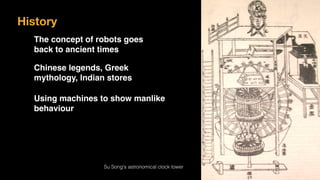
History
The concept of robots goes 

back to ancient times
Chinese legends, Greek
mythology, Indian stores
Using machines to show manlike
behaviour
Su Song's astronomical clock tower
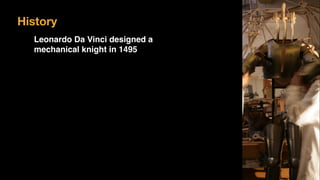
History
Leonardo Da Vinci designed a
mechanical knight in 1495
Culture
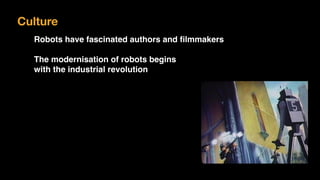
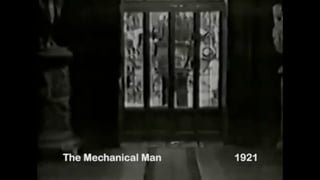
Robots have fascinated authors and filmmakers
The modernisation of robots begins 

with the industrial revolution
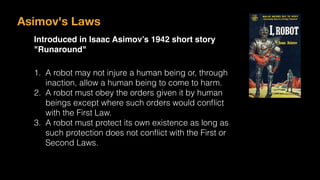
Asimov's Laws
Introduced in Isaac Asimov’s 1942 short story
"Runaround"
1. A robot may not injure a human being or, through
inaction, allow a human being to come to harm.
2. A robot must obey the orders given it by human
beings except where such orders would conflict
with the First Law.
3. A robot must protect its own existence as long as
such protection does not conflict with the First or
Second Laws.
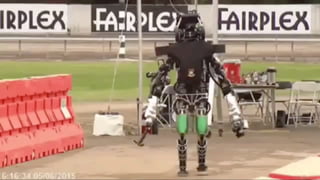
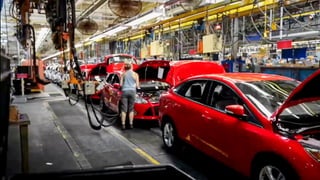
Robotics in the 20th century
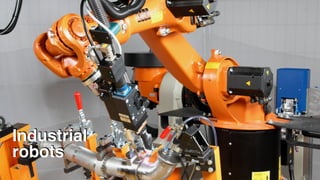
Industrial
robots
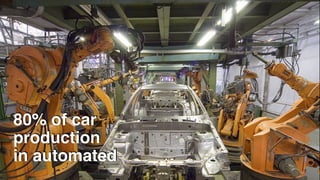
80% of car
production
in automated
Robotics in the 21st century
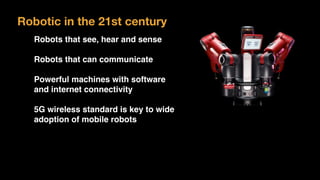
Robotic in the 21st century
Robots that see, hear and sense
Robots that can communicate
Powerful machines with software
and internet connectivity
5G wireless standard is key to wide
adoption of mobile robots
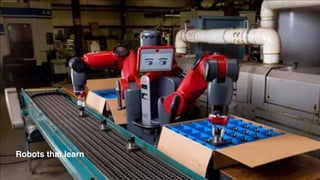
Robots that learn
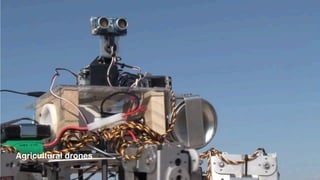
Agricultural drones
Are Robots taking over the world… should we be worried?
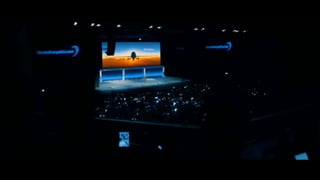
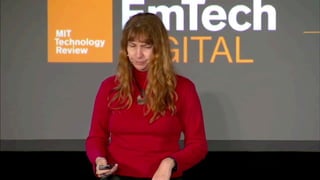
Engineering Social Robots: Next-Generation Human-Robot Interaction
Maja Matarić, USC Robotics and Autonomous Systems Center
EmTech Digital, May 23, 2016
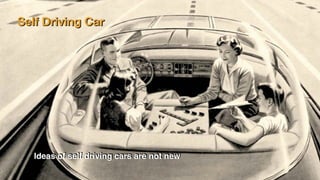
Self Driving Car
Self Driving Car
Ideas of self driving cars are not new
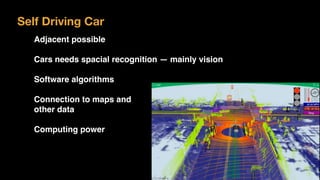
Adjacent possible
Cars needs spacial recognition — mainly vision
Software algorithms
Connection to maps and

other data
Computing power
Self Driving Car
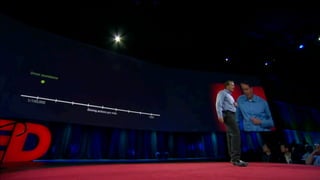
Chris Urmson:
How a driverless car sees the road
TED talk
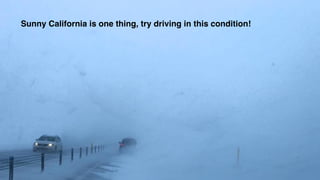
Sunny California is one thing, try driving in this condition!
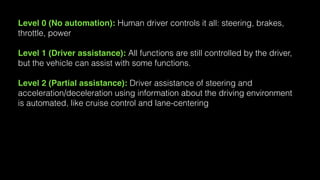
Level 0 (No automation): Human driver controls it all: steering, brakes,
throttle, power
Level 1 (Driver assistance): All functions are still controlled by the driver,
but the vehicle can assist with some functions.
Level 2 (Partial assistance): Driver assistance of steering and
acceleration/deceleration using information about the driving environment
is automated, like cruise control and lane-centering
Level 3 (Conditional assistance): Drivers are still necessary in level 3 cars,
but are able to completely shift "safety-critical functions" to the vehicle, under
certain traffic or environmental conditions
Level 4 (High automation): Designed to perform all safety-critical driving
functions and monitor roadway conditions for an entire trip
Level 5 (Full automation): This refers to a fully-autonomous system that
expects the vehicle's performance to equal that of a human driver, in every
driving scenario—including extreme environments like dirt roads that are
unlikely to be navigated by driverless vehicles in the near future.
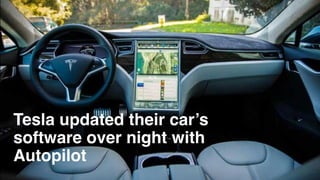
Tesla updated their car’s
software over night with
Autopilot
Delivering on the Promise of Autonomous Vehicles
Sterling Anderson, Tesla
EmTech Digital, May 24, 2016
Unmanned aerial vehicle
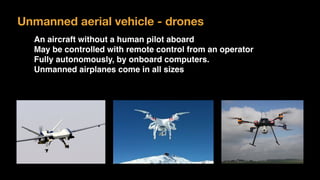
Unmanned aerial vehicle - drones
An aircraft without a human pilot aboard
May be controlled with remote control from an operator
Fully autonomously, by onboard computers.
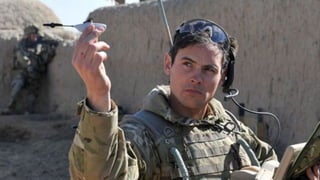
Unmanned airplanes come in all sizes
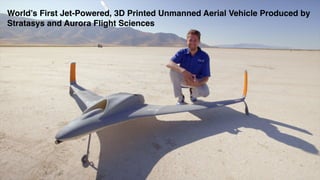
World’s First Jet-Powered, 3D Printed Unmanned Aerial Vehicle Produced by
Stratasys and Aurora Flight Sciences
Unmanned aerial vehicle - drones
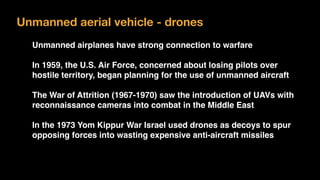
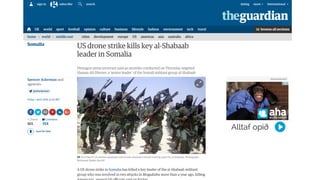
Unmanned airplanes have strong connection to warfare
In 1959, the U.S. Air Force, concerned about losing pilots over
hostile territory, began planning for the use of unmanned aircraft
The War of Attrition (1967-1970) saw the introduction of UAVs with
reconnaissance cameras into combat in the Middle East
In the 1973 Yom Kippur War Israel used drones as decoys to spur
opposing forces into wasting expensive anti-aircraft missiles
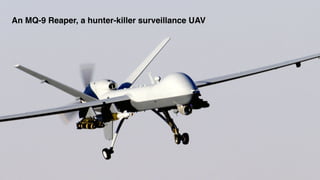
An MQ-9 Reaper, a hunter-killer surveillance UAV
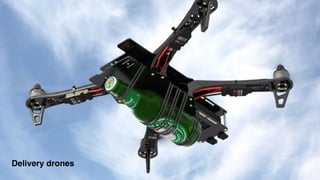
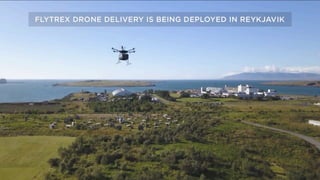
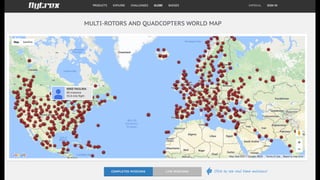
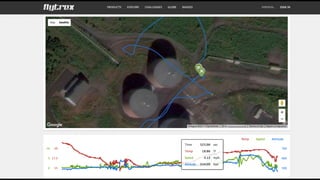
Delivery drones
Summary
The robot revolution is just starting
Self-driving cars will have huge impact
Delivery drones will change the way we shop
Next
Office hours Saturday — Time TBD
Research Paper due 31.03 23:59 with final day 16.04
L24 The Future 02.04 — Open lecture, bring a friend
Lecture Exercise L24: Tell me about the Future

L23 Robotics and Drones

  • 1.
  • 2.
    History The concept ofrobots goes 
 back to ancient times Chinese legends, Greek mythology, Indian stores Using machines to show manlike behaviour Su Song's astronomical clock tower
  • 3.
    History Leonardo Da Vincidesigned a mechanical knight in 1495
  • 4.
    Culture Robots have fascinatedauthors and filmmakers The modernisation of robots begins 
 with the industrial revolution
  • 6.
    Asimov's Laws Introduced inIsaac Asimov’s 1942 short story "Runaround" 1. A robot may not injure a human being or, through inaction, allow a human being to come to harm. 2. A robot must obey the orders given it by human beings except where such orders would conflict with the First Law. 3. A robot must protect its own existence as long as such protection does not conflict with the First or Second Laws.
  • 7.
    Robotics in the20th century
  • 9.
  • 10.
  • 12.
    Robotics in the21st century
  • 13.
    Robotic in the21st century Robots that see, hear and sense Robots that can communicate Powerful machines with software and internet connectivity 5G wireless standard is key to wide adoption of mobile robots
  • 14.
  • 16.
  • 18.
    Are Robots takingover the world… should we be worried?
  • 22.
    Engineering Social Robots:Next-Generation Human-Robot Interaction Maja Matarić, USC Robotics and Autonomous Systems Center EmTech Digital, May 23, 2016
  • 24.
  • 25.
    Self Driving Car Ideasof self driving cars are not new
  • 26.
    Adjacent possible Cars needsspacial recognition — mainly vision Software algorithms Connection to maps and
 other data Computing power Self Driving Car
  • 27.
    Chris Urmson: How adriverless car sees the road TED talk
  • 29.
    Sunny California isone thing, try driving in this condition!
  • 30.
    Level 0 (Noautomation): Human driver controls it all: steering, brakes, throttle, power Level 1 (Driver assistance): All functions are still controlled by the driver, but the vehicle can assist with some functions. Level 2 (Partial assistance): Driver assistance of steering and acceleration/deceleration using information about the driving environment is automated, like cruise control and lane-centering
  • 31.
    Level 3 (Conditionalassistance): Drivers are still necessary in level 3 cars, but are able to completely shift "safety-critical functions" to the vehicle, under certain traffic or environmental conditions Level 4 (High automation): Designed to perform all safety-critical driving functions and monitor roadway conditions for an entire trip Level 5 (Full automation): This refers to a fully-autonomous system that expects the vehicle's performance to equal that of a human driver, in every driving scenario—including extreme environments like dirt roads that are unlikely to be navigated by driverless vehicles in the near future.
  • 32.
    Tesla updated theircar’s software over night with Autopilot
  • 33.
    Delivering on thePromise of Autonomous Vehicles Sterling Anderson, Tesla EmTech Digital, May 24, 2016
  • 35.
  • 36.
    Unmanned aerial vehicle- drones An aircraft without a human pilot aboard May be controlled with remote control from an operator Fully autonomously, by onboard computers. Unmanned airplanes come in all sizes
  • 37.
    World’s First Jet-Powered,3D Printed Unmanned Aerial Vehicle Produced by Stratasys and Aurora Flight Sciences
  • 39.
    Unmanned aerial vehicle- drones Unmanned airplanes have strong connection to warfare In 1959, the U.S. Air Force, concerned about losing pilots over hostile territory, began planning for the use of unmanned aircraft The War of Attrition (1967-1970) saw the introduction of UAVs with reconnaissance cameras into combat in the Middle East In the 1973 Yom Kippur War Israel used drones as decoys to spur opposing forces into wasting expensive anti-aircraft missiles
  • 40.
    An MQ-9 Reaper,a hunter-killer surveillance UAV
  • 43.
  • 47.
    Summary The robot revolutionis just starting Self-driving cars will have huge impact Delivery drones will change the way we shop
  • 48.
    Next Office hours Saturday— Time TBD Research Paper due 31.03 23:59 with final day 16.04 L24 The Future 02.04 — Open lecture, bring a friend Lecture Exercise L24: Tell me about the Future