LECTURE L14
SOFTWARE AND MACHINE LEARNING
The Software Crisis
Software
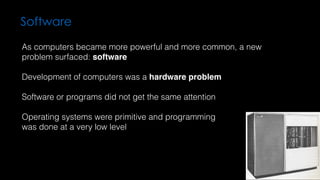
As computers became more powerful and more common, a new
problem surfaced: software
Development of computers was a hardware problem
Software or programs did not get the same attention
Operating systems were primitive and programming 

was done at a very low level
“[The major cause of the software crisis is] that the machines
have become several orders of magnitude more powerful!”
- Edsger Dijkstra, The Humble Programmer
Source:	Software_crisis
Software Engineering was not a established field
Became known as The Software Crisis
The Software Crisis
Q1
What solved the software crisis?
IBM developed OS/360 for System 360

DEC developed VMS for VAX

Unix was grew out individual efforts as response to Multix

System V, BSD, Solaris

Minix was an academic effort, Linux grew out of frustration with Minix
license
Operating Systems
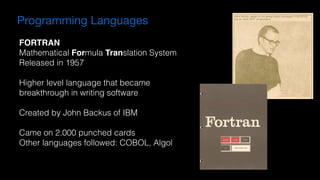
FORTRAN
Mathematical Formula Translation System
Released in 1957
Higher level language that became 

breakthrough in writing software
Created by John Backus of IBM
Came on 2.000 punched cards
Other languages followed: COBOL, Algol
Programming Languages
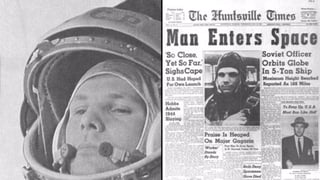
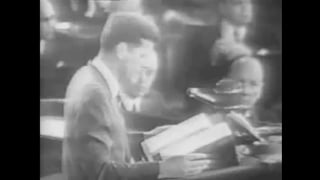
May 25, 1961
Status:
Mainframe era, mini computer early days
Transistor era, integrated circuits just invented
Programming languages new
Q2
What role did the US space program
have on computer innovation?
“The space program badly needed the things the
integrated circuit could provide.”
- Jack St. Clair Kilby
Robert Noyce and Gordon Moore founded Intel
Semiconductor company
Initial focus was on memory chips
There was still enormous potential market for calculations
The vision of Charles Babbage was still not realized but the mainframe
market met the needs of governments and large organizations
Semiconductor Industry is Born
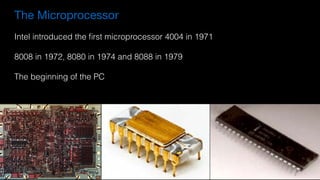
Intel introduced the first microprocessor 4004 in 1971
8008 in 1972, 8080 in 1974 and 8088 in 1979
The beginning of the PC
The Microprocessor
The Microprocessor
Intel was really reluctant to go into the microchip business
No market existed
No demand at the time
Intel created 4004 for another company
They would not market chips, but built them when ordered
The company cancelled the order and Intel was forced to offer them for sale
Q3
What was the first product in the
market after the introduction of
computer chips?
HINT: It disrupted a device that
was invented in1625
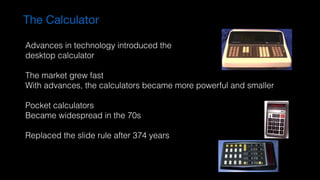
The Calculator
The Calculator
Advances in technology introduced the 

desktop calculator
The market grew fast
With advances, the calculators became more powerful and smaller
Pocket calculators
Became widespread in the 70s
Replaced the slide rule after 374 years
Calculator Wars
Many companies start to make Calculators
Casio, Sharp, Canon, HP, MITS and more
In Europe, Aristo, Denner & Pape, a slide rule manufacturer
since 1872, also entered the market in 1972
Price dropped fast: $400 in 1972, $200, $100 and $50 in 1974
Companies like MITS need to find new ways of revenues
Think about this!
All mini-computer companies had

what it would take to go into small

scale products – they even had

people proposing the idea, but they

did not!
The Personal Computer
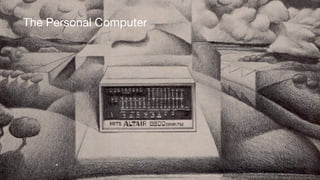
MITS marketed Altair in 1975
Came with Intel 8080
Users needed to assemble the machine themselves
No keyboard, no screen, no printer
256 byte of RAM, programmed with switches
Included BASIC interpreter from Microsoft
Written by Bill Gates and Paul Allen
Cost of $397 appealed to computer enthusiasts
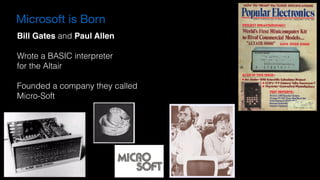
Microsoft is Born
Bill Gates and Paul Allen
Wrote a BASIC interpreter

for the Altair
Founded a company they called

Micro-Soft
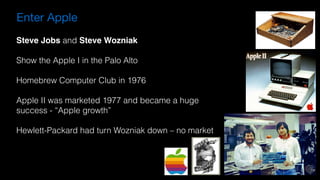
Enter Apple
Steve Jobs and Steve Wozniak
Show the Apple I in the Palo Alto 

Homebrew Computer Club in 1976
Apple II was marketed 1977 and became a huge
success - “Apple growth”
Hewlett-Packard had turn Wozniak down – no market
“The	Personal	Computer	will	fall	flat	on	its	face	in	
business.”	
-	Ken	Olsen
Computer Companies
Existing computer companies were not interested in PCs
DEC, HP, IBM, and Control Data did not see a business model
HP rejected a proposal from Steve Wozniak
DEC rejected a proposal from David Ahl
Support for machines like this was considered impossible
Consequence:
The development of the PC had to begin with hobbyists
Think About This!
The Liquid Network
The Software Industry
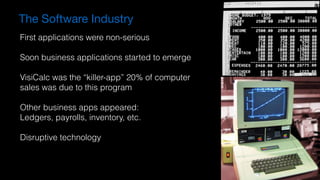
First applications were non-serious
Soon business applications started to emerge
VisiCalc was the “killer-app” 20% of computer
sales was due to this program
Other business apps appeared:
Ledgers, payrolls, inventory, etc.
Disruptive technology
Killer Apps
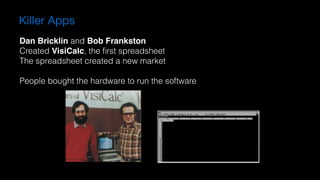
Dan Bricklin and Bob Frankston
Created VisiCalc, the first spreadsheet
The spreadsheet created a new market
People bought the hardware to run the software
Q4
IBM successfully entered the
PC market – according to RPV
theory this would be difficult.
How did they do this?
IBM PC
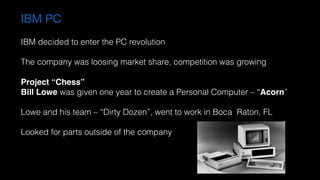
IBM decided to enter the PC revolution
The company was loosing market share, competition was growing
Project “Chess”
Bill Lowe was given one year to create a Personal Computer – “Acorn”
Lowe and his team – “Dirty Dozen”, went to work in Boca Raton, FL
Looked for parts outside of the company
The War of the OS
IBM needed an Operating System
Most popular system was Digital Research CP/M, created by Gary
Kildall
Microsoft was providing programming languages

and suggested that IBM make a deal with DR
Robert X. Cringely PBS documentary
The Birth of the Microsoft DOS
The War of the OS
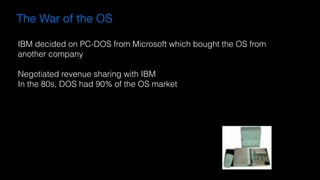
IBM decided on PC-DOS from Microsoft which bought the OS from
another company
Negotiated revenue sharing with IBM
In the 80s, DOS had 90% of the OS market
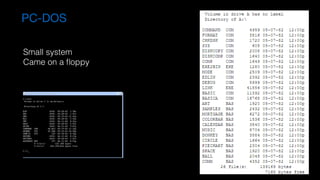
PC-DOS
Small system
Came on a floppy
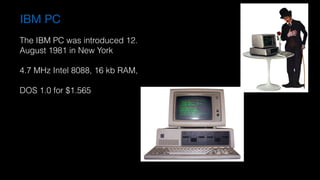
IBM PC
The IBM PC was introduced 12. 

August 1981 in New York
4.7 MHz Intel 8088, 16 kb RAM, 

DOS 1.0 for $1.565
Enter the Clones
Enter the Clones
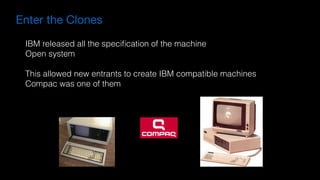
IBM released all the specification of the machine
Open system
This allowed new entrants to create IBM compatible machines
Compac was one of them
Enter the Clones
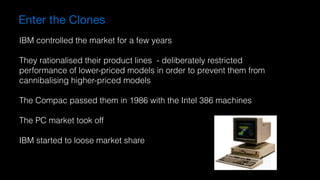
IBM controlled the market for a few years
They rationalised their product lines - deliberately restricted 

performance of lower-priced models in order to prevent them from 

cannibalising higher-priced models
The Compac passed them in 1986 with the Intel 386 machines
The PC market took off
IBM started to loose market share
PC Compatible Machines Ruled
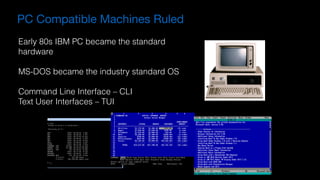
Early 80s IBM PC became the standard
hardware
MS-DOS became the industry standard OS
Command Line Interface – CLI
Text User Interfaces – TUI
Key Trend
Focus in on hardware, the

software is good-enough
Adoption Life Cycle
Still in the early stages – 

technology is the focus
“The best way to predict the future is to invent it.”
- Alan Key
“The Demo” of the Century in 1968
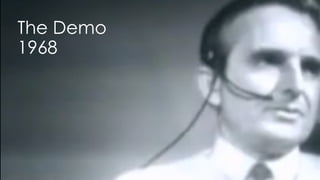
The Demo
1968
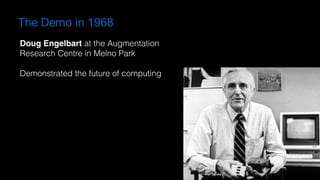
The Demo in 1968
Doug Engelbart at the Augmentation 

Research Centre in Melno Park
Demonstrated the future of computing
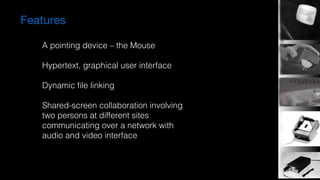
Features
A pointing device – the Mouse


Hypertext, graphical user interface

Dynamic file linking
Shared-screen collaboration involving 

two persons at different sites 

communicating over a network with 

audio and video interface
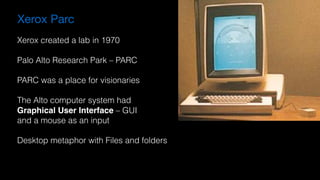
Xerox Parc
Xerox Parc
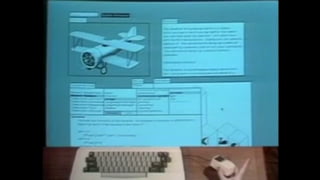
Alto Computer 1972
Xerox created a lab in 1970
Palo Alto Research Park – PARC
PARC was a place for visionaries
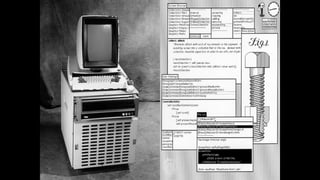
The Alto computer system had 

Graphical User Interface – GUI 

and a mouse as an input
Desktop metaphor with Files and folders
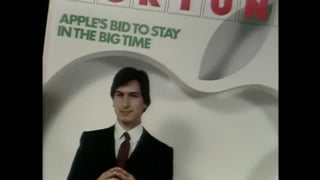
Then Steve came on a visit
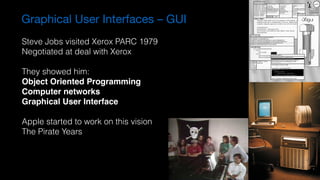
Graphical User Interfaces – GUI
Steve Jobs visited Xerox PARC 1979
Negotiated at deal with Xerox
They showed him:
Object Oriented Programming
Computer networks
Graphical User Interface
Apple started to work on this vision
The Pirate Years
RPV Theory
Xerox had just build the

OS of the future but they

did nothing with it

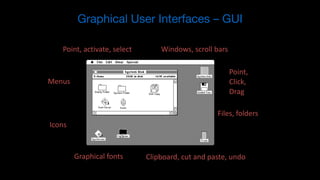
Graphical User Interfaces – GUI
Desktop metaphor
Point,	

Click,

Drag
Files,	folders
Icons
Windows,	scroll	bars
Menus
Graphical	fonts Clipboard,	cut	and	paste,	undo
Point,	activate,	select
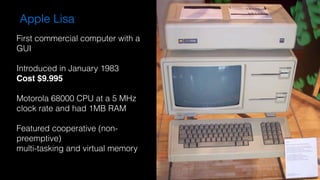
Apple Lisa
First commercial computer with a
GUI
Introduced in January 1983
Cost $9.995
Motorola 68000 CPU at a 5 MHz
clock rate and had 1MB RAM
Featured cooperative (non-
preemptive)
multi-tasking and virtual memory
Q5
Why did the Lisa fail?
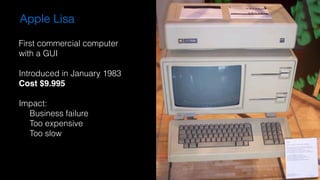
Apple Lisa
First commercial computer
with a GUI
Introduced in January 1983
Cost $9.995
Impact:
Business failure
Too expensive
Too slow
Adjacent Possible
Technology wasn’t there yet
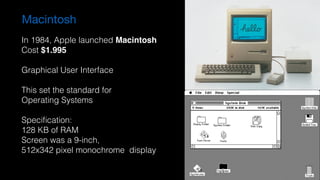
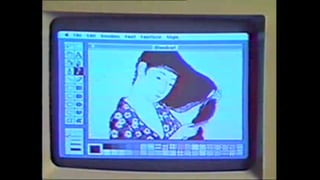
Macintosh
In 1984, Apple launched Macintosh
Cost $1.995
Graphical User Interface
This set the standard for 

Operating Systems
Specification:
128 KB of RAM
Screen was a 9-inch, 

512x342 pixel monochrome display
Macintosh
Acceptance was slow
The Mac was underpowered
The GUI required memory and power
Writing Software was difficult
Gained popularity in education and with 

graphical designers – desktop publishers
Not so popular in the traditional business sector
Microsoft provided applications (office apps)
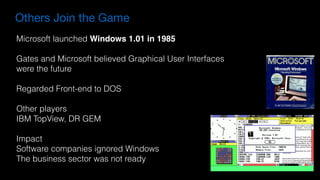
Others Join the Game
Microsoft launched Windows 1.01 in 1985
Gates and Microsoft believed Graphical User Interfaces
were the future
Regarded Front-end to DOS
Other players
IBM TopView, DR GEM
Impact
Software companies ignored Windows
The business sector was not ready
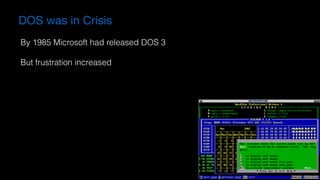
DOS was in Crisis
By 1985 Microsoft had released DOS 3
But frustration increased
Q6
What were customers looking for?
DOS was in Crisis
Single task system – you can only run one program at the time
The 640 KB memory barrier
TSR – Terminate and Stay Resident
became popular but was causing problems
Users were looking for multitasking
Run more than one program at a time
More advanced operating system 

was needed
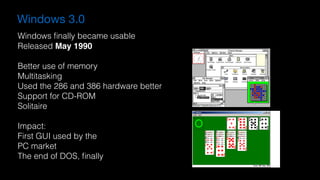
Windows 3.0
Windows finally became usable
Released May 1990
Better use of memory
Multitasking
Used the 286 and 386 hardware better
Support for CD-ROM
Solitaire
Impact:
First GUI used by the

PC market
The end of DOS, finally
Windows 95
KEY TREND
Computers become 

consumer devices
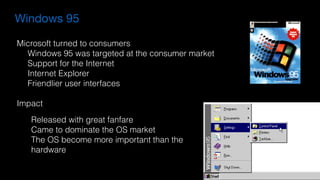
Windows 95
Microsoft turned to consumers
Windows 95 was targeted at the consumer market
Support for the Internet
Internet Explorer
Friendlier user interfaces
Impact
Released with great fanfare
Came to dominate the OS market
The OS become more important than the
hardware
Operating System for Consumers
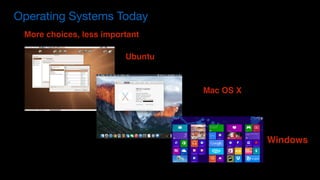
Operating Systems Today
Ubuntu
Mac OS X
Windows
More choices, less important
Operating Systems Today
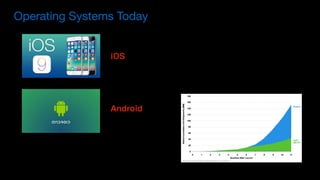
iOS
Android
Lessons
▪ Shift from hardware to software

▪ None of the minicomputer makers became a
significant factor in the desktop personal
computer market

▪ The PC was disruptive technology

▪ The minicomputer users were not buying PCs –
yet

▪ This created a new set of entrants: Apple, Tandy,
Commodore, and IBM
▪ In the late 1980s the performance of PCs met the
needs of minicomputer users

▪ This severely wounded minicomputer makers –
many of them failed

▪ At same time IBM succeeded in entering the PC
market – how?

▪ It created an autonomous organization in Florida –
far away from it’s New York headquarters

▪ They created the PC market

▪ Then headquarters took control and lost control to
the Clones
Lessons
▪ Xerox mangement did not enter the computer
market

▪ PARC members tried to show management – but
they “just didn’t get it”

▪ Xerox is in the copying documents business –
their customers were not asking for computer
systems

▪ Visionary Computers did not fit their resources,
processes and values

– RPV theory
Lessons
▪ Doug Englebart envisioned the future of
computers

▪ Xerox PARC built the visionary computer – but
did not pursue it

▪ Early enthusiast like Ed Roberts of MITS and
others did not get rich of computers and
software

▪ Visionaries like Dan Bricklin and Bob Frankston
invented VisiCalc – did not make much money
Lessons
Lessons
▪ Bill Gates saw the potential of software and started
Microsoft

▪ Took the opportunity with MITS

▪ Focused on software

▪ Gary Kildall invented the C/PM system but Microsoft
bought similar OS and succeeded

▪ Wrote software for Apple and later Macintosh

▪ You don’t have to have superior products to win

▪ You don’t have to invent technology – just use it
Lessons
▪ Apple and Steve Jobs saw the potential of computers
and then GUIs

▪ GUI were slow to appear

▪ Infrastructure product - needs software and users

▪ Stretched the hardware at the time

▪ Disruptive with new market – consumers

▪ Apple Lisa failed – lacking in performance

▪ The Macintosh started slowly and found some niche
market in Desktop Publishing and schools
Lessons
▪ Windows 95 was marketed to the consumer

▪ First mass market of Operating Systems

– The Internet helped

▪ Today we have three major Operating Systems

– Linux (Unix based)

– MacOS (Unix based)

– Windows
Q7
What is the future of Personal Computers and 

Operating Systems?
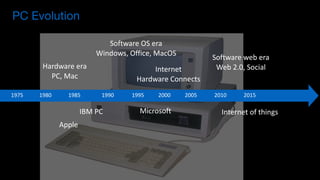
1975 1980 1985 1990 1995 2000 2005
Hardware	era	
PC,	Mac
Software	OS	era	
Windows,	Office,	MacOS
Internet	
Hardware	Connects
IBM	PC Microsoft
Apple
2010
Software	web	era	
Web	2.0,	Social
2015
Internet	of	things
PC Evolution
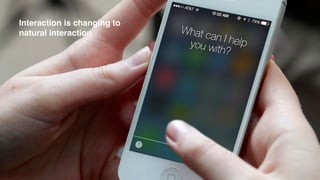
Interaction is changing to
natural interaction
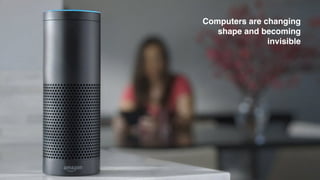
Computers are changing
shape and becoming
invisible
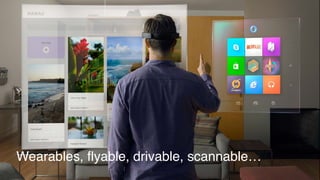
Wearables, flyable, drivable, scannable…
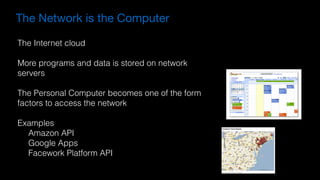
The Network is the Computer
The Internet cloud
More programs and data is stored on network
servers
The Personal Computer becomes one of the form
factors to access the network
Examples
Amazon API
Google Apps
Facework Platform API
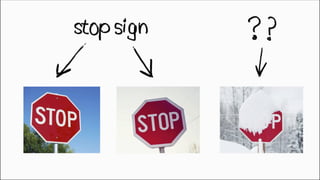
Machine Learning
Machine Learning
Breakthroughs in computer performance (GPUs), algorithms, cloud
computing and big data, has finally created an environment where
neural networks - systems that learn have become a reality
The ideas of learning systems came very early but failed to become
practical
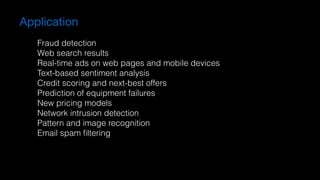
Fraud detection
Web search results
Real-time ads on web pages and mobile devices
Text-based sentiment analysis
Credit scoring and next-best offers
Prediction of equipment failures
New pricing models
Network intrusion detection
Pattern and image recognition
Email spam filtering
Application
Google has TensorFlow, an Open Source Software Library for
Machine Intelligence
Machine Learning Platform
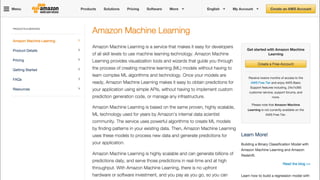
Now platforms are becoming available
Amazon has Amazon Machine Learning
Microsoft is providing machine learning as part of Cortana Analytics
Suite
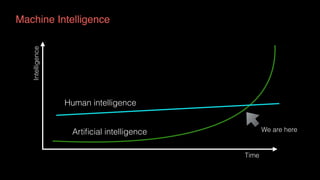
Human intelligence
Artificial intelligence We are here
Intelligence
Time
Machine Intelligence
Next
L15 Augmented and Virtual Reality

L14 Software and Machine Learning

  • 1.
    LECTURE L14 SOFTWARE ANDMACHINE LEARNING
  • 2.
  • 3.
    Software As computers becamemore powerful and more common, a new problem surfaced: software Development of computers was a hardware problem Software or programs did not get the same attention Operating systems were primitive and programming 
 was done at a very low level
  • 4.
    “[The major causeof the software crisis is] that the machines have become several orders of magnitude more powerful!” - Edsger Dijkstra, The Humble Programmer Source: Software_crisis Software Engineering was not a established field Became known as The Software Crisis The Software Crisis
  • 5.
    Q1 What solved thesoftware crisis?
  • 6.
    IBM developed OS/360for System 360 DEC developed VMS for VAX Unix was grew out individual efforts as response to Multix System V, BSD, Solaris Minix was an academic effort, Linux grew out of frustration with Minix license Operating Systems
  • 7.
    FORTRAN Mathematical Formula TranslationSystem Released in 1957 Higher level language that became 
 breakthrough in writing software Created by John Backus of IBM Came on 2.000 punched cards Other languages followed: COBOL, Algol Programming Languages
  • 11.
    May 25, 1961 Status: Mainframeera, mini computer early days Transistor era, integrated circuits just invented Programming languages new
  • 12.
    Q2 What role didthe US space program have on computer innovation?
  • 13.
    “The space programbadly needed the things the integrated circuit could provide.” - Jack St. Clair Kilby
  • 14.
    Robert Noyce andGordon Moore founded Intel Semiconductor company Initial focus was on memory chips There was still enormous potential market for calculations The vision of Charles Babbage was still not realized but the mainframe market met the needs of governments and large organizations Semiconductor Industry is Born
  • 15.
    Intel introduced thefirst microprocessor 4004 in 1971 8008 in 1972, 8080 in 1974 and 8088 in 1979 The beginning of the PC The Microprocessor
  • 16.
    The Microprocessor Intel wasreally reluctant to go into the microchip business No market existed No demand at the time Intel created 4004 for another company They would not market chips, but built them when ordered The company cancelled the order and Intel was forced to offer them for sale
  • 17.
    Q3 What was thefirst product in the market after the introduction of computer chips? HINT: It disrupted a device that was invented in1625
  • 18.
  • 19.
    The Calculator Advances intechnology introduced the 
 desktop calculator The market grew fast With advances, the calculators became more powerful and smaller Pocket calculators Became widespread in the 70s Replaced the slide rule after 374 years
  • 20.
    Calculator Wars Many companiesstart to make Calculators Casio, Sharp, Canon, HP, MITS and more In Europe, Aristo, Denner & Pape, a slide rule manufacturer since 1872, also entered the market in 1972 Price dropped fast: $400 in 1972, $200, $100 and $50 in 1974 Companies like MITS need to find new ways of revenues
  • 21.
    Think about this! Allmini-computer companies had
 what it would take to go into small
 scale products – they even had
 people proposing the idea, but they
 did not!
  • 22.
  • 23.
    The Personal Computer MITSmarketed Altair in 1975 Came with Intel 8080 Users needed to assemble the machine themselves No keyboard, no screen, no printer 256 byte of RAM, programmed with switches Included BASIC interpreter from Microsoft Written by Bill Gates and Paul Allen Cost of $397 appealed to computer enthusiasts
  • 24.
    Microsoft is Born BillGates and Paul Allen Wrote a BASIC interpreter
 for the Altair Founded a company they called
 Micro-Soft
  • 25.
    Enter Apple Steve Jobsand Steve Wozniak Show the Apple I in the Palo Alto 
 Homebrew Computer Club in 1976 Apple II was marketed 1977 and became a huge success - “Apple growth” Hewlett-Packard had turn Wozniak down – no market
  • 26.
  • 27.
    Computer Companies Existing computercompanies were not interested in PCs DEC, HP, IBM, and Control Data did not see a business model HP rejected a proposal from Steve Wozniak DEC rejected a proposal from David Ahl Support for machines like this was considered impossible Consequence: The development of the PC had to begin with hobbyists
  • 29.
    Think About This! TheLiquid Network
  • 30.
    The Software Industry Firstapplications were non-serious Soon business applications started to emerge VisiCalc was the “killer-app” 20% of computer sales was due to this program Other business apps appeared: Ledgers, payrolls, inventory, etc. Disruptive technology
  • 31.
    Killer Apps Dan Bricklinand Bob Frankston Created VisiCalc, the first spreadsheet The spreadsheet created a new market People bought the hardware to run the software
  • 33.
    Q4 IBM successfully enteredthe PC market – according to RPV theory this would be difficult. How did they do this?
  • 34.
    IBM PC IBM decidedto enter the PC revolution The company was loosing market share, competition was growing Project “Chess” Bill Lowe was given one year to create a Personal Computer – “Acorn” Lowe and his team – “Dirty Dozen”, went to work in Boca Raton, FL Looked for parts outside of the company
  • 35.
    The War ofthe OS IBM needed an Operating System Most popular system was Digital Research CP/M, created by Gary Kildall Microsoft was providing programming languages
 and suggested that IBM make a deal with DR
  • 36.
    Robert X. CringelyPBS documentary The Birth of the Microsoft DOS
  • 38.
    The War ofthe OS IBM decided on PC-DOS from Microsoft which bought the OS from another company Negotiated revenue sharing with IBM In the 80s, DOS had 90% of the OS market
  • 39.
  • 40.
    IBM PC The IBMPC was introduced 12. 
 August 1981 in New York 4.7 MHz Intel 8088, 16 kb RAM, 
 DOS 1.0 for $1.565
  • 42.
  • 43.
    Enter the Clones IBMreleased all the specification of the machine Open system This allowed new entrants to create IBM compatible machines Compac was one of them
  • 44.
    Enter the Clones IBMcontrolled the market for a few years They rationalised their product lines - deliberately restricted 
 performance of lower-priced models in order to prevent them from 
 cannibalising higher-priced models The Compac passed them in 1986 with the Intel 386 machines The PC market took off IBM started to loose market share
  • 45.
    PC Compatible MachinesRuled Early 80s IBM PC became the standard hardware MS-DOS became the industry standard OS Command Line Interface – CLI Text User Interfaces – TUI
  • 46.
    Key Trend Focus inon hardware, the
 software is good-enough
  • 47.
    Adoption Life Cycle Stillin the early stages – 
 technology is the focus
  • 48.
    “The best wayto predict the future is to invent it.” - Alan Key “The Demo” of the Century in 1968
  • 49.
  • 50.
    The Demo in1968 Doug Engelbart at the Augmentation 
 Research Centre in Melno Park Demonstrated the future of computing
  • 52.
    Features A pointing device– the Mouse 
 Hypertext, graphical user interface
 Dynamic file linking Shared-screen collaboration involving 
 two persons at different sites 
 communicating over a network with 
 audio and video interface
  • 53.
  • 54.
    Xerox Parc Alto Computer1972 Xerox created a lab in 1970 Palo Alto Research Park – PARC PARC was a place for visionaries The Alto computer system had 
 Graphical User Interface – GUI 
 and a mouse as an input Desktop metaphor with Files and folders
  • 57.
    Then Steve cameon a visit
  • 59.
    Graphical User Interfaces– GUI Steve Jobs visited Xerox PARC 1979 Negotiated at deal with Xerox They showed him: Object Oriented Programming Computer networks Graphical User Interface Apple started to work on this vision The Pirate Years
  • 60.
    RPV Theory Xerox hadjust build the
 OS of the future but they
 did nothing with it

  • 62.
    Graphical User Interfaces– GUI Desktop metaphor Point, 
 Click,
 Drag Files, folders Icons Windows, scroll bars Menus Graphical fonts Clipboard, cut and paste, undo Point, activate, select
  • 63.
    Apple Lisa First commercialcomputer with a GUI Introduced in January 1983 Cost $9.995 Motorola 68000 CPU at a 5 MHz clock rate and had 1MB RAM Featured cooperative (non- preemptive) multi-tasking and virtual memory
  • 64.
    Q5 Why did theLisa fail?
  • 65.
    Apple Lisa First commercialcomputer with a GUI Introduced in January 1983 Cost $9.995 Impact: Business failure Too expensive Too slow
  • 66.
  • 67.
    Macintosh In 1984, Applelaunched Macintosh Cost $1.995 Graphical User Interface This set the standard for 
 Operating Systems Specification: 128 KB of RAM Screen was a 9-inch, 
 512x342 pixel monochrome display
  • 69.
    Macintosh Acceptance was slow TheMac was underpowered The GUI required memory and power Writing Software was difficult Gained popularity in education and with 
 graphical designers – desktop publishers Not so popular in the traditional business sector Microsoft provided applications (office apps)
  • 70.
    Others Join theGame Microsoft launched Windows 1.01 in 1985 Gates and Microsoft believed Graphical User Interfaces were the future Regarded Front-end to DOS Other players IBM TopView, DR GEM Impact Software companies ignored Windows The business sector was not ready
  • 71.
    DOS was inCrisis By 1985 Microsoft had released DOS 3 But frustration increased
  • 72.
  • 73.
    DOS was inCrisis Single task system – you can only run one program at the time The 640 KB memory barrier TSR – Terminate and Stay Resident became popular but was causing problems Users were looking for multitasking Run more than one program at a time More advanced operating system 
 was needed
  • 74.
    Windows 3.0 Windows finallybecame usable Released May 1990 Better use of memory Multitasking Used the 286 and 386 hardware better Support for CD-ROM Solitaire Impact: First GUI used by the
 PC market The end of DOS, finally
  • 75.
  • 77.
    KEY TREND Computers become
 consumer devices
  • 79.
    Windows 95 Microsoft turnedto consumers Windows 95 was targeted at the consumer market Support for the Internet Internet Explorer Friendlier user interfaces Impact Released with great fanfare Came to dominate the OS market The OS become more important than the hardware
  • 81.
  • 83.
    Operating Systems Today Ubuntu MacOS X Windows More choices, less important
  • 84.
  • 85.
    Lessons ▪ Shift fromhardware to software ▪ None of the minicomputer makers became a significant factor in the desktop personal computer market ▪ The PC was disruptive technology ▪ The minicomputer users were not buying PCs – yet ▪ This created a new set of entrants: Apple, Tandy, Commodore, and IBM
  • 86.
    ▪ In thelate 1980s the performance of PCs met the needs of minicomputer users ▪ This severely wounded minicomputer makers – many of them failed ▪ At same time IBM succeeded in entering the PC market – how? ▪ It created an autonomous organization in Florida – far away from it’s New York headquarters ▪ They created the PC market ▪ Then headquarters took control and lost control to the Clones Lessons
  • 87.
    ▪ Xerox mangementdid not enter the computer market ▪ PARC members tried to show management – but they “just didn’t get it” ▪ Xerox is in the copying documents business – their customers were not asking for computer systems ▪ Visionary Computers did not fit their resources, processes and values – RPV theory Lessons
  • 88.
    ▪ Doug Englebartenvisioned the future of computers ▪ Xerox PARC built the visionary computer – but did not pursue it ▪ Early enthusiast like Ed Roberts of MITS and others did not get rich of computers and software ▪ Visionaries like Dan Bricklin and Bob Frankston invented VisiCalc – did not make much money Lessons
  • 89.
    Lessons ▪ Bill Gatessaw the potential of software and started Microsoft ▪ Took the opportunity with MITS ▪ Focused on software ▪ Gary Kildall invented the C/PM system but Microsoft bought similar OS and succeeded ▪ Wrote software for Apple and later Macintosh ▪ You don’t have to have superior products to win ▪ You don’t have to invent technology – just use it
  • 90.
    Lessons ▪ Apple andSteve Jobs saw the potential of computers and then GUIs ▪ GUI were slow to appear ▪ Infrastructure product - needs software and users ▪ Stretched the hardware at the time ▪ Disruptive with new market – consumers ▪ Apple Lisa failed – lacking in performance ▪ The Macintosh started slowly and found some niche market in Desktop Publishing and schools
  • 91.
    Lessons ▪ Windows 95was marketed to the consumer ▪ First mass market of Operating Systems – The Internet helped ▪ Today we have three major Operating Systems – Linux (Unix based) – MacOS (Unix based) – Windows
  • 92.
    Q7 What is thefuture of Personal Computers and 
 Operating Systems?
  • 93.
    1975 1980 19851990 1995 2000 2005 Hardware era PC, Mac Software OS era Windows, Office, MacOS Internet Hardware Connects IBM PC Microsoft Apple 2010 Software web era Web 2.0, Social 2015 Internet of things PC Evolution
  • 94.
    Interaction is changingto natural interaction
  • 95.
    Computers are changing shapeand becoming invisible
  • 96.
  • 97.
    The Network isthe Computer The Internet cloud More programs and data is stored on network servers The Personal Computer becomes one of the form factors to access the network Examples Amazon API Google Apps Facework Platform API
  • 98.
  • 99.
    Machine Learning Breakthroughs incomputer performance (GPUs), algorithms, cloud computing and big data, has finally created an environment where neural networks - systems that learn have become a reality The ideas of learning systems came very early but failed to become practical
  • 101.
    Fraud detection Web searchresults Real-time ads on web pages and mobile devices Text-based sentiment analysis Credit scoring and next-best offers Prediction of equipment failures New pricing models Network intrusion detection Pattern and image recognition Email spam filtering Application
  • 103.
    Google has TensorFlow,an Open Source Software Library for Machine Intelligence Machine Learning Platform Now platforms are becoming available Amazon has Amazon Machine Learning Microsoft is providing machine learning as part of Cortana Analytics Suite
  • 105.
    Human intelligence Artificial intelligenceWe are here Intelligence Time Machine Intelligence
  • 106.
    Next L15 Augmented andVirtual Reality