LECTURE L15
THE MOBILE REVOLUTION
757M daily circulations of all newspapers
969M total TV subscribers
1.3B registered cars
1.1B of all types of computers (PC, netbooks...)
1.2B total landline phones
1.5B total TV sets
1.7B total unique holders of credit cards
2.1B total unique holders of bank accounts
3.9B total FM radios in use
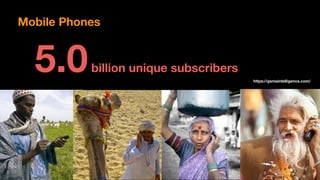
Mobile Phones
8,5billion connections
https://gsmaintelligence.com/
5.0billion unique subscribers
https://gsmaintelligence.com/
Mobile Phones
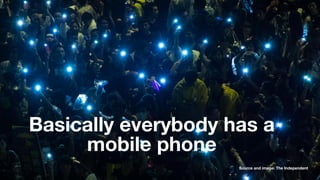
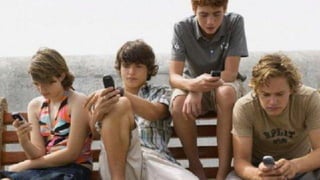
Basically everybody has a
mobile phone
Source and image: The Independent
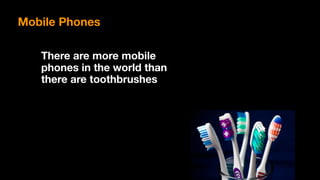
There are more mobile
phones in the world than
there are toothbrushes
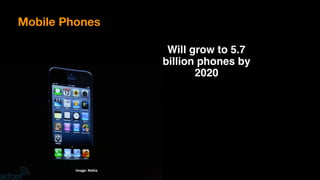
Mobile Phones
Will grow to 5.7
billion phones by
2020
Image:	Nokia
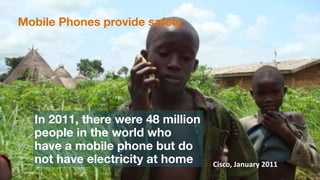
Mobile Phones
Survival
In 2011, there were 48 million
people in the world who
have a mobile phone but do
not have electricity at home
Mobile Phones provide safety
Cisco,	January	2011
The History of Communication
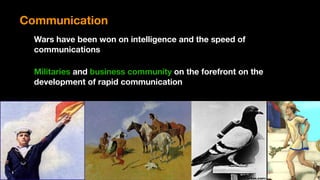
Communication
Wars have been won on intelligence and the speed of
communications
Militaries and business community on the forefront on the
development of rapid communication
Communication
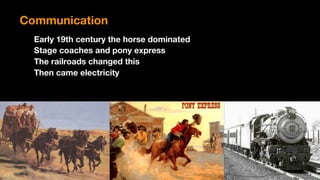
Early 19th century the horse dominated
Stage coaches and pony express
The railroads changed this
Then came electricity
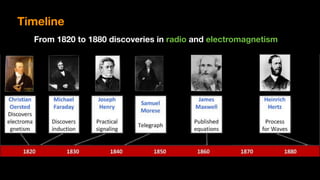
From 1820 to 1880 discoveries in radio and electromagnetism
Timeline
An Industrial Revolution
The period 1870-1914
Innovations in the chemical, electric, petroleum and steel industries
Adjacent Possible
Growth period
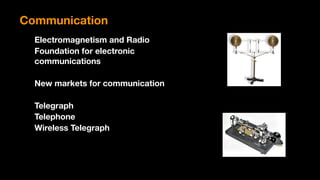
Electromagnetism and Radio
Foundation for electronic

communications
New markets for communication
Telegraph
Telephone
Wireless Telegraph
Communication
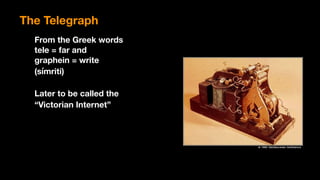
From the Greek words

tele = far and 

graphein = write
(símriti)
Later to be called the
“Victorian Internet”
The Telegraph
The Telegraph
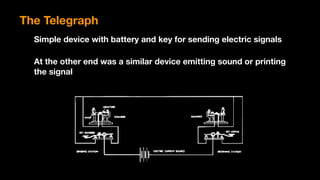
Simple device with battery and key for sending electric signals
At the other end was a similar device emitting sound or printing
the signal
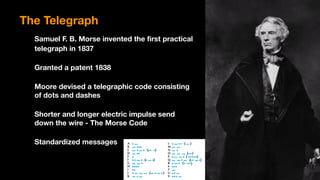
Samuel F. B. Morse invented the first practical
telegraph in 1837
Granted a patent 1838
Moore devised a telegraphic code consisting

of dots and dashes
Shorter and longer electric impulse send 

down the wire - The Morse Code
Standardized messages
The Telegraph
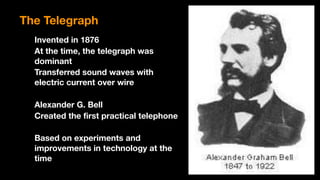
Invented in 1876
At the time, the telegraph was
dominant
Transferred sound waves with
electric current over wire
Alexander G. Bell
Created the first practical telephone
Based on experiments and
improvements in technology at the
time
The Telegraph
At the dawn of the 20th century, two mediums for communication
were dominant
The telegraph: Became important in the American Civil War
(1861-65), dominated by Western Union
The telephone: Dominant technology with the growth of Bell
Both these technologies had one problem: they were wire-based
History
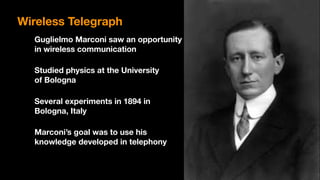
Guglielmo Marconi saw an opportunity

in wireless communication
Studied physics at the University

of Bologna
Several experiments in 1894 in

Bologna, Italy
Marconi’s goal was to use his

knowledge developed in telephony
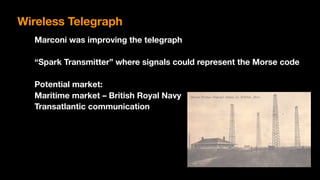
Wireless Telegraph
Marconi was improving the telegraph
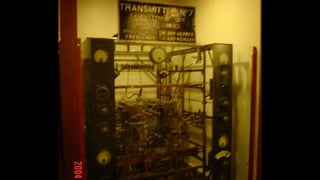
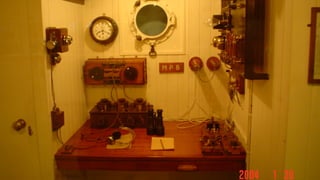
“Spark Transmitter” where signals could represent the Morse code
Potential market:
Maritime market – British Royal Navy
Transatlantic communication
Wireless Telegraph
Many scientists were happy to point out flaws in Marconi’s
inventions
Doubts that wireless had any application
Limitations – radios worded on fixed frequency
Security – anyone could listen in
The telegraph was initially 20 times faster
Cable companies showed no interest in wireless
Skepticism and Competition
Wireless Telegraph was popular in the press
Many companies competed for stock funding
Resulted in Stock inflations - “The Wireless Telegraph bubble”
Sceptic voices started to respond
Series of articles in Success Magazine, 

“Fools and their money” 

appeared 1907

The Wireless Telegraph Bubble
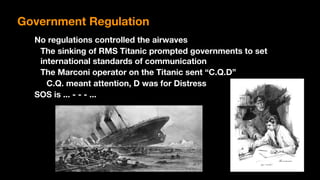
No regulations controlled the airwaves
The sinking of RMS Titanic prompted governments to set
international standards of communication
The Marconi operator on the Titanic sent “C.Q.D”
C.Q. meant attention, D was for Distress
SOS is ... - - - ...
Government Regulation
Around 1940 ideas for wireless communication were established
It was not until the development of microchips and technology for
building devices, that wireless communication became 

practical for individuals
Rules and cautiousness were to delay the progress
Also investments in land based systems
Wireless Communication
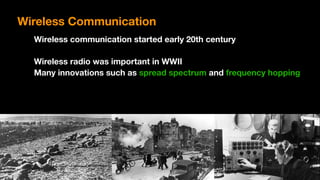
Wireless communication started early 20th century
Wireless radio was important in WWII
Many innovations such as spread spectrum and frequency hopping
Hedwig Eva Maria Kiesler
1913-2000
"Films have a certain place in a
certain time period. Technology is
forever”
- Hedy Lamarr
Wireless Communication
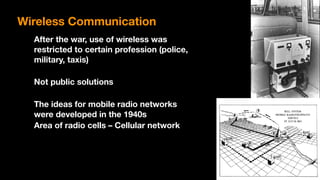
After the war, use of wireless was 

restricted to certain profession (police,
military, taxis)
Not public solutions
The ideas for mobile radio networks
were developed in the 1940s
Area of radio cells – Cellular network
Adjacent Possible
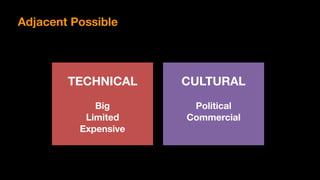
TECHNICAL
Big
Limited
Expensive
CULTURAL
Political
Commercial
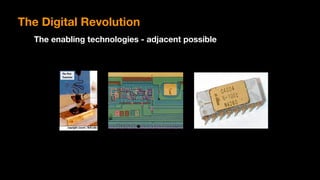
The Digital Revolution
The enabling technologies - adjacent possible
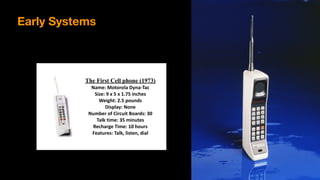
The First Cell phone (1973)
Name:	Motorola	Dyna-Tac

Size:	9	x	5	x	1.75	inches

Weight:	2.5	pounds

Display:	None

Number	of	Circuit	Boards:	30

Talk	time:	35	minutes

Recharge	Time:	10	hours

Features:	Talk,	listen,	dial
Early Systems
Technical Improvements
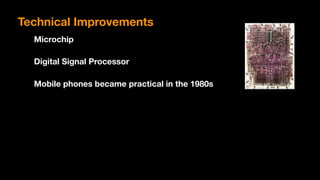
Microchip
Digital Signal Processor
Mobile phones became practical in the 1980s
Cellular Networks
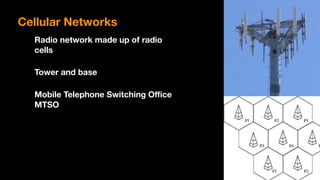
Radio network made up of radio

cells
Tower and base
Mobile Telephone Switching Office 

MTSO
▪ Mobile phones provide safety
▪ The most common device of all
▪ Mobile phones are not practical until 1980s due to size of
technology – Adjacent Possible
▪ The invention of the microchip played crucial role in the
development of cell phones
Lessons Learned: Cellular Phones
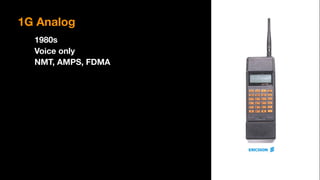
1G Analog
1G Analog
1980s
Voice only
NMT, AMPS, FDMA
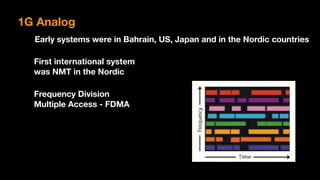
1G Analog
Early systems were in Bahrain, US, Japan and in the Nordic countries
First international system

was NMT in the Nordic
Frequency Division 

Multiple Access - FDMA
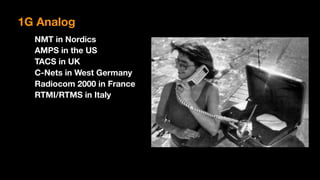
1G Analog
NMT in Nordics
AMPS in the US
TACS in UK
C-Nets in West Germany
Radiocom 2000 in France
RTMI/RTMS in Italy
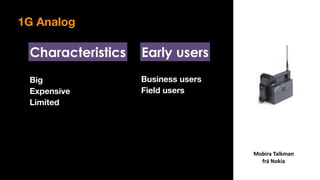
Characteristics
Mobira	Talkman	

frá	Nokia
Early users
1G Analog
Big
Expensive
Limited
Business users
Field users
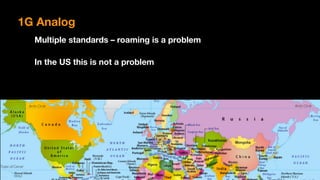
Multiple standards – roaming is a problem
In the US this is not a problem
1G Analog
European countries decide to define 

common standard – digital
Work on a Global System for Mobile 

Communication (GSM) starts 1982
1G Analog
2G Digital
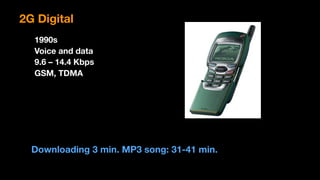
1990s
Voice and data
9.6 – 14.4 Kbps
GSM, TDMA
Downloading 3 min. MP3 song: 31-41 min.
2G Digital
Digital mobile phones appear in early 90s
GMS takes off in 1991 – 

unites Europe
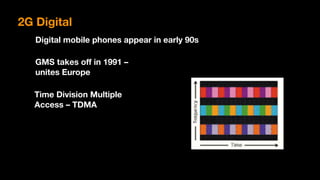
Time Division Multiple 

Access – TDMA

2G Digital
2G Digital
US was slow in adopting 2G because roaming worked well
Digital did not add enough over analog
Texting and SIM cards was not known
GMS
GMS
Global System for Mobile Communication
Built on TDMA – Digital
Three times the capacity of analog, encryption, texting, SIM cards
Texting
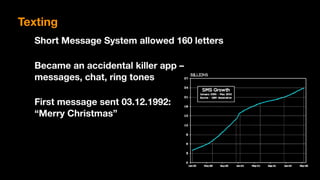
Short Message System allowed 160 letters
Became an accidental killer app – 

messages, chat, ring tones
First message sent 03.12.1992:

“Merry Christmas”
▪ Cars became the first platform for phones
▪ First phones are analog
▪ Multiple standard – each country invents its own
– Problem with standards (history repeats itself?)
▪ Roaming problems in Europe call for a standard
▪ Digital standard developed in Europe, G2
▪ US does not have roaming problems and gets stuck in G1
Lessons Learned: Cellular Phones
3G Packet Switching
Mobile networks and the Internet start to

converge
1G and 2G are circuit switched – fine for voice

The Internet is packet-switched
3G Packet Switching
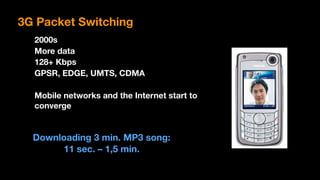
2000s
More data
128+ Kbps
GPSR, EDGE, UMTS, CDMA
Mobile networks and the Internet start to

converge
Downloading 3 min. MP3 song: 

11 sec. – 1,5 min.
3G Packet Switching
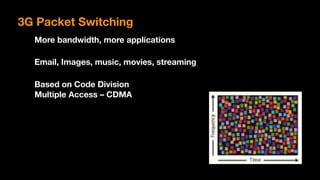
More bandwidth, more applications
Email, Images, music, movies, streaming
Based on Code Division

Multiple Access – CDMA
3G Packet Switching
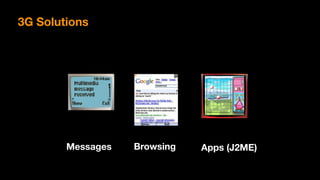
3G Solutions
Messages Browsing Apps (J2ME)
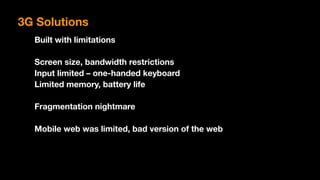
Built with limitations
Screen size, bandwidth restrictions
Input limited – one-handed keyboard
Limited memory, battery life
Fragmentation nightmare
Mobile web was limited, bad version of the web
3G Solutions
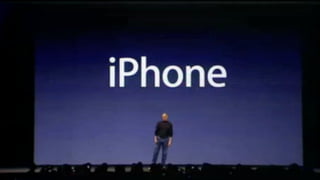
Then, in 2007, the world changed
Copyright	©	2011,	Ólafur	Andri	Ragnarsson
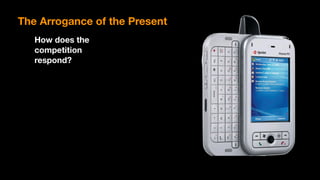
How does the 

competition

respond?
The Arrogance of the Present
Steve Ballmer, Microsoft CEO
iPhone hit the market in June 2007
Ok, let’s check the facts 

five years later
http://www.businessinsider.com/iphone-bigger-than-microsoft-2012-2
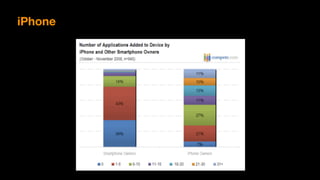
iPhone
Copyright	©	2011,	Ólafur	
Andri	Ragnarsson
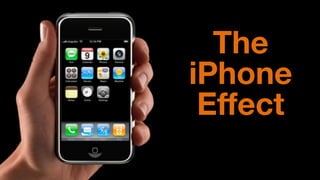
The 

iPhone 

Effect
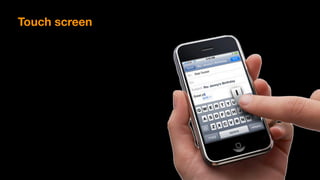
Touch screen
Industrial strength
desktop quality OS
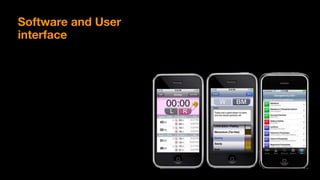
Software and User

interface
Platform for Apps
180 billion apps downloaded (2017)
App market revenue $88 billion in 2016
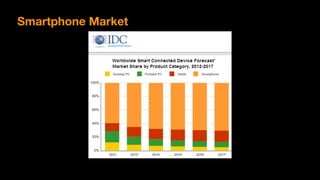
Smartphone Market
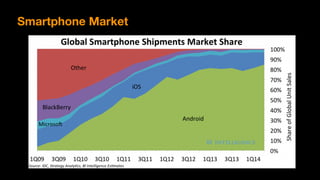
Smartphone Market
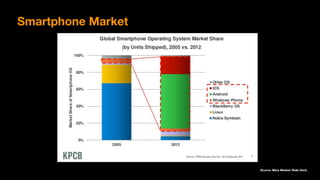
Source: Mary Meeker Slide Deck
Smartphone Market
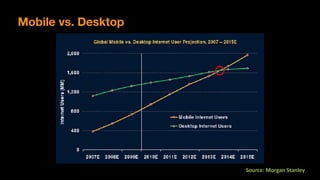
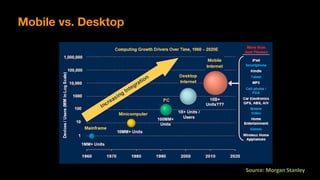
Mobile vs. Desktop
Source:	Morgan	Stanley
Mobile vs. Desktop
Key Trends
Mobile became important in
2010 and will be a revenue
opportunity going forward
Source: Heavy Reading
Any consumer
business that ignores the smartphone, will likely
become irrelevant
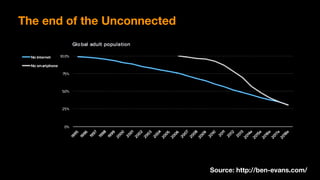
The end of the Unconnected
Source: http://ben-evans.com/
Next
Internet of Things

L15 The Mobile Revolution