LECTURE L16
A WORLD WIDE NETWORK
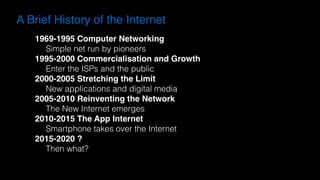
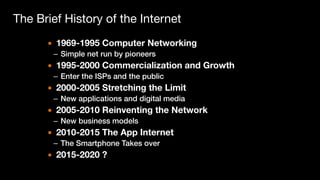
A Brief History of the Internet
1969-1995 Computer Networking
Simple net run by pioneers
1995-2000 Commercialisation and Growth
Enter the ISPs and the public
2000-2005 Stretching the Limit
New applications and digital media
2005-2010 Reinventing the Network
The New Internet emerges
2010-2015 The App Internet
Smartphone takes over the Internet
2015-2020 ?
Then what?
“The Internet works because a lot of people 

cooperate to do things together”
- Jon Postel
1969-1995 Computer Networking
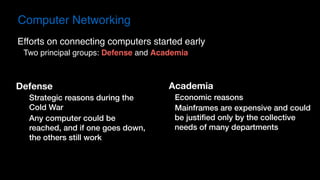
Computer Networking
Defense
Strategic reasons during the
Cold War
Any computer could be
reached, and if one goes down,
the others still work
Efforts on connecting computers started early
Two principal groups: Defense and Academia
Academia
Economic reasons
Mainframes are expensive and could
be justified only by the collective
needs of many departments
ARPANET
▪ Advanced Research Projects Agency (ARPA)
– Founded in 1958
– Attributed by the Russian

Sputnik satellite
– Renamed to DARPA
▪ Two main objectives
– Computers had to talk to each

other to share information
– Links had to be robust
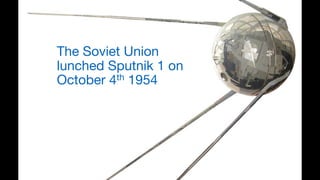
The Soviet Union
lunched Sputnik 1 on
October 4th 1954
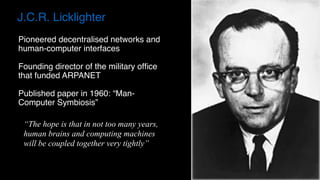
J.C.R. Licklighter
Pioneered decentralised networks and
human-computer interfaces
Founding director of the military office
that funded ARPANET
Published paper in 1960: “Man-
Computer Symbiosis”
“The hope is that in not too many years,
human brains and computing machines
will be coupled together very tightly”
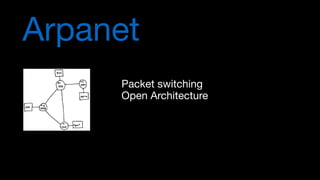
Arpanet
Packet switching

Open Architecture
TCP/IP
Communication protocol

Written by Bob Kahn & Vint Cerf
Internet
Simple, no security

Base on kindness and trust
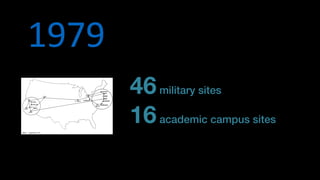
1979
46military sites
16academic campus sites
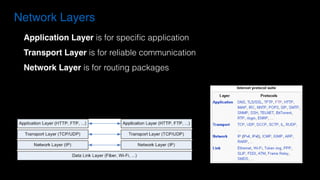
Network Layers
Application Layer is for specific application
Transport Layer is for reliable communication
Network Layer is for routing packages
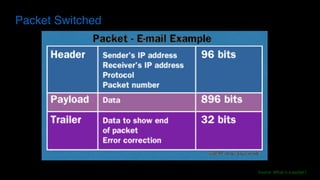
Packet Switched
Source:	What	is	a	packet?
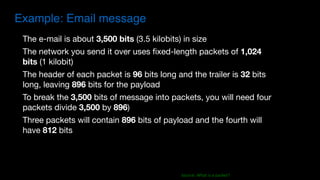
Example: Email message
The e-mail is about 3,500 bits (3.5 kilobits) in size

The network you send it over uses fixed-length packets of 1,024
bits (1 kilobit)

The header of each packet is 96 bits long and the trailer is 32 bits
long, leaving 896 bits for the payload 

To break the 3,500 bits of message into packets, you will need four
packets divide 3,500 by 896)

Three packets will contain 896 bits of payload and the fourth will
have 812 bits
Source:	What	is	a	packet?
WHAT WAS THE
KILLER APP OF
THE EARLY
INTERNET?
Q1
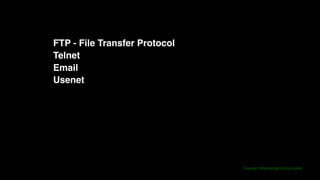
FTP - File Transfer Protocol
Telnet
Email
Usenet
Source:	Internet	protocol	suite
HOW DO YOU
WIRE

ALL THESE
MACHINES
TOGETHER?
Q2
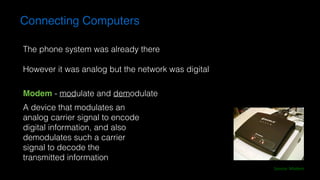
Connecting Computers
Source:	Modem
The phone system was already there
However it was analog but the network was digital
Modem - modulate and demodulate
A device that modulates an 

analog carrier signal to encode 

digital information, and also 

demodulates such a carrier 

signal to decode the 

transmitted information
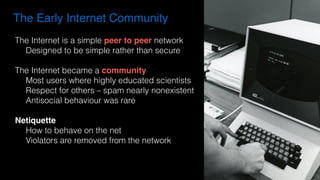
The Early Internet Community
The Internet is a simple peer to peer network
Designed to be simple rather than secure
The Internet became a community
Most users where highly educated scientists
Respect for others – spam nearly nonexistent
Antisocial behaviour was rare
Netiquette
How to behave on the net
Violators are removed from the network
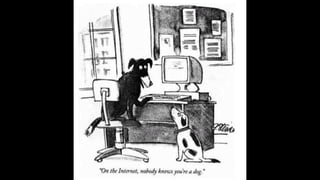
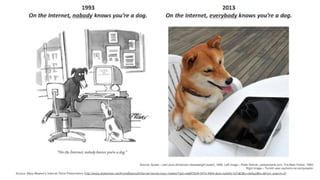
“On the Internet,

nobody knows you're a dog.”
- Peter Steiner cartoon in 

The New Yorker
1995-2000 Commercialisation and growth
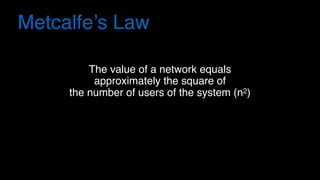
The value of a network equals
approximately the square of
the number of users of the system (n2)
Metcalfe’s Law
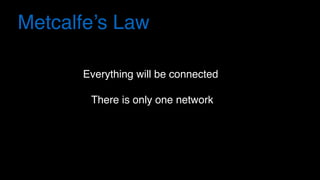
Everything will be connected
There is only one network
Metcalfe’s Law
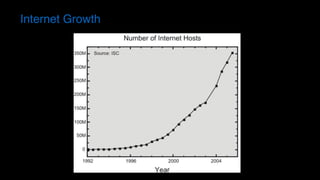
Internet Growth
WHO HELPED
THE INTERNET
BECOME

WIDESPREAD?
Q3
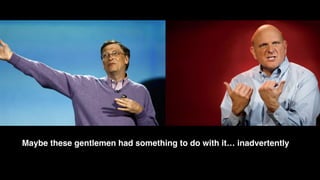
Maybe these gentlemen had something to do with it… inadvertently
Enter WinSock
In the early 1990 the most popular operating systems were Windows and DOS
Designed for Personal Computers
Network support was later added LANs – NetBIOS
WinSock – Windows Sockets
Microsoft had completely ignored TCP/IP
Due to demand from IT companies, efforts started in 1991
WinSock 1.0 became available in 1992
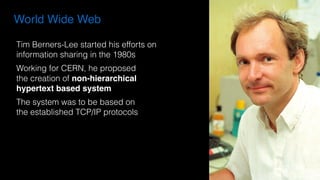
World Wide Web
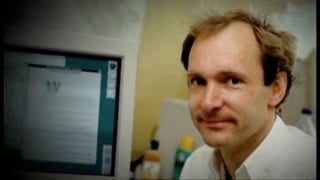
Tim Berners-Lee started his efforts on 

information sharing in the 1980s
Working for CERN, he proposed 

the creation of non-hierarchical 

hypertext based system
The system was to be based on 

the established TCP/IP protocols
World Wide Web
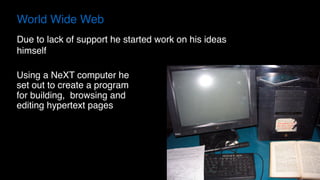
Due to lack of support he started work on his ideas
himself
Using a NeXT computer he 

set out to create a program
for building, browsing and
editing hypertext pages
Hypertext
To move from one document to another
Resource identifiers – URL
To locate a particular resource (computer, document or other
resource) on the network
Client-server model of computing – HTTP
Client software requests of server software resources such
as data or files
Markup language – HTML
Tags embedded in text indicate to a computer how to print or
display the text, e.g. as in italics or bold type
The Basic Idea of WWW
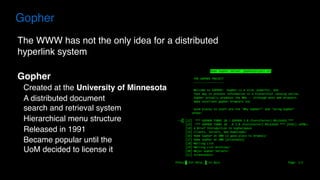
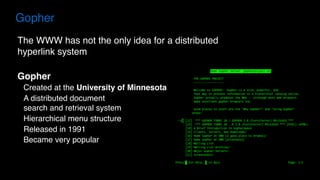
The WWW has not the only idea for a distributed
hyperlink system
Gopher
Created at the University of Minnesota
A distributed document 

search and retrieval system
Hierarchical menu structure
Released in 1991
Became popular until the 

UoM decided to license it
Gopher
The WWW has not the only idea for a distributed
hyperlink system
Gopher
Created at the University of Minnesota
A distributed document 

search and retrieval system
Hierarchical menu structure
Released in 1991
Became very popular
Gopher
WHY DID THE
WWW WIN?
Q5
Lesson: Why did the WWW succeed?
▪ This design was simple

– Simple syntax

– Uniform URL to any resource using any protocols

– No security, not authentication, no tracking

▪ HTTP

– Simple protocol – GET, POST

▪ HTML

– Not an advanced markup – enough to display text in different
sizes

▪ Did not try to solve the problem of back-links

– Avoided a huge problem

– And created an huge opportunity for others to solve it (Google)
Lesson: Why did the WWW succeed?
▪ WWW was FREE

▪ Gopher failed

– More rigid system

– Tree structure – not free format

– Initially free, then UoM decided to licence it
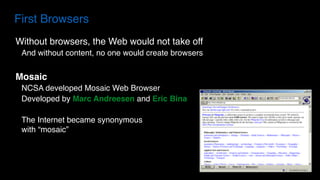
Without browsers, the Web would not take off
And without content, no one would create browsers
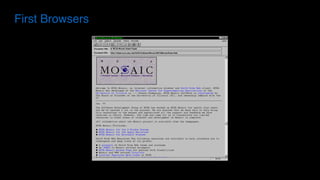
Mosaic
NCSA developed Mosaic Web Browser
Developed by Marc Andreesen and Eric Bina
The Internet became synonymous 

with “mosaic”
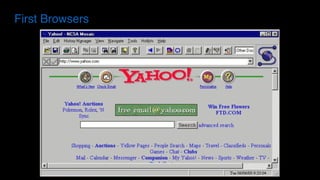
First Browsers
First Browsers
First Browsers
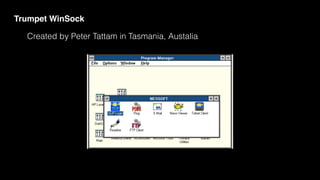
Trumpet WinSock
Created by Peter Tattam in Tasmania, Austalia
Internet Service Providers – ISP

The business of connecting the public to the Internet

Many new companies entered this market

AOL became a giant 

New services 

Domain name registration and hosting

Dial-up access, Leased line access

Web Design, Email services

Laying the Tracks

Companies like Cisco Systems
New Business Emerges
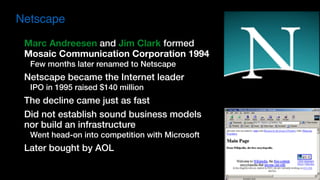
Marc Andreesen and Jim Clark formed 

Mosaic Communication Corporation 1994
Few months later renamed to Netscape
Netscape became the Internet leader
IPO in 1995 raised $140 million
The decline came just as fast
Did not establish sound business models

nor build an infrastructure
Went head-on into competition with Microsoft
Later bought by AOL
Netscape
PHONE COMPANIES

COMPLETELY IGNORED THE INTERNET
LEFT THE SPACE 

OPEN FOR NEW COMPANIES
PHONE COMPANIES

COMPLETELY IGNORED THE INTERNET
Have we seen this before?
Mainframe companies ignore the minicomputers
Minicomputers ignore the PC
8 inch floppy drive companies ignored the 5,25 inch which
ignored the 3,5 inch
Western Union ignored the telephone
The American car companies ignored the cheap Toyota Corolla
Kodak ignored the digital camera
“But none of our customers is asking for this low end cheap…”
“...	an	Internet	browser	is	a	very	trivial	piece	of	software.	
There	are	at	least	30	companies	that	have	written	very	
credible	Internet	browsers,	so	that’s	nothing...”	
-	Bill	Gates
The Arrogance of the Present
The telephone business and software giants initially
ignored the Internet

Their focus was on voice or software

Internet traffic was using the phone lines

Classic example of the RPV theory
Left the field open for new companies

Seeing the success they entered the market

Today most ISPs are phone companies
Enter the Giants
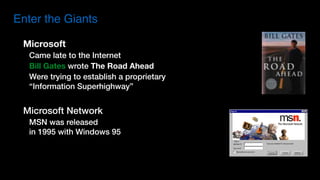
Microsoft
Came late to the Internet
Bill Gates wrote The Road Ahead
Were trying to establish a proprietary 

“Information Superhighway”
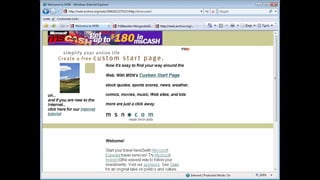
Microsoft Network
MSN was released

in 1995 with Windows 95
Enter the Giants
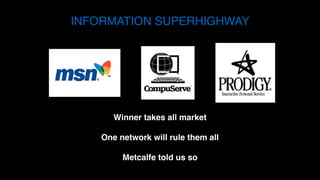
INFORMATION SUPERHIGHWAY
Winner takes all market
One network will rule them all
Metcalfe told us so
Internet
TCP/IP
WHY DID
THE
INTERNET

WIN?
Q6
Personal
Computer
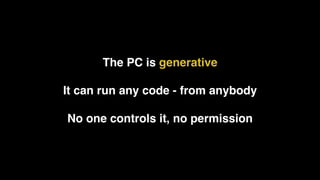
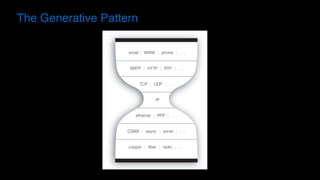
The PC is generative
It can run any code - from anybody
No one controls it, no permission
Jonathan Zittrain
The Future of the Internet and how to stop it
The Generative Pattern
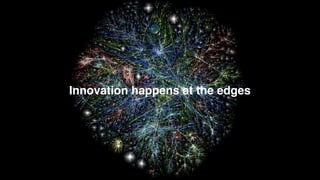
Innovation happens at the edges
Permissionless Innovation
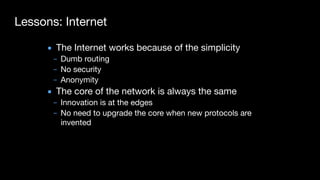
Lessons: Internet
▪ The Internet works because of the simplicity

– Dumb routing

– No security

– Anonymity

▪ The core of the network is always the same

– Innovation is at the edges

– No need to upgrade the core when new protocols are
invented
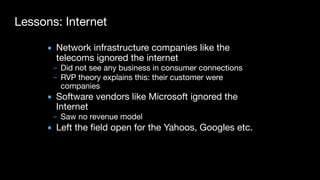
Lessons: Internet
▪ Network infrastructure companies like the
telecoms ignored the internet

– Did not see any business in consumer connections

– RVP theory explains this: their customer were
companies

▪ Software vendors like Microsoft ignored the
Internet

– Saw no revenue model

▪ Left the field open for the Yahoos, Googles etc.
David Bowie in 1999
“Doing research on the Web is like using a library assembled piecemeal by
pack rats and vandalized nightly”
- Roger Ebert (attributed)
2000-2005 Stretching the Limit
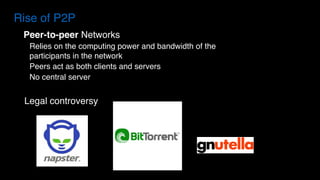
Rise of P2P
Peer-to-peer Networks
Relies on the computing power and bandwidth of the
participants in the network
Peers act as both clients and servers
No central server
Legal controversy
Digitalization of Content
Netflix represents 32.7% of North America´s
peak Web traffic
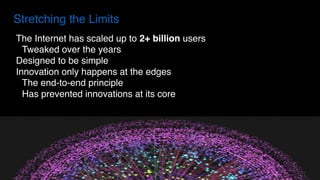
Stretching the Limits
The Internet has scaled up to 2+ billion users
Tweaked over the years
Designed to be simple
Innovation only happens at the edges
The end-to-end principle
Has prevented innovations at its core
Testing the Limits
Visionaries only partially saw the future
The net was designed to be simple peer
to peer network
Things like security and social
responsibility were not a main concern
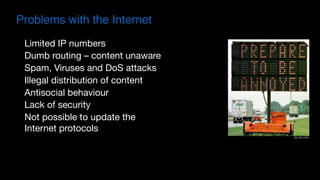
Problems with the Internet
Limited IP numbers

Dumb routing – content unaware

Spam, Viruses and DoS attacks

Illegal distribution of content

Antisocial behaviour 

Lack of security

Not possible to update the

Internet protocols
“If a planet-wide network were built on Mars, 

what would it look like?”
- Reinventing the Internet (Economist)
2005-2010 Reinventing the Network
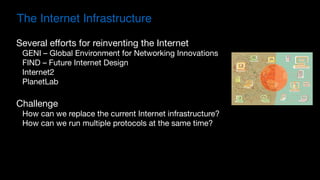
The Internet Infrastructure
Several efforts for reinventing the Internet

GENI – Global Environment for Networking Innovations

FIND – Future Internet Design

Internet2

PlanetLab

Challenge

How can we replace the current Internet infrastructure?

How can we run multiple protocols at the same time?
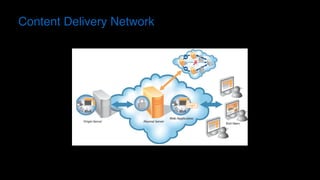
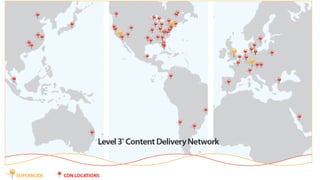
Content Delivery Network
Source: Akamai
“Web 2.0 is the business revolution in the computer
industry caused by the move to the Internet as platform,
and an attempt to understand the rules for success on that
new platform.”
- Tim O'Reilly
Web 2.0
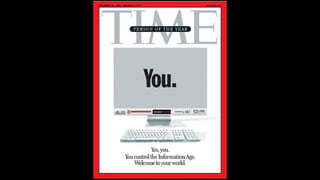
....for seizing the reins of the global media, for
founding and framing the new digital
democracy, for working for nothing and
beating the pros at their own game, TIME's
Person of the Year for 2006 is you

Read	more:	http://www.time.com/time/magazine/article/
0,9171,1569514,00.html#ixzz1FjqlB9yO
Two Waves of Products Development
In the first wave the product
is restricted by the
prevailing technology, but in
the second, there is
something new
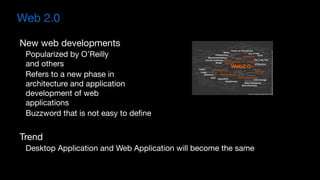
Web 2.0
New web developments 

Popularized by O’Reilly 

and others

Refers to a new phase in 

architecture and application

development of web

applications

Buzzword that is not easy to define

Trend

Desktop Application and Web Application will become the same
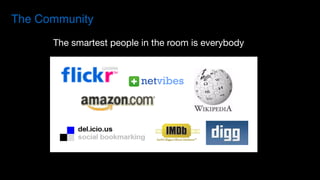
The Community
The smartest people in the room is everybody
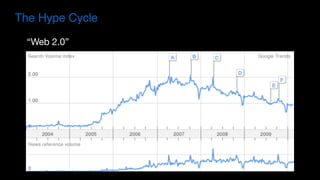
The Hype Cycle
“Web 2.0”
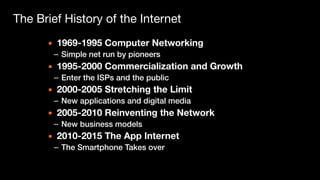
The Brief History of the Internet
▪ 1969-1995 Computer Networking
– Simple net run by pioneers
▪ 1995-2000 Commercialization and Growth
– Enter the ISPs and the public
▪ 2000-2005 Stretching the Limit
– New applications and digital media
▪ 2005-2010 Reinventing the Network
– New business models
▪ 2010-2015 The App Internet
– The Smartphone Takes over
“Web 2.0 is the business revolution in the computer
industry caused by the move to the Internet as platform,
and an attempt to understand the rules for success on that
new platform.”
- Tim O'Reilly
The App Internet
Source: Mary Meeker’s Internet Trend Presentation (http://www.slideshare.net/AndreBastos3/internet-trends-mary-meeker?qid=4a887629-047d-4084-abec-bafd0c1a7a63&v=default&b=&from_search=2)
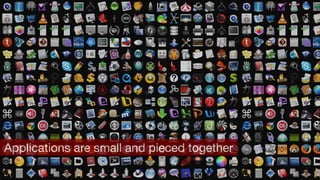
Applications are small and pieced together
The App Internet
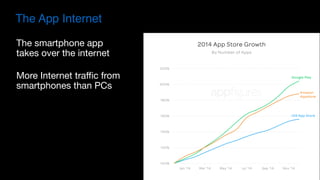
The smartphone app
takes over the internet

More Internet traffic from
smartphones than PCs
Data is in the cloud
Run on any device
Local
The Brief History of the Internet
▪ 1969-1995 Computer Networking
– Simple net run by pioneers
▪ 1995-2000 Commercialization and Growth
– Enter the ISPs and the public
▪ 2000-2005 Stretching the Limit
– New applications and digital media
▪ 2005-2010 Reinventing the Network
– New business models
▪ 2010-2015 The App Internet
– The Smartphone Takes over
▪ 2015-2020 ?
A Brief History of the Internet
2015-2020 The Smart Internet
AI, IoT and Blockchain
2015-2020 The Smart Internet
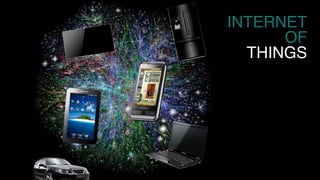
INTERNET
OF
THINGS
Trends
Mobile phones are connecting to the Internet
Sensors will be connected – Internet of Things
New media content is emerging
All content will be digital
Internet of things is estimated to be worth $309 billion by 2020
We are just starting this revolution…
Visions of the Future
Next
L17 The Mobile Revolution

L16 A Worldwide Network

  • 1.
    LECTURE L16 A WORLDWIDE NETWORK
  • 2.
    A Brief Historyof the Internet 1969-1995 Computer Networking Simple net run by pioneers 1995-2000 Commercialisation and Growth Enter the ISPs and the public 2000-2005 Stretching the Limit New applications and digital media 2005-2010 Reinventing the Network The New Internet emerges 2010-2015 The App Internet Smartphone takes over the Internet 2015-2020 ? Then what?
  • 3.
    “The Internet worksbecause a lot of people 
 cooperate to do things together” - Jon Postel 1969-1995 Computer Networking
  • 4.
    Computer Networking Defense Strategic reasonsduring the Cold War Any computer could be reached, and if one goes down, the others still work Efforts on connecting computers started early Two principal groups: Defense and Academia Academia Economic reasons Mainframes are expensive and could be justified only by the collective needs of many departments
  • 6.
    ARPANET ▪ Advanced ResearchProjects Agency (ARPA) – Founded in 1958 – Attributed by the Russian
 Sputnik satellite – Renamed to DARPA ▪ Two main objectives – Computers had to talk to each
 other to share information – Links had to be robust The Soviet Union lunched Sputnik 1 on October 4th 1954
  • 7.
    J.C.R. Licklighter Pioneered decentralisednetworks and human-computer interfaces Founding director of the military office that funded ARPANET Published paper in 1960: “Man- Computer Symbiosis” “The hope is that in not too many years, human brains and computing machines will be coupled together very tightly”
  • 8.
  • 9.
  • 10.
    Internet Simple, no security Baseon kindness and trust
  • 11.
  • 12.
    Network Layers Application Layeris for specific application Transport Layer is for reliable communication Network Layer is for routing packages
  • 13.
  • 14.
    Example: Email message Thee-mail is about 3,500 bits (3.5 kilobits) in size The network you send it over uses fixed-length packets of 1,024 bits (1 kilobit) The header of each packet is 96 bits long and the trailer is 32 bits long, leaving 896 bits for the payload To break the 3,500 bits of message into packets, you will need four packets divide 3,500 by 896) Three packets will contain 896 bits of payload and the fourth will have 812 bits Source: What is a packet?
  • 15.
    WHAT WAS THE KILLERAPP OF THE EARLY INTERNET? Q1
  • 16.
    FTP - FileTransfer Protocol Telnet Email Usenet Source: Internet protocol suite
  • 17.
    HOW DO YOU WIRE
 ALLTHESE MACHINES TOGETHER? Q2
  • 18.
    Connecting Computers Source: Modem The phonesystem was already there However it was analog but the network was digital Modem - modulate and demodulate A device that modulates an 
 analog carrier signal to encode 
 digital information, and also 
 demodulates such a carrier 
 signal to decode the 
 transmitted information
  • 19.
    The Early InternetCommunity The Internet is a simple peer to peer network Designed to be simple rather than secure The Internet became a community Most users where highly educated scientists Respect for others – spam nearly nonexistent Antisocial behaviour was rare Netiquette How to behave on the net Violators are removed from the network
  • 20.
    “On the Internet,
 nobodyknows you're a dog.” - Peter Steiner cartoon in 
 The New Yorker 1995-2000 Commercialisation and growth
  • 23.
    The value ofa network equals approximately the square of the number of users of the system (n2) Metcalfe’s Law
  • 24.
    Everything will beconnected There is only one network Metcalfe’s Law
  • 25.
  • 26.
  • 28.
    Maybe these gentlemenhad something to do with it… inadvertently
  • 29.
    Enter WinSock In theearly 1990 the most popular operating systems were Windows and DOS Designed for Personal Computers Network support was later added LANs – NetBIOS WinSock – Windows Sockets Microsoft had completely ignored TCP/IP Due to demand from IT companies, efforts started in 1991 WinSock 1.0 became available in 1992
  • 30.
    World Wide Web TimBerners-Lee started his efforts on 
 information sharing in the 1980s Working for CERN, he proposed 
 the creation of non-hierarchical 
 hypertext based system The system was to be based on 
 the established TCP/IP protocols
  • 31.
    World Wide Web Dueto lack of support he started work on his ideas himself Using a NeXT computer he 
 set out to create a program for building, browsing and editing hypertext pages
  • 33.
    Hypertext To move fromone document to another Resource identifiers – URL To locate a particular resource (computer, document or other resource) on the network Client-server model of computing – HTTP Client software requests of server software resources such as data or files Markup language – HTML Tags embedded in text indicate to a computer how to print or display the text, e.g. as in italics or bold type The Basic Idea of WWW
  • 34.
    The WWW hasnot the only idea for a distributed hyperlink system Gopher Created at the University of Minnesota A distributed document 
 search and retrieval system Hierarchical menu structure Released in 1991 Became popular until the 
 UoM decided to license it Gopher
  • 35.
    The WWW hasnot the only idea for a distributed hyperlink system Gopher Created at the University of Minnesota A distributed document 
 search and retrieval system Hierarchical menu structure Released in 1991 Became very popular Gopher
  • 36.
  • 37.
    Lesson: Why didthe WWW succeed? ▪ This design was simple – Simple syntax – Uniform URL to any resource using any protocols – No security, not authentication, no tracking ▪ HTTP – Simple protocol – GET, POST ▪ HTML – Not an advanced markup – enough to display text in different sizes ▪ Did not try to solve the problem of back-links – Avoided a huge problem – And created an huge opportunity for others to solve it (Google)
  • 38.
    Lesson: Why didthe WWW succeed? ▪ WWW was FREE ▪ Gopher failed – More rigid system – Tree structure – not free format – Initially free, then UoM decided to licence it
  • 39.
    Without browsers, theWeb would not take off And without content, no one would create browsers Mosaic NCSA developed Mosaic Web Browser Developed by Marc Andreesen and Eric Bina The Internet became synonymous 
 with “mosaic” First Browsers
  • 40.
  • 41.
  • 45.
    Trumpet WinSock Created byPeter Tattam in Tasmania, Austalia
  • 46.
    Internet Service Providers– ISP The business of connecting the public to the Internet Many new companies entered this market AOL became a giant New services Domain name registration and hosting Dial-up access, Leased line access Web Design, Email services Laying the Tracks Companies like Cisco Systems New Business Emerges
  • 47.
    Marc Andreesen andJim Clark formed 
 Mosaic Communication Corporation 1994 Few months later renamed to Netscape Netscape became the Internet leader IPO in 1995 raised $140 million The decline came just as fast Did not establish sound business models
 nor build an infrastructure Went head-on into competition with Microsoft Later bought by AOL Netscape
  • 49.
    PHONE COMPANIES COMPLETELY IGNOREDTHE INTERNET LEFT THE SPACE 
 OPEN FOR NEW COMPANIES
  • 50.
    PHONE COMPANIES COMPLETELY IGNOREDTHE INTERNET Have we seen this before? Mainframe companies ignore the minicomputers Minicomputers ignore the PC 8 inch floppy drive companies ignored the 5,25 inch which ignored the 3,5 inch Western Union ignored the telephone The American car companies ignored the cheap Toyota Corolla Kodak ignored the digital camera “But none of our customers is asking for this low end cheap…”
  • 51.
  • 52.
    The telephone businessand software giants initially ignored the Internet Their focus was on voice or software Internet traffic was using the phone lines Classic example of the RPV theory Left the field open for new companies Seeing the success they entered the market Today most ISPs are phone companies Enter the Giants
  • 53.
    Microsoft Came late tothe Internet Bill Gates wrote The Road Ahead Were trying to establish a proprietary 
 “Information Superhighway” Microsoft Network MSN was released
 in 1995 with Windows 95 Enter the Giants
  • 54.
    INFORMATION SUPERHIGHWAY Winner takesall market One network will rule them all Metcalfe told us so
  • 55.
  • 56.
  • 57.
  • 60.
  • 64.
    The PC isgenerative It can run any code - from anybody No one controls it, no permission
  • 65.
    Jonathan Zittrain The Futureof the Internet and how to stop it
  • 67.
  • 68.
  • 70.
  • 71.
    Lessons: Internet ▪ TheInternet works because of the simplicity – Dumb routing – No security – Anonymity ▪ The core of the network is always the same – Innovation is at the edges – No need to upgrade the core when new protocols are invented
  • 72.
    Lessons: Internet ▪ Networkinfrastructure companies like the telecoms ignored the internet – Did not see any business in consumer connections – RVP theory explains this: their customer were companies ▪ Software vendors like Microsoft ignored the Internet – Saw no revenue model ▪ Left the field open for the Yahoos, Googles etc.
  • 73.
  • 74.
    “Doing research onthe Web is like using a library assembled piecemeal by pack rats and vandalized nightly” - Roger Ebert (attributed) 2000-2005 Stretching the Limit
  • 75.
    Rise of P2P Peer-to-peerNetworks Relies on the computing power and bandwidth of the participants in the network Peers act as both clients and servers No central server Legal controversy
  • 76.
    Digitalization of Content Netflixrepresents 32.7% of North America´s peak Web traffic
  • 77.
    Stretching the Limits TheInternet has scaled up to 2+ billion users Tweaked over the years Designed to be simple Innovation only happens at the edges The end-to-end principle Has prevented innovations at its core
  • 78.
    Testing the Limits Visionariesonly partially saw the future The net was designed to be simple peer to peer network Things like security and social responsibility were not a main concern
  • 79.
    Problems with theInternet Limited IP numbers Dumb routing – content unaware Spam, Viruses and DoS attacks Illegal distribution of content Antisocial behaviour Lack of security Not possible to update the
 Internet protocols
  • 80.
    “If a planet-widenetwork were built on Mars, 
 what would it look like?” - Reinventing the Internet (Economist) 2005-2010 Reinventing the Network
  • 81.
    The Internet Infrastructure Severalefforts for reinventing the Internet GENI – Global Environment for Networking Innovations FIND – Future Internet Design Internet2 PlanetLab Challenge How can we replace the current Internet infrastructure? How can we run multiple protocols at the same time?
  • 82.
  • 84.
    “Web 2.0 isthe business revolution in the computer industry caused by the move to the Internet as platform, and an attempt to understand the rules for success on that new platform.” - Tim O'Reilly Web 2.0
  • 86.
    ....for seizing thereins of the global media, for founding and framing the new digital democracy, for working for nothing and beating the pros at their own game, TIME's Person of the Year for 2006 is you Read more: http://www.time.com/time/magazine/article/ 0,9171,1569514,00.html#ixzz1FjqlB9yO
  • 87.
    Two Waves ofProducts Development In the first wave the product is restricted by the prevailing technology, but in the second, there is something new
  • 88.
    Web 2.0 New webdevelopments Popularized by O’Reilly 
 and others Refers to a new phase in 
 architecture and application
 development of web
 applications Buzzword that is not easy to define Trend Desktop Application and Web Application will become the same
  • 90.
    The Community The smartestpeople in the room is everybody
  • 91.
  • 92.
    The Brief Historyof the Internet ▪ 1969-1995 Computer Networking – Simple net run by pioneers ▪ 1995-2000 Commercialization and Growth – Enter the ISPs and the public ▪ 2000-2005 Stretching the Limit – New applications and digital media ▪ 2005-2010 Reinventing the Network – New business models ▪ 2010-2015 The App Internet – The Smartphone Takes over
  • 93.
    “Web 2.0 isthe business revolution in the computer industry caused by the move to the Internet as platform, and an attempt to understand the rules for success on that new platform.” - Tim O'Reilly The App Internet
  • 94.
    Source: Mary Meeker’sInternet Trend Presentation (http://www.slideshare.net/AndreBastos3/internet-trends-mary-meeker?qid=4a887629-047d-4084-abec-bafd0c1a7a63&v=default&b=&from_search=2)
  • 95.
    Applications are smalland pieced together
  • 96.
    The App Internet Thesmartphone app takes over the internet More Internet traffic from smartphones than PCs
  • 98.
    Data is inthe cloud
  • 99.
    Run on anydevice
  • 100.
  • 107.
    The Brief Historyof the Internet ▪ 1969-1995 Computer Networking – Simple net run by pioneers ▪ 1995-2000 Commercialization and Growth – Enter the ISPs and the public ▪ 2000-2005 Stretching the Limit – New applications and digital media ▪ 2005-2010 Reinventing the Network – New business models ▪ 2010-2015 The App Internet – The Smartphone Takes over ▪ 2015-2020 ?
  • 108.
    A Brief Historyof the Internet 2015-2020 The Smart Internet AI, IoT and Blockchain
  • 109.
  • 110.
  • 111.
    Trends Mobile phones areconnecting to the Internet Sensors will be connected – Internet of Things New media content is emerging All content will be digital Internet of things is estimated to be worth $309 billion by 2020 We are just starting this revolution… Visions of the Future
  • 113.