



























LECTURE L18
INTERNET OF THINGS
“Some have suggested that the internet of things
“changes everything,” but that is a dangerous
oversimplification.”
- Michael E. Porter & James E. Heppelmann
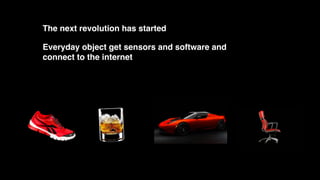
The next revolution has started
Everyday object get sensors and software and
connect to the internet
Revolutions
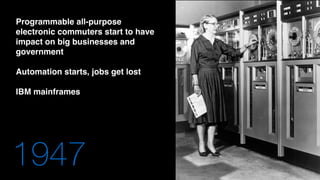
1947
Programmable all-purpose
electronic commuters start to have
impact on big businesses and
government
Automation starts, jobs get lost
IBM mainframes
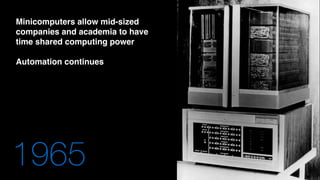
1965
Minicomputers allow mid-sized
companies and academia to have
time shared computing power
Automation continues
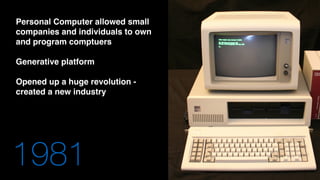
1981
Personal Computer allowed small
companies and individuals to own
and program comptuers
Generative platform
Opened up a huge revolution -
created a new industry
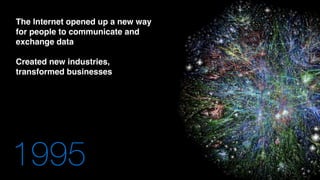
1995
The Internet opened up a new way
for people to communicate and
exchange data
Created new industries,
transformed businesses
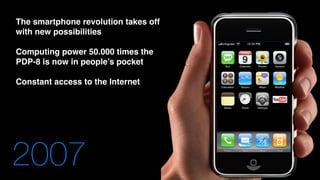
2007
The smartphone revolution takes off
with new possibilities
Computing power 50.000 times the
PDP-8 is now in people’s pocket
Constant access to the Internet
Revolutions
All of these waves cause jobs
to be eliminated and
productivity to be dramatically
increased
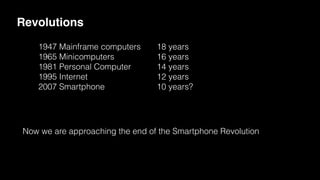
1947 Mainframe computers
1965 Minicomputers
1981 Personal Computer
1995 Internet
2007 Smartphone
18 years
16 years
14 years
12 years
10 years?
Revolutions
Now we are approaching the end of the Smartphone Revolution
The Third Wave of IT
IT is now integral part of the product themselves
Embedded sensors, processors, software, and connectivity in
products, coupled with a product cloud in which product data
is stored and analyzed and some applications are run, are
driving dramatic improvements in product functionality and
performance.
Source: HBR
Adjacent Possible
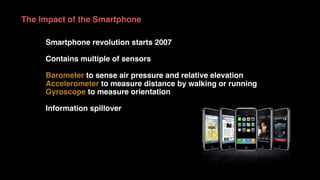
The Impact of the Smartphone
Smartphone revolution starts 2007
Contains multiple of sensors
Barometer to sense air pressure and relative elevation
Accelerometer to measure distance by walking or running
Gyroscope to measure orientation
Information spillover
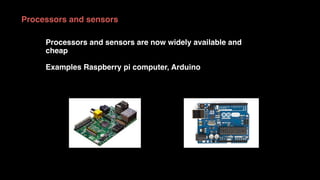
Processors and sensors
Processors and sensors are now widely available and
cheap
Examples Raspberry pi computer, Arduino
By 2020 a cumulative 100 billion processors
will have been shipped, each capable of
processing information and communicating
(Source: Ericsson)
Things get connected
Physical components comprise the product’s mechanical and
electrical parts
Smart components comprise the sensors, microprocessors,
data storage, controls, software, and, typically, an embedded
operating system and enhanced user interface
Connectivity components comprise the ports, antennae, and
protocols enabling wired or wireless connections with the
product
Smart Connected Things
Connectivity takes three forms, which can be present together:
One-to-one: An individual product connects to the user, the
manufacturer, or another product through a port or other
interface
One-to-many: A central system is continuously or intermittently
connected to many products simultaneously
Many-to-many: Multiple products connect to many other types
of products and often also to external data sources
Connectivity
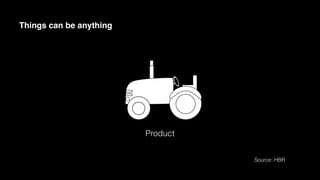
Product
Things can be anything
Source: HBR
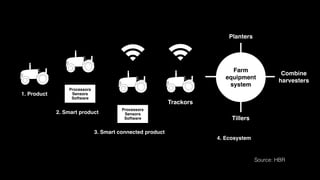
1. Product
Source: HBR
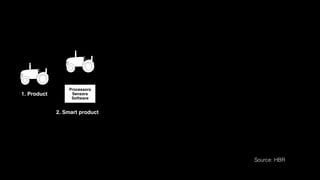
1. Product
2. Smart product
Processors
Sensors
Software
Source: HBR
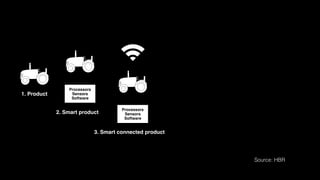
1. Product
2. Smart product
Processors
Sensors
Software
3. Smart connected product
Processors
Sensors
Software
Source: HBR
1. Product
2. Smart product
Processors
Sensors
Software
3. Smart connected product
Processors
Sensors
Software
Source: HBR
Farm
equipment
system
Planters
Tillers
Trackors
Combine
harvesters
4. Ecosystem
Source: HBR
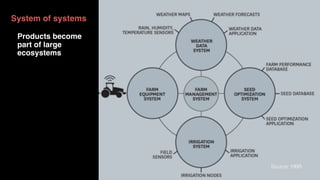
System of systems
Products become
part of large
ecosystems
Between 2013 and 2022, $14.4 trillion of value (net profit) 

will be “up for grabs” for enterprises globally
(Source: Cisco)
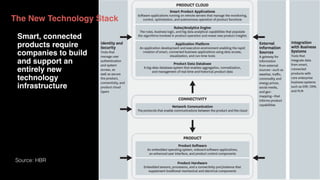
The New Technology Stack
Smart, connected
products require
companies to build
and support an
entirely new
technology
infrastructure
Source: HBR
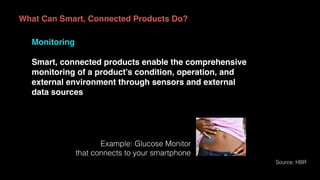
What Can Smart, Connected Products Do?
Monitoring
Smart, connected products enable the comprehensive
monitoring of a product’s condition, operation, and
external environment through sensors and external
data sources
Source: HBR
Example: Glucose Monitor
that connects to your smartphone
What Can Smart, Connected Products Do?
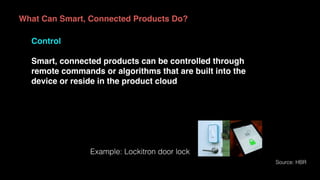
Control
Smart, connected products can be controlled through
remote commands or algorithms that are built into the
device or reside in the product cloud
Source: HBR
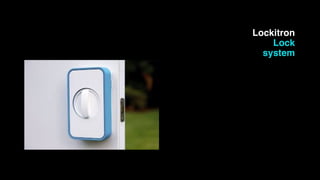
Example: Lockitron door lock
What Can Smart, Connected Products Do?
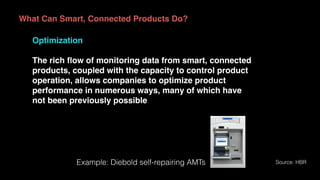
Optimization
The rich flow of monitoring data from smart, connected
products, coupled with the capacity to control product
operation, allows companies to optimize product
performance in numerous ways, many of which have
not been previously possible
Source: HBRExample: Diebold self-repairing AMTs
What Can Smart, Connected Products Do?
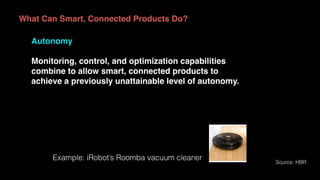
Autonomy
Monitoring, control, and optimization capabilities
combine to allow smart, connected products to
achieve a previously unattainable level of autonomy.
Source: HBR
Example: iRobot’s Roomba vacuum cleaner
Examples
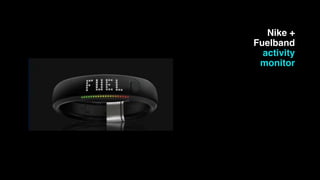
Nike +
Fuelband
activity
monitor
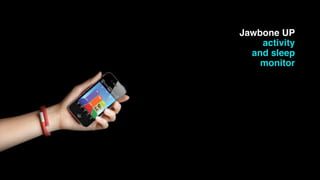
Jawbone UP
activity
and sleep
monitor
Lockitron
Lock
system
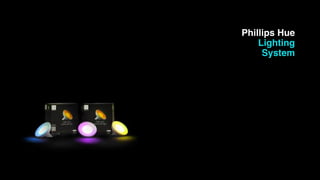
Phillips Hue
Lighting
System
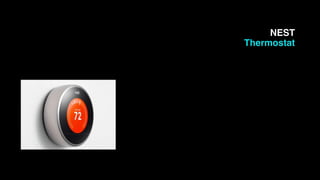
NEST
Thermostat
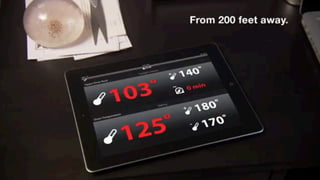
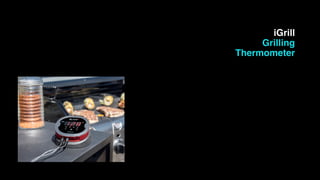
iGrill
Grilling
Thermometer
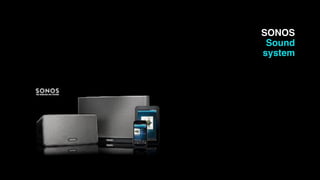
SONOS
Sound
system
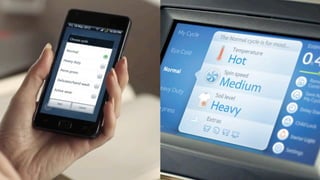
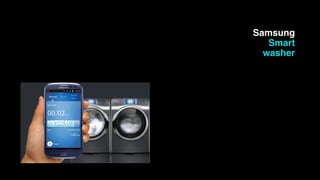
Samsung
Smart
washer
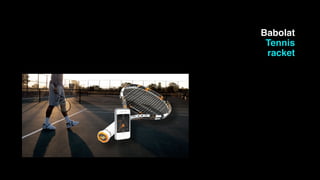
Babolat
Tennis
racket
Ralph Lauren
The Tech Polo
Shirt
Scanadu
Health
Monitoring
Smart Everything
Smart Everything - what does this mean
Traditionally we use computer to use software - we control
the software and tell it what to do and when
Now software is becoming aware of our actiona through
sensors, speech and touch
Software is controlling us in real time
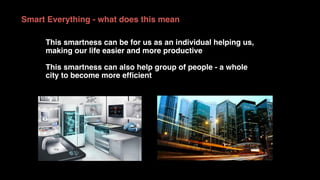
Smart Everything - what does this mean
This smartness can be for us as an individual helping us,
making our life easier and more productive
This smartness can also help group of people - a whole
city to become more efficient
Smart Homes
Smart Cities
NEXT: SOCIAL

L18 Internet of Things

  • 1.
  • 3.
    “Some have suggestedthat the internet of things “changes everything,” but that is a dangerous oversimplification.” - Michael E. Porter & James E. Heppelmann
  • 4.
    The next revolutionhas started Everyday object get sensors and software and connect to the internet
  • 5.
  • 6.
    1947 Programmable all-purpose electronic commutersstart to have impact on big businesses and government Automation starts, jobs get lost IBM mainframes
  • 7.
    1965 Minicomputers allow mid-sized companiesand academia to have time shared computing power Automation continues
  • 8.
    1981 Personal Computer allowedsmall companies and individuals to own and program comptuers Generative platform Opened up a huge revolution - created a new industry
  • 9.
    1995 The Internet openedup a new way for people to communicate and exchange data Created new industries, transformed businesses
  • 10.
    2007 The smartphone revolutiontakes off with new possibilities Computing power 50.000 times the PDP-8 is now in people’s pocket Constant access to the Internet
  • 11.
    Revolutions All of thesewaves cause jobs to be eliminated and productivity to be dramatically increased
  • 12.
    1947 Mainframe computers 1965Minicomputers 1981 Personal Computer 1995 Internet 2007 Smartphone 18 years 16 years 14 years 12 years 10 years? Revolutions Now we are approaching the end of the Smartphone Revolution
  • 13.
    The Third Waveof IT IT is now integral part of the product themselves Embedded sensors, processors, software, and connectivity in products, coupled with a product cloud in which product data is stored and analyzed and some applications are run, are driving dramatic improvements in product functionality and performance. Source: HBR
  • 16.
  • 17.
    The Impact ofthe Smartphone Smartphone revolution starts 2007 Contains multiple of sensors Barometer to sense air pressure and relative elevation Accelerometer to measure distance by walking or running Gyroscope to measure orientation Information spillover
  • 18.
    Processors and sensors Processorsand sensors are now widely available and cheap Examples Raspberry pi computer, Arduino
  • 20.
    By 2020 acumulative 100 billion processors will have been shipped, each capable of processing information and communicating (Source: Ericsson)
  • 21.
  • 22.
    Physical components comprisethe product’s mechanical and electrical parts Smart components comprise the sensors, microprocessors, data storage, controls, software, and, typically, an embedded operating system and enhanced user interface Connectivity components comprise the ports, antennae, and protocols enabling wired or wireless connections with the product Smart Connected Things
  • 23.
    Connectivity takes threeforms, which can be present together: One-to-one: An individual product connects to the user, the manufacturer, or another product through a port or other interface One-to-many: A central system is continuously or intermittently connected to many products simultaneously Many-to-many: Multiple products connect to many other types of products and often also to external data sources Connectivity
  • 24.
    Product Things can beanything Source: HBR
  • 25.
  • 26.
    1. Product 2. Smartproduct Processors Sensors Software Source: HBR
  • 27.
    1. Product 2. Smartproduct Processors Sensors Software 3. Smart connected product Processors Sensors Software Source: HBR
  • 28.
    1. Product 2. Smartproduct Processors Sensors Software 3. Smart connected product Processors Sensors Software Source: HBR Farm equipment system Planters Tillers Trackors Combine harvesters 4. Ecosystem
  • 29.
    Source: HBR System ofsystems Products become part of large ecosystems
  • 31.
    Between 2013 and2022, $14.4 trillion of value (net profit) 
 will be “up for grabs” for enterprises globally (Source: Cisco)
  • 32.
    The New TechnologyStack Smart, connected products require companies to build and support an entirely new technology infrastructure Source: HBR
  • 33.
    What Can Smart,Connected Products Do?
  • 34.
    What Can Smart,Connected Products Do? Monitoring Smart, connected products enable the comprehensive monitoring of a product’s condition, operation, and external environment through sensors and external data sources Source: HBR Example: Glucose Monitor that connects to your smartphone
  • 35.
    What Can Smart,Connected Products Do? Control Smart, connected products can be controlled through remote commands or algorithms that are built into the device or reside in the product cloud Source: HBR Example: Lockitron door lock
  • 36.
    What Can Smart,Connected Products Do? Optimization The rich flow of monitoring data from smart, connected products, coupled with the capacity to control product operation, allows companies to optimize product performance in numerous ways, many of which have not been previously possible Source: HBRExample: Diebold self-repairing AMTs
  • 37.
    What Can Smart,Connected Products Do? Autonomy Monitoring, control, and optimization capabilities combine to allow smart, connected products to achieve a previously unattainable level of autonomy. Source: HBR Example: iRobot’s Roomba vacuum cleaner
  • 38.
  • 40.
  • 42.
  • 44.
  • 46.
  • 48.
  • 50.
  • 52.
  • 54.
  • 56.
  • 58.
  • 60.
  • 61.
  • 62.
    Smart Everything -what does this mean Traditionally we use computer to use software - we control the software and tell it what to do and when Now software is becoming aware of our actiona through sensors, speech and touch Software is controlling us in real time
  • 63.
    Smart Everything -what does this mean This smartness can be for us as an individual helping us, making our life easier and more productive This smartness can also help group of people - a whole city to become more efficient
  • 64.
  • 66.
  • 68.