







LECTURE L19
NETWORK PLATFORMS
Facebook 2004
Social Media
iPhone 2007
Mobile Internet
FourSquare 2009
Location based Services
Eric Schmidt
Le Web Conference 2011
before social media?
READ ONLY CULTURE
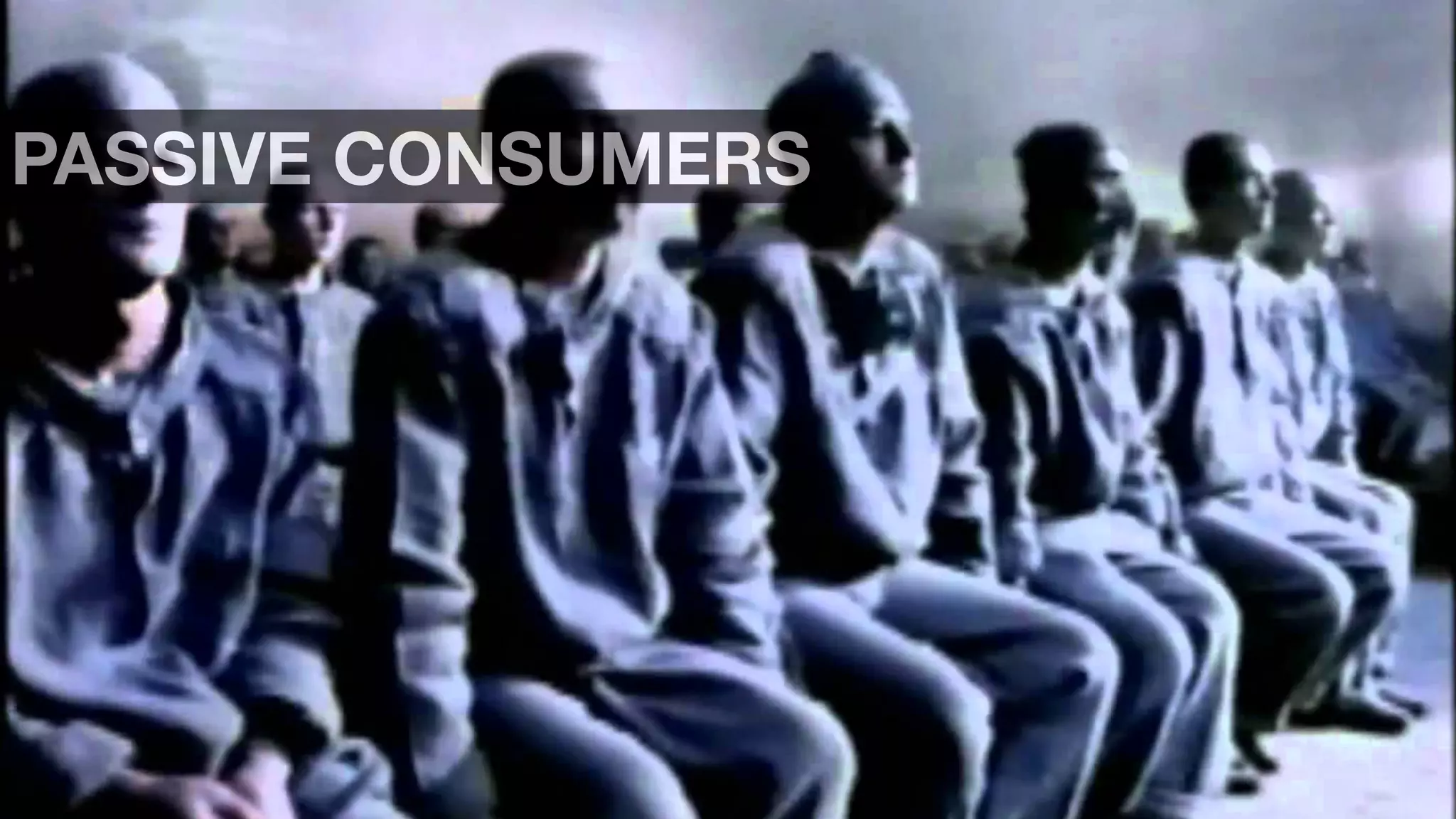
PASSIVE CONSUMERS
STANDARDISED, INDUSTRIALISED
before broadcasting?
SINGING THE SONGS OF THE DAY
CONVERSATION
Radio
Commercial

Radio
TV
Magazines
1900 20001950
Videotapes
Commercial

TV
Newspapers
Films
LP CD DVD
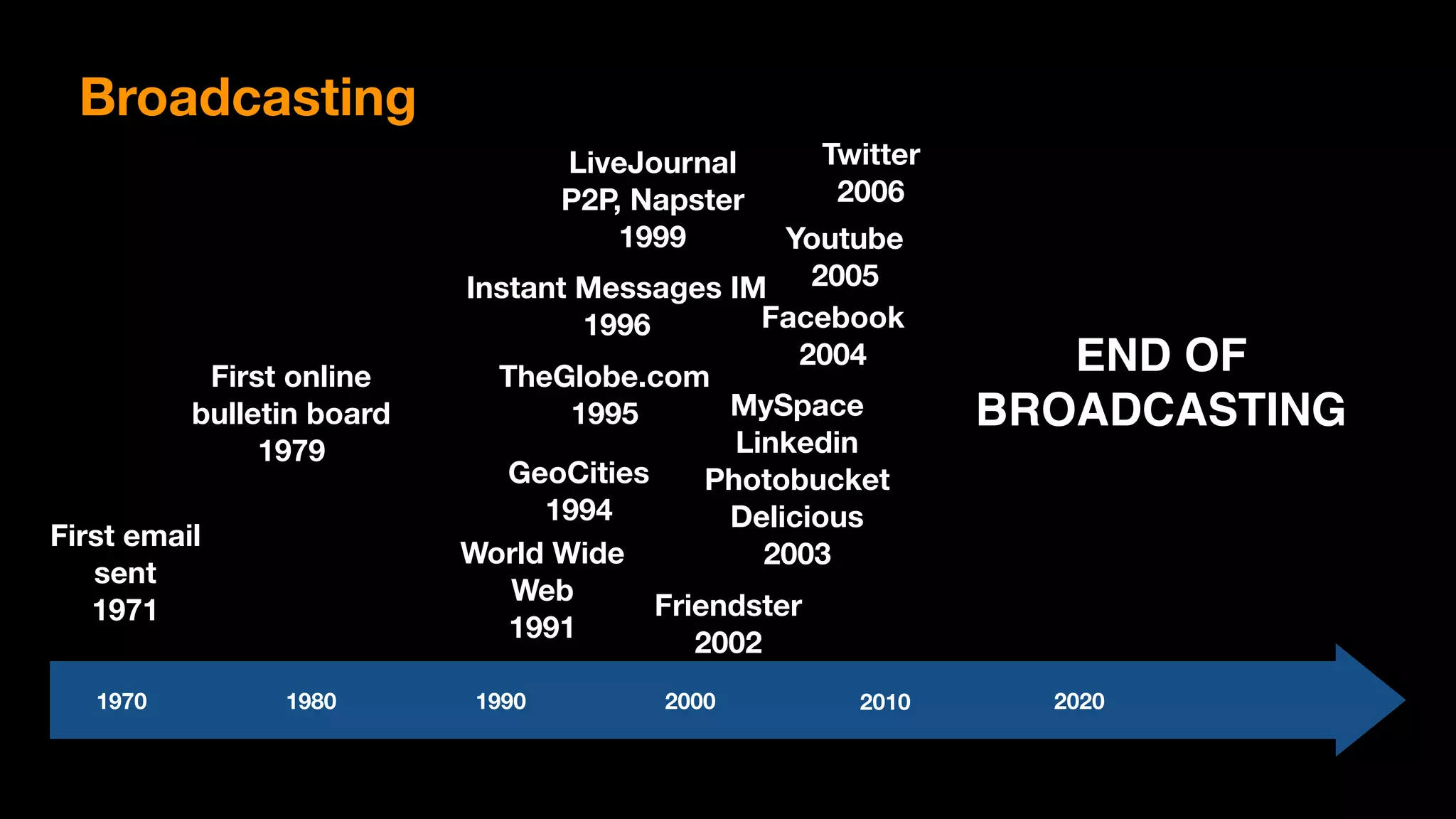
Broadcasting
First email
sent
1971
First online
bulletin board
1979
World Wide
Web
1991
GeoCities
1994
Instant Messages IM
1996
1970 20201980 1990 2000 2010
TheGlobe.com
1995
LiveJournal
P2P, Napster
1999
Friendster
2002
MySpace
Linkedin
Photobucket
Delicious
2003
Facebook
2004
Youtube
2005
Twitter
2006
END OF 

BROADCASTING
Broadcasting
END OF 

BROADCASTING
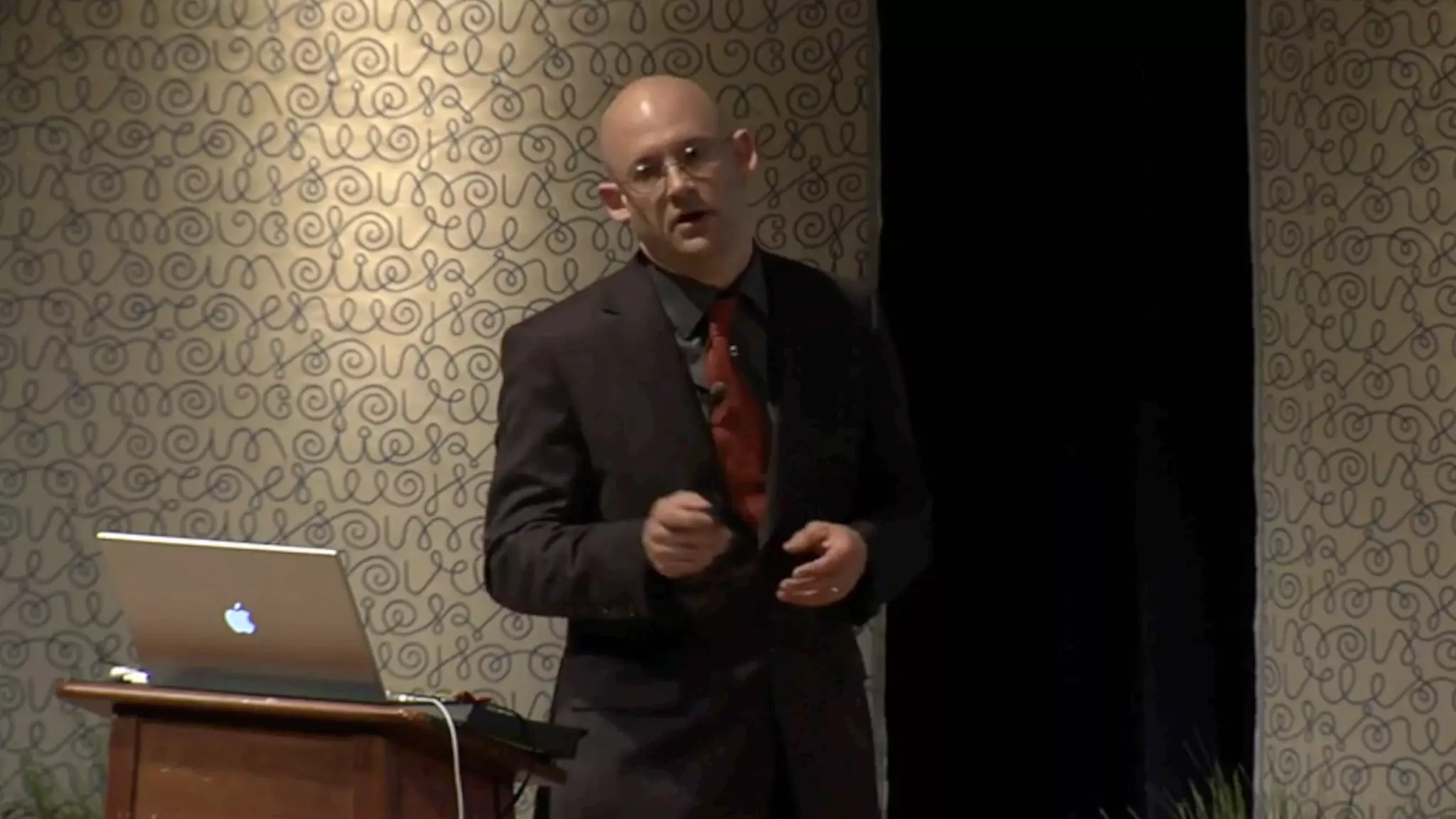
Clay Shirky
How social media can make history
And then we got LOL cats…
Network
Network Effect
Occurs when a product or service becomes more
valuable to its users as more people use it
Understanding this helps build better products and
businesses
Source: Benedict Evans slide deck
Network properties:
1. Whether the nodes are homogeneous or heterogeneous
2. Their type of clustering and degree of connections
3. Directionality of those connections
4. Whether they have (or are) complements
Network Properties
Networks are basically just a set of nodes connected by links
Source: Benedict Evans slide deck
1. Homogeneous or heterogeneous?
Homogeneous: Composed of similar types of nodes
Skype is an example of a homogeneous network where most of
the value is derived from a single class of users, all interested in
placing a phone call
Heterogeneous: Composed of different types of nodes
OpenTable is an example of a heterogeneous network with two
distinct categories of participants: one side is restaurants, the
other side is diners
Source: Benedict Evans slide deck
Network Properties
2. Degree of connections and type of clustering Source
Degree: Measures number of connections to a single node
Clustering coefficient: Measures degree to which nodes in a
graph (e.g., social graph, interest graph, intent graph, etc.)
cluster together
Type of cluster: Can range from hub-and-spoke (star) to
connected (clique). Example of Facebook friends connections
clustering (high school, college, significant other’s, etc. clusters)
Source: Benedict Evans slide deck
Network Properties
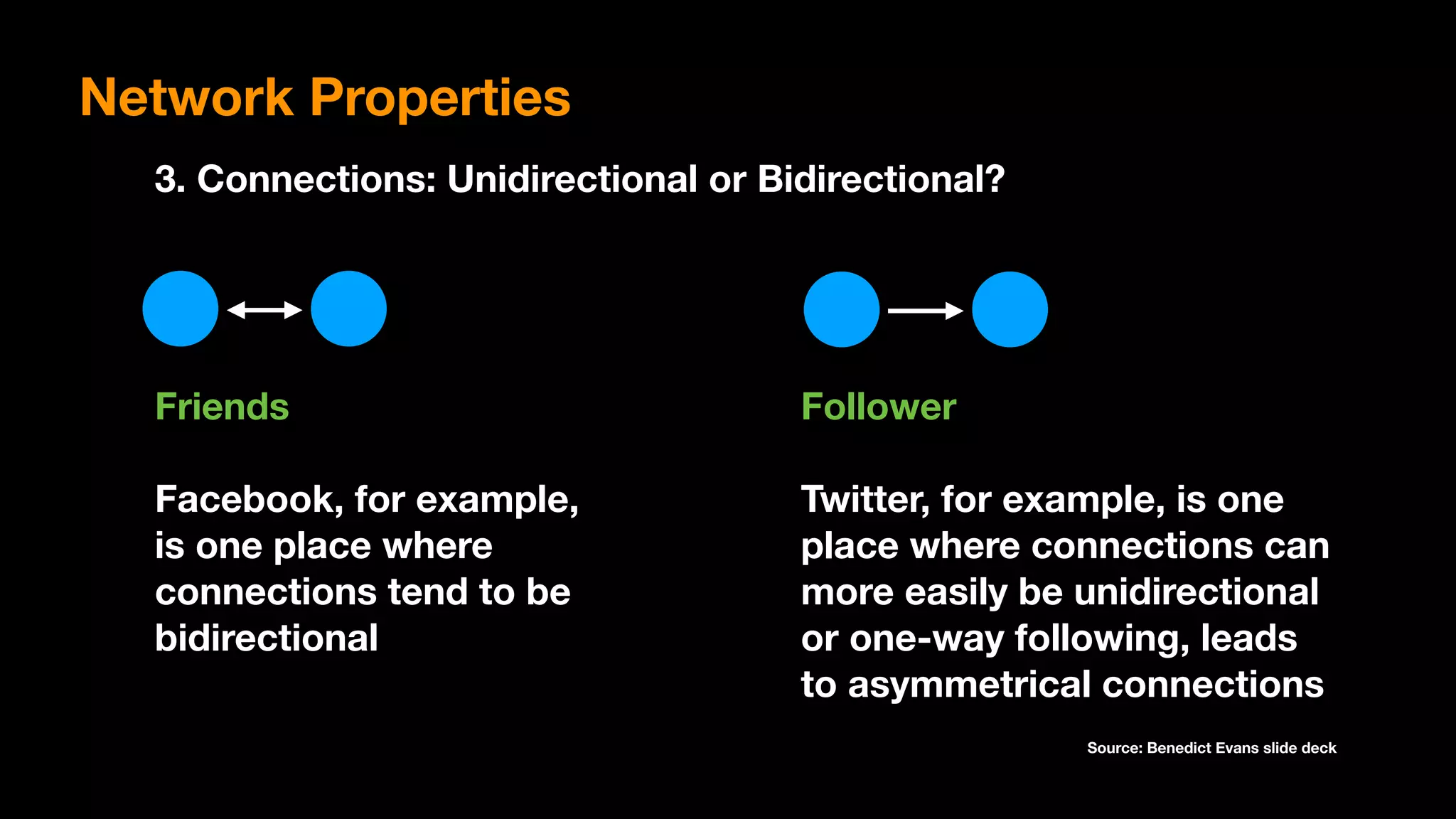
3. Connections: Unidirectional or Bidirectional?
Friends
Facebook, for example,
is one place where
connections tend to be
bidirectional
Follower
Twitter, for example, is one
place where connections can
more easily be unidirectional
or one-way following, leads
to asymmetrical connections
Source: Benedict Evans slide deck
Network Properties
4. Complementary Networks
Increase in usage of one product by a set of users reinforces and
increases the value of a complementary (but separate!) product,
which in turn, increases the value of the original
More usage of the MS Windows operating system, results in
more usage of the MS Office suite of applications
Source: Benedict Evans slide deck
Network Properties
Common law for assessing the value of communication networks
Source: Benedict Evans slide deck
Network Properties
Sarnoff’s Law
Value of the network is proportional to
the number of viewers
V = n
Broadcast: Yahoo!, Netflix
Common law for assessing the value of communication networks
Source: Benedict Evans slide deck
Network Properties
Metcalfe’s Law
Value of the network is proportional to
the square number of connected users
V = n2
Peer to peer: Facebook
Common law for assessing the value of communication networks
Source: Benedict Evans slide deck
Network Properties
Reed’s Law
Value of a group-forming network is proportional to the
and ease with which groups form within it (subgroups
grow faster than sheer number of P2P participants)
V = 2n
Gruop forming: Slack, WhatsApp groups
Send a package to a person in Omaha, Nebraska tell them
the name of the person in Boston, Massachusetts but don’t
give them any address
Tell them to mail the package and instruction to someone
the might know some people that might know the Boston
person
Small World Experiment
How many people were involved?
Turns out that the world is connected by six degrees…
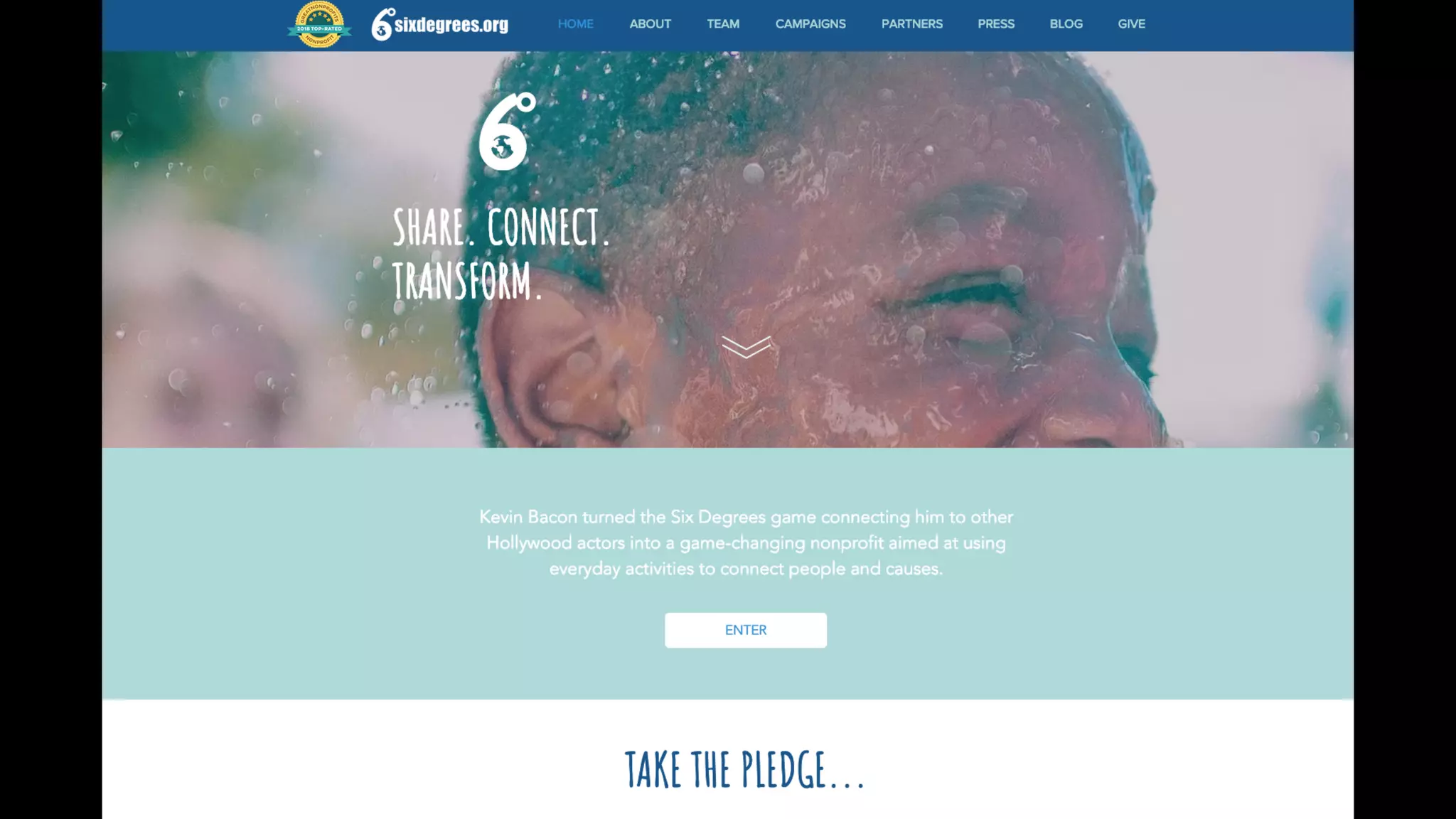
Actor Kevin Bacon claimed
in an interview that he
worked with everyone in
Hollywood or someone
who worked with them
Became a popular party
game…
Six Degree of Separation
Network is a group of interconnected people (social network)
or system of things (telephone, printers to computers)
Marketplace is network where money/transactions flow
between two or more sides with distinct (i.e. hetrogeneous)
groups of users on one side; a successful marketplace is
where supply and demand are attracted to the same place
Network Terms
Platform is a network of users and developers; the multi-sided
feedback loop between those users, developers, and the
platform itself creates a flywheel effectincreasing value for
each of those groups.
It can also be thought of as a network that can be
programmed, customized, and extended by outside users—
often meets needs and creates niches not defined by its
original developers at the outset
Network Terms
Strange things start to happen
Breakfast Club 1985
BRAT PACK
MASHUPS
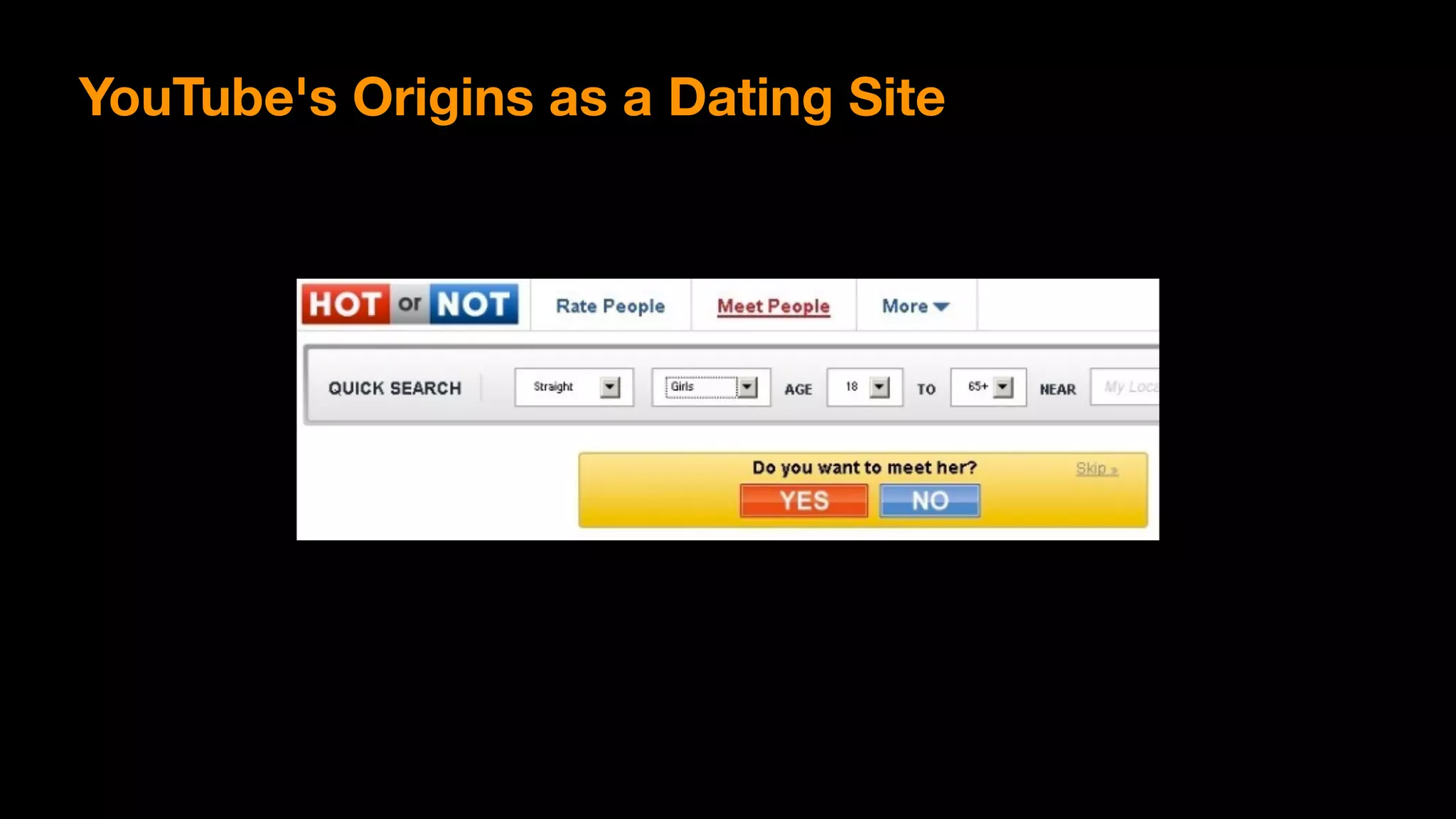
YouTube's Origins as a Dating Site
YouTube is changing the way we Innovate and learn
The Liquid Network just came online…
The YouTube Effect
Chris Anderson
How web video powers global innovation
TED 2010
CROWD
ACCELERATED
INNOVATION
Crowd - Group of people that share a common interest. The
bigger the crowd, more innovation
Light - Clear visibility of the capabilities of the best people
Desire - Innovation is hard, need practice
Crowd Accelerated Innovation
THE TOOLS
OF PRODUCTION
IN THE HANDS
OF PEOPLE
WHAT HAPPENS
WHEN YOU
CONNECT PEOPLE?
Clay Shirky
How cognitive surplus will change the world
WHY DO
PEOPLE
SHARE?
WHY DO
PEOPLE
CONTRIBUTE?
WHY DOES
OPEN SOURCE
WORK?
WHY DOES THESE WORK?
WE DON’T KNOW THESE
PEOPLE AND WE DON’T
TRUST THEM
Rachel Botsman
We've stopped trusting institutions and started trusting strangers
WHY DO
PEOPLE
SHARE?
WHY DO
PEOPLE
CONTRIBUTE?
Sharing is in our self interests
We do it for ourselves
WHY DOES
OPEN SOURCE
WORK?
It is in companies best interest
Those who control the media control the culture
Social media is the first media network created by consumers
New universe of platforms, how we do business
Social Media
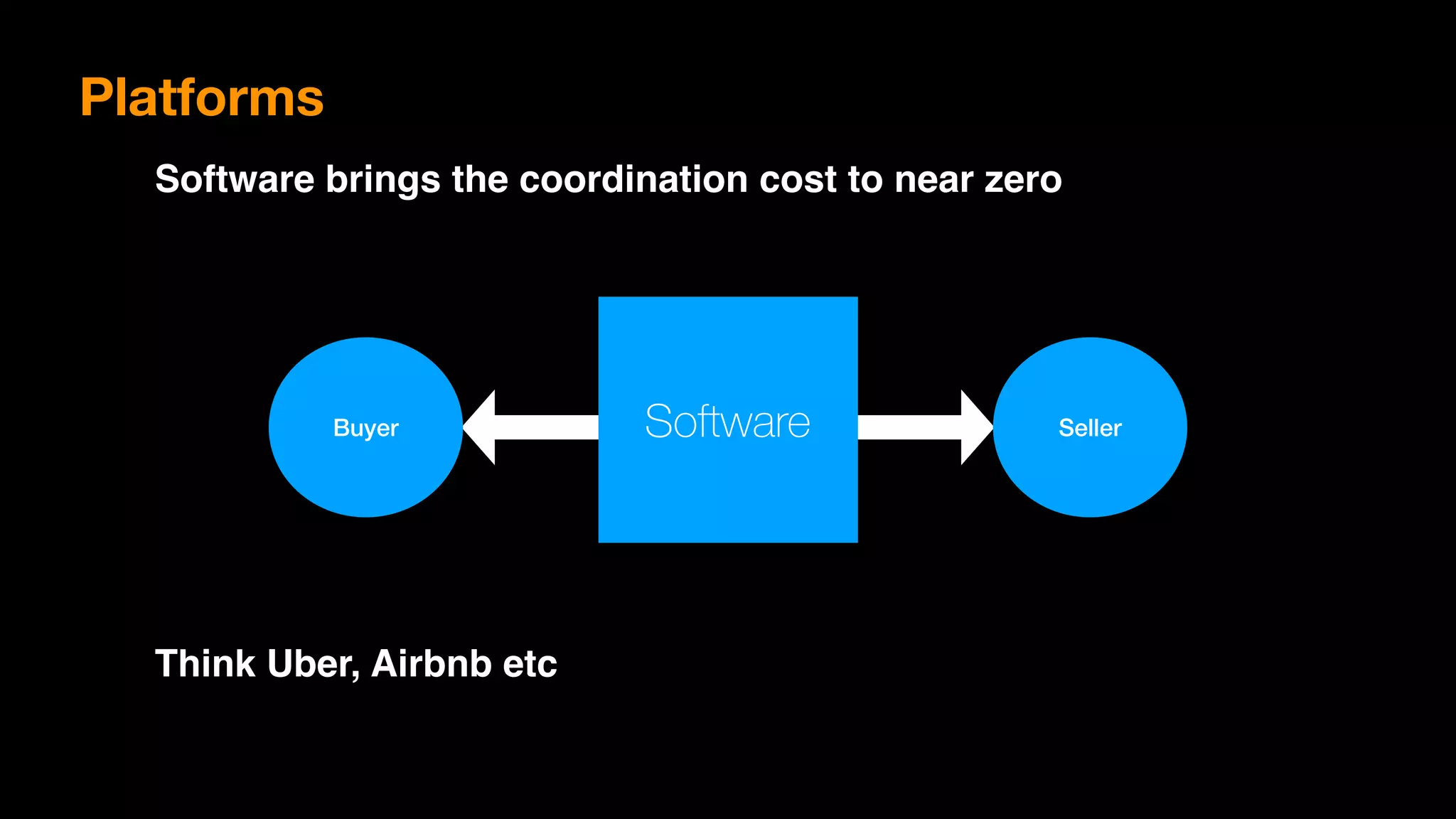
Software SellerBuyer
Software brings the coordination cost to near zero
Think Uber, Airbnb etc
Platforms
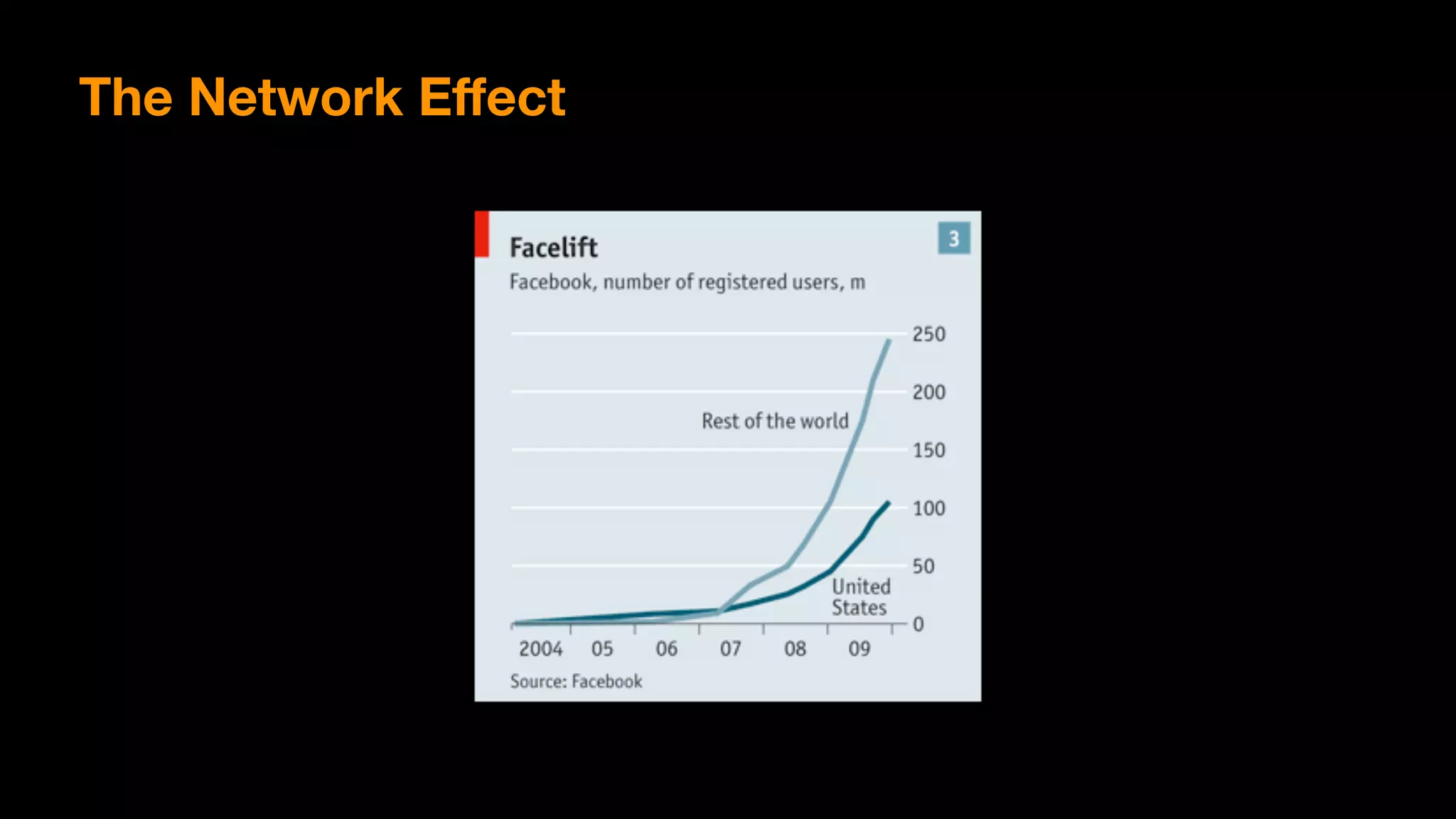
The Network Effect
Worldwide, there are over
2.32 billion monthly active
users (MAU) as of December
31, 2018
Facebook in numbers
January 15, 2009, US Airways Flight 1549
Tahrir Square, 2010
Launched October 2010
1 billion active users
In 2012, Facebook bought 

Instagram for $1 billion
Instagram
Launched March 2010
Pintrest
250 million active users monthy
84% are women
75% of usage is mobile, 93% of users shopped online
Launched September 2011
Snapchat
Users: 400 million
First popular with users age 13-23
7 billion videos per day
Launched September 2010
WhatsApp
Users: 1 billion
700 million photos and 100 million videos every single day
55 employees - bought by Facebook for $19 billion
NEXT

L19 Network Platforms

  • 1.
  • 2.
    Facebook 2004 Social Media iPhone2007 Mobile Internet FourSquare 2009 Location based Services
  • 3.
    Eric Schmidt Le WebConference 2011
  • 7.
  • 8.
  • 9.
  • 10.
  • 11.
  • 12.
  • 13.
  • 14.
  • 15.
    First email sent 1971 First online bulletinboard 1979 World Wide Web 1991 GeoCities 1994 Instant Messages IM 1996 1970 20201980 1990 2000 2010 TheGlobe.com 1995 LiveJournal P2P, Napster 1999 Friendster 2002 MySpace Linkedin Photobucket Delicious 2003 Facebook 2004 Youtube 2005 Twitter 2006 END OF 
 BROADCASTING Broadcasting
  • 16.
  • 17.
    Clay Shirky How socialmedia can make history
  • 19.
    And then wegot LOL cats…
  • 21.
  • 22.
    Network Effect Occurs whena product or service becomes more valuable to its users as more people use it Understanding this helps build better products and businesses Source: Benedict Evans slide deck
  • 23.
    Network properties: 1. Whetherthe nodes are homogeneous or heterogeneous 2. Their type of clustering and degree of connections 3. Directionality of those connections 4. Whether they have (or are) complements Network Properties Networks are basically just a set of nodes connected by links Source: Benedict Evans slide deck
  • 24.
    1. Homogeneous orheterogeneous? Homogeneous: Composed of similar types of nodes Skype is an example of a homogeneous network where most of the value is derived from a single class of users, all interested in placing a phone call Heterogeneous: Composed of different types of nodes OpenTable is an example of a heterogeneous network with two distinct categories of participants: one side is restaurants, the other side is diners Source: Benedict Evans slide deck Network Properties
  • 25.
    2. Degree ofconnections and type of clustering Source Degree: Measures number of connections to a single node Clustering coefficient: Measures degree to which nodes in a graph (e.g., social graph, interest graph, intent graph, etc.) cluster together Type of cluster: Can range from hub-and-spoke (star) to connected (clique). Example of Facebook friends connections clustering (high school, college, significant other’s, etc. clusters) Source: Benedict Evans slide deck Network Properties
  • 26.
    3. Connections: Unidirectionalor Bidirectional? Friends Facebook, for example, is one place where connections tend to be bidirectional Follower Twitter, for example, is one place where connections can more easily be unidirectional or one-way following, leads to asymmetrical connections Source: Benedict Evans slide deck Network Properties
  • 27.
    4. Complementary Networks Increasein usage of one product by a set of users reinforces and increases the value of a complementary (but separate!) product, which in turn, increases the value of the original More usage of the MS Windows operating system, results in more usage of the MS Office suite of applications Source: Benedict Evans slide deck Network Properties
  • 28.
    Common law forassessing the value of communication networks Source: Benedict Evans slide deck Network Properties Sarnoff’s Law Value of the network is proportional to the number of viewers V = n Broadcast: Yahoo!, Netflix
  • 29.
    Common law forassessing the value of communication networks Source: Benedict Evans slide deck Network Properties Metcalfe’s Law Value of the network is proportional to the square number of connected users V = n2 Peer to peer: Facebook
  • 30.
    Common law forassessing the value of communication networks Source: Benedict Evans slide deck Network Properties Reed’s Law Value of a group-forming network is proportional to the and ease with which groups form within it (subgroups grow faster than sheer number of P2P participants) V = 2n Gruop forming: Slack, WhatsApp groups
  • 31.
    Send a packageto a person in Omaha, Nebraska tell them the name of the person in Boston, Massachusetts but don’t give them any address Tell them to mail the package and instruction to someone the might know some people that might know the Boston person Small World Experiment How many people were involved? Turns out that the world is connected by six degrees…
  • 32.
    Actor Kevin Baconclaimed in an interview that he worked with everyone in Hollywood or someone who worked with them Became a popular party game… Six Degree of Separation
  • 34.
    Network is agroup of interconnected people (social network) or system of things (telephone, printers to computers) Marketplace is network where money/transactions flow between two or more sides with distinct (i.e. hetrogeneous) groups of users on one side; a successful marketplace is where supply and demand are attracted to the same place Network Terms
  • 35.
    Platform is anetwork of users and developers; the multi-sided feedback loop between those users, developers, and the platform itself creates a flywheel effectincreasing value for each of those groups. It can also be thought of as a network that can be programmed, customized, and extended by outside users— often meets needs and creates niches not defined by its original developers at the outset Network Terms
  • 37.
  • 38.
  • 39.
  • 41.
    YouTube's Origins asa Dating Site
  • 42.
    YouTube is changingthe way we Innovate and learn The Liquid Network just came online… The YouTube Effect
  • 43.
    Chris Anderson How webvideo powers global innovation TED 2010
  • 45.
  • 46.
    Crowd - Groupof people that share a common interest. The bigger the crowd, more innovation Light - Clear visibility of the capabilities of the best people Desire - Innovation is hard, need practice Crowd Accelerated Innovation
  • 47.
    THE TOOLS OF PRODUCTION INTHE HANDS OF PEOPLE
  • 48.
  • 49.
    Clay Shirky How cognitivesurplus will change the world
  • 51.
  • 52.
  • 53.
  • 55.
    WHY DOES THESEWORK? WE DON’T KNOW THESE PEOPLE AND WE DON’T TRUST THEM
  • 56.
    Rachel Botsman We've stoppedtrusting institutions and started trusting strangers
  • 58.
  • 59.
  • 60.
    Sharing is inour self interests
  • 61.
    We do itfor ourselves
  • 62.
  • 63.
    It is incompanies best interest
  • 65.
    Those who controlthe media control the culture Social media is the first media network created by consumers New universe of platforms, how we do business Social Media
  • 66.
    Software SellerBuyer Software bringsthe coordination cost to near zero Think Uber, Airbnb etc Platforms
  • 69.
  • 70.
    Worldwide, there areover 2.32 billion monthly active users (MAU) as of December 31, 2018 Facebook in numbers
  • 73.
    January 15, 2009,US Airways Flight 1549
  • 76.
  • 77.
    Launched October 2010 1billion active users In 2012, Facebook bought 
 Instagram for $1 billion Instagram
  • 80.
    Launched March 2010 Pintrest 250million active users monthy 84% are women 75% of usage is mobile, 93% of users shopped online
  • 81.
    Launched September 2011 Snapchat Users:400 million First popular with users age 13-23 7 billion videos per day
  • 82.
    Launched September 2010 WhatsApp Users:1 billion 700 million photos and 100 million videos every single day 55 employees - bought by Facebook for $19 billion
  • 83.