Fractures of the Tibial Plateau
Douglas R. Dirschl, MD
Thomas Ellis, MD
Bruce French, MD
Outline
• Anatomy
• Mechanism of Injury
• Evaluation
• Emergency Management
• Surgical Indications
• External Fixation
• Internal Fixation
• Outcomes
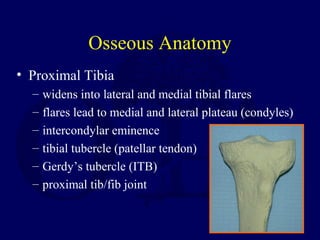
Osseous Anatomy
• Proximal Tibia
– widens into lateral and medial tibial flares
– flares lead to medial and lateral plateau (condyles)
– intercondylar eminence
– tibial tubercle (patellar tendon)
– Gerdy’s tubercle (ITB)
– proximal tib/fib joint
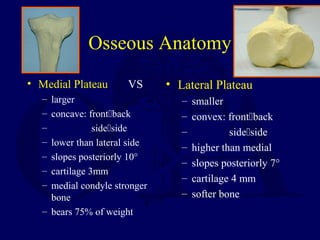
Osseous Anatomy
• Medial Plateau VS
– larger
– concave: frontback
– sideside
– lower than lateral side
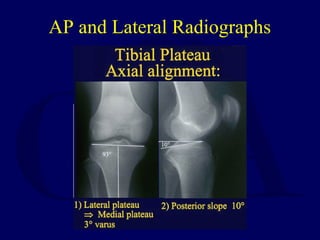
– slopes posteriorly 10°
– cartilage 3mm
– medial condyle stronger
bone
– bears 75% of weight
• Lateral Plateau
– smaller
– convex: frontback
– sideside
– higher than medial
– slopes posteriorly 7°
– cartilage 4 mm
– softer bone
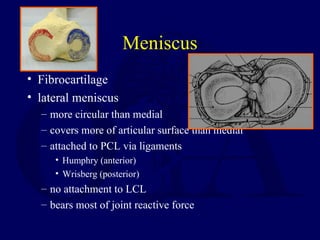
Meniscus
• Fibrocartilage
• lateral meniscus
– more circular than medial
– covers more of articular surface than medial
– attached to PCL via ligaments
• Humphry (anterior)
• Wrisberg (posterior)
– no attachment to LCL
– bears most of joint reactive force
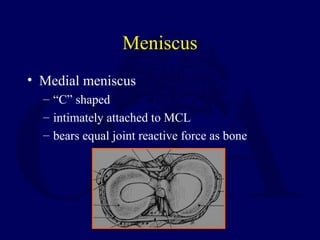
Meniscus
• Medial meniscus
– “C” shaped
– intimately attached to MCL
– bears equal joint reactive force as bone
Introduction/Mechanism of
Injury
• Mean age in most series of tibial plateau
fractures is about 55 years
– Large percentage over age 60
• Elderly population is increasing in numbers
– Fastest growing segment of US population
• Tibial plateau fractures comprise 8% of all
fractures in the elderly population (Hohl)
Mechanism of Injury
• Mechanism of injury is fall from standing
height in most patients
– MVA is increasing as % of fractures
– High energy fracture patterns increasing in this
age group!
• Most common fracture pattern is split-
depressed fracture of lateral tibial plateau
(80% of fractures)
Demographics of
Plateau Fractures
• 1% of all fractures
• 8% of all fractures in the elderly
• lateral plateau involved 55-70%
• medial plateau involved 10-20%
• both involved 10-30%
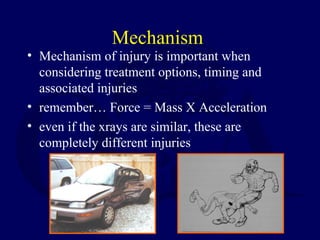
Mechanism
• Mechanism of injury is important when
considering treatment options, timing and
associated injuries
• remember… Force = Mass X Acceleration
• even if the xrays are similar, these are
completely different injuries
Evaluation
• Trauma Evaluation
– ABCs
– Associated Injuries
• Evaluation of Limb
– Gentle exam for knee stability
– Observation of soft tissues
– Neurovascular evaluation
– Evaluate for compartmental syndrome
• Imaging Evaluation
Physical Exam
• Soft Tissue Assessment
– Tscherne & Goetzen (closed injury)
• grade 0: minimal soft tissue damage/ indirect force
• grade 1: superficial abrasion/contusion via pressure from
within
• grade 2: deep, contaminated abrasion with localized
skin/muscle contusion: impending comp. syn.
• Grade 3: extensive skin contusion/crush: sobq avusion;
underlying muscle damage; decompensated cs
– Gustilo and Anderson (open injury)
Physical Exam
• Neurologic exam
– peroneal nerve!
• Vascular exam
– popliteal artery and medial plateau injuries
– beware the of the knee dislocation posing as a
fracture
– beware of posteriorly displaced fracture fragments
– ABI <0.9 urgent arterial study
Physical Exam
• Compartment syndrome
• KNEE STABILITY
– varus/valgus in full extension
– may require premedication
• aspiration of knee effusion/hematoma
• replace with lidocaine+marcaine
Evaluation of Soft Tissues
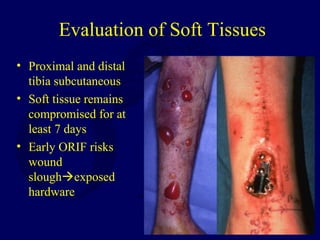
• Proximal and distal
tibia subcutaneous
• Soft tissue remains
compromised for at
least 7 days
• Early ORIF risks
wound
sloughexposed
hardware
Evaluation
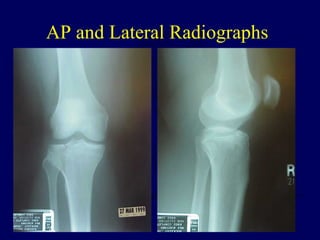
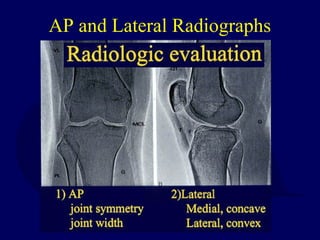
• Plain radiographs
– AP, lateral, ? oblique of knee on 17-inch
cassettes
– AP and lateral of entire tibia
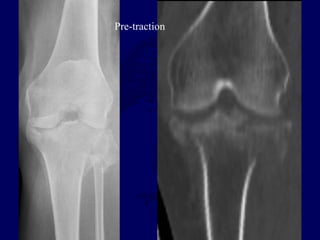
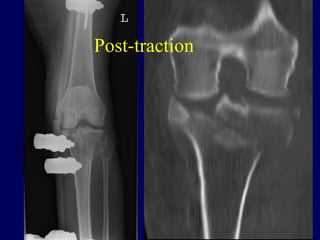
– Traction radiographs
• Very helpful for complex fractures
• Traction can be applied by temporary spanning ex-
fix
– CT scan indications
• Fractures for which you are considering nonsurgical
care
• Complex fractures to assist in surgical planning
• Always obtain CT after applying traction
AP and Lateral Radiographs
Pre-traction
Post-traction
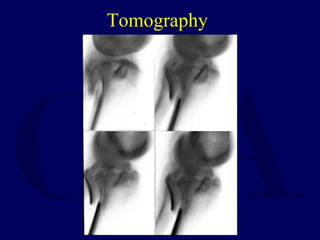
Tomography
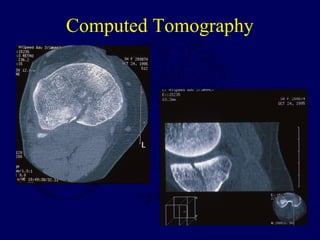
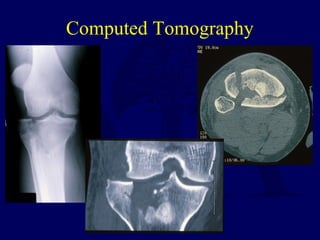
Computed Tomography
• Indications
– Fracture in an active patient for which you are
considering nonsurgical care
– Complex fracture
– To aid surgical planning of approach,
technique, screw position, etc.
• Indications for 3-D reconstructions
– Rare
• Rapid prototyping?
Computed Tomography
Computed Tomography
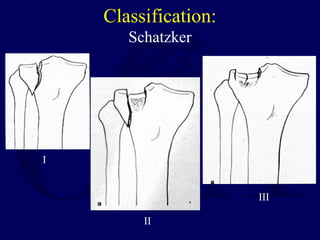
Classification:
Schatzker
I
II
III
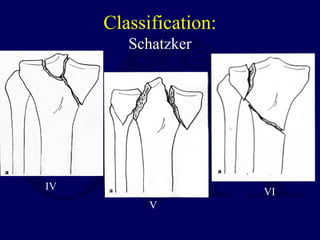
Classification:
Schatzker
IV
V
VI
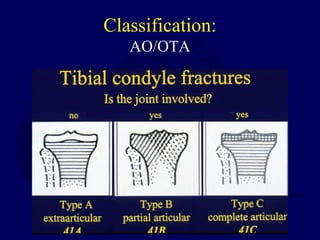
Classification:
AO/OTA
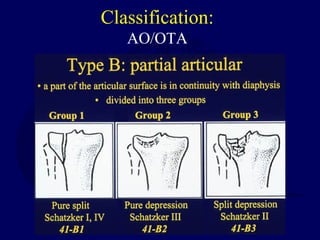
Classification:
AO/OTA
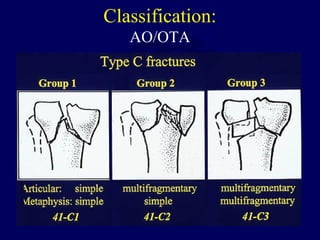
Classification:
AO/OTA
Urgent Management
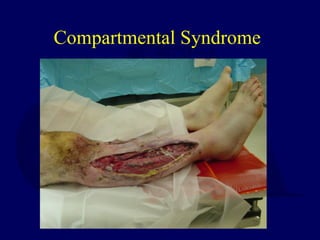
• Rule out compartmental syndrome
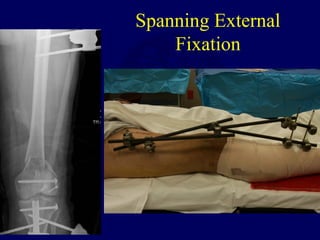
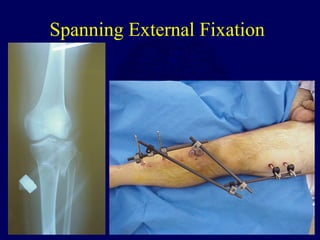
• Provide temporary external stabilization
– Relieves pain
– Stabilizes bone and soft tissues
• Consider spanning external fixation if:
– Complex fracture pattern
– Large amount of shortening
– Soft tissue conditions or other injuries make
immediate ORIF unsafe
Compartmental Syndrome
Spanning External
Fixation
Spanning External Fixation
Surgical Indicatons
• Open Fracture – I&D, spanning ex-fix
• Extensive soft tissue contusion – spanning
ex-fix
• Closed fracture
– Varus/valgus instability of the knee
– Varus or valgus tilt of the proximal tibia
– Meniscal injury/previous mensicectomy
– Articular displacement or gapping???
Should You Operate on These
Fractures?
• “The objective of treatment of tibial plateau
fractures is precise reconstruction of the
articular surface and stable fragment
fixation allowing early motion”
• Do outcomes data support these objectives?
Should You Operate on These
Fractures?
• Tenet: patient outcome will vary directly
with the accuracy of the articular reduction
• The literature seems to indicate that
articular incongruity is tolerated fairly well
and that other factors may be more
important in determining outcome
Lucht et al (Acta Orthop Scand 1971; 42:366)
• 109 fractures treated op and non-op
• 3-10 mm articular depression
– 78% acceptable functional result
• > 10 mm articular depression
– 79% acceptable functional result
Ramussen (JBJS 1973; 55A:1331-1351)
• 183 patients followed for 7.3 years
• Functional outcome no different in 40
patients with > 5 mm articular depression
than in those with < 5 mm
• No correlation between residual articular
depression and arthrosis
Lansinger et al (JBJS 1986; 68A:13-19)
• 102 of Rasmussen’s 183 patients followed
for 20 years
• No change in functional outcomes from the
original study
7 yrs: 87% G or E 20 years: 90% G or E
• All 20 patients with 5-10 mm incongruity
had excellent results (including 9 with
instability of the knee)
Lansinger et al (JBJS 1986; 68A:13-19)
• All 5 patients with > 10 mm incongruity and
stable knees had G or E result
• Poor outcome occur only with combination
of:
– Central depressed condylar fragment
– > 10 mm articular incongruity
– Mediolateral instability of the knee
Koval et al (J Orthop Traum 1994; 6:340-346)
• 18 patients followed 16 months
• Clinical results no different for patients with
anatomic (< 2 mm) or nonanatomic (> 2 mm)
reductions
• 5 nonanatomic reductions:
• 2 excellent, 3 good results
Blokker et al (Clin Orthop 1984; 182:193-199)
• 60 patients followed for 39 months
• Adequacy of articular reduction strongly
associated with outcome
• Satisfactory results:
– Anatomic reduction 86%
– 1-4 mm step-off 75%
– > 5 mm step-off 0%
Blokker et al (Clin Orthop 1984; 182:193-199)
• To attain “satisfactory” rating
• Satisfactory clinical result AND
• Satisfactory radiographic result
– Criterion for satisfactory radiographic result
was < 5 mm articular incongruity
• Patients with > 5 mm incongruity were
assigned an unsatisfactory result, regardless
of clinical outcome
Importance of Factors Other Than
Articular Congruity on Outcome
• The literature clearly indicates that other
factors are critically important to outcome:
– Angular malignment of the proximal tibia
– Resection of the meniscus
– Ligamentous instability
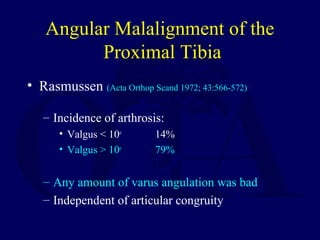
Angular Malalignment of the
Proximal Tibia
• Rasmussen (Acta Orthop Scand 1972; 43:566-572)
– Incidence of arthrosis:
• Valgus < 10o
14%
• Valgus > 10o
79%
– Any amount of varus angulation was bad
– Independent of articular congruity
Meniscectomy
• Jensen et al (JBJS 1990; 72B:49-52)
– Higher rate of arthrosis in patients who had
undergone meniscectomy at surgery
• Honkonen (J Orthop Traum 1995; 4:273-277)
– 70% arthrosis in patients who had undergone
meniscectomy
– results were independent of the amount of
articular incongruity
Ligamentous Instability
• Rasmussen (Acta Orthop Scand 1972; 43:566-572)
– 46% arthrosis in patients with mediolateral
instability (17% incidence in all others)
• Lansinger (JBJS 1986; 68A:13-19)
– Mediolateral instability a necessary condition
for a poor functional outcome
• Honkonen (J Orthop Traum 1995; 4:273-277)
– 69% arthrosis in patients with mediolateral
instability > 10o
Surgical Indicatons
• Open Fracture – I&D, spanning ex-fix
• Extensive soft tissue contusion – spanning
ex-fix
• Closed fracture
– Varus/valgus instability of the knee
– Varus or valgus tilt of the proximal tibia
– Meniscal injury/previous mensicectomy
– Articular displacement or gapping
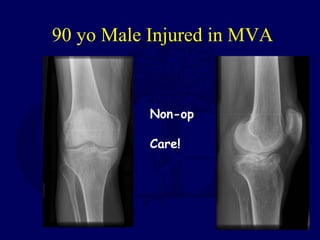
90 yo Male Injured in MVA
Non-op
Care!
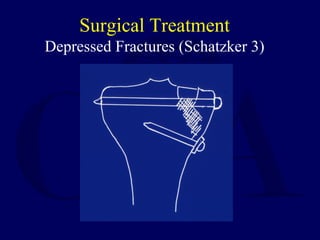
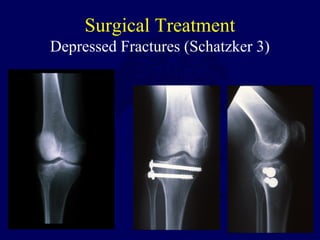
Surgical Treatment
Depressed Fractures (Schatzker 3)
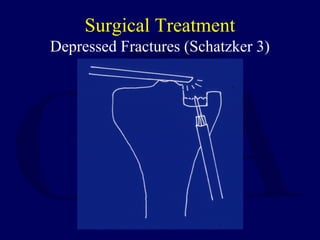
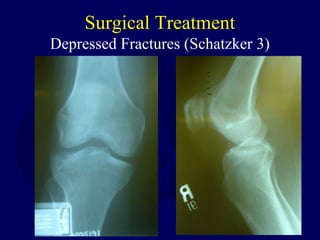
Surgical Treatment
Depressed Fractures (Schatzker 3)
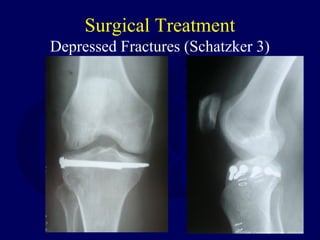
Surgical Treatment
Depressed Fractures (Schatzker 3)
Surgical Treatment
Depressed Fractures (Schatzker 3)
Surgical Treatment
Depressed Fractures (Schatzker 3)
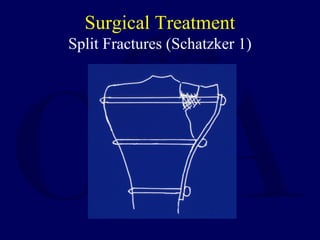
Surgical Treatment
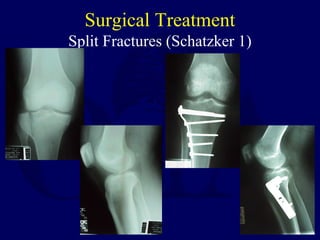
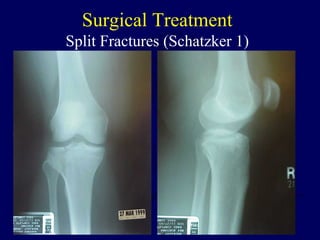
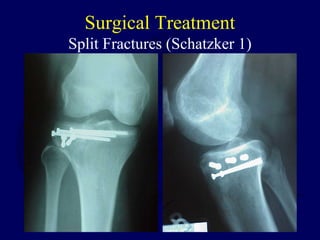
Split Fractures (Schatzker 1)
Surgical Treatment
Split Fractures (Schatzker 1)
Surgical Treatment
Split Fractures (Schatzker 1)
Surgical Treatment
Split Fractures (Schatzker 1)
Surgical Treatment
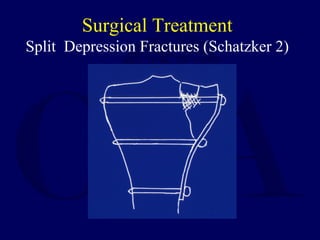
Split Depression Fractures (Schatzker 2)
Fixation Lateral Plateau
Fractures
• Traditional
– large fragment “L” or “T” buttress plate
– 6.5mm subchondral lag screws
– 4.5mm diaphyseal screw
• Current Recommendation
– small fragment fixation
– pre-contoured peri-articular plates
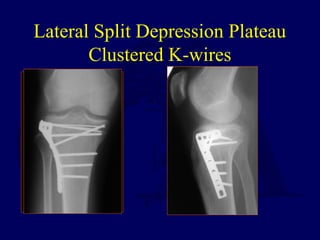
– clustered sudchondral k-wires
•
Biomechanics: Subchondral
Fixation
• 3.5 mm raft construct allowed significantly less
displacement than 6.5 mm screw with axial load (2954
vs. 968 newtons/mm) Twaddle et al AAOs, 1997
• no difference in pull out strength between 6.5mm screws
and 3.5mm screws in subchondral bone Westmoreland
et al J Ortho Trauma 2002
• Subchondral clustered K-wires signicantly enhance load
tolerance depress articular surface Beris et al Bull Hosp
Joint Dis 1996
Large or Small Fixation for the
Lateral Plateau?
• No significant difference between fixation strengths
small vs large frament (Hubbard et al. A J Ortho, 1999)
• Karunaker et al. J Ortho Trauma 2002
– No significant difference in overall stiffness between: large
fragment; periarticular small fragment plate; 3.5 mm
subchondral screws with separate 1/3 semitubular anti-glide
plate
– local depression stiffness > with 3.5 mm vs 6.5 mm screws
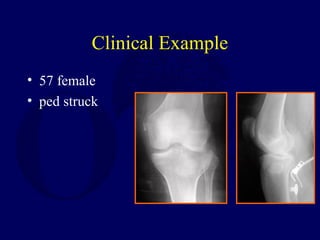
Clinical Example
• 57 female
• ped struck
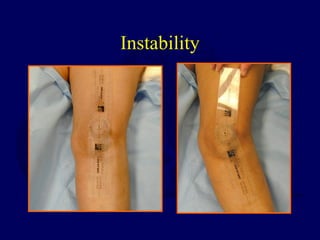
Instability
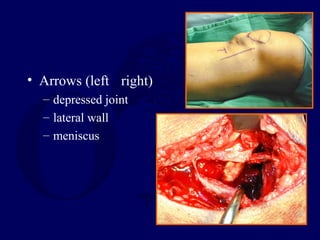
• Arrows (left right)
– depressed joint
– lateral wall
– meniscus
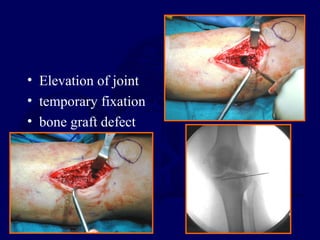
• Elevation of joint
• temporary fixation
• bone graft defect
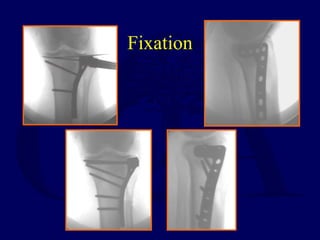
Fixation
Lateral Split Depression Plateau
Clustered K-wires
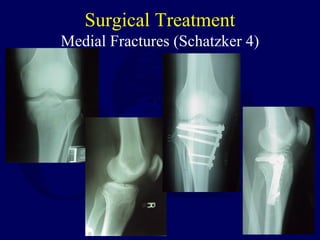
Surgical Treatment
Medial Fractures (Schatzker 4)
Operative Management
High Energy Fractures
• Soft tissue envelop more of an issue
• treatment aimed at minimizing iatrogenic,
surgically induced complications
– limited ORIF with external fixation
• hybrid
• monolateral half pin
– composite fixation
– open reduction joint with perc. locked plate (LISS)
– temporary knee spanning external fixation with delayed
double plating/ locked plate
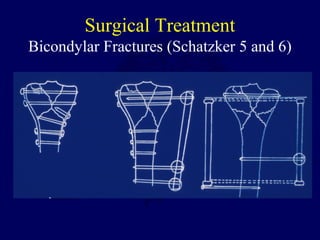
Surgical Treatment
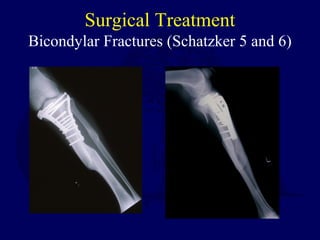
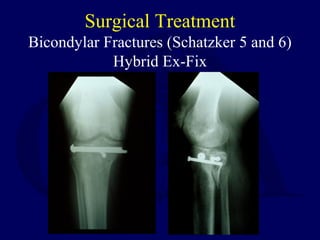
Bicondylar Fractures (Schatzker 5 and 6)
Surgical Treatment
Bicondylar Fractures (Schatzker 5 and 6)
Surgical Treatment
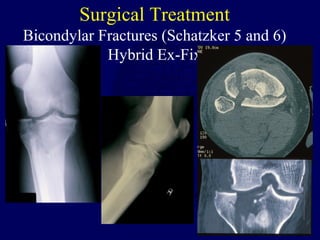
Bicondylar Fractures (Schatzker 5 and 6)
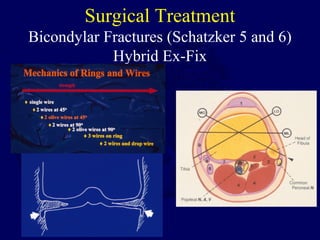
Hybrid Ex-Fix
Surgical Treatment
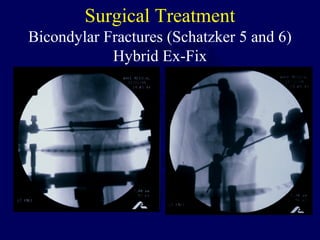
Bicondylar Fractures (Schatzker 5 and 6)
Hybrid Ex-Fix
Surgical Treatment
Bicondylar Fractures (Schatzker 5 and 6)
Hybrid Ex-Fix
Surgical Treatment
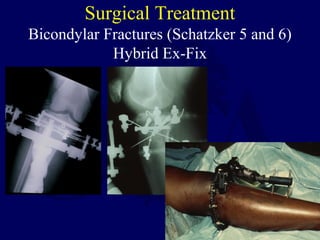
Bicondylar Fractures (Schatzker 5 and 6)
Hybrid Ex-Fix
Surgical Treatment
Bicondylar Fractures (Schatzker 5 and 6)
Hybrid Ex-Fix
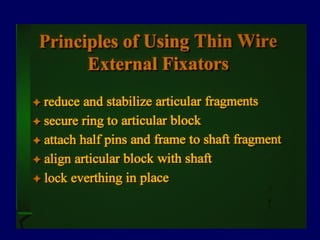
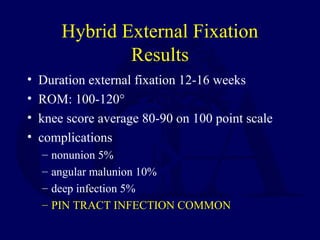
Hybrid External Fixation
Results
• Duration external fixation 12-16 weeks
• ROM: 100-120°
• knee score average 80-90 on 100 point scale
• complications
– nonunion 5%
– angular malunion 10%
– deep infection 5%
– PIN TRACT INFECTION COMMON
Hybrid External Fixation
Pin Tract Infections
• Generally respond to antibiotics + pin care
• may result in septic joint (10%)
• Ways to avoid septic joint:
– stable fracture reduction (impact metaphysis)
– keep pins >15mm from joint
– beware cavity communicating metaphysis joint
– gentle post op ROM to avoid pin irritation
– aggressive investigation post op knee effusion
– consider cross joint adjunct fixation
Temporary Knee Spanning External
Fixation with delayed ORIF
• Acute: femur tibia external fixation
– reduction via ligamentotaxis
– pins in tibia at least 5cm from distal fracture line
• CT scan
• ORIF when soft tissue recovers
– up to 3 weeks!!!
– Double plating
– unilateral locked plate
Surgical Treatment
Bicondylar Fractures (Schatzker 5 and 6)
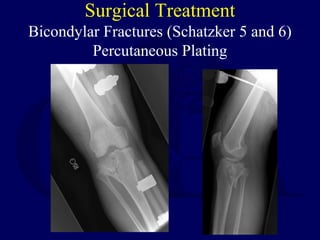
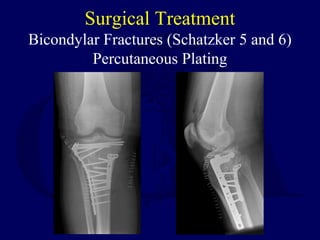
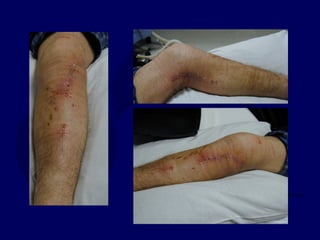
Percutaneous Plating
Surgical Treatment
Bicondylar Fractures (Schatzker 5 and 6)
Percutaneous Plating
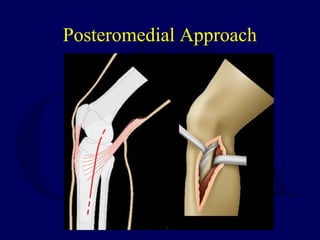
Posteromedial Approach
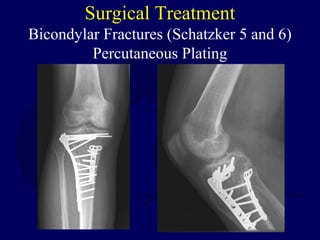
Surgical Treatment
Bicondylar Fractures (Schatzker 5 and 6)
Percutaneous Plating
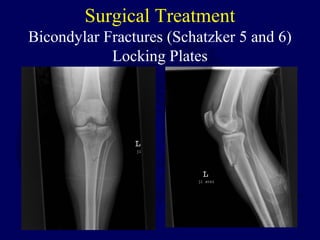
Surgical Treatment
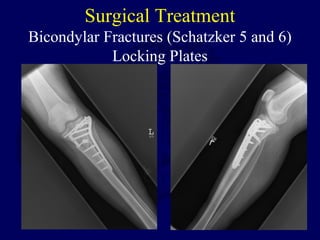
Bicondylar Fractures (Schatzker 5 and 6)
Locking Plates
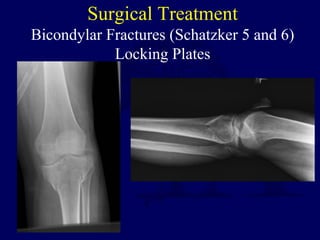
Surgical Treatment
Bicondylar Fractures (Schatzker 5 and 6)
Locking Plates
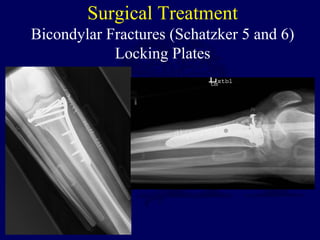
Surgical Treatment
Bicondylar Fractures (Schatzker 5 and 6)
Locking Plates
Surgical Treatment
Bicondylar Fractures (Schatzker 5 and 6)
Locking Plates
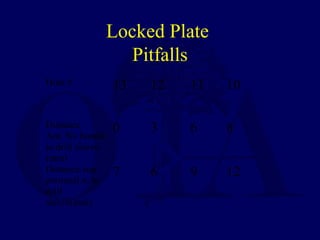
Locked Plate
Pitfalls
Hole # 13 12 11 10
Distance
Ant. Nv bundle
to drill sleeve
(mm)
0 3 6 8
Distance sup
peroneal n. to
drill
sleeve(mm)
7 6 9 12
Locked Plate- Results
• 52 proximal tibia fractures
• 31/52 bicondylar plateau
• 18/52 open injuries
• 1 nonunion
• 4 malunion
• average range of motion 2-116°
• 2 infections (both grade 3B)
Stannard et al. OTA 2001
Locked Plate- Results
• 75 bicondylar plateau fractures
• 16/75 open injuries
• 6 delayed unions: 4/6 union with bone graft
• 1 deep infection
• 9 loss of fixation: 8/9 technique related
• 78% good/excellent results (Rasmussen)
Gosling, Krettek et al. OTA, 2002
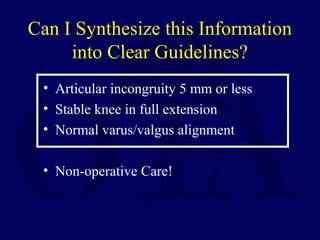
Can I Synthesize this Information
into Clear Guidelines?
• Articular incongruity 5 mm or less
• Stable knee in full extension
• Normal varus/valgus alignment
• Non-operative Care!
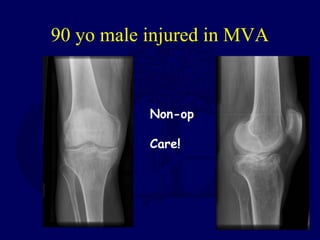
90 yo male injured in MVA
Non-op
Care!
Can I Synthesize this Information
into Clear Guidelines?
• Articular displacement > 5 mm AND
• More than 10 degress varus/valgus
instability to exam in full extension
• Operative Care!
Can I Synthesize this Information
into Clear Guidelines?
• Articular displacement > 5 mm AND
• Knee stable to varus/valgus stress in full
extension
• Favor non-operative care
Can I Synthesize this Information
into Clear Guidelines?
• Varus or valgus tilting of proximal tibia
more than 5 degrees
• Operative Care!
Postoperative Management
• Immediate PROM/AROM of knee
• Shower beginning 48 hours after surgery
– Ok to shower with ex-fix in place
• Routine Pin site care (if ex-fix)
• TDWB for 8-12 weeks
• Sutures out in 2 weeks
• Xrays in 4-6 weeks
Outcomes
• See slides 27-39 in this presentation
• Outcome depends on:
– Varus valgus stability of the knee
– Varus/valgus alignment of the proximal tibia
– Presence of an intact meniscus
– Articular congruity (to a lesser extent)
Treatment Goals
• Focus on restoring stability and proximal
tibial alignment to the knee, rather than
restoring anatomic alignment of the
articular surface at all costs
• Use minimally invasive techniques, when
possible
• Other techniques are preferable to hybrid
ex-fix
• Move the knee early in all patients!
Thank You!
Return to
Lower Extremity
Index

L08 tibial plateau

  • 1.
    Fractures of theTibial Plateau Douglas R. Dirschl, MD Thomas Ellis, MD Bruce French, MD
  • 2.
    Outline • Anatomy • Mechanismof Injury • Evaluation • Emergency Management • Surgical Indications • External Fixation • Internal Fixation • Outcomes
  • 3.
    Osseous Anatomy • ProximalTibia – widens into lateral and medial tibial flares – flares lead to medial and lateral plateau (condyles) – intercondylar eminence – tibial tubercle (patellar tendon) – Gerdy’s tubercle (ITB) – proximal tib/fib joint
  • 4.
    Osseous Anatomy • MedialPlateau VS – larger – concave: frontback – sideside – lower than lateral side – slopes posteriorly 10° – cartilage 3mm – medial condyle stronger bone – bears 75% of weight • Lateral Plateau – smaller – convex: frontback – sideside – higher than medial – slopes posteriorly 7° – cartilage 4 mm – softer bone
  • 5.
    Meniscus • Fibrocartilage • lateralmeniscus – more circular than medial – covers more of articular surface than medial – attached to PCL via ligaments • Humphry (anterior) • Wrisberg (posterior) – no attachment to LCL – bears most of joint reactive force
  • 6.
    Meniscus • Medial meniscus –“C” shaped – intimately attached to MCL – bears equal joint reactive force as bone
  • 7.
    Introduction/Mechanism of Injury • Meanage in most series of tibial plateau fractures is about 55 years – Large percentage over age 60 • Elderly population is increasing in numbers – Fastest growing segment of US population • Tibial plateau fractures comprise 8% of all fractures in the elderly population (Hohl)
  • 8.
    Mechanism of Injury •Mechanism of injury is fall from standing height in most patients – MVA is increasing as % of fractures – High energy fracture patterns increasing in this age group! • Most common fracture pattern is split- depressed fracture of lateral tibial plateau (80% of fractures)
  • 9.
    Demographics of Plateau Fractures •1% of all fractures • 8% of all fractures in the elderly • lateral plateau involved 55-70% • medial plateau involved 10-20% • both involved 10-30%
  • 10.
    Mechanism • Mechanism ofinjury is important when considering treatment options, timing and associated injuries • remember… Force = Mass X Acceleration • even if the xrays are similar, these are completely different injuries
  • 11.
    Evaluation • Trauma Evaluation –ABCs – Associated Injuries • Evaluation of Limb – Gentle exam for knee stability – Observation of soft tissues – Neurovascular evaluation – Evaluate for compartmental syndrome • Imaging Evaluation
  • 12.
    Physical Exam • SoftTissue Assessment – Tscherne & Goetzen (closed injury) • grade 0: minimal soft tissue damage/ indirect force • grade 1: superficial abrasion/contusion via pressure from within • grade 2: deep, contaminated abrasion with localized skin/muscle contusion: impending comp. syn. • Grade 3: extensive skin contusion/crush: sobq avusion; underlying muscle damage; decompensated cs – Gustilo and Anderson (open injury)
  • 13.
    Physical Exam • Neurologicexam – peroneal nerve! • Vascular exam – popliteal artery and medial plateau injuries – beware the of the knee dislocation posing as a fracture – beware of posteriorly displaced fracture fragments – ABI <0.9 urgent arterial study
  • 14.
    Physical Exam • Compartmentsyndrome • KNEE STABILITY – varus/valgus in full extension – may require premedication • aspiration of knee effusion/hematoma • replace with lidocaine+marcaine
  • 15.
    Evaluation of SoftTissues • Proximal and distal tibia subcutaneous • Soft tissue remains compromised for at least 7 days • Early ORIF risks wound sloughexposed hardware
  • 16.
    Evaluation • Plain radiographs –AP, lateral, ? oblique of knee on 17-inch cassettes – AP and lateral of entire tibia – Traction radiographs • Very helpful for complex fractures • Traction can be applied by temporary spanning ex- fix – CT scan indications • Fractures for which you are considering nonsurgical care • Complex fractures to assist in surgical planning • Always obtain CT after applying traction
  • 17.
    AP and LateralRadiographs
  • 18.
    AP and LateralRadiographs
  • 19.
    AP and LateralRadiographs
  • 20.
  • 21.
  • 22.
  • 23.
    Computed Tomography • Indications –Fracture in an active patient for which you are considering nonsurgical care – Complex fracture – To aid surgical planning of approach, technique, screw position, etc. • Indications for 3-D reconstructions – Rare • Rapid prototyping?
  • 24.
  • 25.
  • 26.
  • 27.
  • 28.
  • 29.
  • 30.
  • 31.
    Urgent Management • Ruleout compartmental syndrome • Provide temporary external stabilization – Relieves pain – Stabilizes bone and soft tissues • Consider spanning external fixation if: – Complex fracture pattern – Large amount of shortening – Soft tissue conditions or other injuries make immediate ORIF unsafe
  • 32.
  • 33.
  • 34.
  • 35.
    Surgical Indicatons • OpenFracture – I&D, spanning ex-fix • Extensive soft tissue contusion – spanning ex-fix • Closed fracture – Varus/valgus instability of the knee – Varus or valgus tilt of the proximal tibia – Meniscal injury/previous mensicectomy – Articular displacement or gapping???
  • 36.
    Should You Operateon These Fractures? • “The objective of treatment of tibial plateau fractures is precise reconstruction of the articular surface and stable fragment fixation allowing early motion” • Do outcomes data support these objectives?
  • 37.
    Should You Operateon These Fractures? • Tenet: patient outcome will vary directly with the accuracy of the articular reduction • The literature seems to indicate that articular incongruity is tolerated fairly well and that other factors may be more important in determining outcome
  • 38.
    Lucht et al(Acta Orthop Scand 1971; 42:366) • 109 fractures treated op and non-op • 3-10 mm articular depression – 78% acceptable functional result • > 10 mm articular depression – 79% acceptable functional result
  • 39.
    Ramussen (JBJS 1973;55A:1331-1351) • 183 patients followed for 7.3 years • Functional outcome no different in 40 patients with > 5 mm articular depression than in those with < 5 mm • No correlation between residual articular depression and arthrosis
  • 40.
    Lansinger et al(JBJS 1986; 68A:13-19) • 102 of Rasmussen’s 183 patients followed for 20 years • No change in functional outcomes from the original study 7 yrs: 87% G or E 20 years: 90% G or E • All 20 patients with 5-10 mm incongruity had excellent results (including 9 with instability of the knee)
  • 41.
    Lansinger et al(JBJS 1986; 68A:13-19) • All 5 patients with > 10 mm incongruity and stable knees had G or E result • Poor outcome occur only with combination of: – Central depressed condylar fragment – > 10 mm articular incongruity – Mediolateral instability of the knee
  • 42.
    Koval et al(J Orthop Traum 1994; 6:340-346) • 18 patients followed 16 months • Clinical results no different for patients with anatomic (< 2 mm) or nonanatomic (> 2 mm) reductions • 5 nonanatomic reductions: • 2 excellent, 3 good results
  • 43.
    Blokker et al(Clin Orthop 1984; 182:193-199) • 60 patients followed for 39 months • Adequacy of articular reduction strongly associated with outcome • Satisfactory results: – Anatomic reduction 86% – 1-4 mm step-off 75% – > 5 mm step-off 0%
  • 44.
    Blokker et al(Clin Orthop 1984; 182:193-199) • To attain “satisfactory” rating • Satisfactory clinical result AND • Satisfactory radiographic result – Criterion for satisfactory radiographic result was < 5 mm articular incongruity • Patients with > 5 mm incongruity were assigned an unsatisfactory result, regardless of clinical outcome
  • 45.
    Importance of FactorsOther Than Articular Congruity on Outcome • The literature clearly indicates that other factors are critically important to outcome: – Angular malignment of the proximal tibia – Resection of the meniscus – Ligamentous instability
  • 46.
    Angular Malalignment ofthe Proximal Tibia • Rasmussen (Acta Orthop Scand 1972; 43:566-572) – Incidence of arthrosis: • Valgus < 10o 14% • Valgus > 10o 79% – Any amount of varus angulation was bad – Independent of articular congruity
  • 47.
    Meniscectomy • Jensen etal (JBJS 1990; 72B:49-52) – Higher rate of arthrosis in patients who had undergone meniscectomy at surgery • Honkonen (J Orthop Traum 1995; 4:273-277) – 70% arthrosis in patients who had undergone meniscectomy – results were independent of the amount of articular incongruity
  • 48.
    Ligamentous Instability • Rasmussen(Acta Orthop Scand 1972; 43:566-572) – 46% arthrosis in patients with mediolateral instability (17% incidence in all others) • Lansinger (JBJS 1986; 68A:13-19) – Mediolateral instability a necessary condition for a poor functional outcome • Honkonen (J Orthop Traum 1995; 4:273-277) – 69% arthrosis in patients with mediolateral instability > 10o
  • 49.
    Surgical Indicatons • OpenFracture – I&D, spanning ex-fix • Extensive soft tissue contusion – spanning ex-fix • Closed fracture – Varus/valgus instability of the knee – Varus or valgus tilt of the proximal tibia – Meniscal injury/previous mensicectomy – Articular displacement or gapping
  • 50.
    90 yo MaleInjured in MVA Non-op Care!
  • 51.
  • 52.
  • 53.
  • 54.
  • 55.
  • 56.
  • 57.
  • 58.
  • 59.
  • 60.
    Surgical Treatment Split DepressionFractures (Schatzker 2)
  • 61.
    Fixation Lateral Plateau Fractures •Traditional – large fragment “L” or “T” buttress plate – 6.5mm subchondral lag screws – 4.5mm diaphyseal screw • Current Recommendation – small fragment fixation – pre-contoured peri-articular plates – clustered sudchondral k-wires •
  • 62.
    Biomechanics: Subchondral Fixation • 3.5mm raft construct allowed significantly less displacement than 6.5 mm screw with axial load (2954 vs. 968 newtons/mm) Twaddle et al AAOs, 1997 • no difference in pull out strength between 6.5mm screws and 3.5mm screws in subchondral bone Westmoreland et al J Ortho Trauma 2002 • Subchondral clustered K-wires signicantly enhance load tolerance depress articular surface Beris et al Bull Hosp Joint Dis 1996
  • 63.
    Large or SmallFixation for the Lateral Plateau? • No significant difference between fixation strengths small vs large frament (Hubbard et al. A J Ortho, 1999) • Karunaker et al. J Ortho Trauma 2002 – No significant difference in overall stiffness between: large fragment; periarticular small fragment plate; 3.5 mm subchondral screws with separate 1/3 semitubular anti-glide plate – local depression stiffness > with 3.5 mm vs 6.5 mm screws
  • 64.
    Clinical Example • 57female • ped struck
  • 65.
  • 66.
    • Arrows (leftright) – depressed joint – lateral wall – meniscus
  • 67.
    • Elevation ofjoint • temporary fixation • bone graft defect
  • 68.
  • 69.
    Lateral Split DepressionPlateau Clustered K-wires
  • 70.
  • 71.
    Operative Management High EnergyFractures • Soft tissue envelop more of an issue • treatment aimed at minimizing iatrogenic, surgically induced complications – limited ORIF with external fixation • hybrid • monolateral half pin – composite fixation – open reduction joint with perc. locked plate (LISS) – temporary knee spanning external fixation with delayed double plating/ locked plate
  • 72.
  • 73.
  • 74.
    Surgical Treatment Bicondylar Fractures(Schatzker 5 and 6) Hybrid Ex-Fix
  • 75.
    Surgical Treatment Bicondylar Fractures(Schatzker 5 and 6) Hybrid Ex-Fix
  • 76.
    Surgical Treatment Bicondylar Fractures(Schatzker 5 and 6) Hybrid Ex-Fix
  • 77.
    Surgical Treatment Bicondylar Fractures(Schatzker 5 and 6) Hybrid Ex-Fix
  • 79.
    Surgical Treatment Bicondylar Fractures(Schatzker 5 and 6) Hybrid Ex-Fix
  • 80.
    Hybrid External Fixation Results •Duration external fixation 12-16 weeks • ROM: 100-120° • knee score average 80-90 on 100 point scale • complications – nonunion 5% – angular malunion 10% – deep infection 5% – PIN TRACT INFECTION COMMON
  • 81.
    Hybrid External Fixation PinTract Infections • Generally respond to antibiotics + pin care • may result in septic joint (10%) • Ways to avoid septic joint: – stable fracture reduction (impact metaphysis) – keep pins >15mm from joint – beware cavity communicating metaphysis joint – gentle post op ROM to avoid pin irritation – aggressive investigation post op knee effusion – consider cross joint adjunct fixation
  • 82.
    Temporary Knee SpanningExternal Fixation with delayed ORIF • Acute: femur tibia external fixation – reduction via ligamentotaxis – pins in tibia at least 5cm from distal fracture line • CT scan • ORIF when soft tissue recovers – up to 3 weeks!!! – Double plating – unilateral locked plate
  • 83.
    Surgical Treatment Bicondylar Fractures(Schatzker 5 and 6) Percutaneous Plating
  • 84.
    Surgical Treatment Bicondylar Fractures(Schatzker 5 and 6) Percutaneous Plating
  • 86.
  • 87.
    Surgical Treatment Bicondylar Fractures(Schatzker 5 and 6) Percutaneous Plating
  • 88.
    Surgical Treatment Bicondylar Fractures(Schatzker 5 and 6) Locking Plates
  • 89.
    Surgical Treatment Bicondylar Fractures(Schatzker 5 and 6) Locking Plates
  • 90.
    Surgical Treatment Bicondylar Fractures(Schatzker 5 and 6) Locking Plates
  • 91.
    Surgical Treatment Bicondylar Fractures(Schatzker 5 and 6) Locking Plates
  • 92.
    Locked Plate Pitfalls Hole #13 12 11 10 Distance Ant. Nv bundle to drill sleeve (mm) 0 3 6 8 Distance sup peroneal n. to drill sleeve(mm) 7 6 9 12
  • 93.
    Locked Plate- Results •52 proximal tibia fractures • 31/52 bicondylar plateau • 18/52 open injuries • 1 nonunion • 4 malunion • average range of motion 2-116° • 2 infections (both grade 3B) Stannard et al. OTA 2001
  • 94.
    Locked Plate- Results •75 bicondylar plateau fractures • 16/75 open injuries • 6 delayed unions: 4/6 union with bone graft • 1 deep infection • 9 loss of fixation: 8/9 technique related • 78% good/excellent results (Rasmussen) Gosling, Krettek et al. OTA, 2002
  • 95.
    Can I Synthesizethis Information into Clear Guidelines? • Articular incongruity 5 mm or less • Stable knee in full extension • Normal varus/valgus alignment • Non-operative Care!
  • 96.
    90 yo maleinjured in MVA Non-op Care!
  • 97.
    Can I Synthesizethis Information into Clear Guidelines? • Articular displacement > 5 mm AND • More than 10 degress varus/valgus instability to exam in full extension • Operative Care!
  • 98.
    Can I Synthesizethis Information into Clear Guidelines? • Articular displacement > 5 mm AND • Knee stable to varus/valgus stress in full extension • Favor non-operative care
  • 99.
    Can I Synthesizethis Information into Clear Guidelines? • Varus or valgus tilting of proximal tibia more than 5 degrees • Operative Care!
  • 100.
    Postoperative Management • ImmediatePROM/AROM of knee • Shower beginning 48 hours after surgery – Ok to shower with ex-fix in place • Routine Pin site care (if ex-fix) • TDWB for 8-12 weeks • Sutures out in 2 weeks • Xrays in 4-6 weeks
  • 101.
    Outcomes • See slides27-39 in this presentation • Outcome depends on: – Varus valgus stability of the knee – Varus/valgus alignment of the proximal tibia – Presence of an intact meniscus – Articular congruity (to a lesser extent)
  • 102.
    Treatment Goals • Focuson restoring stability and proximal tibial alignment to the knee, rather than restoring anatomic alignment of the articular surface at all costs • Use minimally invasive techniques, when possible • Other techniques are preferable to hybrid ex-fix • Move the knee early in all patients!
  • 103.