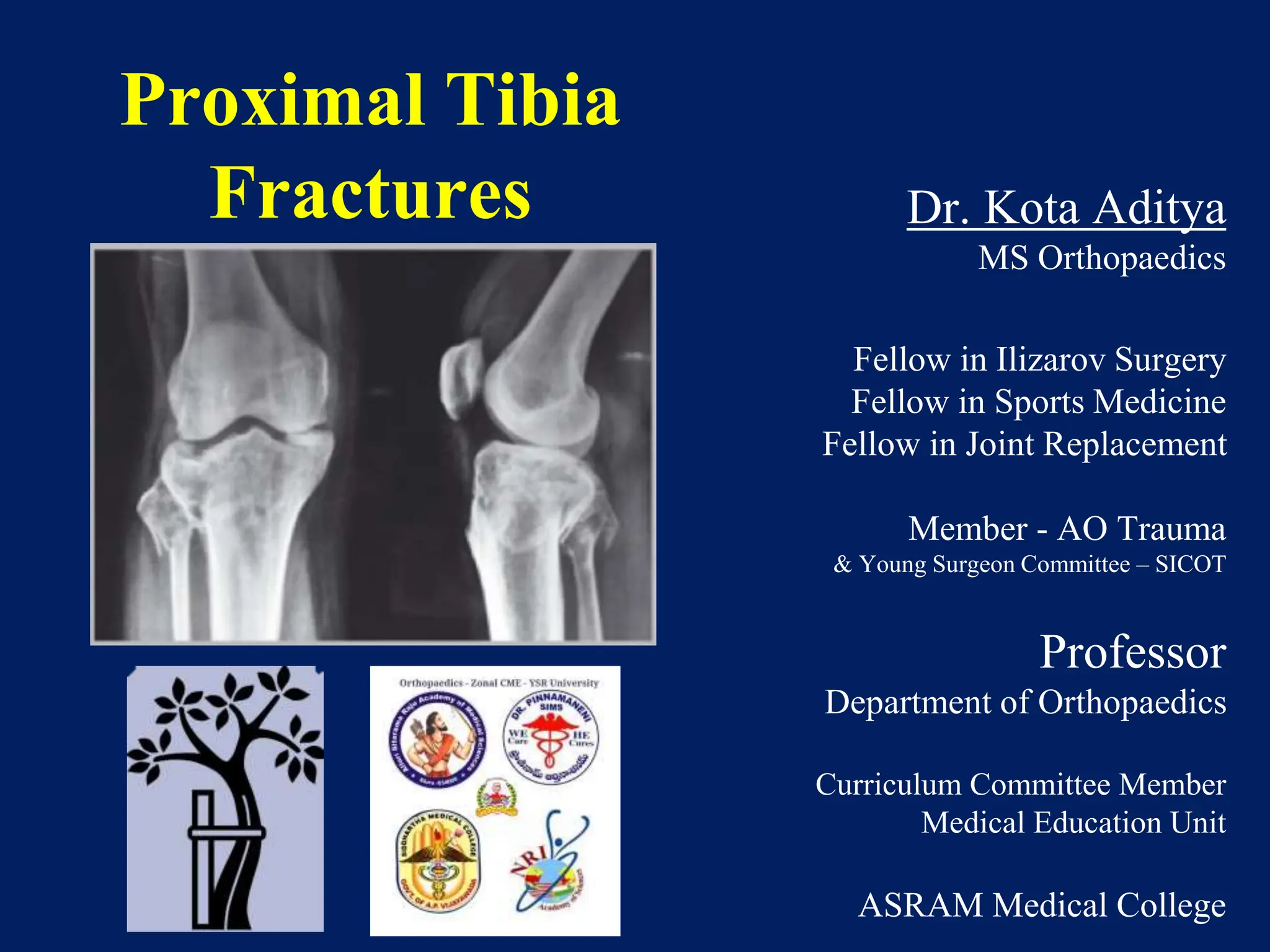
Proximal Tibia
Fractures Dr. Kota Aditya
MS Orthopaedics
Fellow in Ilizarov Surgery
Fellow in Sports Medicine
Fellow in Joint Replacement
Member - AO Trauma
& Young Surgeon Committee – SICOT
Professor
Department of Orthopaedics
Curriculum Committee Member
Medical Education Unit
ASRAM Medical College
• Recognize the anatomy of the proximal tibia
• Describe initial evaluation and management
• Identify common fracture patterns
• Apply treatment principles and strategies
• Partial articular fractures
• Complete articular fractures
• Discuss rehabilitation and complications
• Learn Management in selected tibial plateau case
scenarios
Learning Objectives
Epidemiology
• 1-2% of all fractures
• Bimodal distribution
• Young adults: high energy
mechanism
• Highest in 5th decade
• Male > Female
• Elderly: low energy mechanism
• Osteoporotic bone
• Female > Male
• Lateral Plateau: 70% of fractures
• Medial Plateau: 10% of fractures
• Bicondylar Plateau: 20% of fractures
Anatomy
Consist of Medial
and Lateral Plateau
– Medial larger &
harder (thus less
likely to fracture)
– Medial lower &
concave
– Lateral higher &
convex
– Lateral cartilage
thicker (3 vs 4
mm)
Medial
Lateral Medial
Strong
Lateral
Weak
Medial
concave
Lateral
convex
Anatomy
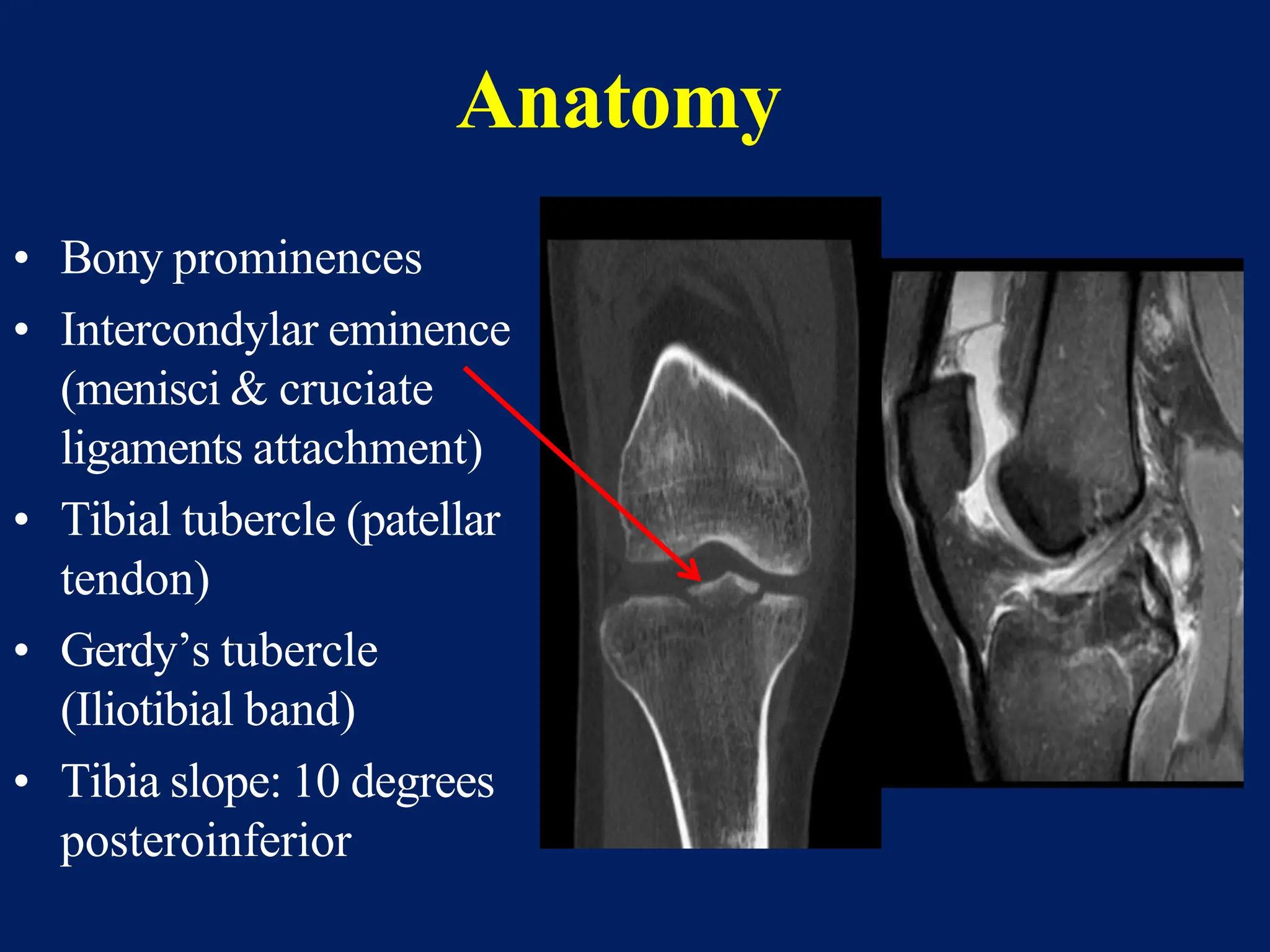
• Bony prominences
• Intercondylar eminence
(menisci & cruciate
ligaments attachment)
• Tibial tubercle (patellar
tendon)
• Gerdy’s tubercle
(Iliotibial band)
• Tibia slope: 10 degrees
posteroinferior
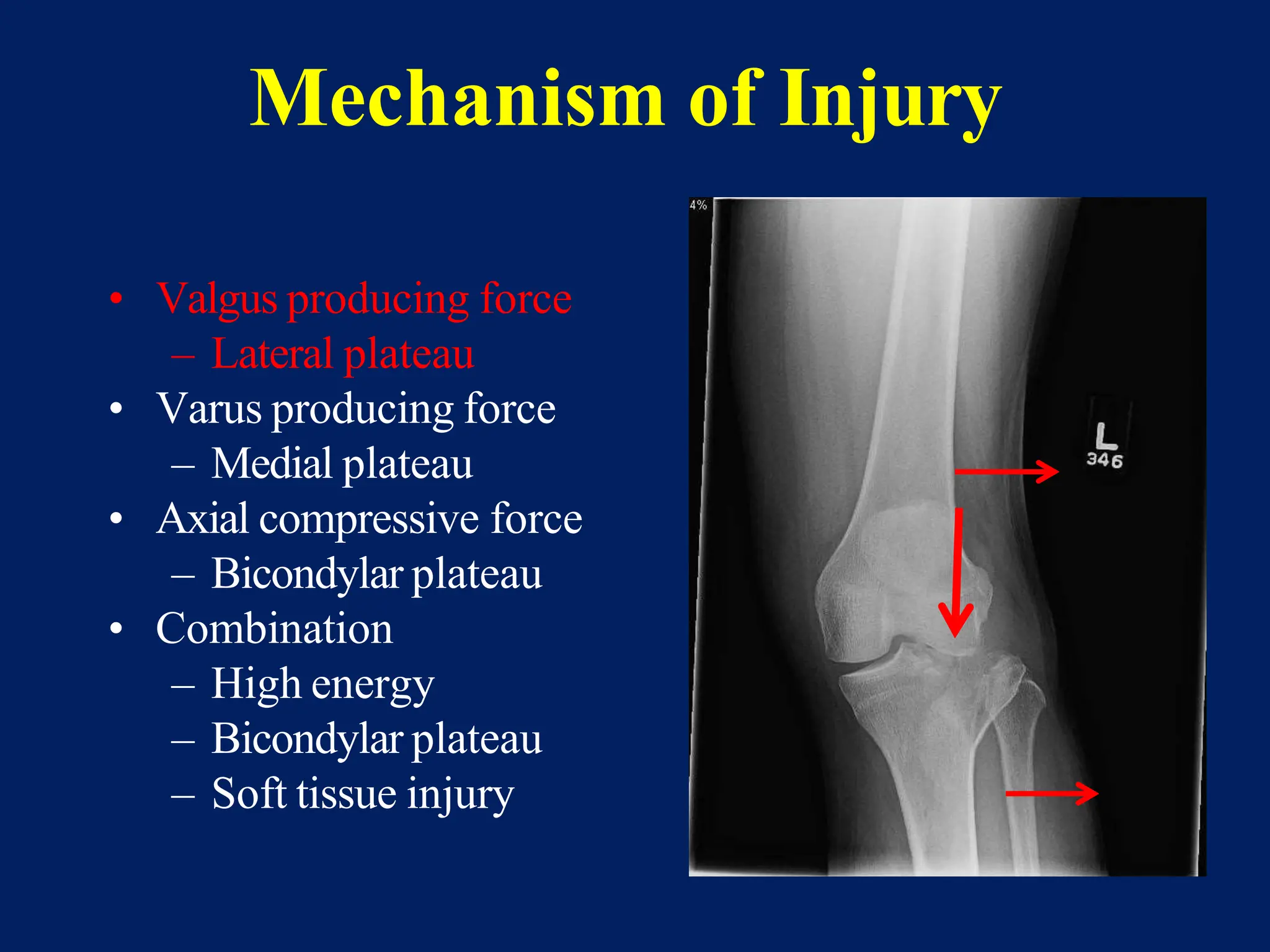
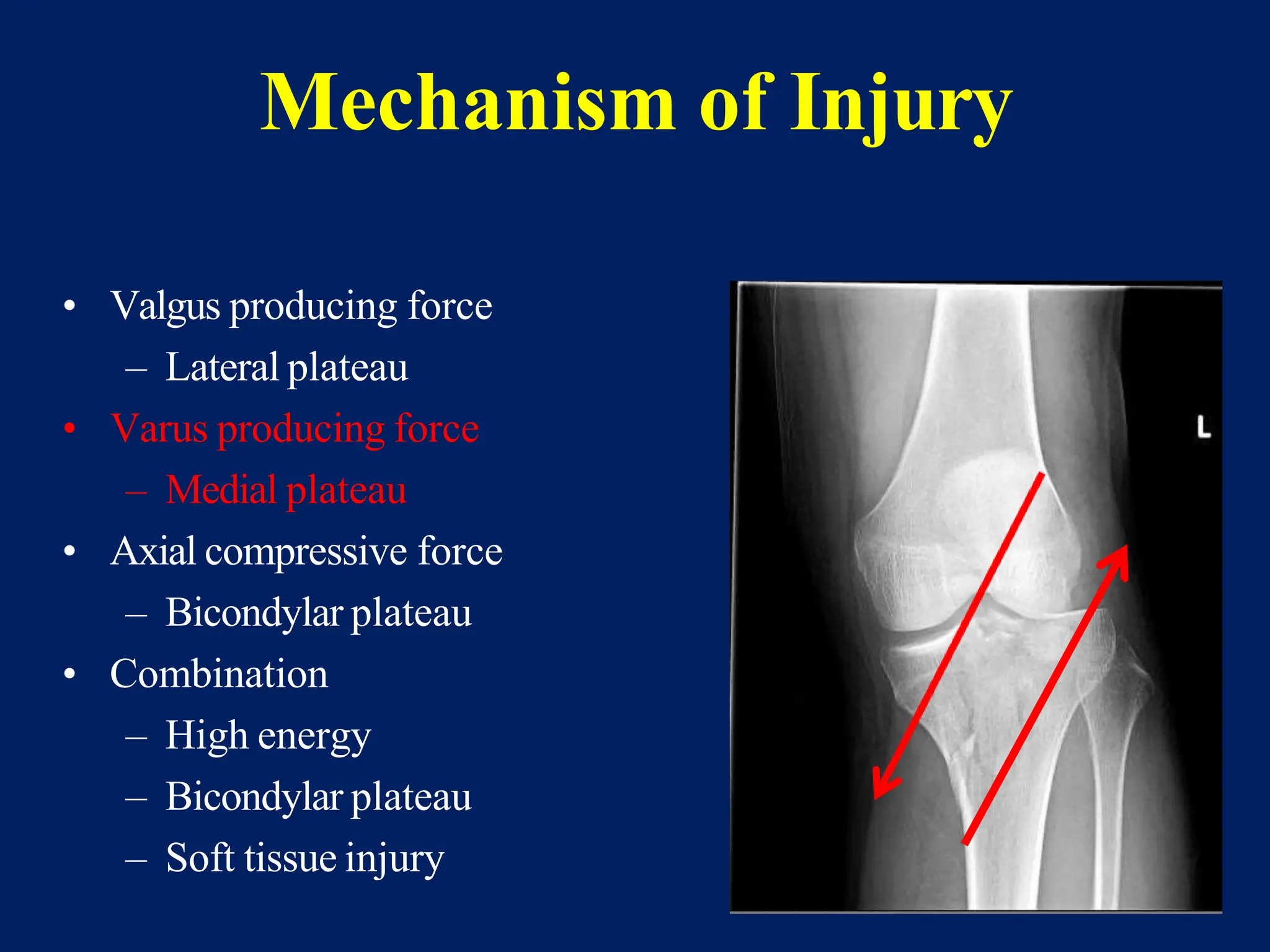
Mechanism of Injury
• Valgus producing force
– Lateral plateau
• Varus producing force
– Medial plateau
• Axial compressive force
– Bicondylar plateau
• Combination
– High energy
– Bicondylar plateau
– Soft tissue injury
Mechanism of Injury
• Valgus producing force
– Lateral plateau
• Varus producing force
– Medial plateau
• Axial compressive force
– Bicondylar plateau
• Combination
– High energy
– Bicondylar plateau
– Soft tissue injury
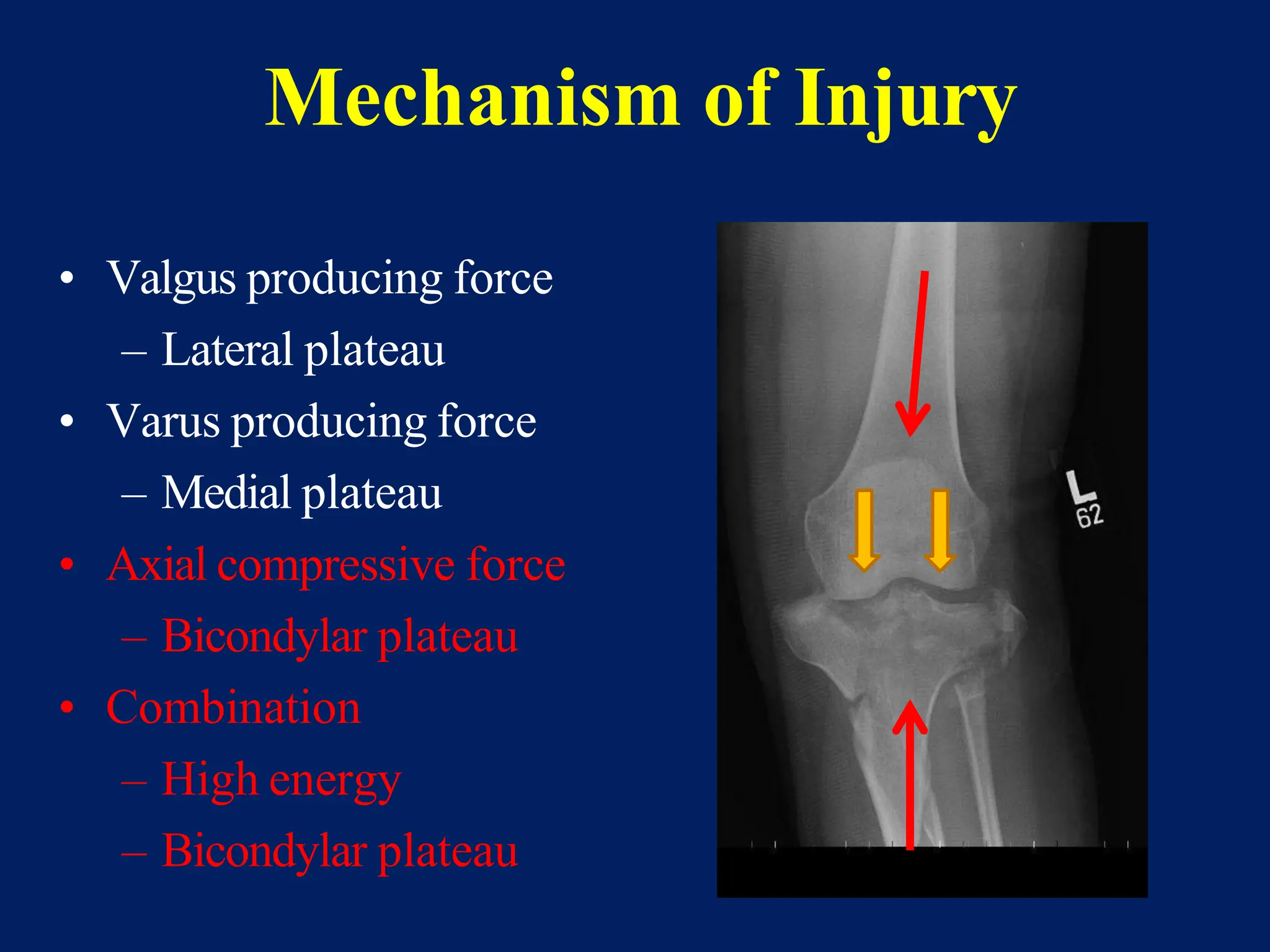
Mechanism of Injury
• Valgus producing force
– Lateral plateau
• Varus producing force
– Medial plateau
• Axial compressive force
– Bicondylar plateau
• Combination
– High energy
– Bicondylar plateau
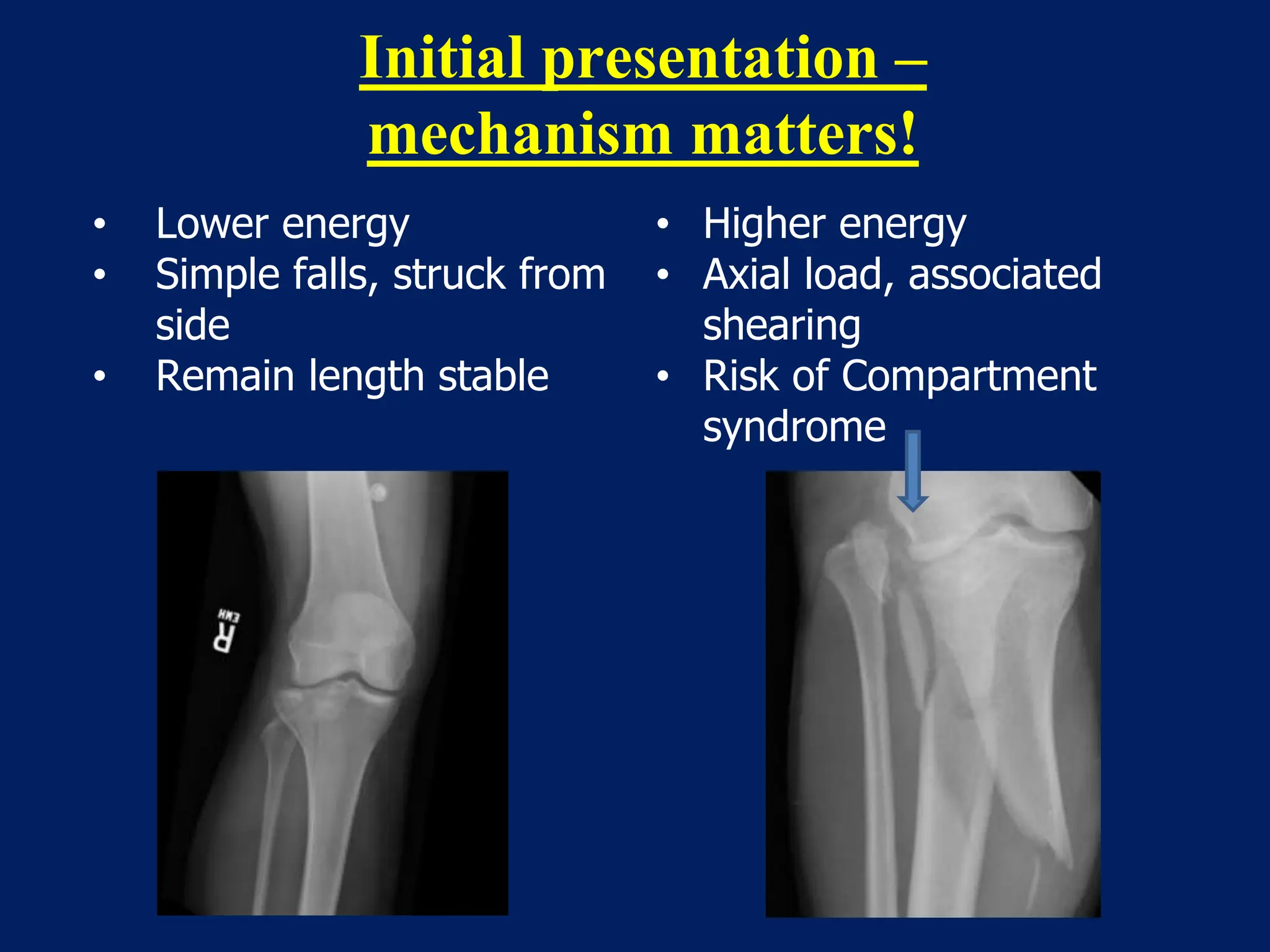
Initial presentation –
mechanism matters!
• Lower energy
• Simple falls, struck from
side
• Remain length stable
• Higher energy
• Axial load, associated
shearing
• Risk of Compartment
syndrome
Associated Injuries
• Lateral plateau
– Tear of meniscus likely if
• > 5mm depression
• > 6mm condylar widening
– MCL / ACL tear
• Medial Plateau
– Fracture / dislocation variant
– Popliteal artery injury
– Peroneal nerve injury
• Bicondylar
– Open injury
– Compartment syndrome
MCL tear
Evaluation - History
• Mechanism of injury
• Injury factors
– Soft tissue status
– Fracture patterns
– Associated injuries
• Patient factors
– Age
– Bone quality
– Comorbidities
• Previous level of activity
– Function demands
Evaluation – Physical Exam
• Initial Inspection
– Skin integrity
– Soft tissue swelling
– Open fracture
– Gross deformity
– Shortened limb
– Neurovascular status
• Always Document the
Examination findings!
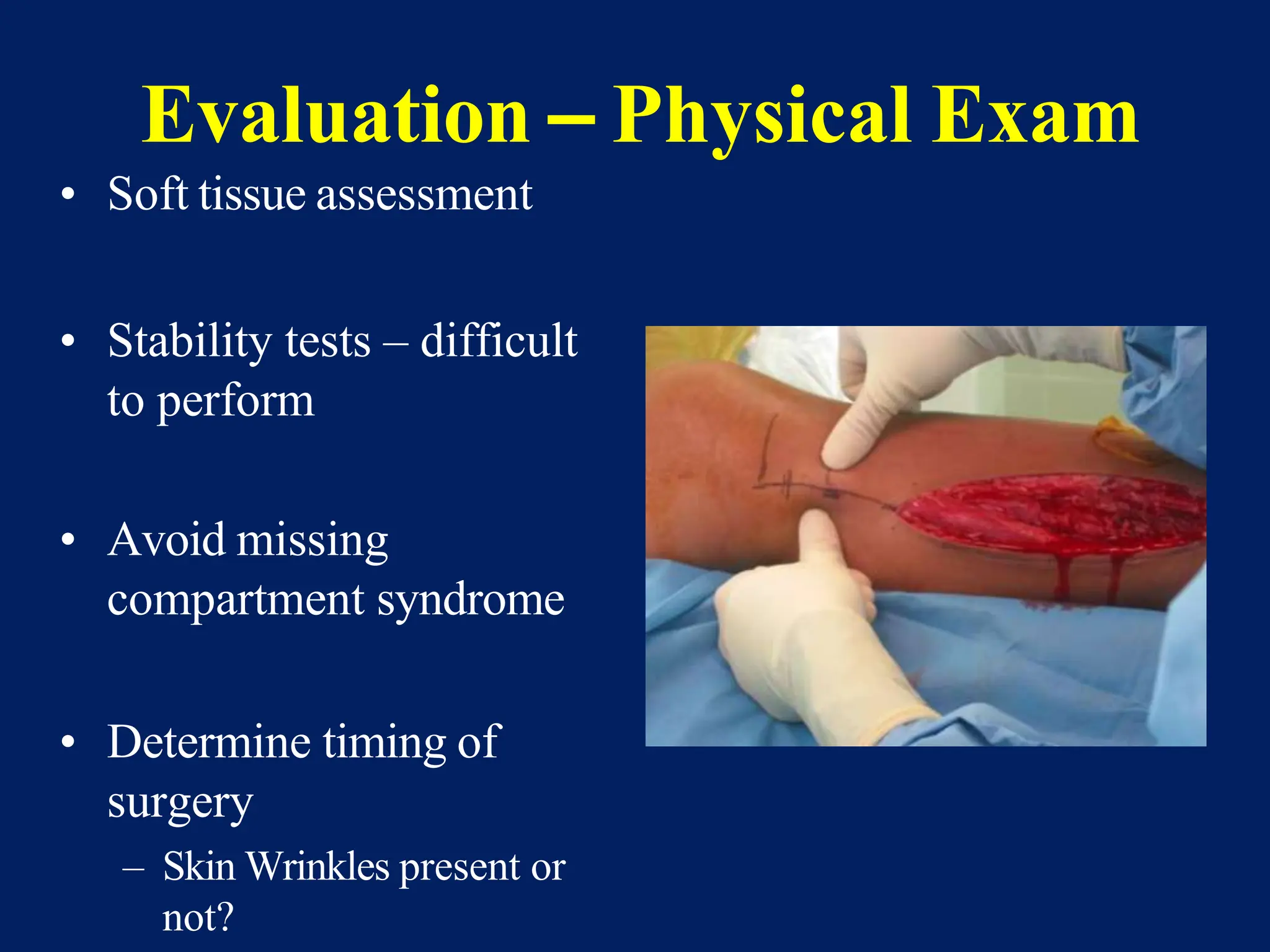
Evaluation – Physical Exam
• Soft tissue assessment
• Stability tests – difficult
to perform
• Avoid missing
compartment syndrome
• Determine timing of
surgery
– Skin Wrinkles present or
not?
Evaluation – Physical Exam
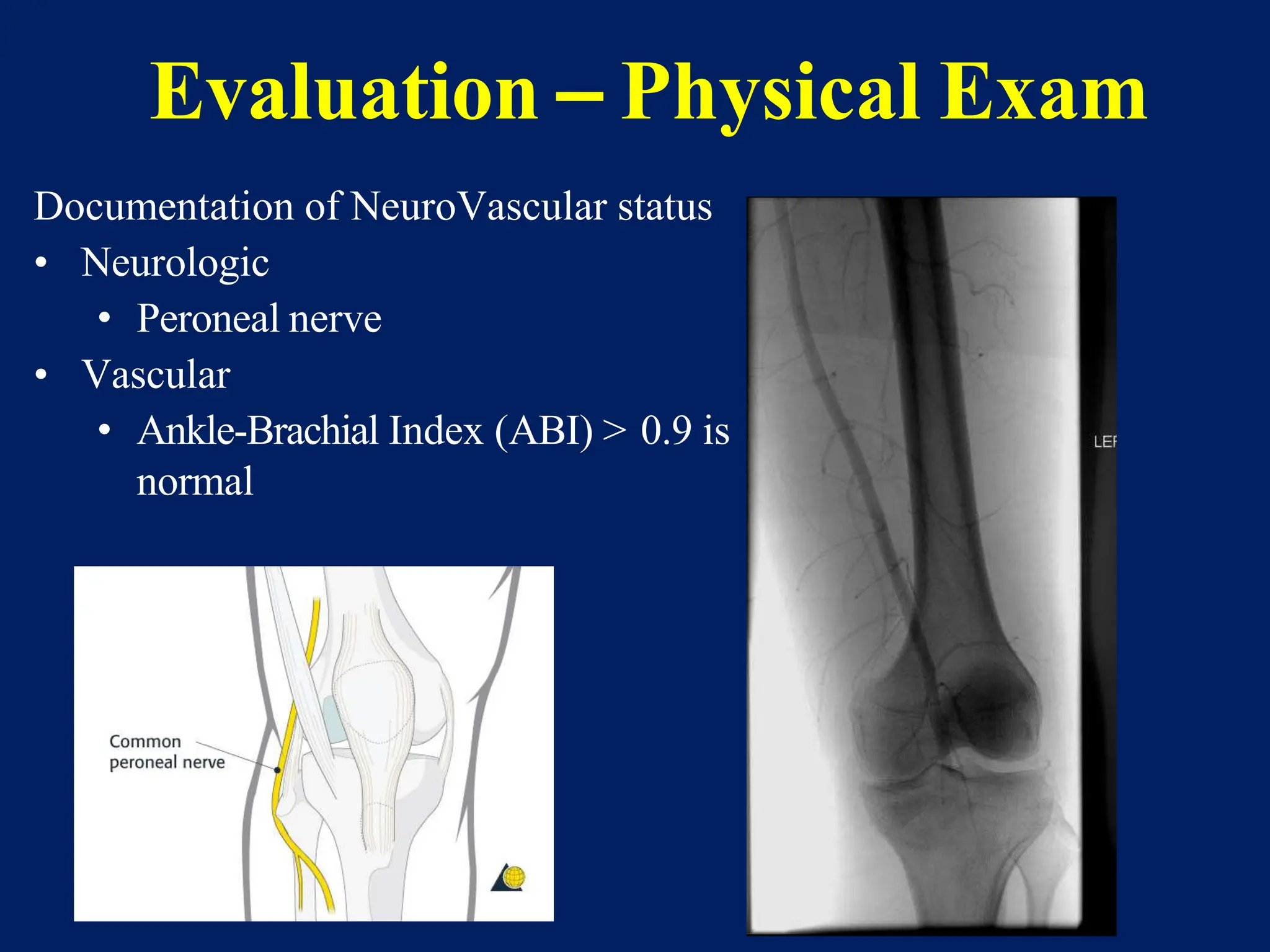
Documentation of NeuroVascular status
• Neurologic
• Peroneal nerve
• Vascular
• Ankle-Brachial Index (ABI) > 0.9 is
normal
Evaluation – Physical Exam
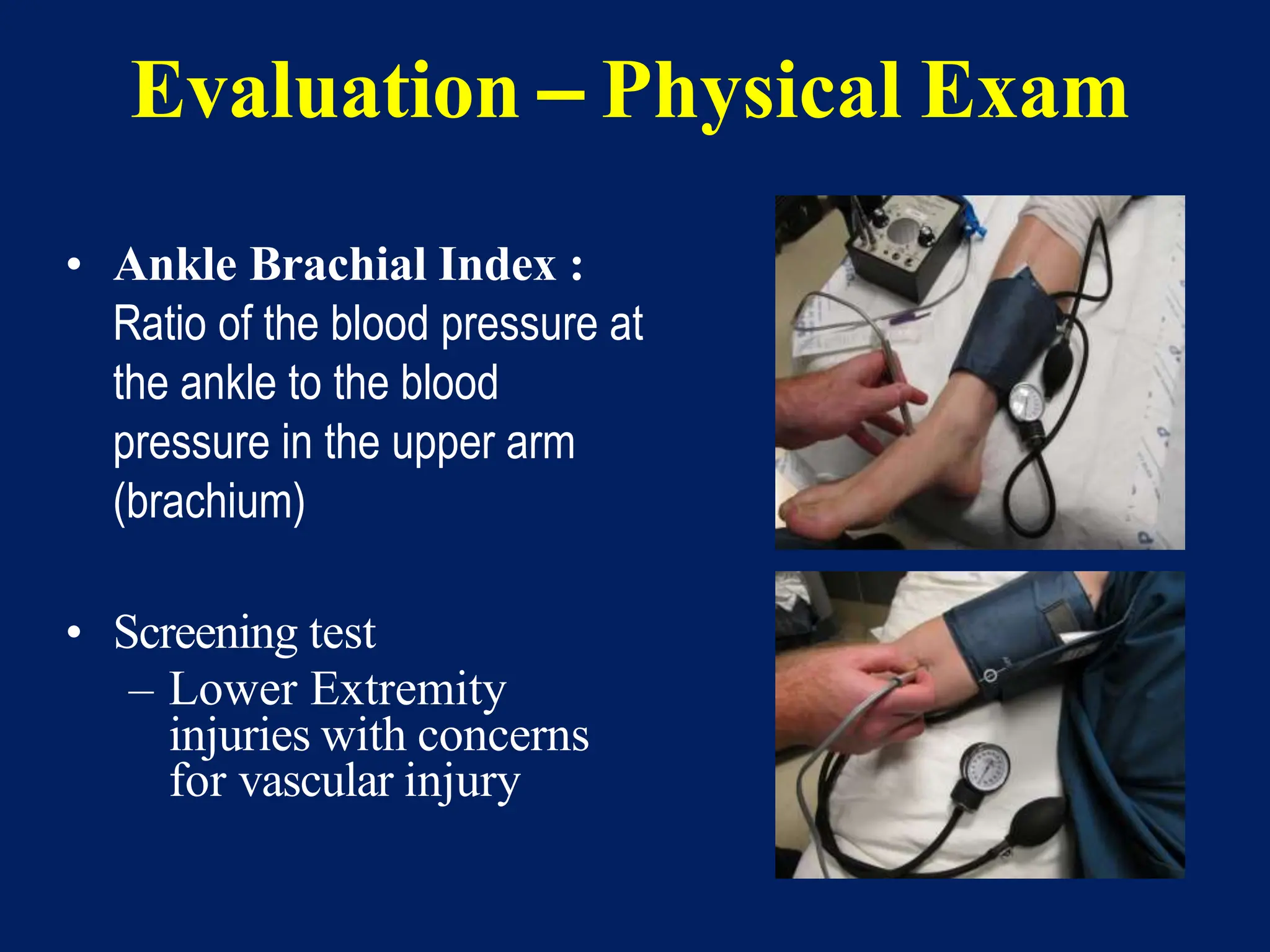
• Ankle Brachial Index :
Ratio of the blood pressure at
the ankle to the blood
pressure in the upper arm
(brachium)
• Screening test
– Lower Extremity
injuries with concerns
for vascular injury
Evaluation–Physical Exam
Ankle Brachial Index
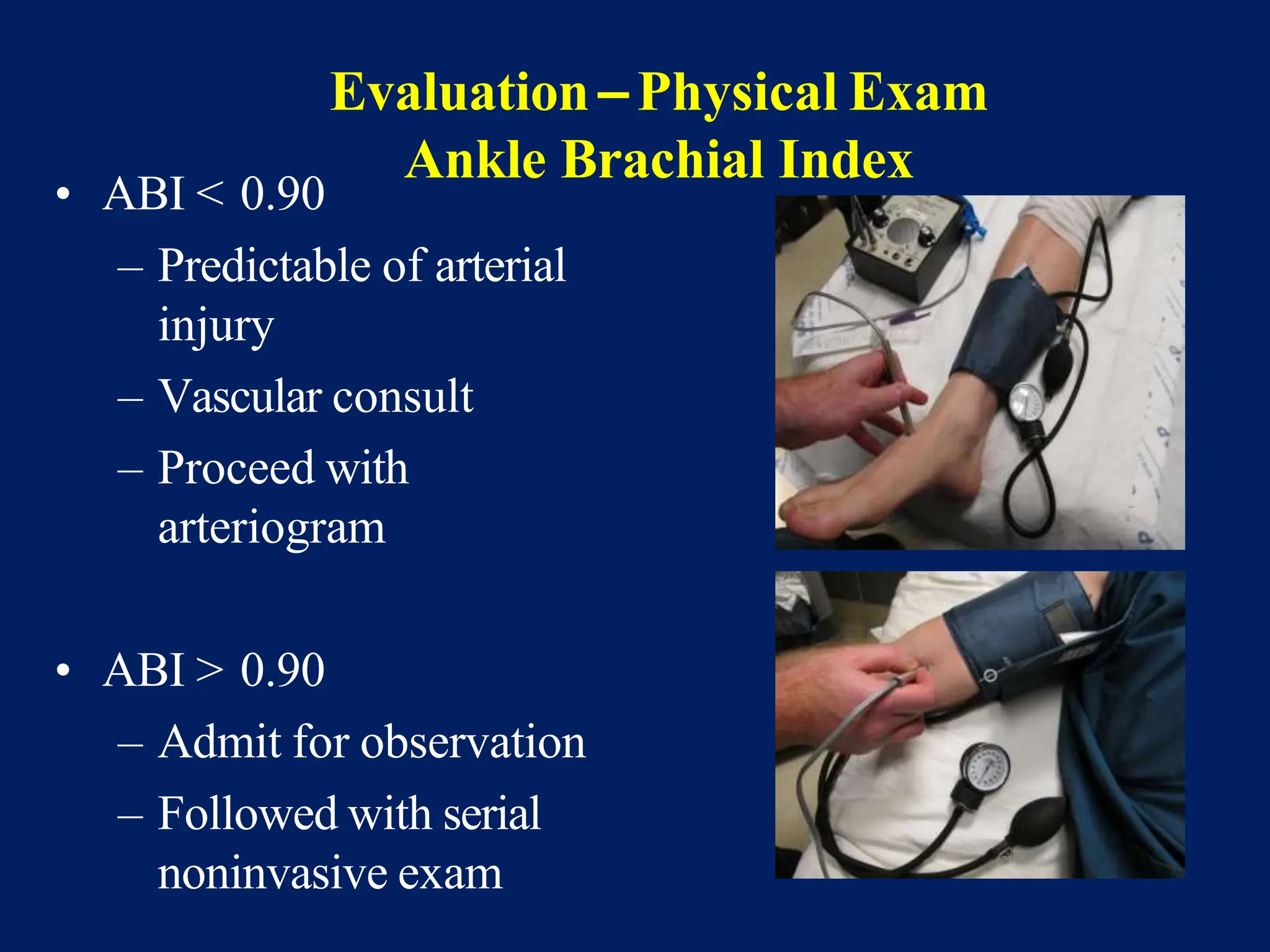
• ABI < 0.90
– Predictable of arterial
injury
– Vascular consult
– Proceed with
arteriogram
• ABI > 0.90
– Admit for observation
– Followed with serial
noninvasive exam
Evaluation - Radiographic
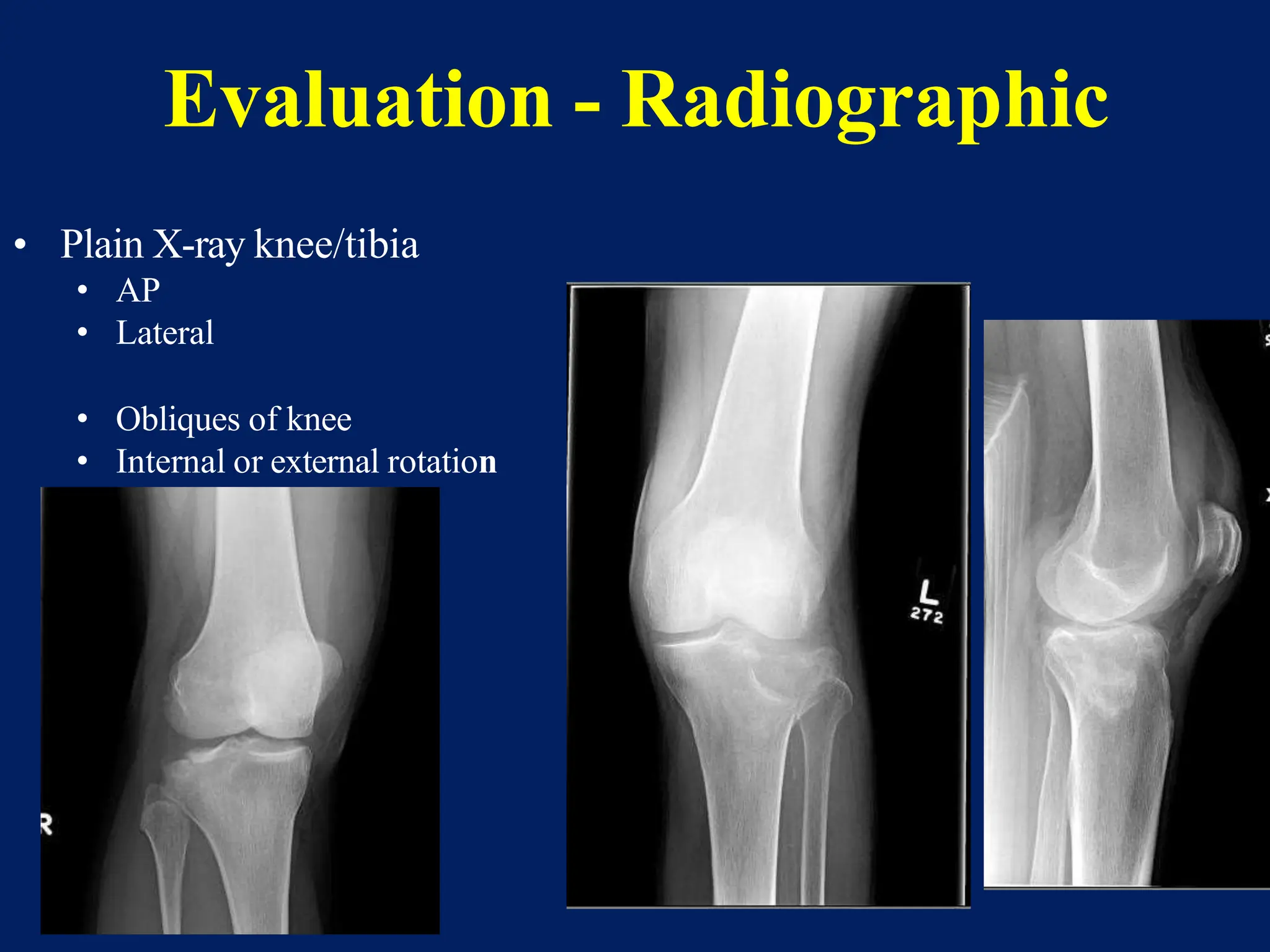
• Plain X-ray knee/tibia
• AP
• Lateral
• Obliques of knee
• Internal or external rotation
Evaluation - Radiographic
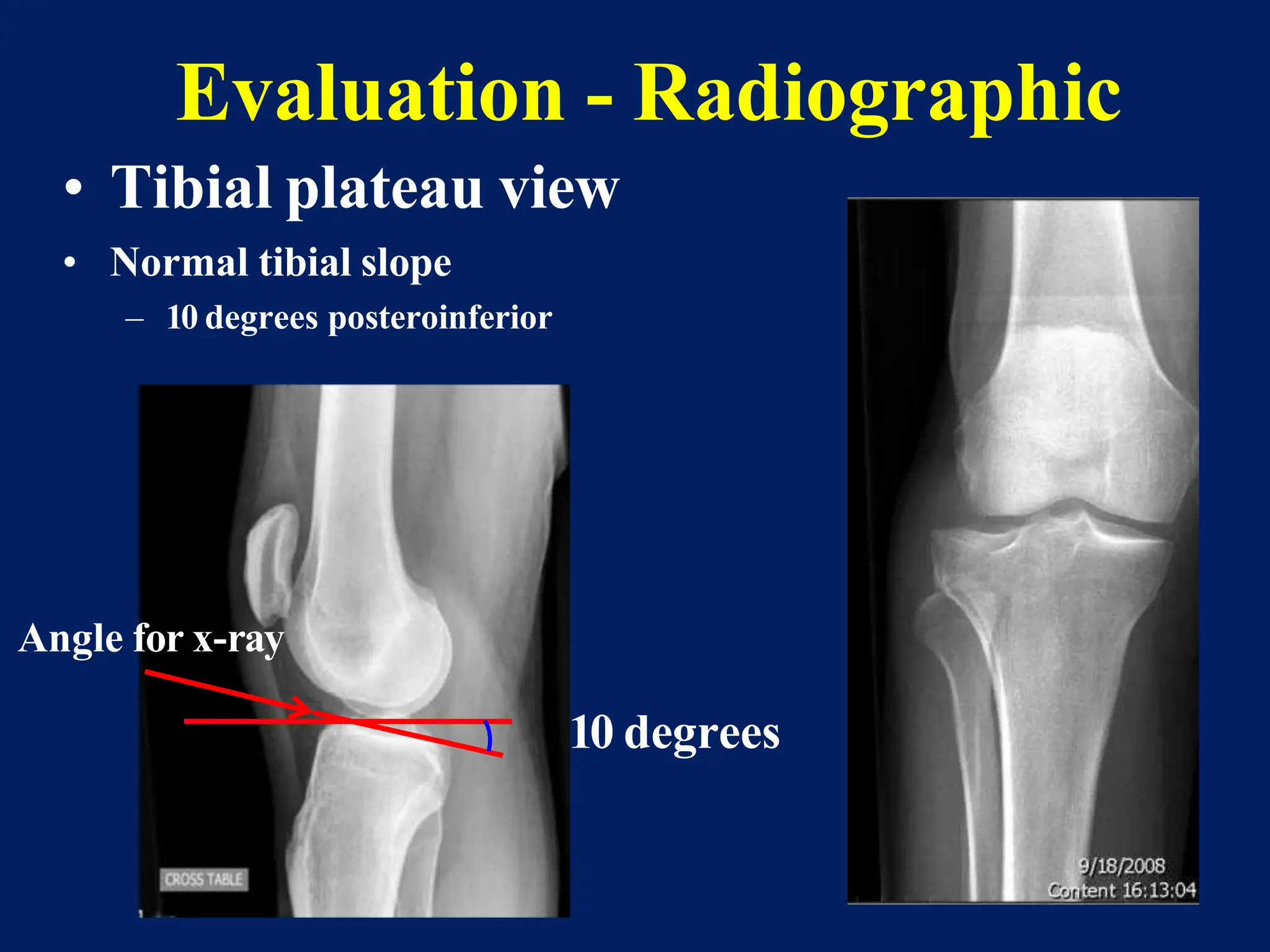
• Tibial plateau view
• Normal tibial slope
– 10 degrees posteroinferior
10 degrees
Angle for x-ray
Evaluation - Radiographic
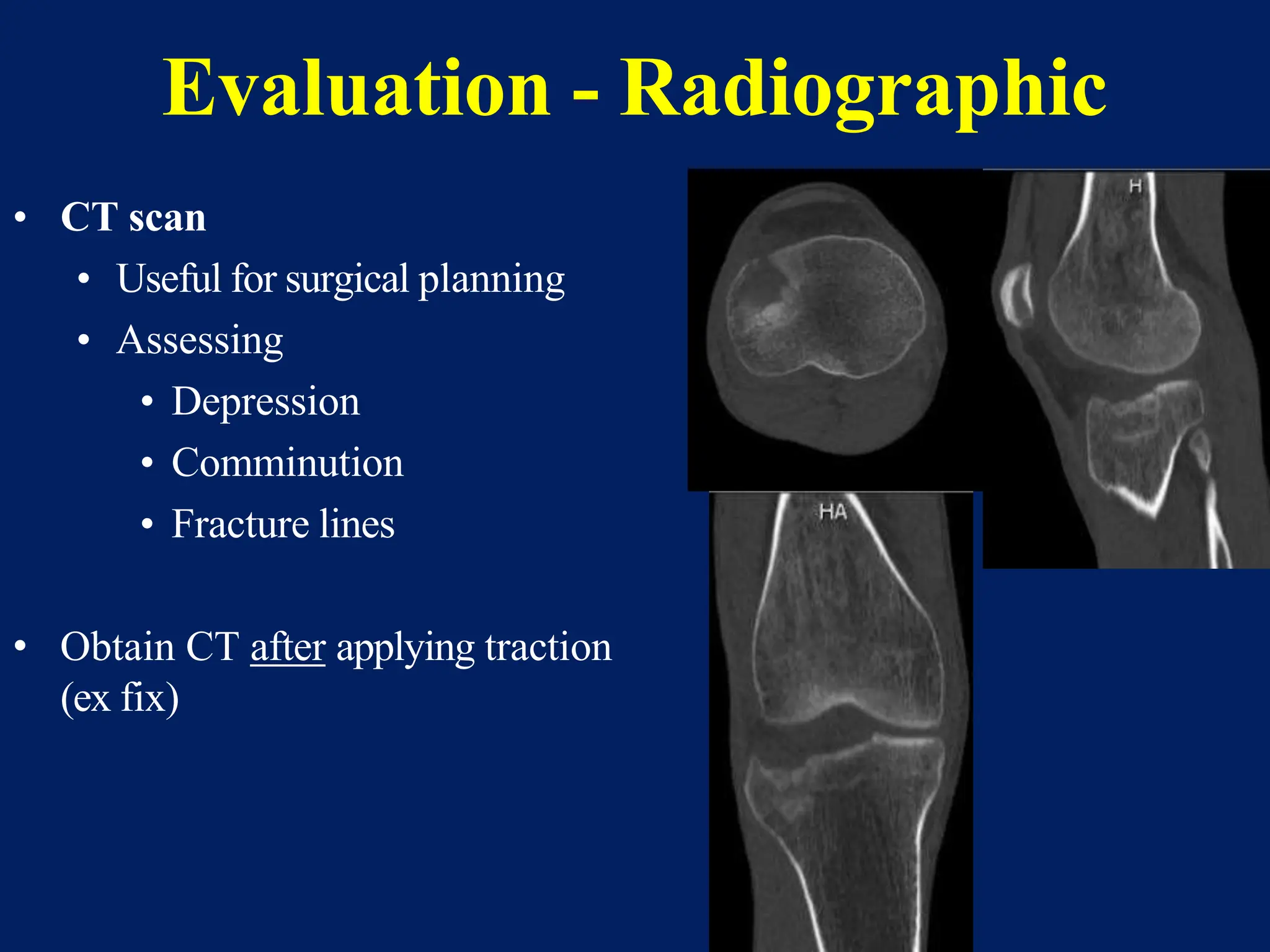
• CT scan
• Useful for surgical planning
• Assessing
• Depression
• Comminution
• Fracture lines
• Obtain CT after applying traction
(ex fix)
Evaluation - Radiographic
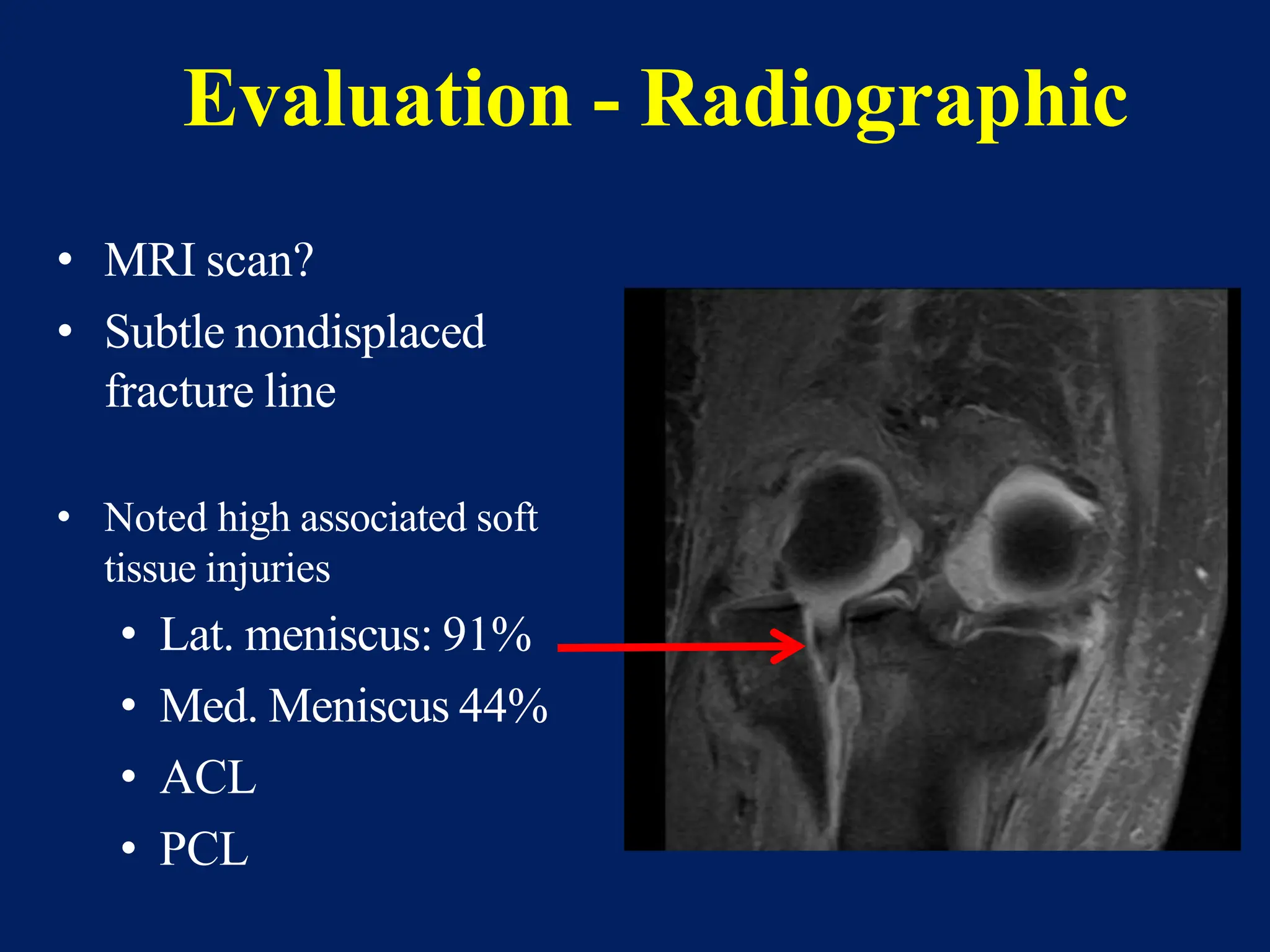
• MRI scan?
• Subtle nondisplaced
fracture line
• Noted high associated soft
tissue injuries
• Lat. meniscus: 91%
• Med. Meniscus 44%
• ACL
• PCL
Classification
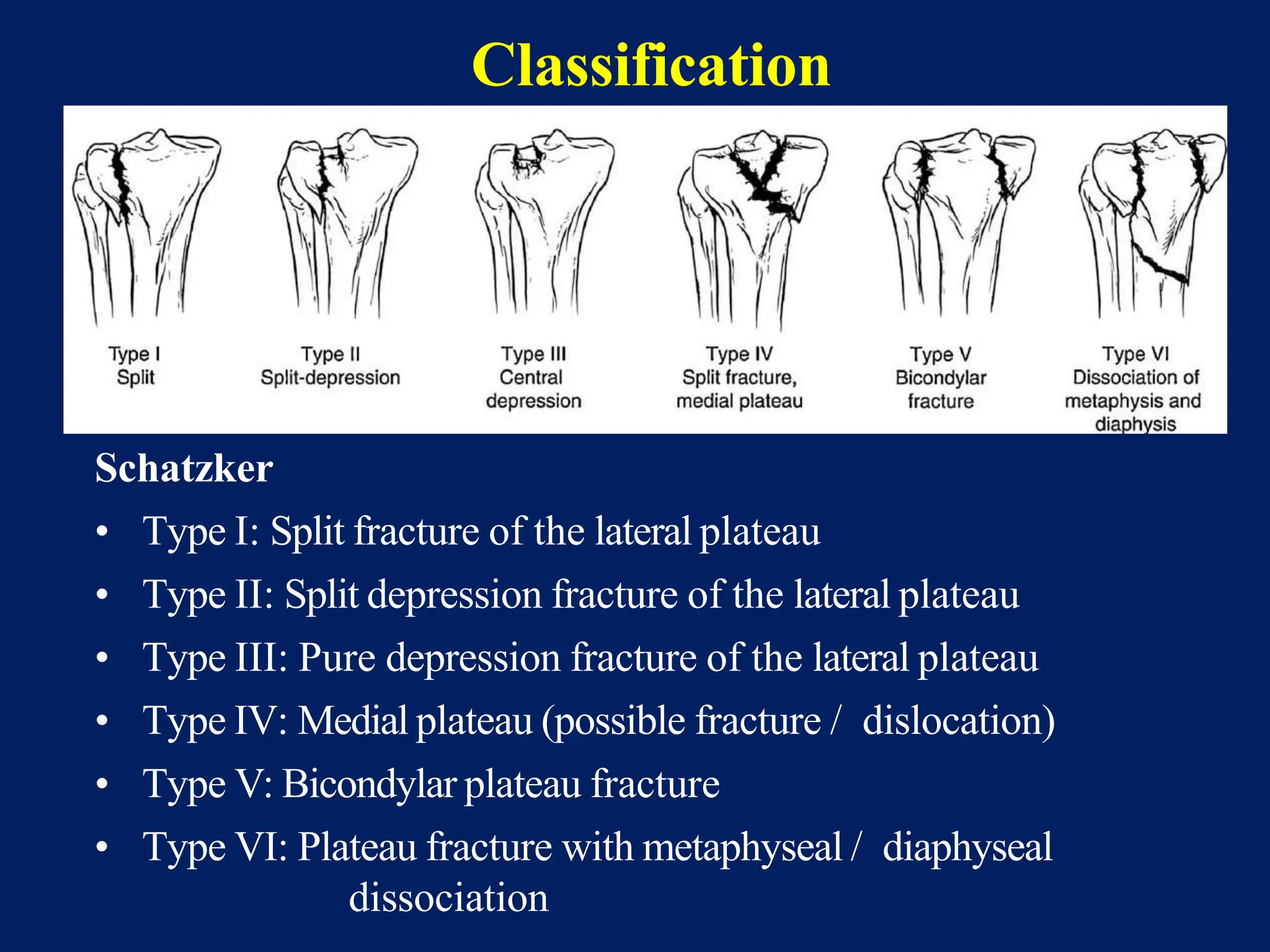
Schatzker
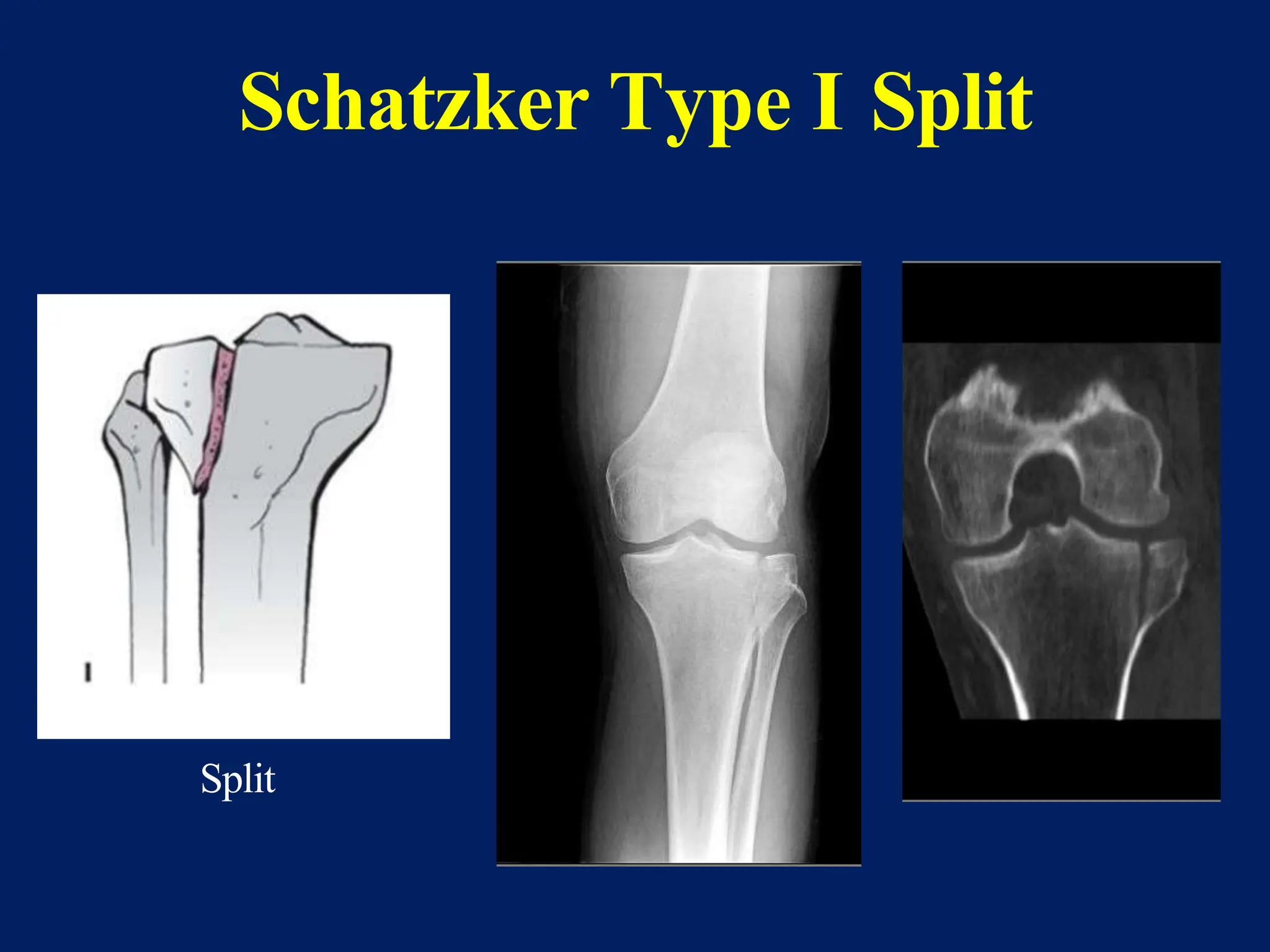
• Type I: Split fracture of the lateral plateau
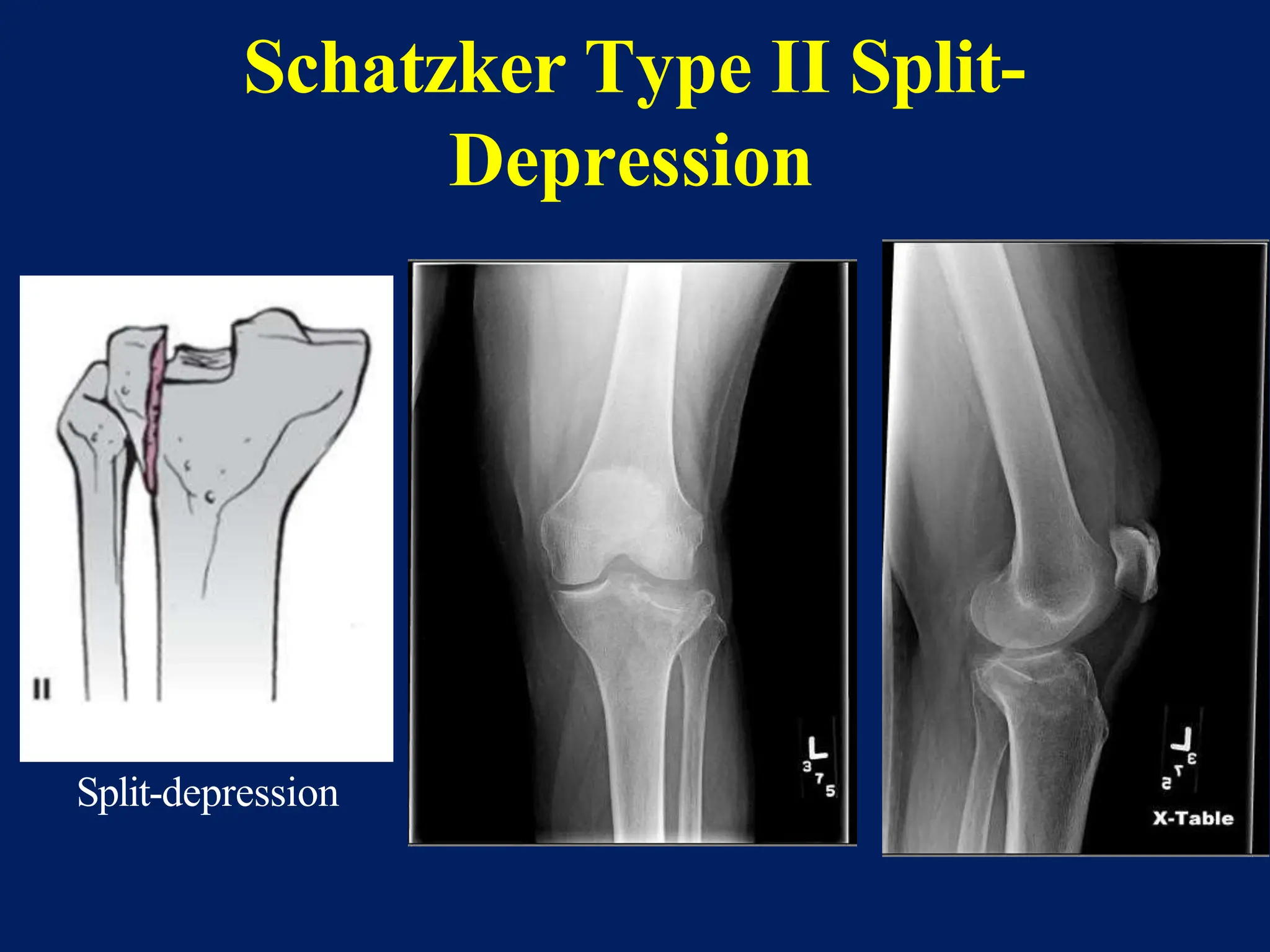
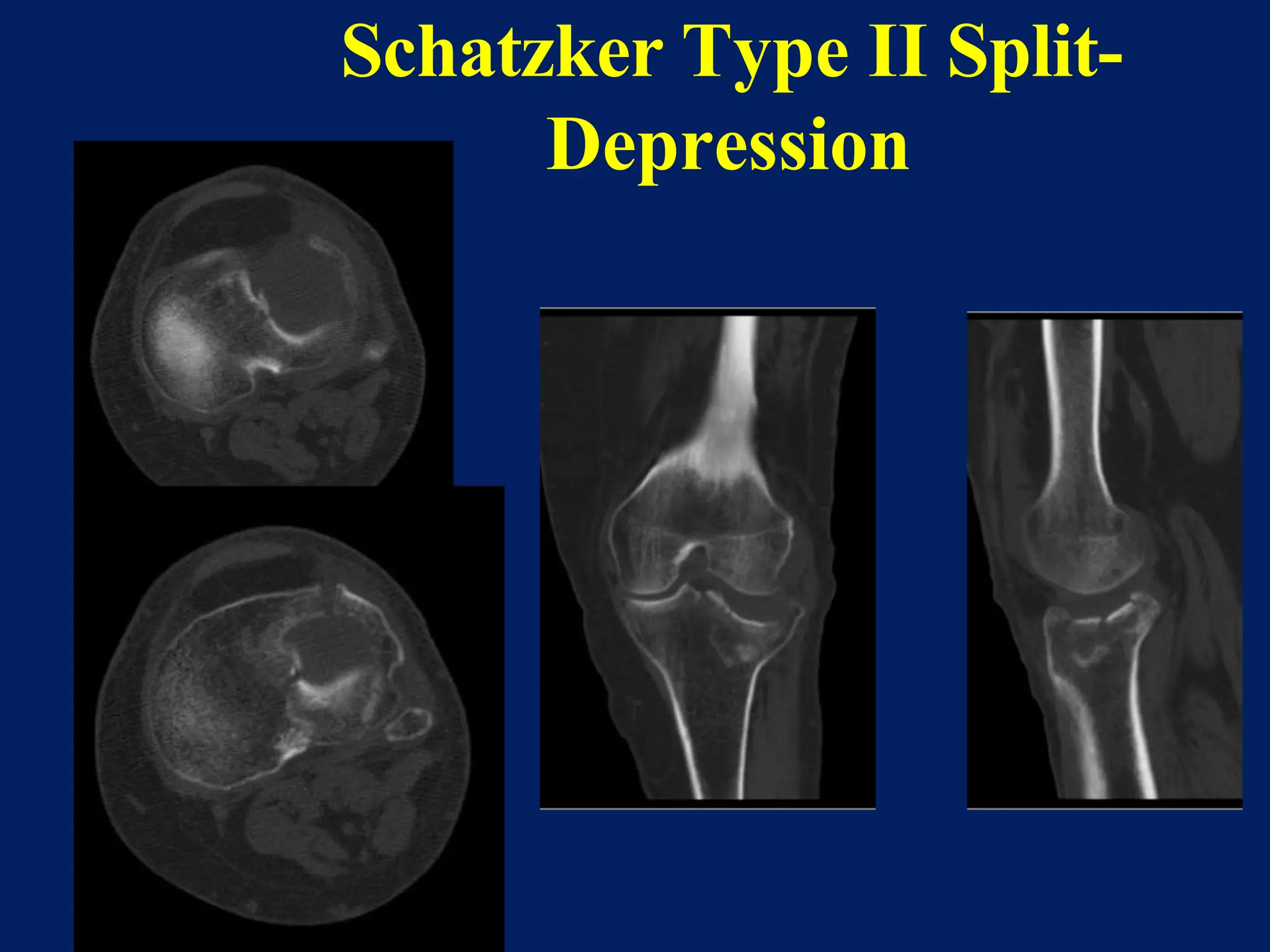
• Type II: Split depression fracture of the lateral plateau
• Type III: Pure depression fracture of the lateral plateau
• Type IV: Medial plateau (possible fracture / dislocation)
• Type V: Bicondylar plateau fracture
• Type VI: Plateau fracture with metaphyseal / diaphyseal
dissociation
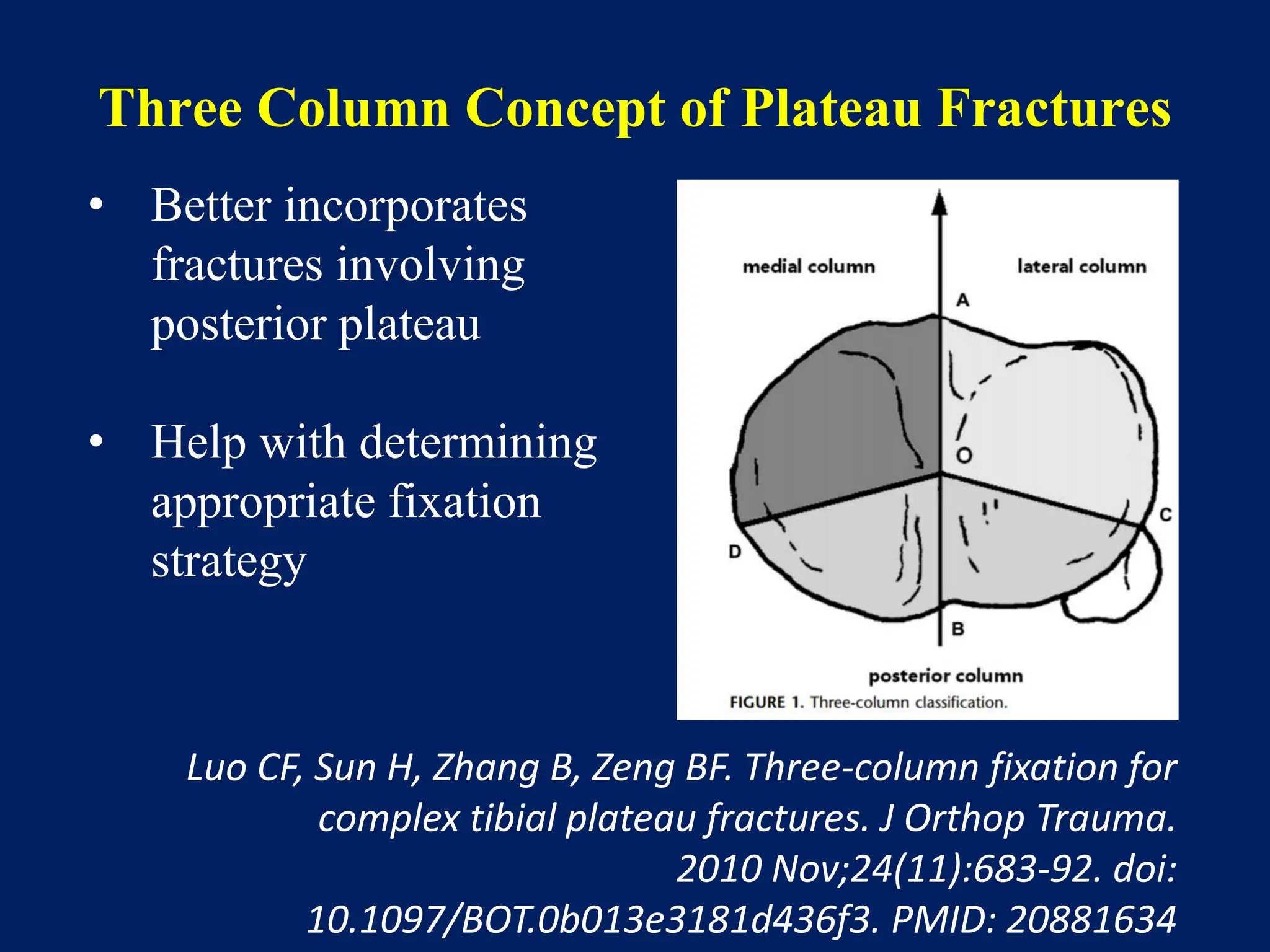
Three Column Concept of Plateau Fractures
• Better incorporates
fractures involving
posterior plateau
• Help with determining
appropriate fixation
strategy
Luo CF, Sun H, Zhang B, Zeng BF. Three-column fixation for
complex tibial plateau fractures. J Orthop Trauma.
2010 Nov;24(11):683-92. doi:
10.1097/BOT.0b013e3181d436f3. PMID: 20881634
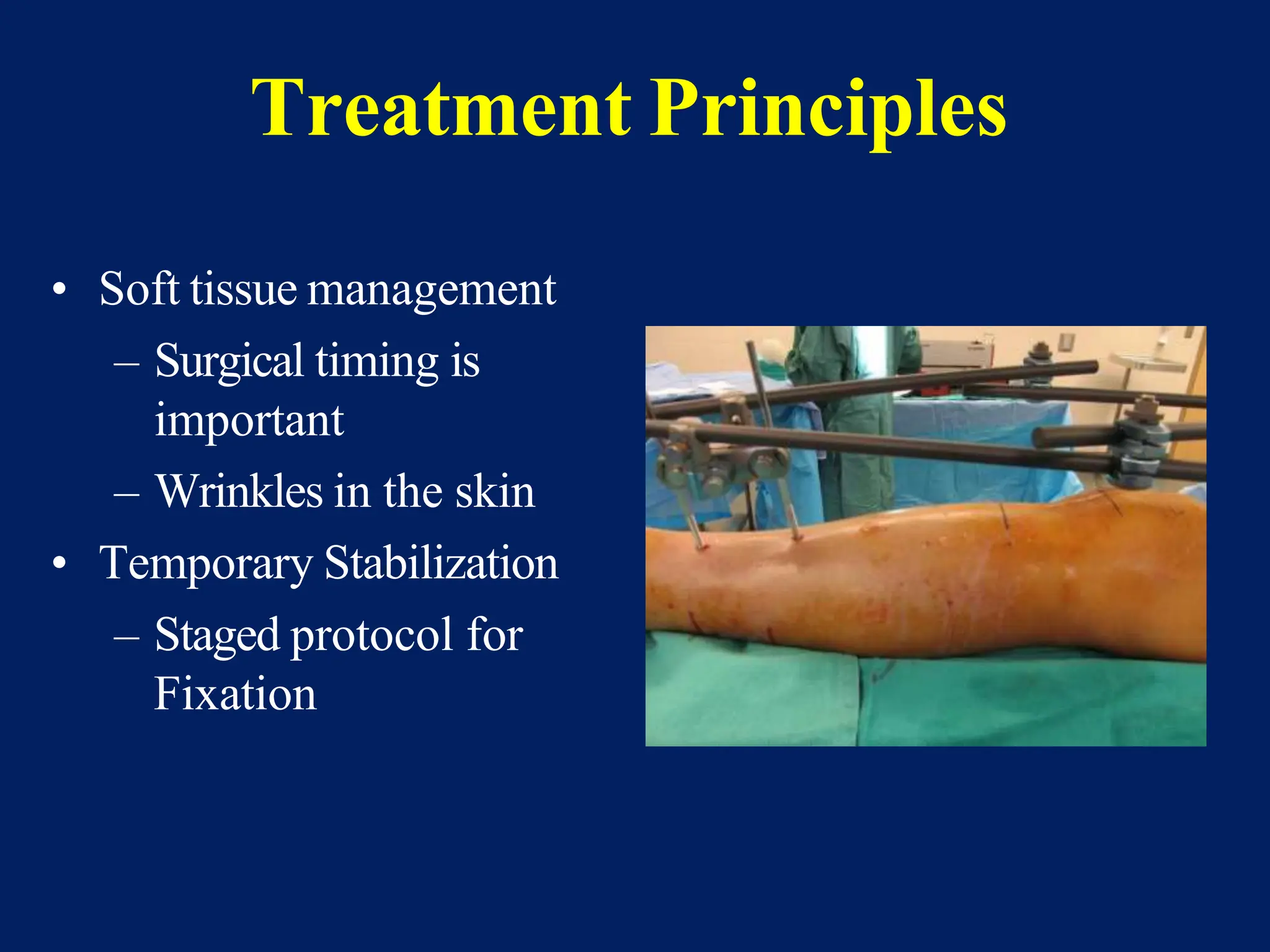
Treatment Principles
• Soft tissue management
– Surgical timing is
important
– Wrinkles in the skin
• Temporary Stabilization
– Staged protocol for
Fixation
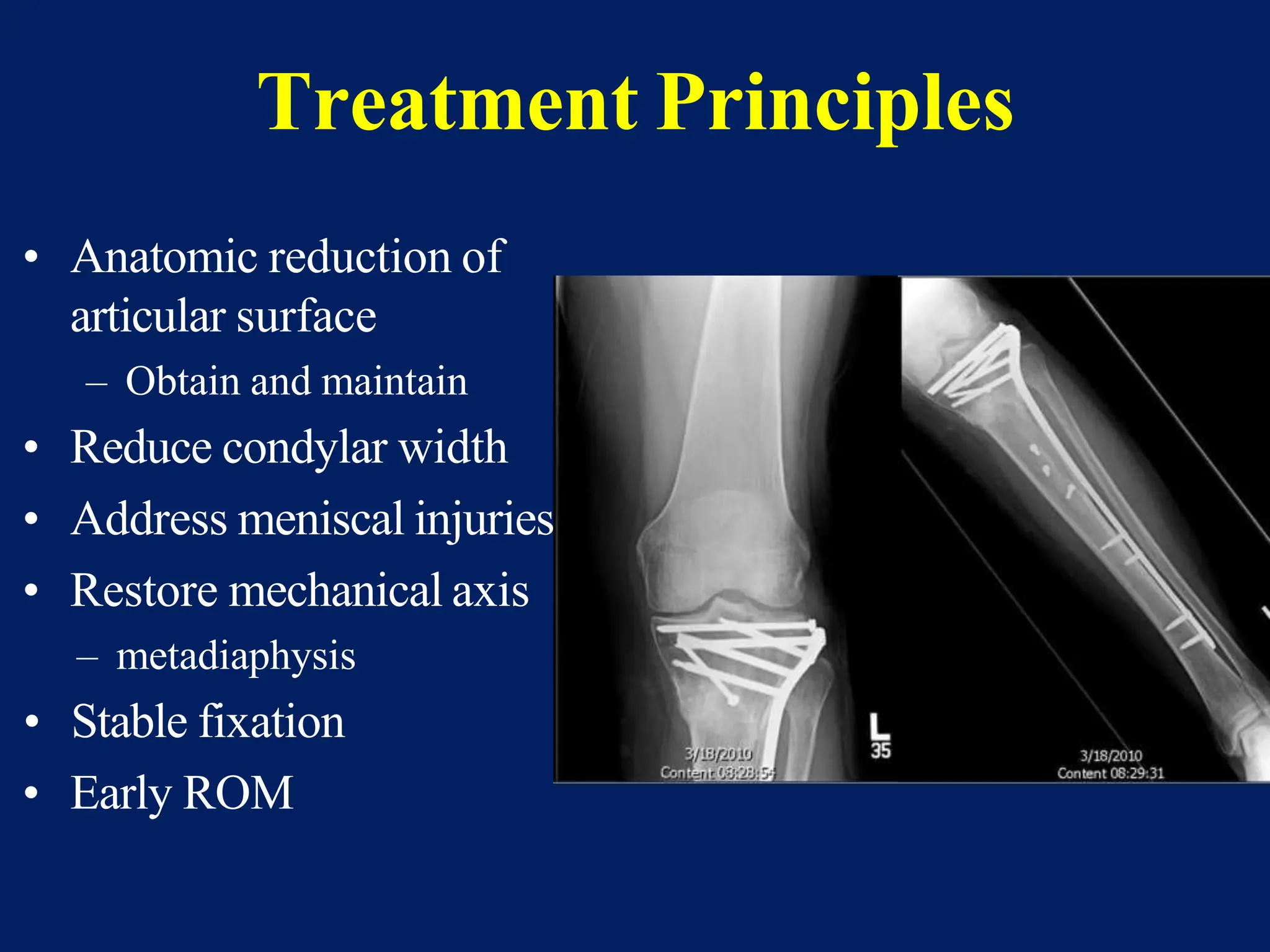
Treatment Principles
• Anatomic reduction of
articular surface
– Obtain and maintain
• Reduce condylar width
• Address meniscal injuries
• Restore mechanical axis
– metadiaphysis
• Stable fixation
• Early ROM
Treatment Options:
Nonsurgical
• Patient factors
– Elderly
– Nonambulatory
– Pre-existing arthritis
• Injury factors
– Articular incongruity
– <5 mm, elderly, sedentary
activity
– Stable Varus / Valgus
stress
• < 5 -10 degrees instability
71 y/o male, multiple med. comorbidities
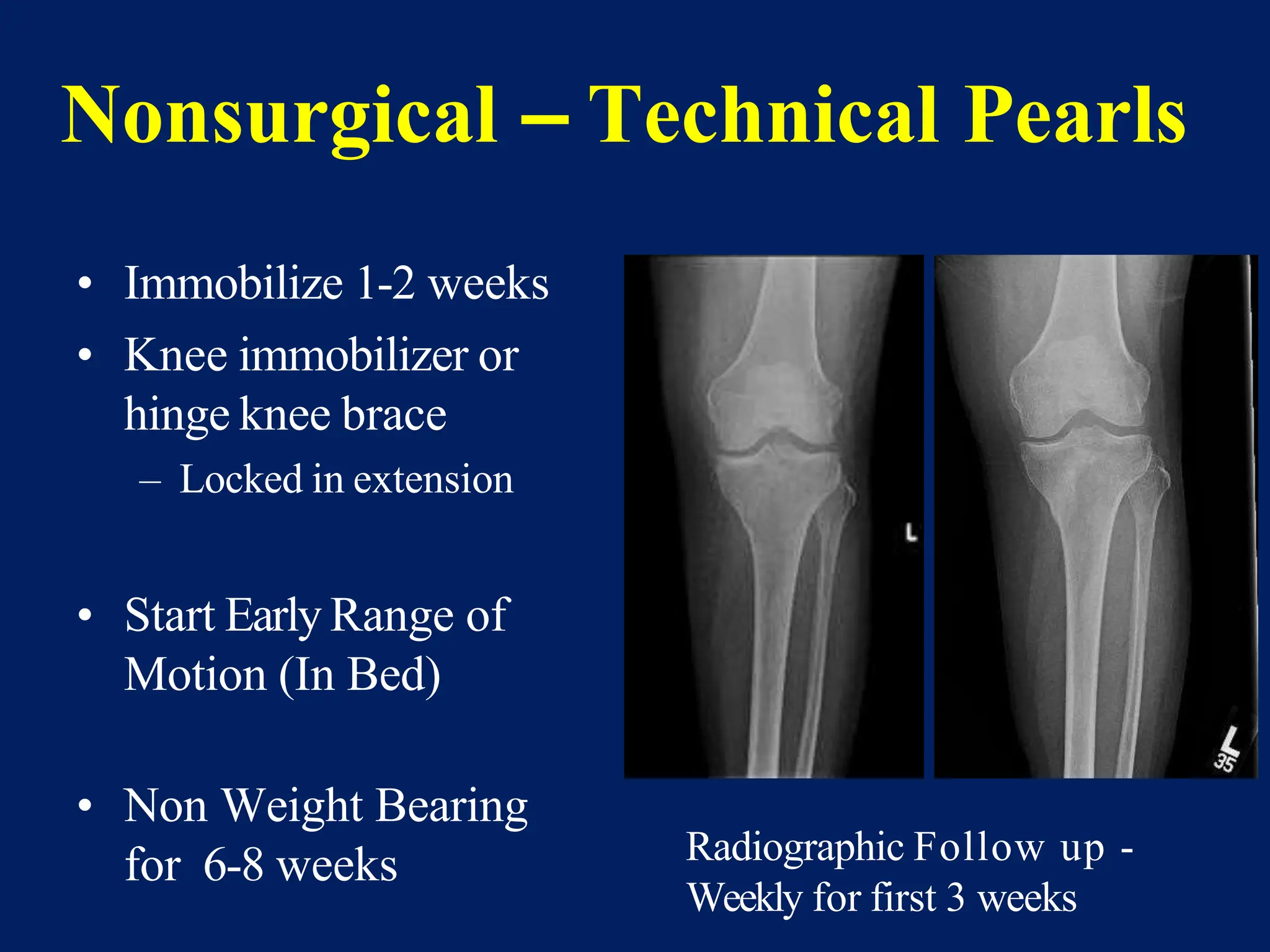
Nonsurgical – Technical Pearls
• Immobilize 1-2 weeks
• Knee immobilizer or
hinge knee brace
– Locked in extension
• Start Early Range of
Motion (In Bed)
• Non Weight Bearing
for 6-8 weeks Radiographic Follow up -
Weekly for first 3 weeks
Indications for Surgery
Absolute indications:
• Open tibial plateau
• Associated
compartment syndrome
• Associated vascular
injury
Indications for Surgery
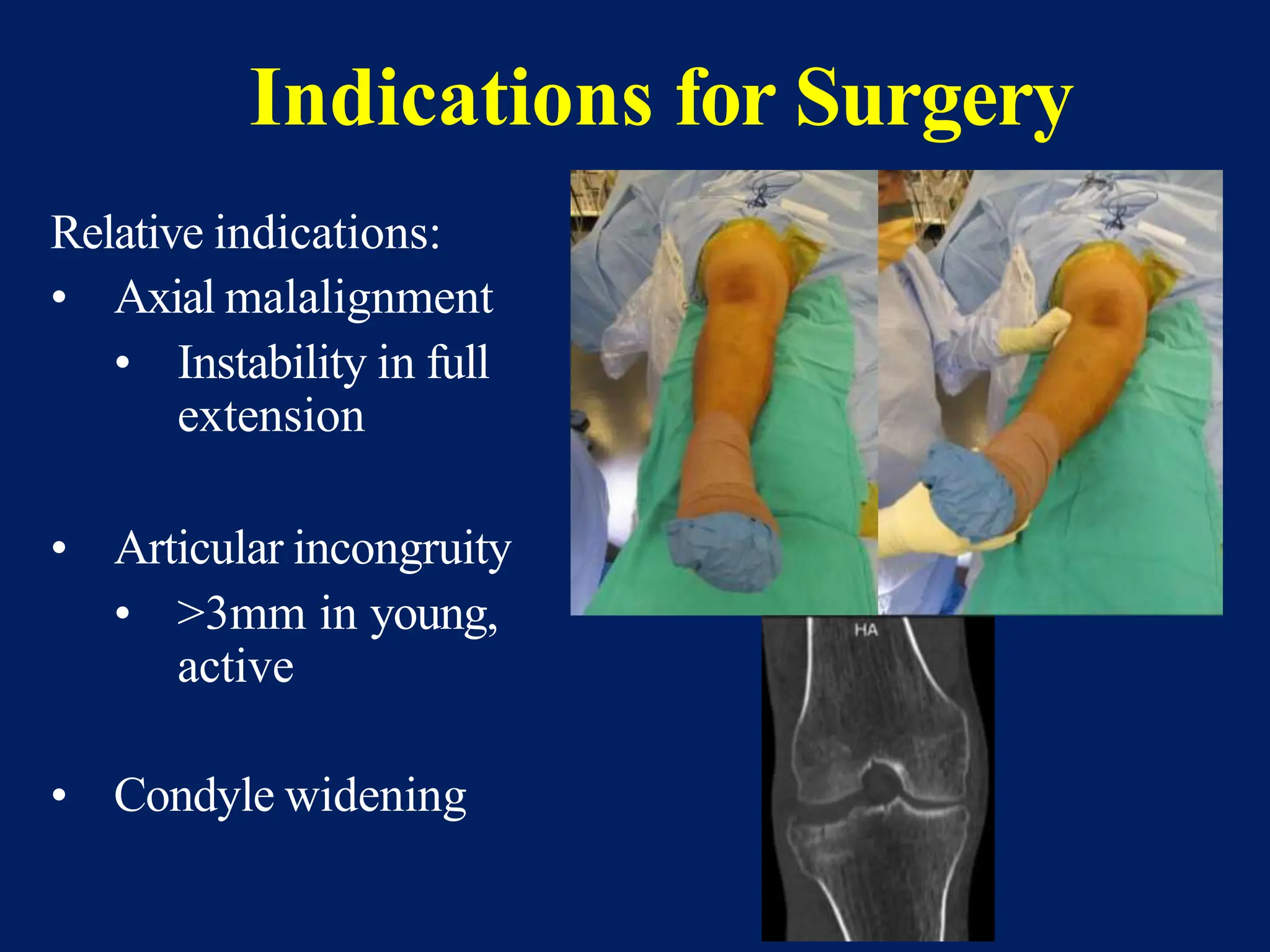
Relative indications:
• Axial malalignment
• Instability in full
extension
• Articular incongruity
• >3mm in young,
active
• Condyle widening
Indications for Surgery
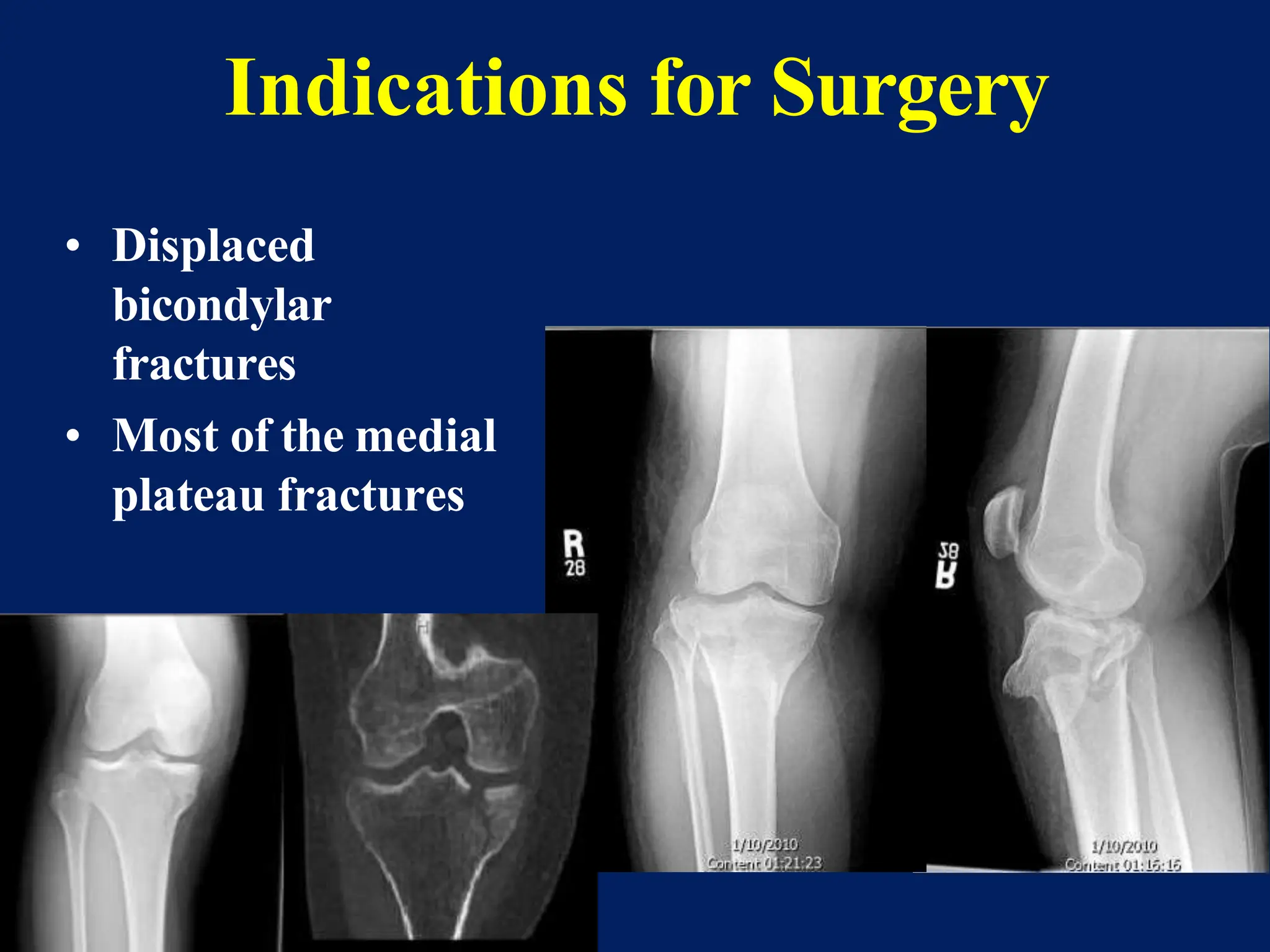
• Displaced
bicondylar
fractures
• Most of the medial
plateau fractures
Timing of Surgery
Low Energy:
Fixed electively and early
High Energy:
Don’t Hurry, Have patience
Temporary External Fixation
• Knee spanning external
fixation
• Ligamentotaxis
• Improve fracture fragment
gross alignment
– Length and alignment
• Minimize further damage
to articular surface
• Soft tissue assessment and
wound care
Temporary External Fixation
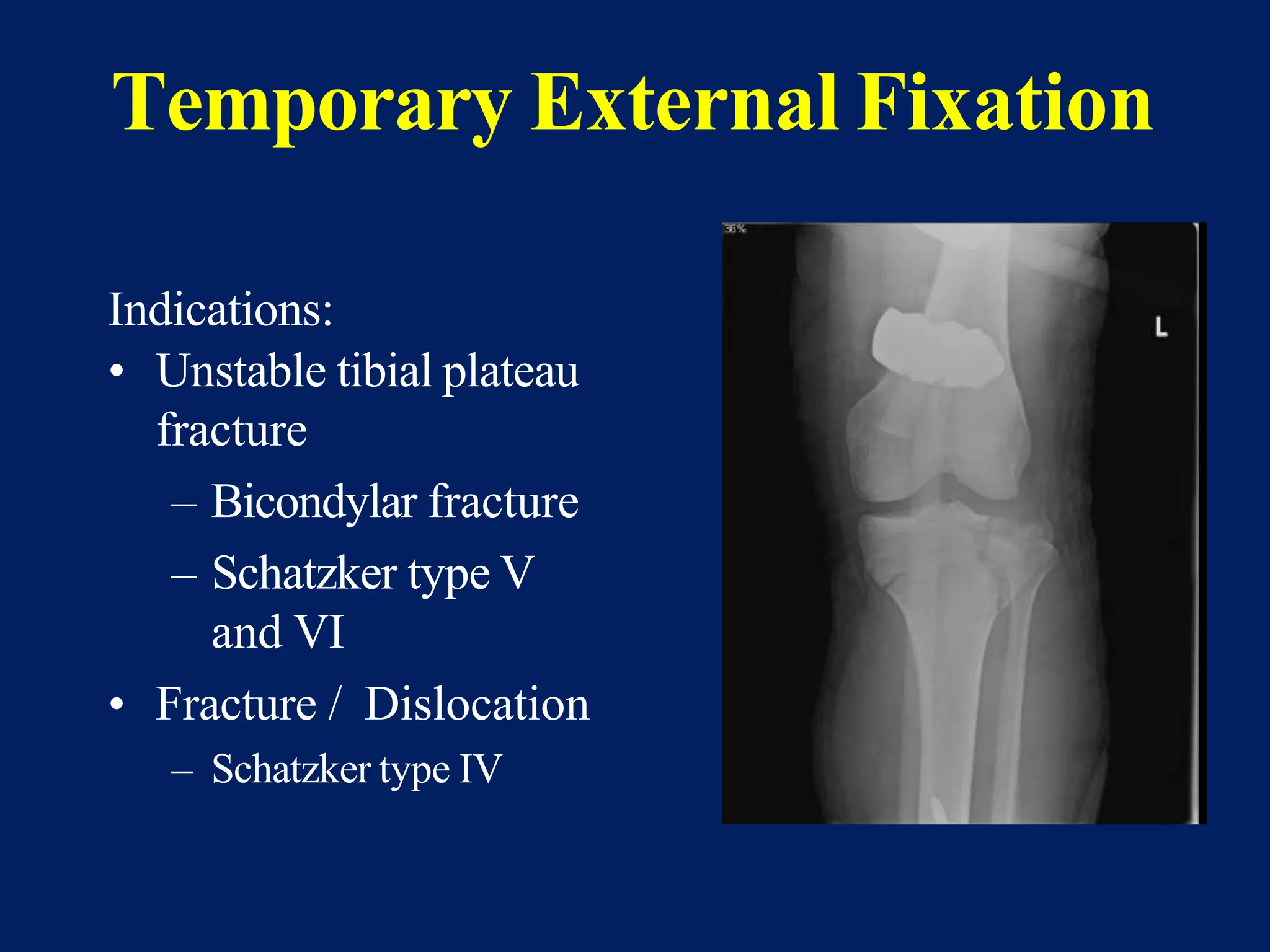
Indications:
• Unstable tibial plateau
fracture
– Bicondylar fracture
– Schatzker type V
and VI
• Fracture / Dislocation
– Schatzker type IV
External Fixation
• 2 pins in femur
– Anterior or lateral
• 2 pins in tibia
– Antero-medial
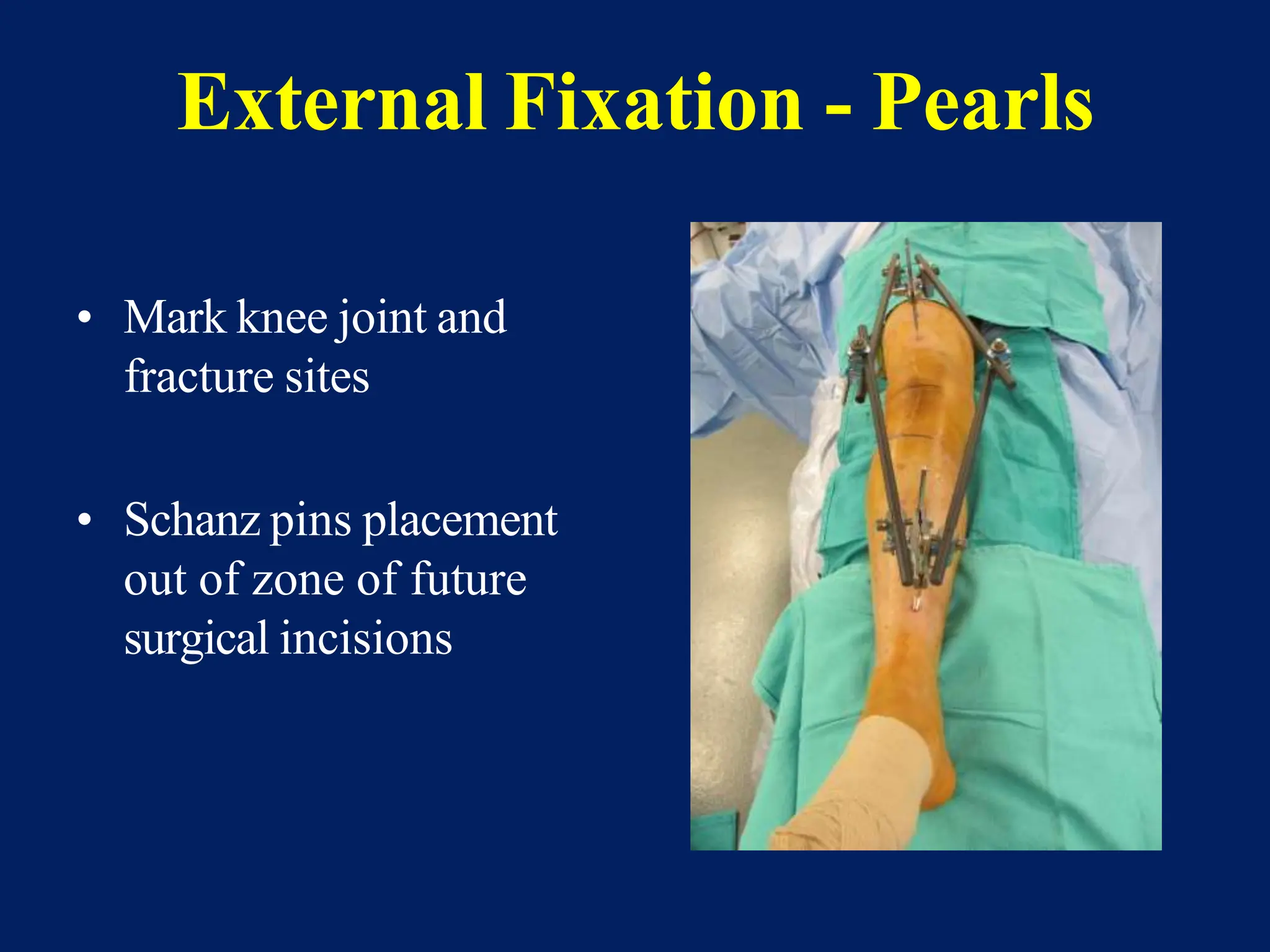
External Fixation - Pearls
• Mark knee joint and
fracture sites
• Schanz pins placement
out of zone of future
surgical incisions
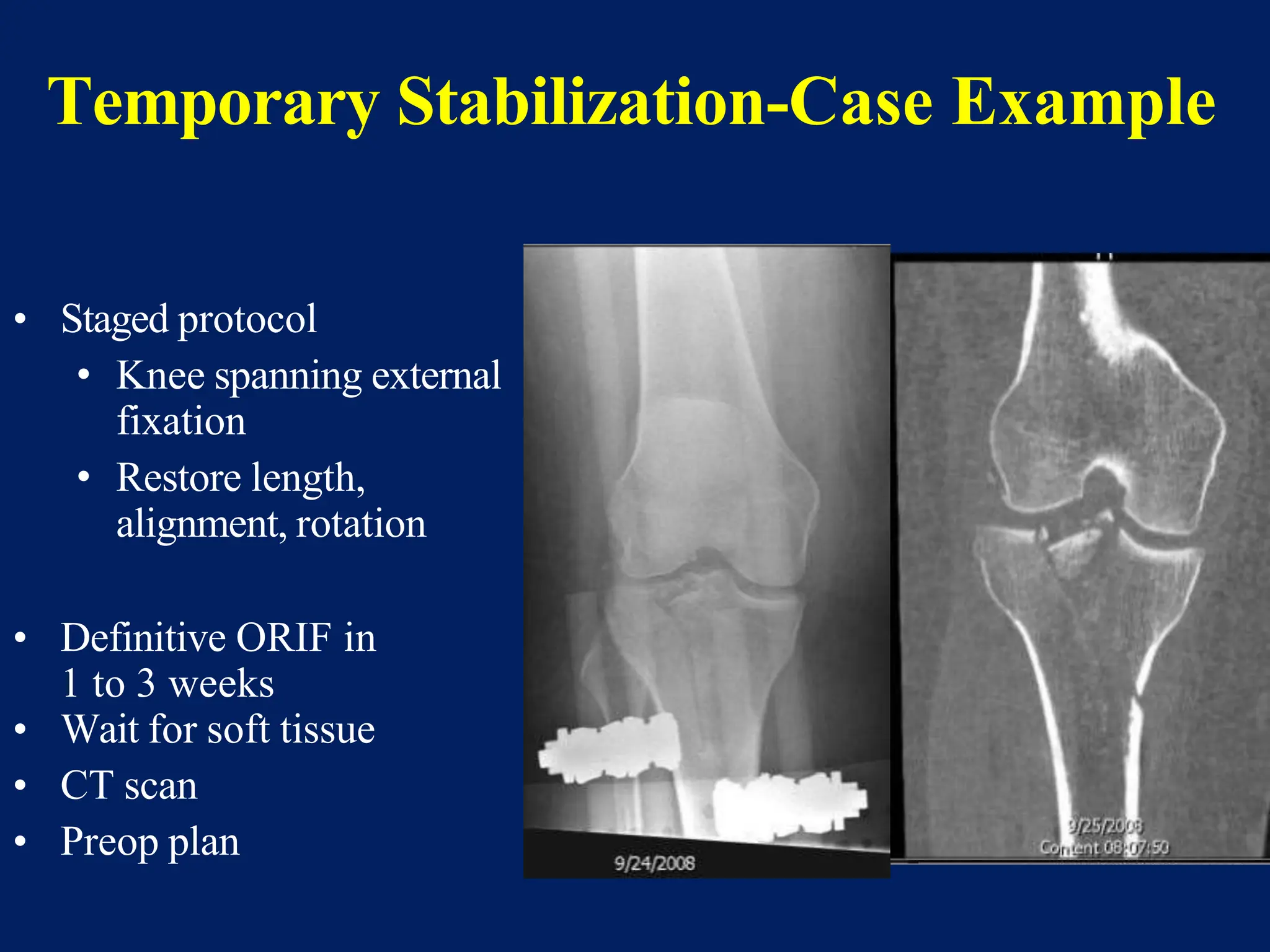
Temporary Stabilization-Case Example
• Staged protocol
• Knee spanning external
fixation
• Restore length,
alignment, rotation
• Definitive ORIF in
1 to 3 weeks
• Wait for soft tissue
• CT scan
• Preop plan
Calcaneum Traction if Ex Fix is
Not Applied in Complex cases
Using Ilizarov Wire and Half Ring
ORIF- Equipment
• Femoral
distractor/
Manual Traction
• Osteotomes
• Bone tamps /
Punch
• Fracture reduction
instruments
• K-wires
ORIF- Implant options
• Unicondylar fracture
• Conventional non-
locking plate
– “L” or “T” plate
– Buttress
• Pre-contoured
periarticular plates
• Raft screws alone
– 3.5mm or 4.5mm
• Locking plate
– Osteoporotic bone
ORIF- Implant Options
• Angular stable (Locking)
implants
• Precontoured for
proximal tibia
• Bicondylar tibia plateau
with metadiaphyseal
involvement
• Spanning or bridging
across fracture zone
• Selected fracture, allows
stabilization of medial
plateau
External Fixation
• Limited internal fixation
– Small incisions or
percutaneous
• Thin-wire ring fixators
– Connect to the shaft
– Fixation distally with 5mm
half-pins
• Advantages
– Minimize soft tissue injury
• Still need to reduce articular
surface!!! May need a
screw!
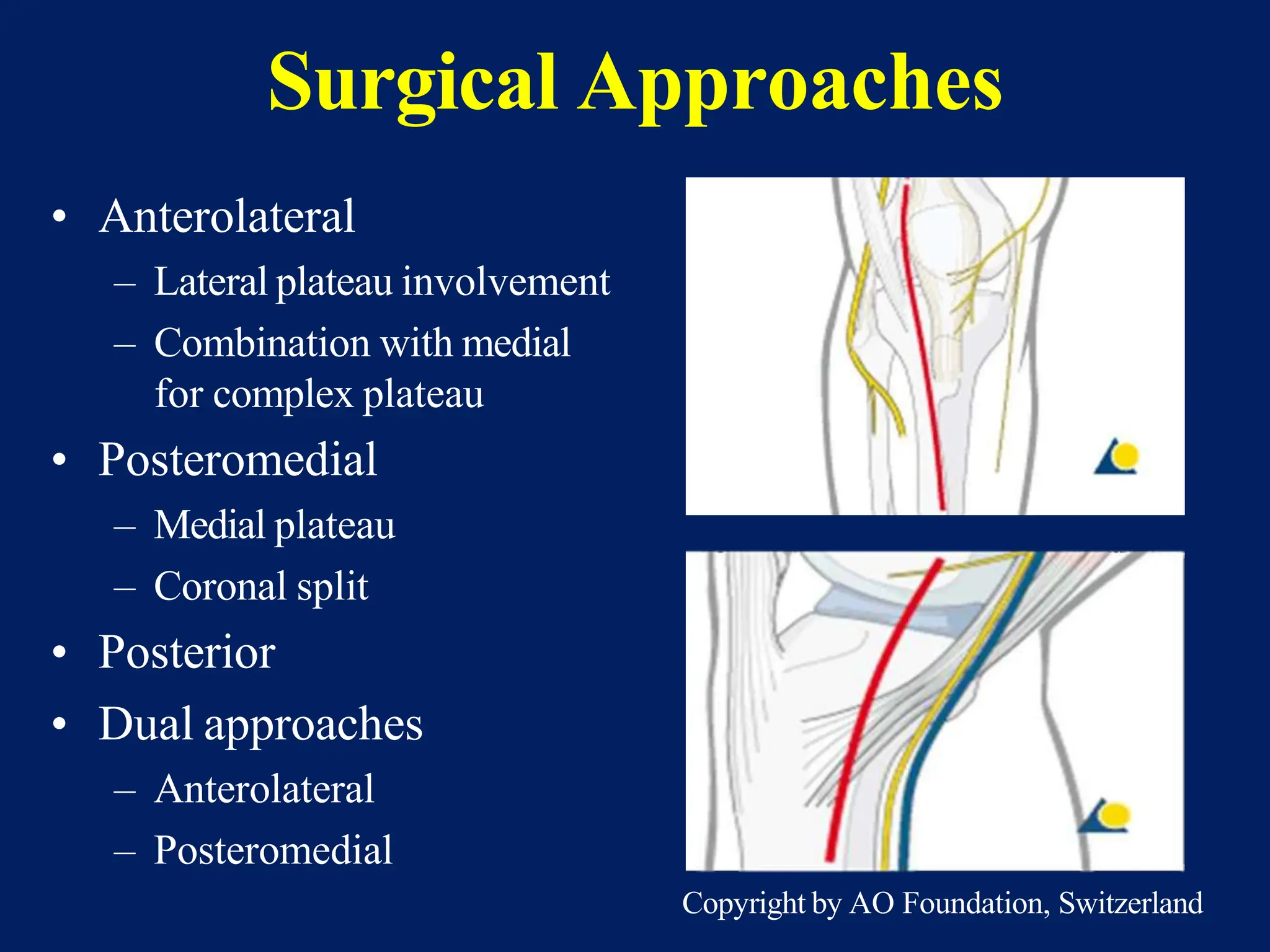
Surgical Approaches
• Anterolateral
– Lateral plateau involvement
– Combination with medial
for complex plateau
• Posteromedial
– Medial plateau
– Coronal split
• Posterior
• Dual approaches
– Anterolateral
– Posteromedial
Copyright by AO Foundation, Switzerland
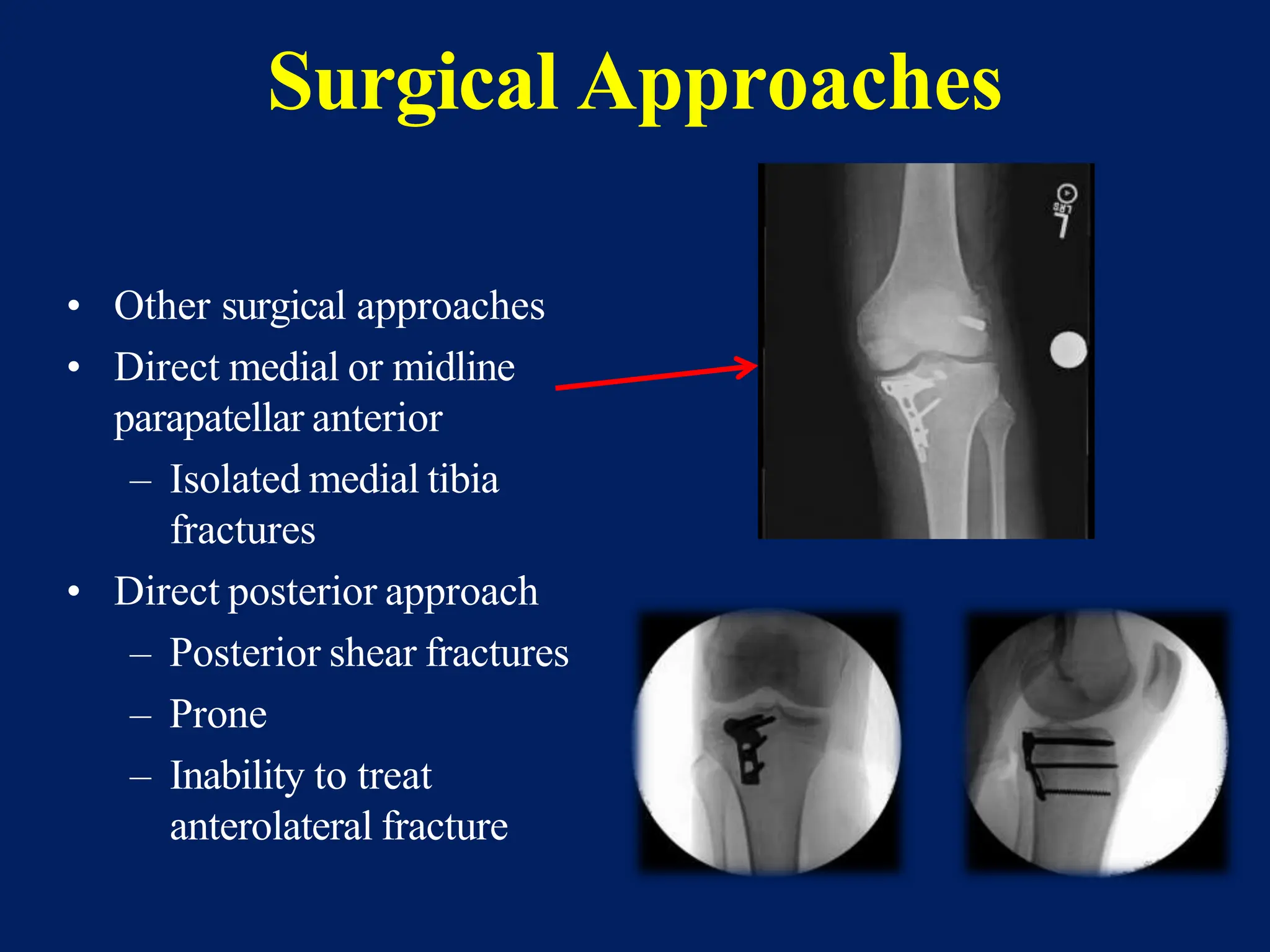
Surgical Approaches
• Other surgical approaches
• Direct medial or midline
parapatellar anterior
– Isolated medial tibia
fractures
• Direct posterior approach
– Posterior shear fractures
– Prone
– Inability to treat
anterolateral fracture
Treatment of Specific
Schatzker Fractures Types
Schatzker Type I Split
Split
• Goals:
• Restore articular congruity
• Articular step off
• Condylar widening
• Open vs.. percutaneous
• Fixation
• Lag screws
• Buttress plate
Schatzker Type I Split
Schatzker Type II Split-
Depression
Split-depression
Schatzker Type II Split-
Depression
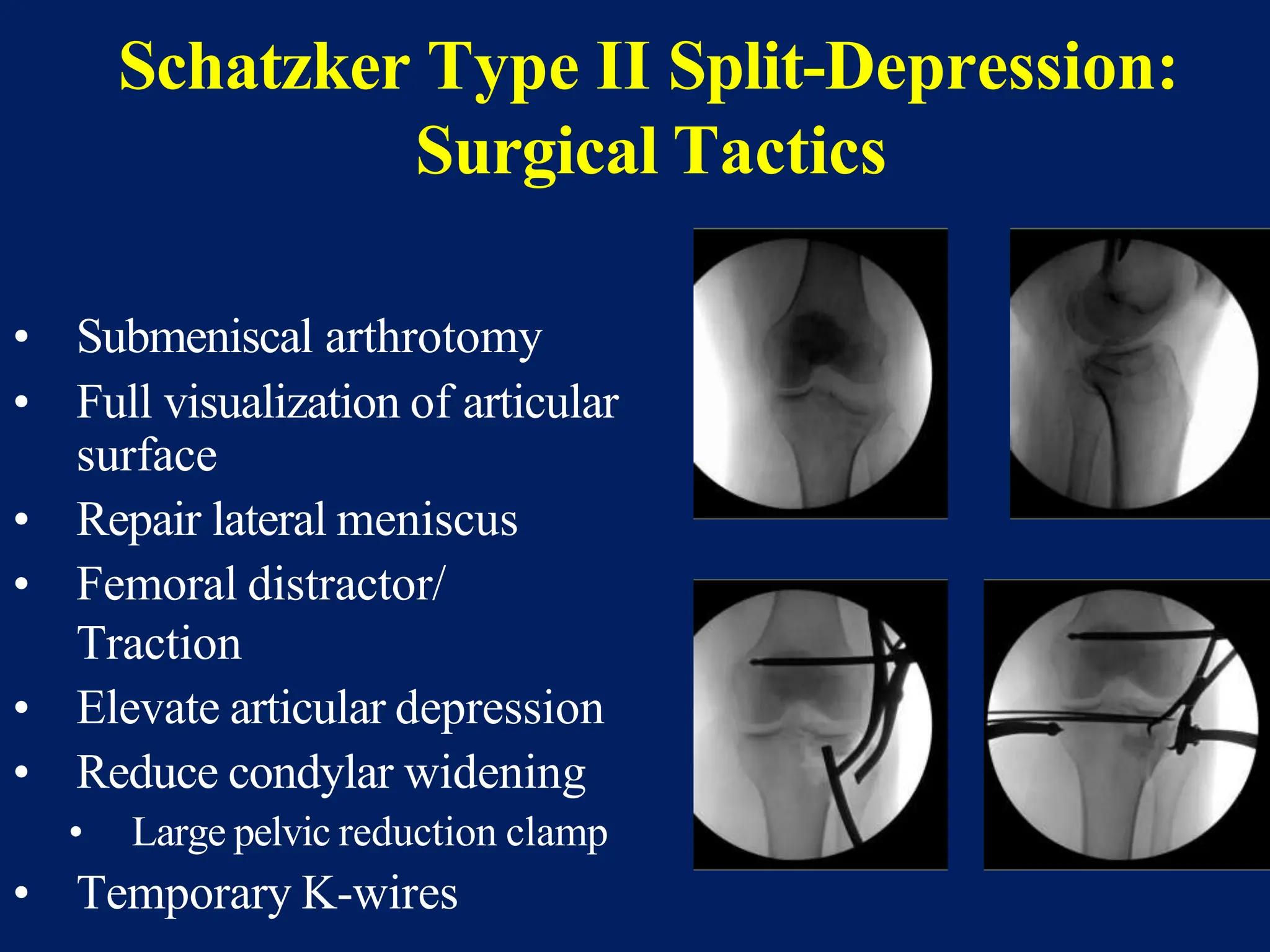
• Submeniscal arthrotomy
• Full visualization of articular
surface
• Repair lateral meniscus
• Femoral distractor/
Traction
• Elevate articular depression
• Reduce condylar widening
• Large pelvic reduction clamp
• Temporary K-wires
Schatzker Type II Split-Depression:
Surgical Tactics
Schatzker Type II Split-Depression
• Fill defect
• Allograft
• Autograft
• Bone substitutes
• Buttress plate
• Nonlocking: Most
• Locked: osteoporotic
bone
• Subchondral raft screws
Schatzker Type III Pure Depression
Central depression
• Surgical technique
• Open approach
• Submeniscal
• Arthroscopic
• Elevate depressed fragment
• Fill defect
• Stabilization
• Subchondral raft screws
Schatzker Type III Pure Depression
• Surgical technique
• Submeniscal arthrotomy
• Arthroscopic
• Elevate depressed fragment
• Fill defect
• Stabilization
• Subchondral screws
Elevate depressed fragment
Schatzker Type IV Medial plateau
CT post ext. fix
Split fracture,
Medial plateau
Schatzker Type IV Medial plateau
• Surgical approach
• Posteromedial
• Interval between
• Pes anserine tendons and Medial head gastrocnemius
Copyright by AO Foundation, Switzerland
Schatzker Type IV Medial
plateau
• Don’t forget about
possible lateral
plateau depression
• May need
anterolateral
incision to reduce
depression
Schatzker Type IV Medial plateau
• Fixation
• Straight medial
plating
• Posteromedial
plating
• Combination
Schatzker Type V, VI Bicondylar
Bicondylar fracture Metadiaphyseal
dissociation
Classic Fracture Pattern
• Bicondylar Fxs
– 2 classic
components:
• Lateral split
depression
• Posteromedial /
coronal split
Schatzker Type V, VI
Bicondylar
• Preop plan is
important
• Review x-rays and
CT scan
• Identify all fractures
Schatzker Type V, VI
Bicondylar
• Preop plan is important
• Review x-rays and CT
scan
• Identify all fractures
Schatzker Type V, VI Bicondylar
• Dual incisions
• Reduce medial plateau
• Antiglide plate
• Reduce lateral plateau
Elevate the
depressed fragment
• Restore condylar width
• Large reduction clamp
• Connect articular block
to diaphysis
Schatzker Type V, VI
Bicondylar
• Maintain reduction
• Dual plating
Schatzker V, VI Bicondylar
• Single lateral fixed angle
implant
• Ability to capture medial
condyle with laterally
based implant
• Medial apex cortical
contact with minimal
comminution
Rehabilitation
Postoperative Care
• Knee brace
• Elevate leg
• Non Weight Bearing for
10-12 weeks
Physical therapy
• Early ROM
• Quadriceps Strengthening
• Gait training
– Crutches for non
weight bearing in
young patients who
are compliant
Complications
• Infection
• Nonunion
– Aseptic
• Metadiaphyseal junction
– Septic
Aseptic Nonunion Revised with Iliac
Crest Bone Grafting
Complications
• Contractures
• Arthrofibrosis
– May require knee
manipulation
– Arthroscopic lysis of
adhesion
• Post Traumatic
Osteoarthritis
4 yr.. F/U
Selected Cases – Case 1
• Schatzker II
Case 1
• Schatzker II
Case 1
• Schatzker II
• ORIF after
elevation of
fragment
• Buttress plate
• Raft screws
Case 2
Bicondylar with metadiaphyseal fracture
Case 2
Bicondylar with metadiaphyseal fracture
• Ext Fix
Case 2
Bicondylar with metadiaphyseal fracture
• ORIF
Selected Cases – Case 3
Bicondylar with tibial tuberosity fracture
• Must address
tuberosity
– Allow early ROM
• Options for
tuberosity fixation
– Lag screws
– Plates/screws
Bicondylar with tibial tuberosity fracture
CT scan
Case 3
Case 3
Bicondylar with tibial tuberosity fracture
• ORIF
• Posteromedial approach
– 3.5mm recon plate
– Buttress
• Anterolateral approach
– Precontour plate
• ORIF tuberosity
– Percutaneous
– Lag screws
Selected Cases - Case 4
Bicondylar with tibial tuberosity fracture
Temporary Ext. Fix
Case 4
Bicondylar with tibial tuberosity fracture
CT scan
Case 4
Bicondylar with tibial tuberosity fracture
• ORIF
• Posteromedial approach
– 3.5mm recon plate
– Buttress
• Anterolateral approach
– Precontour plate
• ORIF tuberosity
– 1/3 tubular plate
• Undisplaced
Type 1 Split
Lateral
Condyle
Fracture
• Percutaneous
CC Screws in
Anti Glide
Method
Case 5
Case 5
Bicondylar Tibial Plateau
Fracture
Fixed using MIPPO
Technique dual locking
plate
Case 6
• Minimally displaced
Bicondylar Fracture
• Fixed with
Posteromedial
Buttress using Semi
tubular Plate and
percutaneous CC
screws for Lateral
Condyle split
fracture
Case 7
• Type 6 Scahtzker
with Poor Soft
Tissue Condition
(skin Bleps and
Blisters)
• Ilizarov Externeral
Fixator after
Interfragmentary
screw to maintain
intra articular
congruity
Case 8
• Type 6 Scahtzker
with Poor Soft
Tissue Condition
(skin Bleps and
Blisters)
• Ilizarov Externeral
Fixator after
Interfragmentary
screw to maintain
intra articular
congruity
Summary
• Understand the fracture pattern
• Respect the soft tissues
• Partial articular (Schatzker 1-3)
• Buttress: Plates +/- interfragmentary screws
• Beware of Medial plateau (Schatzker 4)
• Posteromedial approach
• Complete articular (Schatzker 5,6)
• External fixation is beneficial
• Plan, ORIF Dual Approach may be necessary
References
• OTA PPT Education Resources
• Rockwood and Green’s Fractures in Adults Philadelphia: Lippincott
Williams & Wilkins, 2014.
• Katsenis D. JOrthop Trauma 2009;23(7):493-501.
• Lansinger O. JBone Joint Surg Am 1986;68(1):13-19.
• Rademakers M.V. JOrthop Trauma 2007;21(1):5-10).
• Schatzker J. Clin Orthop Relat Res 1979;138:94-104.
• Stevens DG. JOrthop Trauma 2001;15(5):312-320.
• Weigel DP. JBone Joint Surg Am 2002;84(9):1541-1551.
• The Schatzker Classification Figure 55-9. Court-Brown C, Heckman JD,
McKee M, et al. Rockwood and Green’s Fractures in Adults Philadelphia:
Lippincott Williams & Wilkins, 2014.
• Hansen, Matthias; Pesantez, Rodrigo. AO Surgery Reference.
Thank You

Proximal Tibia Fractures and Its Management.pptx

  • 1.
    Proximal Tibia Fractures Dr.Kota Aditya MS Orthopaedics Fellow in Ilizarov Surgery Fellow in Sports Medicine Fellow in Joint Replacement Member - AO Trauma & Young Surgeon Committee – SICOT Professor Department of Orthopaedics Curriculum Committee Member Medical Education Unit ASRAM Medical College
  • 2.
    • Recognize theanatomy of the proximal tibia • Describe initial evaluation and management • Identify common fracture patterns • Apply treatment principles and strategies • Partial articular fractures • Complete articular fractures • Discuss rehabilitation and complications • Learn Management in selected tibial plateau case scenarios Learning Objectives
  • 3.
    Epidemiology • 1-2% ofall fractures • Bimodal distribution • Young adults: high energy mechanism • Highest in 5th decade • Male > Female • Elderly: low energy mechanism • Osteoporotic bone • Female > Male • Lateral Plateau: 70% of fractures • Medial Plateau: 10% of fractures • Bicondylar Plateau: 20% of fractures
  • 4.
    Anatomy Consist of Medial andLateral Plateau – Medial larger & harder (thus less likely to fracture) – Medial lower & concave – Lateral higher & convex – Lateral cartilage thicker (3 vs 4 mm) Medial Lateral Medial Strong Lateral Weak Medial concave Lateral convex
  • 5.
    Anatomy • Bony prominences •Intercondylar eminence (menisci & cruciate ligaments attachment) • Tibial tubercle (patellar tendon) • Gerdy’s tubercle (Iliotibial band) • Tibia slope: 10 degrees posteroinferior
  • 6.
    Mechanism of Injury •Valgus producing force – Lateral plateau • Varus producing force – Medial plateau • Axial compressive force – Bicondylar plateau • Combination – High energy – Bicondylar plateau – Soft tissue injury
  • 7.
    Mechanism of Injury •Valgus producing force – Lateral plateau • Varus producing force – Medial plateau • Axial compressive force – Bicondylar plateau • Combination – High energy – Bicondylar plateau – Soft tissue injury
  • 8.
    Mechanism of Injury •Valgus producing force – Lateral plateau • Varus producing force – Medial plateau • Axial compressive force – Bicondylar plateau • Combination – High energy – Bicondylar plateau
  • 9.
    Initial presentation – mechanismmatters! • Lower energy • Simple falls, struck from side • Remain length stable • Higher energy • Axial load, associated shearing • Risk of Compartment syndrome
  • 10.
    Associated Injuries • Lateralplateau – Tear of meniscus likely if • > 5mm depression • > 6mm condylar widening – MCL / ACL tear • Medial Plateau – Fracture / dislocation variant – Popliteal artery injury – Peroneal nerve injury • Bicondylar – Open injury – Compartment syndrome MCL tear
  • 11.
    Evaluation - History •Mechanism of injury • Injury factors – Soft tissue status – Fracture patterns – Associated injuries • Patient factors – Age – Bone quality – Comorbidities • Previous level of activity – Function demands
  • 12.
    Evaluation – PhysicalExam • Initial Inspection – Skin integrity – Soft tissue swelling – Open fracture – Gross deformity – Shortened limb – Neurovascular status • Always Document the Examination findings!
  • 13.
    Evaluation – PhysicalExam • Soft tissue assessment • Stability tests – difficult to perform • Avoid missing compartment syndrome • Determine timing of surgery – Skin Wrinkles present or not?
  • 14.
    Evaluation – PhysicalExam Documentation of NeuroVascular status • Neurologic • Peroneal nerve • Vascular • Ankle-Brachial Index (ABI) > 0.9 is normal
  • 15.
    Evaluation – PhysicalExam • Ankle Brachial Index : Ratio of the blood pressure at the ankle to the blood pressure in the upper arm (brachium) • Screening test – Lower Extremity injuries with concerns for vascular injury
  • 16.
    Evaluation–Physical Exam Ankle BrachialIndex • ABI < 0.90 – Predictable of arterial injury – Vascular consult – Proceed with arteriogram • ABI > 0.90 – Admit for observation – Followed with serial noninvasive exam
  • 17.
    Evaluation - Radiographic •Plain X-ray knee/tibia • AP • Lateral • Obliques of knee • Internal or external rotation
  • 18.
    Evaluation - Radiographic •Tibial plateau view • Normal tibial slope – 10 degrees posteroinferior 10 degrees Angle for x-ray
  • 19.
    Evaluation - Radiographic •CT scan • Useful for surgical planning • Assessing • Depression • Comminution • Fracture lines • Obtain CT after applying traction (ex fix)
  • 20.
    Evaluation - Radiographic •MRI scan? • Subtle nondisplaced fracture line • Noted high associated soft tissue injuries • Lat. meniscus: 91% • Med. Meniscus 44% • ACL • PCL
  • 21.
    Classification Schatzker • Type I:Split fracture of the lateral plateau • Type II: Split depression fracture of the lateral plateau • Type III: Pure depression fracture of the lateral plateau • Type IV: Medial plateau (possible fracture / dislocation) • Type V: Bicondylar plateau fracture • Type VI: Plateau fracture with metaphyseal / diaphyseal dissociation
  • 22.
    Three Column Conceptof Plateau Fractures • Better incorporates fractures involving posterior plateau • Help with determining appropriate fixation strategy Luo CF, Sun H, Zhang B, Zeng BF. Three-column fixation for complex tibial plateau fractures. J Orthop Trauma. 2010 Nov;24(11):683-92. doi: 10.1097/BOT.0b013e3181d436f3. PMID: 20881634
  • 23.
    Treatment Principles • Softtissue management – Surgical timing is important – Wrinkles in the skin • Temporary Stabilization – Staged protocol for Fixation
  • 24.
    Treatment Principles • Anatomicreduction of articular surface – Obtain and maintain • Reduce condylar width • Address meniscal injuries • Restore mechanical axis – metadiaphysis • Stable fixation • Early ROM
  • 25.
    Treatment Options: Nonsurgical • Patientfactors – Elderly – Nonambulatory – Pre-existing arthritis • Injury factors – Articular incongruity – <5 mm, elderly, sedentary activity – Stable Varus / Valgus stress • < 5 -10 degrees instability 71 y/o male, multiple med. comorbidities
  • 26.
    Nonsurgical – TechnicalPearls • Immobilize 1-2 weeks • Knee immobilizer or hinge knee brace – Locked in extension • Start Early Range of Motion (In Bed) • Non Weight Bearing for 6-8 weeks Radiographic Follow up - Weekly for first 3 weeks
  • 27.
    Indications for Surgery Absoluteindications: • Open tibial plateau • Associated compartment syndrome • Associated vascular injury
  • 28.
    Indications for Surgery Relativeindications: • Axial malalignment • Instability in full extension • Articular incongruity • >3mm in young, active • Condyle widening
  • 29.
    Indications for Surgery •Displaced bicondylar fractures • Most of the medial plateau fractures
  • 30.
    Timing of Surgery LowEnergy: Fixed electively and early High Energy: Don’t Hurry, Have patience
  • 31.
    Temporary External Fixation •Knee spanning external fixation • Ligamentotaxis • Improve fracture fragment gross alignment – Length and alignment • Minimize further damage to articular surface • Soft tissue assessment and wound care
  • 32.
    Temporary External Fixation Indications: •Unstable tibial plateau fracture – Bicondylar fracture – Schatzker type V and VI • Fracture / Dislocation – Schatzker type IV
  • 33.
    External Fixation • 2pins in femur – Anterior or lateral • 2 pins in tibia – Antero-medial
  • 34.
    External Fixation -Pearls • Mark knee joint and fracture sites • Schanz pins placement out of zone of future surgical incisions
  • 35.
    Temporary Stabilization-Case Example •Staged protocol • Knee spanning external fixation • Restore length, alignment, rotation • Definitive ORIF in 1 to 3 weeks • Wait for soft tissue • CT scan • Preop plan
  • 36.
    Calcaneum Traction ifEx Fix is Not Applied in Complex cases Using Ilizarov Wire and Half Ring
  • 37.
    ORIF- Equipment • Femoral distractor/ ManualTraction • Osteotomes • Bone tamps / Punch • Fracture reduction instruments • K-wires
  • 38.
    ORIF- Implant options •Unicondylar fracture • Conventional non- locking plate – “L” or “T” plate – Buttress • Pre-contoured periarticular plates • Raft screws alone – 3.5mm or 4.5mm • Locking plate – Osteoporotic bone
  • 39.
    ORIF- Implant Options •Angular stable (Locking) implants • Precontoured for proximal tibia • Bicondylar tibia plateau with metadiaphyseal involvement • Spanning or bridging across fracture zone • Selected fracture, allows stabilization of medial plateau
  • 40.
    External Fixation • Limitedinternal fixation – Small incisions or percutaneous • Thin-wire ring fixators – Connect to the shaft – Fixation distally with 5mm half-pins • Advantages – Minimize soft tissue injury • Still need to reduce articular surface!!! May need a screw!
  • 41.
    Surgical Approaches • Anterolateral –Lateral plateau involvement – Combination with medial for complex plateau • Posteromedial – Medial plateau – Coronal split • Posterior • Dual approaches – Anterolateral – Posteromedial Copyright by AO Foundation, Switzerland
  • 42.
    Surgical Approaches • Othersurgical approaches • Direct medial or midline parapatellar anterior – Isolated medial tibia fractures • Direct posterior approach – Posterior shear fractures – Prone – Inability to treat anterolateral fracture
  • 43.
  • 44.
    Schatzker Type ISplit Split
  • 45.
    • Goals: • Restorearticular congruity • Articular step off • Condylar widening • Open vs.. percutaneous • Fixation • Lag screws • Buttress plate Schatzker Type I Split
  • 46.
    Schatzker Type IISplit- Depression Split-depression
  • 47.
    Schatzker Type IISplit- Depression
  • 48.
    • Submeniscal arthrotomy •Full visualization of articular surface • Repair lateral meniscus • Femoral distractor/ Traction • Elevate articular depression • Reduce condylar widening • Large pelvic reduction clamp • Temporary K-wires Schatzker Type II Split-Depression: Surgical Tactics
  • 49.
    Schatzker Type IISplit-Depression • Fill defect • Allograft • Autograft • Bone substitutes • Buttress plate • Nonlocking: Most • Locked: osteoporotic bone • Subchondral raft screws
  • 50.
    Schatzker Type IIIPure Depression Central depression
  • 51.
    • Surgical technique •Open approach • Submeniscal • Arthroscopic • Elevate depressed fragment • Fill defect • Stabilization • Subchondral raft screws Schatzker Type III Pure Depression
  • 52.
    Schatzker Type IIIPure Depression • Surgical technique • Submeniscal arthrotomy • Arthroscopic • Elevate depressed fragment • Fill defect • Stabilization • Subchondral screws
  • 53.
  • 54.
    Schatzker Type IVMedial plateau CT post ext. fix Split fracture, Medial plateau
  • 55.
    Schatzker Type IVMedial plateau • Surgical approach • Posteromedial • Interval between • Pes anserine tendons and Medial head gastrocnemius Copyright by AO Foundation, Switzerland
  • 56.
    Schatzker Type IVMedial plateau • Don’t forget about possible lateral plateau depression • May need anterolateral incision to reduce depression
  • 57.
    Schatzker Type IVMedial plateau • Fixation • Straight medial plating • Posteromedial plating • Combination
  • 58.
    Schatzker Type V,VI Bicondylar Bicondylar fracture Metadiaphyseal dissociation
  • 59.
    Classic Fracture Pattern •Bicondylar Fxs – 2 classic components: • Lateral split depression • Posteromedial / coronal split
  • 60.
    Schatzker Type V,VI Bicondylar • Preop plan is important • Review x-rays and CT scan • Identify all fractures
  • 61.
    Schatzker Type V,VI Bicondylar • Preop plan is important • Review x-rays and CT scan • Identify all fractures
  • 62.
    Schatzker Type V,VI Bicondylar • Dual incisions • Reduce medial plateau • Antiglide plate • Reduce lateral plateau Elevate the depressed fragment • Restore condylar width • Large reduction clamp • Connect articular block to diaphysis
  • 63.
    Schatzker Type V,VI Bicondylar • Maintain reduction • Dual plating
  • 64.
    Schatzker V, VIBicondylar • Single lateral fixed angle implant • Ability to capture medial condyle with laterally based implant • Medial apex cortical contact with minimal comminution
  • 65.
    Rehabilitation Postoperative Care • Kneebrace • Elevate leg • Non Weight Bearing for 10-12 weeks Physical therapy • Early ROM • Quadriceps Strengthening • Gait training – Crutches for non weight bearing in young patients who are compliant
  • 66.
    Complications • Infection • Nonunion –Aseptic • Metadiaphyseal junction – Septic Aseptic Nonunion Revised with Iliac Crest Bone Grafting
  • 67.
    Complications • Contractures • Arthrofibrosis –May require knee manipulation – Arthroscopic lysis of adhesion • Post Traumatic Osteoarthritis 4 yr.. F/U
  • 68.
    Selected Cases –Case 1 • Schatzker II
  • 69.
  • 70.
    Case 1 • SchatzkerII • ORIF after elevation of fragment • Buttress plate • Raft screws
  • 71.
    Case 2 Bicondylar withmetadiaphyseal fracture
  • 72.
    Case 2 Bicondylar withmetadiaphyseal fracture • Ext Fix
  • 73.
    Case 2 Bicondylar withmetadiaphyseal fracture • ORIF
  • 74.
    Selected Cases –Case 3 Bicondylar with tibial tuberosity fracture • Must address tuberosity – Allow early ROM • Options for tuberosity fixation – Lag screws – Plates/screws
  • 75.
    Bicondylar with tibialtuberosity fracture CT scan Case 3
  • 76.
    Case 3 Bicondylar withtibial tuberosity fracture • ORIF • Posteromedial approach – 3.5mm recon plate – Buttress • Anterolateral approach – Precontour plate • ORIF tuberosity – Percutaneous – Lag screws
  • 77.
    Selected Cases -Case 4 Bicondylar with tibial tuberosity fracture Temporary Ext. Fix
  • 78.
    Case 4 Bicondylar withtibial tuberosity fracture CT scan
  • 79.
    Case 4 Bicondylar withtibial tuberosity fracture • ORIF • Posteromedial approach – 3.5mm recon plate – Buttress • Anterolateral approach – Precontour plate • ORIF tuberosity – 1/3 tubular plate
  • 80.
    • Undisplaced Type 1Split Lateral Condyle Fracture • Percutaneous CC Screws in Anti Glide Method Case 5
  • 81.
    Case 5 Bicondylar TibialPlateau Fracture Fixed using MIPPO Technique dual locking plate
  • 82.
    Case 6 • Minimallydisplaced Bicondylar Fracture • Fixed with Posteromedial Buttress using Semi tubular Plate and percutaneous CC screws for Lateral Condyle split fracture
  • 83.
    Case 7 • Type6 Scahtzker with Poor Soft Tissue Condition (skin Bleps and Blisters) • Ilizarov Externeral Fixator after Interfragmentary screw to maintain intra articular congruity
  • 84.
    Case 8 • Type6 Scahtzker with Poor Soft Tissue Condition (skin Bleps and Blisters) • Ilizarov Externeral Fixator after Interfragmentary screw to maintain intra articular congruity
  • 85.
    Summary • Understand thefracture pattern • Respect the soft tissues • Partial articular (Schatzker 1-3) • Buttress: Plates +/- interfragmentary screws • Beware of Medial plateau (Schatzker 4) • Posteromedial approach • Complete articular (Schatzker 5,6) • External fixation is beneficial • Plan, ORIF Dual Approach may be necessary
  • 86.
    References • OTA PPTEducation Resources • Rockwood and Green’s Fractures in Adults Philadelphia: Lippincott Williams & Wilkins, 2014. • Katsenis D. JOrthop Trauma 2009;23(7):493-501. • Lansinger O. JBone Joint Surg Am 1986;68(1):13-19. • Rademakers M.V. JOrthop Trauma 2007;21(1):5-10). • Schatzker J. Clin Orthop Relat Res 1979;138:94-104. • Stevens DG. JOrthop Trauma 2001;15(5):312-320. • Weigel DP. JBone Joint Surg Am 2002;84(9):1541-1551. • The Schatzker Classification Figure 55-9. Court-Brown C, Heckman JD, McKee M, et al. Rockwood and Green’s Fractures in Adults Philadelphia: Lippincott Williams & Wilkins, 2014. • Hansen, Matthias; Pesantez, Rodrigo. AO Surgery Reference.
  • 87.