L-13
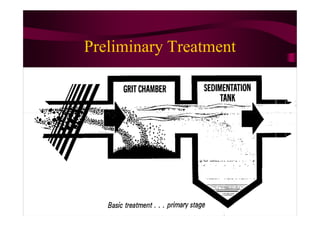
Grit Chamber
Environmental Engineering-II
Preliminary Treatment
Introduction and Objective
• Grit removal basins are the sedimentation
basins placed in front of the fine screen to
remove the inorganic particles having
specific gravity of 2.65 such as sand,
gravel, grit, egg shells, glass pieces,gravel, grit, egg shells, glass pieces,
metal fragments etc. and other non-
putrescible materials that may clog
channels or damage pumps due to
abrasion and to prevent their
accumulation in sludge digesters.
Settling Categories
• Type I - discrete settling in dilute suspensions,
grit chamber good example
• Type II – flocculent materials in dilute
suspensions, primary settling basin good example
• Type III (Zone or hindered settling) – high• Type III (Zone or hindered settling) – high
concentrations (>1000 mg/L), particles interfere
with each other’s settling, secondary settling
basin
• Type IV (Compression settling) – weight of
particles cause more settling, sludge zone in
clarifiers
Types of Grit Chambers
• Grit chambers are of two types:
mechanically cleaned and manually
cleaned.
• In mechanically cleaned grit chamber,• In mechanically cleaned grit chamber,
scraper blades collect the grit settled on
the floor of the grit chamber.
• The grit so collected is elevated to the
ground level by several mechanisms such
as bucket elevators, jet pump and air lift.
• The grit washing mechanisms are also
of several designs most of which are
agitation devices using either water or
air to produce washing action.
• Manually cleaned grit chambers• Manually cleaned grit chambers
should be cleaned at least once a
week.
• The simplest method of cleaning is by
means of shovel.
• There are two general types of grit
chambers
1. Horizontal flow grit chamber and
2. Aerated grit chamber
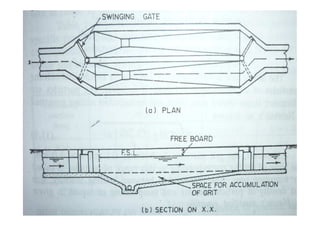
Horizontal flow grit chamber
• Velocity close to 0.3 m/s is maintained.
• Such velocity will carry most of the organic
matter through the channel and will tend to re-
suspend any that settle, but permit heavy grit
to settle.to settle.
• Therefore velocity in the grit chamber shall be
neither too low as to cause settling of lighter
organic particles nor should be so high as not
to cause the settlement of entire silt and grit
present in the sewage.
• Length – 10 to 18 m
• Depth of liquid – 1 to 1.3 m
• Velocity is controlled by means of
velocity control device.
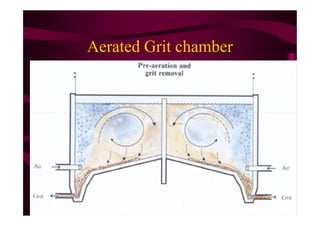
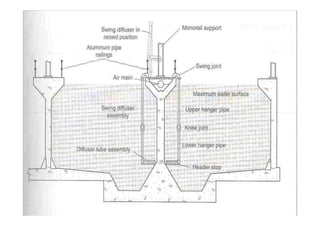
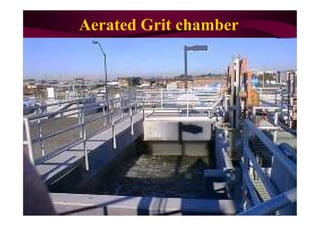
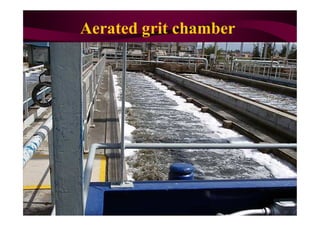
Aerated Grit chamber
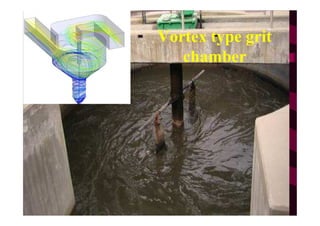
Vortex type grit
chamber
Design criteria
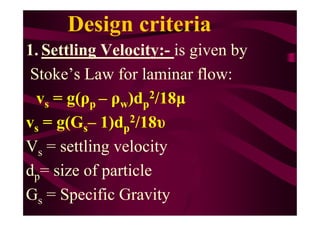
1. Settling Velocity:- is given by
Stoke’s Law for laminar flow:
vs = g(ρp – ρw)dp
2/18µ
v = g(G – 1)d 2/18υvs = g(Gs– 1)dp
2/18υ
Vs = settling velocity
dp= size of particle
Gs = Specific Gravity
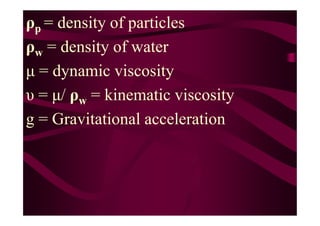
ρp = density of particles
ρw = density of water
µ = dynamic viscosity
υ = µ/ ρw = kinematic viscosity
g = Gravitational accelerationg = Gravitational acceleration
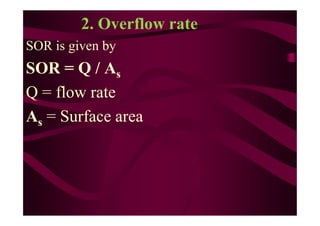
2. Overflow rate
SOR is given by
SOR = Q / As
Q = flow rate
A = Surface areaAs = Surface area
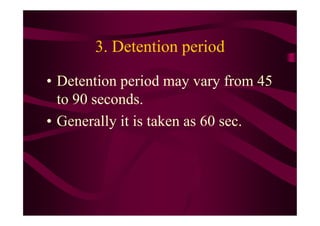
3. Detention period
• Detention period may vary from 45
to 90 seconds.
• Generally it is taken as 60 sec.• Generally it is taken as 60 sec.
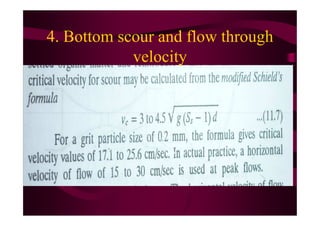
4. Bottom scour and flow through
velocity
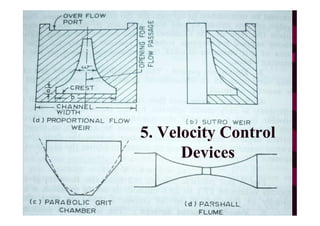
5. Velocity Control
Devices
6. Number of units
• For manually cleaned grit chambers at
least two units shall be provided..
• For mechanically cleaned units one• For mechanically cleaned units one
additional manually cleaned unit as by-
pass shall be provided
7. Dimensions
• Free board of 150 to 300 mm shall be
provided.
• Length can be calculated as
L = vh x t
• Depth can be calculated as• Depth can be calculated as
D = vs x t
• Bottom slopes shall be provided.
• Breadth depends upon velocity control
device adopted.
8. Head loss
• Head loss – 0.06 to 0.6 m
• Depends upon velocity control device
adoptedadopted
Disposal of Grit
• The moisture content of grit varies
from 14 to 34 percent.
• Grit is sometimes washed after
collection to reduce the organiccollection to reduce the organic
concentration which may be as much
as 50 percent of the total solids.
• Filling Low lying area.
• Incineration.
• Well-washed grit has been used on
sludge drying beds, as a cover forsludge drying beds, as a cover for
screenings, and as a surfacing
material for walks and roadways.
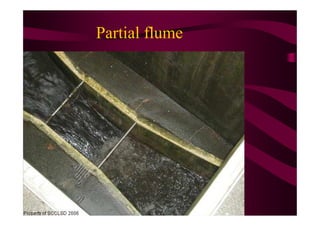
Partial flume
Aerated Grit chamber
Aerated grit chamber
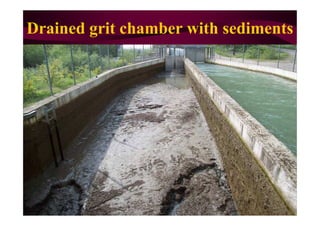
Drained grit chamber with sediments
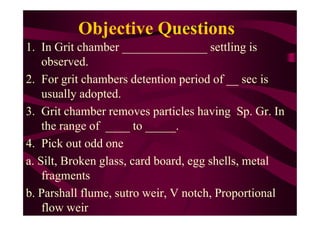
Objective Questions
1. In Grit chamber ______________ settling is
observed.
2. For grit chambers detention period of __ sec is
usually adopted.
3. Grit chamber removes particles having Sp. Gr. In3. Grit chamber removes particles having Sp. Gr. In
the range of ____ to _____.
4. Pick out odd one
a. Silt, Broken glass, card board, egg shells, metal
fragments
b. Parshall flume, sutro weir, V notch, Proportional
flow weir
Theory Questions
Q1. Explain necessity and working of grit
chamber with neat sketch.
Q2. Write a detailed note on ‘ design of
grit chamber’.grit chamber’.

L 13 grit chamber

  • 1.
  • 2.
  • 3.
    Introduction and Objective •Grit removal basins are the sedimentation basins placed in front of the fine screen to remove the inorganic particles having specific gravity of 2.65 such as sand, gravel, grit, egg shells, glass pieces,gravel, grit, egg shells, glass pieces, metal fragments etc. and other non- putrescible materials that may clog channels or damage pumps due to abrasion and to prevent their accumulation in sludge digesters.
  • 4.
    Settling Categories • TypeI - discrete settling in dilute suspensions, grit chamber good example • Type II – flocculent materials in dilute suspensions, primary settling basin good example • Type III (Zone or hindered settling) – high• Type III (Zone or hindered settling) – high concentrations (>1000 mg/L), particles interfere with each other’s settling, secondary settling basin • Type IV (Compression settling) – weight of particles cause more settling, sludge zone in clarifiers
  • 5.
    Types of GritChambers • Grit chambers are of two types: mechanically cleaned and manually cleaned. • In mechanically cleaned grit chamber,• In mechanically cleaned grit chamber, scraper blades collect the grit settled on the floor of the grit chamber. • The grit so collected is elevated to the ground level by several mechanisms such as bucket elevators, jet pump and air lift.
  • 6.
    • The gritwashing mechanisms are also of several designs most of which are agitation devices using either water or air to produce washing action. • Manually cleaned grit chambers• Manually cleaned grit chambers should be cleaned at least once a week. • The simplest method of cleaning is by means of shovel.
  • 7.
    • There aretwo general types of grit chambers 1. Horizontal flow grit chamber and 2. Aerated grit chamber
  • 8.
    Horizontal flow gritchamber • Velocity close to 0.3 m/s is maintained. • Such velocity will carry most of the organic matter through the channel and will tend to re- suspend any that settle, but permit heavy grit to settle.to settle. • Therefore velocity in the grit chamber shall be neither too low as to cause settling of lighter organic particles nor should be so high as not to cause the settlement of entire silt and grit present in the sewage.
  • 10.
    • Length –10 to 18 m • Depth of liquid – 1 to 1.3 m • Velocity is controlled by means of velocity control device.
  • 11.
  • 13.
  • 14.
    Design criteria 1. SettlingVelocity:- is given by Stoke’s Law for laminar flow: vs = g(ρp – ρw)dp 2/18µ v = g(G – 1)d 2/18υvs = g(Gs– 1)dp 2/18υ Vs = settling velocity dp= size of particle Gs = Specific Gravity
  • 15.
    ρp = densityof particles ρw = density of water µ = dynamic viscosity υ = µ/ ρw = kinematic viscosity g = Gravitational accelerationg = Gravitational acceleration
  • 16.
    2. Overflow rate SORis given by SOR = Q / As Q = flow rate A = Surface areaAs = Surface area
  • 17.
    3. Detention period •Detention period may vary from 45 to 90 seconds. • Generally it is taken as 60 sec.• Generally it is taken as 60 sec.
  • 18.
    4. Bottom scourand flow through velocity
  • 19.
  • 20.
    6. Number ofunits • For manually cleaned grit chambers at least two units shall be provided.. • For mechanically cleaned units one• For mechanically cleaned units one additional manually cleaned unit as by- pass shall be provided
  • 21.
    7. Dimensions • Freeboard of 150 to 300 mm shall be provided. • Length can be calculated as L = vh x t • Depth can be calculated as• Depth can be calculated as D = vs x t • Bottom slopes shall be provided. • Breadth depends upon velocity control device adopted.
  • 22.
    8. Head loss •Head loss – 0.06 to 0.6 m • Depends upon velocity control device adoptedadopted
  • 23.
    Disposal of Grit •The moisture content of grit varies from 14 to 34 percent. • Grit is sometimes washed after collection to reduce the organiccollection to reduce the organic concentration which may be as much as 50 percent of the total solids.
  • 24.
    • Filling Lowlying area. • Incineration. • Well-washed grit has been used on sludge drying beds, as a cover forsludge drying beds, as a cover for screenings, and as a surfacing material for walks and roadways.
  • 25.
  • 26.
  • 27.
  • 28.
    Drained grit chamberwith sediments
  • 29.
    Objective Questions 1. InGrit chamber ______________ settling is observed. 2. For grit chambers detention period of __ sec is usually adopted. 3. Grit chamber removes particles having Sp. Gr. In3. Grit chamber removes particles having Sp. Gr. In the range of ____ to _____. 4. Pick out odd one a. Silt, Broken glass, card board, egg shells, metal fragments b. Parshall flume, sutro weir, V notch, Proportional flow weir
  • 30.
    Theory Questions Q1. Explainnecessity and working of grit chamber with neat sketch. Q2. Write a detailed note on ‘ design of grit chamber’.grit chamber’.