Environmental Engineering- II
Depending upon the type of waste,
two systems may be employed for
its collection, conveyance andits collection, conveyance and
disposal :
(a) Conservancy system
(b) Water carriage system.
This is an old system in which various
types of wastes, such as night soil,
garbage etc. are collected separately ingarbage etc. are collected separately in
vessels or deposited in pools or pits
and then removed periodically at least
once in 24 hours.
The system is also known as the dry
system.
1. Night soil - Night soils or human
excreta in latrines, privies or cesspools etc. is
collected separately in pans or pails and
carried on heads of sweepers to a centralcarried on heads of sweepers to a central
place from where it is transported in bullock
carts or motor vans to a place away from the
town for its final disposal. Normally, it is
buried into ground, in trenches, to give
excellent manure in one or two years.
Garbage is collected separately, in dust
bins and conveyed on hand carts or
motor van once or twice is a day.motor van once or twice is a day.
It may consist of waste matter of both
non-combustible as well as combustible
type.The two are therefore sorted out.
Then it is dumped by suitable method
Sullage and storm water are
collected and conveyed separately in
closed or open gutters.closed or open gutters.
1. Hygiene and sanitary aspect:
The conservancy system is highly
unhygienic and cause insanitaryunhygienic and cause insanitary
conditions since the excreta starts
decomposing within few hours of its
production.
Transportation of night soil takes
place in open carts through streets
and other crowded localities.This isand other crowded localities.This is
highly undesirable.
The working of the system depends
entirely on the mercy of labour
(sweepers). If they go on strike even for(sweepers). If they go on strike even for
one day for any reason whatsoever, the
previes/ lavatories can not be used
because of foul smell.
The whole locality will smell very badly.
The lavatories or previes are to be
located outside the house and
slightly away from the mainslightly away from the main
building.
The compact design is therefore
not possible.
Insanitation may be there due
to carriage of sullage through
open drains laid in the streets.open drains laid in the streets.
In the present day world, when man
has progressed much, it is highly
humiliating to ask human beings tohumiliating to ask human beings to
transport night soil in pails on their
heads.
Due to improper or careless
disposal of night soil, there are
more chances of. outbreak ofmore chances of. outbreak of
epidemic.
The liquid wastes from lavatories
etc., during their washing, may soak
in the ground, thus contaminatingin the ground, thus contaminating
the soil.
If the ground water is at a shallow
depth, it may also be polluted due to
percolation of waste water.
Though the system is quite cheap in
the beginning, its maintenance and
establishment costs (i.e. recurringestablishment costs (i.e. recurring
expenditure) are very high
The system requires considerable
land for the disposal of sewage.
In this system, the collection, conveyance
and disposal of various type of wastes are
carried out with the help of water.
Thus, water is used as medium to convey theThus, water is used as medium to convey the
waste from its point of production to the
point of its treatment or final disposal.
Sufficient quantity of water is required to be
mixed with the wastes so that dilution ratio is
so great that the mixture may flow just like
water.
1. Hygienic and sanitary aspect :
The system is very hygienic since the
night soil and other waste water isnight soil and other waste water is
conveyed through closed conduits
which are not directly exposed to the
atmosphere.There is no bad smell
because of continuous flow.
There are no chances of outbreak of
epidemic because flies and other
insects do not have direct access toinsects do not have direct access to
the sewage.
The liquid wastes etc. are directly
conveyed through the sewers, and
therefore there are no changes of thetherefore there are no changes of the
waste water being soaked in the ground
thus contaminating the soil.
No possibility of groundwater
contamination
Since the latrines are flushed after
every use, excreta does not remain and
there are no foul smells.The latrinesthere are no foul smells.The latrines
can therefore be attached to the living
and bed rooms.This permits a compact
design.
The labour required for the operation
and maintenance is extremely small.
Labour may be required for pumpingLabour may be required for pumping
operations and blockage cleaning
The system permits the use of
modern methods of treatment of the
sewerage collected through thesewerage collected through the
sewers.The treated waste water and
sewage can be safely disposed off
without any risk.
Because of treatment facilities,
the land required for the disposal
of the treated wastewater is veryof the treated wastewater is very
much smaller than· that required
for the conservancy system.
Though the initial cost of
installation of the system are very
high, the running costs are veryhigh, the running costs are very
small since manual labour is very
much reduced.
This has been left to you as a
home work
The water carriage system can be
divided into the following types:
A. Separate systemA. Separate system
B. Combined system
C. Partially separate system
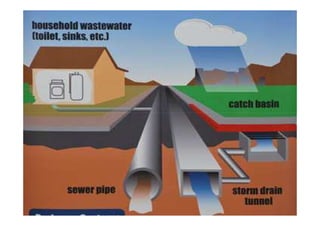
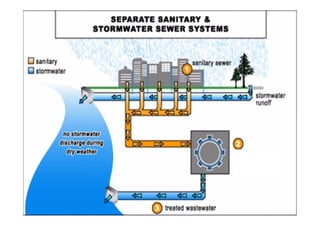
The separate system provides two
separate systems of sewers.
The one intended for the conveyance ofThe one intended for the conveyance of
foul sewage only; and
the other for the rain water, including
the surface washing from certain streets,
overflow from public baths and
foundations etc.
The sewage from the first system of
sewers can be led to the treatment
works, while the flow from theworks, while the flow from the
second system of sewers can be
discharged directly to natural
streams etc. without any treatment.
1.The cost of installation is low-
The storm water can be disposed off
through the open channels along thethrough the open channels along the
road sides. Old sewers may also be
suitably converted to carry rain water.
Thus, the actual sewers carrying foul
sewage will be of smaller size.
2.The load on the treatment units will
be lowered, since only the foul
sewage carried by the separatesewage carried by the separate
sewers need be treated.
3.The sewages in the separate system
will be of more uniform character,
and so will lend itself more easily to
putrification.
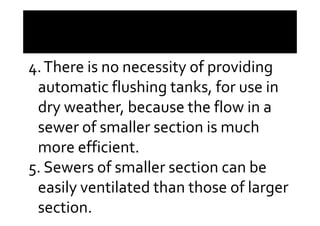
4.There is no necessity of providing
automatic flushing tanks, for use in
dry weather, because the flow in adry weather, because the flow in a
sewer of smaller section is much
more efficient.
5. Sewers of smaller section can be
easily ventilated than those of larger
section.
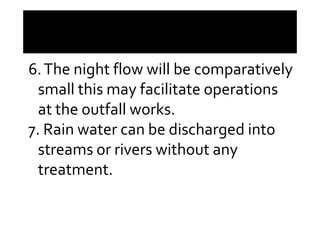
6.The night flow will be comparatively
small this may facilitate operations
at the outfall works.at the outfall works.
7. Rain water can be discharged into
streams or rivers without any
treatment.
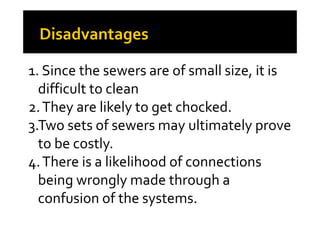
1. Since the sewers are of small size, it is
difficult to clean
2.They are likely to get chocked.2.They are likely to get chocked.
3.Two sets of sewers may ultimately prove
to be costly.
4.There is a likelihood of connections
being wrongly made through a
confusion of the systems.
5. Storm water sewers or drains comes in
use only during the rainy season. During
other part of the year, these may serveother part of the year, these may serve
as dumping place for garbage, and may
get chocked.
6. Because of lesser air contact in small
size sewers, foul smell may be there due
to the sewage gas formed.
The combined system provides only
one sewer to carry both the foul
sewage as well as the rain water.sewage as well as the rain water.
The sewage and rain water are
carried to the sewage treatment
plant, before its final disposal.
1.The system requires only one set of
sewers. Hence the maintenance
costs are reduced.costs are reduced.
2. The sewers are of larger size, and
therefore the chances of their
choking are rare. Also, it is easy to
clean them.
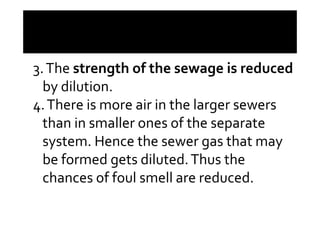
3.The strength of the sewage is reduced
by dilution.
4.There is more air in the larger sewers4.There is more air in the larger sewers
than in smaller ones of the separate
system. Hence the sewer gas that may
be formed gets diluted.Thus the
chances of foul smell are reduced.
1. The cost of construction are very high
because of large dimensions of the sewers
to be constructed at sufficient depth to
receive the sewage from the basement.receive the sewage from the basement.
2. Because of large size of sewers, their
handling and transportation is difficult.
3. Due to the inclusion of the storm water,
the load on the treatment plant increases.
4.The system is uneconomical in the
circumstances when pumping is
required for lifting of sewage.required for lifting of sewage.
5. During heavy rains, the sewers may
overflow, and may thus create
unhygienic conditions and cause
pollution problems.
6. Storm water is unnecessarily polluted.
7. The large sewers get easily silted if
not properly designed.They may
become foul in dry weather, when rain
water, is not available.water, is not available.
8. Large sewers are more difficult to be
ventilated than the smaller ones
In this system, only one set of
underground sewers is laid.
These sewers admit the foul sewage as
well as the early washings by rains. Aswell as the early washings by rains. As
soon as the quantity of storm water
exceeds a certain limit, the storm
water overflows, and is thus collected
and conveyed in open drains to the
natural streams.
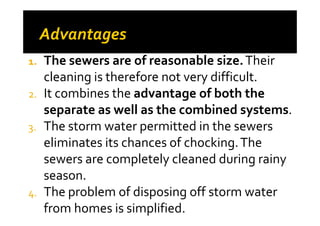
1. The sewers are of reasonable size.Their
cleaning is therefore not very difficult.
2. It combines the advantage of both the
separate as well as the combined systems.separate as well as the combined systems.
3. The storm water permitted in the sewers
eliminates its chances of chocking.The
sewers are completely cleaned during rainy
season.
4. The problem of disposing off storm water
from homes is simplified.
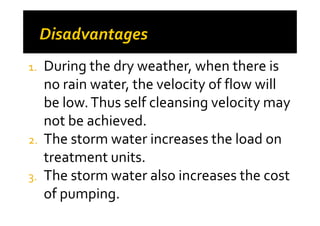
1. During the dry weather, when there is
no rain water, the velocity of flow will
be low.Thus self cleansing velocity may
not be achieved.not be achieved.
2. The storm water increases the load on
treatment units.
3. The storm water also increases the cost
of pumping.
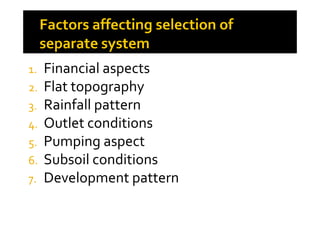
1. Financial aspects
2. Flat topography
3. Rainfall patternRainfall pattern
4. Outlet conditions
5. Pumping aspect
6. Subsoil conditions
7. Development pattern
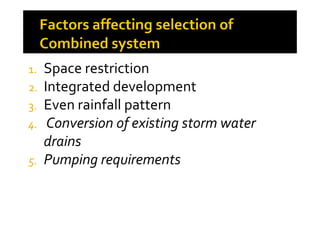
1. Space restriction
2. Integrated development
3. Even rainfall patternEven rainfall pattern
4. Conversion of existing storm water
drains
5. Pumping requirements
1. Conservancy system is also known as
_______________.
2. If the rainfall is there for a shorter duration, and
does not take place throughout the year, it isdoes not take place throughout the year, it is
more economical to adopt _________________.
3. _________________is preferred when, space
available for laying the sewers is restricted.
Q1. Differentiate between
i. Conservancy system andWater carriage system
ii. Combined sewer and separate sewers
Q2. Explain factors affecting selection of
i. Combined sewersi. Combined sewers
ii. Separate sewers
Q3.Write short notes on
i. Conservancy system
ii. Water carriage system
iii. Combined sewer
iv. Separate sewer
Q4. Mention 5 advantages of water carriage
system. (May 2011, 5 marks)
Q5. Explain the combined system of sewerage.
Also mention the factors governing choice ofAlso mention the factors governing choice of
combined system. (May 2011, 8 marks)
Q6. Compare conservancy system with water
carriage system. (Nov 2011, May 2010, 8 marks)
Q7. Describe any two methods of collection of
various types of wastes in the conservancy
system. (May 2010, 5 marks)

L 3 collection and conveyance

  • 1.
  • 2.
    Depending upon thetype of waste, two systems may be employed for its collection, conveyance andits collection, conveyance and disposal : (a) Conservancy system (b) Water carriage system.
  • 3.
    This is anold system in which various types of wastes, such as night soil, garbage etc. are collected separately ingarbage etc. are collected separately in vessels or deposited in pools or pits and then removed periodically at least once in 24 hours. The system is also known as the dry system.
  • 4.
    1. Night soil- Night soils or human excreta in latrines, privies or cesspools etc. is collected separately in pans or pails and carried on heads of sweepers to a centralcarried on heads of sweepers to a central place from where it is transported in bullock carts or motor vans to a place away from the town for its final disposal. Normally, it is buried into ground, in trenches, to give excellent manure in one or two years.
  • 5.
    Garbage is collectedseparately, in dust bins and conveyed on hand carts or motor van once or twice is a day.motor van once or twice is a day. It may consist of waste matter of both non-combustible as well as combustible type.The two are therefore sorted out. Then it is dumped by suitable method
  • 6.
    Sullage and stormwater are collected and conveyed separately in closed or open gutters.closed or open gutters.
  • 7.
    1. Hygiene andsanitary aspect: The conservancy system is highly unhygienic and cause insanitaryunhygienic and cause insanitary conditions since the excreta starts decomposing within few hours of its production.
  • 8.
    Transportation of nightsoil takes place in open carts through streets and other crowded localities.This isand other crowded localities.This is highly undesirable.
  • 9.
    The working ofthe system depends entirely on the mercy of labour (sweepers). If they go on strike even for(sweepers). If they go on strike even for one day for any reason whatsoever, the previes/ lavatories can not be used because of foul smell. The whole locality will smell very badly.
  • 10.
    The lavatories orprevies are to be located outside the house and slightly away from the mainslightly away from the main building. The compact design is therefore not possible.
  • 11.
    Insanitation may bethere due to carriage of sullage through open drains laid in the streets.open drains laid in the streets.
  • 12.
    In the presentday world, when man has progressed much, it is highly humiliating to ask human beings tohumiliating to ask human beings to transport night soil in pails on their heads.
  • 13.
    Due to improperor careless disposal of night soil, there are more chances of. outbreak ofmore chances of. outbreak of epidemic.
  • 14.
    The liquid wastesfrom lavatories etc., during their washing, may soak in the ground, thus contaminatingin the ground, thus contaminating the soil. If the ground water is at a shallow depth, it may also be polluted due to percolation of waste water.
  • 15.
    Though the systemis quite cheap in the beginning, its maintenance and establishment costs (i.e. recurringestablishment costs (i.e. recurring expenditure) are very high
  • 16.
    The system requiresconsiderable land for the disposal of sewage.
  • 17.
    In this system,the collection, conveyance and disposal of various type of wastes are carried out with the help of water. Thus, water is used as medium to convey theThus, water is used as medium to convey the waste from its point of production to the point of its treatment or final disposal. Sufficient quantity of water is required to be mixed with the wastes so that dilution ratio is so great that the mixture may flow just like water.
  • 18.
    1. Hygienic andsanitary aspect : The system is very hygienic since the night soil and other waste water isnight soil and other waste water is conveyed through closed conduits which are not directly exposed to the atmosphere.There is no bad smell because of continuous flow.
  • 19.
    There are nochances of outbreak of epidemic because flies and other insects do not have direct access toinsects do not have direct access to the sewage.
  • 20.
    The liquid wastesetc. are directly conveyed through the sewers, and therefore there are no changes of thetherefore there are no changes of the waste water being soaked in the ground thus contaminating the soil. No possibility of groundwater contamination
  • 21.
    Since the latrinesare flushed after every use, excreta does not remain and there are no foul smells.The latrinesthere are no foul smells.The latrines can therefore be attached to the living and bed rooms.This permits a compact design.
  • 22.
    The labour requiredfor the operation and maintenance is extremely small. Labour may be required for pumpingLabour may be required for pumping operations and blockage cleaning
  • 23.
    The system permitsthe use of modern methods of treatment of the sewerage collected through thesewerage collected through the sewers.The treated waste water and sewage can be safely disposed off without any risk.
  • 24.
    Because of treatmentfacilities, the land required for the disposal of the treated wastewater is veryof the treated wastewater is very much smaller than· that required for the conservancy system.
  • 25.
    Though the initialcost of installation of the system are very high, the running costs are veryhigh, the running costs are very small since manual labour is very much reduced.
  • 26.
    This has beenleft to you as a home work
  • 27.
    The water carriagesystem can be divided into the following types: A. Separate systemA. Separate system B. Combined system C. Partially separate system
  • 28.
    The separate systemprovides two separate systems of sewers. The one intended for the conveyance ofThe one intended for the conveyance of foul sewage only; and the other for the rain water, including the surface washing from certain streets, overflow from public baths and foundations etc.
  • 29.
    The sewage fromthe first system of sewers can be led to the treatment works, while the flow from theworks, while the flow from the second system of sewers can be discharged directly to natural streams etc. without any treatment.
  • 32.
    1.The cost ofinstallation is low- The storm water can be disposed off through the open channels along thethrough the open channels along the road sides. Old sewers may also be suitably converted to carry rain water. Thus, the actual sewers carrying foul sewage will be of smaller size.
  • 33.
    2.The load onthe treatment units will be lowered, since only the foul sewage carried by the separatesewage carried by the separate sewers need be treated. 3.The sewages in the separate system will be of more uniform character, and so will lend itself more easily to putrification.
  • 34.
    4.There is nonecessity of providing automatic flushing tanks, for use in dry weather, because the flow in adry weather, because the flow in a sewer of smaller section is much more efficient. 5. Sewers of smaller section can be easily ventilated than those of larger section.
  • 35.
    6.The night flowwill be comparatively small this may facilitate operations at the outfall works.at the outfall works. 7. Rain water can be discharged into streams or rivers without any treatment.
  • 36.
    1. Since thesewers are of small size, it is difficult to clean 2.They are likely to get chocked.2.They are likely to get chocked. 3.Two sets of sewers may ultimately prove to be costly. 4.There is a likelihood of connections being wrongly made through a confusion of the systems.
  • 37.
    5. Storm watersewers or drains comes in use only during the rainy season. During other part of the year, these may serveother part of the year, these may serve as dumping place for garbage, and may get chocked. 6. Because of lesser air contact in small size sewers, foul smell may be there due to the sewage gas formed.
  • 38.
    The combined systemprovides only one sewer to carry both the foul sewage as well as the rain water.sewage as well as the rain water. The sewage and rain water are carried to the sewage treatment plant, before its final disposal.
  • 39.
    1.The system requiresonly one set of sewers. Hence the maintenance costs are reduced.costs are reduced. 2. The sewers are of larger size, and therefore the chances of their choking are rare. Also, it is easy to clean them.
  • 40.
    3.The strength ofthe sewage is reduced by dilution. 4.There is more air in the larger sewers4.There is more air in the larger sewers than in smaller ones of the separate system. Hence the sewer gas that may be formed gets diluted.Thus the chances of foul smell are reduced.
  • 41.
    1. The costof construction are very high because of large dimensions of the sewers to be constructed at sufficient depth to receive the sewage from the basement.receive the sewage from the basement. 2. Because of large size of sewers, their handling and transportation is difficult. 3. Due to the inclusion of the storm water, the load on the treatment plant increases.
  • 42.
    4.The system isuneconomical in the circumstances when pumping is required for lifting of sewage.required for lifting of sewage. 5. During heavy rains, the sewers may overflow, and may thus create unhygienic conditions and cause pollution problems. 6. Storm water is unnecessarily polluted.
  • 43.
    7. The largesewers get easily silted if not properly designed.They may become foul in dry weather, when rain water, is not available.water, is not available. 8. Large sewers are more difficult to be ventilated than the smaller ones
  • 44.
    In this system,only one set of underground sewers is laid. These sewers admit the foul sewage as well as the early washings by rains. Aswell as the early washings by rains. As soon as the quantity of storm water exceeds a certain limit, the storm water overflows, and is thus collected and conveyed in open drains to the natural streams.
  • 45.
    1. The sewersare of reasonable size.Their cleaning is therefore not very difficult. 2. It combines the advantage of both the separate as well as the combined systems.separate as well as the combined systems. 3. The storm water permitted in the sewers eliminates its chances of chocking.The sewers are completely cleaned during rainy season. 4. The problem of disposing off storm water from homes is simplified.
  • 46.
    1. During thedry weather, when there is no rain water, the velocity of flow will be low.Thus self cleansing velocity may not be achieved.not be achieved. 2. The storm water increases the load on treatment units. 3. The storm water also increases the cost of pumping.
  • 47.
    1. Financial aspects 2.Flat topography 3. Rainfall patternRainfall pattern 4. Outlet conditions 5. Pumping aspect 6. Subsoil conditions 7. Development pattern
  • 48.
    1. Space restriction 2.Integrated development 3. Even rainfall patternEven rainfall pattern 4. Conversion of existing storm water drains 5. Pumping requirements
  • 49.
    1. Conservancy systemis also known as _______________. 2. If the rainfall is there for a shorter duration, and does not take place throughout the year, it isdoes not take place throughout the year, it is more economical to adopt _________________. 3. _________________is preferred when, space available for laying the sewers is restricted.
  • 50.
    Q1. Differentiate between i.Conservancy system andWater carriage system ii. Combined sewer and separate sewers Q2. Explain factors affecting selection of i. Combined sewersi. Combined sewers ii. Separate sewers Q3.Write short notes on i. Conservancy system ii. Water carriage system iii. Combined sewer iv. Separate sewer
  • 51.
    Q4. Mention 5advantages of water carriage system. (May 2011, 5 marks) Q5. Explain the combined system of sewerage. Also mention the factors governing choice ofAlso mention the factors governing choice of combined system. (May 2011, 8 marks) Q6. Compare conservancy system with water carriage system. (Nov 2011, May 2010, 8 marks) Q7. Describe any two methods of collection of various types of wastes in the conservancy system. (May 2010, 5 marks)