LLLL----8888
EQUALIZATIONEQUALIZATIONEQUALIZATIONEQUALIZATION ANDANDANDAND PROPORTIONINGPROPORTIONINGPROPORTIONINGPROPORTIONING
Industrial Waste Treatment
Equalization
Industry will always realize
benefits from delivering a constant
quantity and quality of waste from
its plant.
It will further benefit fromIt will further benefit from
delivering this waste in proportion to
that occurring in its discharge
environment—be it river or sewer
line.
The reason for these facts is that
receiving environments can always
cope better with a constant load of
contaminant and in proportion to its
own existing load.
In fact, an industrial plant canIn fact, an industrial plant can
sometimes can decide not to do any
further expensive treatment of its
wastes after equalization and
proportionment.
Equalization is a method of
retaining waste in a basin so that
the effluent discharged is fairly
uniform in its water qualityuniform in its water quality
characteristics (pH, color,
turbidity, alkalinity, biochemical
oxygen demand [BOD], and so
forth).
The influent to an industrial wastewater
treatment system (IWTS) varies in flow
and concentration of pollutants because
the discharges from the manufacturing
and utility processes are not constant.
This variation affects the operation of
the IWTS and could adversely affect thethe IWTS and could adversely affect the
effluent quality from the plant.
The objective of equalization is to
minimize or control fluctuations in
wastewater characteristics in order to
provide optimum conditions for
subsequent treatment processes.
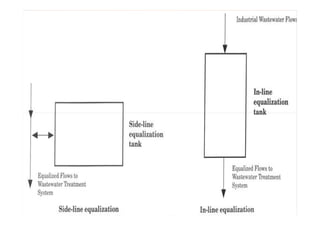
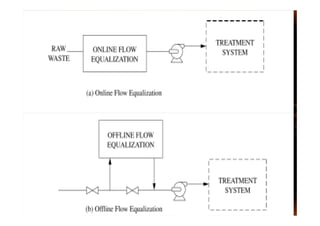
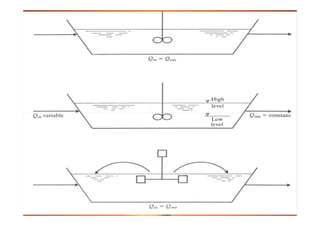
In-line and side-line equalization
systems are both effective ways to
equalize flow volumes, but in-line
equalization is more effective for
leveling out the variations in influent
concentration because the entire
flow is blended with the entireflow is blended with the entire
contents of the holding tank.
The size and type of equalization basin
provided varies with the quantity of
waste and the variability of the
wastewater stream.
The basin should be of a sufficient size
to adequately absorb waste fluctuationsto adequately absorb waste fluctuations
caused by variations in plant-production
scheduling and to dampen the
concentrated batches periodically
dumped or spilled to the sewer.
Objectives of Equalization
1.To provide adequate dampening of
organic fluctuations in order to prevent
shock loading of biological systems.
2.To provide adequate pH control or to
minimize the chemical requirements
necessary for neutralization.necessary for neutralization.
3.To minimize flow surges to physical-
chemical treatment systems and permit
chemical feed rates compatible with
feeding equipment.
4. To provide continuous feed to
biological systems over periods
when the manufacturing plant is not
operating.
5. To provide capacity for controlled
discharge of wastes to municipaldischarge of wastes to municipal
systems in order to distribute waste
loads more evenly.
6. To prevent high concentrations of
toxic materials from entering the
biological treatment plant.
A secondary but significant effect is
that of lowering the concentration of
effluent contaminants.
This is accomplished not only by
discharging out the slugs of a highdischarging out the slugs of a high
concentration of contaminants but
also by physical, chemical, and
biological reactions that may occur
during retention in equalization
basins.
Air is sometimes injected into these
basins to provide:
(1) better mixing;
(2) chemical oxidation of reduced
compounds;
(3) To achieve Some degree of
biological oxidation; and
(4) agitation to prevent suspended
solids from settling.
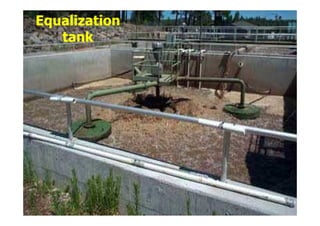
Equalization
tank
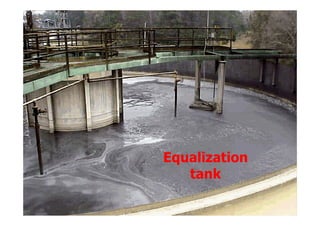
Equalization
tank
Equalization
tank
The mere holding of waste, however, is
not sufficient to equalize it. Each unit
volume of waste discharged must be
adequately mixed with other unit
volumes of waste discharged many hours
previously.
This mixing may be brought about in theThis mixing may be brought about in the
following ways:
(1) proper distribution and baffling;
(2) mechanical agitation;
(3) aeration; and
(4) combinations of all three.
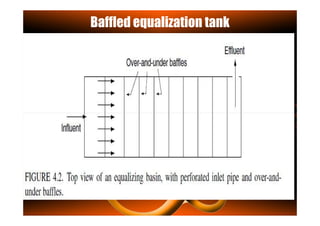
Proper distribution and baffling is the
most economical, though usually the least
efficient, method of mixing. Still, this
method may suffice for many plants.
Horizontal distribution of the waste is
achieved by using either several inlet
pipes, spaced at regular intervals acrosspipes, spaced at regular intervals across
the width of the tank, or a perforated pipe
across the entire width.
Over and- under baffles are advisable
when the tank is wide because they
provide more efficient horizontal and
vertical distribution
Baffled equalization tank
Mechanical agitation eliminates most of
the need for baffles and generally
provides better mixing than baffles alone.
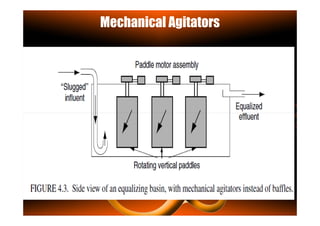
One typical arrangement, shown in Figure
, uses three wooden gate–type agitators
spaced equidistantly along the center linespaced equidistantly along the center line
of the length of the tank. Agitators
operated at a speed of 15 rotations/min
(rpm) by a 3-horsepower (hp) motor are
usually adequate.
Mechanical Agitators
Proportioning
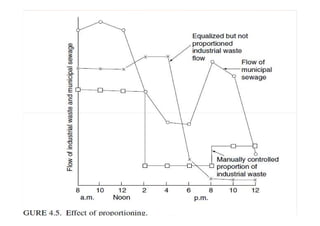
Proportioning means the discharge of
industrial wastes in proportion to the flow
of municipal sewage in the sewers or to
the stream flow in the receiving river.
In most cases, it is possible to combine
equalization and proportioning in theequalization and proportioning in the
same basin.
The effluent from the equalization basin
is metered into the sewer or stream
according to a predetermined schedule.
The objective of proportioningThe objective of proportioning in sewers is to
keep constant the percentage of industrial
wastes to domestic sewage flow entering the
municipal sewage plant. This procedure has
several purposes:
(1)To protect municipal sewage treatment using
chemicals from being impaired by a sudden
overdose of chemicals contained in theoverdose of chemicals contained in the
industrial waste;
(2) To protect biological-treatment devices from
shock loads of industrial wastes that may
inactivate the bacteria; and
(3) To minimize fluctuations of sanitary standards
in the treated effluent.
Methods of proportioning
There are two general methods of
discharging industrial waste in
proportion to the flow of domestic
sewage at the municipal plant:
1. Manual control related to a well1. Manual control related to a well
defined domestic sewage flow
pattern, and
2. Automatic control by electronics.
Manual control is lower in initial
cost but less accurate.
It involves determining the flow
pattern of domestic sewage for each
day of the week over a period of
months.months.
Usually one does this by examining
the flow records of the sewage plant
or by studying the hourly water-
consumption figures for the city.
Automatic control of waste discharge
according to sewage flow involves placing
a metering device that registers the
amount of flow at the most convenient
main sewer connection.
This device translates the rate of flow in
the sewer to a recorder located near thethe sewer to a recorder located near the
plant’s holding tank. The pen on the
recorder actuates either a mechanical
(gear) or a pneumatic (air) control
system for opening or closing the
diaphragm of the pump.
There are, of course, many variations of
automatic flow-control systems. Although
their initial cost is higher than that of
manual control, they will usually return
the investment many times by the
savings in labor costs.
Objective Questions
1. ________________ is a method of
retaining waste in a basin so that
the effluent discharged is fairly
uniform in its water quality
characteristics .characteristics .
2. For better mixing of wastewater,
_____is sometimes injected into
equalization basins .
3. The objective ofThe objective of
____________________________________ in sewers is
to keep constant the percentage of
industrial wastes to domestic
sewage flow entering the municipal
sewage plant.
4. In case of proportioning, ________
control is lower in initial cost but less
accurate.
5. In equalization, ____________
agitation eliminates most of the need
for baffles
Theory Questions
Q1. Write Short notes on
i. Equalization
ii. Proportioning
Q2. Explain in detail ‘EqualizationQ2. Explain in detail ‘Equalization
and Proportioning’.
Q3. Explain the terms
1. In-line Equalization
2. Side line Equalization

L 8 equalization and proportioning

  • 1.
  • 2.
    Equalization Industry will alwaysrealize benefits from delivering a constant quantity and quality of waste from its plant. It will further benefit fromIt will further benefit from delivering this waste in proportion to that occurring in its discharge environment—be it river or sewer line.
  • 3.
    The reason forthese facts is that receiving environments can always cope better with a constant load of contaminant and in proportion to its own existing load. In fact, an industrial plant canIn fact, an industrial plant can sometimes can decide not to do any further expensive treatment of its wastes after equalization and proportionment.
  • 4.
    Equalization is amethod of retaining waste in a basin so that the effluent discharged is fairly uniform in its water qualityuniform in its water quality characteristics (pH, color, turbidity, alkalinity, biochemical oxygen demand [BOD], and so forth).
  • 5.
    The influent toan industrial wastewater treatment system (IWTS) varies in flow and concentration of pollutants because the discharges from the manufacturing and utility processes are not constant. This variation affects the operation of the IWTS and could adversely affect thethe IWTS and could adversely affect the effluent quality from the plant. The objective of equalization is to minimize or control fluctuations in wastewater characteristics in order to provide optimum conditions for subsequent treatment processes.
  • 8.
    In-line and side-lineequalization systems are both effective ways to equalize flow volumes, but in-line equalization is more effective for leveling out the variations in influent concentration because the entire flow is blended with the entireflow is blended with the entire contents of the holding tank.
  • 9.
    The size andtype of equalization basin provided varies with the quantity of waste and the variability of the wastewater stream. The basin should be of a sufficient size to adequately absorb waste fluctuationsto adequately absorb waste fluctuations caused by variations in plant-production scheduling and to dampen the concentrated batches periodically dumped or spilled to the sewer.
  • 10.
    Objectives of Equalization 1.Toprovide adequate dampening of organic fluctuations in order to prevent shock loading of biological systems. 2.To provide adequate pH control or to minimize the chemical requirements necessary for neutralization.necessary for neutralization. 3.To minimize flow surges to physical- chemical treatment systems and permit chemical feed rates compatible with feeding equipment.
  • 11.
    4. To providecontinuous feed to biological systems over periods when the manufacturing plant is not operating. 5. To provide capacity for controlled discharge of wastes to municipaldischarge of wastes to municipal systems in order to distribute waste loads more evenly. 6. To prevent high concentrations of toxic materials from entering the biological treatment plant.
  • 13.
    A secondary butsignificant effect is that of lowering the concentration of effluent contaminants. This is accomplished not only by discharging out the slugs of a highdischarging out the slugs of a high concentration of contaminants but also by physical, chemical, and biological reactions that may occur during retention in equalization basins.
  • 14.
    Air is sometimesinjected into these basins to provide: (1) better mixing; (2) chemical oxidation of reduced compounds; (3) To achieve Some degree of biological oxidation; and (4) agitation to prevent suspended solids from settling.
  • 15.
  • 16.
  • 17.
  • 18.
    The mere holdingof waste, however, is not sufficient to equalize it. Each unit volume of waste discharged must be adequately mixed with other unit volumes of waste discharged many hours previously. This mixing may be brought about in theThis mixing may be brought about in the following ways: (1) proper distribution and baffling; (2) mechanical agitation; (3) aeration; and (4) combinations of all three.
  • 19.
    Proper distribution andbaffling is the most economical, though usually the least efficient, method of mixing. Still, this method may suffice for many plants. Horizontal distribution of the waste is achieved by using either several inlet pipes, spaced at regular intervals acrosspipes, spaced at regular intervals across the width of the tank, or a perforated pipe across the entire width. Over and- under baffles are advisable when the tank is wide because they provide more efficient horizontal and vertical distribution
  • 20.
  • 21.
    Mechanical agitation eliminatesmost of the need for baffles and generally provides better mixing than baffles alone. One typical arrangement, shown in Figure , uses three wooden gate–type agitators spaced equidistantly along the center linespaced equidistantly along the center line of the length of the tank. Agitators operated at a speed of 15 rotations/min (rpm) by a 3-horsepower (hp) motor are usually adequate.
  • 22.
  • 23.
    Proportioning Proportioning means thedischarge of industrial wastes in proportion to the flow of municipal sewage in the sewers or to the stream flow in the receiving river. In most cases, it is possible to combine equalization and proportioning in theequalization and proportioning in the same basin. The effluent from the equalization basin is metered into the sewer or stream according to a predetermined schedule.
  • 24.
    The objective ofproportioningThe objective of proportioning in sewers is to keep constant the percentage of industrial wastes to domestic sewage flow entering the municipal sewage plant. This procedure has several purposes: (1)To protect municipal sewage treatment using chemicals from being impaired by a sudden overdose of chemicals contained in theoverdose of chemicals contained in the industrial waste; (2) To protect biological-treatment devices from shock loads of industrial wastes that may inactivate the bacteria; and (3) To minimize fluctuations of sanitary standards in the treated effluent.
  • 25.
    Methods of proportioning Thereare two general methods of discharging industrial waste in proportion to the flow of domestic sewage at the municipal plant: 1. Manual control related to a well1. Manual control related to a well defined domestic sewage flow pattern, and 2. Automatic control by electronics.
  • 26.
    Manual control islower in initial cost but less accurate. It involves determining the flow pattern of domestic sewage for each day of the week over a period of months.months. Usually one does this by examining the flow records of the sewage plant or by studying the hourly water- consumption figures for the city.
  • 27.
    Automatic control ofwaste discharge according to sewage flow involves placing a metering device that registers the amount of flow at the most convenient main sewer connection. This device translates the rate of flow in the sewer to a recorder located near thethe sewer to a recorder located near the plant’s holding tank. The pen on the recorder actuates either a mechanical (gear) or a pneumatic (air) control system for opening or closing the diaphragm of the pump.
  • 28.
    There are, ofcourse, many variations of automatic flow-control systems. Although their initial cost is higher than that of manual control, they will usually return the investment many times by the savings in labor costs.
  • 30.
    Objective Questions 1. ________________is a method of retaining waste in a basin so that the effluent discharged is fairly uniform in its water quality characteristics .characteristics . 2. For better mixing of wastewater, _____is sometimes injected into equalization basins .
  • 31.
    3. The objectiveofThe objective of ____________________________________ in sewers is to keep constant the percentage of industrial wastes to domestic sewage flow entering the municipal sewage plant. 4. In case of proportioning, ________ control is lower in initial cost but less accurate. 5. In equalization, ____________ agitation eliminates most of the need for baffles
  • 32.
    Theory Questions Q1. WriteShort notes on i. Equalization ii. Proportioning Q2. Explain in detail ‘EqualizationQ2. Explain in detail ‘Equalization and Proportioning’. Q3. Explain the terms 1. In-line Equalization 2. Side line Equalization