Physical Unit Operations
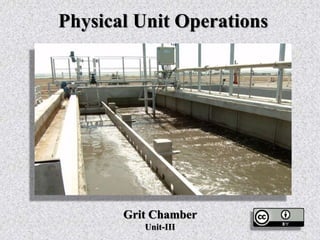
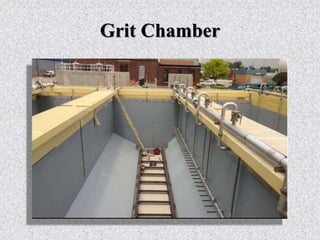
Grit Chamber
Unit-III
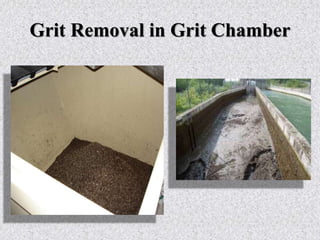
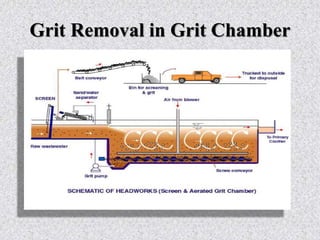
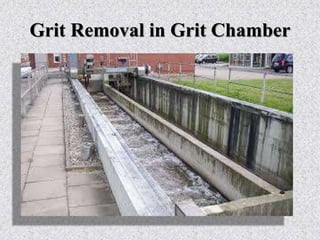
Grit Removal in Grit Chamber
• Sand, ash, Cinder, Bone Chip, egg shells,
etc., of size less than 0.2 mm are included in
grit. It is not putrescible and possesses higher
subsidence value than the organic matter. It is
therefore possible to remove grit from the
waste water easily by reducing the
wastewater velocity in long channel called
as grit channel. The velocity is reduced to
about 0.3 m/sec. The settled grit is washed
before its disposal.
Grit Removal in Grit Chamber
• Grit Chamber is provided for the purpose
of removal of silt and sand particles mainly
so that the same will not cause, the wear and
tear of vanes of pumps, clogging of pipes, as
well as, valve operation difficult. Removal of
grit also reduces accumulation of inert material
in subsequent treatment units. Cementing
effects are also prevented in settling tanks
and digester by removal of grit.
Grit Removal in Grit Chamber
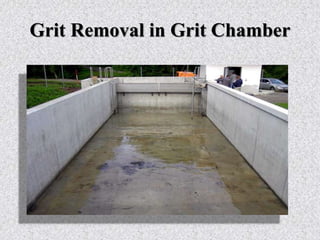
• Grit Removal Unit may be a grit Channel,
Grit Chamber or a Grit Basin. The Word grit
chamber shall be used in subsequent
discussion.
• There are two types of grit chambers
• (i) Horizontal flow Grit Chambers
• (ii) Aerated Grit Chamber
Grit Removal in Grit Chamber
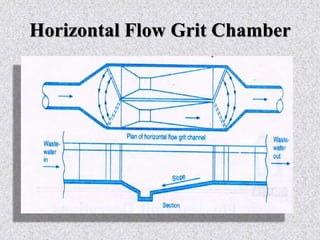
• Horizontal flow grit chamber are designed to
maintain a velocity of around 0.3 m/sec. Such a
velocity falls then the organic particles also settle
down and if velocity becomes high grit particles
will not settle. So to cause only settlement of
grit, it is necessary to maintain constant
velocity of around 0.3 m/sec. The Waste water
flow varies and therefore it is required to
maintain the constant velocity by providing
proportional flow weirs, partial flumes and
palmer- Bowlup flumes.
Horizontal Flow Grit Chamber
Grit Removal in Grit Chamber
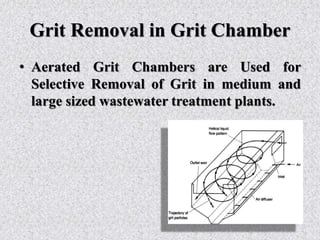
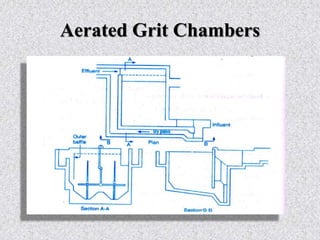
• Aerated Grit Chambers are Used for
Selective Removal of Grit in medium and
large sized wastewater treatment plants.
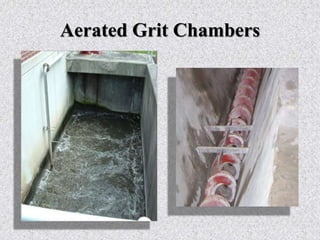
Aerated Grit Chambers
Grit Collection & Removal
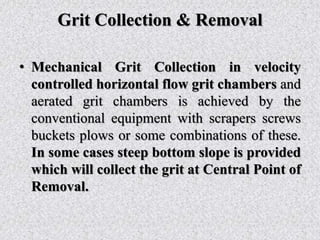
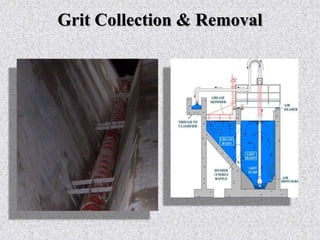
• Mechanical Grit Collection in velocity
controlled horizontal flow grit chambers and
aerated grit chambers is achieved by the
conventional equipment with scrapers screws
buckets plows or some combinations of these.
In some cases steep bottom slope is provided
which will collect the grit at Central Point of
Removal.
Grit Collection & Removal
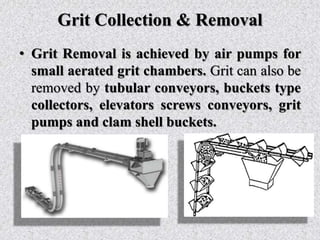
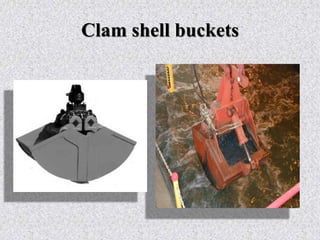
• Grit Removal is achieved by air pumps for
small aerated grit chambers. Grit can also be
removed by tubular conveyors, buckets type
collectors, elevators screws conveyors, grit
pumps and clam shell buckets.
Clam shell buckets
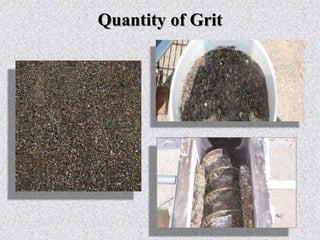
Quantity of Grit
• Grit Quantity varies greatly. It depends upon the
following factors:
• Type of Sewerage System i.e. Separate or Combined
Sewerage System
• Climate Condition
• Soil Type
• Sewer Grades
• Type of Industrial Wastewaters
• Relative Use of Garbage and grinders
• The grit quantity may range from 5 to 200 m3/ Million
Cubic Meter of Wastewater. The typical Value can be
Considered as 30 m3/ million Cubic meter of
wastewater.
Quantity of Grit
Grit Disposal
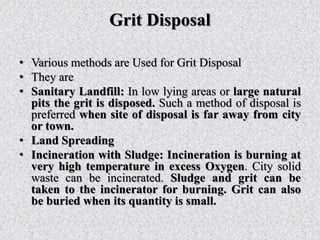
• Various methods are Used for Grit Disposal
• They are
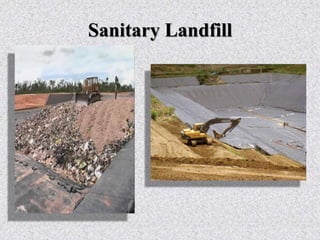
• Sanitary Landfill: In low lying areas or large natural
pits the grit is disposed. Such a method of disposal is
preferred when site of disposal is far away from city
or town.
• Land Spreading
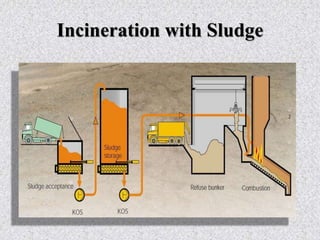
• Incineration with Sludge: Incineration is burning at
very high temperature in excess Oxygen. City solid
waste can be incinerated. Sludge and grit can be
taken to the incinerator for burning. Grit can also
be buried when its quantity is small.
Sanitary Landfill
Land Spreading
Incineration with Sludge
Design of Grit Chambers
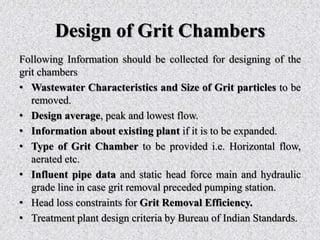
Following Information should be collected for designing of the
grit chambers
• Wastewater Characteristics and Size of Grit particles to be
removed.
• Design average, peak and lowest flow.
• Information about existing plant if it is to be expanded.
• Type of Grit Chamber to be provided i.e. Horizontal flow,
aerated etc.
• Influent pipe data and static head force main and hydraulic
grade line in case grit removal preceded pumping station.
• Head loss constraints for Grit Removal Efficiency.
• Treatment plant design criteria by Bureau of Indian Standards.
Design Criteria for Horizontal Flow Grit
Chambers
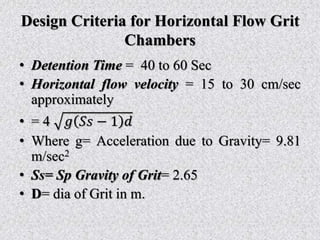
• Detention Time = 40 to 60 Sec
• Horizontal flow velocity = 15 to 30 cm/sec
approximately
• = 4 𝑔 𝑆𝑠 − 1 𝑑
• Where g= Acceleration due to Gravity= 9.81
m/sec2
• Ss= Sp Gravity of Grit= 2.65
• D= dia of Grit in m.
Design Criteria for Horizontal Flow Grit
Chambers
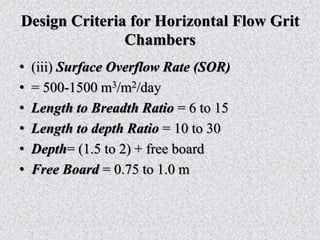
• (iii) Surface Overflow Rate (SOR)
• = 500-1500 m3/m2/day
• Length to Breadth Ratio = 6 to 15
• Length to depth Ratio = 10 to 30
• Depth= (1.5 to 2) + free board
• Free Board = 0.75 to 1.0 m
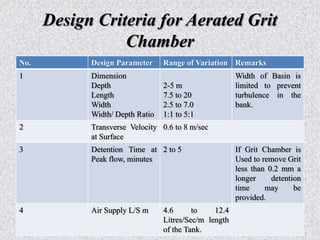
Design Criteria for Aerated Grit
Chamber
No. Design Parameter Range of Variation Remarks
1 Dimension
Depth
Length
Width
Width/ Depth Ratio
2-5 m
7.5 to 20
2.5 to 7.0
1:1 to 5:1
Width of Basin is
limited to prevent
turbulence in the
bank.
2 Transverse Velocity
at Surface
0.6 to 8 m/sec
3 Detention Time at
Peak flow, minutes
2 to 5 If Grit Chamber is
Used to remove Grit
less than 0.2 mm a
longer detention
time may be
provided.
4 Air Supply L/S m 4.6 to 12.4
Litres/Sec/m length
of the Tank.
Design Example
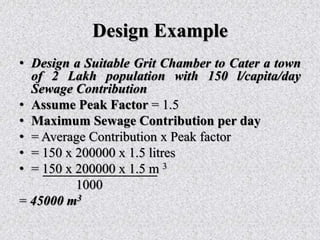
• Design a Suitable Grit Chamber to Cater a town
of 2 Lakh population with 150 l/capita/day
Sewage Contribution
• Assume Peak Factor = 1.5
• Maximum Sewage Contribution per day
• = Average Contribution x Peak factor
• = 150 x 200000 x 1.5 litres
• = 150 x 200000 x 1.5 m 3
1000
= 45000 m3
Design Example
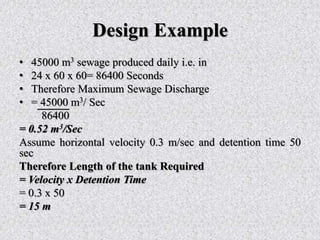
• 45000 m3 sewage produced daily i.e. in
• 24 x 60 x 60= 86400 Seconds
• Therefore Maximum Sewage Discharge
• = 45000 m3/ Sec
86400
= 0.52 m3/Sec
Assume horizontal velocity 0.3 m/sec and detention time 50
sec
Therefore Length of the tank Required
= Velocity x Detention Time
= 0.3 x 50
= 15 m
Design Example
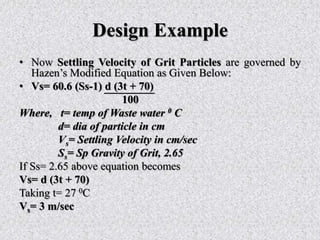
• Now Settling Velocity of Grit Particles are governed by
Hazen’s Modified Equation as Given Below:
• Vs= 60.6 (Ss-1) d (3t + 70)
100
Where, t= temp of Waste water 0 C
d= dia of particle in cm
Vs= Settling Velocity in cm/sec
Ss= Sp Gravity of Grit, 2.65
If Ss= 2.65 above equation becomes
Vs= d (3t + 70)
Taking t= 27 0C
Vs= 3 m/sec
Design Example
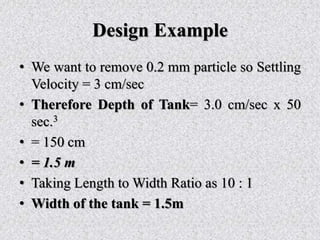
• We want to remove 0.2 mm particle so Settling
Velocity = 3 cm/sec
• Therefore Depth of Tank= 3.0 cm/sec x 50
sec.3
• = 150 cm
• = 1.5 m
• Taking Length to Width Ratio as 10 : 1
• Width of the tank = 1.5m
Design Example
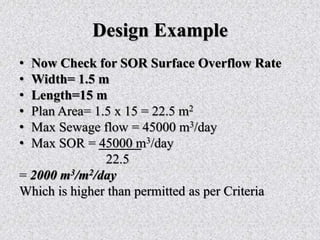
• Now Check for SOR Surface Overflow Rate
• Width= 1.5 m
• Length=15 m
• Plan Area= 1.5 x 15 = 22.5 m2
• Max Sewage flow = 45000 m3/day
• Max SOR = 45000 m3/day
22.5
= 2000 m3/m2/day
Which is higher than permitted as per Criteria
Design Example
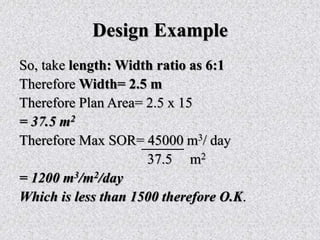
So, take length: Width ratio as 6:1
Therefore Width= 2.5 m
Therefore Plan Area= 2.5 x 15
= 37.5 m2
Therefore Max SOR= 45000 m3/ day
37.5 m2
= 1200 m3/m2/day
Which is less than 1500 therefore O.K.
Grit Chamber
References
• Sewage Disposal & Air Pollution Engineering:
S.K. Garg
• Environmental Engineering : By Prof B.R.Shah
Prof A M Malek
• Internet Websites
Thanks !

Physical Unit Operations

  • 1.
  • 2.
    Grit Removal inGrit Chamber • Sand, ash, Cinder, Bone Chip, egg shells, etc., of size less than 0.2 mm are included in grit. It is not putrescible and possesses higher subsidence value than the organic matter. It is therefore possible to remove grit from the waste water easily by reducing the wastewater velocity in long channel called as grit channel. The velocity is reduced to about 0.3 m/sec. The settled grit is washed before its disposal.
  • 3.
    Grit Removal inGrit Chamber
  • 4.
    Grit Removal inGrit Chamber • Grit Chamber is provided for the purpose of removal of silt and sand particles mainly so that the same will not cause, the wear and tear of vanes of pumps, clogging of pipes, as well as, valve operation difficult. Removal of grit also reduces accumulation of inert material in subsequent treatment units. Cementing effects are also prevented in settling tanks and digester by removal of grit.
  • 5.
    Grit Removal inGrit Chamber
  • 6.
    Grit Removal inGrit Chamber
  • 7.
    Grit Removal inGrit Chamber • Grit Removal Unit may be a grit Channel, Grit Chamber or a Grit Basin. The Word grit chamber shall be used in subsequent discussion. • There are two types of grit chambers • (i) Horizontal flow Grit Chambers • (ii) Aerated Grit Chamber
  • 8.
    Grit Removal inGrit Chamber • Horizontal flow grit chamber are designed to maintain a velocity of around 0.3 m/sec. Such a velocity falls then the organic particles also settle down and if velocity becomes high grit particles will not settle. So to cause only settlement of grit, it is necessary to maintain constant velocity of around 0.3 m/sec. The Waste water flow varies and therefore it is required to maintain the constant velocity by providing proportional flow weirs, partial flumes and palmer- Bowlup flumes.
  • 9.
  • 10.
    Grit Removal inGrit Chamber
  • 11.
    Grit Removal inGrit Chamber • Aerated Grit Chambers are Used for Selective Removal of Grit in medium and large sized wastewater treatment plants.
  • 12.
  • 13.
  • 14.
    Grit Collection &Removal • Mechanical Grit Collection in velocity controlled horizontal flow grit chambers and aerated grit chambers is achieved by the conventional equipment with scrapers screws buckets plows or some combinations of these. In some cases steep bottom slope is provided which will collect the grit at Central Point of Removal.
  • 15.
  • 16.
    Grit Collection &Removal • Grit Removal is achieved by air pumps for small aerated grit chambers. Grit can also be removed by tubular conveyors, buckets type collectors, elevators screws conveyors, grit pumps and clam shell buckets.
  • 17.
  • 18.
    Quantity of Grit •Grit Quantity varies greatly. It depends upon the following factors: • Type of Sewerage System i.e. Separate or Combined Sewerage System • Climate Condition • Soil Type • Sewer Grades • Type of Industrial Wastewaters • Relative Use of Garbage and grinders • The grit quantity may range from 5 to 200 m3/ Million Cubic Meter of Wastewater. The typical Value can be Considered as 30 m3/ million Cubic meter of wastewater.
  • 19.
  • 20.
    Grit Disposal • Variousmethods are Used for Grit Disposal • They are • Sanitary Landfill: In low lying areas or large natural pits the grit is disposed. Such a method of disposal is preferred when site of disposal is far away from city or town. • Land Spreading • Incineration with Sludge: Incineration is burning at very high temperature in excess Oxygen. City solid waste can be incinerated. Sludge and grit can be taken to the incinerator for burning. Grit can also be buried when its quantity is small.
  • 21.
  • 22.
  • 23.
  • 24.
    Design of GritChambers Following Information should be collected for designing of the grit chambers • Wastewater Characteristics and Size of Grit particles to be removed. • Design average, peak and lowest flow. • Information about existing plant if it is to be expanded. • Type of Grit Chamber to be provided i.e. Horizontal flow, aerated etc. • Influent pipe data and static head force main and hydraulic grade line in case grit removal preceded pumping station. • Head loss constraints for Grit Removal Efficiency. • Treatment plant design criteria by Bureau of Indian Standards.
  • 25.
    Design Criteria forHorizontal Flow Grit Chambers • Detention Time = 40 to 60 Sec • Horizontal flow velocity = 15 to 30 cm/sec approximately • = 4 𝑔 𝑆𝑠 − 1 𝑑 • Where g= Acceleration due to Gravity= 9.81 m/sec2 • Ss= Sp Gravity of Grit= 2.65 • D= dia of Grit in m.
  • 26.
    Design Criteria forHorizontal Flow Grit Chambers • (iii) Surface Overflow Rate (SOR) • = 500-1500 m3/m2/day • Length to Breadth Ratio = 6 to 15 • Length to depth Ratio = 10 to 30 • Depth= (1.5 to 2) + free board • Free Board = 0.75 to 1.0 m
  • 27.
    Design Criteria forAerated Grit Chamber No. Design Parameter Range of Variation Remarks 1 Dimension Depth Length Width Width/ Depth Ratio 2-5 m 7.5 to 20 2.5 to 7.0 1:1 to 5:1 Width of Basin is limited to prevent turbulence in the bank. 2 Transverse Velocity at Surface 0.6 to 8 m/sec 3 Detention Time at Peak flow, minutes 2 to 5 If Grit Chamber is Used to remove Grit less than 0.2 mm a longer detention time may be provided. 4 Air Supply L/S m 4.6 to 12.4 Litres/Sec/m length of the Tank.
  • 28.
    Design Example • Designa Suitable Grit Chamber to Cater a town of 2 Lakh population with 150 l/capita/day Sewage Contribution • Assume Peak Factor = 1.5 • Maximum Sewage Contribution per day • = Average Contribution x Peak factor • = 150 x 200000 x 1.5 litres • = 150 x 200000 x 1.5 m 3 1000 = 45000 m3
  • 29.
    Design Example • 45000m3 sewage produced daily i.e. in • 24 x 60 x 60= 86400 Seconds • Therefore Maximum Sewage Discharge • = 45000 m3/ Sec 86400 = 0.52 m3/Sec Assume horizontal velocity 0.3 m/sec and detention time 50 sec Therefore Length of the tank Required = Velocity x Detention Time = 0.3 x 50 = 15 m
  • 30.
    Design Example • NowSettling Velocity of Grit Particles are governed by Hazen’s Modified Equation as Given Below: • Vs= 60.6 (Ss-1) d (3t + 70) 100 Where, t= temp of Waste water 0 C d= dia of particle in cm Vs= Settling Velocity in cm/sec Ss= Sp Gravity of Grit, 2.65 If Ss= 2.65 above equation becomes Vs= d (3t + 70) Taking t= 27 0C Vs= 3 m/sec
  • 31.
    Design Example • Wewant to remove 0.2 mm particle so Settling Velocity = 3 cm/sec • Therefore Depth of Tank= 3.0 cm/sec x 50 sec.3 • = 150 cm • = 1.5 m • Taking Length to Width Ratio as 10 : 1 • Width of the tank = 1.5m
  • 32.
    Design Example • NowCheck for SOR Surface Overflow Rate • Width= 1.5 m • Length=15 m • Plan Area= 1.5 x 15 = 22.5 m2 • Max Sewage flow = 45000 m3/day • Max SOR = 45000 m3/day 22.5 = 2000 m3/m2/day Which is higher than permitted as per Criteria
  • 33.
    Design Example So, takelength: Width ratio as 6:1 Therefore Width= 2.5 m Therefore Plan Area= 2.5 x 15 = 37.5 m2 Therefore Max SOR= 45000 m3/ day 37.5 m2 = 1200 m3/m2/day Which is less than 1500 therefore O.K.
  • 34.
  • 35.
    References • Sewage Disposal& Air Pollution Engineering: S.K. Garg • Environmental Engineering : By Prof B.R.Shah Prof A M Malek • Internet Websites
  • 36.