COAGULATION AIDED SEDIMENTATION
Stability and destabilization of colloids, Coagulation theory,
types of coagulants, chemical feeding, flash mixing,
Clariflocculators, types of flocculators and their design
aspects
14/18/2020
Dr. Dayananda H S
Professor of Civil Engineering,
VVCE, Mysore, Karnataka
24/18/2020
Preamble
• Coagulation and Flocculation deals with Type II settling (i. e.,
Hindered settling)
• Particles - Silt, small and large colloids
• Types of colloids – Hydrophilic and Hydrophobic
• For colloids, ratio of surface area to mass is high, resulting in
electrostatic repulsion and hydration predominates
• Settling velocity varies from few meter/hr to meter/million year
• Hydrophilic colloids are readily dispersed in water and its
stability depends on affinity for water and are negatively
charged
34/18/2020
• Eg - Soaps, soluble starch & proteins, synthetic
detergents
• Stability of Hydrophobic colloids depends on possessed
electric charge, no affinity for water and positively charged
Eg - metal oxides
• Particles carry charge due to loss of atoms, abrasion,
molecular structure
• Vanderwal’s force is a resisting force and Brownian
movement favors coagulation process
• A colloidal dispersion in a liquid is known as ‘Sol’
Eg: Bentonite clay, Kaolinite
44/18/2020
Definitions
Coagulation is a unit process (chemical technique)
adopted for charge neutralization of colloidal particles. Ion
transfer is effected by chemical coagulation
• Floc forming chemicals are added to water for the purpose
of enmeshing the colloidal particles to form rapidly settling
aggregates
• Mixing refers to blending of coagulating chemicals with
water to create more or less homogeneous single or
multiple phase system
54/18/2020
Flocculation is the stirring or agitation of water containing
flocs, a slow mixing technique which promotes the
agglomeration (to gather) of the stabilized particles
• Distinction between coagulation and flocculation is
some what arbitrary
• However, combination of mixing & stirring/agitation that
enhances aggregation is known as Flocculation
64/18/2020
Stability of Colloids
• A colloidal suspension is said to be stable when the dispersion
do not show any tendency to aggregate
• i.e., Colloidal suspension that do not agglomerate is termed
as ‘stable’
• Stability of Colloidal Suspension is due to excessively large
surface to volume ratio due to very small size
• Surface phenomena predominates mass phenomena
• Surface Phenomena is the accumulation of electrical charges
@ the particle surface
• Electrical Conductivity is due to molecular arrangement within
crystals, loss of atoms due to abrasion of the surface or any
other factors
• In most surface waters, the surface of the colloidal particles are
negatively charged
4/18/2020 7
Destabilization of Colloids
• Two forces responsible for destabilization of a sol are
i) Vander Waal’s force and ii) Brownian movement
• Vander Waal ‘s forces - molecular cohesive forces of attraction
that increase in intensity as particles approach each other
• This force becomes very dominant when two colloids come in
close proximity
• Brownian movement is random movement of colloids caused
by molecular bombardment of the dispersion media
• This movement has destabilizing effect on a source and results
with aggregation
• In water purification, destabilization of Hydrophobic colloids is
attained by chemically coagulating using trivalent metallic salts
• Aluminum sulfate, ferric chloride into clusters which are large
enough to be removed by gravity settling
4/18/2020 8
Principle (Mechanism) of Coagulation
The process of Coagulation and Flocculation is mainly based
on two factors
i)Floc formation
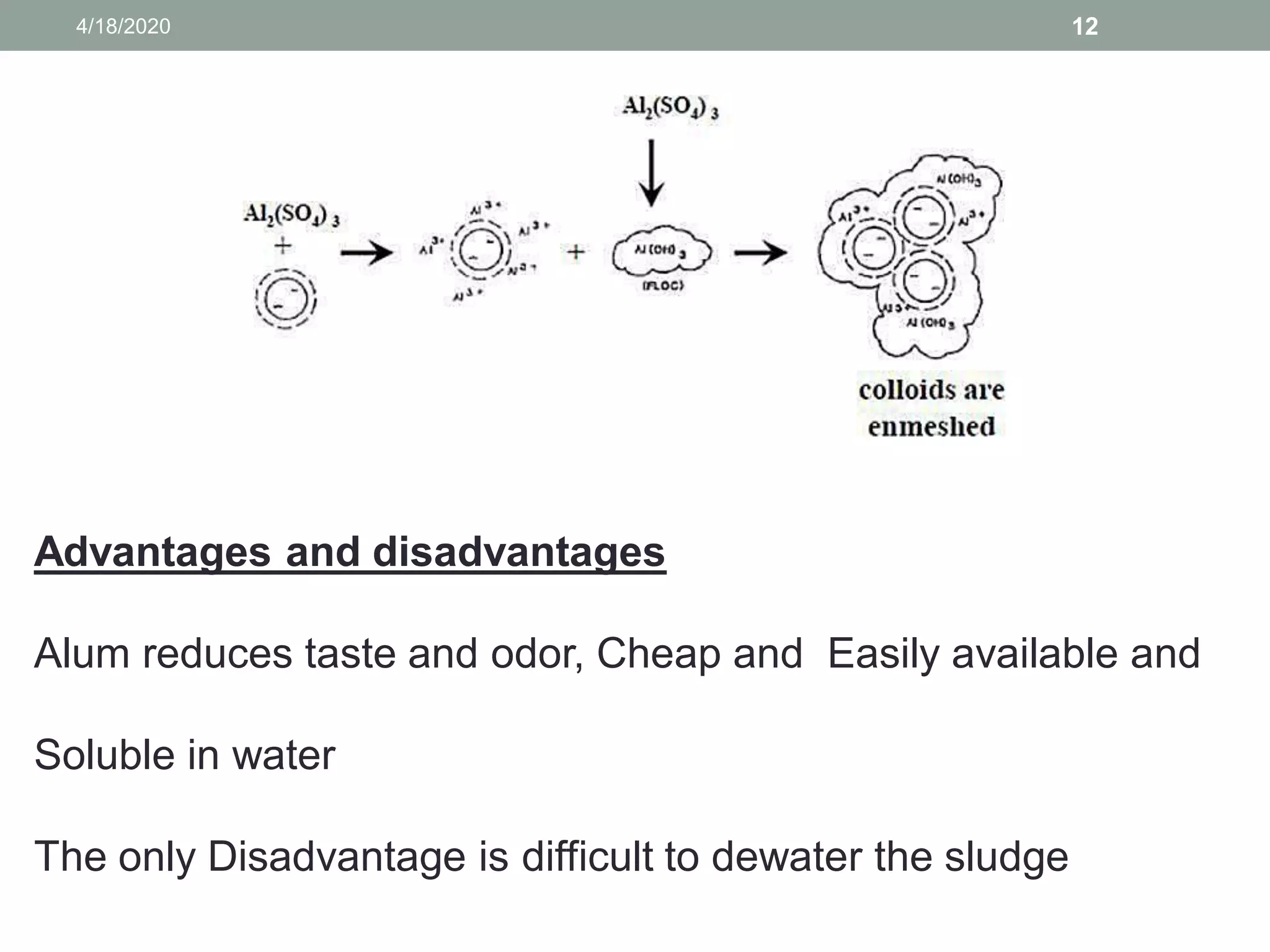
When a coagulant is added to water , it dissolves in it and
forms a spongy gelatinous substance forming floc which will
arrest the suspended and colloidal matter in water, while
descending down at the bottom.
ii) Electrical charge
The colloidal particles in natural waters will be usually
negatively charged. The floc which is positively charged is
opposite in nature and hence it helps in arresting all the
colloidal particles.
4/18/2020 9
Factors affecting coagulation
1. Types of coagulant
2. Quantity of coagulant
3. Characteristics of water -Type & quantity of suspended matter,
Temperature & pH of water
4. Time, turbulence and method of mixing
Types of Coagulant
Mainly used coagulants are aluminum and iron salts
1. Aluminum sulfate
2. Chlorinated copperas
3. Ferrous sulfate and lime
4. Magnesium carbonate and lime
5. Sodium Aluminate
4/18/2020 10
1. Aluminum Sulfate (Alum)
• Aluminum sulfate is cheaper and universally used coagulant
• It contains 17% Aluminum sulfate, a dirty grey solid in form of
lumps
• Alum on addition to water, hydrolyze forming a insoluble
gelatinous precipitate of Aluminum hydroxide, Al(OH)3
• To produce the hydroxide floc, enough alkalinity should be
present in the water
• If alkalinity is not enough, then it should be added. Usually
hydrated lime is used for the purpose (optimum pH is 6.5 –
8.5)
• Under normal circumstances, dose of Alum varies from 10 to
30 mg/L of water
4/18/2020 11
Sometimes sodium carbonate (Soda ash) is added to form
alkalinity, the resulting reaction is ,
Al2(SO4)3.18H2O + 3Na2CO2 = 2Al (OH)2 + 3Na2SO4 +18H2O
+ 3CO2 ….(c)
Al2(SO4)3.18H2O + 3Ca (HCO3)2 = 2Al (OH)3 + 3CaSO4 +18H2O
+ 6CO2 ….(a)
Al2(SO4)3.18H2O + 3Ca (OH)2 = 2Al (OH)3 + 3CaSO4 +18H2O
….(b)
4/18/2020 12
Advantages and disadvantages
Alum reduces taste and odor, Cheap and Easily available and
Soluble in water
The only Disadvantage is difficult to dewater the sludge
4/18/2020 13
2. Ferrous Sulfate (Chlorinated Copperas)
• The optimum pH range is 3.5 to 6.5
• At higher pH i.e. 9.5 it removes manganese
• More expensive than alum
• Effective in colour removal
• Low solubility in water
4/18/2020 14
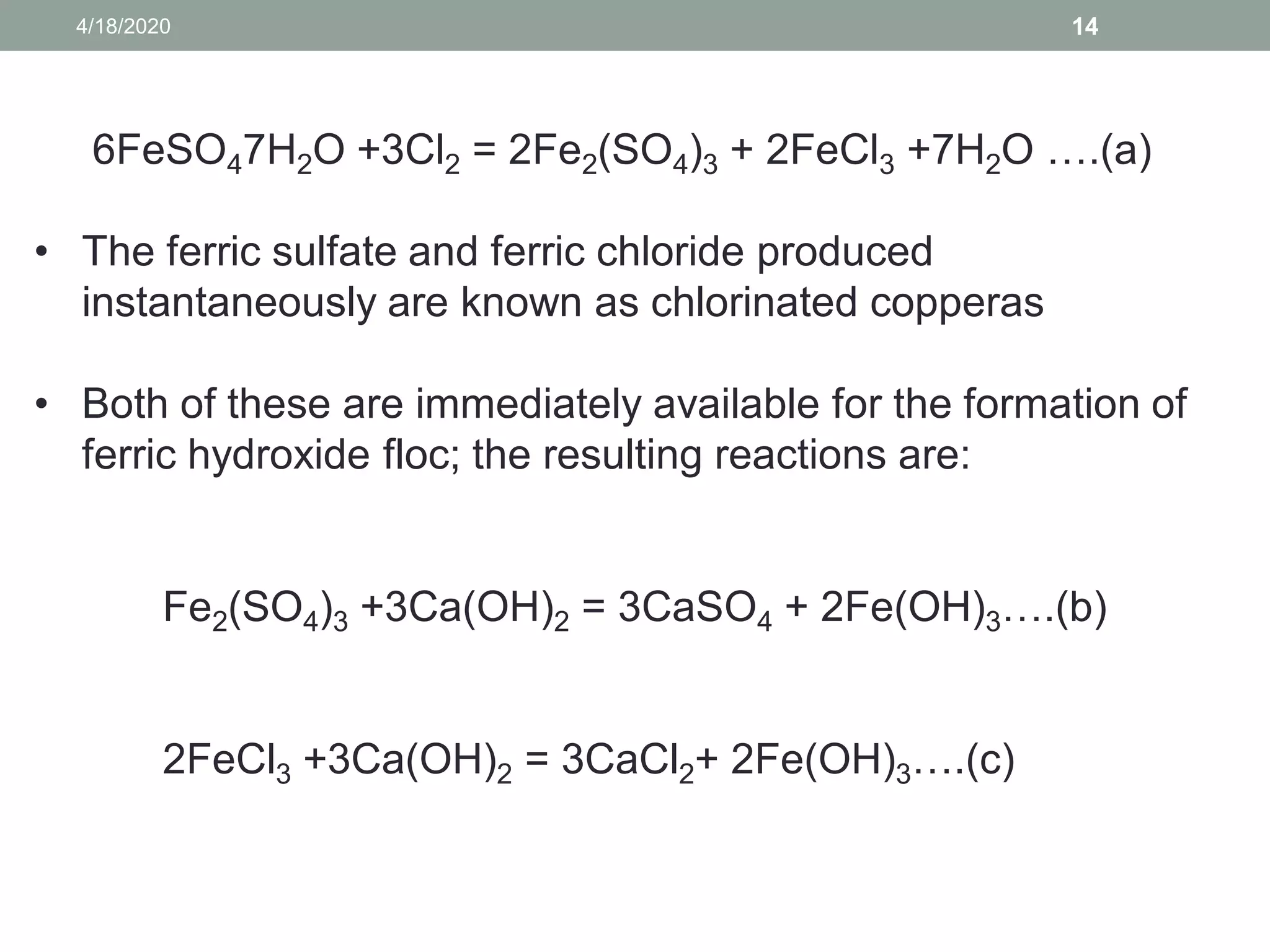
6FeSO47H2O +3Cl2 = 2Fe2(SO4)3 + 2FeCl3 +7H2O ….(a)
• The ferric sulfate and ferric chloride produced
instantaneously are known as chlorinated copperas
• Both of these are immediately available for the formation of
ferric hydroxide floc; the resulting reactions are:
Fe2(SO4)3 +3Ca(OH)2 = 3CaSO4 + 2Fe(OH)3….(b)
2FeCl3 +3Ca(OH)2 = 3CaCl2+ 2Fe(OH)3….(c)
154/18/2020
3. Ferrous Sulfate and lime
• Ferrous sulphate can react with natural calcium bicarbonate
alkalinity in water, but its slow process
• Hence Lime is added in water
• Ferric hydroxide is gelatinous floc, which is heavier than floc
formed by alum
• Optimum pH range is below 7
FeSO4.7H2O + Ca(OH)2 = Fe(OH)2 + CaSO4 +7H2O ….(a)
• The ferrous hydroxide, Fe(OH)2 thus formed, though an
efficient floc, is soon oxidized by dissolved oxygen in water &
ferric hydroxide is formed
4Fe(OH)2 + O2 + 2H2O = 4Fe(OH)3 ….(b)
164/18/2020
4. Magnesium carbonate and lime
• When magnesium carbonate and lime are dissolved in
water, magnesium hydroxide and calcium carbonate are
formed as
• MgCO3 +Ca(OH)2 = Mg(OH)2 +CaCO3
• Byproducts of above reaction forms soluble sludge, so not
commonly used
174/18/2020
5. Sodium Aluminate
• Sodium aluminate (Na2Al2O4)is alkaline in nature and is used
very much less often than alum because of its cost. It reacts
with the salts of calcium and magnesium as follows;
Na2Al2O4 + Ca(HCO3)2 = CaAl2O4 +Na2CO3 +CO +H2O …(a)
Na2Al2O4 + CaCl2 = CaAl2O4 + 2NaCl …..(b)
Na2Al2O4 + CaSO4 = CaAl2O4 + Na2SO4 …..(c)
• The coagulant remove both temporary and permanent
hardness
• It is effective for a pH range of 6 to 8.50 naturally available in
water
184/18/2020
Comparison of Alum and Iron salt
1. Iron salts forms heavy floc as compared to alum, hence
more Solids are removed
2. Time of reaction and floc formation is less for iron salts,
hence ‘t’ reduces
3. Iron salts can work efficiently over wider pH range
4. Iron salts can remove taste and odour
5. Less mud ball formation as compared to alum
6. Under some cases iron salts are more economical
194/18/2020
7. Iron salts cause staining and promotes growth of iron
bacteria
8. Iron salts make water more corrosive as compared to alum
9. Handling of iron salts requires skill
10. More CO2 is formed so water becomes corrosive
11. Alum Coagulation may not be proper, if K or Na are
present in water
204/18/2020
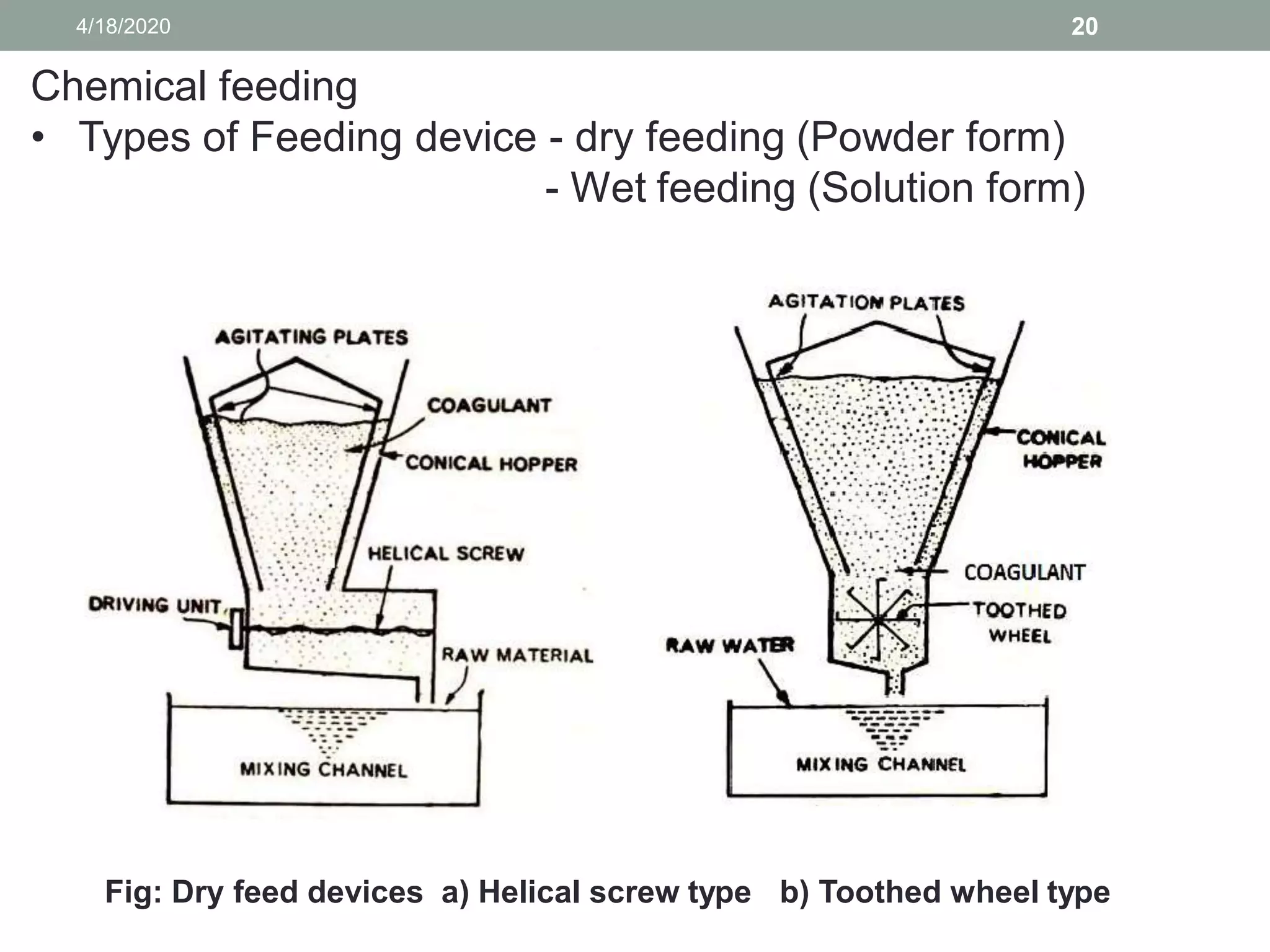
Chemical feeding
• Types of Feeding device - dry feeding (Powder form)
- Wet feeding (Solution form)
Fig: Dry feed devices a) Helical screw type b) Toothed wheel type
214/18/2020
Fig: Solution feeding device a)Conical plug type b) Adjustable weir type
4/18/2020 22
Fig: Hydraulic mixing in water flow
a) Channel with baffles
b) Overflow weir
c) Hydraulic jump mixing
234/18/2020
Flash Mixing (Perikinetic Flocculation)
• Flash mixing is a process of adding coagulant chemicals to
water and the water is mixed quickly
• The purpose of flash mixing is to uniformly disperse the
chemicals throughout the volume of water
• This helps in the formation of micro flocs and results in
proper utilization of chemical preventing localization of
concentration and premature formation of hydroxides
• Flash mixing typically lasts for a minute or less
• If the water is mixed for less than thirty seconds, then the
chemicals will not be properly mixed into the water
• On the other hand, if the water is mixed beyond one minute,
the mixer blades will shear the newly forming floc into small
particles
• The coagulant is introduced at a point of high turbulence
• The rapid mixing of coagulants is carried out in a basin
known as “Flash Mixer”
4/18/2020 24
Hydraulic jump: Hydraulic jump creates
Turbulance & thus helps in better mixing
Mechanical Mixing
Fig: a) Back Mix Impeller b) Flat-blade Impeller
4/18/2020 25
i) Flash mixer (Mixing basin)
• The power input required for mixing is expressed
in terms of temporal mean velocity gradient, G’
• G’ = [ P/µ.V]1/2
G’ = Velocity gradient (per second)
µ = Absolute or dynamic viscosity of water in Ns/m2
V = Volume of water to which P is applied, in m3
The unit of G’ will evidently be 1/s (i.e., per second)
4/18/2020 26
Design criteria
• Impeller speed: 100 to 120 rpm
• Detention period: 30 – 60sec
• Power requirement: 2 to 5 kW/m3 /minute
• (0.041kW/1000cum.day)
• Tank shape: circular or square
• Velocity of flow: 0.9m/sec
• Velocity gradient, G’: 300 S-1
• Depth of tank: 1-3m
• Height to diameter (sides) ratio : 1:1 to 3:1
• Product G ‘T (unit less): 30 000 - 60 000
(T is the detention period)
• Impeller diameter to tank diameter ratio: 0.2 to 0.4
• Minimum Tanks: 2 Tanks
4/18/2020 27
Flocculation ( Forming Flocs)
• After destabilization (i.e., Coagulation), particles will be
ready to a tract and agglomerate and form flocs
• But this agglomeration is slow and they need help to
accelerate this agglomeration
• This help is called Flocculation “which is the slow stirring or
gentle agitation to aggregate the destabilized particles and
form a rapid settling floc”
• This gentle mixing increases the collisions between the
particles and help them to agglomerate.
(rapid mixing will destroy the flocs, hence need gentle
mixing)
• Flocculation occurs in a tank called a Flocculator or
Flocculation Basin equipped with a method for Slow Mixing.
4/18/2020 28
Fig: Flocculation process through Brownian movement
4/18/2020 29
Types of Flocculators (Slow stirring motion)
The most common types of Flocculators used,
a) Hydraulic Mixing Floculator: Hydraulic jump mixing
Horizontal baffled Channel
Vertically baffled channel
b) Mechanical Mixing Floculator:
i) Vertical shaft with impeller (turbine or propeller type blades)
ii) Paddle type with either horizontal or vertical shafts
iii) Walking Beam Flocculator
c) Pneumatic methods: Compressed air agitation,
centrifugal pump
4/18/2020 30
Fig: Rapid Mixing of coagulant in Venturi / Parshal Flume (Hydraulic Jump)
4/18/2020 31
Fig: Hydraulic Mixing Floculators
(b) Vertically baffled channel
(a) Horizontal baffled Channels
4/18/2020 32
Fig: Mechanical Flocculator (Paddle type with vertical shafts)
4/18/2020 33
Fig: Paddle type with horizontal shafts
Fig: Vertical shaft with impeller
(propeller type blades)
4/18/2020 34
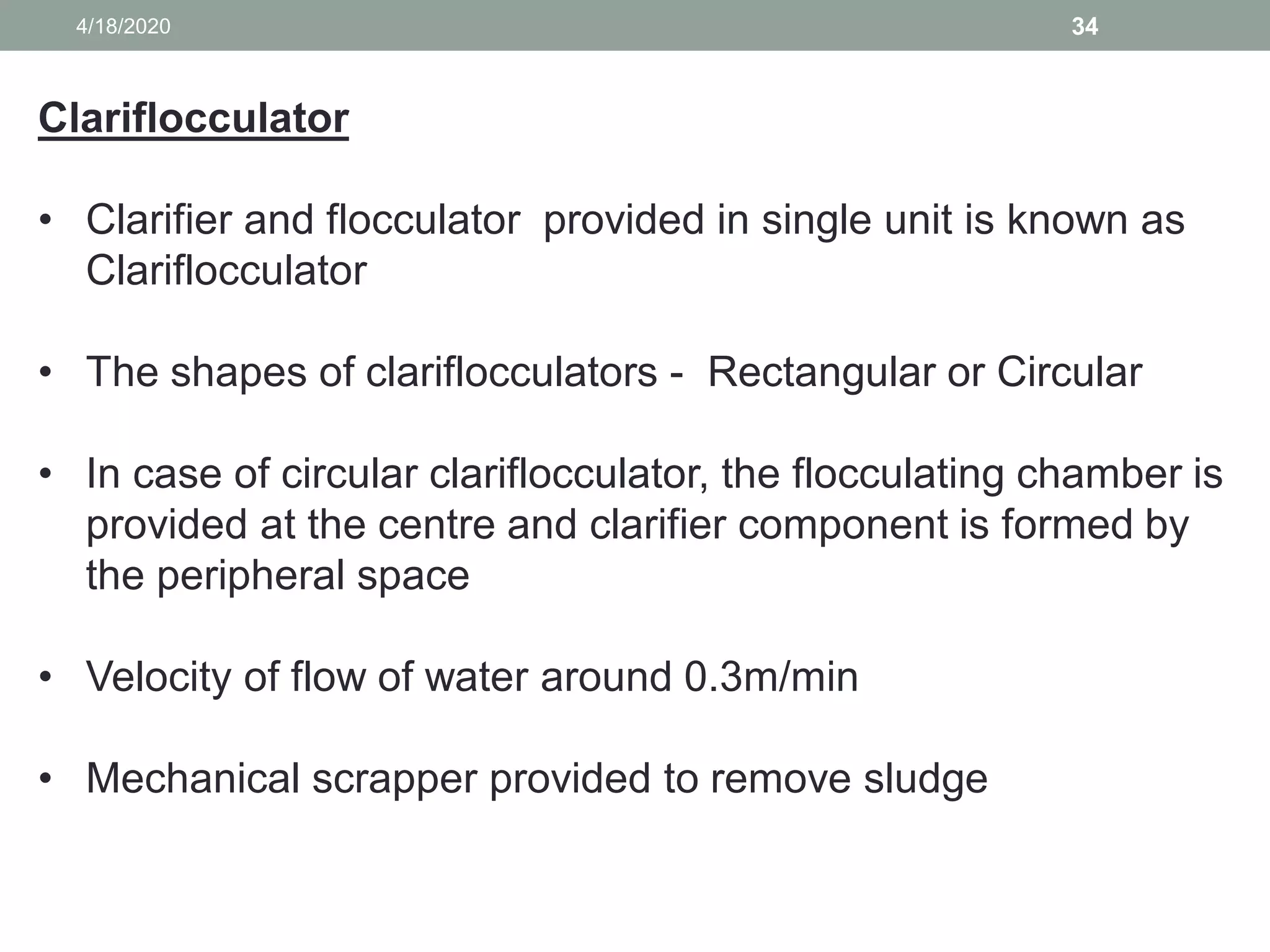
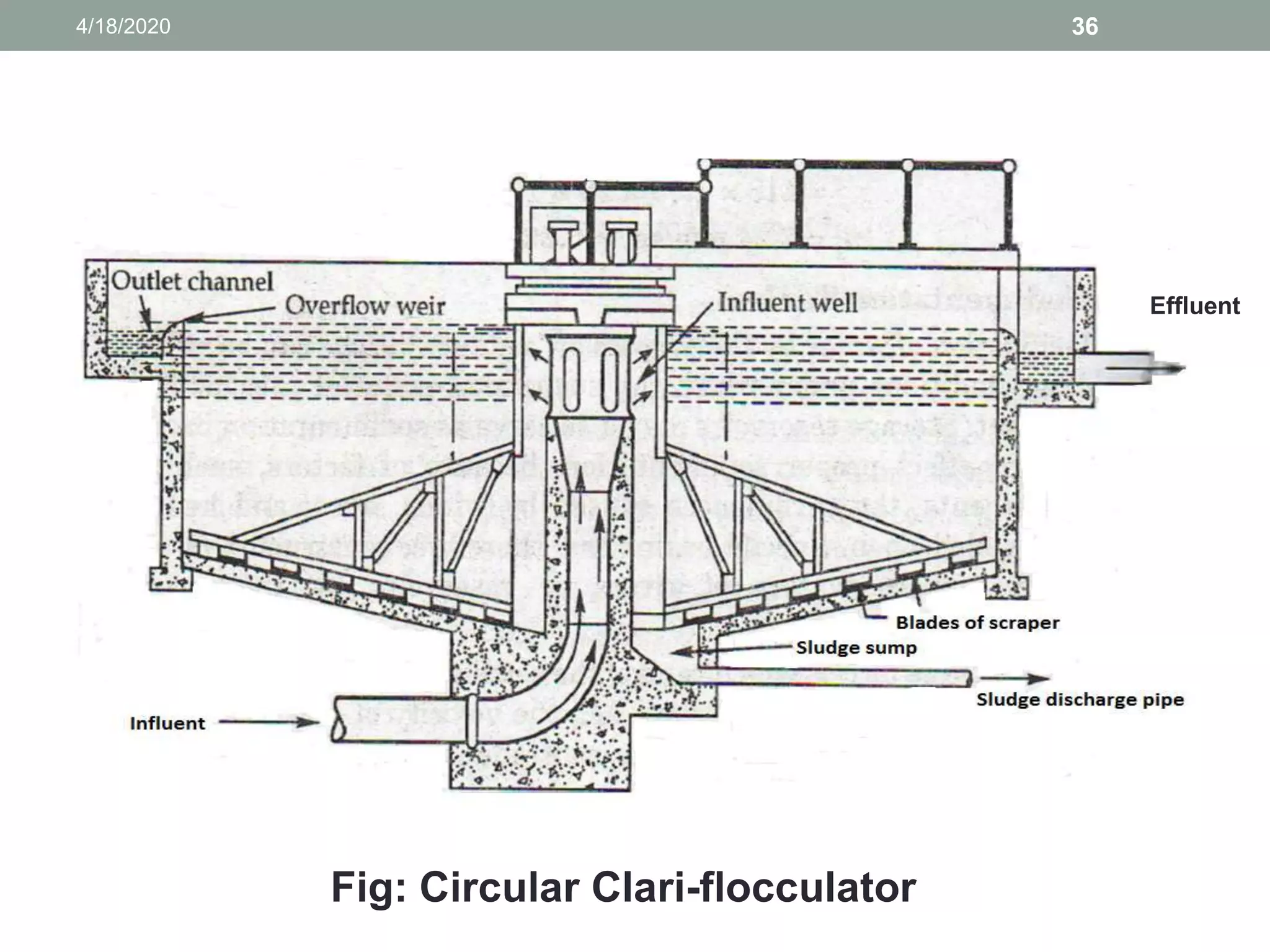
Clariflocculator
• Clarifier and flocculator provided in single unit is known as
Clariflocculator
• The shapes of clariflocculators - Rectangular or Circular
• In case of circular clariflocculator, the flocculating chamber is
provided at the centre and clarifier component is formed by
the peripheral space
• Velocity of flow of water around 0.3m/min
• Mechanical scrapper provided to remove sludge
4/18/2020 35
Fig: Rectangular Clari-flocculator
4/18/2020 36
Effluent
Fig: Circular Clari-flocculator
4/18/2020 37
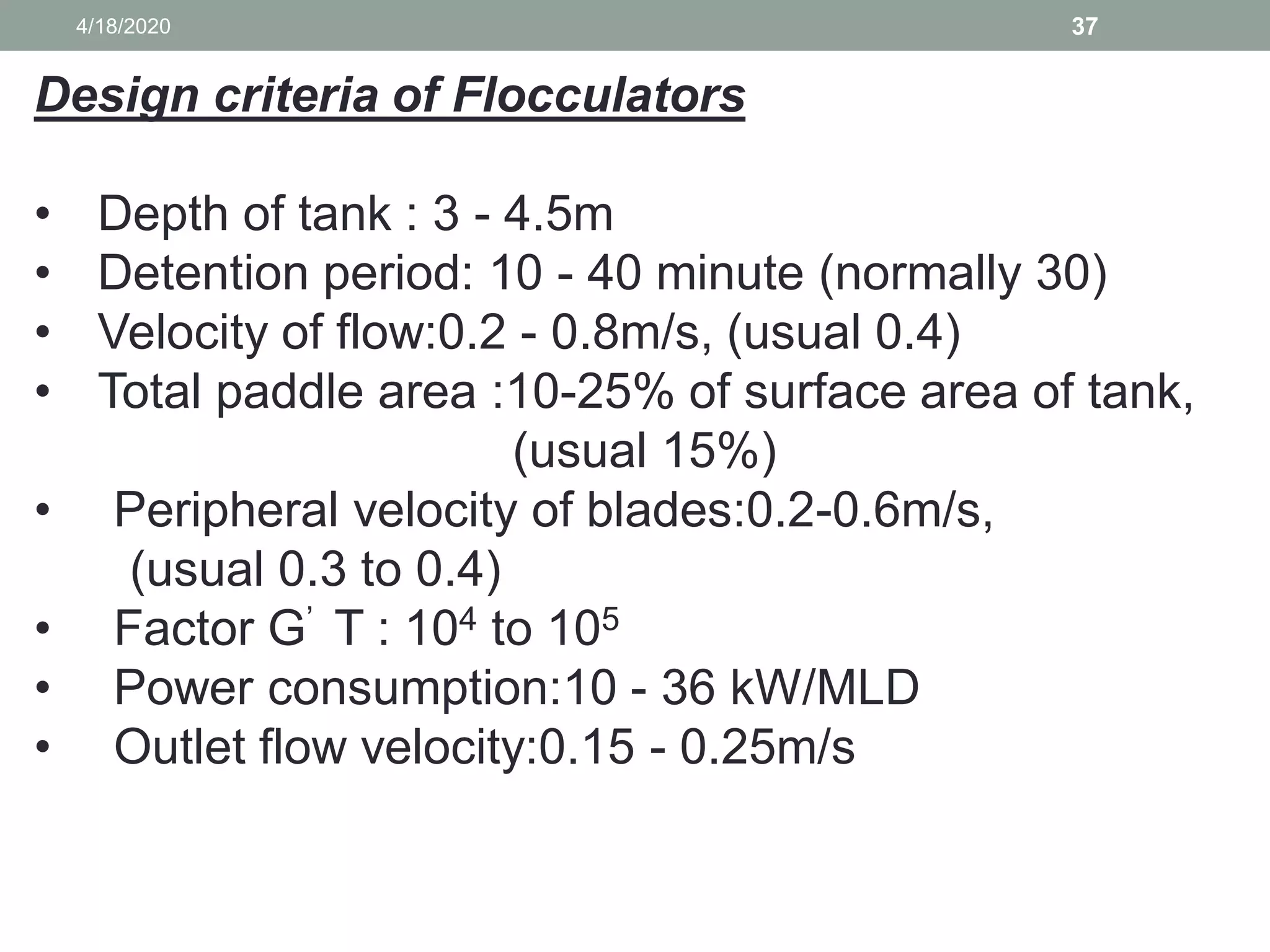
Design criteria of Flocculators
• Depth of tank : 3 - 4.5m
• Detention period: 10 - 40 minute (normally 30)
• Velocity of flow:0.2 - 0.8m/s, (usual 0.4)
• Total paddle area :10-25% of surface area of tank,
(usual 15%)
• Peripheral velocity of blades:0.2-0.6m/s,
(usual 0.3 to 0.4)
• Factor G’ T : 104 to 105
• Power consumption:10 - 36 kW/MLD
• Outlet flow velocity:0.15 - 0.25m/s
4/18/2020 38
FAQ
1. Explain the theory of coagulation.
2. Differentiate between coagulation and flocculation
3. List out coagulants used in water treatment and explain
any one with the help of chemical reactions.
4. Write detailed note on ‘design of flocculator’.
5. Compare Alum and iron salts as coagulants.
6. Sketch and name the components of : i) Flash mixer ii)
Floculation chamber.
7. What is coagulation? What factors affect it? Describe the Jar
test.
8. With the aid of a neat sketch, explain the different functional
components of sedimentation with coagulation unit.
9. Explain suitable device to i) Feed the coagulant ii) Mix the coagulant
10. Derive an expression for “Mean temporal Velocity” gradient in
flocculation of water.
11. With the help of chemical equation, explain the action of alum in water.
Explain with sketch, suitable device to feed the chemical to water.

Coagulation aided Sedimentation

  • 1.
    COAGULATION AIDED SEDIMENTATION Stabilityand destabilization of colloids, Coagulation theory, types of coagulants, chemical feeding, flash mixing, Clariflocculators, types of flocculators and their design aspects 14/18/2020 Dr. Dayananda H S Professor of Civil Engineering, VVCE, Mysore, Karnataka
  • 2.
    24/18/2020 Preamble • Coagulation andFlocculation deals with Type II settling (i. e., Hindered settling) • Particles - Silt, small and large colloids • Types of colloids – Hydrophilic and Hydrophobic • For colloids, ratio of surface area to mass is high, resulting in electrostatic repulsion and hydration predominates • Settling velocity varies from few meter/hr to meter/million year • Hydrophilic colloids are readily dispersed in water and its stability depends on affinity for water and are negatively charged
  • 3.
    34/18/2020 • Eg -Soaps, soluble starch & proteins, synthetic detergents • Stability of Hydrophobic colloids depends on possessed electric charge, no affinity for water and positively charged Eg - metal oxides • Particles carry charge due to loss of atoms, abrasion, molecular structure • Vanderwal’s force is a resisting force and Brownian movement favors coagulation process • A colloidal dispersion in a liquid is known as ‘Sol’ Eg: Bentonite clay, Kaolinite
  • 4.
    44/18/2020 Definitions Coagulation is aunit process (chemical technique) adopted for charge neutralization of colloidal particles. Ion transfer is effected by chemical coagulation • Floc forming chemicals are added to water for the purpose of enmeshing the colloidal particles to form rapidly settling aggregates • Mixing refers to blending of coagulating chemicals with water to create more or less homogeneous single or multiple phase system
  • 5.
    54/18/2020 Flocculation is thestirring or agitation of water containing flocs, a slow mixing technique which promotes the agglomeration (to gather) of the stabilized particles • Distinction between coagulation and flocculation is some what arbitrary • However, combination of mixing & stirring/agitation that enhances aggregation is known as Flocculation
  • 6.
    64/18/2020 Stability of Colloids •A colloidal suspension is said to be stable when the dispersion do not show any tendency to aggregate • i.e., Colloidal suspension that do not agglomerate is termed as ‘stable’ • Stability of Colloidal Suspension is due to excessively large surface to volume ratio due to very small size • Surface phenomena predominates mass phenomena • Surface Phenomena is the accumulation of electrical charges @ the particle surface • Electrical Conductivity is due to molecular arrangement within crystals, loss of atoms due to abrasion of the surface or any other factors • In most surface waters, the surface of the colloidal particles are negatively charged
  • 7.
    4/18/2020 7 Destabilization ofColloids • Two forces responsible for destabilization of a sol are i) Vander Waal’s force and ii) Brownian movement • Vander Waal ‘s forces - molecular cohesive forces of attraction that increase in intensity as particles approach each other • This force becomes very dominant when two colloids come in close proximity • Brownian movement is random movement of colloids caused by molecular bombardment of the dispersion media • This movement has destabilizing effect on a source and results with aggregation • In water purification, destabilization of Hydrophobic colloids is attained by chemically coagulating using trivalent metallic salts • Aluminum sulfate, ferric chloride into clusters which are large enough to be removed by gravity settling
  • 8.
    4/18/2020 8 Principle (Mechanism)of Coagulation The process of Coagulation and Flocculation is mainly based on two factors i)Floc formation When a coagulant is added to water , it dissolves in it and forms a spongy gelatinous substance forming floc which will arrest the suspended and colloidal matter in water, while descending down at the bottom. ii) Electrical charge The colloidal particles in natural waters will be usually negatively charged. The floc which is positively charged is opposite in nature and hence it helps in arresting all the colloidal particles.
  • 9.
    4/18/2020 9 Factors affectingcoagulation 1. Types of coagulant 2. Quantity of coagulant 3. Characteristics of water -Type & quantity of suspended matter, Temperature & pH of water 4. Time, turbulence and method of mixing Types of Coagulant Mainly used coagulants are aluminum and iron salts 1. Aluminum sulfate 2. Chlorinated copperas 3. Ferrous sulfate and lime 4. Magnesium carbonate and lime 5. Sodium Aluminate
  • 10.
    4/18/2020 10 1. AluminumSulfate (Alum) • Aluminum sulfate is cheaper and universally used coagulant • It contains 17% Aluminum sulfate, a dirty grey solid in form of lumps • Alum on addition to water, hydrolyze forming a insoluble gelatinous precipitate of Aluminum hydroxide, Al(OH)3 • To produce the hydroxide floc, enough alkalinity should be present in the water • If alkalinity is not enough, then it should be added. Usually hydrated lime is used for the purpose (optimum pH is 6.5 – 8.5) • Under normal circumstances, dose of Alum varies from 10 to 30 mg/L of water
  • 11.
    4/18/2020 11 Sometimes sodiumcarbonate (Soda ash) is added to form alkalinity, the resulting reaction is , Al2(SO4)3.18H2O + 3Na2CO2 = 2Al (OH)2 + 3Na2SO4 +18H2O + 3CO2 ….(c) Al2(SO4)3.18H2O + 3Ca (HCO3)2 = 2Al (OH)3 + 3CaSO4 +18H2O + 6CO2 ….(a) Al2(SO4)3.18H2O + 3Ca (OH)2 = 2Al (OH)3 + 3CaSO4 +18H2O ….(b)
  • 12.
    4/18/2020 12 Advantages anddisadvantages Alum reduces taste and odor, Cheap and Easily available and Soluble in water The only Disadvantage is difficult to dewater the sludge
  • 13.
    4/18/2020 13 2. FerrousSulfate (Chlorinated Copperas) • The optimum pH range is 3.5 to 6.5 • At higher pH i.e. 9.5 it removes manganese • More expensive than alum • Effective in colour removal • Low solubility in water
  • 14.
    4/18/2020 14 6FeSO47H2O +3Cl2= 2Fe2(SO4)3 + 2FeCl3 +7H2O ….(a) • The ferric sulfate and ferric chloride produced instantaneously are known as chlorinated copperas • Both of these are immediately available for the formation of ferric hydroxide floc; the resulting reactions are: Fe2(SO4)3 +3Ca(OH)2 = 3CaSO4 + 2Fe(OH)3….(b) 2FeCl3 +3Ca(OH)2 = 3CaCl2+ 2Fe(OH)3….(c)
  • 15.
    154/18/2020 3. Ferrous Sulfateand lime • Ferrous sulphate can react with natural calcium bicarbonate alkalinity in water, but its slow process • Hence Lime is added in water • Ferric hydroxide is gelatinous floc, which is heavier than floc formed by alum • Optimum pH range is below 7 FeSO4.7H2O + Ca(OH)2 = Fe(OH)2 + CaSO4 +7H2O ….(a) • The ferrous hydroxide, Fe(OH)2 thus formed, though an efficient floc, is soon oxidized by dissolved oxygen in water & ferric hydroxide is formed 4Fe(OH)2 + O2 + 2H2O = 4Fe(OH)3 ….(b)
  • 16.
    164/18/2020 4. Magnesium carbonateand lime • When magnesium carbonate and lime are dissolved in water, magnesium hydroxide and calcium carbonate are formed as • MgCO3 +Ca(OH)2 = Mg(OH)2 +CaCO3 • Byproducts of above reaction forms soluble sludge, so not commonly used
  • 17.
    174/18/2020 5. Sodium Aluminate •Sodium aluminate (Na2Al2O4)is alkaline in nature and is used very much less often than alum because of its cost. It reacts with the salts of calcium and magnesium as follows; Na2Al2O4 + Ca(HCO3)2 = CaAl2O4 +Na2CO3 +CO +H2O …(a) Na2Al2O4 + CaCl2 = CaAl2O4 + 2NaCl …..(b) Na2Al2O4 + CaSO4 = CaAl2O4 + Na2SO4 …..(c) • The coagulant remove both temporary and permanent hardness • It is effective for a pH range of 6 to 8.50 naturally available in water
  • 18.
    184/18/2020 Comparison of Alumand Iron salt 1. Iron salts forms heavy floc as compared to alum, hence more Solids are removed 2. Time of reaction and floc formation is less for iron salts, hence ‘t’ reduces 3. Iron salts can work efficiently over wider pH range 4. Iron salts can remove taste and odour 5. Less mud ball formation as compared to alum 6. Under some cases iron salts are more economical
  • 19.
    194/18/2020 7. Iron saltscause staining and promotes growth of iron bacteria 8. Iron salts make water more corrosive as compared to alum 9. Handling of iron salts requires skill 10. More CO2 is formed so water becomes corrosive 11. Alum Coagulation may not be proper, if K or Na are present in water
  • 20.
    204/18/2020 Chemical feeding • Typesof Feeding device - dry feeding (Powder form) - Wet feeding (Solution form) Fig: Dry feed devices a) Helical screw type b) Toothed wheel type
  • 21.
    214/18/2020 Fig: Solution feedingdevice a)Conical plug type b) Adjustable weir type
  • 22.
    4/18/2020 22 Fig: Hydraulicmixing in water flow a) Channel with baffles b) Overflow weir c) Hydraulic jump mixing
  • 23.
    234/18/2020 Flash Mixing (PerikineticFlocculation) • Flash mixing is a process of adding coagulant chemicals to water and the water is mixed quickly • The purpose of flash mixing is to uniformly disperse the chemicals throughout the volume of water • This helps in the formation of micro flocs and results in proper utilization of chemical preventing localization of concentration and premature formation of hydroxides • Flash mixing typically lasts for a minute or less • If the water is mixed for less than thirty seconds, then the chemicals will not be properly mixed into the water • On the other hand, if the water is mixed beyond one minute, the mixer blades will shear the newly forming floc into small particles • The coagulant is introduced at a point of high turbulence • The rapid mixing of coagulants is carried out in a basin known as “Flash Mixer”
  • 24.
    4/18/2020 24 Hydraulic jump:Hydraulic jump creates Turbulance & thus helps in better mixing Mechanical Mixing Fig: a) Back Mix Impeller b) Flat-blade Impeller
  • 25.
    4/18/2020 25 i) Flashmixer (Mixing basin) • The power input required for mixing is expressed in terms of temporal mean velocity gradient, G’ • G’ = [ P/µ.V]1/2 G’ = Velocity gradient (per second) µ = Absolute or dynamic viscosity of water in Ns/m2 V = Volume of water to which P is applied, in m3 The unit of G’ will evidently be 1/s (i.e., per second)
  • 26.
    4/18/2020 26 Design criteria •Impeller speed: 100 to 120 rpm • Detention period: 30 – 60sec • Power requirement: 2 to 5 kW/m3 /minute • (0.041kW/1000cum.day) • Tank shape: circular or square • Velocity of flow: 0.9m/sec • Velocity gradient, G’: 300 S-1 • Depth of tank: 1-3m • Height to diameter (sides) ratio : 1:1 to 3:1 • Product G ‘T (unit less): 30 000 - 60 000 (T is the detention period) • Impeller diameter to tank diameter ratio: 0.2 to 0.4 • Minimum Tanks: 2 Tanks
  • 27.
    4/18/2020 27 Flocculation (Forming Flocs) • After destabilization (i.e., Coagulation), particles will be ready to a tract and agglomerate and form flocs • But this agglomeration is slow and they need help to accelerate this agglomeration • This help is called Flocculation “which is the slow stirring or gentle agitation to aggregate the destabilized particles and form a rapid settling floc” • This gentle mixing increases the collisions between the particles and help them to agglomerate. (rapid mixing will destroy the flocs, hence need gentle mixing) • Flocculation occurs in a tank called a Flocculator or Flocculation Basin equipped with a method for Slow Mixing.
  • 28.
    4/18/2020 28 Fig: Flocculationprocess through Brownian movement
  • 29.
    4/18/2020 29 Types ofFlocculators (Slow stirring motion) The most common types of Flocculators used, a) Hydraulic Mixing Floculator: Hydraulic jump mixing Horizontal baffled Channel Vertically baffled channel b) Mechanical Mixing Floculator: i) Vertical shaft with impeller (turbine or propeller type blades) ii) Paddle type with either horizontal or vertical shafts iii) Walking Beam Flocculator c) Pneumatic methods: Compressed air agitation, centrifugal pump
  • 30.
    4/18/2020 30 Fig: RapidMixing of coagulant in Venturi / Parshal Flume (Hydraulic Jump)
  • 31.
    4/18/2020 31 Fig: HydraulicMixing Floculators (b) Vertically baffled channel (a) Horizontal baffled Channels
  • 32.
    4/18/2020 32 Fig: MechanicalFlocculator (Paddle type with vertical shafts)
  • 33.
    4/18/2020 33 Fig: Paddletype with horizontal shafts Fig: Vertical shaft with impeller (propeller type blades)
  • 34.
    4/18/2020 34 Clariflocculator • Clarifierand flocculator provided in single unit is known as Clariflocculator • The shapes of clariflocculators - Rectangular or Circular • In case of circular clariflocculator, the flocculating chamber is provided at the centre and clarifier component is formed by the peripheral space • Velocity of flow of water around 0.3m/min • Mechanical scrapper provided to remove sludge
  • 35.
  • 36.
  • 37.
    4/18/2020 37 Design criteriaof Flocculators • Depth of tank : 3 - 4.5m • Detention period: 10 - 40 minute (normally 30) • Velocity of flow:0.2 - 0.8m/s, (usual 0.4) • Total paddle area :10-25% of surface area of tank, (usual 15%) • Peripheral velocity of blades:0.2-0.6m/s, (usual 0.3 to 0.4) • Factor G’ T : 104 to 105 • Power consumption:10 - 36 kW/MLD • Outlet flow velocity:0.15 - 0.25m/s
  • 38.
    4/18/2020 38 FAQ 1. Explainthe theory of coagulation. 2. Differentiate between coagulation and flocculation 3. List out coagulants used in water treatment and explain any one with the help of chemical reactions. 4. Write detailed note on ‘design of flocculator’. 5. Compare Alum and iron salts as coagulants. 6. Sketch and name the components of : i) Flash mixer ii) Floculation chamber. 7. What is coagulation? What factors affect it? Describe the Jar test. 8. With the aid of a neat sketch, explain the different functional components of sedimentation with coagulation unit. 9. Explain suitable device to i) Feed the coagulant ii) Mix the coagulant 10. Derive an expression for “Mean temporal Velocity” gradient in flocculation of water. 11. With the help of chemical equation, explain the action of alum in water. Explain with sketch, suitable device to feed the chemical to water.