How the notion of knowledge
conversion can be upheld? (Social
Practices)


                        Ujjwal Kumar Joshi
                                        1
Agenda
 ORGANIZATIONAL KNOWLEDGE CREATION
    THEORY
   TACIT KNOWLEDGE
   EXPLICIT KNOWLEDGE
   SOCIAL PRACTICES & KNOWLEDGE CONVERSION
   NONAKA’S FOUR MODELS OF KNOWLEDGE
    CONVERSION
   CONCLUSION


                                              2
ORGANIZATIONAL KNOWLEDGE
CREATION THEORY
Organizational knowledge creation theory aimed at developing a
comprehensive view of knowledge that could shed light on
organizational creativity, learning, innovation and change.

Organizational knowledge creation theory defined
knowledge in three parts:
 Knowledge is justified true belief (based on interaction with the
  world)
 Knowledge is the (i) actuality of skilful action (ii) potentiality of
  defining situation (iii) allows human to define, prepare, shape
  learn to solve problems
 Knowledge is explicit and tacit along a continuum.

                                                                          3
TACIT KNOWLEDGE
 The concept of the Tacit Knowledge was introduced by the
  Hungarian Philosopher-chemist Michael Polanyi (1891-
  1976) in his book “THE TACIT DIMENSION”.
 Tacit Knowledge, even known as Informal knowledge, is
  such knowledge, that are acquired by the individual
  through their experiences, emotions and intuition and that
  is difficult to transfer to other people.
 It is subjective and actionable.


                                                               4
EXPLICIT KNOWLEDGE
 Explicit knowledge is the knowledge that is being
  expressed by the Experts, that is the tacit knowledge, if
  expressed in the written or visible form.
 It can be communicated.

 It is rational, objective and vivid.


                                                              5
SOCIAL PRACTICES & KNOWLEDGE
CONVERSION
 Tacit knowledge of any Individual in an Organization
 helps as:
          Foundation of Social Practice
          Foundation for Creation or Innovation
 How to acquire a tacit Knowledge?
    I.       Participation in Social Practices under the guidance of
             experienced                                 (Wenger, 1998)
    II.      Practitioners’ virtuous behaviors/Expertism (Tsoukas, 2003)
    III.     Practitioners “intuitively” recognise when the “rules” of
             performance apply and which “rules” to follow (Olin and
             Wickenberg, 2001)

                                                                      6
SOCIAL PRACTICES & KNOWLEDGE
CONVERSION
 Practitioner Diversity is a source of Innovation (Roberts,
  2006)
 Practitioner may discover new ways of defining and solving
  problems through knowledge conversion.
 Assembling fresh ideas inside and experiences to reflect on
  events and situation.
 The conversion of knowledge from a tacit towards an
  explicit form is inherently a creative act using metaphors,
  analogies and images.
  Example: Twisting stretch (expanding knowledge and
  team)
                                                                7
SOCIAL PRACTICES & KNOWLEDGE
CONVERSION
 Why Knowledge Conversion is important for Organization?
   Explains how new ideas come forth in Innovation.
   How individual tap into rich practices.
   To acquire tacit knowledge.
   In some cases, Explicit Knowledge fails to represent practical
    circumstances.
   Tacit knowledge is a pre-requisite for a application of Explicit
    Knowledge.
   Plays a critical role in explaining organizational knowledge
    creation.


                                                                       8
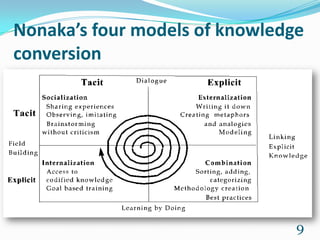
Nonaka’s four models of knowledge
conversion


                                9
Nonaka’s four models of knowledge
conversion Explanation
Socialisation
  (tacit to tacit) is the process of learning by sharing experiences that creates tacit
  knowledge as shared mental models and professional skills (e.g. apprentices learning
  process, or expert consensus achievement during medical meetings).
Externalisation
  (tacit to explicit) is the process of conversion of tacit into explicit knowledge, for example
  the translation of a clinical trial result into a recommendation for clinical practice.
Internalisation
   (explicit to tacit) is the process of individual learning by repeatedly executing an activity
   applying some type of explicit knowledge, e.g. a CPG, and absorbing the relationship
   between actions and results as new personal tacit knowledge.
Combination
  (explicit to explicit) is the process of enriching the available explicit knowledge to
  produce new bodies of knowledge, for example combining medical and organizational
  knowledge into a decision support system.


                                                                                            10
Conclusion
 The conversion can also be done in
 following ways:

       I. Knowledge Management System
       II. Expert Judgment


 System                                               Learning, 11
                                                                     Source:
Usage, 25%                                                %          http://www.wectechnologies.com/img/Expertise.gif


                                                         Documents,
   Story                                                    22%
telling, 8%
                                                        Multimedia,
                                                            5%

     Face to                                         Meetings, 12
    face, 17%                                            %
 Source: https://encrypted-tbn3.gstatic.com/images                                                            11
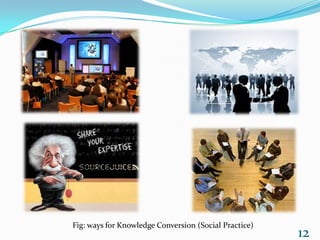
Fig: ways for Knowledge Conversion (Social Practice)
                                                       12
The soft stuff is always harder
     than the hard stuff.
                   -Roger Enrico
                   Vice Chairman of PepsiCo
                    Source: http://www.12manage.com/quotes_ki.html


                                                            13

Knowledge management

  • 1.
    How the notionof knowledge conversion can be upheld? (Social Practices) Ujjwal Kumar Joshi 1
  • 2.
    Agenda  ORGANIZATIONAL KNOWLEDGECREATION THEORY  TACIT KNOWLEDGE  EXPLICIT KNOWLEDGE  SOCIAL PRACTICES & KNOWLEDGE CONVERSION  NONAKA’S FOUR MODELS OF KNOWLEDGE CONVERSION  CONCLUSION 2
  • 3.
    ORGANIZATIONAL KNOWLEDGE CREATION THEORY Organizationalknowledge creation theory aimed at developing a comprehensive view of knowledge that could shed light on organizational creativity, learning, innovation and change. Organizational knowledge creation theory defined knowledge in three parts:  Knowledge is justified true belief (based on interaction with the world)  Knowledge is the (i) actuality of skilful action (ii) potentiality of defining situation (iii) allows human to define, prepare, shape learn to solve problems  Knowledge is explicit and tacit along a continuum. 3
  • 4.
    TACIT KNOWLEDGE  Theconcept of the Tacit Knowledge was introduced by the Hungarian Philosopher-chemist Michael Polanyi (1891- 1976) in his book “THE TACIT DIMENSION”.  Tacit Knowledge, even known as Informal knowledge, is such knowledge, that are acquired by the individual through their experiences, emotions and intuition and that is difficult to transfer to other people.  It is subjective and actionable. 4
  • 5.
    EXPLICIT KNOWLEDGE  Explicitknowledge is the knowledge that is being expressed by the Experts, that is the tacit knowledge, if expressed in the written or visible form.  It can be communicated.  It is rational, objective and vivid. 5
  • 6.
    SOCIAL PRACTICES &KNOWLEDGE CONVERSION  Tacit knowledge of any Individual in an Organization helps as:  Foundation of Social Practice  Foundation for Creation or Innovation  How to acquire a tacit Knowledge? I. Participation in Social Practices under the guidance of experienced (Wenger, 1998) II. Practitioners’ virtuous behaviors/Expertism (Tsoukas, 2003) III. Practitioners “intuitively” recognise when the “rules” of performance apply and which “rules” to follow (Olin and Wickenberg, 2001) 6
  • 7.
    SOCIAL PRACTICES &KNOWLEDGE CONVERSION  Practitioner Diversity is a source of Innovation (Roberts, 2006)  Practitioner may discover new ways of defining and solving problems through knowledge conversion.  Assembling fresh ideas inside and experiences to reflect on events and situation.  The conversion of knowledge from a tacit towards an explicit form is inherently a creative act using metaphors, analogies and images. Example: Twisting stretch (expanding knowledge and team) 7
  • 8.
    SOCIAL PRACTICES &KNOWLEDGE CONVERSION  Why Knowledge Conversion is important for Organization?  Explains how new ideas come forth in Innovation.  How individual tap into rich practices.  To acquire tacit knowledge.  In some cases, Explicit Knowledge fails to represent practical circumstances.  Tacit knowledge is a pre-requisite for a application of Explicit Knowledge.  Plays a critical role in explaining organizational knowledge creation. 8
  • 9.
    Nonaka’s four modelsof knowledge conversion 9
  • 10.
    Nonaka’s four modelsof knowledge conversion Explanation Socialisation (tacit to tacit) is the process of learning by sharing experiences that creates tacit knowledge as shared mental models and professional skills (e.g. apprentices learning process, or expert consensus achievement during medical meetings). Externalisation (tacit to explicit) is the process of conversion of tacit into explicit knowledge, for example the translation of a clinical trial result into a recommendation for clinical practice. Internalisation (explicit to tacit) is the process of individual learning by repeatedly executing an activity applying some type of explicit knowledge, e.g. a CPG, and absorbing the relationship between actions and results as new personal tacit knowledge. Combination (explicit to explicit) is the process of enriching the available explicit knowledge to produce new bodies of knowledge, for example combining medical and organizational knowledge into a decision support system. 10
  • 11.
    Conclusion The conversioncan also be done in following ways: I. Knowledge Management System II. Expert Judgment System Learning, 11 Source: Usage, 25% % http://www.wectechnologies.com/img/Expertise.gif Documents, Story 22% telling, 8% Multimedia, 5% Face to Meetings, 12 face, 17% % Source: https://encrypted-tbn3.gstatic.com/images 11
  • 12.
    Fig: ways forKnowledge Conversion (Social Practice) 12
  • 13.
    The soft stuffis always harder than the hard stuff. -Roger Enrico Vice Chairman of PepsiCo Source: http://www.12manage.com/quotes_ki.html 13